Japan Laptop Battery Market Size & Growth Rate
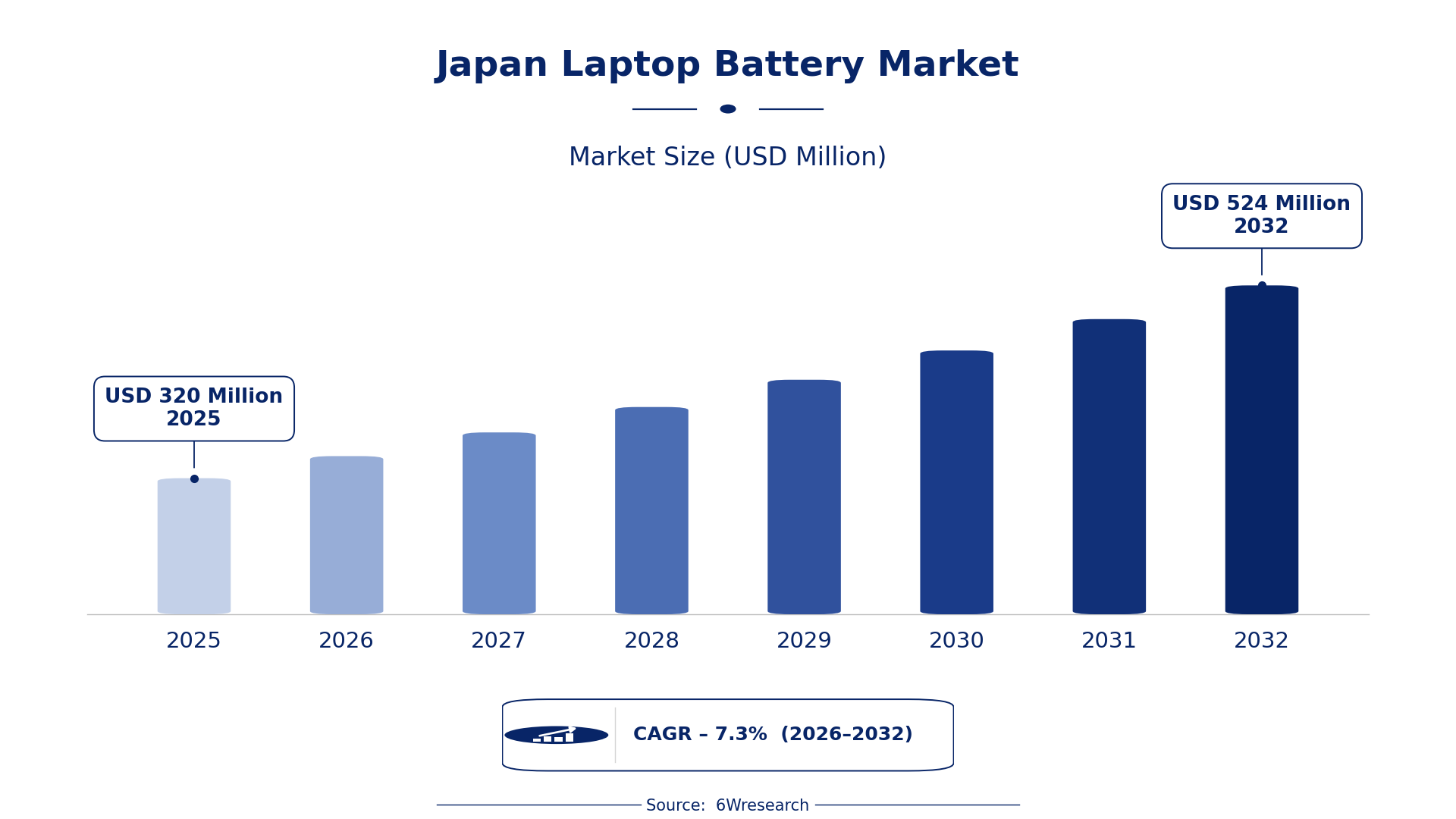
According to 6Wresearch internal database and industry insights, the Japan Laptop Battery Market was valued at USD 320 Million in 2025 and is projected to reach USD 524 Million by 2032, growing at a CAGR of approximately 7.3% during 2026–2032.
Japan Laptop Battery Market Highlights
| Report Metric | Details |
| Report Name | Japan Laptop Battery Market (2026-2032) |
| Market Size 2025 | USD 320 Million |
| Market Size 2032 | USD 524 Million |
| Absolute Growth 2025–2032 | USD 204 Million |
| CAGR 2026–2032 | 7.3% |
| Peak Annual Growth | 8.1% in 2028 |
| Forecast Period | 2026–2032 |
| Historical Data | 2022–2025 |
| Base Year | 2025 |
| Leading Battery Type, 2025 | Secondary Batteries (63% share) |
| Leading Number of Cells, 2025 | 6 (50% share) |
| Leading Sales, 2025 | OEMs (55% share) |
| Leading Distribution Channel, 2025 | Online Stores (61% share) |
| Fastest-Growing Number of Cells | 8 (8.6% CAGR) |
| Fastest-Growing Sales | Aftermarket (8.5% CAGR) |
| Fastest-Growing Distribution Channel | Retail Stores (9.0% CAGR) |
| Growing Sector | Electronics |
| Key End Users | Consumers, Educational Institutions, Electronics Manufacturers, Retailers |
Japan Laptop Battery Market Year-wise Growth Rate and Key Drivers (2022–2032)
This graph illustrates the annual growth rates of the market from 2022 to 2032, highlighting a steady upward trajectory and projected market expansion over the forecast period.
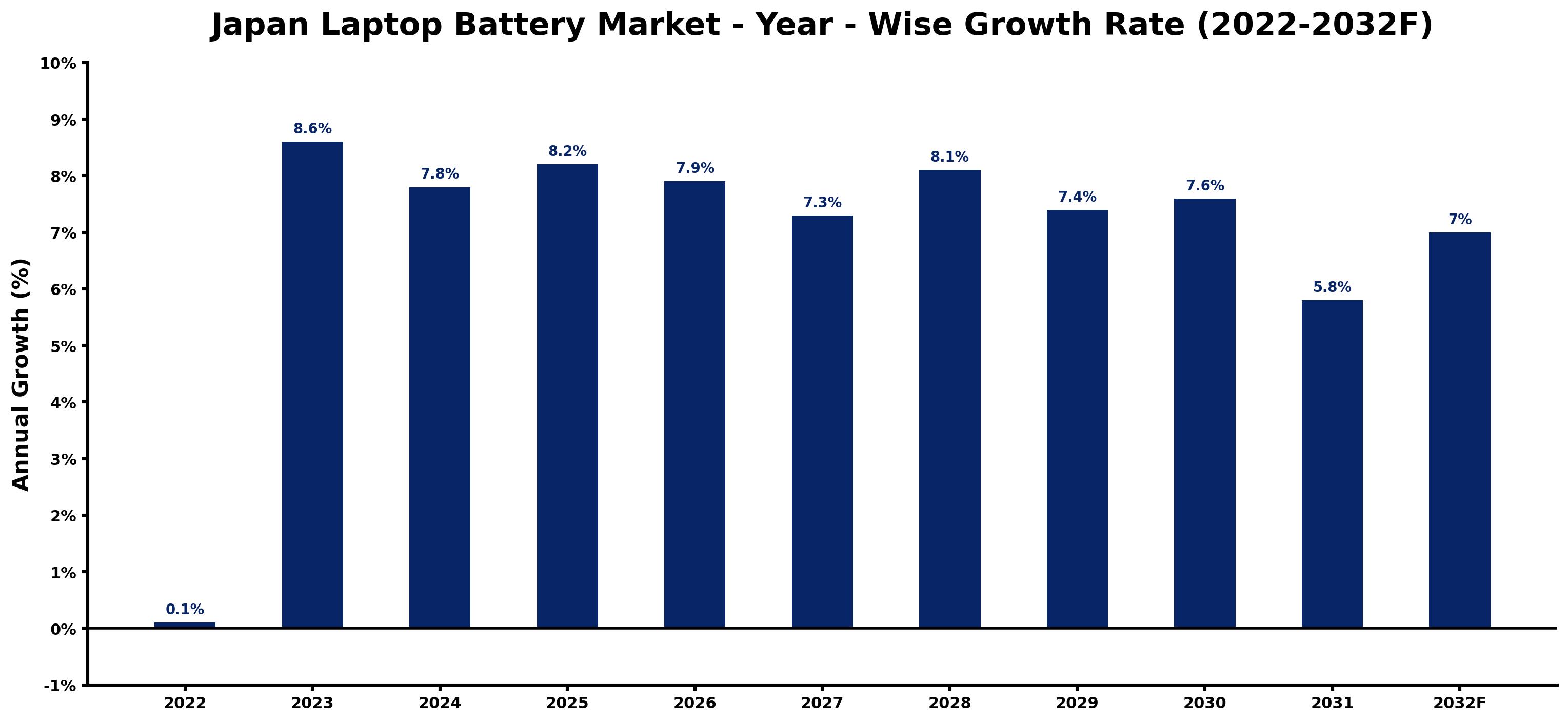
Each row of the following table gives one year's estimated growth and the event or demand shift that explains it.
| Year | Estimated Annual Growth (%) | Market Rationale |
| 2022 | 0.1 | The market showed minimal growth as users began transitioning to newer laptop models. |
| 2023 | 8.6 | Growth accelerated due to increased demand for laptops in education and remote work. |
| 2024 | 7.8 | The market adjusted to supply chain challenges affecting battery production, leading to slower growth. |
| 2025 | 8.2 | Demand surged again as consumers sought replacements for aging batteries in existing laptops. |
| 2026 | 7.9 | Growth is expected to slow as the market stabilises following the previous peak in demand. |
| 2027 | 7.3 | Technological advancements in battery efficiency will continue to drive market growth. |
| 2028 | 8.1 | Growth is projected to accelerate again as new battery technologies gain traction among consumers. |
| 2029 | 7.4 | The market will see a slowdown as competition intensifies among battery suppliers. |
| 2030 | 7.6 | Demand is expected to increase as consumers become more environmentally conscious and seek sustainable options. |
| 2031 | 5.8 | Growth will slow as the market matures and competition leads to price adjustments. |
| 2032 | 7.0 | The market is expected to grow as innovations in battery technology attract new buyers. |
Note: Market size estimations and growth projections presented in this report are based on 6Wresearch's proprietary forecasting methodology, utilizing the latest available industry data, government publications, and primary research inputs.
Japan Laptop Battery Market Synopsis
Laptop batteries serve as rechargeable power sources made primarily from lithium-ion or lithium-polymer technology, essential for powering laptops in personal, educational, and professional settings. The Japan Laptop Battery Market is growing, driven by rising demand for laptops, especially in the education sector, and substantial investments in battery technology. The Tokyo region accounts for 30% of sales, while government initiatives, such as the 2023 recycling program, are promoting energy-efficient battery technologies, further stimulating market expansion.
Market Dynamics Impact Analysis (2026–2032)
| Factor | Type | Impact | Primary Segment Affected |
| Growing adoption of lithium polymer batteries due to their lightweight properties | Driver | High | Secondary Batteries |
| Increased online sales channels providing convenience for consumers | Driver | High | Secondary Batteries |
| Expansion of recycling programs for lithium batteries | Opportunity | High | Secondary Batteries |
| Rising demand for aftermarket batteries as consumers seek replacements | Opportunity | High | Aftermarket |
| Supply chain disruptions affecting battery production | Restraint | High | Secondary Batteries |
| Environmental regulations increasing production costs for manufacturers | Restraint | Medium | Secondary Batteries |
| Competition among suppliers leading to price wars | Challenge | High | Secondary Batteries |
| Technological advancements requiring continuous investment | Challenge | Medium | Secondary Batteries |
Evaluation of Drivers in Japan Laptop Battery Market (2026–2032)
The main growth drivers and the segments they affect most are set out below.
| Drivers | Primary Segment Affected | Why It Matters (Evidence) |
| Increased demand for laptops in education and remote work | Secondary Batteries | This trend has led to a surge in battery purchases, with the Tokyo region accounting for 30% of sales. |
| Growing interest in lightweight lithium polymer batteries | Secondary Batteries | Their adoption is rising due to a shift towards more portable devices, with over 70% of batteries sold being secondary types. |
| Expansion of online sales channels | Secondary Batteries | Online sales of laptop batteries grew by 15% in 2023, reflecting consumer preference for convenience. |
| Government initiatives promoting energy-efficient technologies | Secondary Batteries | The Tokyo Metropolitan Government's support for battery innovation is driving demand for advanced battery solutions, with funding allocated for research. |
| Increased recycling efforts for lithium batteries | Secondary Batteries | The Ministry of Economy, Trade and Industry launched a recycling program in 2023, encouraging sustainable practices and consumer participation. |
Orders keep climbing as demand for laptops in educational institutions and remote work settings rises. In 2023, over 70% of laptop batteries sold were secondary types, reflecting a shift towards more efficient power sources. The expansion of online sales channels has catered to consumer preferences for convenience, with a 15% increase in online sales compared to the previous year.
Evaluation of Restraints in Japan Laptop Battery Market
These are the pressures that could keep growth below its potential.
| Market Restraint | Primary Segment Affected | Why It Matters (Evidence) |
| Supply chain disruptions affecting battery production | Secondary Batteries | These disruptions have caused delays in battery availability, impacting consumer purchasing decisions, with lead times extending up to two weeks. |
| Environmental regulations increasing production costs for manufacturers | Secondary Batteries | Compliance with stringent standards raises costs, which can be passed on to consumers, affecting demand and making batteries more expensive. |
| Intense competition among suppliers | Secondary Batteries | Intense competition erodes profit margins, making it challenging for suppliers to sustain operations and invest in innovation. |
| Technological advancements requiring continuous investment | Secondary Batteries | Manufacturers must invest heavily in R&D to keep pace with innovations, straining financial resources and affecting pricing strategies. |
| Limited awareness of recycling options among consumers | Secondary Batteries | Many consumers are unaware of recycling programs, resulting in lower participation rates and contributing to environmental waste. |
Japan Laptop Battery Market Challenges
Retailers face rising costs as lithium prices have surged by 20% in the last year, increasing expenses for laptop battery procurement. Producers encounter supply chain disruptions, particularly in the Tokyo region, which accounts for 30% of sales, leading to shipment delays of up to two weeks. Manufacturers struggle with technology integration, as the shift towards lithium polymer batteries requires new production processes, extending development timelines by several months. Compliance with the recycling program complicates operations for retailers, increasing costs and complicating inventory management, ultimately affecting pricing strategies for end users.
Trends in the Japan Laptop Battery Market
Buyers and suppliers in the Japan Laptop Battery Market are adjusting to the following trends.
- Shift Towards Lightweight Battery Technologies: The Tokyo region is increasingly adopting lightweight lithium polymer batteries, preferred for their efficiency. In 2023, the adoption rate of these batteries rose significantly, reflecting changing consumer preferences and leading to higher sales.
- Surge in Online Sales Channels: Since 2023, online sales of laptop batteries have surged, with a 15% increase compared to the previous year. This shift is prompted by consumer demand for convenience and variety in purchasing options.
- Launch of Recycling Initiatives: The introduction of a recycling program for lithium batteries in 2023 marks a pivotal step towards sustainability. This initiative is expected to increase consumer awareness and participation in recycling efforts, benefiting the environment.
- Growing Aftermarket Demand for Battery Replacements: As laptop users seek to extend the life of their devices, the aftermarket for battery replacements is expanding. In 2023, this segment saw a notable increase in sales, driven by consumer awareness of replacement options.
Investment Opportunities in the Japan Laptop Battery Market
The openings below show where demand in the Japan Laptop Battery Market is visible and how suppliers can enter.
- Collaborations for Improved Recycling Programs: With the government allocating 500 million yen for battery technology research, partnerships with local agencies can enhance recycling efforts. Buyers in the electronics sector are increasingly seeking sustainable solutions.
- Investment in Lightweight Battery Manufacturing: The demand for lightweight lithium polymer batteries is growing, with a projected increase in production capacity. Manufacturers in the Tokyo region can benefit from investing in this technology to meet rising consumer preferences.
- Expansion of Online Retail Channels: Online sales channels are projected to grow, reflecting a shift in consumer purchasing behaviour. Retailers can capitalise on this trend by enhancing their online presence and offerings to attract more customers.
- Development of Energy-Efficient Battery Solutions: The Tokyo Metropolitan Government promotes energy-efficient technologies, creating opportunities for manufacturers to innovate. Investing in R&D can position companies favourably in the market and meet evolving consumer demands.
Government Initiatives in the Japan Laptop Battery Market
The GX Promotion Act (2023) establishes a legal framework for promoting green technologies, building on the Economic Security Promotion Act (2022), which supports supply chain resilience. This new act encourages manufacturers to adopt sustainable practices, aligning with Japan's decarbonisation goals. The government allocated 500 million yen for battery technology research and development, further supporting innovation in the sector.
The Ministry of Economy, Trade and Industry oversees the implementation of recycling programs for lithium batteries, providing funding and support for initiatives. This enables buyers to access sustainable battery options while contributing to environmental goals, with over 100 certified retailers participating in the program and benefiting from the increased awareness.
Future Insight of the Japan Laptop Battery Market
The launch of new recycling facilities will enhance waste management and support sustainability efforts. By 2032, advancements in battery technology will improve lithium-ion battery performance, benefiting both buyers and suppliers. The government's JPY 150 trillion investment in decarbonisation will drive research and development, reducing production costs. Local initiatives will promote energy-efficient battery technologies, making laptop batteries more appealing to consumers.
Market Segmentation Analysis
Japan Laptop Battery Market report covers a detailed analysis of the following market segments:
By Battery Type – Secondary Batteries Lead and Record the Fastest Growth
According to Summon Dutta, Assistant Manager at 6Wresearch, Secondary Batteries took 63% of battery type revenue in 2025, more than any other category. Secondary batteries hold the largest share as they are the primary type used for laptops, meeting the demands of both personal and professional users. Their widespread adoption is reinforced by compliance with JIS standards, ensuring reliability and performance in various applications. Its lead should widen, with a projected CAGR of 8.8% during 2026–2032, the highest in this split. The growth of secondary batteries is driven by the increasing demand for lightweight and efficient power sources in laptops, with over 70% of batteries sold being secondary. This trend will likely continue as consumers increasingly favour longer-lasting battery options. Suppliers should prioritise the quality and efficiency of secondary batteries to align with rising consumer expectations.
By Number of Cells – 6 Leads, 8 Expected to Grow Fastest
6 held 50% of the Japan Laptop Battery Market by number of cells in 2025. The 6-cell configuration serves as the standard for most laptops, ensuring widespread adoption among manufacturers. This commonality results in consistent demand, particularly from mid-range devices that rely on dependable power sources. The quickest growth will come from 8, forecast to expand at a CAGR of 8.6% between 2026 and 2032. The 8-cell configuration is becoming increasingly popular in high-performance laptops, as users demand longer battery life for intensive applications. This trend indicates that the segment will likely experience robust growth moving forward. Manufacturers should consider expanding their offerings to include 8-cell configurations to capture the growing high-performance laptop market.
By Sales – OEMs Lead, Aftermarket Expected to Grow Fastest
The largest sales category in 2025 was OEMs, at 55% of revenue. OEMs represent the primary source of laptop batteries for manufacturers, ensuring that devices are equipped with compatible and reliable power sources. This segment's prominence underscores the strong partnerships between laptop producers and battery suppliers, facilitating a steady supply chain. Over 2026–2032, Aftermarket is expected to post the fastest growth, at a CAGR of 8.5%. The aftermarket segment is witnessing rapid growth as consumers increasingly seek replacements and upgrades for their devices, particularly through online channels. This trend highlights a shift towards more personalised battery solutions among users. Retailers should enhance their aftermarket offerings to cater to the increasing consumer demand for replacement batteries.
By Distribution Channel – Online Stores Lead, Retail Stores Expected to Grow Fastest
With 61% of distribution channel revenue in 2025, Online Stores was the largest category. Online stores have become the leading distribution channel, offering consumers convenience and a broad selection of products. This shift towards digital shopping aligns with changing consumer preferences for easy access to various options. Retail Stores are projected to grow fastest, at a CAGR of 9.0% during 2026–2032. Retail stores are experiencing growth due to their ability to provide immediate access to products, appealing to consumers who prefer in-person shopping. This resurgence indicates a potential equilibrium between online and offline sales channels. Suppliers should develop strategies to optimise their presence in both online and retail markets to maximise reach and sales.
Key Attractiveness of the Report
- 10 Years of Market Numbers
- Historical Data Starting from 2022 to 2025
- Base Year 2025
- Forecast Data until 2032
- Key Performance Indicators Impacting the Market
- Major Upcoming Developments and Projects
Key Highlights of the Report:
- Japan Laptop Battery Market Outlook
- Market Size of Japan Laptop Battery Market, 2025
- Forecast of Japan Laptop Battery Market, 2032
- Historical Data and Forecast of Japan Laptop Battery Revenues & Volume for the Period 2022-2032
- Japan Laptop Battery Market Trend Evolution
- Japan Laptop Battery Market Drivers and Challenges
- Japan Laptop Battery Price Trends
- Japan Laptop Battery Porter's Five Forces
- Japan Laptop Battery Industry Life Cycle
- Historical Data and Forecast of Japan Laptop Battery Market Revenues & Volume By Battery Type for the Period 2022-2032
- Historical Data and Forecast of Japan Laptop Battery Market Revenues & Volume By Primary Batteries for the Period 2022-2032
- Historical Data and Forecast of Japan Laptop Battery Market Revenues & Volume By Secondary Batteries for the Period 2022-2032
- Historical Data and Forecast of Japan Laptop Battery Market Revenues & Volume By Number of Cells for the Period 2022-2032
- Historical Data and Forecast of Japan Laptop Battery Market Revenues & Volume By 3 for the Period 2022-2032
- Historical Data and Forecast of Japan Laptop Battery Market Revenues & Volume By 4 for the Period 2022-2032
- Historical Data and Forecast of Japan Laptop Battery Market Revenues & Volume By 6 for the Period 2022-2032
- Historical Data and Forecast of Japan Laptop Battery Market Revenues & Volume By 8 for the Period 2022-2032
- Historical Data and Forecast of Japan Laptop Battery Market Revenues & Volume By 9 for the Period 2022-2032
- Historical Data and Forecast of Japan Laptop Battery Market Revenues & Volume By 12 for the Period 2022-2032
- Historical Data and Forecast of Japan Laptop Battery Market Revenues & Volume By Sales for the Period 2022-2032
- Historical Data and Forecast of Japan Laptop Battery Market Revenues & Volume By OEMs for the Period 2022-2032
- Historical Data and Forecast of Japan Laptop Battery Market Revenues & Volume By Aftermarket for the Period 2022-2032
- Historical Data and Forecast of Japan Laptop Battery Market Revenues & Volume By Distribution Channel for the Period 2022-2032
- Historical Data and Forecast of Japan Laptop Battery Market Revenues & Volume By Retail Stores for the Period 2022-2032
- Historical Data and Forecast of Japan Laptop Battery Market Revenues & Volume By Online Stores for the Period 2022-2032
- Japan Laptop Battery Import Export Trade Statistics
- Market Opportunity Assessment By Battery Type
- Market Opportunity Assessment By Number of Cells
- Market Opportunity Assessment By Sales
- Market Opportunity Assessment By Distribution Channel
- Japan Laptop Battery Top Companies Market Share
- Japan Laptop Battery Competitive Benchmarking By Technical and Operational Parameters
- Japan Laptop Battery Company Profiles
- Japan Laptop Battery Key Strategic Recommendations
Market Covered
Segments analysed in this report are listed below.
By Battery Type
- Primary Batteries
- Secondary Batteries
By Number of Cells
- 3
- 4
- 6
- 8
- 9
- 12
By Sales
- OEMs
- Aftermarket
By Distribution Channel
- Retail Stores
- Online Stores































