Japan Layer Feed Market Size & Growth Rate
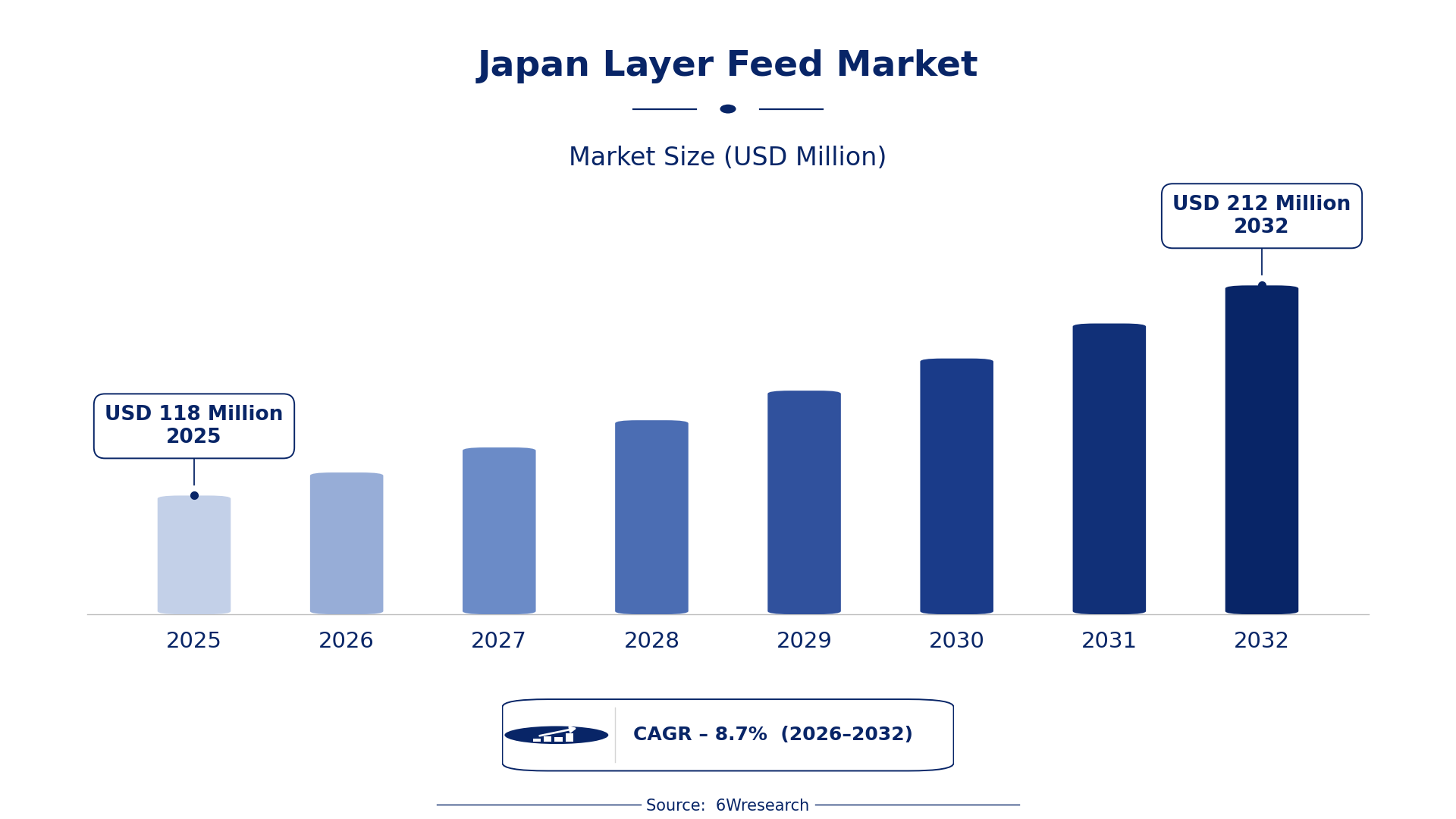
According to 6Wresearch internal database and industry insights, the Japan Layer Feed Market was valued at USD 118 Million in 2025 and is projected to reach USD 212 Million by 2032, growing at a CAGR of approximately 8.7% during 2026–2032.
Japan Layer Feed Market Highlights
| Report Metric | Details |
| Report Name | Japan Layer Feed Market (2026-2032) |
| Market Size 2025 | USD 118 Million |
| Market Size 2032 | USD 212 Million |
| Absolute Growth 2025–2032 | USD 94 Million |
| CAGR 2026–2032 | 8.7% |
| Peak Annual Growth | 9.6% in 2030 |
| Forecast Period | 2026–2032 |
| Historical Data | 2022–2025 |
| Base Year | 2025 |
| Leading Product Type, 2025 | Starter Feed (44% share) |
| Leading Feed Form, 2025 | Crumbles/Pellets (49% share) |
| Leading Distribution Channel, 2025 | Direct Sales (45% share) |
| Leading End User, 2025 | Poultry Farms (44% share) |
| Fastest-Growing Product Type | Grower Feed (12.5% CAGR) |
| Fastest-Growing Feed Form | Mash (12.2% CAGR) |
| Fastest-Growing Distribution Channel | Online Platforms (11.3% CAGR) |
| Fastest-Growing End User | Egg-Laying Facilities (11.5% CAGR) |
| Growing Sector | Poultry Farming |
| Key End Users | Poultry Farms, Egg-Laying Facilities, Organic Egg Producers, Commercial Poultry Units |
Japan Layer Feed Market Year-wise Growth Rate and Key Drivers (2022–2032)
This graph illustrates the annual growth rates of the market from 2022 to 2032, highlighting a steady upward trajectory and projected market expansion over the forecast period.
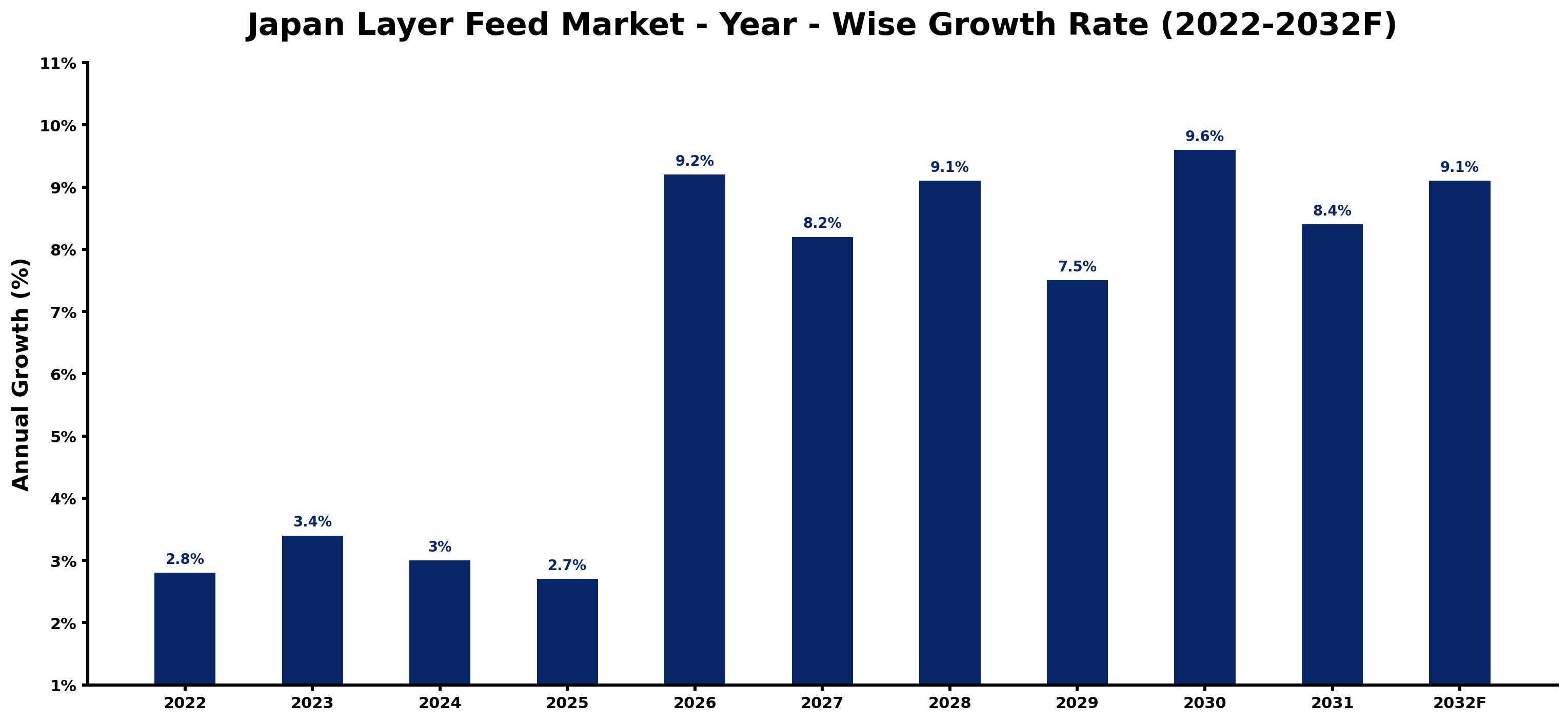
Below, each year's estimated growth is shown next to the factor that most influenced it.
| Year | Estimated Annual Growth (%) | Market Rationale |
| 2022 | 2.8 | The market experienced steady growth due to stable poultry production levels. |
| 2023 | 3.4 | Demand increased as the poultry population remained strong and egg production improved. |
| 2024 | 3.0 | Growth slowed slightly as producers adjusted to market conditions and feed prices. |
| 2025 | 2.7 | The market continued to grow but at a slower rate as competition intensified. |
| 2026 | 9.2 | Demand is expected to surge as technological advancements in poultry farming begin to take effect. |
| 2027 | 8.2 | Growth is projected to moderate as producers adapt to new technologies and market conditions. |
| 2028 | 9.1 | The market is expected to see renewed interest as organic feed options gain popularity among consumers. |
| 2029 | 7.5 | Growth is projected to slow again as the market stabilises following rapid technological adoption. |
| 2030 | 9.6 | A peak in growth is expected as the demand for layer feed reaches new heights. |
| 2031 | 8.4 | The market will experience a slight slowdown as producers face increasing operational costs. |
| 2032 | 9.1 | Growth is projected to resume as consumer preferences shift towards organic and sustainable options. |
Note: Market size estimations and growth projections presented in this report are based on 6Wresearch's proprietary forecasting methodology, utilizing the latest available industry data, government publications, and primary research inputs.
Japan Layer Feed Market Synopsis
Layer feed is a specialised animal feed formulated for egg-laying hens, combining grains, proteins, vitamins, and minerals to optimise egg production and support hen health. The Japan Layer Feed Market is expanding due to a poultry population of around 150 million hens and a growing preference for organic options, which now account for 10% of the total feed market. Regions like Tokyo and Osaka are key demand drivers, while technological advancements and government support for organic farming further stimulate growth in this sector.
Market Dynamics Impact Analysis (2026–2032)
| Factor | Type | Impact | Primary Segment Affected |
| Rising poultry population | Driver | High | Starter Feed |
| Increased demand for organic products | Driver | High | Organic Layer Feed |
| Growing consumer interest in sustainable farming | Opportunity | Medium | Organic Layer Feed |
| Expansion of online sales channels | Opportunity | Medium | Online Platforms |
| High production costs for feed ingredients | Restraint | High | Starter Feed |
| Strict regulations on feed additives | Restraint | Medium | Starter Feed |
| Aging poultry farmer demographic | Challenge | High | Poultry Farms |
| Need for modernization in farming practices | Challenge | Medium | Poultry Farms |
Evaluation of Drivers in Japan Layer Feed Market (2026–2032)
Key forces behind demand, with the segment each one moves most, are listed below.
| Drivers | Primary Segment Affected | Why It Matters (Evidence) |
| Increase in poultry population | Starter Feed | Japan's poultry population reached approximately 150 million hens, driving higher demand for feed. |
| Growing preference for organic feed | Organic Layer Feed | Organic layer feed accounted for 10% of the total feed market, reflecting changing consumer trends. |
| Technological advancements in farming | Starter Feed | The adoption of smart farming technologies is increasing efficiency, resulting in higher feed purchases among farmers. |
| Rising egg production per hen | Starter Feed | The average egg production per hen is around 300 eggs annually, boosting feed requirements. |
| Support from government subsidies | Organic Layer Feed | Government subsidies for organic farming are promoting the adoption of organic layer feed. |
Purchasing is picking up as Japan's poultry population reaches approximately 150 million hens, creating strong demand for layer feed. The average egg production per hen is about 300 eggs annually, prompting increased consumption of feed. Organic options are gaining traction, accounting for 10% of the market, as consumers shift towards healthier choices. Technological advancements in poultry farming are improving production efficiency, encouraging farmers to invest in higher-quality feed.
Evaluation of Restraints in Japan Layer Feed Market
These restraints slow adoption and weigh on supplier margins.
| Market Restraint | Primary Segment Affected | Why It Matters (Evidence) |
| High production costs for feed ingredients | Starter Feed | The average price of layer feed is approximately 30,000 JPY per ton, affecting profitability. |
| Strict regulations on feed additives | Starter Feed | Compliance with stringent regulations by the Food Safety Commission complicates sourcing for producers. |
| Aging poultry farmer demographic | Poultry Farms | The increasing average age of poultry farmers may lead to potential labour shortages. |
| Limited availability of organic feed | Organic Layer Feed | Access to organic feed options is restricted, impacting some producers' ability to meet demand. |
| Competition from imported feed ingredients | Starter Feed | In 2022, Japan imported 200,000 tons of feed ingredients, impacting local producers. |
Japan Layer Feed Market Challenges
Buyers in Japan's poultry sector struggle with rising layer feed prices, averaging 30,000 JPY per ton, driven by increased demand for organic and non-GMO options. This trend forces buyers to allocate more of their budgets to feed, squeezing their profit margins. Technology adoption lags due to the ageing poultry farmer demographic, leading to production inefficiencies that delay output and reduce competitiveness for farms. Strict regulations on feed additives complicate ingredient sourcing, causing supply chain disruptions that hinder producers' ability to meet market demands promptly.
Trends in the Japan Layer Feed Market
Several trends are reshaping the Japan Layer Feed Market; the most important are set out below.
- Shift towards Organic Layer Feed: Since 2022, there has been a notable shift towards organic layer feed, as consumer health trends drive demand. Organic layer feed now accounts for 10% of the market, reflecting increased interest in sustainable products.
- Rise of Smart Farming Technologies: In 2023, smart farming technologies began reshaping poultry farming practices. These innovations are improving production efficiency, resulting in increased feed purchases among modern poultry farmers.
- Growth of Online Sales Channels: Beginning in 2023, online platforms have gained traction in the layer feed market. With a projected CAGR of 11.3%, these channels are becoming essential for reaching contemporary poultry farmers.
- Expansion of Poultry Farming Regions: From 2022 onwards, Tokyo and Osaka have emerged as major poultry farming regions. This concentration supports local feed production and boosts demand for layer feed.
Investment Opportunities in the Japan Layer Feed Market
Several openings in the Japan Layer Feed Market merit attention from investors.
- Gap in Organic Layer Feed Supply: With organic layer feed accounting for only 10% of the market, there is a clear opportunity for suppliers to fill this gap. Poultry farms, especially organic egg producers, are increasingly seeking sustainable options.
- Investment in Smart Farming Technologies: The rise of smart farming technologies presents an opportunity for suppliers to invest in advanced feed solutions. Poultry farms in regions like Kanto are looking to modernise their operations.
- Expansion of Direct Sales Channels: As Direct Sales held a 45% share in 2025, there is room for growth in this channel. Local poultry farms are the primary buyers, creating opportunities for suppliers to enhance their market presence.
- Focus on Sustainable Practices: With the government targeting a 20% increase in organic farming area by 2025, suppliers can invest in organic layer feed production. This aligns with the needs of organic egg producers.
Government Initiatives in the Japan Layer Feed Market
The GX Promotion Act, established in 2023, builds upon earlier regulations by providing a framework for promoting organic farming. This act encourages producers to adopt sustainable practices and offers financial incentives for organic feed production. The government has set a target to increase organic farming area by 20% by 2025, supporting the growth of the organic layer feed market.
In 2022, the Ministry of Agriculture, Forestry and Fisheries allocated 5 billion JPY to support organic farming initiatives. The agency oversees compliance with feed safety regulations, ensuring that producers meet quality standards.
Future Insight of the Japan Layer Feed Market
By 2032, smart farming initiatives will reshape poultry production in Japan, driving efficiency and improving egg quality. The government’s target to increase organic farming area will create a surge in demand for organic layer feed, providing new opportunities for suppliers. Updated JIS standards will set higher quality benchmarks, ensuring safety and nutritional integrity of feed. With Japan producing approximately 1.5 million tons of layer feed in 2022, advancements in feed formulation will cater to the rising consumer preference for non-GMO products, broadening market potential.
Market Segmentation Analysis
Japan Layer Feed Market report covers a detailed analysis of the following market segments:
By Product Type – Starter Feed Leads, Grower Feed Expected to Grow Fastest
According to Saurav Kr Singh, Senior Research Analyst at 6Wresearch, Starter Feed took 44% of product type revenue in 2025, more than any other category. Starter Feed commands the largest share due to its critical role in nurturing young chicks, which are essential for future egg production. In Japan, a considerable amount of the 1.5 million tons of layer feed produced is allocated to Starter Feed to ensure optimal chick growth. The quickest growth will come from Grower Feed, forecast to expand at a CAGR of 12.5% between 2026 and 2032. The swift growth of Grower Feed is fuelled by the increasing focus on maximising the development of hens before they begin laying eggs. As the demand for eggs rises, poultry farmers are prioritising this segment to enhance production efficiency. Suppliers must focus on Grower Feed to leverage the growing demand for efficient hen development.
By Feed Form – Crumbles/Pellets Lead, Mash Expected to Grow Fastest
In 2025, Crumbles/Pellets led the feed form split with a 49% share. Crumbles dominate the market due to their convenience for hens, facilitating better feed intake and utilisation. This form is particularly favoured by poultry farmers in regions like Tokyo and Osaka, where feed production facilities are predominantly located. Over 2026–2032, Mash is expected to post the fastest growth, at a CAGR of 12.2%. Mash is experiencing the fastest growth as it remains a traditional choice for smaller farms, where simplicity and cost-effectiveness are essential. The adoption of this form by more small-scale farmers is likely to drive increased demand. Suppliers may need to expand their product offerings to include Mash to cater to the growing number of smaller poultry operations.
By Distribution Channel – Direct Sales Leads, Online Platforms Expected to Grow Fastest
Direct Sales held 45% of the Japan Layer Feed Market by distribution channel in 2025. Direct Sales is the leading distribution channel as it provides local farmers with immediate access to layer feed, ensuring they can meet their operational needs efficiently. This method is particularly effective in rural areas where poultry farming is a key economic activity. Online Platforms are set to record the highest CAGR in this split, 11.3% over 2026–2032. Online Platforms are rapidly gaining traction among tech-savvy farmers who prefer the convenience of purchasing feed digitally. The rise in e-commerce reflects a shift in purchasing behaviour, especially following events like the National Poultry Expo. Suppliers should invest in online sales strategies to reach a broader customer base and adapt to changing purchasing preferences.
By End User – Poultry Farms Lead, Egg-Laying Facilities Expected to Grow Fastest
Poultry Farms accounted for 44% of the market by end user in 2025. Poultry Farms represent the largest segment of layer feed consumers in Japan, supported by a robust population of approximately 150 million hens. These farms are crucial for meeting domestic egg requirements, making them a key market for feed suppliers. Egg-Laying Facilities are projected to grow fastest, at a CAGR of 11.5% during 2026–2032. Egg-Laying Facilities are experiencing the fastest growth as they are vital for enhancing egg production efficiency. With an average annual output of about 300 eggs per hen, these facilities are integral to the poultry supply chain. Suppliers should tailor their offerings to meet the specific needs of Egg-Laying Facilities to seize growth opportunities.
Key Attractiveness of the Report
- 10 Years of Market Numbers
- Historical Data Starting from 2022 to 2025
- Base Year 2025
- Forecast Data until 2032
- Key Performance Indicators Impacting the Market
- Major Upcoming Developments and Projects
Key Highlights of the Report:
- Japan Layer Feed Market Outlook
- Market Size of Japan Layer Feed Market, 2025
- Forecast of Japan Layer Feed Market, 2032
- Historical Data and Forecast of Japan Layer Feed Revenues & Volume for the Period 2022-2032F
- Japan Layer Feed Market Trend Evolution
- Japan Layer Feed Market Drivers and Challenges
- Japan Layer Feed Price Trends
- Japan Layer Feed Porter's Five Forces
- Japan Layer Feed Industry Life Cycle
- Historical Data and Forecast of Japan Layer Feed Market Revenues & Volume By Product Type for the Period 2022-2032F
- Historical Data and Forecast of Japan Layer Feed Market Revenues & Volume By Starter Feed for the Period 2022-2032F
- Historical Data and Forecast of Japan Layer Feed Market Revenues & Volume By Grower Feed for the Period 2022-2032F
- Historical Data and Forecast of Japan Layer Feed Market Revenues & Volume By Finisher Feed for the Period 2022-2032F
- Historical Data and Forecast of Japan Layer Feed Market Revenues & Volume By Organic Layer Feed for the Period 2022-2032F
- Historical Data and Forecast of Japan Layer Feed Market Revenues & Volume By Feed Form for the Period 2022-2032F
- Historical Data and Forecast of Japan Layer Feed Market Revenues & Volume By Crumbles/Pellets for the Period 2022-2032F
- Historical Data and Forecast of Japan Layer Feed Market Revenues & Volume By Mash for the Period 2022-2032F
- Historical Data and Forecast of Japan Layer Feed Market Revenues & Volume By Pellets for the Period 2022-2032F
- Historical Data and Forecast of Japan Layer Feed Market Revenues & Volume By Non-GMO/Certified for the Period 2022-2032F
- Historical Data and Forecast of Japan Layer Feed Market Revenues & Volume By Distribution Channel for the Period 2022-2032F
- Historical Data and Forecast of Japan Layer Feed Market Revenues & Volume By Direct Sales for the Period 2022-2032F
- Historical Data and Forecast of Japan Layer Feed Market Revenues & Volume By Online Platforms for the Period 2022-2032F
- Historical Data and Forecast of Japan Layer Feed Market Revenues & Volume By Industrial Suppliers for the Period 2022-2032F
- Historical Data and Forecast of Japan Layer Feed Market Revenues & Volume By Specialty Stores for the Period 2022-2032F
- Historical Data and Forecast of Japan Layer Feed Market Revenues & Volume By End User for the Period 2022-2032F
- Historical Data and Forecast of Japan Layer Feed Market Revenues & Volume By Poultry Farms for the Period 2022-2032F
- Historical Data and Forecast of Japan Layer Feed Market Revenues & Volume By Egg-Laying Facilities for the Period 2022-2032F
- Historical Data and Forecast of Japan Layer Feed Market Revenues & Volume By Commercial Poultry Units for the Period 2022-2032F
- Historical Data and Forecast of Japan Layer Feed Market Revenues & Volume By Organic Egg Producers for the Period 2022-2032F
- Japan Layer Feed Import Export Trade Statistics
- Market Opportunity Assessment By Product Type
- Market Opportunity Assessment By Feed Form
- Market Opportunity Assessment By Distribution Channel
- Market Opportunity Assessment By End User
- Japan Layer Feed Top Companies Market Share
- Japan Layer Feed Competitive Benchmarking By Technical and Operational Parameters
- Japan Layer Feed Company Profiles
- Japan Layer Feed Key Strategic Recommendations
Market Covered
Segments analysed in this report are listed below.
By Product Type
- Starter Feed
- Grower Feed
- Finisher Feed
- Organic Layer Feed
By Feed Form
- Crumbles/Pellets
- Mash
- Pellets
- Non-GMO/Certified
By Distribution Channel
- Direct Sales
- Online Platforms
- Industrial Suppliers
- Specialty Stores
By End User
- Poultry Farms
- Egg-Laying Facilities
- Commercial Poultry Units
- Organic Egg Producers






































