Japan LCD TV Core Chip Market Size & Growth Rate
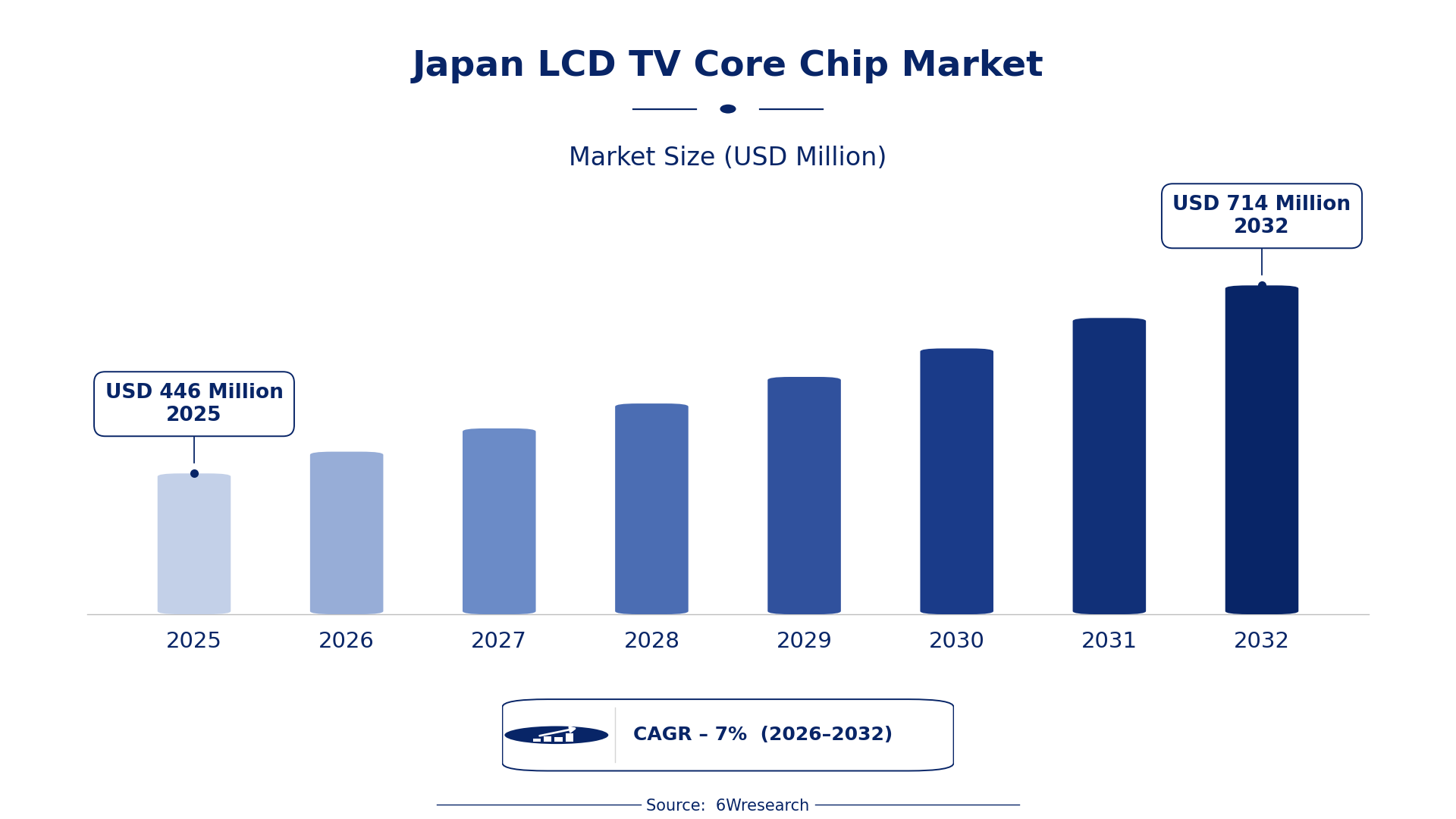
According to 6Wresearch internal database and industry insights, the Japan LCD TV Core Chip Market was valued at USD 446 Million in 2025 and is projected to reach USD 714 Million by 2032, growing at a CAGR of approximately 7% during 2026–2032.
Japan LCD TV Core Chip Market Highlights
| Report Metric | Details |
| Report Name | Japan LCD TV Core Chip Market (2026-2032) |
| Market Size 2025 | USD 446 Million |
| Market Size 2032 | USD 714 Million |
| Absolute Growth 2025–2032 | USD 268 Million |
| CAGR 2026–2032 | 7% |
| Peak Annual Growth | 8.3% in 2028 |
| Forecast Period | 2026–2032 |
| Historical Data | 2022–2025 |
| Base Year | 2025 |
| Leading Application, 2025 | Residential (48% share) |
| Leading Type, 2025 | 8-bit (38% share) |
| Fastest-Growing Application | Commercial (9.1% CAGR) |
| Fastest-Growing Type | 16-bit (9.7% CAGR) |
| Growing Sector | Residential |
| Key End Users | Residential consumers, commercial display providers, educational institutions |
Japan LCD TV Core Chip Market Year-wise Growth Rate and Key Drivers (2022–2032)
This graph illustrates the annual growth rates of the market from 2022 to 2032, highlighting a steady upward trajectory and projected market expansion over the forecast period.
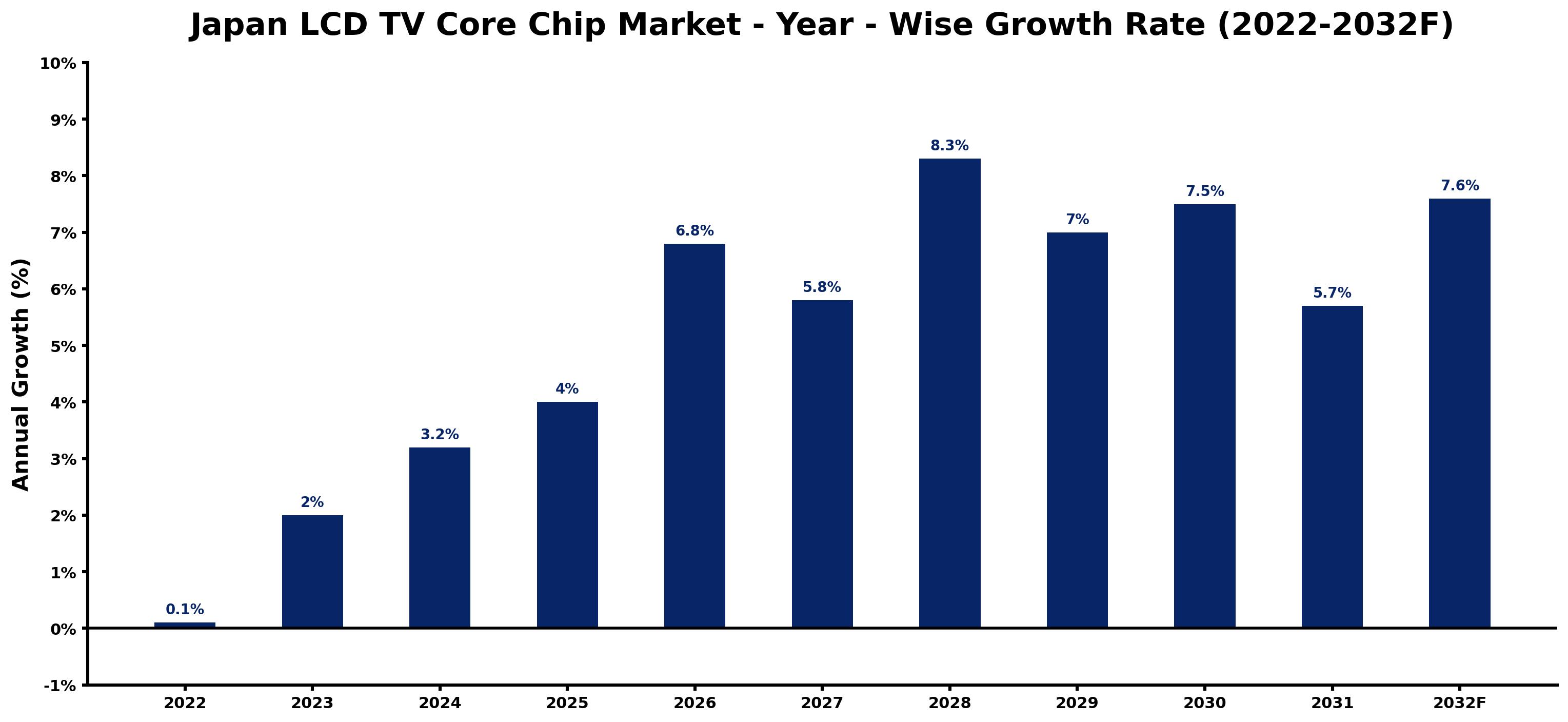
The yearly estimates that follow link every growth rate to its principal driver, so readers can see why the pace changed in each period.
| Year | Estimated Annual Growth (%) | Market Rationale |
| 2022 | 0.1 | The market experienced minimal growth due to ongoing adjustments in consumer electronics preferences. |
| 2023 | 2.0 | Demand increased as consumers began upgrading to newer LCD TV models with advanced features. |
| 2024 | 3.2 | Growth continued as more households invested in larger screens and better image quality. |
| 2025 | 4.0 | The market peaked historically as the adoption of 32-bit core chips became widespread in mid-range TVs. |
| 2026 | 6.8 | Growth accelerated as manufacturers expanded production capabilities to meet rising consumer demand. |
| 2027 | 5.8 | The growth rate slowed slightly as market saturation began to affect new purchases. |
| 2028 | 8.3 | The market is expected to see a surge in demand, driven by technological advancements in display quality. |
| 2029 | 7.0 | Growth is projected to decelerate as competition intensifies among manufacturers for market share. |
| 2030 | 7.5 | Demand is expected to rebound as new product launches revitalise consumer interest in LCD TVs. |
| 2031 | 5.7 | Growth will slow again as the market stabilises following several years of rapid expansion. |
| 2032 | 7.6 | The market is projected to grow steadily as ongoing technological improvements attract buyers. |
Note: Market size estimations and growth projections presented in this report are based on 6Wresearch's proprietary forecasting methodology, utilizing the latest available industry data, government publications, and primary research inputs.
Japan LCD TV Core Chip Market Synopsis
LCD TV core chips are semiconductor devices that control display functions in LCD televisions. They are produced through advanced manufacturing processes, including silicon wafer fabrication and photolithography. The Japan LCD TV Core Chip Market is growing, driven by high domestic demand, with the average household owning 2.5 televisions. The Semiconductor Strategy launched in 2021 and the increasing integration of advanced technology into TVs are propelling market expansion. The commercial sector is also expanding, with a notable rise in installations in urban areas, further boosting demand.
Market Dynamics Impact Analysis (2026–2032)
| Factor | Type | Impact | Primary Segment Affected |
| Growing demand for high-definition displays in residential applications | Driver | High | Residential |
| Rising commercial display installations in retail and corporate environments | Driver | High | Commercial |
| Increasing investments in semiconductor technology by local manufacturers | Opportunity | High | Commercial |
| Expansion of educational tools using LCD technology in schools | Opportunity | Medium | Educational |
| Supply chain disruptions affecting semiconductor materials | Restraint | High | Residential |
| Intense competition among manufacturers leading to price wars | Restraint | Medium | Residential |
| High initial investment costs for advanced manufacturing equipment | Challenge | High | Residential |
| Rapid technological changes requiring constant upgrades | Challenge | Medium | Residential |
Evaluation of Drivers in Japan LCD TV Core Chip Market (2026–2032)
The main growth drivers and the segments they affect most are set out below.
| Drivers | Primary Segment Affected | Why It Matters (Evidence) |
| Increased consumer spending on home entertainment systems | Residential | The average household in Japan owns 2.5 televisions, driving demand for core chips to improve viewing experiences. |
| Expansion of commercial displays in urban areas | Commercial | In 2023, the commercial display sector saw a growth rate of 9.1%, reflecting the need for effective advertising solutions. |
| Technological advancements in display resolution and quality | Residential | The adoption of 32-bit core chips in mid-range TVs improves image quality, attracting more buyers. |
| Government initiatives promoting semiconductor production | Commercial | The Semiconductor Strategy launched in 2021 supports local manufacturers, increasing production capacity. |
| Growing integration of LCD technology in educational tools | Educational | The Digital New Deal program aims to advance digital technology adoption in education, increasing demand for LCD components. |
Buyers are adding capacity as consumer spending on home entertainment systems rises, with households investing in larger screens and better image quality. Local manufacturers are increasing production capacity to meet the growing demand for high-quality LCD TVs, particularly in residential applications. The integration of LCD technology in educational tools is also creating additional demand as schools upgrade their resources. In 2023, the commercial display sector saw a growth rate of 9.1%, reflecting the need for effective advertising solutions. Technological advancements in display resolution are prompting the adoption of 32-bit core chips, improving image quality and attracting buyers.
Evaluation of Restraints in Japan LCD TV Core Chip Market
These are the pressures that could keep growth below its potential.
| Market Restraint | Primary Segment Affected | Why It Matters (Evidence) |
| Supply chain disruptions affecting semiconductor materials | Residential | Shortages in essential materials have delayed production timelines for manufacturers, impacting delivery schedules. |
| Intense competition among manufacturers leading to price wars | Residential | Price wars have reduced margins, making it difficult for smaller manufacturers to remain profitable. |
| High initial investment costs for advanced manufacturing equipment | Residential | These costs can deter new entrants from competing in the market, limiting innovation. |
| Rapid technological changes requiring constant upgrades | Residential | Manufacturers face pressure to continuously innovate, straining resources and impacting profitability. |
| Consumer preferences shifting towards alternative display technologies | Residential | As consumers explore options like OLEDs, demand for traditional LCD TVs may decline. |
Japan LCD TV Core Chip Market Challenges
In Japan, 20 million LCD TVs are in use, yet a shortage of skilled technicians in semiconductor manufacturing is delaying production timelines for suppliers. Strict adherence to JIS standards raises costs, potentially increasing prices for buyers by 15%. Rising raw material expenses contribute to a 10% surge in production costs, which can deter consumer purchases. Local suppliers face intense competition from international markets, forcing them to lower prices and potentially compromising product quality, which negatively impacts buyers' trust in reliability.
Trends in the Japan LCD TV Core Chip Market
Below are the shifts with the largest effect on the Japan LCD TV Core Chip Market.
- Shift towards 32-bit Core Chips: In 2023, the adoption of 32-bit core chips in mid-range TVs increased, improving image quality and processing speed. This trend reflects consumer preferences for higher-quality displays, with over 20 million LCD TVs in use in Japan.
- Growing Demand for Commercial Displays: Retailers are increasingly investing in commercial displays, with a notable rise in installations in urban areas. In 2023, the commercial display sector saw a growth rate of 9.1%, reflecting the need for effective advertising solutions.
- Integration of LCD Technology in Education: The Digital New Deal program is advancing the integration of LCD technology in educational tools, increasing demand for projectors and interactive displays in schools. This shift is expected to improve learning experiences across Japan.
- Emergence of 64-bit Core Chips: As of 2023, demand for 64-bit core chips is rising in high-end models, reflecting a trend towards advanced processing capabilities. This shift is evident in new product launches targeting tech-savvy consumers.
Investment Opportunities in the Japan LCD TV Core Chip Market
Below are the investment opportunities with the strongest case in the Japan LCD TV Core Chip Market.
- Educational Institutions Upgrading Technology: Schools are investing in advanced educational tools, creating a demand for LCD technology. The Digital New Deal program supports this shift, with funding aimed at improving digital learning environments.
- Commercial Sector Expanding Display Installations: Retailers are seeking new display solutions, presenting opportunities for suppliers of LCD technology. Partnerships with local distributors can facilitate entry into this growing market segment.
- Rising Demand for Home Entertainment Systems: With households investing in larger screens, there is a growing need for high-quality LCD core chips. Suppliers can target residential buyers by promoting advanced features in their products.
- Government Support for Semiconductor Development: The Semiconductor Strategy launched in 2021 provides funding for local manufacturers, creating opportunities for investment in production facilities and technology upgrades.
Government Initiatives in the Japan LCD TV Core Chip Market
The Semiconductor and Digital Industry Strategy, introduced by the Ministry of Economy, Trade and Industry in June 2021, aims to secure domestic semiconductor manufacturing. This measure encourages local production, ensuring a stable supply of LCD TV core chips for manufacturers and reducing reliance on imports. The strategy includes funding of approximately 100 billion yen to support research and development in semiconductor technology, benefitting the LCD TV sector.
The Economic Security Promotion Act, enacted in 2022, supports supply-chain resilience for critical products. This act facilitates the procurement of essential materials for LCD TV core chip production, benefiting manufacturers by ensuring a consistent supply of necessary components. The act has allocated 50 billion yen to strengthen domestic supply chains for semiconductor materials.
Future Insight of the Japan LCD TV Core Chip Market
The investment pipeline in semiconductor technology will expand, driven by the government's 'Semiconductor Strategy' and the 'Digital New Deal' program. By 2032, advancements in manufacturing processes will enhance production efficiency, generating demand for approximately 3 million additional LCD TV core chips annually. Increased digital technology integration in education will further elevate the need for high-quality LCD TVs. This evolution will create opportunities for suppliers to innovate and for buyers to access improved products.
Market Segmentation Analysis
Japan LCD TV Core Chip Market report covers a detailed analysis of the following market segments:
By Application – Residential Leads, Commercial Expected to Grow Fastest
According to Dhaval Chaurasia, Assistant Manager at 6Wresearch, the largest application category in 2025 was Residential, at 48% of revenue. The residential segment holds the largest share due to the average household in Japan owning 2.5 televisions, reflecting a strong demand for LCD TVs. Additionally, the presence of over 20 million LCD TVs in use indicates a well-established installed base supporting this segment. The quickest growth will come from Commercial, forecast to expand at a CAGR of 9.1% between 2026 and 2032. The commercial segment is experiencing rapid growth as businesses increasingly adopt LCD displays for advertising and information dissemination. This trend is further encouraged by initiatives like the 'Digital New Deal' programme, which promotes technology integration in various sectors. Suppliers should focus on developing products tailored for commercial applications to capitalise on this growth opportunity.
By Type – 8-bit Leads, 16-bit Expected to Grow Fastest
With 38% of type revenue in 2025, 8-bit was the largest category. The 8-bit core chips dominate the market as they are cost-effective and serve low-end devices, which remain common in many households. Their established role in budget-friendly televisions ensures their continued prevalence in the market. 16-bit is set to record the highest CAGR in this split, 9.7% over 2026–2032. The 16-bit core chips are seeing rapid growth as they are preferred in mid-range televisions, appealing to consumers seeking better performance and features. This shift towards enhanced technology will likely sustain their upward growth trend. Buyers should prioritise investments in 16-bit technology to benefit from improved performance and capabilities in their LCD TVs.
Key Attractiveness of the Report
- 10 Years of Market Numbers
- Historical Data Starting from 2022 to 2025
- Base Year 2025
- Forecast Data until 2032
- Key Performance Indicators Impacting the Market
- Major Upcoming Developments and Projects
Key Highlights of the Report:
- Japan LCD TV Core Chip Market Outlook
- Market Size of Japan LCD TV Core Chip Market, 2025
- Forecast of Japan LCD TV Core Chip Market, 2032
- Historical Data and Forecast of Japan LCD TV Core Chip Revenues & Volume for the Period 2022-2032
- Japan LCD TV Core Chip Market Trend Evolution
- Japan LCD TV Core Chip Market Drivers and Challenges
- Japan LCD TV Core Chip Price Trends
- Japan LCD TV Core Chip Porter's Five Forces
- Japan LCD TV Core Chip Industry Life Cycle
- Historical Data and Forecast of Japan LCD TV Core Chip Market Revenues & Volume By Application for the Period 2022-2032
- Historical Data and Forecast of Japan LCD TV Core Chip Market Revenues & Volume By Residential for the Period 2022-2032
- Historical Data and Forecast of Japan LCD TV Core Chip Market Revenues & Volume By Commercial for the Period 2022-2032
- Historical Data and Forecast of Japan LCD TV Core Chip Market Revenues & Volume By Educational for the Period 2022-2032
- Historical Data and Forecast of Japan LCD TV Core Chip Market Revenues & Volume By Type for the Period 2022-2032
- Historical Data and Forecast of Japan LCD TV Core Chip Market Revenues & Volume By 8-bit for the Period 2022-2032
- Historical Data and Forecast of Japan LCD TV Core Chip Market Revenues & Volume By 16-bit for the Period 2022-2032
- Historical Data and Forecast of Japan LCD TV Core Chip Market Revenues & Volume By 32-bit for the Period 2022-2032
- Historical Data and Forecast of Japan LCD TV Core Chip Market Revenues & Volume By 64-bit for the Period 2022-2032
- Japan LCD TV Core Chip Import Export Trade Statistics
- Market Opportunity Assessment By Application
- Market Opportunity Assessment By Type
- Japan LCD TV Core Chip Top Companies Market Share
- Japan LCD TV Core Chip Competitive Benchmarking By Technical and Operational Parameters
- Japan LCD TV Core Chip Company Profiles
- Japan LCD TV Core Chip Key Strategic Recommendations
Market Covered
Segments analysed in this report are listed below.
By Application
- Residential
- Commercial
- Educational
By Type
- 8-bit
- 16-bit
- 32-bit
- 64-bit






































