Japan Leafy Greens Market Size & Growth Rate
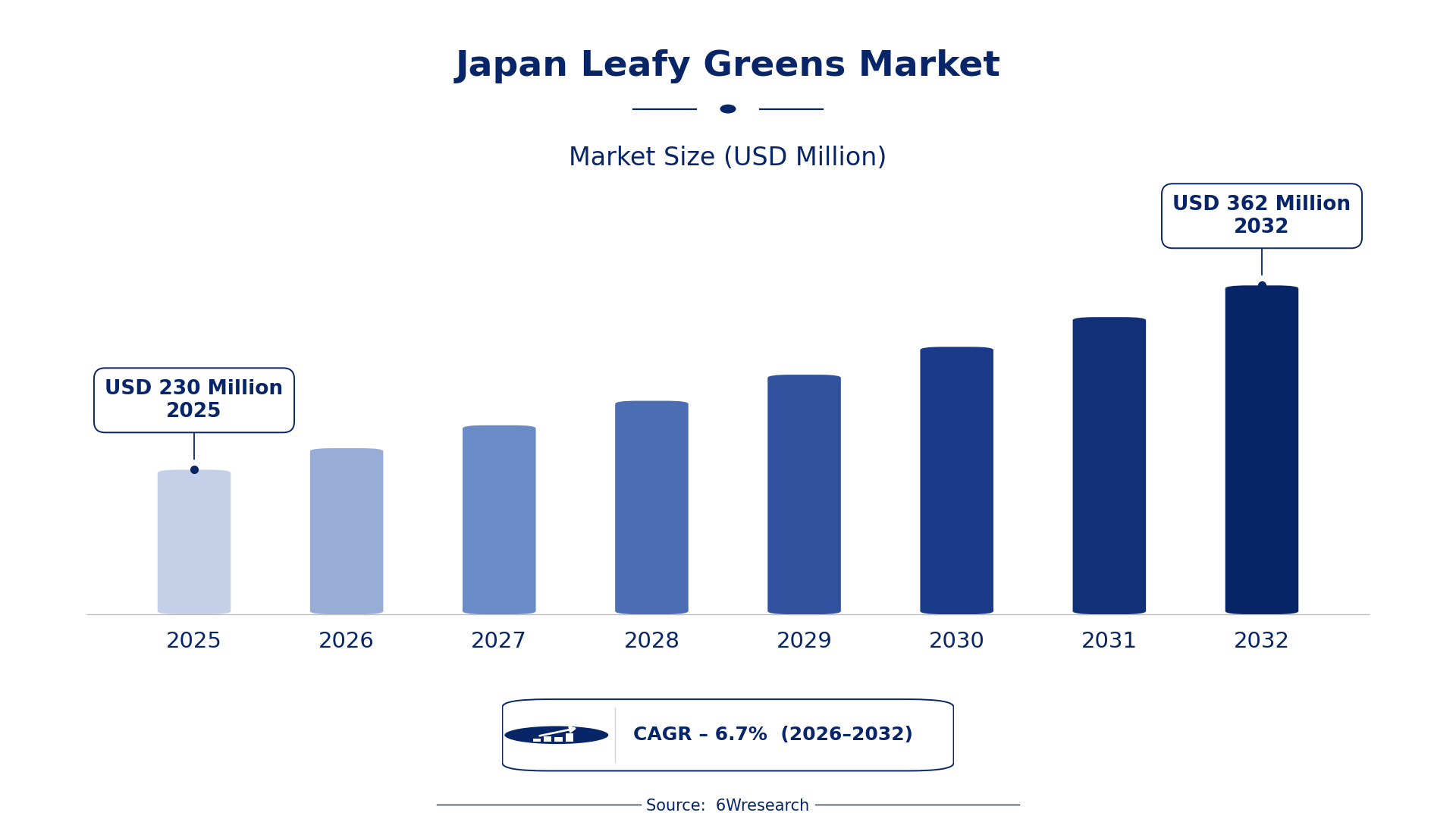
According to 6Wresearch internal database and industry insights, the Japan Leafy Greens Market was valued at USD 230 Million in 2025 and is projected to reach USD 362 Million by 2032, growing at a CAGR of approximately 6.7% during 2026–2032.
Japan Leafy Greens Market Highlights
| Report Metric | Details |
| Report Name | Japan Leafy Greens Market (2026-2032) |
| Market Size 2025 | USD 230 Million |
| Market Size 2032 | USD 362 Million |
| Absolute Growth 2025–2032 | USD 132 Million |
| CAGR 2026–2032 | 6.7% |
| Peak Annual Growth | 8.0% in 2029 |
| Forecast Period | 2026–2032 |
| Historical Data | 2022–2025 |
| Base Year | 2025 |
| Leading Product Type, 2025 | Spinach (35% share) |
| Leading Farming Method, 2025 | Organic (39% share) |
| Leading Distribution Channel, 2025 | Retail Stores (38% share) |
| Leading Packaging Type, 2025 | Plastic Clamshell (41% share) |
| Leading End User, 2025 | Consumers (51% share) |
| Fastest-Growing Product Type | Lettuce (9.2% CAGR) |
| Fastest-Growing Farming Method | Hydroponic (9.4% CAGR) |
| Fastest-Growing Distribution Channel | Wholesale (8.8% CAGR) |
| Fastest-Growing Packaging Type | Bags (9.3% CAGR) |
| Fastest-Growing End User | Food Service Industry (8.6% CAGR) |
| Growing Sector | Food Service Industry |
| Key End Users | Consumers, Food Service Industry, Restaurants |
Japan Leafy Greens Market Year-wise Growth Rate and Key Drivers (2022–2032)
This graph illustrates the annual growth rates of the market from 2022 to 2032, highlighting a steady upward trajectory and projected market expansion over the forecast period.
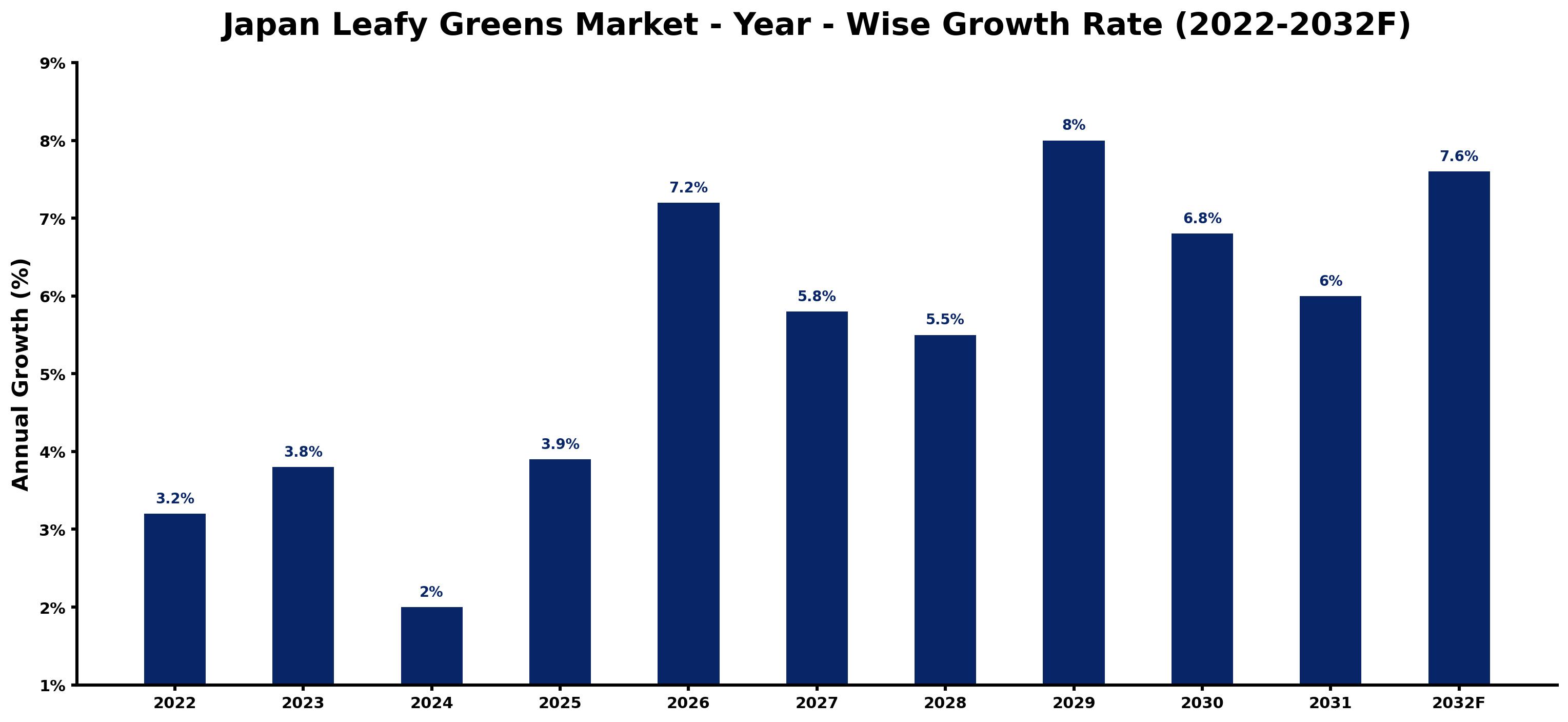
The following figures match every annual growth estimate with the main market development of that year, giving the reasoning behind each rise or slowdown.
| Year | Estimated Annual Growth (%) | Market Rationale |
| 2022 | 3.2 | The market showed steady growth, reflecting stable consumer demand for fresh produce. |
| 2023 | 3.8 | Demand rose as urban populations increasingly sought fresh leafy greens for healthy diets. |
| 2024 | 2.0 | Growth slowed due to market saturation and limited expansion in production capacity. |
| 2025 | 3.9 | Increased interest in organic products led to faster growth compared to the previous year. |
| 2026 | 7.2 | A surge in hydroponic farming adoption is expected to contribute to a notable rise in growth. |
| 2027 | 5.8 | Growth is projected to slow as the market adjusts to new consumer trends and production methods. |
| 2028 | 5.5 | Continued consumer interest in health and wellness is expected to keep growth steady, albeit slower. |
| 2029 | 8.0 | A peak in demand for fresh produce will drive growth, reaching its highest rate. |
| 2030 | 6.8 | Growth is projected to slow as the market stabilises after the peak demand period in 2029. |
| 2031 | 6.0 | The market will continue to grow, albeit at a reduced rate as competition increases. |
| 2032 | 7.6 | Demand for organic and locally sourced products is expected to drive growth again. |
Note: Market size estimations and growth projections presented in this report are based on 6Wresearch's proprietary forecasting methodology, utilizing the latest available industry data, government publications, and primary research inputs.
Japan Leafy Greens Market Synopsis
Leafy greens encompass a variety of vegetables featuring edible leaves, primarily grown for human consumption. The Japan Leafy Greens Market is thriving due to rising consumer health consciousness and robust demand from the food service industry, particularly in urban centres like Tokyo. With approximately 1.5 million tons produced in 2022, the market is expanding as trends in organic and hydroponic farming gain momentum, driven by a growing population and shifting culinary preferences.
Market Dynamics Impact Analysis (2026–2032)
| Factor | Type | Impact | Primary Segment Affected |
| Rising health awareness among consumers | Driver | High | Organic |
| Growing urban population driving demand for fresh produce | Driver | High | Retail Stores |
| Increased consumer preference for organic products | Opportunity | High | Organic |
| Expansion of hydroponic farming methods | Opportunity | Medium | Hydroponic |
| Aging farmer population leading to labour shortages | Restraint | High | Conventional |
| Limited awareness of hydroponic benefits among consumers | Restraint | Medium | Hydroponic |
| High production costs for organic farming | Challenge | High | Organic |
| Competition from imported leafy greens | Challenge | Medium | Retail Stores |
Evaluation of Drivers in Japan Leafy Greens Market (2026–2032)
The following drivers explain most of the expected growth.
| Drivers | Primary Segment Affected | Why It Matters (Evidence) |
| Growing health consciousness among consumers | Organic | This trend encourages consumers to seek healthier options, leading to increased purchases of organic leafy greens, which accounted for 15% of total consumption in 2022. |
| Urban farming initiatives in Tokyo | Hydroponic | These initiatives support year-round production capabilities, driving demand for hydroponically grown leafy greens, which are becoming increasingly popular among consumers. |
| Rising food service industry demand | Food Service Industry | The food service industry, valued at over 20 trillion yen, increasingly incorporates leafy greens into menus, boosting overall market demand. |
| Increase in online grocery shopping | Online Platforms | With a 25% increase in online grocery shopping over the last year, consumers are purchasing leafy greens through digital channels, enhancing market accessibility. |
| Government support for organic farming | Organic | Government initiatives aim to increase organic farming land by 30% by 2025, improving the supply of organic leafy greens and meeting consumer demand. |
A wider customer base explains much of the growth, as health consciousness among consumers has risen. Approximately 20 kg of leafy greens are consumed per person annually, fuelling demand for fresh produce. Organic leafy greens accounted for 15% of total consumption in 2022, reflecting a shift towards healthier options. The food service industry, valued at over 20 trillion yen, increasingly incorporates leafy greens into menus, further boosting demand.
Evaluation of Restraints in Japan Leafy Greens Market
These are the pressures that could keep growth below its potential.
| Market Restraint | Primary Segment Affected | Why It Matters (Evidence) |
| Aging farmer population | Conventional | With the average age of farmers over 65, the industry faces labour shortages affecting production capacity. |
| High production costs for organic farming | Organic | Organic farming requires higher investment, limiting growth potential for smaller producers. |
| Limited consumer awareness of hydroponic benefits | Hydroponic | Many consumers are unaware of the advantages of hydroponic systems, hindering market expansion. |
| Competition from imported leafy greens | Retail Stores | Imported leafy greens can be cheaper, impacting local producers' market share. |
| Regulatory compliance costs for organic certification | Organic | Producers face costs to meet JAS standards, which can deter new entrants. |
Japan Leafy Greens Market Challenges
Producers in the Kanto region face fierce competition, driving down prices and squeezing profit margins for local growers. Stringent JAS standards delay organic certification, costing farmers potential sales in a market where organic leafy greens constituted 15% of consumption in 2022. Supply chain disruptions often occur due to reliance on urban farming initiatives, resulting in spoilage that impacts restaurants needing fresh produce. Rising costs for seeds and fertilisers have increased operational expenses, forcing farmers to raise prices, which risks alienating budget-conscious buyers.
Trends in the Japan Leafy Greens Market
Buyers and suppliers in the Japan Leafy Greens Market are adjusting to the following trends.
- Consumers Shifting Towards Organic Options: Japanese consumers are increasingly prioritising organic leafy greens, as seen in the 15% share of organic products in 2022. This shift reflects a growing awareness of health and sustainability, encouraging suppliers to expand their organic offerings.
- Hydroponic Farming Gaining Popularity: Hydroponic farming is becoming more popular in urban areas, supported by government initiatives. This method allows for year-round production, addressing the needs of urban populations seeking fresh produce.
- Retail Stores Enhancing Fresh Produce Sections: Retail stores are expanding their fresh produce sections to meet rising consumer demand. With 60% of leafy greens sales occurring through this channel, stores are adapting to consumer preferences for fresh, local products.
- Online Grocery Shopping on the Rise: Online grocery shopping has surged by 25% in the past year, reflecting changing consumer habits. This trend is particularly relevant for leafy greens, as more consumers seek convenient access to fresh produce.
Investment Opportunities in the Japan Leafy Greens Market
Where to invest in the Japan Leafy Greens Market: the main openings are set out below.
- Invest in Organic Farming: With organic leafy greens accounting for 15% of consumption, there is a clear opportunity for investment in organic farming. This aligns with consumer preferences for healthier options, particularly in urban areas.
- Expand Hydroponic Systems: The increasing popularity of hydroponic farming presents an opportunity for suppliers to invest in this technology. With government support, urban areas can benefit from year-round production capabilities.
- Develop Online Sales Channels: The growth of online grocery shopping highlights the need for suppliers to develop online sales channels. This is particularly relevant for urban consumers seeking fresh produce conveniently delivered to their homes.
- Focus on Specialty Store Offerings: Specialty stores have seen a 15% increase in gourmet leafy greens sales, indicating a niche market. Suppliers can target this segment by offering unique varieties and premium products.
Government Initiatives in the Japan Leafy Greens Market
The Food Recycling Law, established in 2000, mandates food businesses to reduce waste and recycle it into feed and fertiliser. This law complements the Food Sanitation Act, which ensures food safety standards are met, benefiting producers by improving product quality and consumer trust.
A target to increase organic farming land by 30% by 2025 has been set, with the Ministry of Agriculture, Forestry and Fisheries overseeing the initiative. This aims to improve the availability of organic leafy greens, benefiting both producers and consumers.
Future Insight of the Japan Leafy Greens Market
Urban farming facilities will emerge by 2032, driven by government initiatives and technological advancements. The Japanese government plans to increase organic farming land by 30% by 2025, which will improve the availability of organic leafy greens for buyers. Adoption of innovative farming technologies will reduce transportation costs, allowing suppliers to provide fresher products at competitive prices. As the average Japanese consumer consumes about 20 kg of leafy greens annually, demand for diverse varieties will encourage suppliers to expand their offerings.
Market Segmentation Analysis
Japan Leafy Greens Market report covers a detailed analysis of the following market segments:
By Product Type – Spinach Leads, Lettuce Expected to Grow Fastest
According to Vasu Joshi, Associate Consultant at 6Wresearch, with 35% of product type revenue in 2025, Spinach was the largest category. Spinach holds the largest share due to its widespread use in both salads and cooking, appealing to a broad consumer base. For instance, its versatility makes it a staple in many Japanese households, contributing to its strong demand. Over 2026–2032, Lettuce is expected to post the fastest growth, at a CAGR of 9.2%. Lettuce is experiencing rapid growth as it is increasingly preferred for salads and sandwiches, reflecting changing consumer eating habits. The rise in health consciousness among consumers has further accelerated its popularity in recent years. Suppliers should focus on promoting lettuce to capitalise on its growing demand.
By Farming Method – Organic Leads, Hydroponic Expected to Grow Fastest
The largest farming method category in 2025 was Organic, at 39% of revenue. Organic farming commands the largest share as consumer preference for organic produce is on the rise, influenced by health and environmental considerations. With over 30 certified organic farms in Japan, there is a consistent supply to satisfy this increasing demand. Hydroponic is set to record the highest CAGR in this split, 9.4% over 2026–2032. Hydroponic farming is rapidly gaining popularity due to its capacity for year-round production, particularly appealing to urban dwellers who desire fresh leafy greens. The government's support for urban agriculture initiatives is further accelerating the adoption of hydroponic methods. Suppliers should focus on offering both organic and hydroponic products to meet the evolving preferences of health-conscious consumers.
By Distribution Channel – Retail Stores Lead, Wholesale Expected to Grow Fastest
In 2025, Retail Stores led the distribution channel split with a 38% share. Retail stores lead the distribution of leafy greens, accounting for 60% of sales, providing consumers with convenient access to fresh products. This strong presence in retail highlights the direct connection between consumers and their preferred purchasing channels. The quickest growth will come from Wholesale, forecast to expand at a CAGR of 8.8% between 2026 and 2032. Wholesale distribution is expanding quickly as it effectively supplies leafy greens to various outlets, meeting the rising demands of the food service sector. This growth is indicative of the increasing incorporation of leafy greens in culinary practices across Japan. Suppliers should enhance their wholesale relationships to capitalise on the growing demand from the food service industry.
By Packaging Type – Plastic Clamshell Leads, Bags Expected to Grow Fastest
Plastic Clamshell took 41% of packaging type revenue in 2025, more than any other category. Plastic clamshell packaging is the most widely used as it preserves freshness and allows for visibility, making it a popular choice among consumers. Its commonality in retail environments underscores its effectiveness in maintaining product quality and attracting health-conscious buyers. Bags are projected to grow fastest, at a CAGR of 9.3% during 2026–2032. Bags are gaining traction due to their convenience, particularly for consumers looking for portable options for leafy greens. The trend towards on-the-go consumption is driving this shift in packaging preferences among buyers. Manufacturers should consider developing innovative bag designs to cater to the convenience-oriented consumer.
By End User – Consumers Lead, Food Service Industry Expected to Grow Fastest
Consumers held 51% of the Japan Leafy Greens Market by end user in 2025. Consumers form the largest end user group, primarily due to their direct purchases of leafy greens for home use. The average consumption of about 20 kg per person annually highlights the substantial market size and demand for fresh produce. Over 2026–2032, Food Service Industry is expected to post the fastest growth, at a CAGR of 8.6%. The food service industry is rapidly growing as it increasingly incorporates leafy greens into menus, reflecting changing dining trends and consumer preferences. This segment's growth is supported by the overall expansion of the food service market in Japan. Suppliers must adapt their strategies to effectively serve both individual consumers and the food service sector.
Key Attractiveness of the Report
- 10 Years of Market Numbers
- Historical Data Starting from 2022 to 2025
- Base Year 2025
- Forecast Data until 2032
- Key Performance Indicators Impacting the Market
- Major Upcoming Developments and Projects
Key Highlights of the Report:
- Japan Leafy Greens Market Outlook
- Market Size of Japan Leafy Greens Market, 2025
- Forecast of Japan Leafy Greens Market, 2032
- Historical Data and Forecast of Japan Leafy Greens Market Revenues & Volume for the Period 2022-2032F
- Japan Leafy Greens Market Trend Evolution
- Japan Leafy Greens Market Drivers and Challenges
- Japan Leafy Greens Market Price Trends
- Japan Leafy Greens Market Porter's Five Forces
- Japan Leafy Greens Market Industry Life Cycle
- Historical Data and Forecast of Japan Leafy Greens Market Revenues & Volume By Product Type for the Period 2022-2032F
- Historical Data and Forecast of Japan Leafy Greens Market Revenues & Volume By Spinach for the Period 2022-2032F
- Historical Data and Forecast of Japan Leafy Greens Market Revenues & Volume By Lettuce for the Period 2022-2032F
- Historical Data and Forecast of Japan Leafy Greens Market Revenues & Volume By Kale for the Period 2022-2032F
- Historical Data and Forecast of Japan Leafy Greens Market Revenues & Volume By Arugula for the Period 2022-2032F
- Historical Data and Forecast of Japan Leafy Greens Market Revenues & Volume By Farming Method for the Period 2022-2032F
- Historical Data and Forecast of Japan Leafy Greens Market Revenues & Volume By Organic for the Period 2022-2032F
- Historical Data and Forecast of Japan Leafy Greens Market Revenues & Volume By Hydroponic for the Period 2022-2032F
- Historical Data and Forecast of Japan Leafy Greens Market Revenues & Volume By Conventional for the Period 2022-2032F
- Historical Data and Forecast of Japan Leafy Greens Market Revenues & Volume By Indoor Farming for the Period 2022-2032F
- Historical Data and Forecast of Japan Leafy Greens Market Revenues & Volume By Distribution Channel for the Period 2022-2032F
- Historical Data and Forecast of Japan Leafy Greens Market Revenues & Volume By Retail Stores for the Period 2022-2032F
- Historical Data and Forecast of Japan Leafy Greens Market Revenues & Volume By Wholesale for the Period 2022-2032F
- Historical Data and Forecast of Japan Leafy Greens Market Revenues & Volume By Online Platforms for the Period 2022-2032F
- Historical Data and Forecast of Japan Leafy Greens Market Revenues & Volume By Specialty Stores for the Period 2022-2032F
- Historical Data and Forecast of Japan Leafy Greens Market Revenues & Volume By Packaging Type for the Period 2022-2032F
- Historical Data and Forecast of Japan Leafy Greens Market Revenues & Volume By Plastic Clamshell for the Period 2022-2032F
- Historical Data and Forecast of Japan Leafy Greens Market Revenues & Volume By Bags for the Period 2022-2032F
- Historical Data and Forecast of Japan Leafy Greens Market Revenues & Volume By Boxes for the Period 2022-2032F
- Historical Data and Forecast of Japan Leafy Greens Market Revenues & Volume By Trays for the Period 2022-2032F
- Historical Data and Forecast of Japan Leafy Greens Market Revenues & Volume By End User for the Period 2022-2032F
- Historical Data and Forecast of Japan Leafy Greens Market Revenues & Volume By Consumers for the Period 2022-2032F
- Historical Data and Forecast of Japan Leafy Greens Market Revenues & Volume By Food Service Industry for the Period 2022-2032F
- Historical Data and Forecast of Japan Leafy Greens Market Revenues & Volume By Restaurants for the Period 2022-2032F
- Historical Data and Forecast of Japan Leafy Greens Market Revenues & Volume By Hotels & Cafes for the Period 2022-2032F
- Japan Leafy Greens Market Import Export Trade Statistics
- Market Opportunity Assessment By Product Type
- Market Opportunity Assessment By Farming Method
- Market Opportunity Assessment By Distribution Channel
- Market Opportunity Assessment By Packaging Type
- Market Opportunity Assessment By End User
- Japan Leafy Greens Market Top Companies Market Share
- Japan Leafy Greens Market Competitive Benchmarking By Technical and Operational Parameters
- Japan Leafy Greens Market Company Profiles
- Japan Leafy Greens Market Key Strategic Recommendations
Market Covered
The following segment groups are covered in the report.
By Product Type
- Spinach
- Lettuce
- Kale
- Arugula
By Farming Method
- Organic
- Hydroponic
- Conventional
- Indoor Farming
By Distribution Channel
- Retail Stores
- Wholesale
- Online Platforms
- Specialty Stores
By Packaging Type
- Plastic Clamshell
- Bags
- Boxes
- Trays
By End User
- Consumers
- Food Service Industry
- Restaurants
- Hotels & Cafes






































