Japan LED Lights Market Size & Growth Rate
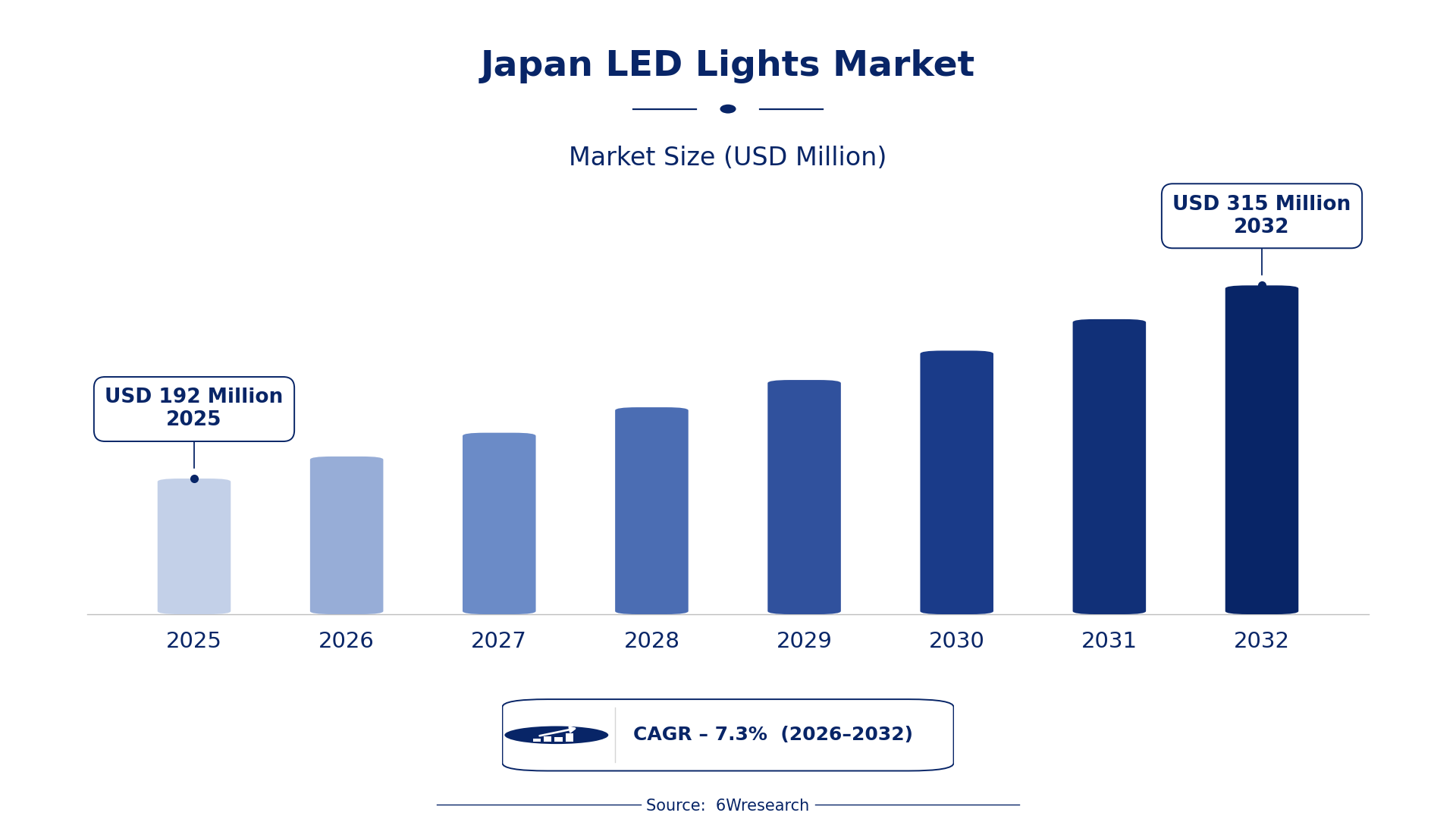
According to 6Wresearch internal database and industry insights, the Japan LED Lights Market was valued at USD 192 Million in 2025 and is projected to reach USD 315 Million by 2032, growing at a CAGR of approximately 7.3% during 2026–2032.
Japan LED Lights Market Highlights
| Report Metric | Details |
| Report Name | Japan LED Lights Market (2026-2032) |
| Market Size 2025 | USD 192 Million |
| Market Size 2032 | USD 315 Million |
| Absolute Growth 2025–2032 | USD 123 Million |
| CAGR 2026–2032 | 7.3% |
| Peak Annual Growth | 8.8% in 2028 |
| Forecast Period | 2026–2032 |
| Historical Data | 2022–2025 |
| Base Year | 2025 |
| Leading Product Type, 2025 | LED Bulbs (37% share) |
| Leading Power Range, 2025 | Less than 5W (32% share) |
| Leading Application, 2025 | Residential Lighting (40% share) |
| Leading Lighting Type, 2025 | Warm White (44% share) |
| Leading End User, 2025 | Residential (40% share) |
| Fastest-Growing Product Type | LED Strips (10.0% CAGR) |
| Fastest-Growing Power Range | 5W to 20W (10.5% CAGR) |
| Fastest-Growing Application | Architectural Lighting (9.6% CAGR) |
| Fastest-Growing Lighting Type | RGB (10.2% CAGR) |
| Fastest-Growing End User | Hospitality (9.2% CAGR) |
| Growing Sector | Residential Lighting |
| Key End Users | Residential, Commercial, Industrial, Hospitality |
Japan LED Lights Market Year-wise Growth Rate and Key Drivers (2022–2032)
This graph illustrates the annual growth rates of the market from 2022 to 2032, highlighting a steady upward trajectory and projected market expansion over the forecast period.
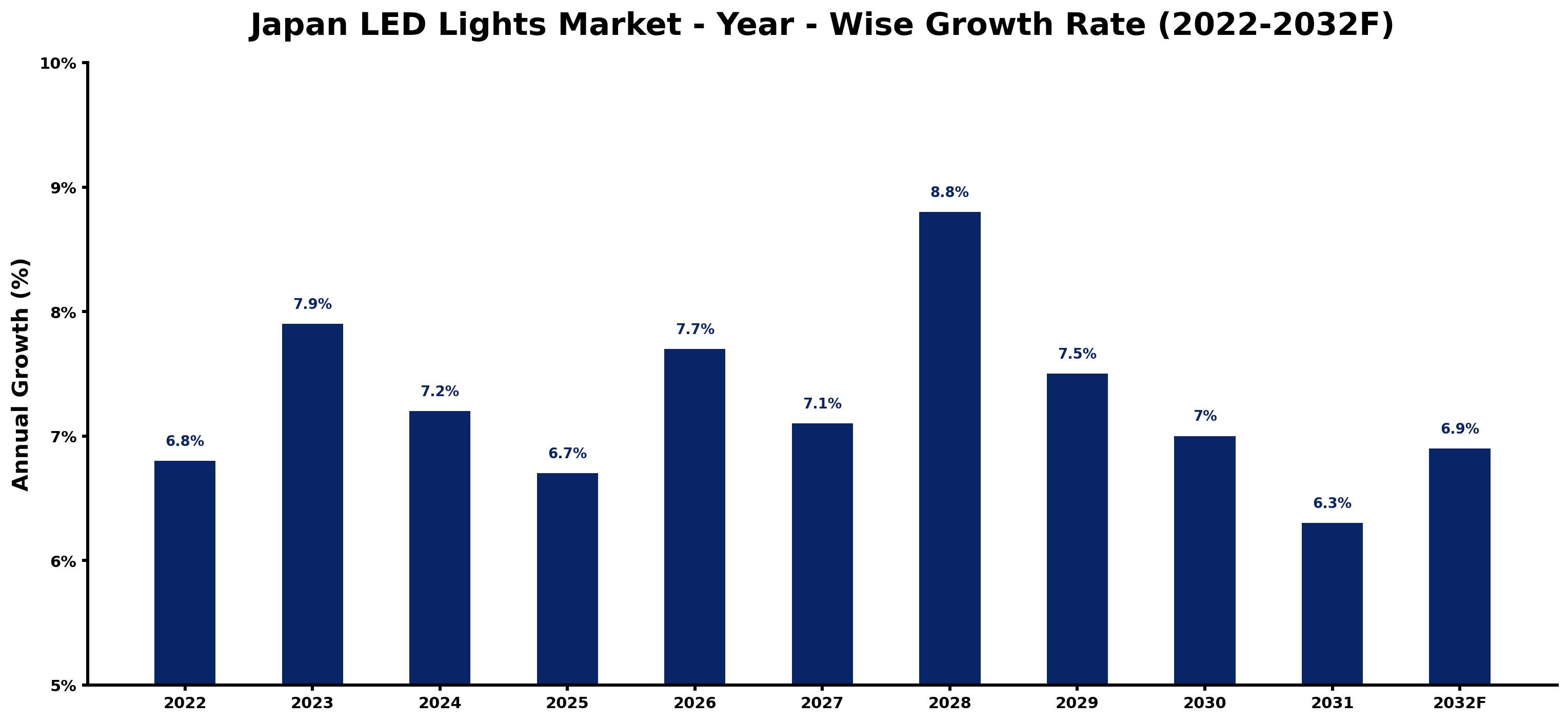
The table below sets out the estimated growth rate for each year and the main factor behind it.
| Year | Estimated Annual Growth (%) | Market Rationale |
| 2022 | 6.8 | The market exhibited steady growth due to increased energy efficiency awareness among consumers. |
| 2023 | 7.9 | Demand surged as over 70% of households adopted LED lighting solutions, boosting overall sales. |
| 2024 | 7.2 | Growth slowed slightly as consumers adjusted to market saturation and explored alternatives. |
| 2025 | 6.7 | The market continued to grow, driven by ongoing residential and commercial demand for energy-efficient solutions. |
| 2026 | 7.7 | Demand is expected to rise as architectural lighting projects gain traction in urban areas. |
| 2027 | 7.1 | The market is projected to grow at a slower rate due to competitive pressures from alternative technologies. |
| 2028 | 8.8 | Growth is expected to accelerate as urban development projects boost demand for architectural lighting solutions. |
| 2029 | 7.5 | Demand growth is projected to slow as the market matures and competition increases. |
| 2030 | 7.0 | The market will continue to grow, supported by smart city initiatives and ongoing retrofitting projects. |
| 2031 | 6.3 | Growth is projected to slow as the LED market approaches saturation in residential applications. |
| 2032 | 6.9 | Demand is expected to rise again as new technologies and applications emerge in the market. |
Note: Market size estimations and growth projections presented in this report are based on 6Wresearch's proprietary forecasting methodology, utilizing the latest available industry data, government publications, and primary research inputs.
Japan LED Lights Market Synopsis
LED lights are solid-state devices that convert electricity into light, primarily used for general illumination, decorative lighting, and specialized applications. The Japan LED Lights Market is experiencing robust growth due to widespread adoption in residential and commercial sectors, with the Tokyo metropolitan area accounting for 30% of demand. Government efforts to promote energy-efficient technologies, such as the Cool Japan strategy, are driving this market, projected to reach 1.2 billion units by 2025, reflecting a strong shift towards sustainability.
Market Dynamics Impact Analysis (2026–2032)
| Factor | Type | Impact | Primary Segment Affected |
| Growing adoption of energy-efficient lighting solutions | Driver | High | Residential Lighting |
| Increased urban development projects requiring advanced lighting | Driver | High | Architectural Lighting |
| Rise in government incentives for LED retrofitting | Opportunity | High | Commercial Lighting |
| Expansion of smart city initiatives promoting LED streetlights | Opportunity | High | Industrial Lighting |
| Market saturation in residential applications | Restraint | Medium | Residential Lighting |
| High initial costs of LED installations for some consumers | Restraint | Medium | Commercial Lighting |
| Competition from alternative lighting technologies | Challenge | High | Architectural Lighting |
| Supply chain disruptions affecting LED component availability | Challenge | Medium | Industrial Lighting |
Evaluation of Drivers in Japan LED Lights Market (2026–2032)
The following drivers explain most of the expected growth.
| Drivers | Primary Segment Affected | Why It Matters (Evidence) |
| Increased energy efficiency awareness among consumers | Residential Lighting | Over 70% of households have adopted LED lighting, driving demand for energy-efficient solutions and replacements. |
| Urban development projects boosting architectural aesthetics | Architectural Lighting | Urban development projects are projected to increase demand for architectural lighting solutions, improving city landscapes. |
| Government incentives for LED retrofitting in public buildings | Commercial Lighting | Incentives for retrofitting public buildings are boosting demand in the commercial sector, contributing to overall growth. |
| Smart city initiatives promoting LED streetlight installations | Industrial Lighting | LED streetlights are being installed in over 50 cities, improving urban infrastructure and promoting energy efficiency. |
| Technological advancements in LED manufacturing | Architectural Lighting | Innovations in LED technology are improving performance and expanding applications in architectural lighting projects. |
Behind the steady rise in orders sits a shift towards energy-efficient lighting solutions, with over 70% of Japanese households adopting LED lights as of 2023. Urban development projects in cities like Tokyo are driving demand for architectural lighting, which is projected to grow due to improved aesthetics. Incentives for retrofitting public buildings are encouraging demand in the commercial sector, contributing to a 40% share of total sales.
Evaluation of Restraints in Japan LED Lights Market
Below are the constraints most often cited by buyers and suppliers, with the segment each affects.
| Market Restraint | Primary Segment Affected | Why It Matters (Evidence) |
| Market saturation in residential applications | Residential Lighting | As the market matures, growth in residential applications is slowing due to saturation, limiting new sales opportunities. |
| High initial costs of LED installations for some consumers | Commercial Lighting | The upfront investment for LED installations can deter some commercial buyers, affecting overall adoption rates. |
| Supply chain disruptions affecting project timelines | Industrial Lighting | Supply chain issues can delay project timelines and increase costs for industrial buyers, affecting their purchasing decisions. |
| Limited awareness of advanced LED features among consumers | Residential Lighting | Consumers may not fully understand the benefits of advanced LED features, limiting adoption and driving decisions. |
| Competition from alternative lighting technologies | Commercial Lighting | Competition from alternative technologies can divert attention and investment away from LED solutions. |
Japan LED Lights Market Challenges
High demand for skilled technicians hampers producers' ability to innovate and meet the market's needs. This shortage stems from a lack of vocational training programs, delaying product development and reducing competitiveness. Importers face elevated logistics costs, particularly in the Tokyo metropolitan area, where transportation can account for 15% of total import expenses, impacting pricing strategies. Buyers encounter rising prices as over 70% of households adopt LED lighting, intensifying competition for limited products and increasing costs for consumers. Competition intensifies as the hospitality sector increasingly utilises LED solutions, forcing suppliers to reduce prices to retain market share, which compresses profit margins.
Trends in the Japan LED Lights Market
The following changes are redrawing the Japan LED Lights Market.
- Transition to Smart Lighting Solutions: The trend towards smart lighting solutions is gaining traction, with smart LED products projected to grow. In 2023, the average installed base of LED lights in commercial buildings reached 80%, indicating a shift towards integrated lighting systems.
- Shift towards Energy-Efficient Street Lighting: The Japanese government aims for 100% LED street lighting by 2030, promoting energy efficiency. As of 2023, over 50 cities are installing LED streetlights, improving urban infrastructure and reducing energy consumption.
- Growth in Architectural Lighting Applications: Urban development projects are driving demand for architectural lighting solutions, with a projected growth rate of 9.6% in this segment. The Cool Japan strategy supports energy-efficient technologies, including architectural LED lighting.
- Increased Adoption in Hospitality Sector: The hospitality industry is increasingly utilizing LED lighting for ambiance and energy savings. As of 2023, this sector is expected to grow at a rate of 9.2%, reflecting a shift towards sustainable lighting solutions.
Investment Opportunities in the Japan LED Lights Market
The opportunities below stand out in the Japan LED Lights Market for new entrants and existing suppliers.
- Timing for Energy-Efficient Upgrades: With the government's target to reduce energy consumption by 20%, there is a strong push for energy-efficient upgrades in public buildings. This presents opportunities for suppliers to engage with local governments and contractors.
- Focus on Smart City Developments: As smart city initiatives expand, there is a growing need for advanced LED solutions. Urban areas like Tokyo are ideal for partnerships in smart lighting projects, driving demand for innovative products.
- Investment in Architectural Lighting: The architectural lighting segment is experiencing a surge in demand, driven by urban development projects. Suppliers can target construction firms involved in these projects for collaboration and growth opportunities.
- Entry into the Hospitality Sector: The hospitality industry is prioritising energy-efficient lighting solutions to enhance guest experiences. Suppliers can enter this market through partnerships with hotel chains focusing on sustainability and energy savings.
Government Initiatives in the Japan LED Lights Market
The regulatory framework for LED lights in Japan is shaped by several key laws, including the Energy Saving Act, which mandates energy efficiency standards for lighting products. The Cool Japan strategy, initiated in 2018, promotes energy-efficient technologies, including LED lighting, to improve sustainability across various sectors, aiming to reduce energy consumption by 20%.
The Ministry of the Environment oversees programs to incentivize LED retrofitting in public buildings. In 2023, this ministry launched a program aimed at increasing LED adoption, with funding allocated for retrofitting projects in urban areas, improving energy efficiency and reducing costs for municipalities.
Future Insight of the Japan LED Lights Market
Investment in LED technology will increase, spurred by government incentives and urban development initiatives, leading to heightened demand for energy-efficient solutions. By 2032, achieving 100% LED street lighting will drive production and innovation, benefiting both buyers and suppliers. The average lifespan of LED lights, approximately 25,000 hours, will make them more attractive as consumers pursue long-term savings. Smart city projects will further accelerate LED adoption, creating expanded opportunities for suppliers in the market.
Market Segmentation Analysis
Japan LED Lights Market report covers a detailed analysis of the following market segments:
By Product Type – LED Bulbs Lead, LED Strips Expected to Grow Fastest
According to Anjali Gupta, Research Analyst at 6Wresearch, in 2025, LED Bulbs led the product type split with a 37% share. LED Bulbs lead the market due to their widespread use for general lighting in homes and businesses, making them essential fixtures in many households. With over 70% of Japanese households adopting LED solutions, they fulfil critical lighting requirements effectively. LED Strips are set to record the highest CAGR in this split, 10.0% over 2026–2032. The growth of LED Strips is propelled by their rising use for decorative purposes in residential and commercial settings. Urban development projects are increasing the demand for aesthetically pleasing lighting options, further boosting this segment's growth. Suppliers should consider expanding their product lines to include more LED Strips to capitalise on the rising trend in decorative lighting.
By Power Range – Less than 5W Leads, 5W to 20W Expected to Grow Fastest
Less than 5W accounted for 32% of the market by power range in 2025. The Less than 5W segment leads due to its suitability for small fixtures and accent lighting, making it ideal for various residential applications. This low power consumption aligns with Japan's energy-saving initiatives, encouraging widespread adoption. Over 2026–2032, 5W to 20W is expected to post the fastest growth, at a CAGR of 10.5%. The 5W to 20W range is experiencing the fastest growth as it is commonly used in both residential and commercial lighting solutions. This segment's versatility and efficiency cater to the increasing demand for energy-efficient lighting options. Buyers should consider investing in 5W to 20W solutions to benefit from both energy efficiency and versatility.
By Application – Residential Lighting Leads, Architectural Lighting Expected to Grow Fastest
The largest application category in 2025 was Residential Lighting, at 40% of revenue. Residential Lighting holds the largest share as it is essential for home illumination needs, with over 70% of Japanese households adopting LED solutions. This widespread adoption reflects the importance of energy efficiency and longevity in residential settings. The quickest growth will come from Architectural Lighting, forecast to expand at a CAGR of 9.6% between 2026 and 2032. Architectural Lighting is growing rapidly due to urban development projects that focus on enhancing building aesthetics and safety. The ongoing initiatives in cities to modernise infrastructure will likely drive further demand for advanced lighting solutions. Suppliers should prioritise architectural lighting offerings to meet the increasing demands of urban development projects.
By Lighting Type – Warm White Leads, RGB Expected to Grow Fastest
Warm White held 44% of the Japan LED Lights Market by lighting type in 2025. Warm White is preferred for creating a cosy atmosphere in homes, making it the leading choice among consumers seeking comfort in their living spaces. This preference is reflected in the high adoption rates of warm white LED solutions across households. RGB is projected to grow fastest, at a CAGR of 10.2% during 2026–2032. The RGB segment is growing quickly due to its use in decorative and entertainment purposes, appealing to consumers looking for versatile lighting options. This trend aligns with the increasing popularity of smart home technologies that incorporate colour-changing capabilities. Suppliers should invest in RGB lighting products to cater to the rising demand for versatile and decorative lighting solutions.
By End User – Residential Leads, Hospitality Expected to Grow Fastest
Residential took 40% of end user revenue in 2025, more than any other category. The Residential segment leads the market as it represents a significant demand for home lighting solutions, with a notable shift towards energy-efficient LED technology in households. This transition is largely driven by the desire for sustainable and long-lasting lighting options. Hospitality is set to record the highest CAGR in this split, 9.2% over 2026–2032. The Hospitality sector is witnessing rapid growth as hotels and restaurants increasingly adopt LED lighting to create ambiance and achieve energy savings. This trend is part of a broader commitment within the industry to enhance customer experiences while prioritising sustainability. Buyers in the hospitality sector should consider LED solutions to enhance guest experiences and lower energy expenses.
Key Attractiveness of the Report
- 10 Years of Market Numbers
- Historical Data Starting from 2022 to 2025
- Base Year 2025
- Forecast Data until 2032
- Key Performance Indicators Impacting the Market
- Major Upcoming Developments and Projects
Key Highlights of the Report:
- Japan LED Lights Market Outlook
- Market Size of Japan LED Lights Market,2025
- Forecast of Japan LED Lights Market, 2032
- Historical Data and Forecast of Japan LED Lights Revenues & Volume for the Period 2022-2032
- Japan LED Lights Market Trend Evolution
- Japan LED Lights Market Drivers and Challenges
- Japan LED Lights Price Trends
- Japan LED Lights Porter's Five Forces
- Japan LED Lights Industry Life Cycle
- Historical Data and Forecast of Japan LED Lights Market Revenues & Volume By Product Type for the Period 2022-2032
- Historical Data and Forecast of Japan LED Lights Market Revenues & Volume By LED Bulbs for the Period 2022-2032
- Historical Data and Forecast of Japan LED Lights Market Revenues & Volume By LED Tubes for the Period 2022-2032
- Historical Data and Forecast of Japan LED Lights Market Revenues & Volume By LED Panels for the Period 2022-2032
- Historical Data and Forecast of Japan LED Lights Market Revenues & Volume By LED Spotlights for the Period 2022-2032
- Historical Data and Forecast of Japan LED Lights Market Revenues & Volume By LED Strips for the Period 2022-2032
- Historical Data and Forecast of Japan LED Lights Market Revenues & Volume By Power Range for the Period 2022-2032
- Historical Data and Forecast of Japan LED Lights Market Revenues & Volume By Less than 5W for the Period 2022-2032
- Historical Data and Forecast of Japan LED Lights Market Revenues & Volume By 5W to 20W for the Period 2022-2032
- Historical Data and Forecast of Japan LED Lights Market Revenues & Volume By 20W to 50W for the Period 2022-2032
- Historical Data and Forecast of Japan LED Lights Market Revenues & Volume By Above 50W for the Period 2022-2032
- Historical Data and Forecast of Japan LED Lights Market Revenues & Volume By Variable Output for the Period 2022-2032
- Historical Data and Forecast of Japan LED Lights Market Revenues & Volume By Application for the Period 2022-2032
- Historical Data and Forecast of Japan LED Lights Market Revenues & Volume By Residential Lighting for the Period 2022-2032
- Historical Data and Forecast of Japan LED Lights Market Revenues & Volume By Commercial Lighting for the Period 2022-2032
- Historical Data and Forecast of Japan LED Lights Market Revenues & Volume By Industrial Lighting for the Period 2022-2032
- Historical Data and Forecast of Japan LED Lights Market Revenues & Volume By Automotive Lighting for the Period 2022-2032
- Historical Data and Forecast of Japan LED Lights Market Revenues & Volume By Architectural Lighting for the Period 2022-2032
- Historical Data and Forecast of Japan LED Lights Market Revenues & Volume By Lighting Type for the Period 2022-2032
- Historical Data and Forecast of Japan LED Lights Market Revenues & Volume By Warm White for the Period 2022-2032
- Historical Data and Forecast of Japan LED Lights Market Revenues & Volume By Cool White for the Period 2022-2032
- Historical Data and Forecast of Japan LED Lights Market Revenues & Volume By Daylight White for the Period 2022-2032
- Historical Data and Forecast of Japan LED Lights Market Revenues & Volume By RGB for the Period 2022-2032
- Historical Data and Forecast of Japan LED Lights Market Revenues & Volume By Customizable Colors for the Period 2022-2032
- Historical Data and Forecast of Japan LED Lights Market Revenues & Volume By End User for the Period 2022-2032
- Historical Data and Forecast of Japan LED Lights Market Revenues & Volume By Residential for the Period 2022-2032
- Historical Data and Forecast of Japan LED Lights Market Revenues & Volume By Commercial for the Period 2022-2032
- Historical Data and Forecast of Japan LED Lights Market Revenues & Volume By Industrial for the Period 2022-2032
- Historical Data and Forecast of Japan LED Lights Market Revenues & Volume By Automotive for the Period 2022-2032
- Historical Data and Forecast of Japan LED Lights Market Revenues & Volume By Hospitality for the Period 2022-2032
- Japan LED Lights Import Export Trade Statistics
- Market Opportunity Assessment By Product Type
- Market Opportunity Assessment By Power Range
- Market Opportunity Assessment By Application
- Market Opportunity Assessment By Lighting Type
- Market Opportunity Assessment By End User
- Japan LED Lights Top Companies Market Share
- Japan LED Lights Competitive Benchmarking By Technical and Operational Parameters
- Japan LED Lights Company Profiles
- Japan LED Lights Key Strategic Recommendations
Market Covered
The report covers the following segments.
By Product Type
- LED Bulbs
- LED Tubes
- LED Panels
- LED Spotlights
- LED Strips
By Power Range
- Less than 5W
- 5W to 20W
- 20W to 50W
- Above 50W
- Variable Output
By Application
- Residential Lighting
- Commercial Lighting
- Industrial Lighting
- Automotive Lighting
- Architectural Lighting
By Lighting Type
- Warm White
- Cool White
- Daylight White
- RGB
- Customizable Colors
By End User
- Residential
- Commercial
- Industrial
- Automotive
- Hospitality































