Japan LFP Battery Pack Market Size & Growth Rate
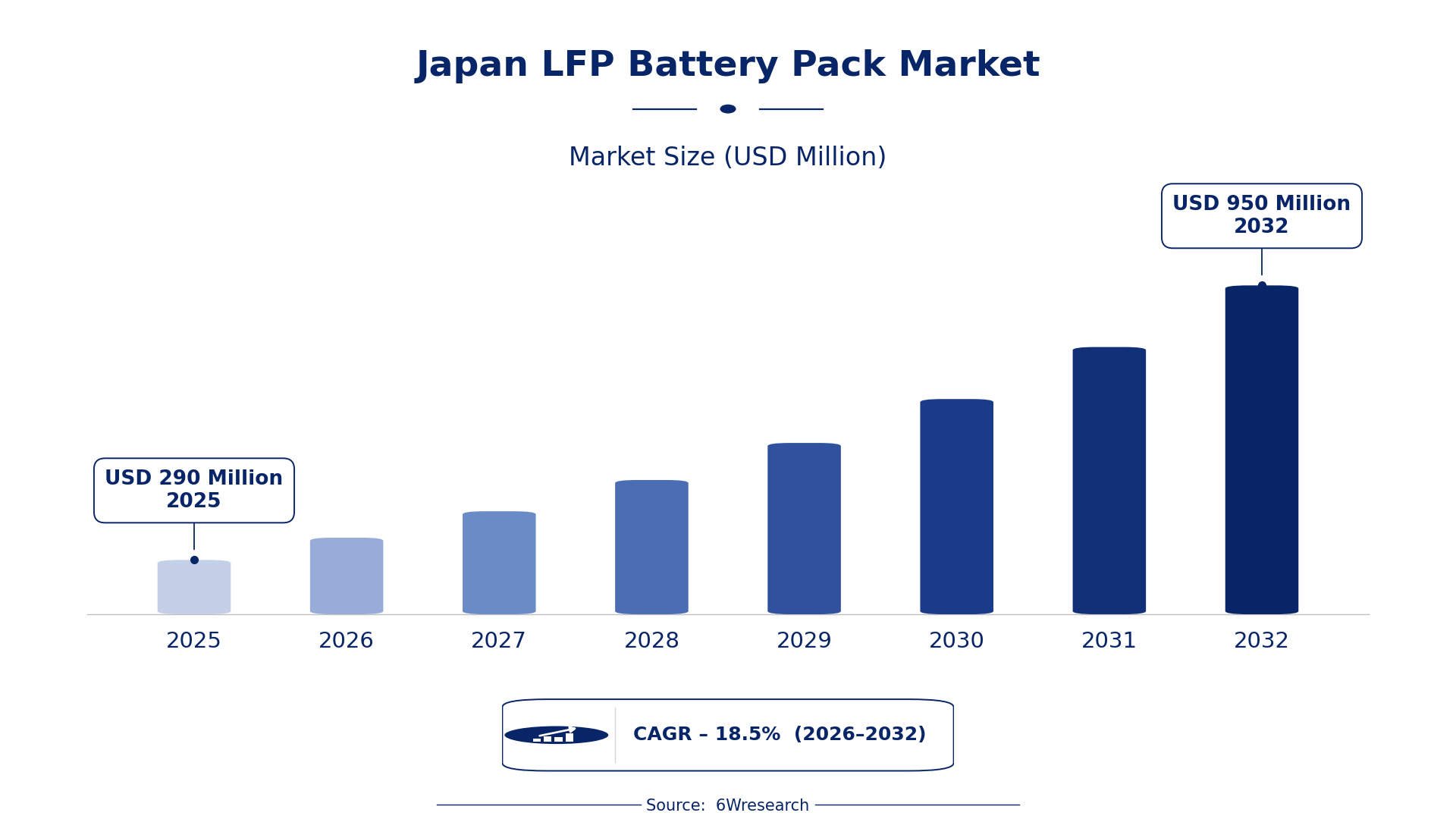
According to 6Wresearch internal database and industry insights, the Japan LFP Battery Pack Market was valued at USD 290 Million in 2025 and is projected to reach USD 950 Million by 2032, growing at a CAGR of approximately 18.5% during 2026–2032.
Japan LFP Battery Pack Market Highlights
| Report Metric | Details |
| Report Name | Japan LFP Battery Pack Market (2026-2032) |
| Market Size 2025 | USD 290 Million |
| Market Size 2032 | USD 950 Million |
| Absolute Growth 2025–2032 | USD 660 Million |
| CAGR 2026–2032 | 18.5% |
| Peak Annual Growth | 19.6% in 2032 |
| Forecast Period | 2026–2032 |
| Historical Data | 2022–2025 |
| Base Year | 2025 |
| Leading Product Type, 2025 | Portable (66% share) |
| Leading Application, 2025 | Automotive (68% share) |
| Leading Vehicle Type, 2025 | Light Commercial Vehicles (40% share) |
| Leading Battery Capacity, 2025 | 40-80 kWh (57% share) |
| Fastest-Growing Product Type | Stationary (19.8% CAGR) |
| Fastest-Growing Application | Renewable Energy Storage (24.9% CAGR) |
| Fastest-Growing Vehicle Type | Medium and Heavy-Duty Trucks (19.6% CAGR) |
| Fastest-Growing Battery Capacity | Above 80 kWh (21.4% CAGR) |
| Growing Sector | Renewable Energy Storage |
| Key End Users | Automotive, Renewable Energy Storage |
Japan LFP Battery Pack Market Year-wise Growth Rate and Key Drivers (2022–2032)
This graph illustrates the annual growth rates of the market from 2022 to 2032, highlighting a steady upward trajectory and projected market expansion over the forecast period.
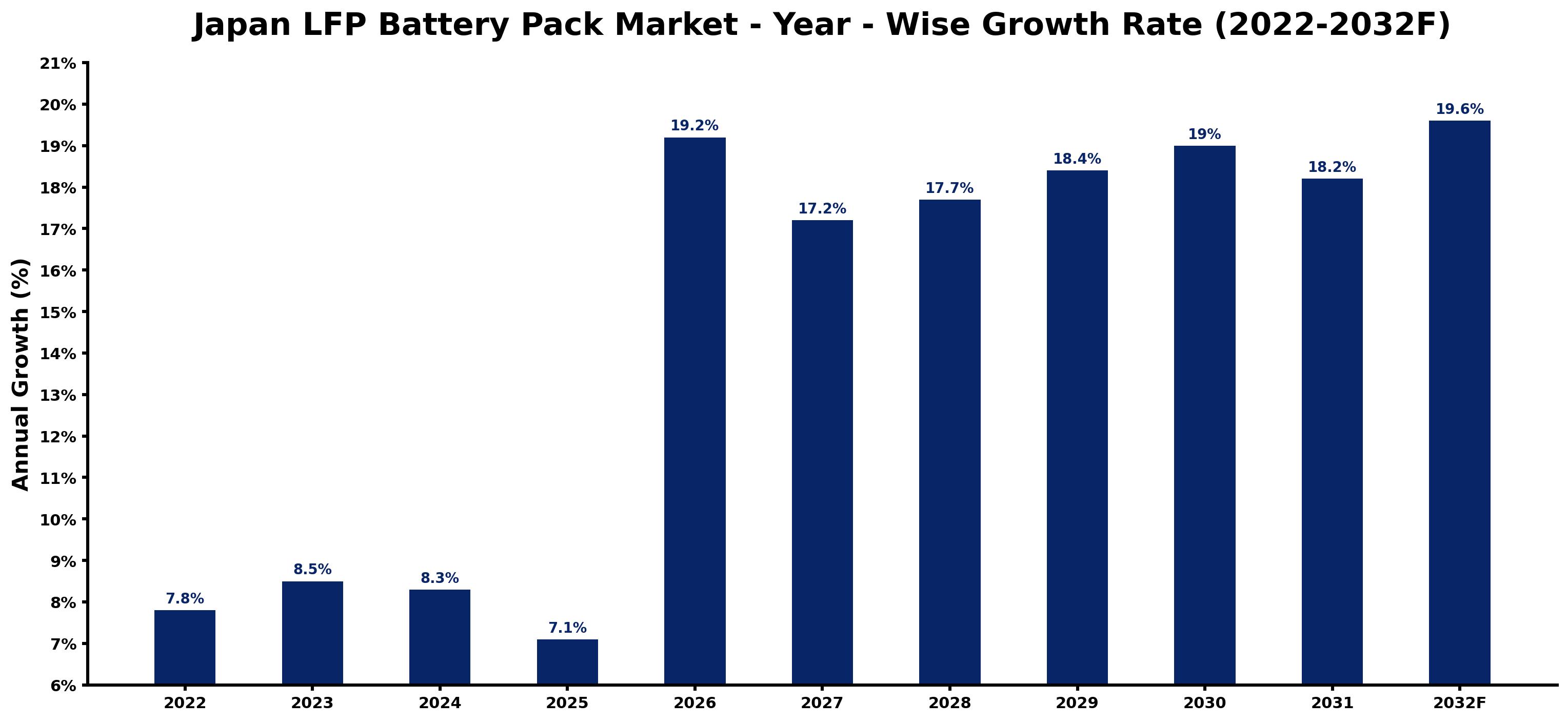
Year by year, the estimates below pair each growth rate with the development that shaped it.
| Year | Estimated Annual Growth (%) | Market Rationale |
| 2022 | 7.8 | The market exhibited steady growth due to increasing electric vehicle adoption. |
| 2023 | 8.5 | Demand surged as electric vehicle registrations rose in urban areas. |
| 2024 | 8.3 | Growth slowed slightly as supply chain issues impacted battery production. |
| 2025 | 7.1 | Market expansion continued but at a reduced pace amid global material shortages. |
| 2026 | 19.2 | The market accelerated as investments in renewable energy storage gained traction. |
| 2027 | 17.2 | Growth moderated as competition intensified among battery technologies. |
| 2028 | 17.7 | Demand increased again with rising electric vehicle sales and infrastructure development. |
| 2029 | 18.4 | The market saw a boost from new government incentives for electric vehicles. |
| 2030 | 19.0 | Growth continued as battery technology improved and production scaled up. |
| 2031 | 18.2 | The market experienced a slight slowdown as saturation in some segments began. |
| 2032 | 19.6 | Demand peaked with a notable rise in electric vehicle models featuring LFP batteries. |
Note: Market size estimations and growth projections presented in this report are based on 6Wresearch's proprietary forecasting methodology, utilizing the latest available industry data, government publications, and primary research inputs.
Japan LFP Battery Pack Market Synopsis
LFP Battery Packs are rechargeable batteries made with lithium iron phosphate, primarily used in electric vehicles and renewable energy storage. The Japan LFP Battery Pack Market is projected to grow, driven by the increasing adoption of electric vehicles, with key factors including the target of 1 million electric vehicles on the road by 2030 and ongoing investment in renewable energy solutions, which boosts the demand for efficient energy storage systems.
Market Dynamics Impact Analysis (2026–2032)
| Factor | Type | Impact | Primary Segment Affected |
| Growing electric vehicle registrations in urban areas | Driver | High | Automotive |
| Increased investments in renewable energy infrastructure | Driver | High | Renewable Energy Storage |
| Expansion of battery recycling facilities | Opportunity | Medium | Stationary |
| Rising demand for energy storage systems in commercial sectors | Opportunity | Medium | Stationary |
| Supply chain disruptions affecting battery materials | Restraint | High | Automotive |
| High production costs of LFP batteries | Restraint | Medium | Automotive |
| Intense competition from alternative battery technologies | Challenge | High | Automotive |
| Regulatory hurdles in battery disposal and recycling | Challenge | Medium | Stationary |
Evaluation of Drivers in Japan LFP Battery Pack Market (2026–2032)
The following drivers explain most of the expected growth.
| Drivers | Primary Segment Affected | Why It Matters (Evidence) |
| Increasing electric vehicle adoption | Automotive | Japan's electric vehicle market is expected to reach 1.5 million units by 2025, driving LFP battery demand. |
| Government decarbonisation investments | Renewable Energy Storage | Japan's GX Basic Policy targets JPY 150 trillion for decarbonisation, increasing energy storage needs. |
| Surge in renewable energy installations | Renewable Energy Storage | The Tokyo metropolitan area has over 500 MW capacity in renewable energy storage as of 2023. |
| Stricter battery safety standards | Automotive | ISO 26262 standards are being adopted, increasing the demand for reliable battery systems. |
| Growing public awareness of sustainability | Automotive | Japan aims for a 46% reduction in greenhouse gas emissions by 2030, boosting electric vehicle usage. |
Orders keep climbing as Japan's electric vehicle market is expected to reach 1.5 million units by 2025, driving demand for LFP batteries. The Tokyo metropolitan area has seen over 500 MW of renewable energy storage capacity installed in 2023, increasing the need for efficient battery systems. Adoption of ISO 26262 standards for automotive safety is also pushing manufacturers to seek reliable battery technologies. Growing public awareness of sustainability, as Japan aims for a 46% reduction in greenhouse gas emissions by 2030, leads to more electric vehicle purchases.
Evaluation of Restraints in Japan LFP Battery Pack Market
The main factors holding the market back are set out below.
| Market Restraint | Primary Segment Affected | Why It Matters (Evidence) |
| Regulatory hurdles for new battery technologies | Automotive | Japan's regulatory framework complicates the approval process for new battery technologies, causing delays that can extend project timelines by up to 12 months for producers. |
| Skilled worker shortages in battery manufacturing | Renewable Energy Storage | A shortage of skilled workers in battery manufacturing hampers production efficiency, causing suppliers to miss delivery deadlines. |
| Supply chain disruptions for raw materials | Automotive | Supply chain disruptions for raw materials, particularly lithium and phosphate, can inflate costs by 15% for manufacturers. |
| Technological investment requirements | Renewable Energy Storage | Technological advancements in battery systems require continuous investment, straining budgets for energy storage providers. |
| Market saturation in certain segments | Automotive | Increasing competition and market saturation in some segments can limit growth opportunities for new entrants. |
Japan LFP Battery Pack Market Challenges
Japan's complex regulatory environment results in lengthy approval processes for new battery technologies, delaying product launches by up to 12 months for producers. A shortage of skilled technicians in battery manufacturing creates production inefficiencies, leading to potential revenue losses of around 15% for suppliers unable to meet demand. Disruptions in the raw material supply chain for lithium and phosphate can inflate costs by 15%, forcing manufacturers to raise prices and impacting buyers' budgets. Rapid technological advancements require heavy investments, straining resources for energy storage providers and limiting their ability to adopt new solutions.
Trends in the Japan LFP Battery Pack Market
The following changes are redrawing the Japan LFP Battery Pack Market.
- Shift Towards Renewable Energy Storage Solutions: The 'Green Growth Strategy' initiated in 2023 promotes renewable energy storage installations, with over 500 MW capacity in the Tokyo metropolitan area. This trend is driving demand for LFP batteries among energy storage providers.
- Transition from Traditional to Electric Vehicles: By 2030, Japan aims to have 1 million electric vehicles on the road, increasing the demand for LFP battery packs. This shift is evident in the automotive sector's growing focus on electric models.
- Increased Adoption of Safety Standards: The adoption of ISO 26262 standards for battery safety began in 2023, ensuring higher safety levels in battery systems. This change is influencing manufacturers to invest in compliant technologies.
- Emergence of Larger Battery Capacities: The demand for above 80 kWh battery packs is rising, with a CAGR of 21.4% projected from 2026 to 2032. This trend is driven by the need for larger energy storage in electric vehicles.
Investment Opportunities in the Japan LFP Battery Pack Market
Where to invest in the Japan LFP Battery Pack Market: the main openings are set out below.
- Partnerships for Battery Technology Development: Local partnerships are essential for developing advanced LFP battery technologies, with Japan's GX Basic Policy targeting JPY 150 trillion in decarbonisation investments over 10 years. Collaborating with research institutions can boost innovation.
- Investment in Energy Storage Facilities: With the installed base of energy storage systems expected to reach 3.5 GWh by 2025, investing in energy storage facilities presents a lucrative opportunity for suppliers. Targeting regions with high renewable energy capacity can yield significant returns.
- Expansion into Electric Vehicle Market: The electric vehicle market in Japan is projected to reach 1.5 million units by 2025, creating a demand for LFP batteries. Suppliers can enter this market by forming joint ventures with local automotive manufacturers.
- Certification for Renewable Energy Solutions: Obtaining certification for renewable energy storage solutions can improve market access. The Ministry of the Environment supports LFP battery research with a budget of ¥5 billion for 2023, providing funding opportunities.
Government Initiatives in the Japan LFP Battery Pack Market
The Economic Security Promotion Act (2022) supports supply-chain resilience for critical products, including LFP batteries, by encouraging local production and reducing dependency on imports. This measure aims to secure the supply chain for battery materials and components, facilitating smoother operations for producers.
The Ministry of the Environment allocates ¥5 billion in 2023 to support research and development in battery technologies. This funding aids manufacturers in improving their product offerings and ensures compliance with safety standards, benefiting buyers seeking reliable solutions.
Future Insight of the Japan LFP Battery Pack Market
Investment in decarbonisation initiatives, projected at ¥150 trillion over the next decade, will drive demand for LFP battery packs. By 2032, the electric vehicle market is expected to see 1.5 million units on the road, significantly increasing the need for reliable energy storage solutions. The implementation of ISO 26262 standards will enhance safety and reliability, encouraging buyers to invest in LFP technology. As the installed base of energy storage systems is anticipated to reach 3.5 GWh by 2025, suppliers will benefit from a market increasingly prioritising renewable energy integration.
Market Segmentation Analysis
Japan LFP Battery Pack Market report covers a detailed analysis of the following market segments:
By Product Type – Portable Leads, Stationary Expected to Grow Fastest
According to Sachin Kumar Rai, Senior Research Analyst at 6Wresearch, with 66% of product type revenue in 2025, Portable was the largest category. The portable segment holds the largest share as it caters to a wide range of consumer electronics, particularly smartphones and tablets, which are essential in everyday life. The substantial volume of portable device sales in Japan underpins this segment's dominance. Over 2026–2032, Stationary is expected to post the fastest growth, at a CAGR of 19.8%. The stationary segment is experiencing rapid growth driven by the increasing installation of energy storage systems, particularly in the Tokyo metropolitan area, which has over 500 MW capacity in 2023. This trend is supported by Japan's commitment to integrating renewable energy and achieving energy self-sufficiency. Suppliers should focus on enhancing their offerings in stationary applications to capitalise on the growing market for energy storage solutions.
By Application – Automotive Leads, Renewable Energy Storage Expected to Grow Fastest
In 2025, Automotive led the application split with a 68% share. The automotive application leads the market as LFP batteries are widely used in electric vehicles, which are projected to reach 1.5 million units by 2025 in Japan. The government's target of 1 million electric vehicles on the road by 2030 further solidifies this segment's dominance. The quickest growth will come from Renewable Energy Storage, forecast to expand at a CAGR of 24.9% between 2026 and 2032. Renewable energy storage is the fastest-growing application, driven by Japan's aim to increase its renewable energy share to 36-38% by 2030. The surge in installations of energy storage systems reflects the urgent need to store energy from renewable sources like solar and wind. Buyers in the renewable energy sector should consider investing in LFP battery technology to meet future energy storage demands.
By Vehicle Type – Light Commercial Vehicles Lead, Medium and Heavy-Duty Trucks Expected to Grow Fastest
Light Commercial Vehicles took 40% of vehicle type revenue in 2025, more than any other category. Light commercial vehicles dominate the market as they increasingly adopt LFP batteries for their reliability and safety in various applications. The segment benefits from the rising adoption of electric light commercial vehicles, reflecting Japan's automotive trends. Medium and Heavy-Duty Trucks are projected to grow fastest, at a CAGR of 19.6% during 2026–2032. Medium and heavy-duty trucks are witnessing the fastest growth due to their adoption of LFP batteries, which offer improved efficiency and performance for electric logistics. The focus on reducing emissions in the transportation sector is propelling this segment's rapid expansion. Suppliers should prioritise developing LFP battery solutions tailored for medium and heavy-duty trucks to leverage this growth opportunity.
By Battery Capacity – 40-80 kWh Leads, Above 80 kWh Expected to Grow Fastest
40-80 kWh accounted for 57% of the market by battery capacity in 2025. The 40-80 kWh capacity range leads the market as it is commonly used in many electric vehicles, aligning well with the specifications of current models in Japan. This capacity range is particularly suitable for light commercial vehicles that require a balanced energy supply. Above 80 kWh is set to record the highest CAGR in this split, 21.4% over 2026–2032. Above 80 kWh is the fastest-growing capacity segment, driven by the increasing demand for larger vehicles that require more energy for extended ranges. This trend is underscored by manufacturers' efforts to produce electric trucks and larger electric vehicles. Suppliers must enhance their production capabilities for higher capacity batteries to meet the demands of the evolving electric vehicle market.
Key Attractiveness of the Report
- 10 Years of Market Numbers
- Historical Data Starting from 2022 to 2025
- Base Year 2025
- Forecast Data until 2032
- Key Performance Indicators Impacting the Market
- Major Upcoming Developments and Projects
Key Highlights of the Report:
- Japan LFP Battery Pack Market Outlook
- Market Size of Japan LFP Battery Pack Market,2025
- Forecast of Japan LFP Battery Pack Market, 2032
- Historical Data and Forecast of Japan LFP Battery Pack Revenues & Volume for the Period 2022-2032
- Japan LFP Battery Pack Market Trend Evolution
- Japan LFP Battery Pack Market Drivers and Challenges
- Japan LFP Battery Pack Price Trends
- Japan LFP Battery Pack Porter's Five Forces
- Japan LFP Battery Pack Industry Life Cycle
- Historical Data and Forecast of Japan LFP Battery Pack Market Revenues & Volume By Product Type for the Period 2022-2032
- Historical Data and Forecast of Japan LFP Battery Pack Market Revenues & Volume By Portable for the Period 2022-2032
- Historical Data and Forecast of Japan LFP Battery Pack Market Revenues & Volume By Stationary for the Period 2022-2032
- Historical Data and Forecast of Japan LFP Battery Pack Market Revenues & Volume By Application for the Period 2022-2032
- Historical Data and Forecast of Japan LFP Battery Pack Market Revenues & Volume By Automotive for the Period 2022-2032
- Historical Data and Forecast of Japan LFP Battery Pack Market Revenues & Volume By Renewable Energy Storage for the Period 2022-2032
- Historical Data and Forecast of Japan LFP Battery Pack Market Revenues & Volume By Vehicle Type for the Period 2022-2032
- Historical Data and Forecast of Japan LFP Battery Pack Market Revenues & Volume By Light Commercial Vehicles for the Period 2022-2032
- Historical Data and Forecast of Japan LFP Battery Pack Market Revenues & Volume By Medium and Heavy-Duty Trucks for the Period 2022-2032
- Historical Data and Forecast of Japan LFP Battery Pack Market Revenues & Volume By Passenger Vehicles for the Period 2022-2032
- Historical Data and Forecast of Japan LFP Battery Pack Market Revenues & Volume By Battery Capacity for the Period 2022-2032
- Historical Data and Forecast of Japan LFP Battery Pack Market Revenues & Volume By 40-80 kWh for the Period 2022-2032
- Historical Data and Forecast of Japan LFP Battery Pack Market Revenues & Volume By Above 80 kWh for the Period 2022-2032
- Historical Data and Forecast of Japan LFP Battery Pack Market Revenues & Volume By Below 40 kWh for the Period 2022-2032
- Japan LFP Battery Pack Import Export Trade Statistics
- Market Opportunity Assessment By Product Type
- Market Opportunity Assessment By Application
- Market Opportunity Assessment By Vehicle Type
- Market Opportunity Assessment By Battery Capacity
- Japan LFP Battery Pack Top Companies Market Share
- Japan LFP Battery Pack Competitive Benchmarking By Technical and Operational Parameters
- Japan LFP Battery Pack Company Profiles
- Japan LFP Battery Pack Key Strategic Recommendations
Market Covered
The report covers the following segments.
By Product Type
- Portable
- Stationary
By Application
- Automotive
- Renewable Energy Storage
By Vehicle Type
- Light Commercial Vehicles
- Medium and Heavy-Duty Trucks
- Passenger Vehicles
By Battery Capacity
- 40-80 kWh
- Above 80 kWh
- Below 40 kWh






































