Japan Lithium-Ion Battery Separator Market Size & Growth Rate
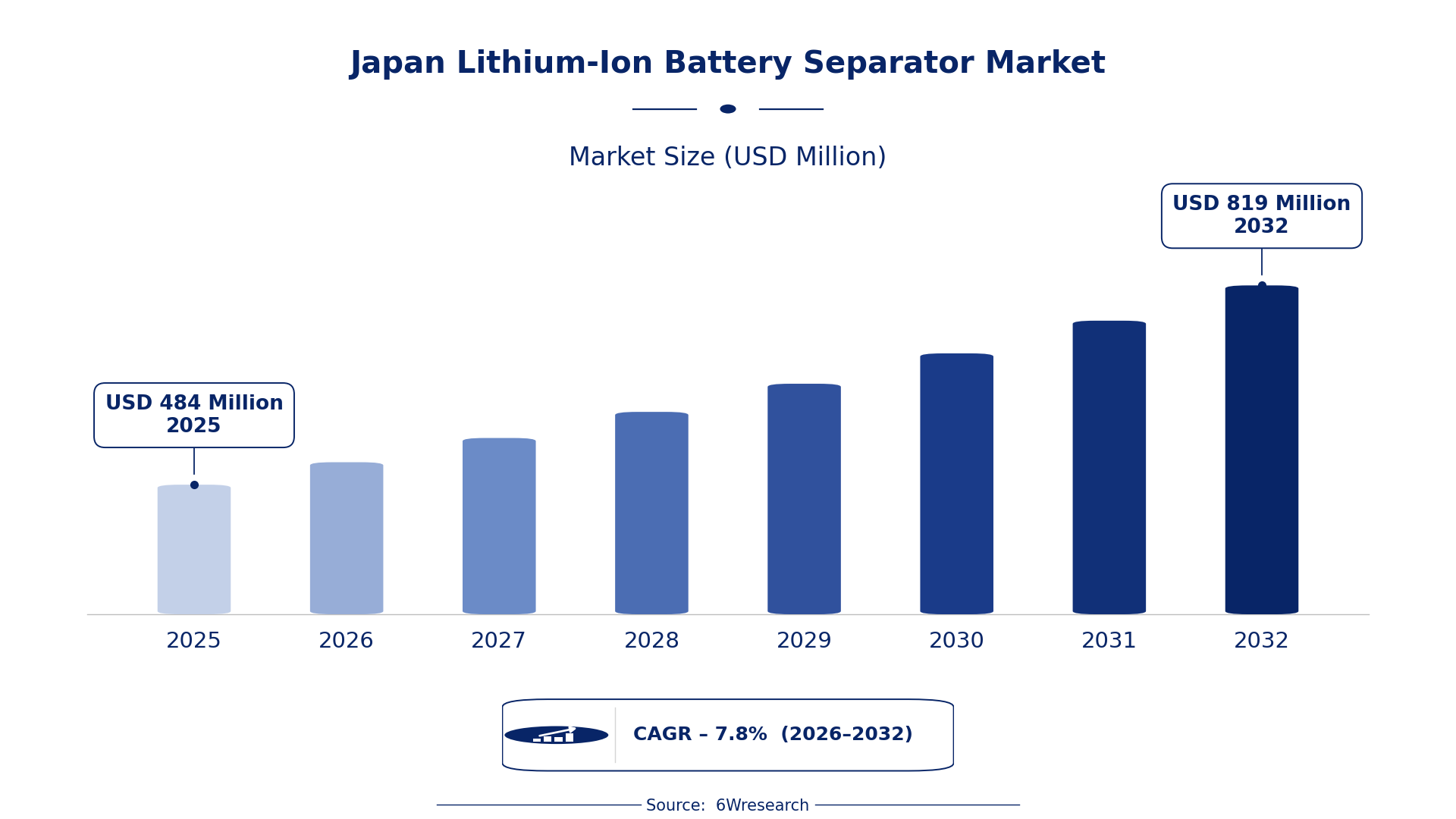
According to 6Wresearch internal database and industry insights, the Japan Lithium-Ion Battery Separator Market was valued at USD 484 Million in 2025 and is projected to reach USD 819 Million by 2032, growing at a CAGR of approximately 7.8% during 2026–2032.
Japan Lithium-Ion Battery Separator Market Highlights
| Report Metric | Details |
| Report Name | Japan Lithium-Ion Battery Separator Market (2026-2032) |
| Market Size 2025 | USD 484 Million |
| Market Size 2032 | USD 819 Million |
| Absolute Growth 2025–2032 | USD 335 Million |
| CAGR 2026–2032 | 7.8% |
| Peak Annual Growth | 9.6% in 2026 |
| Forecast Period | 2026–2032 |
| Historical Data | 2022–2025 |
| Base Year | 2025 |
| Leading Technology Type, 2025 | Polyethylene (35% share) |
| Leading Application, 2025 | Electric Vehicles (43% share) |
| Leading End User, 2025 | Automotive Manufacturers (44% share) |
| Leading Product Type, 2025 | Microporous Films (41% share) |
| Fastest-Growing Technology Type | Ceramic-coated (10.6% CAGR) |
| Fastest-Growing Application | Energy Storage Systems (10.2% CAGR) |
| Fastest-Growing End User | Energy Companies (9.8% CAGR) |
| Fastest-Growing Product Type | Composite Separators (11.0% CAGR) |
| Growing Sector | Electric Vehicles |
| Key End Users | Automotive Manufacturers, Electronics Producers, Energy Companies |
Japan Lithium-Ion Battery Separator Market Year-wise Growth Rate and Key Drivers (2022–2032)
This graph illustrates the annual growth rates of the market from 2022 to 2032, highlighting a steady upward trajectory and projected market expansion over the forecast period.
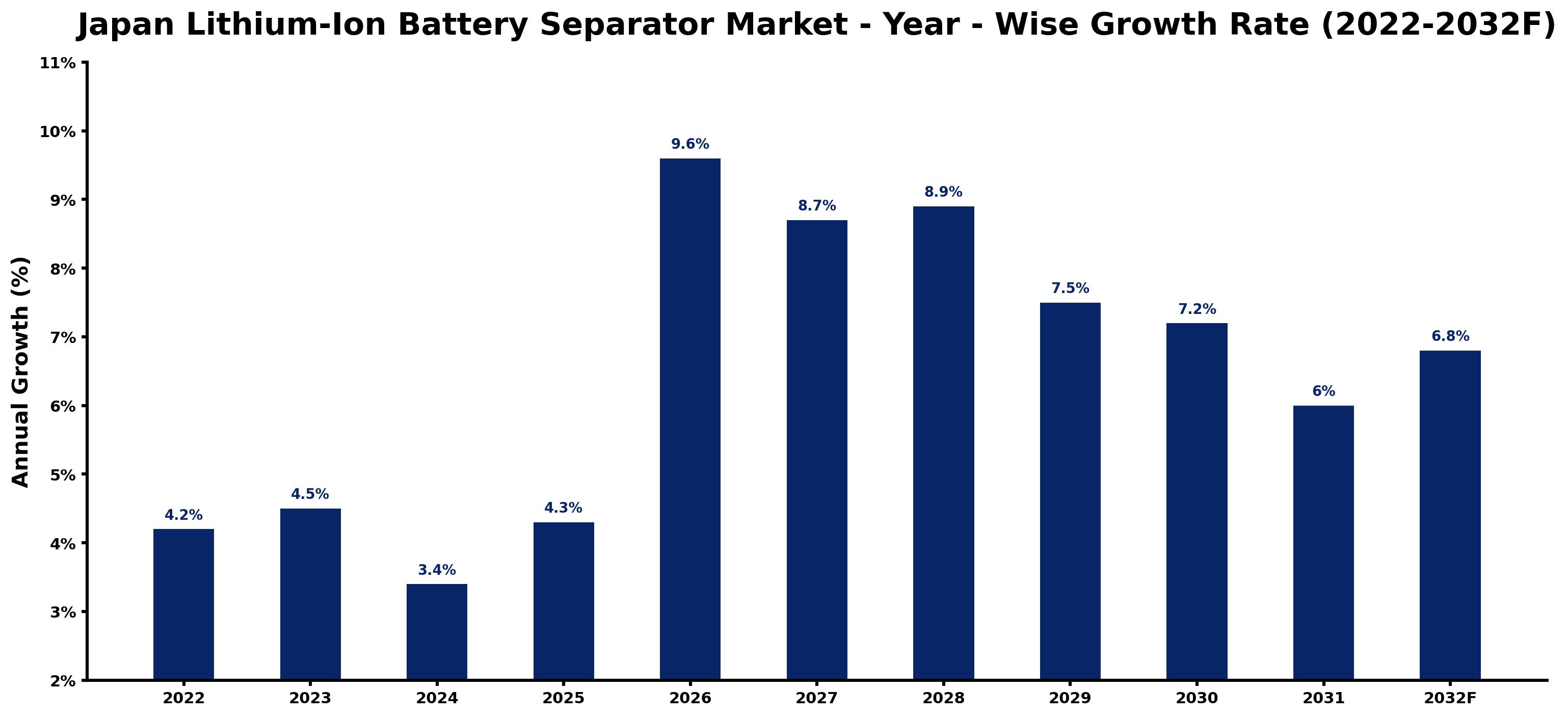
Each row of the following table gives one year's estimated growth and the event or demand shift that explains it.
| Year | Estimated Annual Growth (%) | Market Rationale |
| 2022 | 4.2 | The market experienced steady growth due to increasing demand from the automotive sector. |
| 2023 | 4.5 | Demand rose as automotive manufacturers expanded electric vehicle production capabilities. |
| 2024 | 3.4 | Growth slowed as manufacturers adjusted to supply chain challenges and market saturation. |
| 2025 | 4.3 | The market rebounded with renewed investments in battery technology and production. |
| 2026 | 9.6 | Demand surged as electric vehicle adoption accelerated across the country. |
| 2027 | 8.7 | Growth moderated as manufacturers faced increased competition and market adjustments. |
| 2028 | 8.9 | Demand increased again as energy storage systems gained traction in residential applications. |
| 2029 | 7.5 | Growth slowed as the market matured and competition intensified among suppliers. |
| 2030 | 7.2 | Demand continued to rise, driven by government incentives for renewable energy integration. |
| 2031 | 6.0 | Growth moderated as the market stabilised and production capacities reached maturity. |
| 2032 | 6.8 | Demand is expected to increase due to rising electric vehicle sales and energy storage needs. |
Note: Market size estimations and growth projections presented in this report are based on 6Wresearch's proprietary forecasting methodology, utilizing the latest available industry data, government publications, and primary research inputs.
Japan Lithium-Ion Battery Separator Market Synopsis
Lithium-Ion Battery Separators are critical components in lithium-ion batteries, made from materials like polyethylene and polypropylene. They prevent short-circuiting while allowing lithium ions to pass through, primarily used in electric vehicles, consumer electronics, and energy storage systems. The Japan Lithium-Ion Battery Separator Market is expanding, driven by automotive demand, which accounts for over 40% of lithium-ion battery usage. Investments in battery technology and a focus on renewable energy integration further stimulate market growth, with the government targeting substantial decarbonisation investments over the next decade.
Market Dynamics Impact Analysis (2026–2032)
| Factor | Type | Impact | Primary Segment Affected |
| Growing demand for electric vehicles drives the need for high-performance battery separators. | Driver | High | Electric Vehicles |
| Technological advancements in battery manufacturing enhance separator performance and safety. | Driver | High | Microporous Films |
| Increasing investments in energy storage systems create demand for reliable battery separators. | Opportunity | High | Energy Storage Systems |
| The push for decarbonisation opens avenues for innovative battery technologies. | Opportunity | High | Composite Separators |
| Supply chain disruptions impact the availability of raw materials for separator production. | Restraint | Medium | Polypropylene |
| High production costs limit the competitiveness of domestic manufacturers. | Restraint | Medium | Ceramic-coated |
| Talent shortages in advanced manufacturing affect production capabilities. | Challenge | High | Microporous Films |
| Technological obsolescence risks existing manufacturing processes and products. | Challenge | Medium | Polyethylene |
Evaluation of Drivers in Japan Lithium-Ion Battery Separator Market (2026–2032)
Key forces behind demand, with the segment each one moves most, are listed below.
| Drivers | Primary Segment Affected | Why It Matters (Evidence) |
| Rising electric vehicle production increases demand for battery separators. | Electric Vehicles | The automotive sector accounts for over 40% of lithium-ion battery demand, driving separator purchases. |
| Technological advancements improve separator performance and safety. | Microporous Films | Innovations in materials increase ionic conductivity, leading to higher demand from electronics producers. |
| Growing energy storage market boosts separator requirements for batteries. | Energy Storage Systems | The total installed capacity for energy storage systems reached 1.2 GW in 2023, increasing separator needs. |
| Government initiatives promote decarbonisation and renewable energy integration. | Composite Separators | Japan targets a 46% cut in greenhouse-gas emissions by 2030, increasing demand for advanced battery technologies. |
| Increased consumer electronics production raises separator demand. | Consumer Electronics | Tokyo is a major hub for electronics, influencing battery separator consumption. |
Most of the extra volume comes from rising electric vehicle production, which increases the demand for battery separators. The automotive sector, accounting for over 40% of lithium-ion battery demand, drives purchases as manufacturers expand electric vehicle capabilities. Advancements in materials improve separator performance, resulting in heightened demand from electronics producers. The energy storage market also boosts requirements, with total installed capacity reaching 1.2 GW in 2023.
Evaluation of Restraints in Japan Lithium-Ion Battery Separator Market
The key brakes on demand, and where they bite hardest, are shown below.
| Market Restraint | Primary Segment Affected | Why It Matters (Evidence) |
| Supply chain disruptions hinder the availability of key raw materials for production. | Polypropylene | Supply chain issues have affected the availability of polypropylene, essential for separator manufacturing. |
| High production costs limit competitiveness in the domestic market. | Ceramic-coated | Rising costs of advanced materials impact the pricing strategies of ceramic-coated separators. |
| Regulatory compliance increases operational costs for manufacturers. | Microporous Films | Manufacturers face stringent quality standards, raising production costs and affecting pricing. |
| Limited skilled workforce hampers production capabilities. | Polyethylene | A shortage of skilled labour in advanced manufacturing affects production efficiency and output. |
| Market saturation leads to increased competition among suppliers. | Composite Separators | As the market matures, competition intensifies, impacting profit margins for suppliers. |
Japan Lithium-Ion Battery Separator Market Challenges
Japan's production of lithium-ion batteries reached approximately 1.5 million units in 2022, but rising raw material costs have increased production expenses by 15%, straining manufacturers. Supply chain disruptions have delayed deliveries of essential components, impacting production schedules for local electronics producers. Many suppliers face challenges in adopting new technologies, as the shift to composite separators necessitates significant investment, hindering innovation. Regulatory hurdles complicate compliance processes, resulting in extended timeframes for new product approvals, which can delay market entry for manufacturers by up to six months.
Trends in the Japan Lithium-Ion Battery Separator Market
Four trends stand out in the Japan Lithium-Ion Battery Separator Market.
- Shift from Traditional to Advanced Battery Technologies: Tokyo is experiencing a shift towards advanced battery technologies, with the government allocating ¥10 billion in 2023 for research into new solutions. This trend is improving the performance and safety of lithium-ion batteries, benefiting manufacturers and consumers.
- Transition from Single to Multi-layered Separators: The demand for multi-layered separators is increasing, with a projected CAGR of 10.6% in the coming years. This shift is motivated by the need for improved performance and safety in high-energy applications, particularly in electric vehicles.
- Emergence of Composite Separators in High-Performance Applications: Composite separators are gaining traction in Japan, with their market share expected to grow. This trend is supported by the automotive sector's push for enhanced battery performance, resulting in increased adoption in electric vehicles.
- Growing Demand for Energy Storage Solutions: Energy companies are increasingly investing in energy storage solutions, with total installed capacity reaching 1.2 GW in 2023. This trend reflects the rising need for reliable battery separators to support renewable energy integration.
Investment Opportunities in the Japan Lithium-Ion Battery Separator Market
Investors looking at the Japan Lithium-Ion Battery Separator Market should consider the following areas.
- Investment in Advanced Manufacturing Facilities: Tokyo is a key location for investment in advanced manufacturing facilities for battery separators. The market gap is clear, with a projected growth of 10.6% for ceramic-coated separators, indicating a need for suppliers to establish local partnerships.
- Expansion of Energy Storage Systems: The energy storage market is set to grow, supported by government incentives. With over 50% of energy storage systems deployed in residential applications, suppliers should focus on developing tailored solutions for this sector.
- Increased Demand from Automotive Sector: Automotive manufacturers are rapidly adopting electric vehicle technologies, with an expected investment of ¥1 trillion by 2025. Suppliers should align their offerings with the evolving needs of this buyer group to capture market share.
- Development of Sustainable Battery Solutions: There is a growing opportunity for suppliers to develop sustainable battery solutions, particularly in light of Japan's target for net zero emissions by 2050. Engaging with local manufacturers to create eco-friendly products can enhance market presence.
Government Initiatives in the Japan Lithium-Ion Battery Separator Market
The Economic Security Promotion Act (2022) supports supply-chain resilience for critical products, including battery separators. This measure encourages manufacturers to invest in local production capabilities, ensuring a steady supply of essential materials for production, which is vital for meeting the increasing needs in the automotive and electronics sectors.
The Battery Industry Strategy overseen by the Ministry of Economy, Trade and Industry promotes investment in advanced battery technologies, ensuring that producers meet the rising demand for lithium-ion battery separators. The strategy targets 150 GWh of domestic battery manufacturing capacity by 2030.
Future Insight of the Japan Lithium-Ion Battery Separator Market
Battery manufacturers will increasingly embrace advanced technologies by 2032, driven by government incentives and a ¥10 billion investment in research for battery innovations. The automotive sector will transform with a projected ¥1 trillion investment in electric vehicle technology by 2025, creating demand for high-performance separators. Energy storage systems will grow, with residential applications expected to dominate due to supportive government policies. Enhanced recycling programs will promote sustainability practices within the industry, ensuring a more circular economy.
Market Segmentation Analysis
Japan Lithium-Ion Battery Separator Market report covers a detailed analysis of the following market segments:
By Technology Type – Polyethylene Leads, Ceramic-coated Expected to Grow Fastest
According to Sachin Kumar Rai, Senior Research Analyst at 6Wresearch, the largest technology type category in 2025 was Polyethylene, at 35% of revenue. Polyethylene holds the largest share due to its widespread use in battery separators, attributed to its excellent dielectric properties. Its significant application in the automotive sector, which represents over 40% of lithium-ion battery demand, solidifies its leading position. Ceramic-coated is set to record the highest CAGR in this split, 10.6% over 2026–2032. Ceramic-coated separators are growing rapidly because they enhance safety and performance in high-energy applications. The automotive industry's substantial investment in electric vehicle technology is a key factor driving this demand. Suppliers should focus on advancing ceramic-coated technologies to capitalise on this growth potential.
By Application – Electric Vehicles Lead, Energy Storage Systems Expected to Grow Fastest
In 2025, Electric Vehicles led the application split with a 43% share. Electric Vehicles dominate the market as they are critical for battery performance, with Japan's automotive industry investing heavily in electric vehicle technology. This segment benefits from the government's commitment to decarbonisation and sustainable transport. Energy Storage Systems are projected to grow fastest, at a CAGR of 10.2% during 2026–2032. Energy Storage Systems are growing quickly due to increasing demand for renewable energy integration and grid stability. The total installed capacity for energy storage systems in Japan reached 1.2 GW in 2023, highlighting this trend. Buyers in the energy sector should consider investing in battery separators tailored for energy storage to meet future demands.
By End User – Automotive Manufacturers Lead, Energy Companies Expected to Grow Fastest
Automotive Manufacturers accounted for 44% of the market by end user in 2025. Automotive Manufacturers represent the largest share as they are major consumers of battery separators for electric and hybrid vehicles. The automotive sector's substantial investment in electric vehicle technology underpins this demand. The quickest growth will come from Energy Companies, forecast to expand at a CAGR of 9.8% between 2026 and 2032. Energy Companies are the fastest-growing segment as they increasingly adopt battery separators for energy storage solutions related to renewable energy. The government's incentives for renewable energy are further propelling this growth. Suppliers need to engage with energy companies to provide tailored solutions that support renewable energy initiatives.
By Product Type – Microporous Films Lead, Composite Separators Expected to Grow Fastest
Microporous Films took 41% of product type revenue in 2025, more than any other category. Microporous Films lead the market owing to their high ionic conductivity and safety features, making them a preferred choice for battery separators. Their extensive application in electric vehicles further reinforces their dominant position. Over 2026–2032, Composite Separators are expected to post the fastest growth, at a CAGR of 11.0%. Composite Separators are experiencing rapid growth as they provide enhanced performance in batteries, particularly for high-performance applications. This trend is in line with the automotive sector's increasing emphasis on advanced battery technologies. Manufacturers need to invest in research and development for composite separator technologies to meet the rising performance demands.
Key Attractiveness of the Report
- 10 Years of Market Numbers
- Historical Data Starting from 2022 to 2025
- Base Year 2025
- Forecast Data until 2032
- Key Performance Indicators Impacting the Market
- Major Upcoming Developments and Projects
Key Highlights of the Report:
- Japan Lithium-Ion Battery Separator Market Outlook
- Market Size of Japan Lithium-Ion Battery Separator Market,2025
- Forecast of Japan Lithium-Ion Battery Separator Market, 2032
- Historical Data and Forecast of Japan Lithium-Ion Battery Separator Revenues & Volume for the Period 2022-2032
- Japan Lithium-Ion Battery Separator Market Trend Evolution
- Japan Lithium-Ion Battery Separator Market Drivers and Challenges
- Japan Lithium-Ion Battery Separator Price Trends
- Japan Lithium-Ion Battery Separator Porter's Five Forces
- Japan Lithium-Ion Battery Separator Industry Life Cycle
- Historical Data and Forecast of Japan Lithium-Ion Battery Separator Market Revenues & Volume By Technology Type for the Period 2022-2032
- Historical Data and Forecast of Japan Lithium-Ion Battery Separator Market Revenues & Volume By Polyethylene for the Period 2022-2032
- Historical Data and Forecast of Japan Lithium-Ion Battery Separator Market Revenues & Volume By Polypropylene for the Period 2022-2032
- Historical Data and Forecast of Japan Lithium-Ion Battery Separator Market Revenues & Volume By Ceramic-coated for the Period 2022-2032
- Historical Data and Forecast of Japan Lithium-Ion Battery Separator Market Revenues & Volume By Nonwoven for the Period 2022-2032
- Historical Data and Forecast of Japan Lithium-Ion Battery Separator Market Revenues & Volume By Multi-layered for the Period 2022-2032
- Historical Data and Forecast of Japan Lithium-Ion Battery Separator Market Revenues & Volume By Application for the Period 2022-2032
- Historical Data and Forecast of Japan Lithium-Ion Battery Separator Market Revenues & Volume By Electric Vehicles for the Period 2022-2032
- Historical Data and Forecast of Japan Lithium-Ion Battery Separator Market Revenues & Volume By Consumer Electronics for the Period 2022-2032
- Historical Data and Forecast of Japan Lithium-Ion Battery Separator Market Revenues & Volume By Energy Storage Systems for the Period 2022-2032
- Historical Data and Forecast of Japan Lithium-Ion Battery Separator Market Revenues & Volume By Power Tools for the Period 2022-2032
- Historical Data and Forecast of Japan Lithium-Ion Battery Separator Market Revenues & Volume By Medical Devices for the Period 2022-2032
- Historical Data and Forecast of Japan Lithium-Ion Battery Separator Market Revenues & Volume By End User for the Period 2022-2032
- Historical Data and Forecast of Japan Lithium-Ion Battery Separator Market Revenues & Volume By Automotive Manufacturers for the Period 2022-2032
- Historical Data and Forecast of Japan Lithium-Ion Battery Separator Market Revenues & Volume By Electronics Producers for the Period 2022-2032
- Historical Data and Forecast of Japan Lithium-Ion Battery Separator Market Revenues & Volume By Energy Companies for the Period 2022-2032
- Historical Data and Forecast of Japan Lithium-Ion Battery Separator Market Revenues & Volume By Tool Manufacturers for the Period 2022-2032
- Historical Data and Forecast of Japan Lithium-Ion Battery Separator Market Revenues & Volume By Medical Equipment Producers for the Period 2022-2032
- Historical Data and Forecast of Japan Lithium-Ion Battery Separator Market Revenues & Volume By Product Type for the Period 2022-2032
- Historical Data and Forecast of Japan Lithium-Ion Battery Separator Market Revenues & Volume By Microporous Films for the Period 2022-2032
- Historical Data and Forecast of Japan Lithium-Ion Battery Separator Market Revenues & Volume By Nonwoven Fabrics for the Period 2022-2032
- Historical Data and Forecast of Japan Lithium-Ion Battery Separator Market Revenues & Volume By Composite Separators for the Period 2022-2032
- Historical Data and Forecast of Japan Lithium-Ion Battery Separator Market Revenues & Volume By Fiber-based Separators for the Period 2022-2032
- Historical Data and Forecast of Japan Lithium-Ion Battery Separator Market Revenues & Volume By Laminated Separators for the Period 2022-2032
- Japan Lithium-Ion Battery Separator Import Export Trade Statistics
- Market Opportunity Assessment By Technology Type
- Market Opportunity Assessment By Application
- Market Opportunity Assessment By End User
- Market Opportunity Assessment By Product Type
- Japan Lithium-Ion Battery Separator Top Companies Market Share
- Japan Lithium-Ion Battery Separator Competitive Benchmarking By Technical and Operational Parameters
- Japan Lithium-Ion Battery Separator Company Profiles
- Japan Lithium-Ion Battery Separator Key Strategic Recommendations
Market Covered
The report covers the following segments.
By Technology Type
- Polyethylene
- Polypropylene
- Ceramic-coated
- Nonwoven
- Multi-layered
By Application
- Electric Vehicles
- Consumer Electronics
- Energy Storage Systems
- Power Tools
- Medical Devices
By End User
- Automotive Manufacturers
- Electronics Producers
- Energy Companies
- Tool Manufacturers
- Medical Equipment Producers
By Product Type
- Microporous Films
- Nonwoven Fabrics
- Composite Separators
- Fiber-based Separators
- Laminated Separators































