Japan Livestock and Aquatic Additives Market Size & Growth Rate
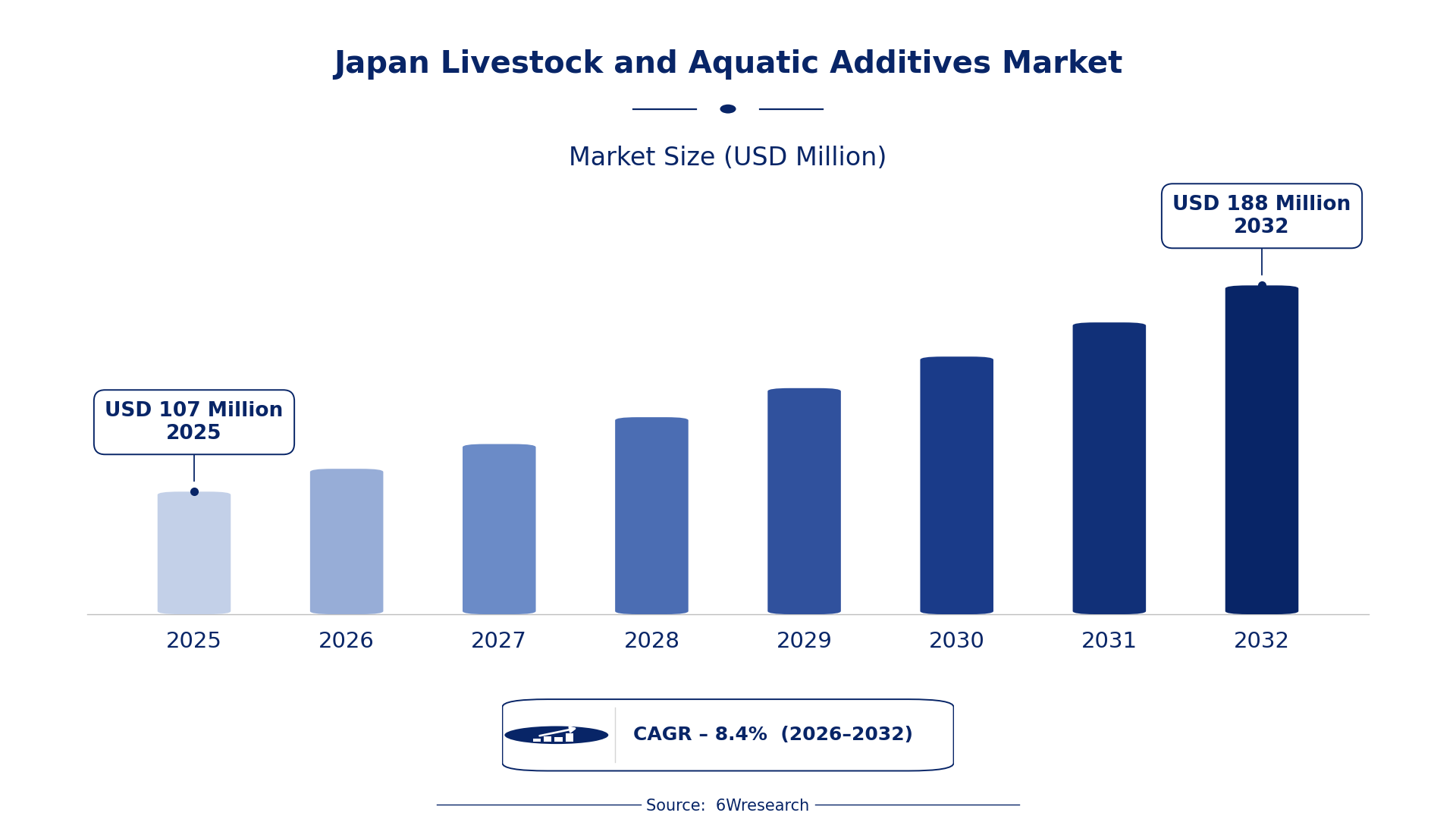
According to 6Wresearch internal database and industry insights, the Japan Livestock and Aquatic Additives Market was valued at USD 107 Million in 2025 and is projected to reach USD 188 Million by 2032, growing at a CAGR of approximately 8.4% during 2026–2032.
Japan Livestock and Aquatic Additives Market Highlights
| Report Metric | Details |
| Report Name | Japan Livestock and Aquatic Additives Market (2026-2032) |
| Market Size 2025 | USD 107 Million |
| Market Size 2032 | USD 188 Million |
| Absolute Growth 2025–2032 | USD 81 Million |
| CAGR 2026–2032 | 8.4% |
| Peak Annual Growth | 9.9% in 2032 |
| Forecast Period | 2026–2032 |
| Historical Data | 2022–2025 |
| Base Year | 2025 |
| Leading Additive Type, 2025 | Probiotics (47% share) |
| Leading Target Species, 2025 | Cattle (45% share) |
| Leading Distribution Channel, 2025 | Direct Sales (43% share) |
| Leading End User, 2025 | Commercial Farms (38% share) |
| Fastest-Growing Additive Type | Mineral Supplements (12.1% CAGR) |
| Fastest-Growing Target Species | Fish (11.8% CAGR) |
| Fastest-Growing Distribution Channel | Online Platforms (11.3% CAGR) |
| Fastest-Growing End User | Aquaculture Integrators (10.9% CAGR) |
| Growing Sector | Aquaculture |
| Key End Users | Commercial Farms, Aquaculture Integrators, Feed Producers, Veterinary Feed Distributors |
Japan Livestock and Aquatic Additives Market Year-wise Growth Rate and Key Drivers (2022–2032)
This graph illustrates the annual growth rates of the market from 2022 to 2032, highlighting a steady upward trajectory and projected market expansion over the forecast period.
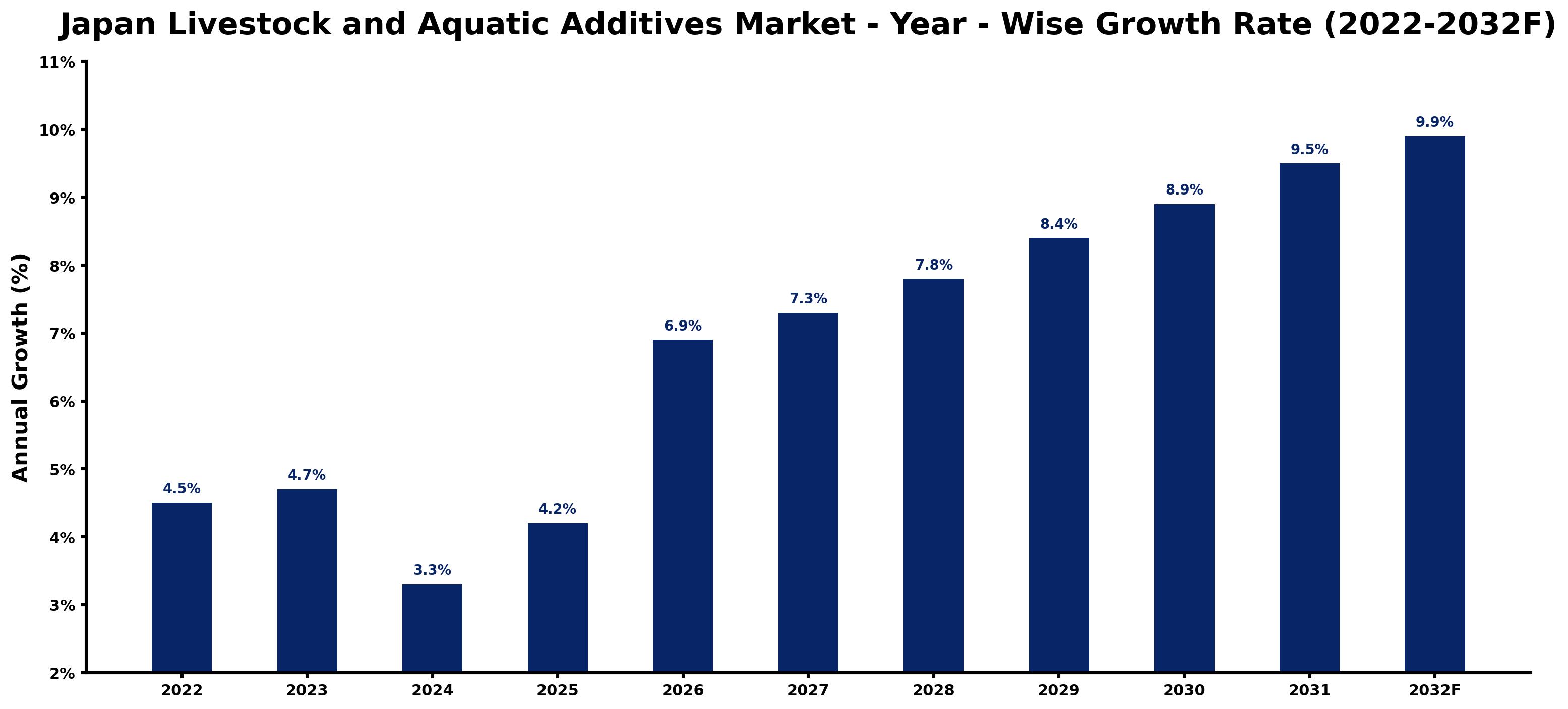
The following figures match every annual growth estimate with the main market development of that year, giving the reasoning behind each rise or slowdown.
| Year | Estimated Annual Growth (%) | Market Rationale |
| 2022 | 4.5 | The livestock market showed stable growth due to consistent demand from domestic users. |
| 2023 | 4.7 | Growth accelerated as poultry production reached 1.5 million tons, boosting feed additive needs. |
| 2024 | 3.3 | A slowdown occurred as demand stabilised after previous growth spurts in livestock production. |
| 2025 | 4.2 | Demand increased again with commercial farms consuming 80% of livestock feed, driving additive purchases. |
| 2026 | 6.9 | The market is expected to expand rapidly, driven by rising adoption of enzyme blends in swine feed. |
| 2027 | 7.3 | Growth will continue as aquaculture operations increasingly rely on specialized feed additives. |
| 2028 | 7.8 | Demand is projected to surge further due to the growing focus on improving nutrient absorption in livestock. |
| 2029 | 8.4 | The market is anticipated to see heightened growth as fish farming operations expand their use of additives. |
| 2030 | 8.9 | Continued growth is expected to be supported by innovations in feed production technologies and additives. |
| 2031 | 9.5 | Demand is projected to rise sharply as the aquaculture sector benefits from government support and investment. |
| 2032 | 9.9 | The market is expected to peak with a strong focus on improving livestock health and productivity. |
Note: Market size estimations and growth projections presented in this report are based on 6Wresearch's proprietary forecasting methodology, utilizing the latest available industry data, government publications, and primary research inputs.
Japan Livestock and Aquatic Additives Market Synopsis
Livestock and aquatic additives enhance animal feed to improve growth, health, and productivity. These substances, derived from fermentation or chemical synthesis, play a vital role in boosting digestion and immune responses. The Japan Livestock and Aquatic Additives Market is expanding due to the increasing livestock population, especially in cattle and poultry, alongside the growing aquaculture sector, which produced over 700,000 tons of fish in 2022. Regulatory support and investments in aquaculture technology are further driving demand for these essential products.
Market Dynamics Impact Analysis (2026–2032)
| Factor | Type | Impact | Primary Segment Affected |
| Increasing livestock population and aquaculture production | Driver | High | Cattle |
| Rising adoption of enzyme blends in swine feed | Driver | High | Swine |
| Growing demand for specialized feed additives in fish farming | Opportunity | High | Fish |
| Investment in aquaculture technology by the government | Opportunity | High | Aquaculture Integrators |
| Regulatory compliance costs for feed producers | Restraint | High | Feed Producers |
| Limited awareness of the benefits of additives among small farms | Restraint | Medium | Commercial Farms |
| High competition among feed producers affecting pricing | Challenge | High | Feed Producers |
| Supply chain disruptions impacting availability of additives | Challenge | Medium | Veterinary Feed Distributors |
Evaluation of Drivers in Japan Livestock and Aquatic Additives Market (2026–2032)
Below are the drivers that matter most for revenue growth, with supporting evidence.
| Drivers | Primary Segment Affected | Why It Matters (Evidence) |
| Rising livestock population | Cattle | Japan's cattle population includes approximately 4 million, increasing demand for additives to support growth. |
| Growing poultry production | Poultry | Poultry production reached 1.5 million tons in 2022, driving higher feed additive consumption. |
| Increased aquaculture output | Fish | The aquaculture sector produced over 700,000 tons of fish in 2022, boosting the need for specialized additives. |
| Adoption of probiotics in livestock feed | Probiotics | Probiotics are used in 30% of livestock feeds in Japan, improving gut health and productivity. |
| Government support for feed safety | Mineral Supplements | The Economic Security Promotion Act supports the use of additives, ensuring quality and safety in livestock feed. |
Several shifts outside the market lift sales. The livestock population in Japan, including approximately 4 million cattle, drives demand for additives that improve growth and health. The poultry sector's production levels have surged, which has increased the need for feed enhancements. Furthermore, the aquaculture sector's output has expanded, boosting demand for specialized feed solutions. The focus on improving gut health has led to a rise in the use of probiotics, which are now included in a significant portion of livestock feeds.
Evaluation of Restraints in Japan Livestock and Aquatic Additives Market
These are the pressures that could keep growth below its potential.
| Market Restraint | Primary Segment Affected | Why It Matters (Evidence) |
| Regulatory compliance costs for feed producers | Feed Producers | Compliance with existing regulations increases operational costs for producers, affecting pricing strategies. |
| Limited awareness of the benefits of additives among small farms | Commercial Farms | Many small farms lack knowledge about the advantages of using additives, limiting their adoption. |
| Supply chain disruptions impacting availability of additives | Veterinary Feed Distributors | Disruptions in supply chains can lead to shortages of essential additives, affecting distribution. |
| High competition among feed producers affecting pricing | Feed Producers | Intense competition leads to price wars, impacting profitability for many producers in the market. |
| Dependence on specific raw materials for additives | Mineral Supplements | Fluctuations in the availability of key raw materials can disrupt production and supply of additives. |
Japan Livestock and Aquatic Additives Market Challenges
Regulatory requirements in Japan demand rigorous testing for livestock and aquatic additives, resulting in approval delays that can last up to 12 months for suppliers. Rapid advancements in feed technology present challenges for producers, many of whom struggle to keep up, leading to a 15% increase in production costs for those unable to adapt. A shortage of skilled workers hampers the effective application of new additives, causing a 20% decrease in output for commercial farms. Intense competition among feed producers drives prices down, limiting research and development budgets, which ultimately affects product quality for buyers.
Trends in the Japan Livestock and Aquatic Additives Market
Four trends stand out in the Japan Livestock and Aquatic Additives Market.
- Shift towards Probiotics in Livestock Feed: The trend towards using probiotics in livestock feed began in 2022, with 30% of feeds now incorporating them. This shift improves gut health and productivity, particularly in commercial farms.
- Transition to Online Purchasing Platforms: Since 2023, there has been a notable shift towards online platforms for purchasing livestock additives. This change is driven by convenience, with online sales growing at a rate of 11.3%.
- Increased Focus on Mineral Supplements: Starting in 2026, mineral supplements gained prominence in livestock feed, particularly for dairy cows. This trend is driven by the need for essential nutrients, with a projected growth rate of 12.1%.
- Aquaculture Sector Emphasizing Feed Additives: The aquaculture sector has increasingly prioritised the use of specialised feed additives since 2022. This focus is supported by government initiatives, improving fish production.
Investment Opportunities in the Japan Livestock and Aquatic Additives Market
The following opportunities in the Japan Livestock and Aquatic Additives Market pair current demand with a clear way in.
- Commercial Farms Seeking Advanced Additives: Commercial farms are currently looking for effective livestock additives to improve productivity. The market is expected to grow as suppliers can partner with local feed producers to meet this demand.
- Aquaculture Integrators Needing Specialized Solutions: Aquaculture integrators require advanced feed additives to improve fish health and yield. The market is expanding, with over 60% of fish farms utilizing these additives.
- Investment in Sustainable Practices: There is a growing opportunity for suppliers of sustainable additives, especially with government support for aquaculture technology. This is timely as the aquaculture sector continues to expand.
- Rising Demand for Online Sales Channels: With online platforms growing at 11.3%, suppliers can tap into this channel to reach a broader audience. Establishing partnerships with e-commerce platforms can enhance market penetration.
Government Initiatives in the Japan Livestock and Aquatic Additives Market
The Economic Security Promotion Act, enacted in 2022, supports supply-chain resilience for critical products, including livestock additives. This law complements existing regulations by ensuring that producers can maintain a steady supply of essential feed components, thereby improving food security. The Act aims to enhance the reliability of livestock feed production, which is crucial for meeting domestic demand.
The Ministry of Agriculture, Forestry and Fisheries oversees the implementation of livestock feed regulations, which mandate that all feed additives meet safety standards. This ensures that buyers can trust the quality of the products they purchase, promoting safer livestock production practices. The ministry also conducts regular inspections to ensure compliance, benefiting both producers and consumers.
Future Insight of the Japan Livestock and Aquatic Additives Market
By 2032, buyers will experience improved feed efficiency through the adoption of advanced aquaculture technologies that enhance sustainability, driven by government initiatives. The introduction of ISO 22000 standards will elevate safety and quality in feed products, instilling greater consumer confidence. Investment in innovative additives is expected to increase, positively impacting growth rates across livestock sectors. With over 700,000 tons of fish produced in 2022, the trend towards specialised additives will present suppliers with opportunities to develop tailored solutions.
Market Segmentation Analysis
Japan Livestock and Aquatic Additives Market report covers a detailed analysis of the following market segments:
By Additive Type – Probiotics Lead, Mineral Supplements Expected to Grow Fastest
According to Saurav Kr Singh, Senior Research Analyst at 6Wresearch, Probiotics took 47% of additive type revenue in 2025, more than any other category. Probiotics dominate the market as they are extensively utilised to improve gut health in livestock, which is crucial for enhancing overall productivity. Their presence in 30% of livestock feeds illustrates their integral role in supporting animal health. Mineral Supplements are set to record the highest CAGR in this split, 12.1% over 2026–2032. Mineral supplements are experiencing rapid growth due to their essential role in livestock growth and development, particularly for dairy cows. The increasing recognition among farmers of their benefits is driving this surge in demand. Suppliers must focus on creating high-quality mineral supplements to meet the growing requirements of livestock producers.
By Target Species – Cattle Leads, Fish Expected to Grow Fastest
Cattle accounted for 45% of the market by target species in 2025. Cattle lead the market as they are a primary source of beef and dairy production in Japan. The presence of approximately 4 million cattle highlights their nutritional needs, which fuel the demand for additives. Over 2026–2032, Fish is expected to post the fastest growth, at a CAGR of 11.8%. Fish are the fastest-growing segment due to their critical importance in aquaculture operations, which produced over 700,000 tons in 2022. The government's support for sustainable aquaculture practices is further driving this growth. Buyers should consider diversifying their additive options to include products tailored for fish to capitalise on the expanding aquaculture sector.
By Distribution Channel – Direct Sales Leads, Online Platforms Expected to Grow Fastest
Direct Sales held 43% of the Japan Livestock and Aquatic Additives Market by distribution channel in 2025. Direct sales are the predominant distribution channel, providing a straightforward method for farmers to acquire feed products. This approach facilitates direct engagement between suppliers and end users, ensuring tailored solutions. Online Platforms are projected to grow fastest, at a CAGR of 11.3% during 2026–2032. Online platforms are the fastest-growing channel for purchasing additives, fuelled by the increasing digitalisation of the agricultural sector. The convenience and accessibility of online shopping are drawing more buyers to this avenue. Suppliers must strengthen their online presence to capture the expanding market of customers who prefer digital purchasing options.
By End User – Commercial Farms Lead, Aquaculture Integrators Expected to Grow Fastest
The largest end user category in 2025 was Commercial Farms, at 38% of revenue. Commercial farms represent the largest end users of additives, accounting for 80% of livestock feed consumption in Japan. Their scale and operational needs create a consistent demand for various feed additives. The quickest growth will come from Aquaculture Integrators, forecast to expand at a CAGR of 10.9% between 2026 and 2032. Aquaculture integrators are the fastest-growing end user group, as they play an integral role in the aquaculture supply chain. The increasing production of fish and government support for aquaculture technology are driving this trend. Suppliers should develop targeted strategies to engage aquaculture integrators, who are becoming increasingly vital in the market.
Key Attractiveness of the Report
- 10 Years of Market Numbers
- Historical Data Starting from 2022 to 2025
- Base Year 2025
- Forecast Data until 2032
- Key Performance Indicators Impacting the Market
- Major Upcoming Developments and Projects
Key Highlights of the Report:
- Japan Livestock and Aquatic Additives Market Outlook
- Market Size of Japan Livestock and Aquatic Additives Market, 2025
- Forecast of Japan Livestock and Aquatic Additives Market, 2032
- Historical Data and Forecast of Japan Livestock and Aquatic Additives Revenues & Volume for the Period 2022-2032F
- Japan Livestock and Aquatic Additives Market Trend Evolution
- Japan Livestock and Aquatic Additives Market Drivers and Challenges
- Japan Livestock and Aquatic Additives Price Trends
- Japan Livestock and Aquatic Additives Porter's Five Forces
- Japan Livestock and Aquatic Additives Industry Life Cycle
- Historical Data and Forecast of Japan Livestock and Aquatic Additives Market Revenues & Volume By Additive Type for the Period 2022-2032F
- Historical Data and Forecast of Japan Livestock and Aquatic Additives Market Revenues & Volume By Probiotics for the Period 2022-2032F
- Historical Data and Forecast of Japan Livestock and Aquatic Additives Market Revenues & Volume By Enzyme Blends for the Period 2022-2032F
- Historical Data and Forecast of Japan Livestock and Aquatic Additives Market Revenues & Volume By Antioxidants for the Period 2022-2032F
- Historical Data and Forecast of Japan Livestock and Aquatic Additives Market Revenues & Volume By Mineral Supplements for the Period 2022-2032F
- Historical Data and Forecast of Japan Livestock and Aquatic Additives Market Revenues & Volume By Target Species for the Period 2022-2032F
- Historical Data and Forecast of Japan Livestock and Aquatic Additives Market Revenues & Volume By Cattle, Poultry, Fish for the Period 2022-2032F
- Historical Data and Forecast of Japan Livestock and Aquatic Additives Market Revenues & Volume By Swine, Shrimp for the Period 2022-2032F
- Historical Data and Forecast of Japan Livestock and Aquatic Additives Market Revenues & Volume By All Livestock for the Period 2022-2032F
- Historical Data and Forecast of Japan Livestock and Aquatic Additives Market Revenues & Volume By Dairy Cows/Farmed Fish for the Period 2022-2032F
- Historical Data and Forecast of Japan Livestock and Aquatic Additives Market Revenues & Volume By Distribution Channel for the Period 2022-2032F
- Historical Data and Forecast of Japan Livestock and Aquatic Additives Market Revenues & Volume By Direct Sales for the Period 2022-2032F
- Historical Data and Forecast of Japan Livestock and Aquatic Additives Market Revenues & Volume By Online Platforms for the Period 2022-2032F
- Historical Data and Forecast of Japan Livestock and Aquatic Additives Market Revenues & Volume By Industrial Suppliers for the Period 2022-2032F
- Historical Data and Forecast of Japan Livestock and Aquatic Additives Market Revenues & Volume By Specialty Stores for the Period 2022-2032F
- Historical Data and Forecast of Japan Livestock and Aquatic Additives Market Revenues & Volume By End User for the Period 2022-2032F
- Historical Data and Forecast of Japan Livestock and Aquatic Additives Market Revenues & Volume By Commercial Farms for the Period 2022-2032F
- Historical Data and Forecast of Japan Livestock and Aquatic Additives Market Revenues & Volume By Feed Producers for the Period 2022-2032F
- Historical Data and Forecast of Japan Livestock and Aquatic Additives Market Revenues & Volume By Veterinary Feed Distributors for the Period 2022-2032F
- Historical Data and Forecast of Japan Livestock and Aquatic Additives Market Revenues & Volume By Aquaculture Integrators for the Period 2022-2032F
- Japan Livestock and Aquatic Additives Import Export Trade Statistics
- Market Opportunity Assessment By Additive Type
- Market Opportunity Assessment By Target Species
- Market Opportunity Assessment By Distribution Channel
- Market Opportunity Assessment By End User
- Japan Livestock and Aquatic Additives Top Companies Market Share
- Japan Livestock and Aquatic Additives Competitive Benchmarking By Technical and Operational Parameters
- Japan Livestock and Aquatic Additives Company Profiles
- Japan Livestock and Aquatic Additives Key Strategic Recommendations
Market Covered
Segments analysed in this report are listed below.
By Additive Type
- Probiotics
- Enzyme Blends
- Antioxidants
- Mineral Supplements
By Target Species
- Cattle
- Poultry
- Fish
- Swine
- Shrimp
- All Livestock
- Dairy Cows/Farmed Fish
By Distribution Channel
- Direct Sales
- Online Platforms
- Industrial Suppliers
- Specialty Stores
By End User
- Commercial Farms
- Feed Producers
- Veterinary Feed Distributors
- Aquaculture Integrators






































