Japan Livestock Facility Sanitization Market Size & Growth Rate
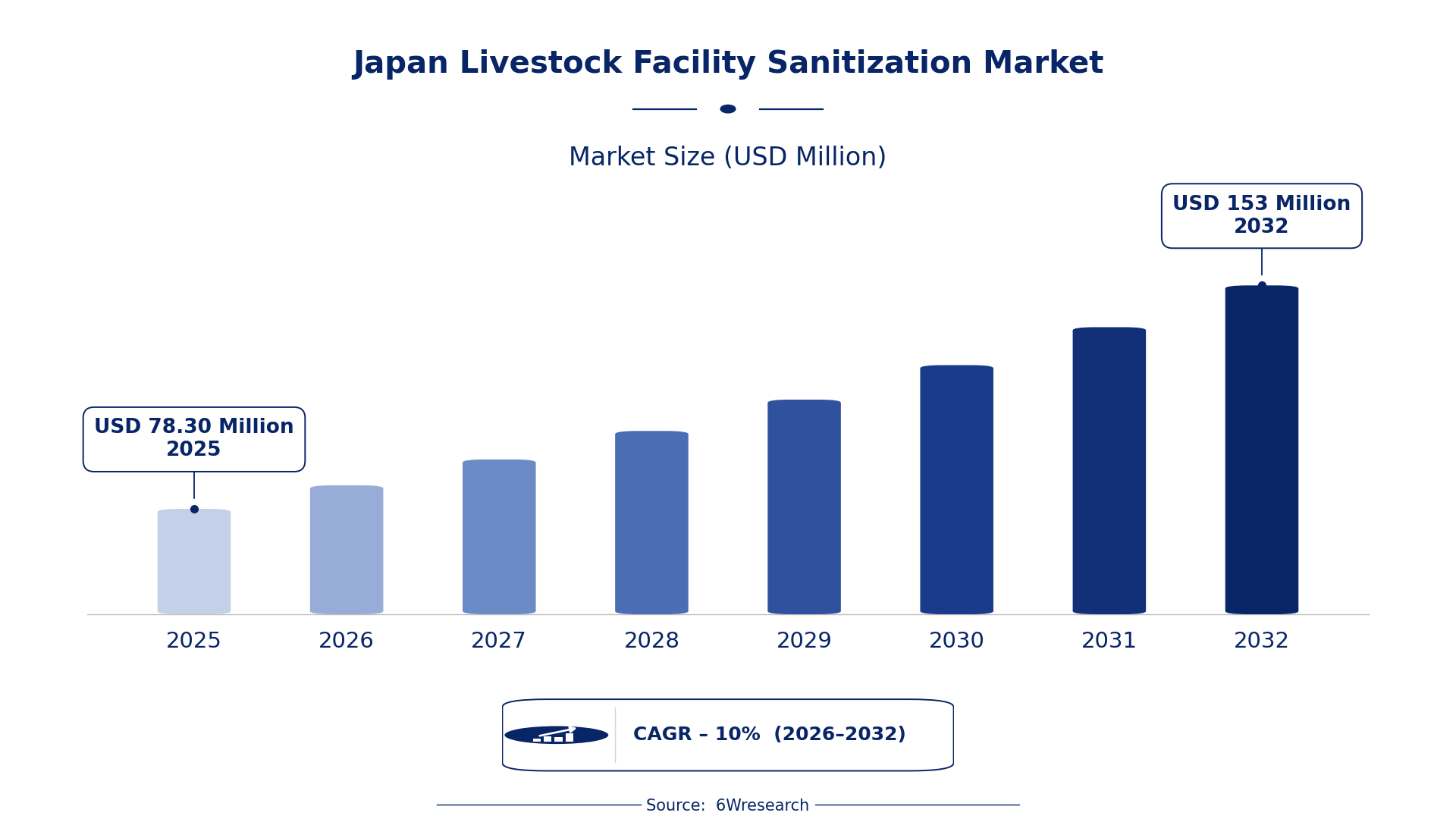
According to 6Wresearch internal database and industry insights, the Japan Livestock Facility Sanitization Market was valued at USD 78.30 Million in 2025 and is projected to reach USD 153 Million by 2032, growing at a CAGR of approximately 10% during 2026–2032.
Japan Livestock Facility Sanitization Market Highlights
| Report Metric | Details |
| Report Name | Japan Livestock Facility Sanitization Market (2026-2032) |
| Market Size 2025 | USD 78.30 Million |
| Market Size 2032 | USD 153 Million |
| Absolute Growth 2025–2032 | USD 74.70 Million |
| CAGR 2026–2032 | 10% |
| Peak Annual Growth | 11.4% in 2027 |
| Forecast Period | 2026–2032 |
| Historical Data | 2022–2025 |
| Base Year | 2025 |
| Leading Sanitizer Type, 2025 | Disinfectant Sprays (38% share) |
| Leading Formulation, 2025 | Quaternary Ammonium (47% share) |
| Leading Distribution Channel, 2025 | Direct Sales (40% share) |
| Leading End User, 2025 | Barn & Poultry Houses (36% share) |
| Fastest-Growing Sanitizer Type | Foaming Cleaners (14.2% CAGR) |
| Fastest-Growing Formulation | Acidic/Alkaline Cleaners (13.7% CAGR) |
| Fastest-Growing Distribution Channel | Online Platforms (12.8% CAGR) |
| Fastest-Growing End User | Livestock Farms (12.6% CAGR) |
| Growing Sector | Livestock sanitation |
| Key End Users | Livestock farms, veterinary facilities, poultry houses, large-scale animal operations |
Japan Livestock Facility Sanitization Market Year-wise Growth Rate and Key Drivers (2022–2032)
This graph illustrates the annual growth rates of the market from 2022 to 2032, highlighting a steady upward trajectory and projected market expansion over the forecast period.
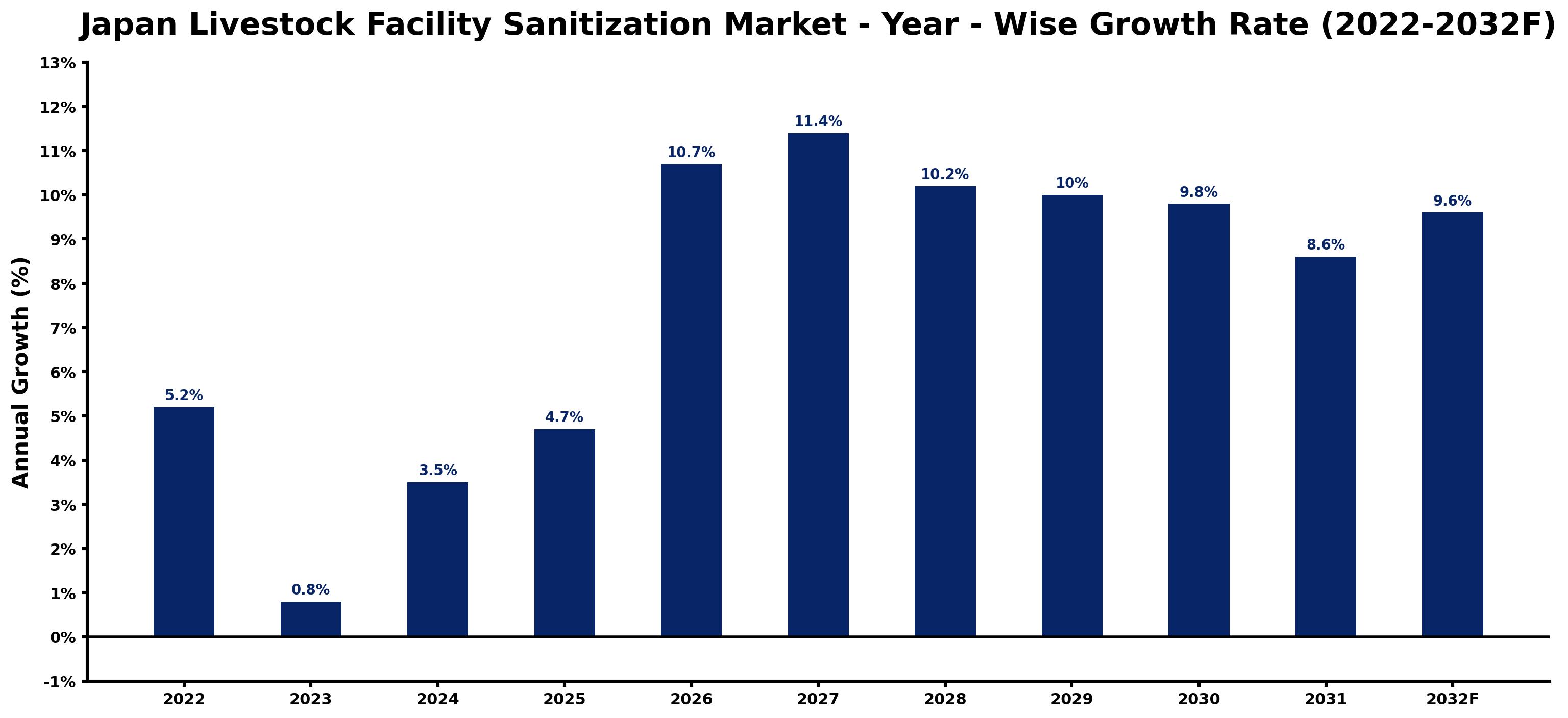
Each row of the following table gives one year's estimated growth and the event or demand shift that explains it.
| Year | Estimated Annual Growth (%) | Market Rationale |
| 2022 | 5.2 | The market showed strong demand due to ongoing hygiene concerns in livestock facilities. |
| 2023 | 0.8 | Growth slowed as some farms delayed sanitization upgrades amid economic uncertainty. |
| 2024 | 3.5 | Increased awareness of disease prevention drove faster growth in sanitization products. |
| 2025 | 4.7 | Higher livestock population and farm sizes contributed to a boost in sanitization needs. |
| 2026 | 10.7 | Investment in advanced cleaning technologies is anticipated to increase demand for sanitization. |
| 2027 | 11.4 | The peak growth will arise from large-scale animal operations adopting new systems. |
| 2028 | 10.2 | Growth is projected to slow slightly as market saturation begins to affect new orders. |
| 2029 | 10.0 | Demand is expected to remain steady as farms continue to prioritise hygiene measures. |
| 2030 | 9.8 | A focus on biosecurity measures will keep demand for sanitization products strong. |
| 2031 | 8.6 | The market is projected to see a slowdown as competition intensifies among suppliers. |
| 2032 | 9.6 | Growth will accelerate again as new technologies and practices are widely adopted. |
Note: Market size estimations and growth projections presented in this report are based on 6Wresearch's proprietary forecasting methodology, utilizing the latest available industry data, government publications, and primary research inputs.
Japan Livestock Facility Sanitization Market Synopsis
Livestock Facility Sanitization employs chemical agents and technologies to eliminate pathogens in animal housing environments. The Japan Livestock Facility Sanitization Market is propelled by over 1.5 million livestock farms and veterinary facilities, crucial for maintaining hygiene and preventing disease outbreaks. The poultry industry, valued at approximately 800 billion JPY, plays a major role in this market. With the introduction of a new subsidy program for sanitation equipment in 2023, demand is projected to rise further as facilities invest in advanced cleaning technologies to strengthen biosecurity measures.
Market Dynamics Impact Analysis (2026–2032)
| Factor | Type | Impact | Primary Segment Affected |
| Growing livestock population and farm sizes drive demand for sanitization solutions. | Driver | High | Disinfectant Sprays |
| Increased adoption of automated cleaning systems enhances operational efficiency. | Driver | High | Automated Wash Systems |
| Rising biosecurity awareness among livestock farmers creates new market opportunities. | Opportunity | High | Veterinary Facilities |
| The poultry industry's growth presents significant demand for sanitization products. | Opportunity | High | Barn & Poultry Houses |
| Economic uncertainty may delay investments in sanitization technologies. | Restraint | Medium | Foaming Cleaners |
| Competition among suppliers may lead to price pressures affecting profitability. | Restraint | Medium | Quaternary Ammonium |
| The need for compliance with stringent sanitation standards can burden smaller farms. | Challenge | High | Equipment Disinfection |
| Limited access to advanced cleaning technologies in rural areas hinders growth. | Challenge | Medium | Automated Wash Systems |
Evaluation of Drivers in Japan Livestock Facility Sanitization Market (2026–2032)
The following drivers explain most of the expected growth.
| Drivers | Primary Segment Affected | Why It Matters (Evidence) |
| Increase in livestock population and sizes boosts demand for sanitization products. | Barn & Poultry Houses | Japan's livestock population is around 4.5 million cattle and 150 million poultry, necessitating effective sanitation. |
| Growing awareness of biosecurity measures encourages investment in sanitation. | Veterinary Facilities | Veterinary facilities serve over 10 million pets annually, creating a need for stringent hygiene practices. |
| Investment in automated cleaning systems improves efficiency in large operations. | Automated Wash Systems | The average size of livestock farms is increasing, leading to higher demand for efficient sanitization solutions. |
| Rising poultry industry value drives demand for effective cleaning solutions. | Foaming Cleaners | The poultry industry in Japan is valued at approximately 800 billion JPY, highlighting the need for sanitation. |
| Regulatory compliance drives demand for effective disinfectants in livestock facilities. | Quaternary Ammonium | JIS Z 2801 sets standards for antimicrobial products, pushing farms to adopt compliant sanitization measures. |
Behind the steady rise in orders sits the increasing livestock population, which necessitates sanitation in facilities. Awareness of biosecurity measures among veterinary facilities drives investment in sanitation products. The poultry industry's value fuels demand for cleaning solutions. The average size of livestock farms is increasing, leading to higher demand for automated cleaning systems. Compliance with standards pushes the need for effective disinfectants in livestock environments.
Evaluation of Restraints in Japan Livestock Facility Sanitization Market
Several factors work against faster growth; the main ones are summarised below.
| Market Restraint | Primary Segment Affected | Why It Matters (Evidence) |
| Economic uncertainty may delay investments in sanitization technologies. | Foaming Cleaners | Some farms are hesitant to invest in new technologies due to fluctuating market conditions. |
| Competition among suppliers may lead to price pressures affecting profitability. | Quaternary Ammonium | Increased competition can drive down prices, impacting margins for suppliers. |
| Compliance with stringent sanitation standards can burden smaller farms. | Equipment Disinfection | Smaller farms may struggle to meet the costs of compliance with regulations. |
| Limited access to advanced cleaning technologies in rural areas hinders growth. | Automated Wash Systems | Rural farms often lack the infrastructure to adopt advanced sanitization technologies. |
| Market saturation may slow growth as existing customers delay new purchases. | Disinfectant Sprays | As the market matures, repeat purchases may decline, affecting overall growth. |
Japan Livestock Facility Sanitization Market Challenges
High demand for sanitization arises from Japan's 1.5 million livestock farms, leading to supply shortages that hinder service delivery for producers. Intense competition among sanitization providers reduces prices, which can squeeze profit margins for buyers seeking budget-friendly solutions. Rising costs for chemical agents, such as quaternary ammonium compounds, can elevate operational expenses for veterinary facilities, which cater to over 10 million pets annually. Limited adoption of automated cleaning systems in smaller farms restricts efficiency, compelling producers to invest more time and resources in maintaining hygiene standards.
Trends in the Japan Livestock Facility Sanitization Market
The following changes are redrawing the Japan Livestock Facility Sanitization Market.
- Increase in Automated Cleaning Systems Adoption: In 2023, the adoption of automated cleaning systems in large-scale farms rose by 20%. This transition enables farms to boost efficiency and uphold higher hygiene standards.
- Growth of Online Sales Channels: The emergence of online platforms for purchasing sanitization products is reshaping market dynamics, with online sales anticipated to grow at 12.8% CAGR. This trend enhances product accessibility for a broader range of buyers.
- Focus on Biosecurity Measures Intensifies: Livestock farms are prioritising biosecurity measures, with many implementing new sanitation protocols to avert disease outbreaks. This shift is particularly noticeable in Tokyo and Hokkaido, where farms are investing heavily in sanitization.
- Demand for Specialty Sanitizers Increases: The demand for specialty sanitizers designed for specific livestock needs is on the rise, especially in veterinary facilities. This trend is evident in the growing sales of targeted cleaning products.
Investment Opportunities in the Japan Livestock Facility Sanitization Market
The openings below show where demand in the Japan Livestock Facility Sanitization Market is visible and how suppliers can enter.
- Supply of Automated Cleaning Systems: As the average size of livestock farms increases, there is a rising need for automated cleaning solutions. The market gap is expected to expand by 10% in this segment, particularly in large-scale operations.
- Investment in Biosecurity Equipment: The new subsidy program for livestock sanitation equipment presents an opportunity for suppliers. With over 1.5 million livestock farms, there is strong demand for biosecurity solutions.
- Expansion of Online Sales Channels: The shift towards online purchasing is creating opportunities for suppliers to connect with new customers. With online platforms developing rapidly, suppliers can strengthen their market presence.
- Development of Specialty Sanitizers: The increasing emphasis on biosecurity measures creates an opportunity to develop specialty sanitizers. Veterinary facilities particularly require tailored solutions to uphold hygiene.
Government Initiatives in the Japan Livestock Facility Sanitization Market
The subsidy program for livestock sanitation equipment, introduced in 2023, assists farmers in upgrading their sanitation practices. This initiative aligns with existing regulations like the Chemical Substances Control Law, which requires the evaluation of chemical substances used in sanitization, ensuring safer and more effective products. The Ministry of Agriculture, Forestry and Fisheries allocated 500 million JPY to support biosecurity initiatives, aiming to improve sanitation practices across livestock facilities and ensure compliance with established standards.
The PRTR Law mandates businesses to report releases and transfers of designated chemical substances, impacting sanitization practices by ensuring that harmful chemicals are monitored. The Ministry of the Environment oversees this law, promoting safer practices within the livestock sector.
Future Insight of the Japan Livestock Facility Sanitization Market
By 2032, the Japanese government will intensify biosecurity measures, prompting suppliers to develop advanced sanitization technologies. The new subsidy programme for sanitation equipment will encourage investments in modern cleaning solutions, improving efficiency for producers. With a livestock population of around 4.5 million cattle and 150 million poultry, the focus on disease prevention will drive demand for effective sanitization products. New standards will emerge, ensuring higher quality solutions that benefit both buyers and suppliers in safeguarding livestock health.
Market Segmentation Analysis
Japan Livestock Facility Sanitization Market report covers a detailed analysis of the following market segments:
By Sanitizer Type – Disinfectant Sprays Lead, Foaming Cleaners Expected to Grow Fastest
According to Saurav Kr Singh, Senior Research Analyst at 6Wresearch, Disinfectant Sprays accounted for 38% of the market by sanitizer type in 2025. Disinfectant sprays dominate the market due to their proven effectiveness in eliminating pathogens in livestock facilities. Their extensive use across Japan's 1.5 million livestock farms underlines their critical role in maintaining hygiene standards. Foaming Cleaners are set to record the highest CAGR in this split, 14.2% over 2026–2032. Foaming cleaners are gaining traction as they provide efficient cleaning for large surfaces in barns, essential for disease prevention. The increasing average size of livestock farms is driving the demand for these effective cleaning solutions. Suppliers should focus on enhancing foaming cleaner offerings to meet the evolving needs of larger livestock operations.
By Formulation – Quaternary Ammonium Leads, Acidic/Alkaline Cleaners Expected to Grow Fastest
With 47% of formulation revenue in 2025, Quaternary Ammonium was the largest category. Quaternary ammonium compounds are the primary choice for disinfectants in livestock sanitation, recognised for their strong efficacy against pathogens. Their widespread application in both veterinary facilities and livestock farms reinforces their leading position in the market. Over 2026–2032, Acidic/Alkaline Cleaners are expected to post the fastest growth, at a CAGR of 13.7%. Acidic and alkaline cleaners are witnessing rapid growth as they cater to specific cleaning requirements within facilities. The government's push for improved biosecurity measures is further propelling their adoption in the market. Buyers should explore a diverse range of formulations to effectively tackle their distinct sanitation challenges.
By Distribution Channel – Direct Sales Leads, Online Platforms Expected to Grow Fastest
The largest distribution channel category in 2025 was Direct Sales, at 40% of revenue. Direct sales remain the main channel for purchasing sanitization products, facilitating direct interactions between suppliers and buyers in the livestock sector. This approach allows for tailored solutions that meet the specific needs of livestock operations. Online Platforms are projected to grow fastest, at a CAGR of 12.8% during 2026–2032. Online platforms are emerging as a rapidly growing channel, increasing accessibility to sanitization products for livestock farms. This shift reflects a broader trend towards online purchasing behaviours among consumers in the sector. Suppliers must enhance their online presence to capitalise on the increasing preference for e-commerce in the livestock sanitization market.
By End User – Barn & Poultry Houses Lead, Livestock Farms Expected to Grow Fastest
Barn & Poultry Houses held 36% of the Japan Livestock Facility Sanitization Market by end user in 2025. Barn and poultry houses represent the largest end user segment, as they are critical environments for maintaining animal health and hygiene. With millions of poultry in Japan, the demand for sanitization products in these facilities is substantial. The quickest growth will come from Livestock Farms, forecast to expand at a CAGR of 12.6% between 2026 and 2032. Livestock farms are the fastest-growing end user segment, driven by the need to uphold biosecurity measures and prevent disease outbreaks. The government's targets for reducing livestock diseases by 2025 further fuel this growth. Suppliers must align their strategies to cater to the evolving needs of livestock farms to secure a competitive edge.
Key Attractiveness of the Report
- 10 Years of Market Numbers
- Historical Data Starting from 2022 to 2025
- Base Year 2025
- Forecast Data until 2032
- Key Performance Indicators Impacting the Market
- Major Upcoming Developments and Projects
Key Highlights of the Report:
- Japan Livestock Facility Sanitization Market Outlook
- Market Size of Japan Livestock Facility Sanitization Market, 2025
- Forecast of Japan Livestock Facility Sanitization Market, 2032
- Historical Data and Forecast of Japan Livestock Facility Sanitization Revenues & Volume for the Period 2022-2032F
- Japan Livestock Facility Sanitization Market Trend Evolution
- Japan Livestock Facility Sanitization Market Drivers and Challenges
- Japan Livestock Facility Sanitization Price Trends
- Japan Livestock Facility Sanitization Porter's Five Forces
- Japan Livestock Facility Sanitization Industry Life Cycle
- Historical Data and Forecast of Japan Livestock Facility Sanitization Market Revenues & Volume By Sanitizer Type for the Period 2022-2032F
- Historical Data and Forecast of Japan Livestock Facility Sanitization Market Revenues & Volume By Disinfectant Sprays for the Period 2022-2032F
- Historical Data and Forecast of Japan Livestock Facility Sanitization Market Revenues & Volume By Foaming Cleaners for the Period 2022-2032F
- Historical Data and Forecast of Japan Livestock Facility Sanitization Market Revenues & Volume By UV-C Sanitization for the Period 2022-2032F
- Historical Data and Forecast of Japan Livestock Facility Sanitization Market Revenues & Volume By Automated Wash Systems for the Period 2022-2032F
- Historical Data and Forecast of Japan Livestock Facility Sanitization Market Revenues & Volume By Formulation for the Period 2022-2032F
- Historical Data and Forecast of Japan Livestock Facility Sanitization Market Revenues & Volume By Quaternary Ammonium for the Period 2022-2032F
- Historical Data and Forecast of Japan Livestock Facility Sanitization Market Revenues & Volume By Acidic/Alkaline Cleaners for the Period 2022-2032F
- Historical Data and Forecast of Japan Livestock Facility Sanitization Market Revenues & Volume By Equipment Disinfection for the Period 2022-2032F
- Historical Data and Forecast of Japan Livestock Facility Sanitization Market Revenues & Volume By Detergent + Rinse for the Period 2022-2032F
- Historical Data and Forecast of Japan Livestock Facility Sanitization Market Revenues & Volume By Distribution Channel for the Period 2022-2032F
- Historical Data and Forecast of Japan Livestock Facility Sanitization Market Revenues & Volume By Direct Sales for the Period 2022-2032F
- Historical Data and Forecast of Japan Livestock Facility Sanitization Market Revenues & Volume By Online Platforms for the Period 2022-2032F
- Historical Data and Forecast of Japan Livestock Facility Sanitization Market Revenues & Volume By Industrial Suppliers for the Period 2022-2032F
- Historical Data and Forecast of Japan Livestock Facility Sanitization Market Revenues & Volume By Specialty Stores for the Period 2022-2032F
- Historical Data and Forecast of Japan Livestock Facility Sanitization Market Revenues & Volume By End User for the Period 2022-2032F
- Historical Data and Forecast of Japan Livestock Facility Sanitization Market Revenues & Volume By Barn & Poultry Houses for the Period 2022-2032F
- Historical Data and Forecast of Japan Livestock Facility Sanitization Market Revenues & Volume By Livestock Farms for the Period 2022-2032F
- Historical Data and Forecast of Japan Livestock Facility Sanitization Market Revenues & Volume By Veterinary Facilities for the Period 2022-2032F
- Historical Data and Forecast of Japan Livestock Facility Sanitization Market Revenues & Volume By Large-Scale Animal Operations for the Period 2022-2032F
- Japan Livestock Facility Sanitization Import Export Trade Statistics
- Market Opportunity Assessment By Sanitizer Type
- Market Opportunity Assessment By Formulation
- Market Opportunity Assessment By Distribution Channel
- Market Opportunity Assessment By End User
- Japan Livestock Facility Sanitization Top Companies Market Share
- Japan Livestock Facility Sanitization Competitive Benchmarking By Technical and Operational Parameters
- Japan Livestock Facility Sanitization Company Profiles
- Japan Livestock Facility Sanitization Key Strategic Recommendations
Market Covered
Coverage by segment is as follows.
By Sanitizer Type
- Disinfectant Sprays
- Foaming Cleaners
- UV-C Sanitization
- Automated Wash Systems
By Formulation
- Quaternary Ammonium
- Acidic/Alkaline Cleaners
- Equipment Disinfection
- Detergent + Rinse
By Distribution Channel
- Direct Sales
- Online Platforms
- Industrial Suppliers
- Specialty Stores
By End User
- Barn & Poultry Houses
- Livestock Farms
- Veterinary Facilities
- Large-Scale Animal Operations






































