Japan Livestock Farming Market Size & Growth Rate
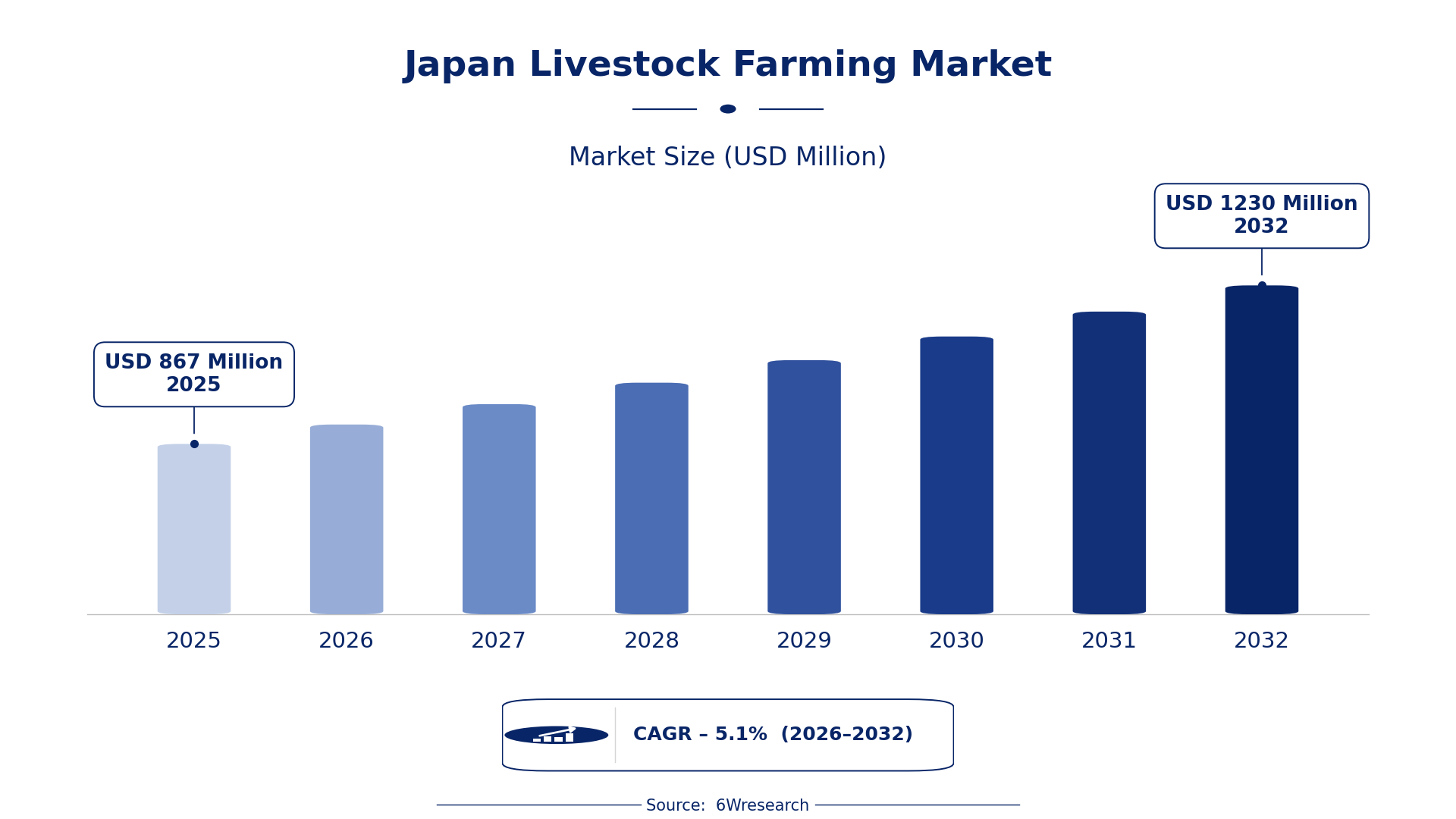
According to 6Wresearch internal database and industry insights, the Japan Livestock Farming Market was valued at USD 867 Million in 2025 and is projected to reach USD 1,230 Million by 2032, growing at a CAGR of approximately 5.1% during 2026–2032.
Japan Livestock Farming Market Highlights
| Report Metric | Details |
| Report Name | Japan Livestock Farming Market (2026-2032) |
| Market Size 2025 | USD 867 Million |
| Market Size 2032 | USD 1,230 Million |
| Absolute Growth 2025–2032 | USD 363 Million |
| CAGR 2026–2032 | 5.1% |
| Peak Annual Growth | 6.0% in 2028 |
| Forecast Period | 2026–2032 |
| Historical Data | 2022–2025 |
| Base Year | 2025 |
| Leading Livestock Type, 2025 | Poultry (Chicken/Turkey) (49% share) |
| Leading Farming Method, 2025 | Cage/Free-Range (47% share) |
| Leading Distribution Channel, 2025 | Direct Sales (41% share) |
| Leading End User, 2025 | Meat & Egg Distributors (34% share) |
| Fastest-Growing Livestock Type | Cattle (Beef/Dairy) (7.5% CAGR) |
| Fastest-Growing Farming Method | Pasture/Ranch (7.7% CAGR) |
| Fastest-Growing Distribution Channel | Online Platforms (6.8% CAGR) |
| Fastest-Growing End User | Milk & Beef Processors (7.0% CAGR) |
| Growing Sector | Meat and Dairy Production |
| Key End Users | Meat Distributors, Dairy Processors, Seafood Processors, Organic Farmers |
Japan Livestock Farming Market Year-wise Growth Rate and Key Drivers (2022–2032)
This graph illustrates the annual growth rates of the market from 2022 to 2032, highlighting a steady upward trajectory and projected market expansion over the forecast period.
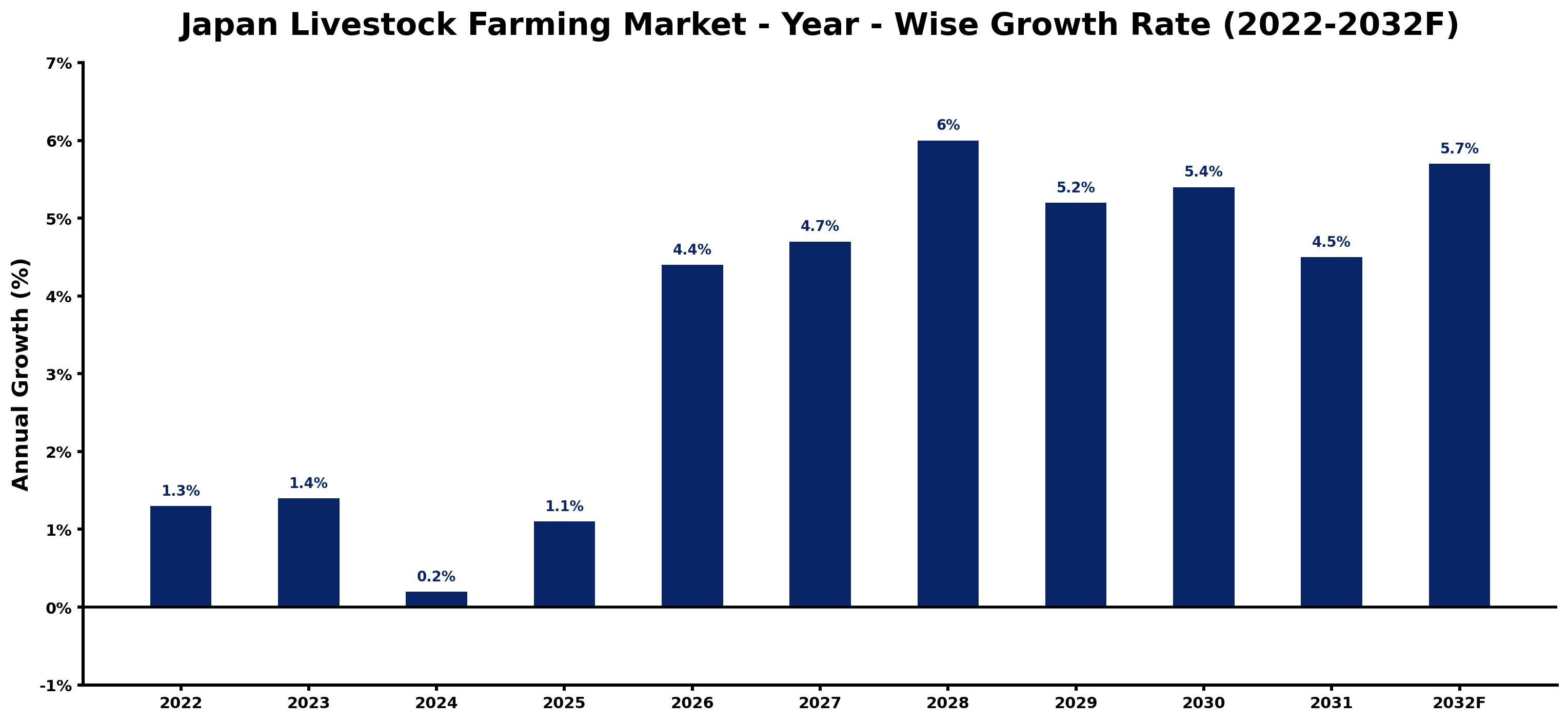
For each year, the table pairs the estimated growth rate with the leading influence on demand, showing how the drivers changed across the period.
| Year | Estimated Annual Growth (%) | Market Rationale |
| 2022 | 1.3 | The market showed steady growth, reflecting stable consumer demand for livestock products. |
| 2023 | 1.4 | Growth accelerated due to increased poultry production and rising meat consumption. |
| 2024 | 0.2 | A slowdown occurred as production faced challenges from rising feed costs. |
| 2025 | 1.1 | Growth improved as domestic beef production initiatives gained traction. |
| 2026 | 4.4 | The market is expected to grow faster as investments in sustainable farming increase. |
| 2027 | 4.7 | Demand is projected to rise further with expanding aquaculture operations. |
| 2028 | 6.0 | The peak growth year will see heightened investments in livestock technology. |
| 2029 | 5.2 | Growth is expected to slow slightly as market saturation begins. |
| 2030 | 5.4 | Demand for organic livestock products will drive growth in this year. |
| 2031 | 4.5 | A slowdown is anticipated as the market stabilises after rapid expansion. |
| 2032 | 5.7 | Growth will accelerate again as new livestock facilities come online. |
Note: Market size estimations and growth projections presented in this report are based on 6Wresearch's proprietary forecasting methodology, utilizing the latest available industry data, government publications, and primary research inputs.
Japan Livestock Farming Market Synopsis
Livestock farming in Japan involves breeding and raising animals for food, including poultry, cattle, swine, and aquaculture. The sector is crucial for domestic consumption, with poultry production reaching approximately 1.3 million tons in 2022. The Japan Livestock Farming Market is growing due to rising meat consumption, increased demand for dairy products, and investments in sustainable practices. The government aims to raise domestic beef production by 10% by 2025, further stimulating market growth through initiatives that support local farmers and improve food security.
Market Dynamics Impact Analysis (2026–2032)
| Factor | Type | Impact | Primary Segment Affected |
| Increasing domestic meat consumption | Driver | High | Poultry (Chicken/Turkey) |
| Investment in sustainable farming practices | Driver | High | Cattle (Beef/Dairy) |
| Growing demand for organic livestock products | Opportunity | High | Cattle (Beef/Dairy) |
| Expansion of aquaculture facilities | Opportunity | High | Aquaculture (Fish/Shrimp) |
| Rising feed costs impacting profitability | Restraint | High | Swine Farming |
| Aging farmer population leading to labour shortages | Restraint | Medium | Cattle (Beef/Dairy) |
| High competition from imported livestock products | Challenge | High | Poultry (Chicken/Turkey) |
| Regulatory compliance costs for organic certification | Challenge | Medium | Cattle (Beef/Dairy) |
Evaluation of Drivers in Japan Livestock Farming Market (2026–2032)
Below are the drivers that matter most for revenue growth, with supporting evidence.
| Drivers | Primary Segment Affected | Why It Matters (Evidence) |
| Rising poultry production | Poultry (Chicken/Turkey) | Japan produced approximately 1.3 million tons of poultry meat in 2022, leading to increased purchases by meat distributors. |
| Increased dairy demand | Cattle (Beef/Dairy) | The dairy cattle population in Japan is about 1.5 million, driving purchases by milk processors. |
| Aquaculture expansion | Aquaculture (Fish/Shrimp) | Aquaculture production in Japan reached 600,000 tons in 2022, prompting seafood processing firms to buy more. |
| Sustainable farming investments | Cattle (Beef/Dairy) | The government aims to increase domestic beef production by 10% by 2025, encouraging investment in beef farms. |
| Online sales growth | Direct Sales | Online sales of livestock products increased by 15% in the last year, prompting direct sales channels to expand. |
Orders keep climbing as the average per capita meat consumption in Japan is around 40 kg annually, prompting meat distributors to increase purchases. The dairy cattle population, approximately 1.5 million, supports rising demand from milk processors. The goal to boost domestic beef production by 10% by 2025 encourages investments in beef farms. Online sales of livestock products surged by 15%, prompting direct sales channels to expand rapidly. Aquaculture production, valued at 600,000 tons, drives seafood processing firms to source more products.
Evaluation of Restraints in Japan Livestock Farming Market
The following restraints limit how fast demand can grow.
| Market Restraint | Primary Segment Affected | Why It Matters (Evidence) |
| Rising feed costs affecting profit margins | Swine Farming | The livestock feed market is valued at approximately 1.2 billion USD, which strains farmers' profitability. |
| Aging farmer population causing labour shortages | Cattle (Beef/Dairy) | The average age of farmers in Japan is over 65 years, creating a need for new entrants. |
| High competition from imported livestock products | Poultry (Chicken/Turkey) | Increased imports challenge local producers, reducing their market share. |
| Regulatory compliance costs for organic certification | Cattle (Beef/Dairy) | Farmers incur high costs to meet organic standards, affecting their competitiveness. |
| Limited agricultural land availability | Aquaculture (Fish/Shrimp) | The total agricultural land area used for livestock farming is around 2 million hectares, constraining expansion. |
Japan Livestock Farming Market Challenges
Producers face stringent regulations from the Ministry of Agriculture, Forestry and Fisheries, which can delay farm operations and increase compliance costs for over 100,000 workers in the sector. Rising feed costs, estimated at approximately 1.2 billion USD, squeeze profit margins and may lead to higher prices for buyers. Local farmers encounter fierce competition from imported livestock products, forcing them to lower prices and affecting their market share. An aging farmer population, with an average age exceeding 65 years, creates a skills gap that restricts productivity and innovation for producers.
Trends in the Japan Livestock Farming Market
Several trends are reshaping the Japan Livestock Farming Market; the most important are set out below.
- Shift towards Sustainable Farming: In 2022, Japan observed a shift towards sustainable livestock farming practices, with many farms adopting ISO 14001 for environmental management. This change is driven by consumer demand for organic products, as evidenced by the government's subsidy program for organic farming.
- Increase in Online Sales: Online sales of livestock products increased by 15% last year, reflecting changing consumer purchasing habits. This trend is particularly strong among younger consumers seeking convenience and variety in their food choices.
- Growth in Aquaculture Production: Aquaculture production reached 600,000 tons in 2022, indicating a shift towards seafood as a staple protein source. This growth is supported by initiatives from the Fisheries Agency to improve aquaculture facilities.
- Rising Demand for Organic Products: The Japanese government promotes organic livestock farming, resulting in a growing market for organic meat and dairy. The subsidy program for organic farming has led to increased interest among farmers.
Investment Opportunities in the Japan Livestock Farming Market
The following areas offer the clearest openings for investors and suppliers in the Japan Livestock Farming Market.
- Gap in Organic Livestock Supply: With organic livestock products gaining popularity, there is a gap in supply. Farmers can invest in organic certification to meet rising consumer demand, particularly from health-conscious buyers.
- Investment in Aquaculture Facilities: The aquaculture industry in Japan is expanding, creating opportunities for investment in new facilities. Seafood processing firms are seeking local suppliers to meet increasing demand.
- Direct Sales Channel Expansion: The rise in online sales, which increased by 15% last year, presents an opportunity for suppliers to enhance their direct sales channels. Meat and egg distributors are particularly interested in this shift.
- Support for Sustainable Practices: The government’s subsidy program for organic livestock farming offers a timely opportunity for farmers to adopt sustainable practices. This aligns with the growing consumer preference for environmentally friendly products.
Government Initiatives in the Japan Livestock Farming Market
The Food Recycling Law, enacted in 2000, mandates food businesses to reduce waste by recycling it into feed and fertiliser. This law has encouraged livestock farmers to adopt more sustainable practices, positively impacting the livestock farming sector. The Food Sanitation Act amendment in 2018 introduced a positive list system for food utensils, containers, and packaging, enhancing food safety standards in the livestock sector.
The Digital Agency oversees livestock regulations and funds various initiatives to promote sustainable farming. The Fisheries Agency, established to support aquaculture, approves projects that enhance operational efficiency in the livestock sector.
Future Insight of the Japan Livestock Farming Market
New initiatives in sustainable livestock farming will emerge by 2032, focusing on local production and improving supply chains for buyers. The government aims to increase domestic beef production by 2025, which will reshape market conditions and benefit suppliers. Enhanced adoption of ISO 14001 standards will improve environmental management practices across farms. The growth of online sales of livestock products, which increased by 15% last year, will continue to transform purchasing habits and broaden market access.
Market Segmentation Analysis
Japan Livestock Farming Market report covers a detailed analysis of the following market segments:
By Livestock Type – Poultry (Chicken/Turkey) Leads, Cattle (Beef/Dairy) Expected to Grow Fastest
According to Saurav Kr Singh, Senior Research Analyst at 6Wresearch, with 49% of livestock type revenue in 2025, Poultry (Chicken/Turkey) was the largest category. Poultry farming commands the largest share as it meets the high demand for chicken meat in Japan, which reached approximately 1.3 million tons in 2022. This preference is evident among consumers who prioritise poultry as a key protein source in their diets. Cattle (Beef/Dairy) is projected to grow fastest, at a CAGR of 7.5% during 2026–2032. Cattle farming is set for rapid growth, with government plans to boost domestic beef production by 10% by 2025, driven by increasing consumer interest in beef and dairy. This growth trajectory suggests that poultry will maintain its lead while cattle gains traction. Suppliers should prioritise poultry products while also preparing for the anticipated growth in cattle farming.
By Farming Method – Cage/Free-Range Leads, Pasture/Ranch Expected to Grow Fastest
Cage/Free-Range accounted for 47% of the market by farming method in 2025. Cage/Free-Range farming leads the market as it encompasses diverse practices that cater to poultry, aligning with consumer preferences for quality and animal welfare. This method is further supported by government initiatives promoting sustainable livestock practices. The quickest growth will come from Pasture/Ranch, forecast to expand at a CAGR of 7.7% between 2026 and 2032. Pasture/Ranch farming is on the rise, particularly for cattle, as it resonates with consumer demand for organic and ethically raised products. This trend indicates a broader shift towards sustainable farming practices that could enhance the appeal of pasture-raised livestock. Buyers may increasingly favour products from pasture-raised systems, prompting suppliers to adapt their farming methods accordingly.
By Distribution Channel – Direct Sales Leads, Online Platforms Expected to Grow Fastest
In 2025, Direct Sales led the distribution channel split with a 41% share. Direct Sales remains the primary distribution channel, commonly employed for fresh livestock products, ensuring that consumers receive high-quality items directly from producers. This method is crucial for maintaining the freshness and quality of meat and dairy offerings. Online Platforms are set to record the highest CAGR in this split, 6.8% over 2026–2032. Online Platforms are rapidly expanding, evidenced by a 15% rise in online sales of livestock products last year, reflecting a shift in consumer purchasing behaviour. This trend underscores the need for suppliers to invest in digital sales strategies to capture this growing market segment. Suppliers must strengthen their online presence to meet the increasing demand for livestock products through digital channels.
By End User – Meat & Egg Distributors Lead, Milk & Beef Processors Expected to Grow Fastest
Meat & Egg Distributors took 34% of end user revenue in 2025, more than any other category. Meat & Egg Distributors hold the largest share as they are essential to the supply chain for meat and egg products, ensuring these staples reach consumers efficiently. Their established networks are crucial for maintaining consistent supply and quality of these products. Over 2026–2032, Milk & Beef Processors are expected to post the fastest growth, at a CAGR of 7.0%. Milk & Beef Processors are witnessing the fastest growth due to their vital role in the dairy and beef markets, addressing the rising consumer demand for these products. This growth is likely to create additional opportunities for collaboration within the supply chain. Suppliers should explore partnerships with processors to align with the increasing demand in the dairy and beef sectors.
Key Attractiveness of the Report
- 10 Years of Market Numbers
- Historical Data Starting from 2022 to 2025
- Base Year 2025
- Forecast Data until 2032
- Key Performance Indicators Impacting the Market
- Major Upcoming Developments and Projects
Key Highlights of the Report:
- Japan Livestock Farming Market Outlook
- Market Size of Japan Livestock Farming Market, 2025
- Forecast of Japan Livestock Farming Market, 2032
- Historical Data and Forecast of Japan Livestock Farming Revenues & Volume for the Period 2022-2032F
- Japan Livestock Farming Market Trend Evolution
- Japan Livestock Farming Market Drivers and Challenges
- Japan Livestock Farming Price Trends
- Japan Livestock Farming Porter's Five Forces
- Japan Livestock Farming Industry Life Cycle
- Historical Data and Forecast of Japan Livestock Farming Market Revenues & Volume By Livestock Type for the Period 2022-2032F
- Historical Data and Forecast of Japan Livestock Farming Market Revenues & Volume By Poultry (Chicken/Turkey) for the Period 2022-2032F
- Historical Data and Forecast of Japan Livestock Farming Market Revenues & Volume By Cattle (Beef/Dairy) for the Period 2022-2032F
- Historical Data and Forecast of Japan Livestock Farming Market Revenues & Volume By Swine Farming for the Period 2022-2032F
- Historical Data and Forecast of Japan Livestock Farming Market Revenues & Volume By Aquaculture (Fish/Shrimp) for the Period 2022-2032F
- Historical Data and Forecast of Japan Livestock Farming Market Revenues & Volume By Farming Method for the Period 2022-2032F
- Historical Data and Forecast of Japan Livestock Farming Market Revenues & Volume By Cage/Free-Range for the Period 2022-2032F
- Historical Data and Forecast of Japan Livestock Farming Market Revenues & Volume By Pasture/Ranch for the Period 2022-2032F
- Historical Data and Forecast of Japan Livestock Farming Market Revenues & Volume By Intensive/Outdoor for the Period 2022-2032F
- Historical Data and Forecast of Japan Livestock Farming Market Revenues & Volume By Pond/Tank Cultivation for the Period 2022-2032F
- Historical Data and Forecast of Japan Livestock Farming Market Revenues & Volume By Distribution Channel for the Period 2022-2032F
- Historical Data and Forecast of Japan Livestock Farming Market Revenues & Volume By Direct Sales for the Period 2022-2032F
- Historical Data and Forecast of Japan Livestock Farming Market Revenues & Volume By Online Platforms for the Period 2022-2032F
- Historical Data and Forecast of Japan Livestock Farming Market Revenues & Volume By Industrial Suppliers for the Period 2022-2032F
- Historical Data and Forecast of Japan Livestock Farming Market Revenues & Volume By Specialty Stores for the Period 2022-2032F
- Historical Data and Forecast of Japan Livestock Farming Market Revenues & Volume By End User for the Period 2022-2032F
- Historical Data and Forecast of Japan Livestock Farming Market Revenues & Volume By Meat & Egg Distributors for the Period 2022-2032F
- Historical Data and Forecast of Japan Livestock Farming Market Revenues & Volume By Milk & Beef Processors for the Period 2022-2032F
- Historical Data and Forecast of Japan Livestock Farming Market Revenues & Volume By Pork Value Chain, Feedlots for the Period 2022-2032F
- Historical Data and Forecast of Japan Livestock Farming Market Revenues & Volume By Seafood Processing Firms for the Period 2022-2032F
- Japan Livestock Farming Import Export Trade Statistics
- Market Opportunity Assessment By Livestock Type
- Market Opportunity Assessment By Farming Method
- Market Opportunity Assessment By Distribution Channel
- Market Opportunity Assessment By End User
- Japan Livestock Farming Top Companies Market Share
- Japan Livestock Farming Competitive Benchmarking By Technical and Operational Parameters
- Japan Livestock Farming Company Profiles
- Japan Livestock Farming Key Strategic Recommendations
Market Covered
Coverage by segment is as follows.
By Livestock Type
- Poultry (Chicken/Turkey)
- Cattle (Beef/Dairy)
- Swine Farming
- Aquaculture (Fish/Shrimp)
By Farming Method
- Cage/Free-Range
- Pasture/Ranch
- Intensive/Outdoor
- Pond/Tank Cultivation
By Distribution Channel
- Direct Sales
- Online Platforms
- Industrial Suppliers
- Specialty Stores
By End User
- Meat & Egg Distributors
- Milk & Beef Processors
- Pork Value Chain
- Feedlots
- Seafood Processing Firms






































