Japan Livestock Feed Additive Market Size & Growth Rate
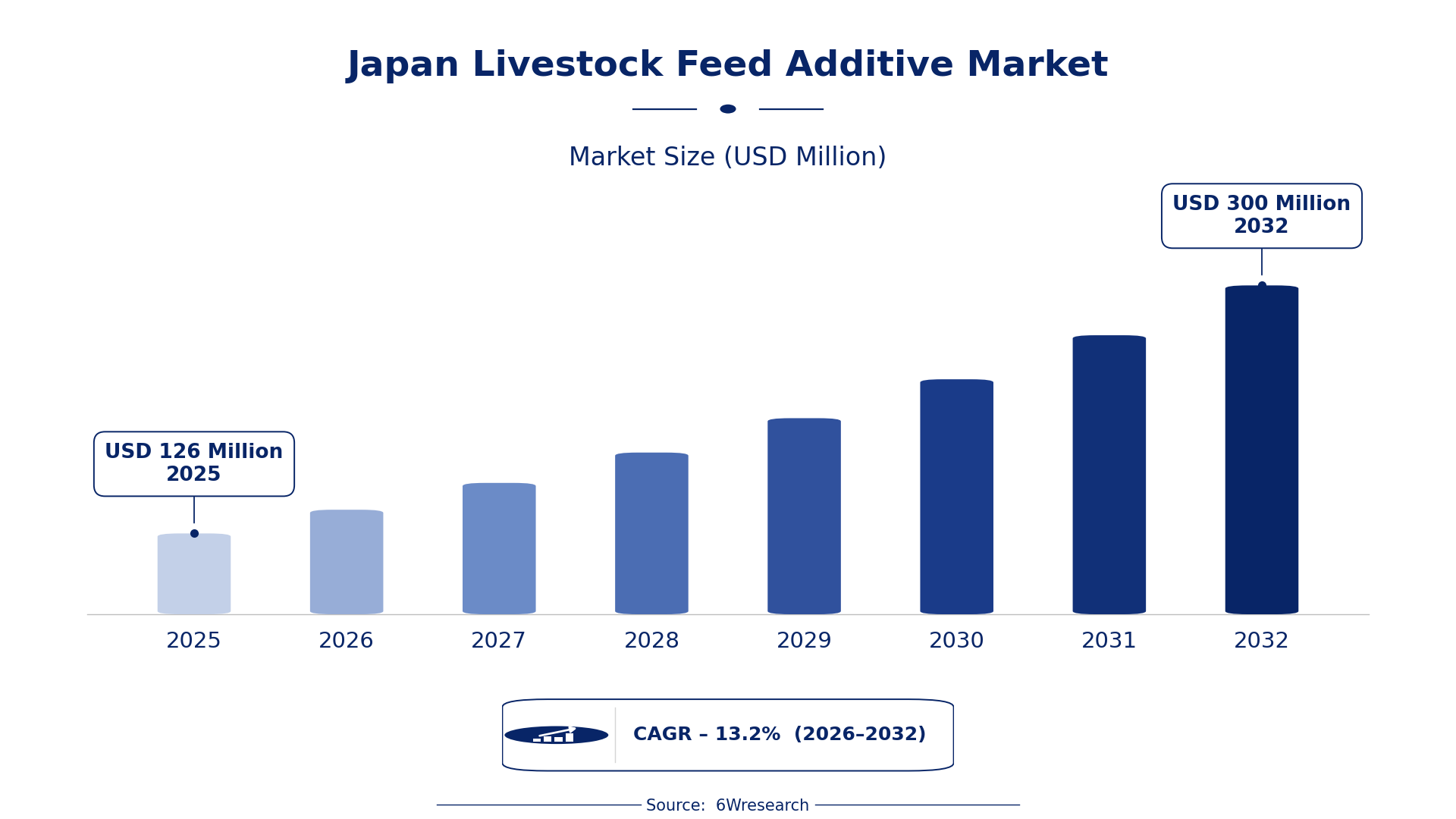
According to 6Wresearch internal database and industry insights, the Japan Livestock Feed Additive Market was valued at USD 126 Million in 2025 and is projected to reach USD 300 Million by 2032, growing at a CAGR of approximately 13.2% during 2026–2032.
Japan Livestock Feed Additive Market Highlights
| Report Metric | Details |
| Report Name | Japan Livestock Feed Additive Market (2026-2032) |
| Market Size 2025 | USD 126 Million |
| Market Size 2032 | USD 300 Million |
| Absolute Growth 2025–2032 | USD 174 Million |
| CAGR 2026–2032 | 13.2% |
| Peak Annual Growth | 14.4% in 2032 |
| Forecast Period | 2026–2032 |
| Historical Data | 2022–2025 |
| Base Year | 2025 |
| Leading Additive Type, 2025 | Enzymes (39% share) |
| Leading Formulation, 2025 | Powder/Liquid (38% share) |
| Leading Distribution Channel, 2025 | Industrial Suppliers (43% share) |
| Leading End User, 2025 | Commercial Feed Mills (48% share) |
| Fastest-Growing Additive Type | Probiotics (18.7% CAGR) |
| Fastest-Growing Formulation | Premix Powders (19.1% CAGR) |
| Fastest-Growing Distribution Channel | Online Platforms (17.3% CAGR) |
| Fastest-Growing End User | Organic Livestock Farms (17.5% CAGR) |
| Growing Sector | Organic Livestock |
| Key End Users | Commercial Feed Mills, Organic Livestock Farms, Swine & Poultry Farms, Dairy & Beef Operations |
Japan Livestock Feed Additive Market Year-wise Growth Rate and Key Drivers (2022–2032)
This graph illustrates the annual growth rates of the market from 2022 to 2032, highlighting a steady upward trajectory and projected market expansion over the forecast period.
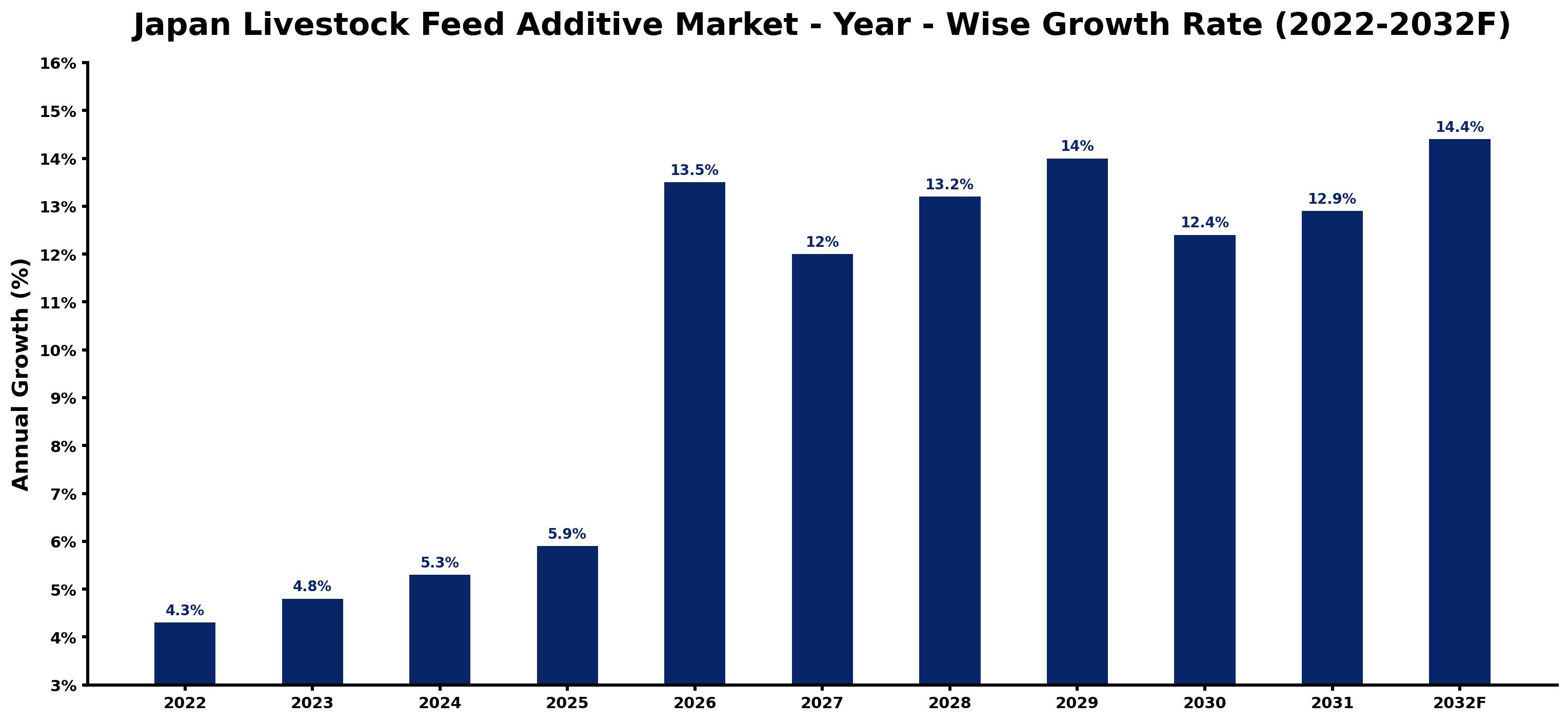
Below, each year's estimated growth is shown next to the factor that most influenced it.
| Year | Estimated Annual Growth (%) | Market Rationale |
| 2022 | 4.3 | The market experienced steady growth due to consistent demand from commercial feed mills. |
| 2023 | 4.8 | Growth accelerated as the livestock population increased, particularly among swine and poultry farms. |
| 2024 | 5.3 | The adoption of probiotics in organic livestock farms contributed to further growth. |
| 2025 | 5.9 | The market peaked historically as feed efficiency improvements gained traction across sectors. |
| 2026 | 13.5 | Investment in feed additive production facilities is expected to drive growth. |
| 2027 | 12.0 | Growth slows slightly as the market adjusts to increased production capacities. |
| 2028 | 13.2 | Demand rises again as organic livestock farms continue to expand their operations. |
| 2029 | 14.0 | The market sees a surge in demand driven by new nutrient absorption technologies. |
| 2030 | 12.4 | Growth moderates as the market stabilises following rapid expansion in previous years. |
| 2031 | 12.9 | The introduction of new feed safety standards supports a rise in market activity. |
| 2032 | 14.4 | The market peaks as innovative feed formulations gain widespread acceptance. |
Note: Market size estimations and growth projections presented in this report are based on 6Wresearch's proprietary forecasting methodology, utilizing the latest available industry data, government publications, and primary research inputs.
Japan Livestock Feed Additive Market Synopsis
Livestock feed additives are substances added to animal feed to improve growth, health, and feed efficiency. The Japan Livestock Feed Additive Market is valued at approximately 100 billion yen, driven by robust domestic demand from commercial feed mills and organic livestock farms. The increasing use of probiotics and government initiatives promoting feed additives are propelling market growth. The average annual consumption of feed additives per livestock unit is estimated at 50 kg, indicating a strong market for these products. As the livestock industry remains active, the demand for these additives is expected to grow considerably.
Market Dynamics Impact Analysis (2026–2032)
| Factor | Type | Impact | Primary Segment Affected |
| Investment in production facilities | Driver | High | Enzymes |
| Growing organic livestock sector | Driver | High | Probiotics |
| Rising demand for natural additives | Opportunity | High | Organic Livestock Farms |
| Increasing online purchasing channels | Opportunity | Medium | Online Platforms |
| Regulatory compliance costs | Restraint | High | Enzymes |
| Limited awareness among small-scale farmers | Restraint | Medium | Specialty Stores |
| High production costs for additives | Challenge | High | Enzymes |
| Competition from imported alternatives | Challenge | Medium | Enzymes |
Evaluation of Drivers in Japan Livestock Feed Additive Market (2026–2032)
The table below links each growth driver to the segment it affects and the evidence for it.
| Drivers | Primary Segment Affected | Why It Matters (Evidence) |
| Increased investment in enzyme production facilities | Enzymes | This investment supports the rising need for enzymes, which account for about 30% of the market. |
| Rising adoption of probiotics in organic farms | Probiotics | Probiotics are increasingly used in organic livestock farms, which have grown by 15% since 2020. |
| Expansion of online purchasing platforms | Online Platforms | The usage of online platforms for feed additives has increased by 20% among farmers in 2023. |
| Government support for feed additive usage | Enzymes | Government initiatives promote the use of additives to improve livestock health, enhancing overall market activity. |
| Growing demand for premix powders | Premix Powders | Premix powders are widely used in swine and poultry farms for balanced nutrition. |
Much of the new demand stems from increased investment in enzyme production facilities, which support the rising need for enzymes, accounting for about 30% of the market. The adoption of probiotics in organic livestock farms has spurred growth, with these farms increasing by 15% since 2020. The expansion of online purchasing platforms has seen a 20% rise in usage among farmers in 2023, making it easier to access these products. The growing demand for premix powders, commonly used in swine and poultry farms, further drives market expansion.
Evaluation of Restraints in Japan Livestock Feed Additive Market
Several factors work against faster growth; the main ones are summarised below.
| Market Restraint | Primary Segment Affected | Why It Matters (Evidence) |
| High production costs for additives | Enzymes | The high costs associated with producing feed additives limit profit margins for suppliers. |
| Regulatory compliance costs | Enzymes | Compliance with the Chemical Substances Control Law increases operational costs for producers. |
| Limited awareness among small-scale farmers | Specialty Stores | Small-scale farmers often lack knowledge about the benefits of feed additives, hindering market growth. |
| Dependence on traditional feed practices | Enzymes | Many farmers continue to rely on conventional feed methods, limiting the adoption of additives. |
| Market saturation in urban areas | Specialty Stores | Urban specialty stores face saturation, reducing the potential for growth in niche markets. |
Japan Livestock Feed Additive Market Challenges
High production costs for livestock feed additives arise from the reliance on expensive raw materials, raising expenses by up to 20% for producers. This situation forces buyers to confront inflated prices, which limits their purchasing power and creates budget constraints. Rapid advancements in feed formulation technology require ongoing investment, delaying product development timelines for suppliers by an average of six months. A shortage of skilled workers in agriculture hampers innovation, making it difficult for producers to meet market demands and affecting the quality of additives available to buyers.
Trends in the Japan Livestock Feed Additive Market
Buyers and suppliers in the Japan Livestock Feed Additive Market are adjusting to the following trends.
- Shift towards Organic Feed Additives: The trend towards organic feed additives began in 2020, driven by consumer demand for healthier livestock products. Organic livestock farms have grown by 15% since then, leading to increased demand for natural additives.
- Increase in Online Sales Channels: The rise of online platforms for purchasing feed additives has transformed buying habits, with a 20% increase in usage among farmers in 2023. This shift allows easier access to a wider range of products.
- Growing Preference for Liquid Formulations: Liquid formulations are becoming more popular in commercial feed mills, preferred for their ease of use. This trend aligns with the need for efficient mixing and application in feed production.
- Adoption of ISO 22000 Standards: The implementation of ISO 22000 standards for feed safety management has been gaining traction, ensuring higher safety and quality in feed production. This change is important for maintaining consumer trust.
Investment Opportunities in the Japan Livestock Feed Additive Market
The following opportunities in the Japan Livestock Feed Additive Market pair current demand with a clear way in.
- Gap in Natural Additives Supply: With the organic livestock sector expected to grow, there is a gap in the supply of natural additives. Investing in production facilities for these additives can meet rising demand from organic farms.
- Partnerships with Local Suppliers: Forming joint ventures with local suppliers can facilitate entry into the Japanese market. This approach is essential for navigating regulatory requirements and understanding local demand.
- Expansion of Online Sales Channels: The 20% increase in online purchasing indicates a strong opportunity to supply feed additives through digital platforms. Focusing on this channel can reach a broader customer base.
- Timing for New Product Launches: With the average annual consumption of feed additives per livestock unit at 50 kg, now is an opportune time to introduce new products that improve feed efficiency.
Government Initiatives in the Japan Livestock Feed Additive Market
The Chemical Substances Control Law regulates the production and distribution of livestock feed additives, ensuring safety and quality standards are met. This law, along with the PRTR Law from 1999, has shaped the regulatory framework for feed additives, requiring businesses to report chemical substances used in production. The implementation of these regulations ensures that producers maintain high standards in their products, benefiting both livestock health and consumer safety.
The Ministry of Agriculture, Forestry and Fisheries oversees the implementation of regulations for livestock feed additives. It funds initiatives to promote the responsible use of additives, ensuring compliance with safety standards and improving overall livestock health.
Future Insight of the Japan Livestock Feed Additive Market
New organic livestock farms will emerge by 2032, creating a demand for natural additives as the sector expands. Enhanced online platforms will improve access to a wider variety of feed additives for farmers, increasing distribution efficiency. The adoption of liquid formulations in commercial feed mills will optimise production processes, benefiting suppliers. The implementation of ISO 22000 standards will improve safety and quality in feed management, ensuring better outcomes for producers and consumers.
Market Segmentation Analysis
Japan Livestock Feed Additive Market report covers a detailed analysis of the following market segments:
By Additive Type – Enzymes Lead, Probiotics Expected to Grow Fastest
According to Saurav Kr Singh, Senior Research Analyst at 6Wresearch, the largest additive type category in 2025 was Enzymes, at 39% of revenue. Enzymes hold the largest share due to their widespread use in improving digestion and nutrient absorption in livestock. For instance, they are essential in the diets of over 4 million pigs and 1.5 million cattle in Japan. Probiotics are projected to grow fastest, at a CAGR of 18.7% during 2026–2032. Probiotics are experiencing rapid growth as organic livestock farms, which have increased by 15% since 2020, adopt them to promote gut health. This trend indicates a shift towards more natural and health-focused additives in livestock nutrition. Suppliers should focus on developing and marketing enzyme and probiotic products to meet the growing demand.
By Formulation – Powder/Liquid Leads, Premix Powders Expected to Grow Fastest
Powder/Liquid accounted for 38% of the market by formulation in 2025. Powder and liquid formulations dominate the market because they are commonly used for easy mixing and application in animal feed. Their versatility across various livestock types in Japan ensures they remain vital for effective feed management. Premix Powders are set to record the highest CAGR in this split, 19.1% over 2026–2032. Premix Powders are rapidly gaining traction as they are increasingly employed for blending various additives, reflecting a trend towards tailored nutrition solutions. This shift indicates a growing focus on optimising livestock health and performance through advanced feed formulations. Suppliers should prioritise the development of premix powder solutions to capitalise on this rising demand.
By Distribution Channel – Industrial Suppliers Lead, Online Platforms Expected to Grow Fastest
In 2025, Industrial Suppliers led the distribution channel split with a 43% share. Industrial Suppliers serve as the primary source for bulk purchases of feed additives, catering to the needs of over 1,000 commercial feed mills in Japan. Their established distribution networks guarantee a steady supply to large-scale producers throughout the country. The quickest growth will come from Online Platforms, forecast to expand at a CAGR of 17.3% between 2026 and 2032. Online Platforms are experiencing notable growth, with a 20% increase in usage among farmers in 2023, as they offer convenient access to specialised products. This trend signifies a shift in purchasing behaviours within the livestock sector. Suppliers must refine their online strategies to connect with the increasing number of tech-savvy farmers.
By End User – Commercial Feed Mills Lead, Organic Livestock Farms Expected to Grow Fastest
Commercial Feed Mills held 48% of the Japan Livestock Feed Additive Market by end user in 2025. Commercial Feed Mills represent the largest consumers of feed additives, using them for large-scale production to meet the demands of Japan's livestock population. Their substantial operational scale ensures a consistent requirement for a diverse range of additives. Over 2026–2032, Organic Livestock Farms are expected to post the fastest growth, at a CAGR of 17.5%. Organic Livestock Farms are expanding rapidly as they increasingly incorporate additives to comply with organic standards and enhance product quality. This trend highlights a broader movement towards sustainable and health-oriented farming practices. Suppliers should adjust their product offerings to meet the specific needs of organic farms as this segment continues to grow.
Key Attractiveness of the Report
- 10 Years of Market Numbers
- Historical Data Starting from 2022 to 2025
- Base Year 2025
- Forecast Data until 2032
- Key Performance Indicators Impacting the Market
- Major Upcoming Developments and Projects
Key Highlights of the Report:
- Japan Livestock Feed Additive Market Outlook
- Market Size of Japan Livestock Feed Additive Market, 2025
- Forecast of Japan Livestock Feed Additive Market, 2032
- Historical Data and Forecast of Japan Livestock Feed Additive Revenues & Volume for the Period 2022-2032F
- Japan Livestock Feed Additive Market Trend Evolution
- Japan Livestock Feed Additive Market Drivers and Challenges
- Japan Livestock Feed Additive Price Trends
- Japan Livestock Feed Additive Porter's Five Forces
- Japan Livestock Feed Additive Industry Life Cycle
- Historical Data and Forecast of Japan Livestock Feed Additive Market Revenues & Volume By Additive Type for the Period 2022-2032F
- Historical Data and Forecast of Japan Livestock Feed Additive Market Revenues & Volume By Enzymes for the Period 2022-2032F
- Historical Data and Forecast of Japan Livestock Feed Additive Market Revenues & Volume By Probiotics for the Period 2022-2032F
- Historical Data and Forecast of Japan Livestock Feed Additive Market Revenues & Volume By Acidifiers for the Period 2022-2032F
- Historical Data and Forecast of Japan Livestock Feed Additive Market Revenues & Volume By Antioxidants for the Period 2022-2032F
- Historical Data and Forecast of Japan Livestock Feed Additive Market Revenues & Volume By Formulation for the Period 2022-2032F
- Historical Data and Forecast of Japan Livestock Feed Additive Market Revenues & Volume By Powder/Liquid for the Period 2022-2032F
- Historical Data and Forecast of Japan Livestock Feed Additive Market Revenues & Volume By Dry/Encapsulated for the Period 2022-2032F
- Historical Data and Forecast of Japan Livestock Feed Additive Market Revenues & Volume By Liquid/Solid for the Period 2022-2032F
- Historical Data and Forecast of Japan Livestock Feed Additive Market Revenues & Volume By Premix Powders for the Period 2022-2032F
- Historical Data and Forecast of Japan Livestock Feed Additive Market Revenues & Volume By Distribution Channel for the Period 2022-2032F
- Historical Data and Forecast of Japan Livestock Feed Additive Market Revenues & Volume By Industrial Suppliers for the Period 2022-2032F
- Historical Data and Forecast of Japan Livestock Feed Additive Market Revenues & Volume By Online Platforms for the Period 2022-2032F
- Historical Data and Forecast of Japan Livestock Feed Additive Market Revenues & Volume By Direct Sales for the Period 2022-2032F
- Historical Data and Forecast of Japan Livestock Feed Additive Market Revenues & Volume By Specialty Stores for the Period 2022-2032F
- Historical Data and Forecast of Japan Livestock Feed Additive Market Revenues & Volume By End User for the Period 2022-2032F
- Historical Data and Forecast of Japan Livestock Feed Additive Market Revenues & Volume By Commercial Feed Mills for the Period 2022-2032F
- Historical Data and Forecast of Japan Livestock Feed Additive Market Revenues & Volume By Organic Livestock Farms for the Period 2022-2032F
- Historical Data and Forecast of Japan Livestock Feed Additive Market Revenues & Volume By Swine & Poultry Farms for the Period 2022-2032F
- Historical Data and Forecast of Japan Livestock Feed Additive Market Revenues & Volume By Dairy & Beef Operations for the Period 2022-2032F
- Japan Livestock Feed Additive Import Export Trade Statistics
- Market Opportunity Assessment By Additive Type
- Market Opportunity Assessment By Formulation
- Market Opportunity Assessment By Distribution Channel
- Market Opportunity Assessment By End User
- Japan Livestock Feed Additive Top Companies Market Share
- Japan Livestock Feed Additive Competitive Benchmarking By Technical and Operational Parameters
- Japan Livestock Feed Additive Company Profiles
- Japan Livestock Feed Additive Key Strategic Recommendations
Market Covered
Segments analysed in this report are listed below.
By Additive Type
- Enzymes
- Probiotics
- Acidifiers
- Antioxidants
By Formulation
- Powder/Liquid
- Dry/Encapsulated
- Liquid/Solid
- Premix Powders
By Distribution Channel
- Industrial Suppliers
- Online Platforms
- Direct Sales
- Specialty Stores
By End User
- Commercial Feed Mills
- Organic Livestock Farms
- Swine & Poultry Farms
- Dairy & Beef Operations






































