Japan Livestock Feed Equipment Market Size & Growth Rate
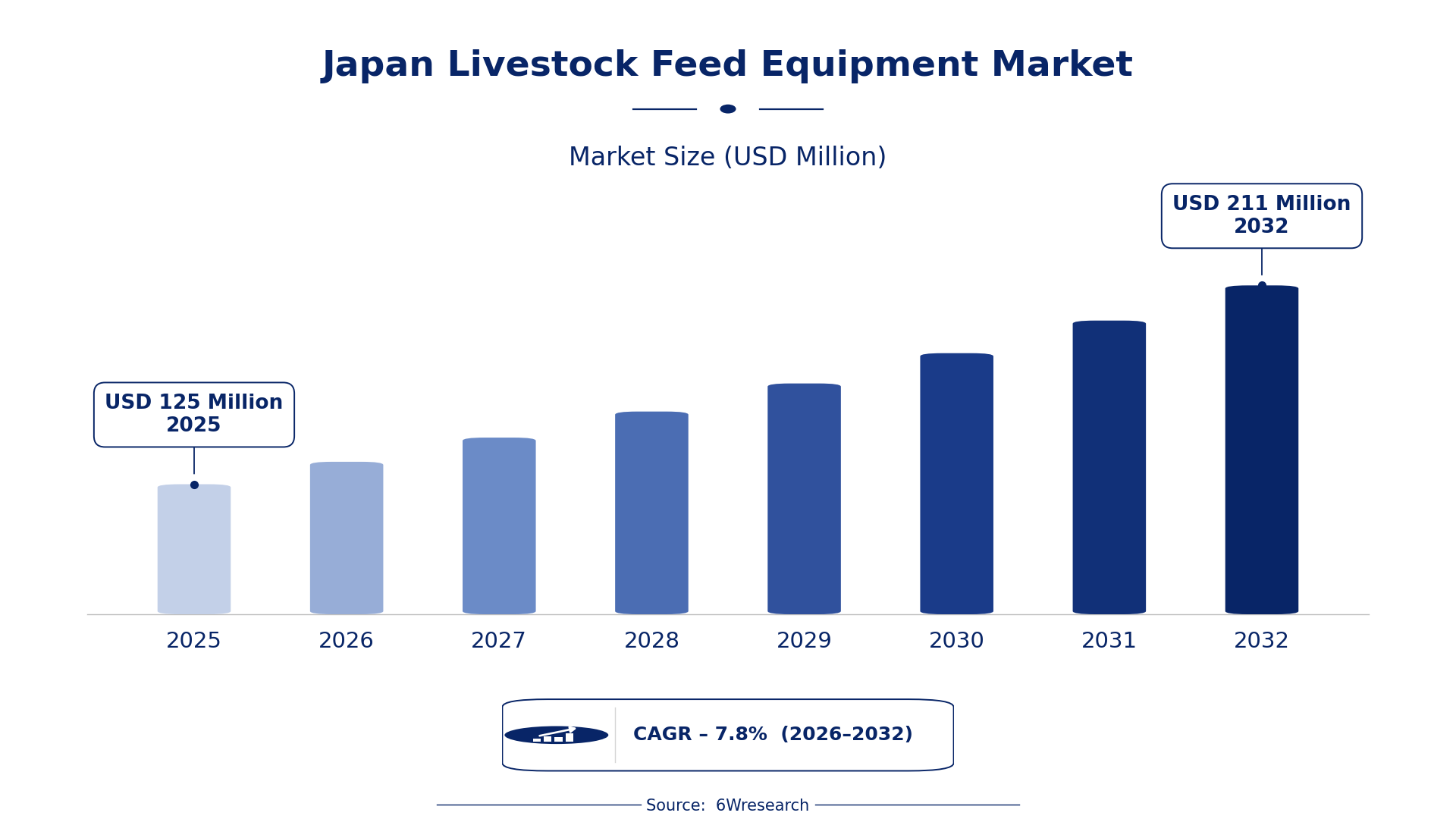
According to 6Wresearch internal database and industry insights, the Japan Livestock Feed Equipment Market was valued at USD 125 Million in 2025 and is projected to reach USD 211 Million by 2032, growing at a CAGR of approximately 7.8% during 2026–2032.
Japan Livestock Feed Equipment Market Highlights
| Report Metric | Details |
| Report Name | Japan Livestock Feed Equipment Market (2026-2032) |
| Market Size 2025 | USD 125 Million |
| Market Size 2032 | USD 211 Million |
| Absolute Growth 2025–2032 | USD 86 Million |
| CAGR 2026–2032 | 7.8% |
| Peak Annual Growth | 8.7% in 2027 |
| Forecast Period | 2026–2032 |
| Historical Data | 2022–2025 |
| Base Year | 2025 |
| Leading Equipment Type, 2025 | Mixer-Wagons (51% share) |
| Leading Operation Mode, 2025 | Hammer/Pellet Mills (49% share) |
| Leading Distribution Channel, 2025 | Direct Sales (38% share) |
| Leading End User, 2025 | Large-Scale Dairy Farms (48% share) |
| Fastest-Growing Equipment Type | TMR Feeders (10.6% CAGR) |
| Fastest-Growing Distribution Channel | Online Platforms (10.0% CAGR) |
| Fastest-Growing End User | Co-ops & Feed Mills (9.9% CAGR) |
| Growing Sector | dairy production |
| Key End Users | large-scale dairy farms, cooperatives, feed mills, beef feedlots |
Japan Livestock Feed Equipment Market Year-wise Growth Rate and Key Drivers (2022–2032)
This graph illustrates the annual growth rates of the market from 2022 to 2032, highlighting a steady upward trajectory and projected market expansion over the forecast period.
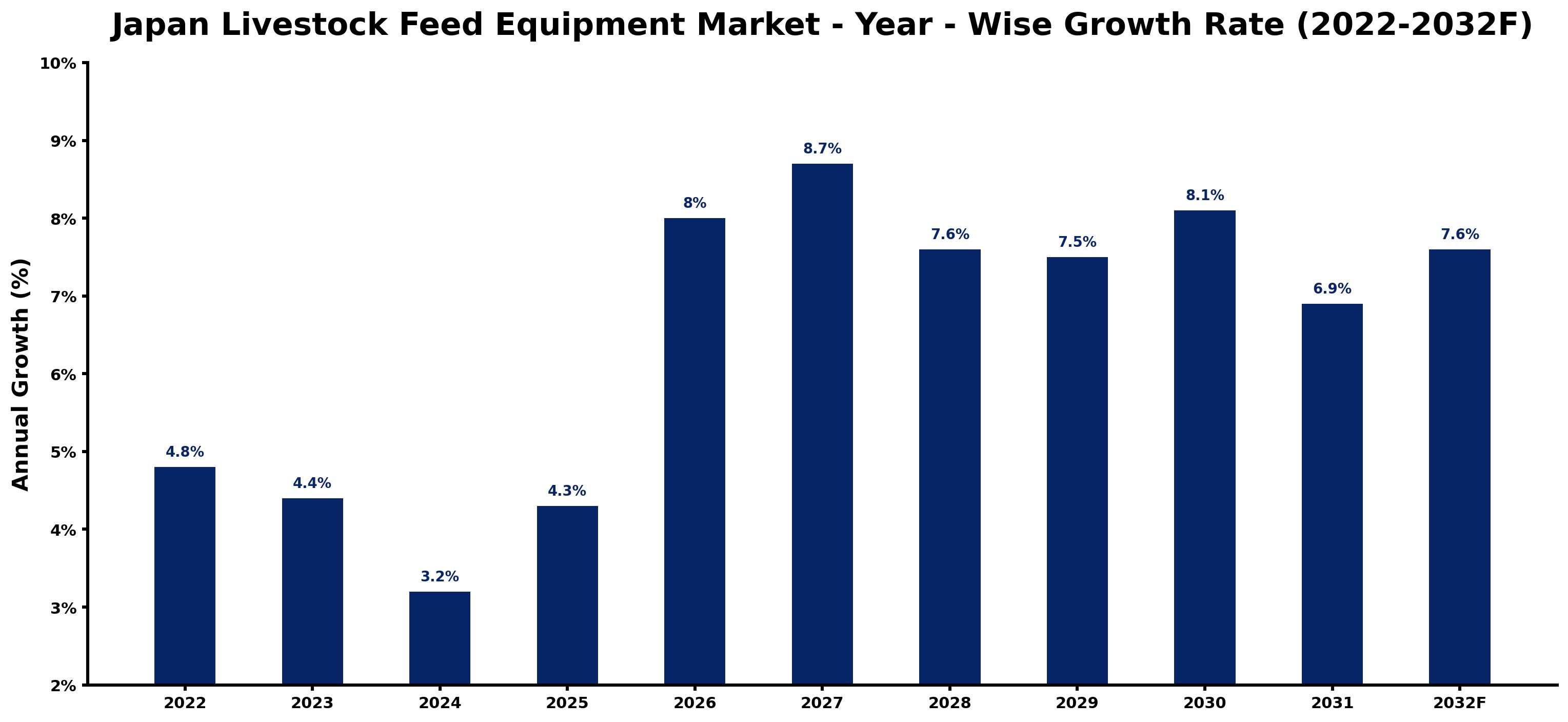
The table below sets out the estimated growth rate for each year and the main factor behind it.
| Year | Estimated Annual Growth (%) | Market Rationale |
| 2022 | 4.8 | The market experienced strong demand from large-scale dairy farms and cooperatives. |
| 2023 | 4.4 | Growth slowed due to market saturation and limited supply chain capacity. |
| 2024 | 3.2 | Continued slow growth reflected challenges in feed production efficiency and rising operational costs. |
| 2025 | 4.3 | Demand increased as dairy production expanded, driving equipment purchases. |
| 2026 | 8.0 | Growth is expected to accelerate with rising investments in feed efficiency technologies and practices. |
| 2027 | 8.7 | The market is projected to peak due to heightened demand from dairy producers and feed mills. |
| 2028 | 7.6 | Growth is expected to slow as the market stabilises after the previous peak. |
| 2029 | 7.5 | Continued slow growth is projected due to market maturity and competitive pressures. |
| 2030 | 8.1 | Demand will rise again as technological advancements improve feed processing. |
| 2031 | 6.9 | Growth is expected to slow as the market adjusts to new operational standards and regulations. |
| 2032 | 7.6 | Demand is expected to rise with increasing focus on sustainable livestock practices. |
Note: Market size estimations and growth projections presented in this report are based on 6Wresearch's proprietary forecasting methodology, utilizing the latest available industry data, government publications, and primary research inputs.
Japan Livestock Feed Equipment Market Synopsis
Livestock feed equipment includes machinery used for preparing and distributing animal feed, crucial for dairy and beef production. The Japan Livestock Feed Equipment Market is growing, driven by approximately 1.5 million dairy cows and an increasing focus on feed efficiency. Demand primarily comes from large-scale dairy farms and cooperatives, with rising investments in advanced technologies further propelling growth. The market is expected to reach around 1.2 trillion yen in 2023 as producers aim to boost productivity and adhere to strict safety regulations.
Market Dynamics Impact Analysis (2026–2032)
| Factor | Type | Impact | Primary Segment Affected |
| Increasing dairy production drives demand for efficient feed preparation equipment. | Driver | High | TMR Feeders |
| Growing focus on sustainable livestock practices presents opportunities for innovative equipment. | Opportunity | High | Mixer-Wagons |
| Strict feed safety regulations require compliance, limiting market entry for new players. | Restraint | High | Feed Grinders |
| Aging farmer population may lead to workforce shortages in the livestock sector. | Challenge | Medium | Bunk Feeders |
| Rising operational costs necessitate investment in efficient feed processing solutions. | Driver | High | Hammer/Pellet Mills |
| Online sales channels are expanding, offering new distribution opportunities. | Opportunity | Medium | Online Platforms |
| Limited access to advanced technologies may hinder competitiveness. | Restraint | Medium | TMR Feeders |
| Market saturation could restrict growth potential for existing suppliers. | Challenge | Medium | Mixer-Wagons |
Evaluation of Drivers in Japan Livestock Feed Equipment Market (2026–2032)
The factors lifting demand, and the evidence behind each, are summarised below.
| Drivers | Primary Segment Affected | Why It Matters (Evidence) |
| Rising dairy production increases the need for efficient feed equipment. | TMR Feeders | The TMR feeder market is growing due to increasing dairy production, with approximately 1.5 million dairy cows in Japan. |
| Investments in feed processing technologies improve operational efficiency. | Hammer/Pellet Mills | Feed grinders are essential in over 70% of feed production facilities, driving demand for advanced equipment. |
| Growing consumer demand for high-quality livestock products boosts feed equipment purchases. | Mixer-Wagons | The average dairy farm size is expected to increase to 150 cows by 2025, leading to higher demand for efficient feed mixing solutions. |
| Sustainable farming practices encourage investments in modern feed solutions. | Bunk Feeders | Government initiatives promote sustainable livestock practices, increasing demand for compliant equipment. |
| Technological advancements improve feed conversion ratios, enhancing profitability. | Feed Grinders | The average feed conversion ratio for beef cattle in Japan is 6.5, prompting investments in efficient feed preparation. |
Behind the steady rise in orders is Japan's increasing dairy production, with approximately 1.5 million dairy cows driving the need for TMR feeders. By 2025, the average size of dairy farms is projected to rise to 150 cows, resulting in greater demand for efficient feed mixing solutions. Investments in advanced feed processing technologies are essential, as over 70% of feed production facilities depend on grinders to enhance efficiency. Sustainable practices are prompting large-scale dairy farms to invest in bunk feeders, while technological advancements that improve feed conversion ratios encourage further investments in grinders to boost profitability.
Evaluation of Restraints in Japan Livestock Feed Equipment Market
These are the pressures that could keep growth below its potential.
| Market Restraint | Primary Segment Affected | Why It Matters (Evidence) |
| Strict feed safety regulations limit market entry for new suppliers. | Feed Grinders | Japan adheres to JIS standards, requiring compliance that can be costly for new entrants. |
| Limited access to advanced technologies may hinder competitiveness. | TMR Feeders | Many producers face challenges in adopting new technologies, affecting their operational efficiency. |
| Aging farmer population may lead to workforce shortages in the livestock sector. | Bunk Feeders | The average age of farmers in Japan is 66, impacting the availability of skilled labour. |
| Market saturation could restrict growth potential for existing suppliers. | Mixer-Wagons | With a mature market, competition intensifies, limiting new customer acquisition. |
| Rising operational costs necessitate investment in efficient feed processing solutions. | Hammer/Pellet Mills | Increasing minimum wage, currently at JPY 1,055 per hour, raises operational expenses. |
Japan Livestock Feed Equipment Market Challenges
Buyers in Japan's livestock feed market are contending with rising operational costs as the national minimum wage reached JPY 1,055 per hour in October 2024, which pressures profit margins for large-scale farms. Stringent feed safety regulations from the Ministry of Agriculture, Forestry and Fisheries necessitate substantial investments in quality control, causing delays in production schedules for feed mills. A notable skills gap exists, with the average age of farmers at 66 years, leading to a shortage of trained personnel for operating advanced equipment. Supply chain inefficiencies arise since over 2,000 feed mills rely heavily on feed grinders, resulting in maintenance delays and increased downtime.
Trends in the Japan Livestock Feed Equipment Market
Four trends stand out in the Japan Livestock Feed Equipment Market.
- Shift from Traditional to Automated Feed Solutions: Since 2023, there has been a notable shift towards automated feed solutions, particularly in the Hokkaido region, where dairy production is concentrated. This transition is reflected as online sales of agricultural equipment increased by 15%, indicating a growing preference for efficiency.
- Transition from Manual to Digital Distribution Channels: The livestock feed equipment market is moving towards digital sales platforms. In recent years, online platforms have gained traction, with a 15% increase in sales, reflecting changing buyer preferences for convenience and accessibility.
- Emergence of Sustainable Feed Practices: The emphasis on sustainable livestock practices has gained momentum, particularly driven by government initiatives. More farms are adopting eco-friendly feed solutions, enhancing production efficiency and meeting consumer demands.
- Prioritisation of Feed Safety Standards: Since the enactment of the Feed Safety Law in 2004, there has been a strong focus on adhering to stringent feed safety standards. This trend is vital for producers aiming to maintain compliance and ensure product quality.
Investment Opportunities in the Japan Livestock Feed Equipment Market
The openings below show where demand in the Japan Livestock Feed Equipment Market is visible and how suppliers can enter.
- Joint Ventures with Local Producers: Entering the market through joint ventures with local producers is timely, especially as the market is projected to grow to USD 211 million by 2032, creating substantial demand.
- Investment in Sustainable Equipment: With the government's aim to increase domestic feed production by 20% by 2025, there is a clear opportunity to invest in sustainable feed equipment that meets new standards, particularly for cooperatives and large-scale farms.
- Expansion of Online Sales Channels: The rise in online sales of agricultural equipment, which increased by 15% last year, presents an opportunity to develop digital platforms for distribution, catering to tech-savvy buyers in urban areas.
- Focus on Feed Efficiency Technologies: The market gap for advanced feed efficiency technologies is clear, with a projected growth rate of 7.8% by 2032. Suppliers should concentrate on innovative solutions for large-scale dairy farms.
Government Initiatives in the Japan Livestock Feed Equipment Market
The Industrial Standardization Act, amended in 2019, establishes the framework for product and test standards in Japan, ensuring that livestock feed equipment meets quality and safety requirements. This law mandates compliance for producers, impacting their operational practices and product offerings. Additionally, the Act against Unjustifiable Premiums and Misleading Representations prohibits misleading labelling and advertising of goods, ensuring transparency in the market.
The Ministry of Agriculture, Forestry and Fisheries oversees the implementation of feed safety regulations and funds initiatives aimed at promoting sustainable livestock practices. This agency ensures that producers adhere to safety standards, providing guidance and support for compliance. In 2023, the ministry funded several projects to improve feed quality and safety across the industry.
Future Insight of the Japan Livestock Feed Equipment Market
Technological advancements in feed efficiency will reshape the market by 2032, with insights from the National Livestock Breeding Center improving production methods. The government's initiative to boost domestic feed production by 20% by 2025 will strengthen local supply chains. Online sales of agricultural equipment, which surged by 15% last year, will continue to broaden buyer choices. As the average dairy farm size increases to 150 cows by 2025, suppliers must adapt their offerings to meet the demands of larger farming operations.
Market Segmentation Analysis
Japan Livestock Feed Equipment Market report covers a detailed analysis of the following market segments:
By Equipment Type – Mixer-Wagons Lead, TMR Feeders Expected to Grow Fastest
According to Saurav Kr Singh, Senior Research Analyst at 6Wresearch, Mixer-Wagons took 51% of equipment type revenue in 2025, more than any other category. Mixer-wagons play a crucial role in the efficient mixing and distribution of feed, making them indispensable for large-scale dairy operations. Their widespread use in regions such as Hokkaido, known for its dairy production, solidifies their leading market share. TMR Feeders are projected to grow fastest, at a CAGR of 10.6% during 2026–2032. The TMR feeders are experiencing rapid growth, driven by the increasing demand for total mixed ration feeding as dairy production rises. This trend is further supported by government initiatives aimed at boosting domestic feed production by 20% by 2025, ensuring sustained demand. Suppliers should focus on enhancing TMR feeder offerings to capitalise on this growth opportunity.
By Operation Mode – Hammer/Pellet Mills Lead and Record the Fastest Growth
In 2025, Hammer/Pellet Mills led the operation mode split with a 49% share. Hammer/pellet mills are essential for processing feed, ensuring the production of high-quality feed that meets industry standards. Their widespread use across over 2,000 feed mills in Japan highlights their critical role in the market. Hammer/Pellet Mills are also forecast to expand faster than any other category, at a CAGR of 9.8% over 2026–2032. Hammer/pellet mills are also the fastest-growing segment, as their efficiency aligns with the increasing demand for quality feed in the livestock sector. This dual role suggests that their market share will continue to expand as they meet evolving needs. Suppliers must uphold high standards in hammer/pellet mills to satisfy the livestock industry's growing expectations.
By Distribution Channel – Direct Sales Leads, Online Platforms Expected to Grow Fastest
The largest distribution channel category in 2025 was Direct Sales, at 38% of revenue. Direct sales remain the primary method of equipment distribution, allowing manufacturers to establish strong relationships with large-scale dairy farms. This channel's effectiveness is underscored by its prevalence in the market, particularly among major agricultural cooperatives. Online Platforms are set to record the highest CAGR in this split, 10.0% over 2026–2032. Online platforms are emerging as the fastest-growing distribution channel, with a 15% increase in agricultural equipment sales online over the past year. This shift indicates a growing preference for digital purchasing options among buyers. Suppliers should invest in online marketing strategies to capture the increasing demand through digital channels.
By End User – Large-Scale Dairy Farms Lead, Co-ops & Feed Mills Expected to Grow Fastest
With 48% of end user revenue in 2025, Large-Scale Dairy Farms was the largest category. Large-scale dairy farms dominate the market as they constitute the primary users of feed equipment, driven by their substantial feed requirements. Their operational scale necessitates advanced feed machinery to maximise production efficiency and maintain high-quality standards. The quickest growth will come from Co-ops & Feed Mills, forecast to expand at a CAGR of 9.9% between 2026 and 2032. Co-ops and feed mills represent the fastest-growing end user segment, as they are pivotal in the feed production and distribution process, responding to the increasing demand for quality feed. Their expansion indicates a notable shift within the livestock feed supply chain. Suppliers must tailor their solutions to meet the evolving needs of co-ops and feed mills.
Key Attractiveness of the Report
- 10 Years of Market Numbers
- Historical Data Starting from 2022 to 2025
- Base Year 2025
- Forecast Data until 2032
- Key Performance Indicators Impacting the Market
- Major Upcoming Developments and Projects
Key Highlights of the Report:
- Japan Livestock Feed Equipment Market Outlook
- Market Size of Japan Livestock Feed Equipment Market, 2025
- Forecast of Japan Livestock Feed Equipment Market, 2032
- Historical Data and Forecast of Japan Livestock Feed Equipment Revenues & Volume for the Period 2022-2032F
- Japan Livestock Feed Equipment Market Trend Evolution
- Japan Livestock Feed Equipment Market Drivers and Challenges
- Japan Livestock Feed Equipment Price Trends
- Japan Livestock Feed Equipment Porter's Five Forces
- Japan Livestock Feed Equipment Industry Life Cycle
- Historical Data and Forecast of Japan Livestock Feed Equipment Market Revenues & Volume By Equipment Type for the Period 2022-2032F
- Historical Data and Forecast of Japan Livestock Feed Equipment Market Revenues & Volume By Mixer-Wagons for the Period 2022-2032F
- Historical Data and Forecast of Japan Livestock Feed Equipment Market Revenues & Volume By Feed Grinders for the Period 2022-2032F
- Historical Data and Forecast of Japan Livestock Feed Equipment Market Revenues & Volume By Bunk Feeders for the Period 2022-2032F
- Historical Data and Forecast of Japan Livestock Feed Equipment Market Revenues & Volume By TMR Feeders for the Period 2022-2032F
- Historical Data and Forecast of Japan Livestock Feed Equipment Market Revenues & Volume By Operation Mode for the Period 2022-2032F
- Historical Data and Forecast of Japan Livestock Feed Equipment Market Revenues & Volume By Tongue-/Trailer-Mounted for the Period 2022-2032F
- Historical Data and Forecast of Japan Livestock Feed Equipment Market Revenues & Volume By Hammer/Pellet Mills for the Period 2022-2032F
- Historical Data and Forecast of Japan Livestock Feed Equipment Market Revenues & Volume By Gravity/Automated for the Period 2022-2032F
- Historical Data and Forecast of Japan Livestock Feed Equipment Market Revenues & Volume By Self-Propelled for the Period 2022-2032F
- Historical Data and Forecast of Japan Livestock Feed Equipment Market Revenues & Volume By Distribution Channel for the Period 2022-2032F
- Historical Data and Forecast of Japan Livestock Feed Equipment Market Revenues & Volume By Direct Sales for the Period 2022-2032F
- Historical Data and Forecast of Japan Livestock Feed Equipment Market Revenues & Volume By Online Platforms for the Period 2022-2032F
- Historical Data and Forecast of Japan Livestock Feed Equipment Market Revenues & Volume By Industrial Suppliers for the Period 2022-2032F
- Historical Data and Forecast of Japan Livestock Feed Equipment Market Revenues & Volume By Specialty Stores for the Period 2022-2032F
- Historical Data and Forecast of Japan Livestock Feed Equipment Market Revenues & Volume By End User for the Period 2022-2032F
- Historical Data and Forecast of Japan Livestock Feed Equipment Market Revenues & Volume By Large-Scale Dairy Farms for the Period 2022-2032F
- Historical Data and Forecast of Japan Livestock Feed Equipment Market Revenues & Volume By Co-ops & Feed Mills for the Period 2022-2032F
- Historical Data and Forecast of Japan Livestock Feed Equipment Market Revenues & Volume By Feedlot Operations for the Period 2022-2032F
- Historical Data and Forecast of Japan Livestock Feed Equipment Market Revenues & Volume By Beef Feedlots for the Period 2022-2032F
- Japan Livestock Feed Equipment Import Export Trade Statistics
- Market Opportunity Assessment By Equipment Type
- Market Opportunity Assessment By Operation Mode
- Market Opportunity Assessment By Distribution Channel
- Market Opportunity Assessment By End User
- Japan Livestock Feed Equipment Top Companies Market Share
- Japan Livestock Feed Equipment Competitive Benchmarking By Technical and Operational Parameters
- Japan Livestock Feed Equipment Company Profiles
- Japan Livestock Feed Equipment Key Strategic Recommendations
Market Covered
The following segment groups are covered in the report.
By Equipment Type
- Mixer-Wagons
- Feed Grinders
- Bunk Feeders
- TMR Feeders
By Operation Mode
- Tongue-/Trailer-Mounted
- Hammer/Pellet Mills
- Gravity/Automated
- Self-Propelled
By Distribution Channel
- Direct Sales
- Online Platforms
- Industrial Suppliers
- Specialty Stores
By End User
- Large-Scale Dairy Farms
- Co-ops & Feed Mills
- Feedlot Operations
- Beef Feedlots






































