Japan Livestock Feed Market Size & Growth Rate
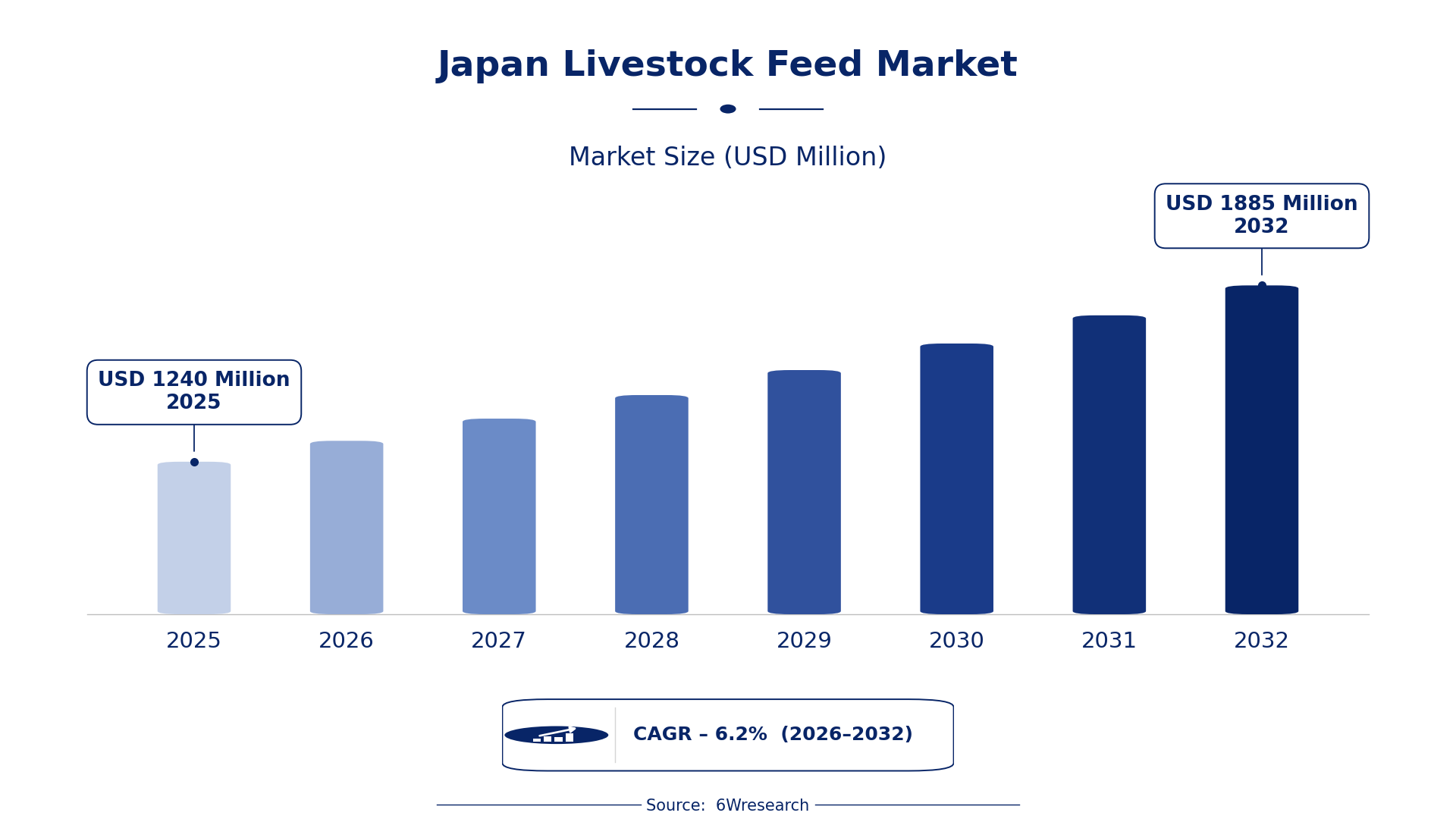
According to 6Wresearch internal database and industry insights, the Japan Livestock Feed Market was valued at USD 1,240 Million in 2025 and is projected to reach USD 1,885 Million by 2032, growing at a CAGR of approximately 6.2% during 2026–2032.
Japan Livestock Feed Market Highlights
| Report Metric | Details |
| Report Name | Japan Livestock Feed Market (2026-2032) |
| Market Size 2025 | USD 1,240 Million |
| Market Size 2032 | USD 1,885 Million |
| Absolute Growth 2025–2032 | USD 645 Million |
| CAGR 2026–2032 | 6.2% |
| Peak Annual Growth | 7.2% in 2028 |
| Forecast Period | 2026–2032 |
| Historical Data | 2022–2025 |
| Base Year | 2025 |
| Leading Feed Type, 2025 | Mash/Pellets (44% share) |
| Leading Species Targeted, 2025 | Poultry (45% share) |
| Leading Distribution Channel, 2025 | Direct Sales (37% share) |
| Leading End User, 2025 | Broiler & Layer Farms (37% share) |
| Fastest-Growing Feed Type | Concentrates (9.0% CAGR) |
| Fastest-Growing Species Targeted | Swine (8.1% CAGR) |
| Fastest-Growing Distribution Channel | Online Platforms (8.3% CAGR) |
| Fastest-Growing End User | Pig Production Farms (8.4% CAGR) |
| Growing Sector | Poultry |
| Key End Users | Poultry Farms, Dairy Cooperatives, Swine Farms, Beef Producers |
Japan Livestock Feed Market Year-wise Growth Rate and Key Drivers (2022–2032)
This graph illustrates the annual growth rates of the market from 2022 to 2032, highlighting a steady upward trajectory and projected market expansion over the forecast period.
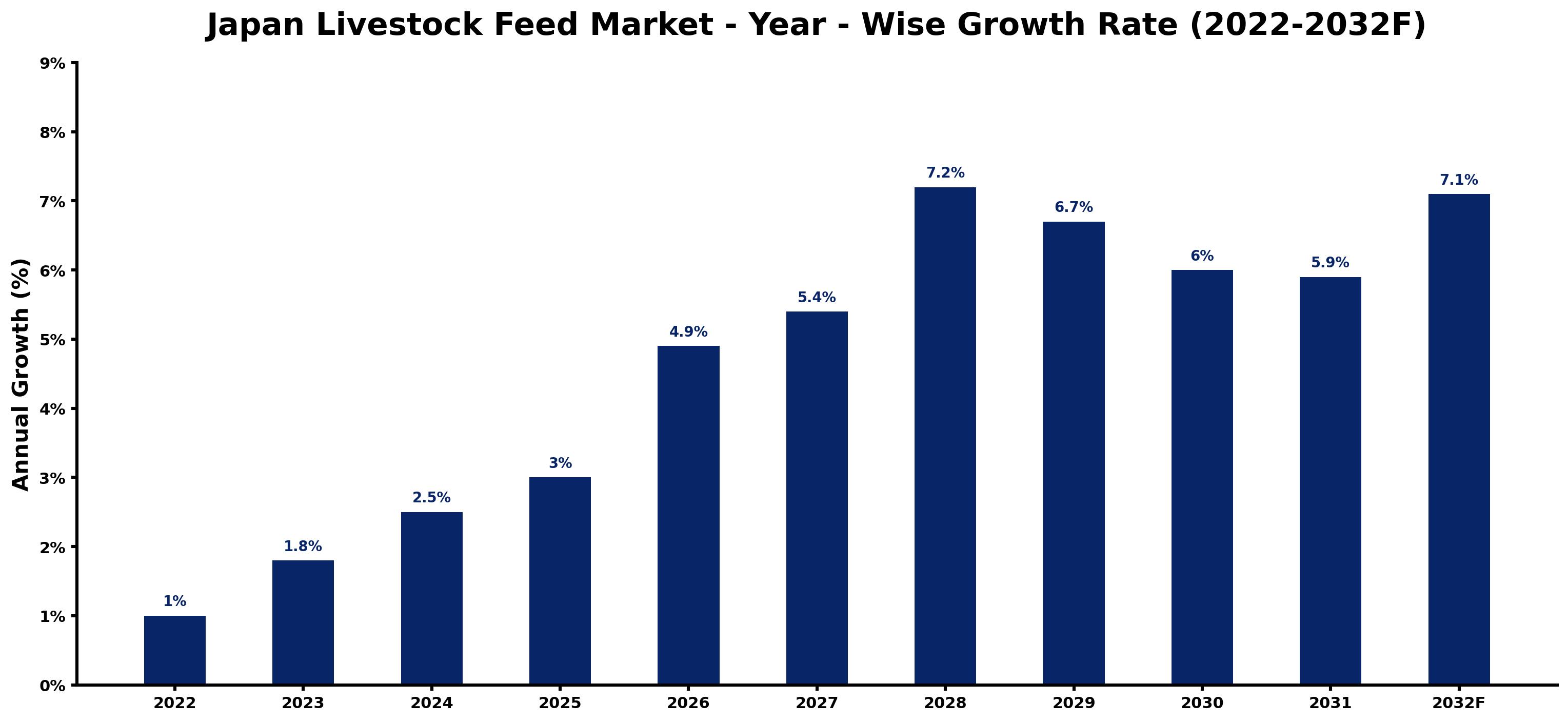
Year by year, the estimates below pair each growth rate with the development that shaped it.
| Year | Estimated Annual Growth (%) | Market Rationale |
| 2022 | 1.0 | The market showed steady activity with consistent feed production levels. |
| 2023 | 1.8 | Growth accelerated as demand from poultry farms increased. |
| 2024 | 2.5 | Higher feed intake for dairy cattle boosted overall consumption rates. |
| 2025 | 3.0 | The poultry sector's strong performance drove demand for livestock feed. |
| 2026 | 4.9 | Rising investments in feed production facilities are expected to enhance supply capacity. |
| 2027 | 5.4 | Increased adoption of TMR mixes among dairy farms will support growth. |
| 2028 | 7.2 | The market peaked as feed production expanded to meet rising demand. |
| 2029 | 6.7 | Growth slowed slightly as supply chain issues began to impact availability. |
| 2030 | 6.0 | Continued demand from swine farms will maintain a positive growth trend. |
| 2031 | 5.9 | Growth decelerated as market adjustments took place in response to costs. |
| 2032 | 7.1 | Demand surged again as subsidies for feed production are expected to increase. |
Note: Market size estimations and growth projections presented in this report are based on 6Wresearch's proprietary forecasting methodology, utilizing the latest available industry data, government publications, and primary research inputs.
Japan Livestock Feed Market Synopsis
Livestock feed in Japan consists of mash, pellets, concentrates, and TMR mixes, produced to meet the nutritional needs of livestock such as poultry, swine, and cattle. The Japan Livestock Feed Market is growing due to rising consumption in the poultry sector, which accounts for 45% of total feed use. Investments in production facilities and the increasing adoption of modern feed types, particularly TMR mixes, are driving demand from dairy and beef producers, further advancing market growth.
Market Dynamics Impact Analysis (2026–2032)
| Factor | Type | Impact | Primary Segment Affected |
| Growing poultry production | Driver | High | Poultry |
| Increased adoption of TMR mixes | Driver | High | Dairy |
| Expansion of online sales channels | Opportunity | High | Direct Sales |
| Rising demand for specialty feed products | Opportunity | Medium | Concentrates |
| Supply chain disruptions affecting feed availability | Restraint | High | Mash/Pellets |
| Rising costs of raw materials impacting production | Restraint | High | Concentrates |
| Increased competition among feed producers | Challenge | Medium | Mash/Pellets |
| Regulatory compliance costs for feed safety | Challenge | Medium | Mash/Pellets |
Evaluation of Drivers in Japan Livestock Feed Market (2026–2032)
Key forces behind demand, with the segment each one moves most, are listed below.
| Drivers | Primary Segment Affected | Why It Matters (Evidence) |
| Rising poultry production | Poultry | The poultry sector accounts for 45% of total livestock feed consumption, driving increased purchases of feed. |
| Increased adoption of TMR mixes | Dairy | With 30% of dairy farms using TMR mixes, demand for these products is rising. |
| Growing dairy cattle population | Dairy | The population of dairy cattle in Japan is approximately 1.5 million, increasing feed demand. |
| Expansion of online sales channels | Direct Sales | Online sales of livestock feed grew by 15% in 2023, attracting more buyers. |
| Increased feed safety standards | Mash/Pellets | ISO 22000 standards enhance feed quality, encouraging producers to invest in compliance. |
Buyers are adding capacity as the poultry sector continues to thrive, accounting for 45% of total livestock feed consumption. The average daily feed intake for dairy cattle is 25 kg, which increases demand for TMR mixes, now used by 30% of dairy farms. The population of dairy cattle drives further feed purchases. Compliance with ISO 22000 standards is prompting producers to invest in quality improvements, boosting overall market growth. The Tokyo region, a major hub for livestock feed distribution, is seeing increased activity as suppliers respond to rising demand.
Evaluation of Restraints in Japan Livestock Feed Market
The main factors holding the market back are set out below.
| Market Restraint | Primary Segment Affected | Why It Matters (Evidence) |
| Supply chain disruptions | Mash/Pellets | Global supply chain issues increased the average cost of livestock feed by 10% in 2023. |
| Rising raw material costs | Concentrates | The cost pressures from raw materials increased production costs for feed producers by 15%. |
| Competition among feed producers | Mash/Pellets | Increased competition can lead to price wars, impacting profitability for producers. |
| Regulatory compliance costs | Concentrates | Compliance with feed safety regulations can increase operational costs for producers by 20%. |
| Limited presence of specialty stores | Specialty Stores | The minor role of specialty stores restricts market access for certain feed types. |
Japan Livestock Feed Market Challenges
Dairy farms in Hokkaido face challenges with rising costs, as feed prices increased by 10% in 2023 due to global supply chain disruptions, squeezing their operating margins. A shortage of skilled workers in livestock feed production continues, as fewer trained professionals enter the field, resulting in production delays that hinder suppliers' ability to meet demand. Supply chain disruptions lead to inconsistent availability of key ingredients, forcing producers to seek substitutes, which can delay shipments to buyers. Buyers confront escalating prices and reduced choices, particularly in the poultry sector, which accounts for 45% of total livestock feed consumption, as they navigate these ongoing challenges.
Trends in the Japan Livestock Feed Market
These developments are changing demand patterns in the Japan Livestock Feed Market.
- Shift towards TMR Mixes: The adoption of TMR mixes in dairy farming has increased, with 30% of farms now using them. This shift improves nutritional management and efficiency in feed use.
- Growth of Online Sales Channels: Since 2023, online platforms for livestock feed have expanded rapidly, growing by 15%. This trend is reshaping how buyers access feed products, increasing convenience.
- Increase in Feed Safety Standards: The implementation of ISO 22000 standards for feed safety management has become important. This change ensures higher quality and safety in livestock feed production.
- Rising Demand for Specialty Feeds: The demand for specialty feed products is increasing, driven by specific nutritional needs. This trend is particularly evident in the concentrates segment, which is projected to grow.
Investment Opportunities in the Japan Livestock Feed Market
Below are the investment opportunities with the strongest case in the Japan Livestock Feed Market.
- Tokyo Region as a Distribution Hub: The Tokyo region serves as a major hub for livestock feed distribution, presenting opportunities for logistics investments. With a growing market, suppliers can benefit from strategic partnerships.
- Investment in Feed Production Facilities: Increased subsidies for feed production by 20% in 2023 create opportunities for new facilities. Collaborating with local farmers in Hokkaido can improve supply chain efficiency.
- Focus on Dairy Cooperatives: Dairy cooperatives are significant users of mixed feed products, with over 1 million tons utilised annually. Suppliers can enter this market by offering tailored feed solutions.
- Expansion of Direct Sales Channels: The direct sales channel, holding a 37% market share, presents investment opportunities. Establishing partnerships with industrial suppliers can streamline distribution.
Government Initiatives in the Japan Livestock Feed Market
The Livestock Industry Promotion Act supports livestock feed production by incentivising local farmers and ensuring quality standards. This act has led to a 20% increase in subsidies for feed production in 2023, benefiting farmers across Japan. Compliance with ISO 22000 standards ensures that producers maintain high safety and quality levels in feed manufacturing, which is crucial for meeting the nutritional needs of livestock and improving overall production efficiency.
The Ministry of Agriculture, Forestry and Fisheries oversees the regulation of the livestock feed market, approving safety standards and funding initiatives aimed at improving feed production. The Japan Feed Association plays a key role in enforcing quality standards, ensuring that producers adhere to regulations that safeguard livestock health. This oversight is crucial for maintaining consumer confidence and supporting the growth of the livestock industry.
Future Insight of the Japan Livestock Feed Market
Investment in advanced livestock feed production technologies will drive demand for more efficient manufacturing practices. By 2032, the increased adoption of TMR mixes, currently used by 30% of dairy farms, will enhance nutritional delivery for livestock. Enhanced subsidies for feed production will further support local farmers, ensuring a reliable supply chain. Online sales, which expanded by 15% in 2023, will continue evolving, offering buyers improved purchasing flexibility and convenience.
Market Segmentation Analysis
Japan Livestock Feed Market report covers a detailed analysis of the following market segments:
By Feed Type – Mash/Pellets Lead, Concentrates Expected to Grow Fastest
According to Saurav Kr Singh, Senior Research Analyst at 6Wresearch, in 2025, Mash/Pellets led the feed type split with a 44% share. Mash and pellets dominate the feed type segment due to their widespread use as staple feeds for livestock. This is particularly true in regions like Hokkaido, where substantial volumes of feed are consumed annually, supporting the local dairy industry. Over 2026–2032, Concentrates are expected to post the fastest growth, at a CAGR of 9.0%. Concentrates are witnessing rapid growth as they are increasingly used to enhance the nutritional value of feed, which is essential for modern livestock management. The rising focus on livestock health and productivity is a primary factor contributing to this trend. Suppliers should prioritise the production of high-quality concentrates to align with the growing market demand.
By Species Targeted – Poultry Leads, Swine Expected to Grow Fastest
The largest species targeted category in 2025 was Poultry, at 45% of revenue. The poultry sector leads the species targeted segment, accounting for 45% of total livestock feed consumption in Japan. This dominance is largely due to the high levels of poultry production, which plays a crucial role in the Japanese food industry. Swine is projected to grow fastest, at a CAGR of 8.1% during 2026–2032. Swine feed is experiencing significant growth as it is essential for swine farms to ensure optimal growth and production efficiency. The increasing demand for pork in Japan is a key factor driving this expansion. Suppliers must adapt their products to meet the specific nutritional needs of swine to take advantage of this growth opportunity.
By Distribution Channel – Direct Sales Leads, Online Platforms Expected to Grow Fastest
With 37% of distribution channel revenue in 2025, Direct Sales was the largest category. Direct sales are the leading distribution method for livestock feed, providing farmers with easy access to essential products. This approach is particularly effective in regions with a high concentration of livestock farms, ensuring efficient supply. The quickest growth will come from Online Platforms, forecast to expand at a CAGR of 8.3% between 2026 and 2032. Online platforms are rapidly becoming a preferred purchasing channel for livestock feed, evidenced by a 15% growth in 2023. This trend highlights the changing buying habits of farmers who seek convenience and efficiency in their procurement processes. Suppliers should invest in online sales strategies to capture the growing segment of customers who prefer digital purchasing.
By End User – Broiler & Layer Farms Lead, Pig Production Farms Expected to Grow Fastest
Broiler & Layer Farms held 37% of the Japan Livestock Feed Market by end user in 2025. Broiler and layer farms are the leading end users of livestock feed, reflecting their substantial role in poultry production. These farms rely heavily on consistent feed supply to maintain their operations. Pig Production Farms are set to record the highest CAGR in this split, 8.4% over 2026–2032. Pig production farms are rapidly increasing their feed consumption as they require specialised feed to optimise growth rates and production. This trend is supported by the rising demand for pork in the domestic market. Suppliers need to tailor their products to meet the specific requirements of pig production farms to seize market opportunities.
Key Attractiveness of the Report
- 10 Years of Market Numbers
- Historical Data Starting from 2022 to 2025
- Base Year 2025
- Forecast Data until 2032
- Key Performance Indicators Impacting the Market
- Major Upcoming Developments and Projects
Key Highlights of the Report:
- Japan Livestock Feed Market Outlook
- Market Size of Japan Livestock Feed Market, 2025
- Forecast of Japan Livestock Feed Market, 2032
- Historical Data and Forecast of Japan Livestock Feed Revenues & Volume for the Period 2022-2032F
- Japan Livestock Feed Market Trend Evolution
- Japan Livestock Feed Market Drivers and Challenges
- Japan Livestock Feed Price Trends
- Japan Livestock Feed Porter's Five Forces
- Japan Livestock Feed Industry Life Cycle
- Historical Data and Forecast of Japan Livestock Feed Market Revenues & Volume By Feed Type for the Period 2022-2032F
- Historical Data and Forecast of Japan Livestock Feed Market Revenues & Volume By Mash/Pellets for the Period 2022-2032F
- Historical Data and Forecast of Japan Livestock Feed Market Revenues & Volume By Concentrates for the Period 2022-2032F
- Historical Data and Forecast of Japan Livestock Feed Market Revenues & Volume By TMR Mixes for the Period 2022-2032F
- Historical Data and Forecast of Japan Livestock Feed Market Revenues & Volume By Forage & Silage for the Period 2022-2032F
- Historical Data and Forecast of Japan Livestock Feed Market Revenues & Volume By Species Targeted for the Period 2022-2032F
- Historical Data and Forecast of Japan Livestock Feed Market Revenues & Volume By Poultry for the Period 2022-2032F
- Historical Data and Forecast of Japan Livestock Feed Market Revenues & Volume By Swine for the Period 2022-2032F
- Historical Data and Forecast of Japan Livestock Feed Market Revenues & Volume By Dairy for the Period 2022-2032F
- Historical Data and Forecast of Japan Livestock Feed Market Revenues & Volume By Cattle for the Period 2022-2032F
- Historical Data and Forecast of Japan Livestock Feed Market Revenues & Volume By Distribution Channel for the Period 2022-2032F
- Historical Data and Forecast of Japan Livestock Feed Market Revenues & Volume By Direct Sales for the Period 2022-2032F
- Historical Data and Forecast of Japan Livestock Feed Market Revenues & Volume By Online Platforms for the Period 2022-2032F
- Historical Data and Forecast of Japan Livestock Feed Market Revenues & Volume By Industrial Suppliers for the Period 2022-2032F
- Historical Data and Forecast of Japan Livestock Feed Market Revenues & Volume By Specialty Stores for the Period 2022-2032F
- Historical Data and Forecast of Japan Livestock Feed Market Revenues & Volume By End User for the Period 2022-2032F
- Historical Data and Forecast of Japan Livestock Feed Market Revenues & Volume By Broiler & Layer Farms for the Period 2022-2032F
- Historical Data and Forecast of Japan Livestock Feed Market Revenues & Volume By Pig Production Farms for the Period 2022-2032F
- Historical Data and Forecast of Japan Livestock Feed Market Revenues & Volume By Dairy Cooperatives for the Period 2022-2032F
- Historical Data and Forecast of Japan Livestock Feed Market Revenues & Volume By Ranches & Beef Producers for the Period 2022-2032F
- Japan Livestock Feed Import Export Trade Statistics
- Market Opportunity Assessment By Feed Type
- Market Opportunity Assessment By Species Targeted
- Market Opportunity Assessment By Distribution Channel
- Market Opportunity Assessment By End User
- Japan Livestock Feed Top Companies Market Share
- Japan Livestock Feed Competitive Benchmarking By Technical and Operational Parameters
- Japan Livestock Feed Company Profiles
- Japan Livestock Feed Key Strategic Recommendations
Market Covered
The report covers the following segments.
By Feed Type
- Mash/Pellets
- Concentrates
- TMR Mixes
- Forage & Silage
By Species Targeted
- Poultry
- Swine
- Dairy
- Cattle
By Distribution Channel
- Direct Sales
- Online Platforms
- Industrial Suppliers
- Specialty Stores
By End User
- Broiler & Layer Farms
- Pig Production Farms
- Dairy Cooperatives
- Ranches & Beef Producers






































