Japan Livestock Feeding Automation Market Size & Growth Rate
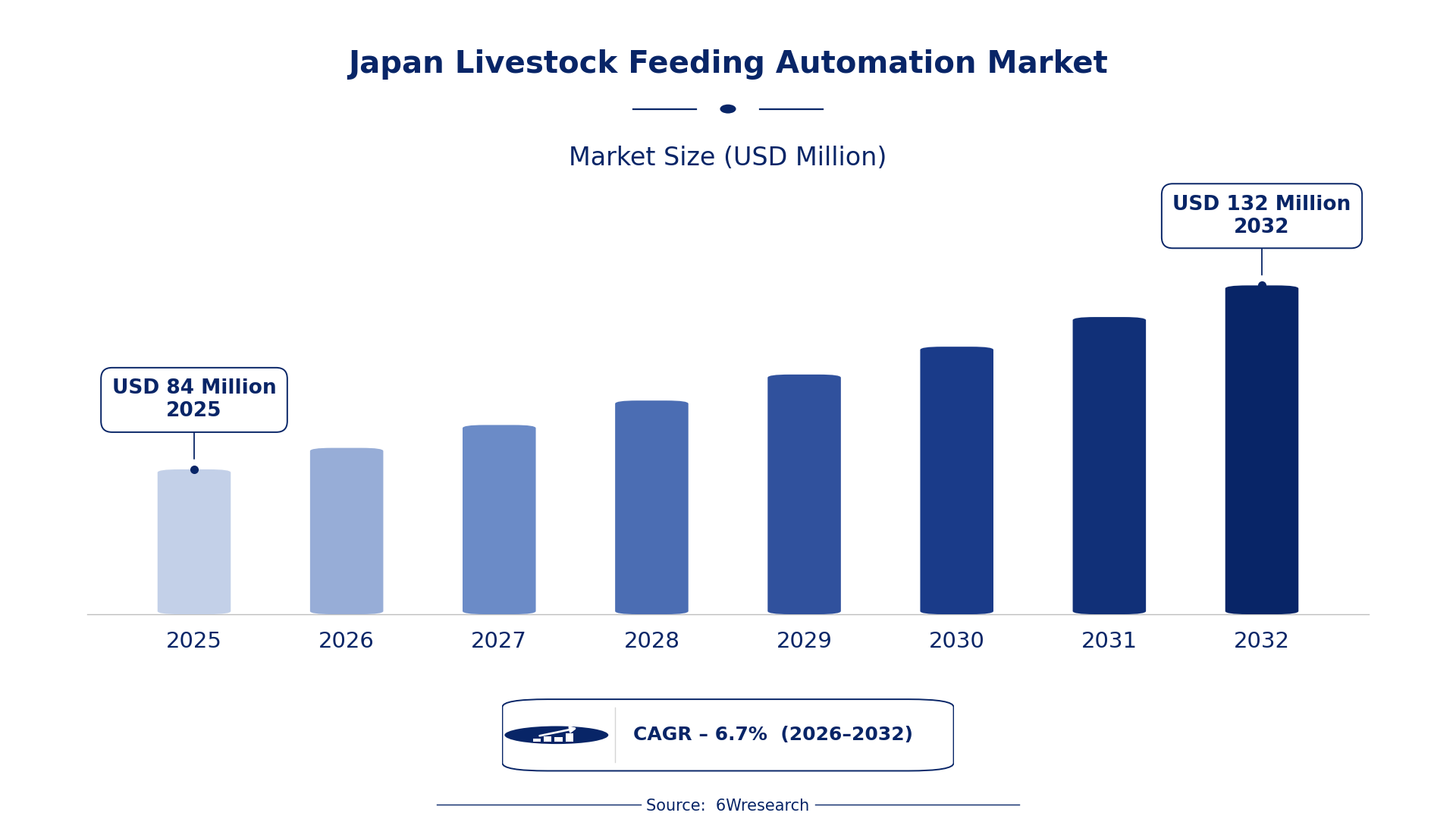
According to 6Wresearch internal database and industry insights, the Japan Livestock Feeding Automation Market was valued at USD 84 Million in 2025 and is projected to reach USD 132 Million by 2032, growing at a CAGR of approximately 6.7% during 2026–2032.
Japan Livestock Feeding Automation Market Highlights
| Report Metric | Details |
| Report Name | Japan Livestock Feeding Automation Market (2026-2032) |
| Market Size 2025 | USD 84 Million |
| Market Size 2032 | USD 132 Million |
| Absolute Growth 2025–2032 | USD 48 Million |
| CAGR 2026–2032 | 6.7% |
| Peak Annual Growth | 7.6% in 2029 |
| Forecast Period | 2026–2032 |
| Historical Data | 2022–2025 |
| Base Year | 2025 |
| Leading System Type, 2025 | Robotic Feeders (41% share) |
| Leading Automation Level, 2025 | Fully Auto (35% share) |
| Leading Distribution Channel, 2025 | Direct Sales (39% share) |
| Leading End User, 2025 | Dairy & Feedlot Operators (49% share) |
| Fastest-Growing System Type | Smart Feed Wagons (9.9% CAGR) |
| Fastest-Growing Distribution Channel | Online Platforms (8.9% CAGR) |
| Fastest-Growing End User | Poultry/Egg Farms (9.0% CAGR) |
| Growing Sector | Poultry/Egg Farms |
| Key End Users | Dairy & Feedlot Operators, Poultry/Egg Farms, Large Farm Operations, Contract Growers |
Japan Livestock Feeding Automation Market Year-wise Growth Rate and Key Drivers (2022–2032)
This graph illustrates the annual growth rates of the market from 2022 to 2032, highlighting a steady upward trajectory and projected market expansion over the forecast period.
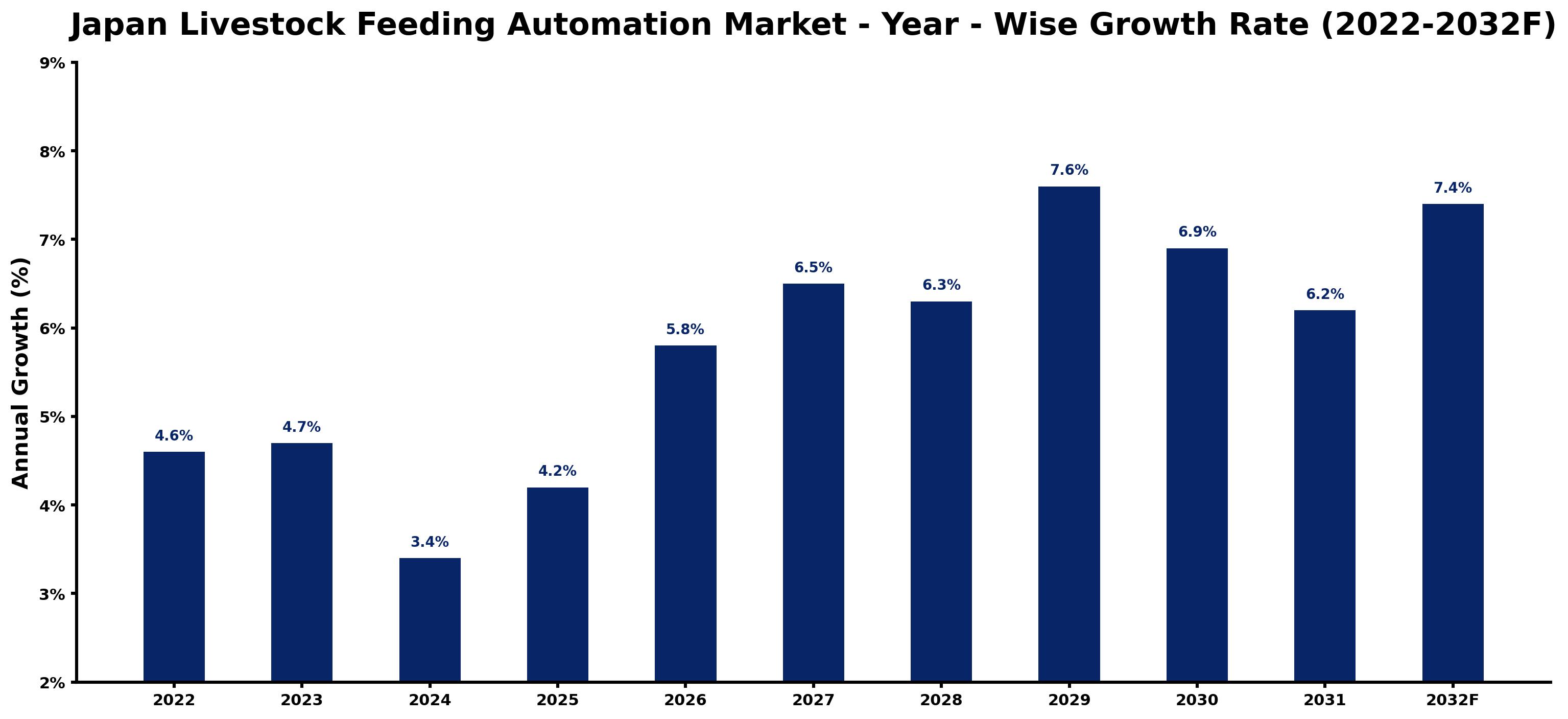
The yearly estimates that follow link every growth rate to its principal driver, so readers can see why the pace changed in each period.
| Year | Estimated Annual Growth (%) | Market Rationale |
| 2022 | 4.6 | The market showed steady growth due to increased interest in automation technologies among farmers. |
| 2023 | 4.7 | Demand rose as more farms adopted advanced feeding systems for efficiency and productivity. |
| 2024 | 3.4 | Growth slowed as market saturation began affecting new investments in automation technologies. |
| 2025 | 4.2 | A resurgence in growth occurred as technology adoption continued among dairy and feedlot operators. |
| 2026 | 5.8 | Demand is expected to increase due to rising investments in agricultural technology and automation systems. |
| 2027 | 6.5 | The market is projected to grow as dairy and feedlot operators expand their automation capabilities and efficiency. |
| 2028 | 6.3 | Growth is anticipated to slow slightly as market maturity begins to set in for feeding automation systems. |
| 2029 | 7.6 | The market is expected to peak with a surge in demand for fully automated feeding solutions. |
| 2030 | 6.9 | Growth is projected to moderate as the market stabilises after reaching peak demand levels for automation. |
| 2031 | 6.2 | A further slowdown is expected as operators focus on optimising existing feeding systems and technologies. |
| 2032 | 7.4 | Demand is anticipated to surge again as new technologies and systems enter the livestock feeding automation market. |
Note: Market size estimations and growth projections presented in this report are based on 6Wresearch's proprietary forecasting methodology, utilizing the latest available industry data, government publications, and primary research inputs.
Japan Livestock Feeding Automation Market Synopsis
Livestock feeding automation encompasses technologies that optimise feeding processes in livestock operations, employing robotics, sensors, and IoT for precise feeding. The Japan Livestock Feeding Automation Market is on an upward trajectory as dairy and poultry farmers embrace these systems to enhance feed efficiency and lower labour costs. This expansion is fuelled by increased investments in agricultural technology, with the government aiming for JPY 150 trillion in decarbonisation investments over the next decade, driving demand for advanced feeding solutions and boosting productivity across the sector.
Market Dynamics Impact Analysis (2026–2032)
| Factor | Type | Impact | Primary Segment Affected |
| Increased adoption of advanced robotics in large farms | Driver | High | Robotic Feeders |
| Growing focus on feed efficiency and animal health | Driver | High | Fully Auto |
| Rising demand for efficient feeding solutions in dairy farming | Opportunity | High | Dairy & Feedlot Operators |
| Expansion of online platforms for purchasing feeding systems | Opportunity | Medium | Online Platforms |
| High initial investment costs for automation systems | Restraint | High | Automated Bunk Feeders |
| Limited awareness of automation benefits among smaller farms | Restraint | Medium | Smart Feed Wagons |
| Challenges in integrating new technologies with existing systems | Challenge | High | Sensor-Based Systems |
| Dependence on skilled labour for system maintenance and operation | Challenge | Medium | IoT-Integrated |
Evaluation of Drivers in Japan Livestock Feeding Automation Market (2026–2032)
Demand rests on the following drivers, each shown with the segment it touches most.
| Drivers | Primary Segment Affected | Why It Matters (Evidence) |
| Increased efficiency in feed distribution | Robotic Feeders | The adoption of robotic feeders improves feed distribution efficiency, leading to reduced labour costs and better animal health, with 30% of large farms using automated systems. |
| Focus on sustainability and reduced emissions | Fully Auto | Fully automated systems help farms meet Japan's greenhouse gas reduction targets, contributing to the overall goal of a 46% cut by 2030. |
| Growing livestock population and production demands | Dairy & Feedlot Operators | The Japanese dairy sector, with over 1.5 million cows, drives demand for automation to manage increased production efficiently and sustainably. |
| Technological advancements in IoT and sensors | Smart Feed Wagons | IoT integration in feeding systems is increasing, with large farms adopting these technologies for precise feed management and monitoring. |
| Government support for agricultural technology | Automated Bunk Feeders | Funding from the Ministry of Agriculture, Forestry and Fisheries encourages the adoption of automated feeding systems across various livestock farms. |
The strongest pull on demand comes from the increasing efficiency of feed distribution, with 30% of large farms adopting robotic feeders to reduce labour costs and improve animal health. Sustainability efforts align with Japan's greenhouse gas reduction targets, prompting more farms to implement fully automated systems. The livestock population, particularly in dairy farming, fuels demand for automation, with over 1.5 million dairy cows in the country. Advancements in IoT and sensor technologies increase monitoring capabilities, driving greater adoption of smart feed wagons.
Evaluation of Restraints in Japan Livestock Feeding Automation Market
The key brakes on demand, and where they bite hardest, are shown below.
| Market Restraint | Primary Segment Affected | Why It Matters (Evidence) |
| High initial investment costs for automation systems | Automated Bunk Feeders | The upfront costs deter smaller farms from investing in automated feeding solutions, limiting market growth opportunities. |
| Limited awareness of automation benefits among smaller farms | Smart Feed Wagons | Many smaller operators lack knowledge about the advantages of automation, hindering wider adoption of these systems. |
| Challenges in integrating new technologies with existing systems | Sensor-Based Systems | Farmers face difficulties in incorporating new feeding technologies into their current operations, which slows down market penetration. |
| Dependence on skilled labour for system maintenance and operation | IoT-Integrated | The need for skilled technicians to maintain and operate advanced systems creates barriers for some operators in the market. |
| Market saturation in certain regions | Robotic Feeders | As more farms adopt automation, the market in some areas becomes saturated, which slows growth and new investments. |
Japan Livestock Feeding Automation Market Challenges
Intense competition among livestock producers compresses profit margins, compelling farmers reliant on automated feeding systems to seek cost efficiencies. Suppliers encounter difficulties in keeping pace with rapid technological advancements, which can hinder system upgrades and lead to missed opportunities for buyers seeking improved efficiency. A shortage of skilled workers in agricultural technology restricts the implementation of advanced feeding systems, resulting in productivity challenges for farms. Rising labour costs, with the national minimum wage reaching JPY 1,055 per hour, increase operational expenses for producers, prompting them to reassess their automation investments.
Trends in the Japan Livestock Feeding Automation Market
Below are the shifts with the largest effect on the Japan Livestock Feeding Automation Market.
- Shift from Manual to Automated Feeding: Dairy and feedlot operators are increasingly moving from manual feeding methods to automated systems, particularly in the Hokkaido region, where advanced technologies are widely adopted. Approximately 30% of large farms now utilise these systems for improved efficiency.
- Growing Popularity of IoT Integration: The integration of IoT technologies in feeding systems is gaining traction in Japan, particularly among large farm operations. This trend is evidenced by the rising adoption rate of IoT-enabled systems, which is around 30% of large farms.
- Transition to Fully Automated Solutions: The shift towards fully automated feeding systems began in 2026, with many operators recognising the benefits of complete automation. This has led to a projected CAGR of 9.4% for this segment through 2032.
- Expansion of Online Sales Channels: Farmers are increasingly turning to online platforms for purchasing feeding automation systems, reflecting a growing trend in the market. Online sales are expected to grow at a CAGR of 8.9% through 2032.
Investment Opportunities in the Japan Livestock Feeding Automation Market
Where to invest in the Japan Livestock Feeding Automation Market: the main openings are set out below.
- Dairy & Feedlot Operators Seeking Efficiency: Dairy and feedlot operators are keen to invest in automated feeding systems to boost productivity. With the Japanese feed industry valued at approximately ¥1 trillion annually, there exists a considerable opportunity for suppliers to cater to this demand for efficiency.
- Hokkaido Region's Adoption of Advanced Technologies: The Hokkaido region, renowned for its dairy farming, is increasingly embracing automation. With a rising trend towards efficiency, suppliers can penetrate this market by collaborating with local farms to provide advanced feeding solutions.
- Growing Demand for IoT-Integrated Systems: The escalating adoption of IoT technologies in feeding systems offers an opportunity for suppliers. With the average farm size in Japan being about 100 acres, there is a demand for efficient solutions that can be addressed through local partnerships.
- Investment in Agricultural Technology: With Japan targeting JPY 150 trillion in decarbonisation investments over the next decade, there is a pressing need for advanced feeding solutions. Suppliers can capitalise on this market by aligning with government initiatives and supporting local farmers.
Government Initiatives in the Japan Livestock Feeding Automation Market
The New Robot Strategy (2015) aims to expand robot use in agriculture, promoting productivity and efficiency in livestock feeding automation. This initiative builds on previous laws by establishing a framework for increased automation in farming practices, encouraging producers to adopt advanced technologies and systems for improved operational outcomes.
In 2023, a government programme allocated ¥2 billion for agricultural technology advancements, administered by the Ministry of Agriculture, Forestry and Fisheries. This funding assists farmers in adopting innovative feeding systems, promoting efficiency and sustainability in livestock operations.
Future Insight of the Japan Livestock Feeding Automation Market
The government programme for agricultural technology will allocate ¥150 trillion over ten years, supporting advancements in livestock feeding automation. By 2032, IoT integration will become standard in feeding systems, enabling real-time monitoring and adjustments for improved efficiency. Increased public and private investment in decarbonisation will drive demand for technologies that reduce emissions, benefiting both buyers and suppliers. As the adoption rate of automated systems in large farms rises to 50%, suppliers will need to innovate continuously to meet buyer expectations.
Market Segmentation Analysis
Japan Livestock Feeding Automation Market report covers a detailed analysis of the following market segments:
By System Type – Robotic Feeders Lead, Smart Feed Wagons Expected to Grow Fastest
According to Saurav Kr Singh, Senior Research Analyst at 6Wresearch, with 41% of system type revenue in 2025, Robotic Feeders was the largest category. Robotic feeders dominate the market due to their crucial role in enhancing efficiency for large livestock operations, especially in regions like Tohoku known for dairy farming. The presence of over 1.5 million dairy cows as of 2022 further supports the demand for these systems. The quickest growth will come from Smart Feed Wagons, forecast to expand at a CAGR of 9.9% between 2026 and 2032. Smart feed wagons are experiencing rapid growth as they incorporate advanced technology for precise feed delivery, appealing to large farms aiming for optimal feeding processes. The increasing integration of IoT in feeding systems significantly fuels this segment's expansion. Suppliers should focus on enhancing features of smart feed wagons to meet the rising demand from technologically inclined farmers.
By Automation Level – Fully Auto Leads and Records the Fastest Growth
Fully Auto held 35% of the Japan Livestock Feeding Automation Market by automation level in 2025. Fully automated systems lead the market by providing comprehensive solutions for large-scale feeding operations, ensuring consistent feed delivery while reducing labour costs. This is particularly beneficial for farms averaging about 100 acres, where efficiency is paramount. The same category is also set to grow fastest, at a CAGR of 9.4% during 2026–2032. The fully automated segment is witnessing swift growth as it meets the rising demand for efficiency and precision in livestock feeding, particularly in large farms. This sustained lead indicates that ongoing advancements in automation will further strengthen its market position. Buyers will increasingly prefer fully automated solutions to improve operational efficiency and decrease manual labour in their feeding processes.
By Distribution Channel – Direct Sales Leads, Online Platforms Expected to Grow Fastest
Direct Sales accounted for 39% of the market by distribution channel in 2025. Direct sales are the primary channel for acquiring feeding systems, allowing manufacturers to establish strong relationships with end users while offering customised solutions. This approach effectively reaches dairy and feedlot operators who require dependable systems. Online Platforms are projected to grow fastest, at a CAGR of 8.9% during 2026–2032. Online platforms are rapidly becoming a preferred distribution channel, allowing suppliers to engage with a broader audience of tech-savvy farmers. The convenience and accessibility of online purchasing are significant factors propelling this segment's growth. Suppliers should enhance their online presence to capitalise on the growing trend of digital purchasing among farmers.
By End User – Dairy & Feedlot Operators Lead, Poultry/Egg Farms Expected to Grow Fastest
Dairy & Feedlot Operators took 49% of end user revenue in 2025, more than any other category. Dairy and feedlot operators represent the largest user group of feeding automation, motivated by the need for efficient milk production and management of extensive herds. Their substantial adoption of automation highlights the importance of optimising feeding processes within the dairy sector. Over 2026–2032, Poultry/Egg Farms are expected to post the fastest growth, at a CAGR of 9.0%. Poultry and egg farms are experiencing the fastest growth in adopting feeding automation, driven by their focus on improving operational efficiency and maximising production. The demand for poultry meat, which reached approximately 1.5 million tons in 2021, fuels this trend. Suppliers should tailor their offerings to meet the specific needs of poultry farms, as this segment is positioned for rapid growth.
Key Attractiveness of the Report
- 10 Years of Market Numbers
- Historical Data Starting from 2022 to 2025
- Base Year 2025
- Forecast Data until 2032
- Key Performance Indicators Impacting the Market
- Major Upcoming Developments and Projects
Key Highlights of the Report:
- Japan Livestock Feeding Automation Market Outlook
- Market Size of Japan Livestock Feeding Automation Market, 2025
- Forecast of Japan Livestock Feeding Automation Market, 2032
- Historical Data and Forecast of Japan Livestock Feeding Automation Revenues & Volume for the Period 2022-2032F
- Japan Livestock Feeding Automation Market Trend Evolution
- Japan Livestock Feeding Automation Market Drivers and Challenges
- Japan Livestock Feeding Automation Price Trends
- Japan Livestock Feeding Automation Porter's Five Forces
- Japan Livestock Feeding Automation Industry Life Cycle
- Historical Data and Forecast of Japan Livestock Feeding Automation Market Revenues & Volume By System Type for the Period 2022-2032F
- Historical Data and Forecast of Japan Livestock Feeding Automation Market Revenues & Volume By Robotic Feeders for the Period 2022-2032F
- Historical Data and Forecast of Japan Livestock Feeding Automation Market Revenues & Volume By Automated Bunk Feeders for the Period 2022-2032F
- Historical Data and Forecast of Japan Livestock Feeding Automation Market Revenues & Volume By Smart Feed Wagons for the Period 2022-2032F
- Historical Data and Forecast of Japan Livestock Feeding Automation Market Revenues & Volume By Sensor-Based Systems for the Period 2022-2032F
- Historical Data and Forecast of Japan Livestock Feeding Automation Market Revenues & Volume By Automation Level for the Period 2022-2032F
- Historical Data and Forecast of Japan Livestock Feeding Automation Market Revenues & Volume By Fully Auto for the Period 2022-2032F
- Historical Data and Forecast of Japan Livestock Feeding Automation Market Revenues & Volume By Timed/Volume Control for the Period 2022-2032F
- Historical Data and Forecast of Japan Livestock Feeding Automation Market Revenues & Volume By Telemetry-Linked for the Period 2022-2032F
- Historical Data and Forecast of Japan Livestock Feeding Automation Market Revenues & Volume By IoT-Integrated for the Period 2022-2032F
- Historical Data and Forecast of Japan Livestock Feeding Automation Market Revenues & Volume By Distribution Channel for the Period 2022-2032F
- Historical Data and Forecast of Japan Livestock Feeding Automation Market Revenues & Volume By Direct Sales for the Period 2022-2032F
- Historical Data and Forecast of Japan Livestock Feeding Automation Market Revenues & Volume By Online Platforms for the Period 2022-2032F
- Historical Data and Forecast of Japan Livestock Feeding Automation Market Revenues & Volume By Industrial Suppliers for the Period 2022-2032F
- Historical Data and Forecast of Japan Livestock Feeding Automation Market Revenues & Volume By Specialty Stores for the Period 2022-2032F
- Historical Data and Forecast of Japan Livestock Feeding Automation Market Revenues & Volume By End User for the Period 2022-2032F
- Historical Data and Forecast of Japan Livestock Feeding Automation Market Revenues & Volume By Poultry/Egg Farms for the Period 2022-2032F
- Historical Data and Forecast of Japan Livestock Feeding Automation Market Revenues & Volume By Dairy & Feedlot Operators for the Period 2022-2032F
- Historical Data and Forecast of Japan Livestock Feeding Automation Market Revenues & Volume By Large Farm Operations for the Period 2022-2032F
- Historical Data and Forecast of Japan Livestock Feeding Automation Market Revenues & Volume By Contract Growers for the Period 2022-2032F
- Japan Livestock Feeding Automation Import Export Trade Statistics
- Market Opportunity Assessment By System Type
- Market Opportunity Assessment By Automation Level
- Market Opportunity Assessment By Distribution Channel
- Market Opportunity Assessment By End User
- Japan Livestock Feeding Automation Top Companies Market Share
- Japan Livestock Feeding Automation Competitive Benchmarking By Technical and Operational Parameters
- Japan Livestock Feeding Automation Company Profiles
- Japan Livestock Feeding Automation Key Strategic Recommendations
Market Covered
This report examines the market across the segments below.
By System Type
- Robotic Feeders
- Automated Bunk Feeders
- Smart Feed Wagons
- Sensor-Based Systems
By Automation Level
- Fully Auto
- Timed/Volume Control
- Telemetry-Linked
- IoT-Integrated
By Distribution Channel
- Direct Sales
- Online Platforms
- Industrial Suppliers
- Specialty Stores
By End User
- Poultry/Egg Farms
- Dairy & Feedlot Operators
- Large Farm Operations
- Contract Growers






































