Japan Livestock Feeding Equipment Market Size & Growth Rate
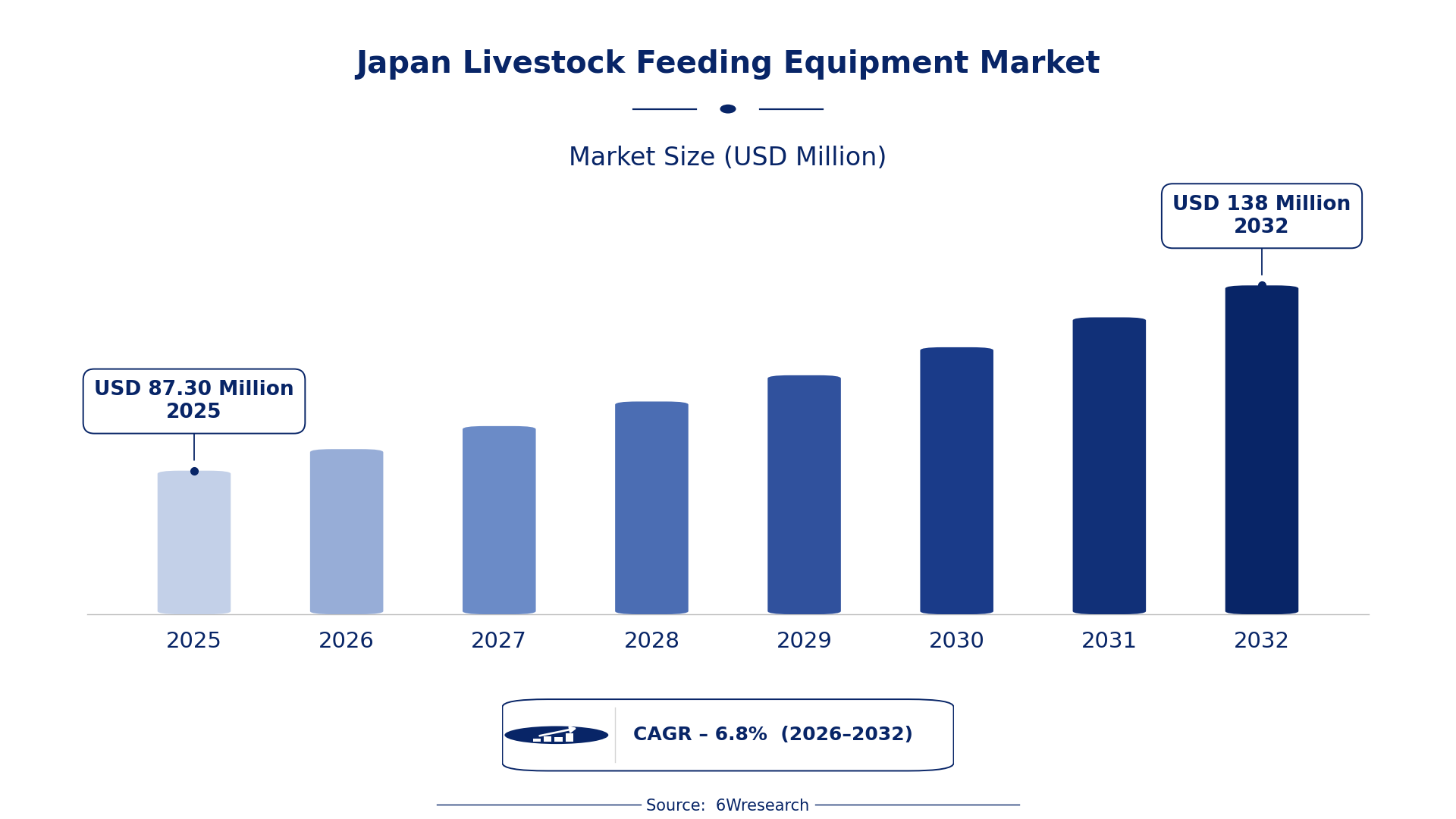
According to 6Wresearch internal database and industry insights, the Japan Livestock Feeding Equipment Market was valued at USD 87.30 Million in 2025 and is projected to reach USD 138 Million by 2032, growing at a CAGR of approximately 6.8% during 2026–2032.
Japan Livestock Feeding Equipment Market Highlights
| Report Metric | Details |
| Report Name | Japan Livestock Feeding Equipment Market (2026-2032) |
| Market Size 2025 | USD 87.30 Million |
| Market Size 2032 | USD 138 Million |
| Absolute Growth 2025–2032 | USD 50.70 Million |
| CAGR 2026–2032 | 6.8% |
| Peak Annual Growth | 7.5% in 2030 |
| Forecast Period | 2026–2032 |
| Historical Data | 2022–2025 |
| Base Year | 2025 |
| Leading Equipment Type, 2025 | Auger Feeders (35% share) |
| Leading Power Source, 2025 | PTO/Electric (39% share) |
| Leading Distribution Channel, 2025 | Direct Sales (39% share) |
| Leading End User, 2025 | Dairy & Swine Farms (43% share) |
| Fastest-Growing Equipment Type | Feed Silos (9.7% CAGR) |
| Fastest-Growing Power Source | Gravity/Elevator (10.4% CAGR) |
| Fastest-Growing Distribution Channel | Online Platforms (9.0% CAGR) |
| Fastest-Growing End User | Feed Mills & Co-ops (9.1% CAGR) |
| Growing Sector | Feed Mills & Co-ops |
| Key End Users | Dairy & Swine Farms, Feed Mills & Co-ops, Feedlot Operators, Agricultural Contractors |
Japan Livestock Feeding Equipment Market Year-wise Growth Rate and Key Drivers (2022–2032)
This graph illustrates the annual growth rates of the market from 2022 to 2032, highlighting a steady upward trajectory and projected market expansion over the forecast period.
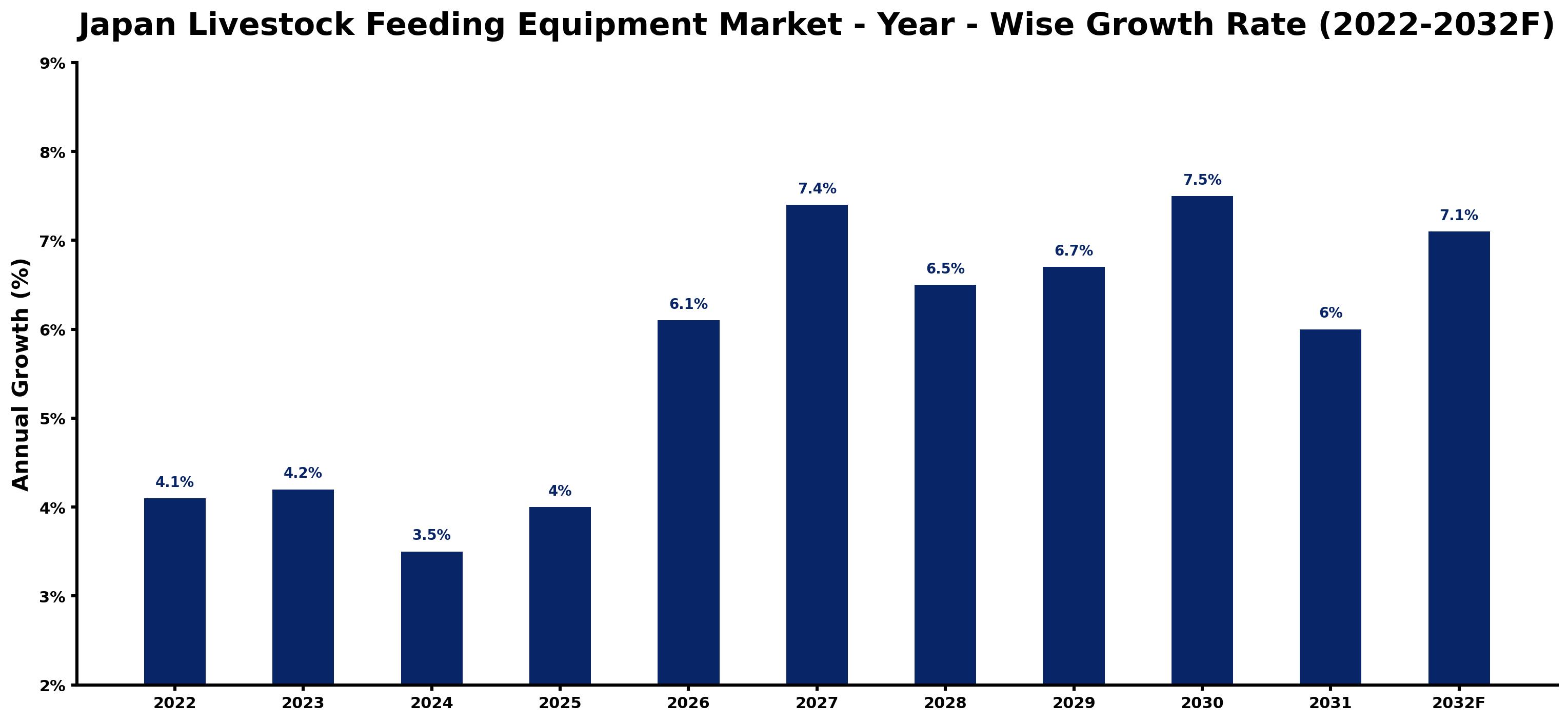
Annual growth estimates for each year appear below with the principal reason behind them, explaining the shifts that set the pace of the market.
| Year | Estimated Annual Growth (%) | Market Rationale |
| 2022 | 4.1 | The market experienced steady growth driven by stable demand from dairy and swine farms. |
| 2023 | 4.2 | Growth accelerated due to increased dairy production and investments in feeding technologies. |
| 2024 | 3.5 | A slowdown occurred as market expansion faced challenges in supply chain logistics. |
| 2025 | 4.0 | Demand picked up again as dairy farms modernised their feeding equipment. |
| 2026 | 6.1 | Growth is expected to surge with rising investments in feed efficiency technologies and practices. |
| 2027 | 7.4 | Market growth is projected to intensify, supported by increasing dairy herd sizes and feed consumption. |
| 2028 | 6.5 | A slight slowdown is anticipated as equipment supply struggles to meet rising demand. |
| 2029 | 6.7 | Demand is expected to rise again as online sales channels expand for livestock feeding equipment. |
| 2030 | 7.5 | The market is projected to peak with investments in advanced feeding systems and technologies. |
| 2031 | 6.0 | Growth is expected to moderate as market saturation begins to affect new equipment purchases. |
| 2032 | 7.1 | Demand is projected to rise again due to ongoing technological advancements in feeding. |
Note: Market size estimations and growth projections presented in this report are based on 6Wresearch's proprietary forecasting methodology, utilizing the latest available industry data, government publications, and primary research inputs.
Japan Livestock Feeding Equipment Market Synopsis
Livestock feeding equipment refers to machinery designed for efficient feed distribution to livestock, primarily dairy cows and pigs. This equipment, made from durable materials, improves feeding operations on farms. The Japan Livestock Feeding Equipment Market is expanding due to increasing dairy production, with over 1.5 million dairy cows in the country. Rising investments in modern feeding technologies and practices are driving demand, particularly in regions like Hokkaido, where feed silos are essential for bulk storage.
Market Dynamics Impact Analysis (2026–2032)
| Factor | Type | Impact | Primary Segment Affected |
| Growing investments in modern feeding technologies | Driver | High | TMR Mixers |
| Increased dairy production and herd sizes | Driver | High | Auger Feeders |
| Rising demand for efficient feed storage solutions | Opportunity | High | Feed Silos |
| Expansion of online sales channels for livestock equipment | Opportunity | Medium | Online Platforms |
| Supply chain disruptions affecting equipment availability | Restraint | High | Conveyors/Loaders |
| High initial investment costs for advanced equipment | Restraint | Medium | TMR Mixers |
| Difficulty in meeting ISO standards for equipment | Challenge | High | Feed Silos |
| Competition from imported specialized equipment | Challenge | Medium | Auger Feeders |
Evaluation of Drivers in Japan Livestock Feeding Equipment Market (2026–2032)
The following drivers explain most of the expected growth.
| Drivers | Primary Segment Affected | Why It Matters (Evidence) |
| Increasing dairy production | TMR Mixers | This equipment is essential for preparing balanced feed, with the average dairy cow consuming around 25 kg of feed daily. |
| Technological advancements in feed storage | Feed Silos | These innovations allow for better management of bulk feed, crucial in regions like Hokkaido where dairy farming is prevalent. |
| Expansion of online sales platforms | Conveyors/Loaders | This growth enhances market access for farmers, leading to increased purchases of essential feeding equipment. |
| Government funding for modernization initiatives | Auger Feeders | The ¥2 billion allocated in 2023 supports the adoption of efficient feeding technologies among livestock producers. |
| Rising herd sizes on farms | Feed Mills & Co-ops | Larger herds necessitate more efficient feed distribution systems, driving demand for advanced feeding equipment. |
Orders keep climbing as rising dairy production levels necessitate efficient feeding solutions. The average feed consumption per dairy cow is around 25 kg per day, driving demand for TMR mixers. Increased herd sizes further boost the need for effective feed distribution systems. Technological advancements are reshaping feed storage capabilities, allowing farmers to manage bulk feed more efficiently. The expansion of online platforms for livestock equipment sales has opened new channels for buyers, improving market access.
Evaluation of Restraints in Japan Livestock Feeding Equipment Market
These restraints slow adoption and weigh on supplier margins.
| Market Restraint | Primary Segment Affected | Why It Matters (Evidence) |
| Skills shortage in the agricultural sector | Auger Feeders | Fewer workers entering agriculture limits operational efficiency, increasing training costs for existing staff. |
| Supply chain disruptions | Feed Silos | Reliance on specific feed suppliers can delay delivery and disrupt feeding schedules for dairy farms. |
| Rising material costs for equipment | TMR Mixers | Inflation and global supply chain issues are pushing prices up by 15% for buyers. |
| Increased operational costs | Conveyors/Loaders | Japan's minimum wage rise to JPY 1,055 per hour forces buyers to allocate more budget for labour. |
| Market saturation | Online Platforms | An oversupply of equipment may lead to reduced demand for new purchases. |
Japan Livestock Feeding Equipment Market Challenges
Producers encounter rising training costs due to a skills shortage in the agricultural workforce, which diminishes operational efficiency and increases expenses by up to 20%. Supply chain disruptions arise from reliance on specific feed suppliers, leading to potential delays in feed delivery that can disrupt feeding schedules for dairy farms. Material costs for livestock feeding equipment have increased by 15% due to inflation, directly affecting profitability for buyers. Rising labour costs, driven by Japan's minimum wage increase to JPY 1,055 per hour, force buyers to allocate additional funds for workforce management, further straining budgets.
Trends in the Japan Livestock Feeding Equipment Market
The shifts below are changing how Japan Livestock Feeding Equipment Market products are bought and supplied.
- Expansion of Advanced Feeding Technologies: Regions like Hokkaido are increasingly adopting advanced feeding technologies, with a 20% rise in TMR mixer usage, improving operational efficiency for dairy farmers.
- Surge in Online Sales Channels: The use of online platforms for livestock equipment sales has surged by 15%, providing farmers with easier access to a wider range of products.
- Growing Importance of Efficient Feed Storage: Feed silos are becoming essential in Japan's dairy regions, with a 10% increase in installations, allowing farms to manage bulk feed more effectively.
- Increase in Dairy Herd Sizes: The number of dairy cows in Japan is projected to grow, with a 5% increase expected by 2025, driving demand for efficient feeding solutions.
Investment Opportunities in the Japan Livestock Feeding Equipment Market
Several openings in the Japan Livestock Feeding Equipment Market merit attention from investors.
- Collaborate with Local Distributors: Now is an opportune moment to invest in livestock feeding equipment, as demand is on the rise. Partnering with local distributors in Hokkaido can enhance market penetration.
- Supply Advanced Feed Mixing Equipment: There is an increasing need for TMR mixers due to rising dairy production. Targeting dairy farms in regions like Hokkaido can yield substantial returns.
- Invest in Online Sales Platforms: With a 15% increase in online sales, providing digital solutions for livestock equipment can attract tech-savvy farmers seeking convenience.
- Focus on Bulk Feed Storage Solutions: As feed silos gain popularity, supplying effective storage solutions can address the needs of swine farms, particularly in regions with high livestock density.
Government Initiatives in the Japan Livestock Feeding Equipment Market
The Act on the Rational Use of Energy, established in 1979, requires large energy users to adopt energy-saving technologies. This law compels livestock feeding equipment producers to enhance operational efficiency and reduce energy consumption, which is vital for sustainable farming practices.
Various schemes implemented by the Ministry of Agriculture, Forestry and Fisheries support farmers in adopting modern feeding practices. In 2023, the government allocated ¥2 billion for agricultural modernization initiatives, which directly benefits dairy and swine farms by improving their feeding operations.
Future Insight of the Japan Livestock Feeding Equipment Market
Technological advancements in automation will transform demand for livestock feeding equipment by 2032, driven by government support for agricultural modernisation initiatives. Improved ISO 9001 standards will refine manufacturing processes, benefiting suppliers by ensuring higher quality products. The rise of online sales platforms will provide buyers with better access to a wider range of equipment options. With over 5 million tons of feed produced annually, suppliers must align their offerings with the efficiency demands of the evolving livestock sector.
Market Segmentation Analysis
Japan Livestock Feeding Equipment Market report covers a detailed analysis of the following market segments:
By Equipment Type – Auger Feeders Lead, Feed Silos Expected to Grow Fastest
According to Saurav Kr Singh, Senior Research Analyst at 6Wresearch, Auger Feeders took 35% of equipment type revenue in 2025, more than any other category. Auger feeders hold the largest market share due to their widespread use in efficient feed distribution for various livestock operations. In Hokkaido, a key dairy region, these feeders are essential for managing feed effectively. Feed Silos are set to record the highest CAGR in this split, 9.7% over 2026–2032. Feed silos are growing quickly because they are crucial for bulk feed storage, particularly in areas with high dairy cow populations. With around 1.5 million dairy cows in Japan, the need for effective feed management solutions is on the rise. Suppliers must focus on enhancing the availability of feed silos to meet the increasing market demand.
By Power Source – PTO/Electric Leads, Gravity/Elevator Expected to Grow Fastest
The largest power source category in 2025 was PTO/Electric, at 39% of revenue. PTO/electric power sources are the most common in the market, providing reliable energy for livestock feeding equipment. This is particularly relevant in dairy and swine farms where operational efficiency is critical. The quickest growth will come from Gravity/Elevator, forecast to expand at a CAGR of 10.4% between 2026 and 2032. The gravity/elevator segment is rapidly expanding as it becomes more common in feed handling systems, aiding in the efficient movement of feed materials. The production of over 5 million tons of feed annually by feed mills supports this growth. Buyers should evaluate gravity/elevator systems to improve their feed handling capabilities.
By Distribution Channel – Direct Sales Leads, Online Platforms Expected to Grow Fastest
With 39% of distribution channel revenue in 2025, Direct Sales was the largest category. Direct sales are the primary distribution method for livestock feeding equipment, enabling manufacturers to provide tailored solutions directly to customers. This method effectively reaches large dairy and swine farms that require specific equipment. Over 2026–2032, Online Platforms are expected to post the fastest growth, at a CAGR of 9.0%. Online platforms are quickly becoming a popular distribution channel, as shown by a 15% increase in usage reflecting changing purchasing habits among farmers. The convenience of online shopping is drawing more end users in the livestock sector. Suppliers should enhance their online presence to capitalise on the growing trend of digital sales.
By End User – Dairy & Swine Farms Lead, Feed Mills & Co-ops Expected to Grow Fastest
Dairy & Swine Farms held 43% of the Japan Livestock Feeding Equipment Market by end user in 2025. Dairy and swine farms are the leading end users of feeding equipment, highlighting the strength of Japan's livestock sector. With over 10,000 registered swine farms and numerous dairy operations, these farms create substantial demand for feeding solutions. Feed Mills & Co-ops are projected to grow fastest, at a CAGR of 9.1% during 2026–2032. Feed mills and co-ops are experiencing the fastest growth as they play a vital role in feed processing for various livestock operations. The annual feed production exceeding 5 million tons drives their need for efficient feeding equipment. Suppliers should target feed mills and co-ops to align with the rising processing demands in the livestock industry.
Key Attractiveness of the Report
- 10 Years of Market Numbers
- Historical Data Starting from 2022 to 2025
- Base Year 2025
- Forecast Data until 2032
- Key Performance Indicators Impacting the Market
- Major Upcoming Developments and Projects
Key Highlights of the Report:
- Japan Livestock Feeding Equipment Market Outlook
- Market Size of Japan Livestock Feeding Equipment Market, 2025
- Forecast of Japan Livestock Feeding Equipment Market, 2032
- Historical Data and Forecast of Japan Livestock Feeding Equipment Revenues & Volume for the Period 2022-2032F
- Japan Livestock Feeding Equipment Market Trend Evolution
- Japan Livestock Feeding Equipment Market Drivers and Challenges
- Japan Livestock Feeding Equipment Price Trends
- Japan Livestock Feeding Equipment Porter's Five Forces
- Japan Livestock Feeding Equipment Industry Life Cycle
- Historical Data and Forecast of Japan Livestock Feeding Equipment Market Revenues & Volume By Equipment Type for the Period 2022-2032F
- Historical Data and Forecast of Japan Livestock Feeding Equipment Market Revenues & Volume By Auger Feeders for the Period 2022-2032F
- Historical Data and Forecast of Japan Livestock Feeding Equipment Market Revenues & Volume By Feed Silos for the Period 2022-2032F
- Historical Data and Forecast of Japan Livestock Feeding Equipment Market Revenues & Volume By TMR Mixers for the Period 2022-2032F
- Historical Data and Forecast of Japan Livestock Feeding Equipment Market Revenues & Volume By Conveyors/Loaders for the Period 2022-2032F
- Historical Data and Forecast of Japan Livestock Feeding Equipment Market Revenues & Volume By Power Source for the Period 2022-2032F
- Historical Data and Forecast of Japan Livestock Feeding Equipment Market Revenues & Volume By PTO/Electric for the Period 2022-2032F
- Historical Data and Forecast of Japan Livestock Feeding Equipment Market Revenues & Volume By Gravity/Elevator for the Period 2022-2032F
- Historical Data and Forecast of Japan Livestock Feeding Equipment Market Revenues & Volume By PTO or Diesel for the Period 2022-2032F
- Historical Data and Forecast of Japan Livestock Feeding Equipment Market Revenues & Volume By Hydraulic/Electric for the Period 2022-2032F
- Historical Data and Forecast of Japan Livestock Feeding Equipment Market Revenues & Volume By Distribution Channel for the Period 2022-2032F
- Historical Data and Forecast of Japan Livestock Feeding Equipment Market Revenues & Volume By Direct Sales for the Period 2022-2032F
- Historical Data and Forecast of Japan Livestock Feeding Equipment Market Revenues & Volume By Online Platforms for the Period 2022-2032F
- Historical Data and Forecast of Japan Livestock Feeding Equipment Market Revenues & Volume By Industrial Suppliers for the Period 2022-2032F
- Historical Data and Forecast of Japan Livestock Feeding Equipment Market Revenues & Volume By Specialty Stores for the Period 2022-2032F
- Historical Data and Forecast of Japan Livestock Feeding Equipment Market Revenues & Volume By End User for the Period 2022-2032F
- Historical Data and Forecast of Japan Livestock Feeding Equipment Market Revenues & Volume By Dairy & Swine Farms for the Period 2022-2032F
- Historical Data and Forecast of Japan Livestock Feeding Equipment Market Revenues & Volume By Feed Mills & Co-ops for the Period 2022-2032F
- Historical Data and Forecast of Japan Livestock Feeding Equipment Market Revenues & Volume By Feedlot Operators for the Period 2022-2032F
- Historical Data and Forecast of Japan Livestock Feeding Equipment Market Revenues & Volume By Agricultural Contractors for the Period 2022-2032F
- Japan Livestock Feeding Equipment Import Export Trade Statistics
- Market Opportunity Assessment By Equipment Type
- Market Opportunity Assessment By Power Source
- Market Opportunity Assessment By Distribution Channel
- Market Opportunity Assessment By End User
- Japan Livestock Feeding Equipment Top Companies Market Share
- Japan Livestock Feeding Equipment Competitive Benchmarking By Technical and Operational Parameters
- Japan Livestock Feeding Equipment Company Profiles
- Japan Livestock Feeding Equipment Key Strategic Recommendations
Market Covered
The study includes the following segmentation.
By Equipment Type
- Auger Feeders
- Feed Silos
- TMR Mixers
- Conveyors/Loaders
By Power Source
- PTO/Electric
- Gravity/Elevator
- PTO or Diesel
- Hydraulic/Electric
By Distribution Channel
- Direct Sales
- Online Platforms
- Industrial Suppliers
- Specialty Stores
By End User
- Dairy & Swine Farms
- Feed Mills & Co-ops
- Feedlot Operators
- Agricultural Contractors






































