Japan Livestock Genomics Market Size & Growth Rate
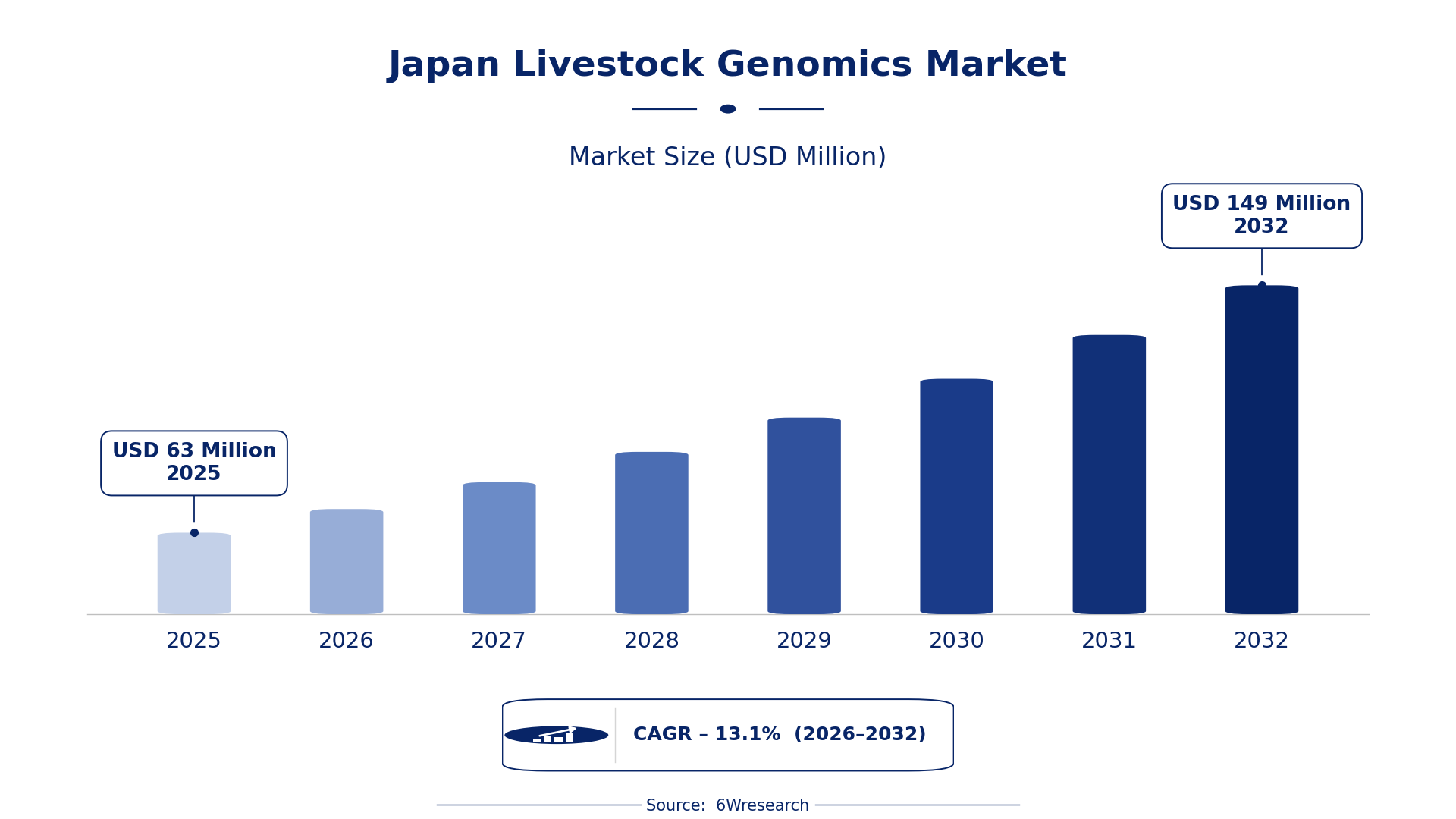
According to 6Wresearch internal database and industry insights, the Japan Livestock Genomics Market was valued at USD 63 Million in 2025 and is projected to reach USD 149 Million by 2032, growing at a CAGR of approximately 13.1% during 2026–2032.
Japan Livestock Genomics Market Highlights
| Report Metric | Details |
| Report Name | Japan Livestock Genomics Market (2026-2032) |
| Market Size 2025 | USD 63 Million |
| Market Size 2032 | USD 149 Million |
| Absolute Growth 2025–2032 | USD 86 Million |
| CAGR 2026–2032 | 13.1% |
| Peak Annual Growth | 15.0% in 2032 |
| Forecast Period | 2026–2032 |
| Historical Data | 2022–2025 |
| Base Year | 2025 |
| Leading Service Type, 2025 | Breed Selection (37% share) |
| Leading Genomic Approach, 2025 | SNP Panel Testing (48% share) |
| Leading Distribution Channel, 2025 | Online Platforms (42% share) |
| Leading End User, 2025 | Genetic Improvement Farms (41% share) |
| Fastest-Growing Service Type | Disease Resistance (17.7% CAGR) |
| Fastest-Growing Genomic Approach | Genomic EBV (17.2% CAGR) |
| Fastest-Growing Distribution Channel | Direct Sales (17.6% CAGR) |
| Fastest-Growing End User | Livestock Breeders (17.4% CAGR) |
| Growing Sector | livestock breeding |
| Key End Users | livestock breeders, research institutes, genetic improvement farms |
Japan Livestock Genomics Market Year-wise Growth Rate and Key Drivers (2022–2032)
This graph illustrates the annual growth rates of the market from 2022 to 2032, highlighting a steady upward trajectory and projected market expansion over the forecast period.
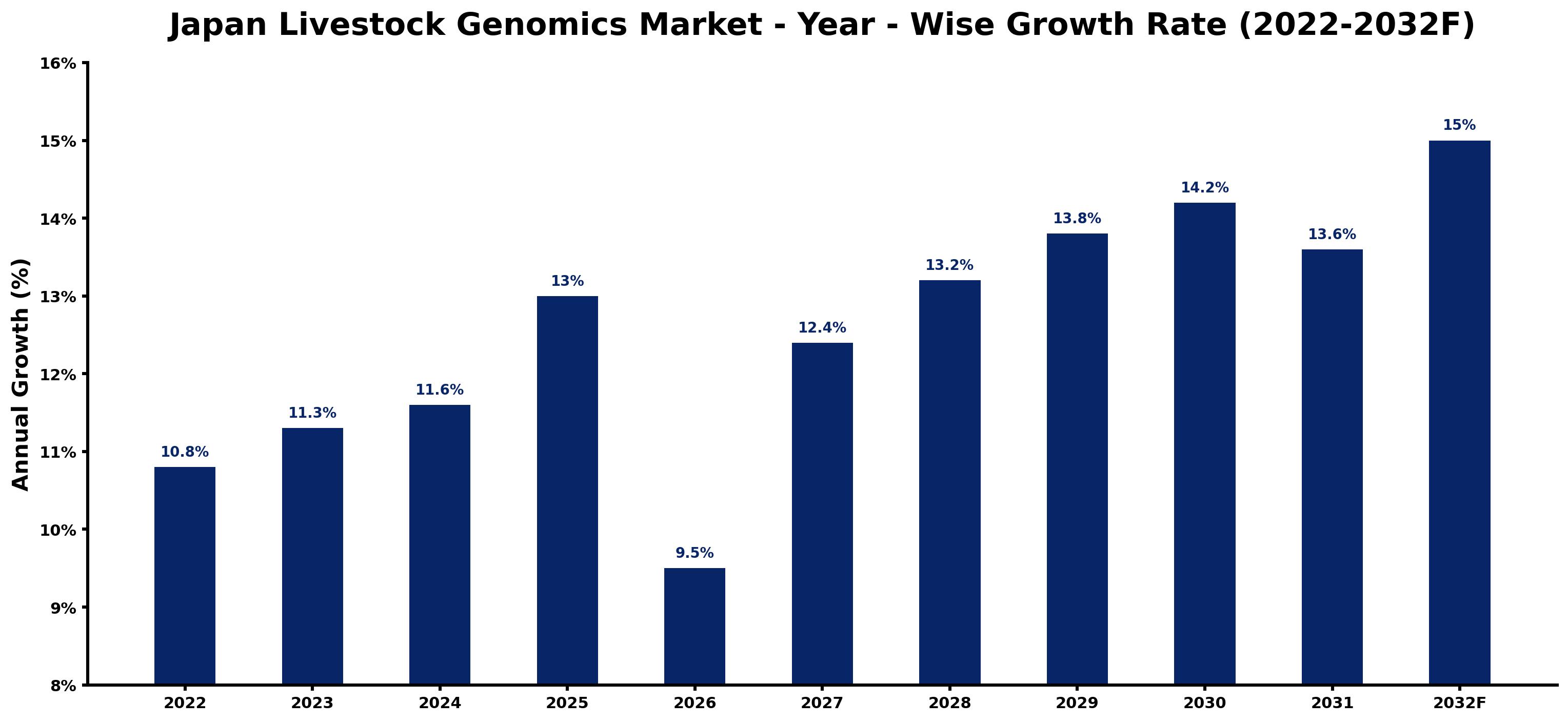
The yearly estimates that follow link every growth rate to its principal driver, so readers can see why the pace changed in each period.
| Year | Estimated Annual Growth (%) | Market Rationale |
| 2022 | 10.8 | The livestock breeding sector showed stable growth as genomic technologies gained traction among breeders. |
| 2023 | 11.3 | Demand for livestock genomics rose as breeders focused on enhancing disease resistance and breed traits. |
| 2024 | 11.6 | The market continued to expand with advancements in genomic testing methods and increased awareness among breeders. |
| 2025 | 13.0 | Growth accelerated due to the integration of genomic selection in beef cattle breeding programs in Hokkaido. |
| 2026 | 9.5 | The growth rate is expected to slow as the market stabilises following rapid advancements in genomic technologies. |
| 2027 | 12.4 | Demand is projected to increase again as livestock breeders invest more in genomic technologies for a competitive edge. |
| 2028 | 13.2 | The market is expected to see further growth driven by the adoption of genomic EBVs in dairy farming practices. |
| 2029 | 13.8 | Continued advancements in trait profiling methodologies will support rising demand among livestock breeders. |
| 2030 | 14.2 | The growth rate is projected to increase as genomic testing services expand across various livestock sectors. |
| 2031 | 13.6 | Growth is expected to slow slightly as the market matures, but demand for genomic solutions will remain strong. |
| 2032 | 15.0 | The peak growth rate is projected as the livestock sector fully embraces genomic advancements. |
Note: Market size estimations and growth projections presented in this report are based on 6Wresearch's proprietary forecasting methodology, utilizing the latest available industry data, government publications, and primary research inputs.
Japan Livestock Genomics Market Synopsis
Livestock genomics applies genomic technologies to improve breeding and management, utilising advanced methods such as SNP analysis and whole-genome sequencing. The Japan Livestock Genomics Market is expanding, driven by increasing demand from domestic livestock breeders and research institutes, contributing significantly to agricultural GDP. In 2023, a programme was launched to improve disease resistance in livestock, reflecting the sector's focus on enhancing breed traits and health outcomes.
Market Dynamics Impact Analysis (2026–2032)
| Factor | Type | Impact | Primary Segment Affected |
| Increasing adoption of genomic technologies among livestock breeders | Driver | High | Breed Selection |
| Growing investment in genomic testing services for livestock | Driver | High | Genomic EBV |
| Emerging demand for disease-resistant livestock breeds | Opportunity | High | Disease Resistance |
| Expansion of online platforms for genomic service delivery | Opportunity | Medium | Online Platforms |
| Aging population of livestock breeders impacting technology adoption | Restraint | High | Genetic Improvement Farms |
| Limited awareness of genomic benefits among smaller breeders | Restraint | Medium | Livestock Breeders |
| High costs associated with advanced genomic testing technologies | Challenge | High | SNP Panel Testing |
| Need for continuous training in genomic technologies for breeders | Challenge | Medium | Research Institutes |
Evaluation of Drivers in Japan Livestock Genomics Market (2026–2032)
Key forces behind demand, with the segment each one moves most, are listed below.
| Drivers | Primary Segment Affected | Why It Matters (Evidence) |
| Increased genomic testing for breed selection | Breed Selection | Approximately 30% of livestock breeders have adopted genomic technologies to improve traits. |
| Growing use of genomic EBVs in dairy farming | Genomic EBV | Genomic EBVs are standard practices in the dairy industry, improving breeding accuracy for producers. |
| Rising demand for disease-resistant livestock | Disease Resistance | In 2023, a programme was launched to improve disease resistance using genomic technologies, promoting healthier herds. |
| Expansion of SNP panel testing services | SNP Panel Testing | SNP panel testing is widely used in genetic improvement farms across Japan, enhancing breeding outcomes. |
| Increased investment in genomic technologies | Livestock Breeders | Livestock breeders are increasingly investing in genomic technologies for competitive advantage in the market. |
What keeps demand rising is the increasing adoption of genomic technologies among livestock breeders. Approximately 30% of breeders now utilise these methods, reflecting a shift towards modern practices. The growing use of genomic EBVs in dairy farming supports this trend, as breeders seek accurate breeding values. SNP panel testing has become a standard practice in genetic improvement farms, driving demand for advanced genomic services. As livestock breeders invest more in these technologies, the market is expected to continue expanding.
Evaluation of Restraints in Japan Livestock Genomics Market
The main factors holding the market back are set out below.
| Market Restraint | Primary Segment Affected | Why It Matters (Evidence) |
| Limited genomic testing facilities delay genetic evaluations for livestock producers. | SNP Panel Testing | This shortage results in extended breeding timelines, affecting overall productivity. |
| Competition from non-adopting breeders limits market share for genomic technologies. | Genomic EBV | Producers not utilising genomic advancements risk falling behind in efficiency and output. |
| High costs of implementing genomic technologies strain financial resources for breeders. | Whole-Genome Seq | Investments in modernisation can consume a significant portion of annual budgets. |
| Insufficient training on genomic technologies hinders effective adoption among breeders. | Trait Profiling | Breeders lacking expertise may struggle to implement genomic solutions effectively. |
| Limited awareness of genomic benefits restricts market growth potential. | Disease Resistance | Some breeders remain hesitant to invest in genomic technologies due to a lack of understanding. |
Japan Livestock Genomics Market Challenges
Japan's livestock population of approximately 4 million cattle and 9 million pigs faces supply challenges due to a shortage of genomic testing facilities, delaying genetic evaluations for producers and extending breeding timelines. Competition intensifies as genomic technologies are adopted at a rate of only 30%, causing producers who do not innovate to lose market share. Limited access to advanced testing methods, such as SNP panel testing, hampers some breeders' productivity and efficiency. Rising costs associated with implementing genomic technologies strain producers, with modernisation investments consuming around 20% of their annual budgets.
Trends in the Japan Livestock Genomics Market
The following changes are redrawing the Japan Livestock Genomics Market.
- Shift to Digital Platforms for Genomic Services: Online platforms for genomic services have seen increased usage among breeders, with 42% of the distribution channel in 2025. This shift allows for easier access to genomic testing and results, improving service delivery.
- Transition from Traditional to Genomic Breeding Methods: The livestock industry is moving towards genomic breeding methods, with SNP panel testing becoming widely adopted. This change is reflected in the 30% adoption rate of genomic technologies among breeders, enhancing breeding efficiency.
- Emergence of Disease Resistance Programmes: In 2023, Japan launched a programme aimed at improving disease resistance in livestock using genomics. This initiative reflects the industry's focus on improving herd health and productivity, driving demand for genomic solutions.
- Prioritisation of Genomic EBVs in Dairy Farming: Genomic EBVs are increasingly prioritised in dairy farming, with significant adoption rates. This trend is driven by the need for accurate breeding values to enhance dairy herd performance and profitability.
Investment Opportunities in the Japan Livestock Genomics Market
The following opportunities in the Japan Livestock Genomics Market pair current demand with a clear way in.
- Collaborate with Local Research Institutes: Partnering with local research institutes can improve genomic testing capabilities. The livestock breeding sector, contributing significantly to Japan's agricultural GDP, presents a valuable opportunity for collaboration.
- Invest in Online Service Platforms: With 42% of the distribution channel in online platforms, there is a notable gap in service delivery. Investing in these platforms can effectively meet the demand for genomic services among breeders.
- Focus on Disease Resistance Technologies: The launch of a disease resistance programme in 2023 highlights the need for genomic solutions. Concentrating on this area can attract investments from livestock breeders seeking competitive advantages in their operations.
- Expand Training Programs for Breeders: As the average age of livestock breeders is around 60 years, there is a need for modernisation. Expanding training programs can help improve technology adoption and operational efficiency among breeders.
Government Initiatives in the Japan Livestock Genomics Market
The Industrial Safety and Health Act of 1972 mandates employer responsibilities regarding hazardous substances, impacting livestock genomic producers by ensuring safe practices in testing laboratories. The GX Promotion Act of 2023 further supports the livestock genomics sector by providing a legal framework for sustainable practices, encouraging investments in genomic technologies and research initiatives.
The Ministry of Agriculture, Forestry and Fisheries oversees funding for genomic research initiatives, ensuring compliance with national standards and promoting advancements in the sector. The Digital Agency, established in September 2021, leads the digital transformation of government services, including genomic research approvals and funding, facilitating innovation in livestock genomics.
Future Insight of the Japan Livestock Genomics Market
Government funding for research initiatives will drive advancements in livestock genomics by 2032, prompting suppliers to broaden genomic testing services for breeders. The integration of whole-genome sequencing will improve genetic disease research, leading to better health outcomes. Increased collaboration with international research organisations will enhance knowledge sharing and innovation. As breeders adopt genomic data for informed decision-making, the livestock industry will become more competitive and efficient, ultimately benefiting both buyers and suppliers.
Market Segmentation Analysis
Japan Livestock Genomics Market report covers a detailed analysis of the following market segments:
By Service Type – Breed Selection Leads, Disease Resistance Expected to Grow Fastest
According to Saurav Kr Singh, Senior Research Analyst at 6Wresearch, the largest service type category in 2025 was Breed Selection, at 37% of revenue. Breed selection is the largest sub-segment due to its critical role in improving livestock traits, especially among Japan's substantial cattle and pig populations. This method is particularly prominent in breeding programmes across regions like Hokkaido, where genomic selection is gaining traction. Disease Resistance is projected to grow fastest, at a CAGR of 17.7% during 2026–2032. Disease resistance is experiencing rapid growth, driven by a new programme launched in 2023 aimed at enhancing livestock health through genomic technologies. This emphasis on disease resistance is essential for maintaining herd health and productivity in the livestock industry. Suppliers should focus on services that improve breed selection and disease resistance to align with the evolving needs of the livestock sector.
By Genomic Approach – SNP Panel Testing Leads, Genomic EBV Expected to Grow Fastest
In 2025, SNP Panel Testing led the genomic approach split with a 48% share. SNP panel testing leads the market as it is widely utilised for genetic analysis across various farms in Japan, establishing itself as a standard practice for livestock improvement. Its broad application ensures a strong installed base among breeders, facilitating effective genetic testing. Genomic EBV is set to record the highest CAGR in this split, 17.2% over 2026–2032. Genomic EBV is witnessing rapid growth due to its crucial role in estimating breeding values, becoming increasingly vital for livestock breeders seeking competitive advantages. Its integration into breeding strategies is expected to accelerate its adoption further. Buyers should invest in genomic EBV technologies to enhance their breeding programmes and improve overall livestock quality.
By Distribution Channel – Online Platforms Lead, Direct Sales Expected to Grow Fastest
Online Platforms held 42% of the Japan Livestock Genomics Market by distribution channel in 2025. Online platforms dominate the distribution channel as they provide essential service delivery for genomic testing, catering to the rising number of livestock breeders seeking digital solutions. This trend reflects a shift towards convenience and accessibility in service provision. The quickest growth will come from Direct Sales, forecast to expand at a CAGR of 17.6% between 2026 and 2032. Direct sales are growing rapidly, representing the primary sales method for genomic services and allowing for personalised interactions and tailored solutions. This shift indicates a move towards more direct engagement between service providers and breeders. Suppliers should strengthen their direct sales strategies to build closer relationships with livestock breeders and effectively address their specific needs.
By End User – Genetic Improvement Farms Lead, Livestock Breeders Expected to Grow Fastest
With 41% of end user revenue in 2025, Genetic Improvement Farms was the largest category. Genetic improvement farms are the largest user group of genomic technologies, directly applying these advancements to enhance livestock traits and productivity. Their significant involvement in the livestock sector underscores the importance of genomic applications in farm management. Over 2026–2032, Livestock Breeders are expected to post the fastest growth, at a CAGR of 17.4%. Livestock breeders are the fastest-growing segment as they increasingly adopt genomic advancements to improve their herds and gain a competitive edge. This trend highlights the critical role breeders play in the uptake of genomic technologies. Suppliers must provide tailored genomic solutions that specifically address the needs of livestock breeders to drive market growth.
Key Attractiveness of the Report
- 10 Years of Market Numbers
- Historical Data Starting from 2022 to 2025
- Base Year 2025
- Forecast Data until 2032
- Key Performance Indicators Impacting the Market
- Major Upcoming Developments and Projects
Key Highlights of the Report:
- Japan Livestock Genomics Market Outlook
- Market Size of Japan Livestock Genomics Market, 2025
- Forecast of Japan Livestock Genomics Market, 2032
- Historical Data and Forecast of Japan Livestock Genomics Revenues & Volume for the Period 2022-2032F
- Japan Livestock Genomics Market Trend Evolution
- Japan Livestock Genomics Market Drivers and Challenges
- Japan Livestock Genomics Price Trends
- Japan Livestock Genomics Porter's Five Forces
- Japan Livestock Genomics Industry Life Cycle
- Historical Data and Forecast of Japan Livestock Genomics Market Revenues & Volume By Service Type for the Period 2022-2032F
- Historical Data and Forecast of Japan Livestock Genomics Market Revenues & Volume By Breed Selection for the Period 2022-2032F
- Historical Data and Forecast of Japan Livestock Genomics Market Revenues & Volume By Disease Resistance for the Period 2022-2032F
- Historical Data and Forecast of Japan Livestock Genomics Market Revenues & Volume By Parentage Verification for the Period 2022-2032F
- Historical Data and Forecast of Japan Livestock Genomics Market Revenues & Volume By Trait Profiling for the Period 2022-2032F
- Historical Data and Forecast of Japan Livestock Genomics Market Revenues & Volume By Genomic Approach for the Period 2022-2032F
- Historical Data and Forecast of Japan Livestock Genomics Market Revenues & Volume By SNP Panel Testing for the Period 2022-2032F
- Historical Data and Forecast of Japan Livestock Genomics Market Revenues & Volume By Genomic EBV for the Period 2022-2032F
- Historical Data and Forecast of Japan Livestock Genomics Market Revenues & Volume By DNA Fingerprinting for the Period 2022-2032F
- Historical Data and Forecast of Japan Livestock Genomics Market Revenues & Volume By Whole-Genome Seq for the Period 2022-2032F
- Historical Data and Forecast of Japan Livestock Genomics Market Revenues & Volume By Distribution Channel for the Period 2022-2032F
- Historical Data and Forecast of Japan Livestock Genomics Market Revenues & Volume By Online Platforms for the Period 2022-2032F
- Historical Data and Forecast of Japan Livestock Genomics Market Revenues & Volume By Direct Sales for the Period 2022-2032F
- Historical Data and Forecast of Japan Livestock Genomics Market Revenues & Volume By Industrial Suppliers for the Period 2022-2032F
- Historical Data and Forecast of Japan Livestock Genomics Market Revenues & Volume By Specialty Stores for the Period 2022-2032F
- Historical Data and Forecast of Japan Livestock Genomics Market Revenues & Volume By End User for the Period 2022-2032F
- Historical Data and Forecast of Japan Livestock Genomics Market Revenues & Volume By Genetic Improvement Farms for the Period 2022-2032F
- Historical Data and Forecast of Japan Livestock Genomics Market Revenues & Volume By Livestock Breeders for the Period 2022-2032F
- Historical Data and Forecast of Japan Livestock Genomics Market Revenues & Volume By Breed Societies for the Period 2022-2032F
- Historical Data and Forecast of Japan Livestock Genomics Market Revenues & Volume By Research Institutes for the Period 2022-2032F
- Japan Livestock Genomics Import Export Trade Statistics
- Market Opportunity Assessment By Service Type
- Market Opportunity Assessment By Genomic Approach
- Market Opportunity Assessment By Distribution Channel
- Market Opportunity Assessment By End User
- Japan Livestock Genomics Top Companies Market Share
- Japan Livestock Genomics Competitive Benchmarking By Technical and Operational Parameters
- Japan Livestock Genomics Company Profiles
- Japan Livestock Genomics Key Strategic Recommendations
Market Covered
The study includes the following segmentation.
By Service Type
- Breed Selection
- Disease Resistance
- Parentage Verification
- Trait Profiling
By Genomic Approach
- SNP Panel Testing
- Genomic EBV
- DNA Fingerprinting
- Whole-Genome Seq
By Distribution Channel
- Online Platforms
- Direct Sales
- Industrial Suppliers
- Specialty Stores
By End User
- Genetic Improvement Farms
- Livestock Breeders
- Breed Societies
- Research Institutes






































