Japan Livestock Health Market Size & Growth Rate
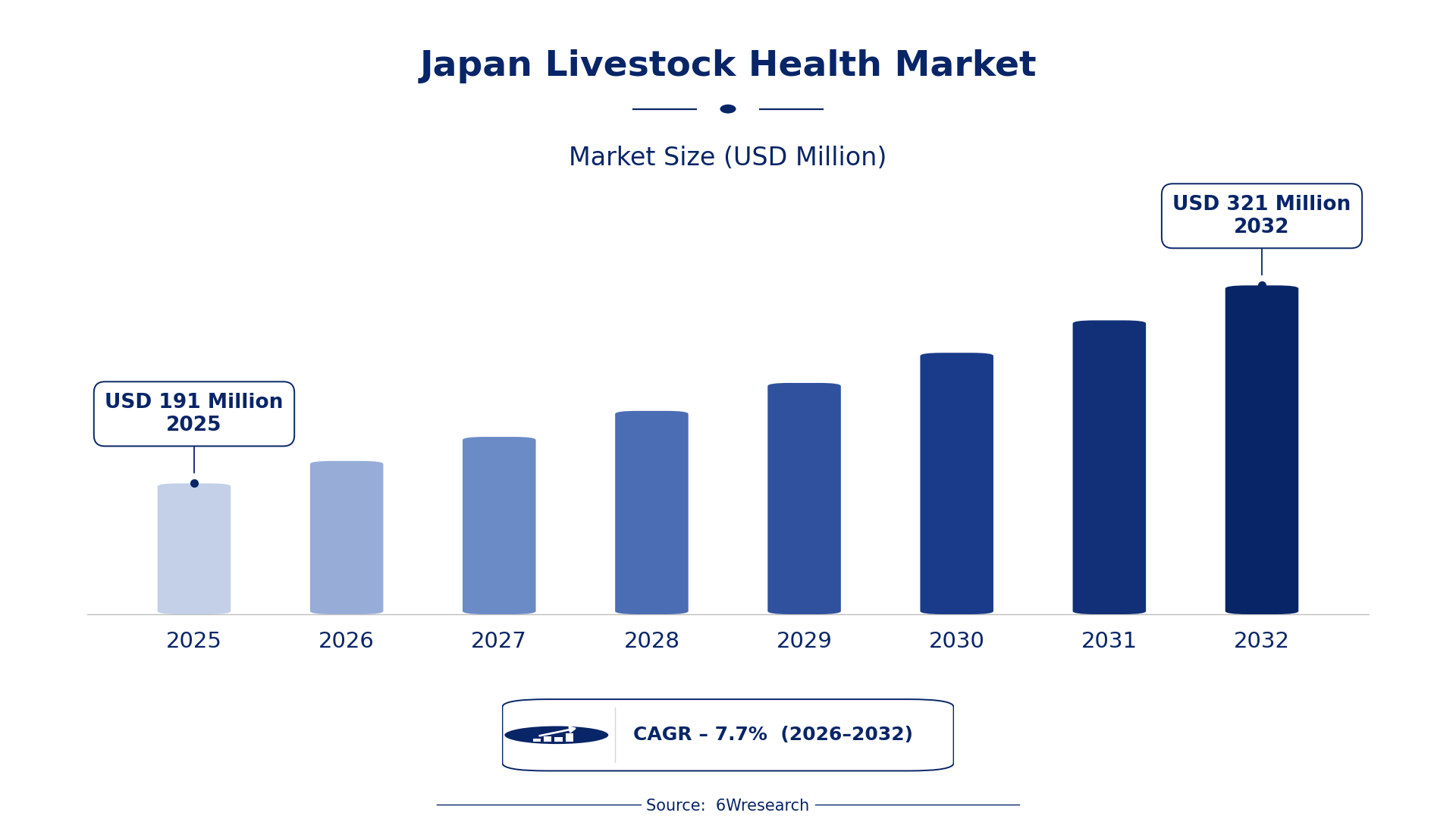
According to 6Wresearch internal database and industry insights, the Japan Livestock Health Market was valued at USD 191 Million in 2025 and is projected to reach USD 321 Million by 2032, growing at a CAGR of approximately 7.7% during 2026–2032.
Japan Livestock Health Market Highlights
| Report Metric | Details |
| Report Name | Japan Livestock Health Market (2026-2032) |
| Market Size 2025 | USD 191 Million |
| Market Size 2032 | USD 321 Million |
| Absolute Growth 2025–2032 | USD 130 Million |
| CAGR 2026–2032 | 7.7% |
| Peak Annual Growth | 8.8% in 2028 |
| Forecast Period | 2026–2032 |
| Historical Data | 2022–2025 |
| Base Year | 2025 |
| Leading Health Service, 2025 | Veterinary Visits (46% share) |
| Leading Delivery Mode, 2025 | On-Farm Practice (34% share) |
| Leading Distribution Channel, 2025 | Direct Sales (47% share) |
| Leading End User, 2025 | Farmers & Ranchers (52% share) |
| Fastest-Growing Health Service | Tele-Vet Services (10.0% CAGR) |
| Fastest-Growing Delivery Mode | Online Consultation (10.1% CAGR) |
| Fastest-Growing Distribution Channel | Online Platforms (10.4% CAGR) |
| Fastest-Growing End User | Smallholder Farms (10.2% CAGR) |
| Growing Sector | Veterinary Services |
| Key End Users | Farmers & Ranchers, Veterinary Clinics, Smallholder Farms, Poultry & Cattle Producers |
Japan Livestock Health Market Year-wise Growth Rate and Key Drivers (2022–2032)
This graph illustrates the annual growth rates of the market from 2022 to 2032, highlighting a steady upward trajectory and projected market expansion over the forecast period.
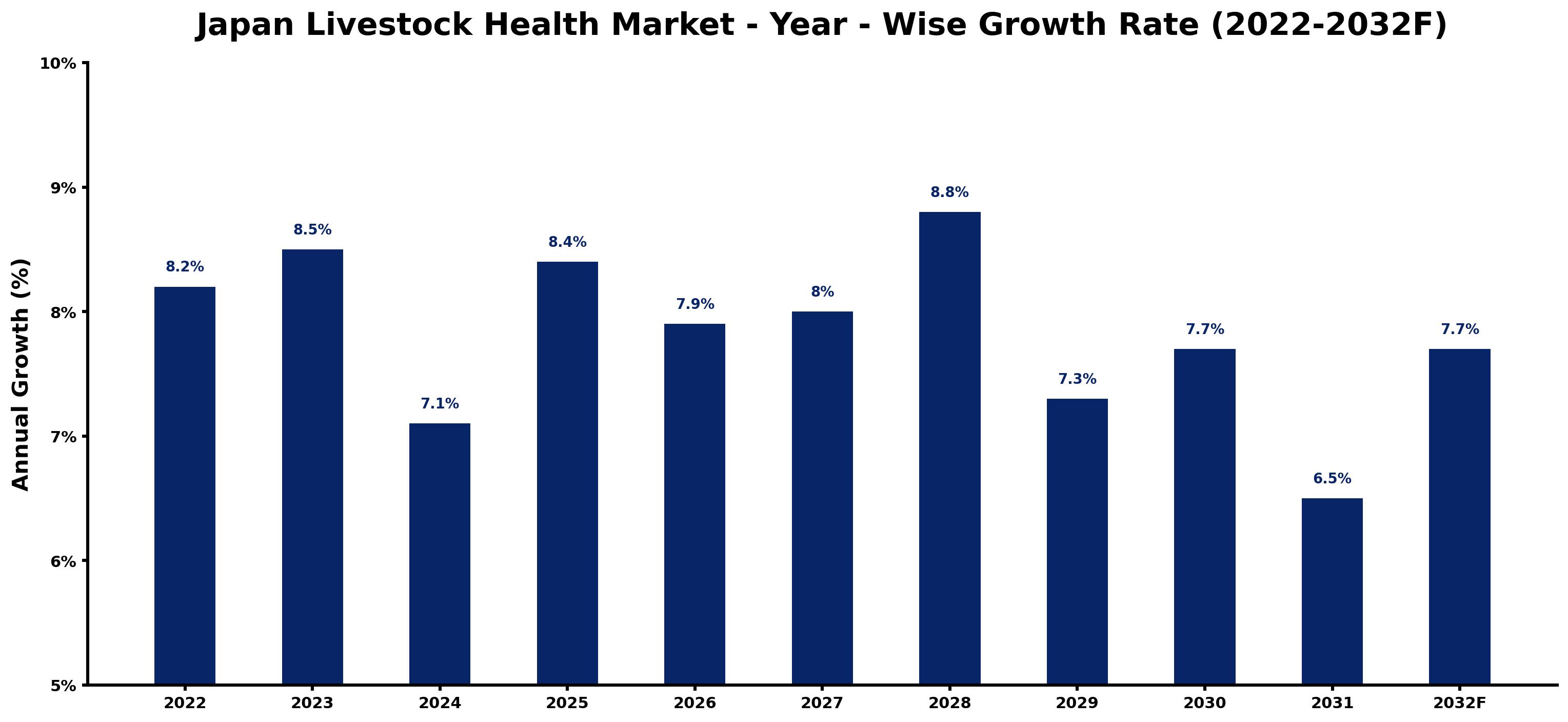
Annual growth estimates for each year appear below with the principal reason behind them, explaining the shifts that set the pace of the market.
| Year | Estimated Annual Growth (%) | Market Rationale |
| 2022 | 8.2 | The market experienced steady growth due to increased veterinary visits and preventive health measures. |
| 2023 | 8.5 | Growth accelerated as investments in livestock health services rose among domestic producers. |
| 2024 | 7.1 | A slowdown occurred as some farmers adjusted spending in response to market fluctuations. |
| 2025 | 8.4 | The market rebounded with renewed investments in veterinary services and health management. |
| 2026 | 7.9 | Growth is expected to slow slightly as spending stabilises after previous peaks. |
| 2027 | 8.0 | Demand is projected to rise again as producers focus on improving livestock health and productivity. |
| 2028 | 8.8 | The peak growth year is expected to see heightened investments in tele-veterinary services and diagnostics. |
| 2029 | 7.3 | A slowdown will follow as the market adjusts to the previous year's rapid growth. |
| 2030 | 7.7 | Growth is expected to resume as producers increasingly adopt preventive health measures and technologies. |
| 2031 | 6.5 | The market will slow again as some segments mature and spending patterns stabilise. |
| 2032 | 7.7 | Growth is projected to pick up with renewed focus on health monitoring and diagnostics for livestock. |
Note: Market size estimations and growth projections presented in this report are based on 6Wresearch's proprietary forecasting methodology, utilizing the latest available industry data, government publications, and primary research inputs.
Japan Livestock Health Market Synopsis
Livestock health products encompass veterinary services, diagnostic testing, and preventive measures aimed at maintaining animal welfare. According to the Japan Livestock Health Market, domestic farmers and ranchers, along with veterinary clinics, drive demand for these essential services. Growth is supported by increased investments in veterinary practices and monitoring programs, with the market valued at around 100 billion JPY in 2023, reflecting a strong emphasis on disease prevention and treatment.
Market Dynamics Impact Analysis (2026–2032)
| Factor | Type | Impact | Primary Segment Affected |
| Increased veterinary visits drive demand for health services and diagnostics. | Driver | High | Veterinary Visits |
| Rising usage of tele-vet services enhances access to veterinary care. | Driver | High | Tele-Vet Services |
| The gap in veterinary service provision in rural areas presents an opportunity. | Opportunity | Medium | Diagnostic Testing |
| Growing smallholder farms require enhanced veterinary services and products. | Opportunity | Medium | Farmers & Ranchers |
| High costs of veterinary services can limit access for some farmers. | Restraint | High | Veterinary Visits |
| Limited awareness of preventive health measures may hinder adoption rates. | Restraint | Medium | Preventive Health |
| Rural areas may face challenges in accessing timely veterinary services. | Challenge | High | On-Farm Practice |
| The need for continuous training in veterinary practices can strain resources. | Challenge | Medium | Veterinary Visits |
Evaluation of Drivers in Japan Livestock Health Market (2026–2032)
Demand rests on the following drivers, each shown with the segment it touches most.
| Drivers | Primary Segment Affected | Why It Matters (Evidence) |
| Increased investment in veterinary services | Veterinary Visits | This investment leads to more frequent health checks, with the average veterinary visit costing around 10,000 JPY, encouraging farmers to prioritise livestock welfare. |
| Growth in tele-veterinary services | Tele-Vet Services | The surge in remote consultations, increasing by 30% since 2022, allows farmers to access veterinary care more efficiently, enhancing overall livestock health. |
| Expansion of diagnostic testing services | Diagnostic Testing | The rise in diagnostic testing in rural areas helps identify diseases early, improving health management and encouraging farmers to invest in preventive measures. |
| Focus on preventive health measures | Preventive Health | Emphasis on vaccinations and health management strategies is essential to prevent disease outbreaks, driving demand for preventive health products among producers. |
| Growth of on-farm practices | On-Farm Practice | Veterinarians conducting health checks directly on farms improve livestock welfare, with the average distance for these visits being about 50 km from clinics. |
Purchasing is picking up as producers increasingly invest in veterinary services, with the average veterinary visit costing around 10,000 JPY. Remote consultations have surged, enabling producers to consult veterinarians efficiently. In rural areas, diagnostic testing services are expanding, which is vital for disease management. Producers are prioritising preventive health measures, focusing on vaccinations to prevent outbreaks. On-farm practices are also rising, allowing veterinarians to conduct direct health checks, which boosts livestock welfare and productivity across Japan.
Evaluation of Restraints in Japan Livestock Health Market
The following restraints limit how fast demand can grow.
| Market Restraint | Primary Segment Affected | Why It Matters (Evidence) |
| High costs of veterinary services limit access for some farmers. | Veterinary Visits | The average cost of a veterinary visit at 10,000 JPY can be prohibitive for smaller farms. |
| Limited awareness of preventive health measures may hinder adoption rates. | Preventive Health | Many producers lack knowledge about the benefits of vaccinations and health management practices. |
| Access to timely veterinary services can be challenging in rural areas. | On-Farm Practice | The average distance for on-farm visits is about 50 km, complicating service delivery. |
| The number of smallholder farms may not sustain high veterinary service demand. | Smallholder Farms | While usage has increased by 15% since 2020, smallholder farms often operate on tight budgets. |
| Ongoing education requirements for veterinarians can strain resources. | Veterinary Visits | Continuous training for veterinarians impacts service availability and resource allocation. |
Japan Livestock Health Market Challenges
High veterinary visit costs of around 15,000 JPY per session strain producers' budgets, limiting their ability to maintain optimal livestock welfare. Regulatory compliance under the Animal Infectious Diseases Control Law complicates operations for veterinary clinics, leading to delays that can hinder timely health interventions for livestock. Supply chain disruptions affect the availability of essential livestock health products, causing delays for clinics that depend on prompt access to treatments. Farmers encounter challenges in securing veterinary services due to the average distance of 50 km for on-farm visits, which can postpone necessary health measures for their animals.
Trends in the Japan Livestock Health Market
Buyers and suppliers in the Japan Livestock Health Market are adjusting to the following trends.
- Farmers Increasingly Use Tele-Vet Services: Producers are shifting towards tele-vet services for consultations, improving accessibility. In 2023, usage increased by 30%, indicating a growing preference for remote care.
- Rise in Preventive Health Measures: Preventive health measures are becoming more prevalent among livestock producers, focusing on vaccinations. The Japanese livestock health strategy emphasises these measures to prevent disease outbreaks, supporting producer initiatives.
- Diagnostic Testing Expanding in Rural Areas: Diagnostic testing services are increasingly available in rural regions, improving livestock health management. This expansion is vital for identifying diseases in livestock populations, enhancing overall health outcomes.
- On-Farm Practices Gaining Popularity: On-farm practices are becoming more common as veterinarians conduct health checks directly on farms. This approach improves animal welfare and productivity across Japan, benefiting both producers and livestock.
Investment Opportunities in the Japan Livestock Health Market
Investors looking at the Japan Livestock Health Market should consider the following areas.
- Partner with Local Veterinary Clinics: With a growing veterinary services market valued at around 100 billion JPY, partnerships with local clinics can improve service delivery. Producers in rural areas are particularly in need of these services.
- Invest in Preventive Health Products: The emphasis on preventive health measures presents an opportunity, with producers increasingly prioritising vaccinations. The Japan Veterinary Medical Association supports initiatives to promote these products, enhancing market penetration.
- Expand Diagnostic Testing Services: The demand for diagnostic testing services is rising, particularly in rural areas where access is limited. Investing in mobile testing units can effectively meet this need and improve livestock health outcomes.
- Develop Tele-Vet Platforms: The increasing usage of tele-vet services, which rose by 30% since 2022, indicates a market gap. Developing platforms for remote consultations can cater to producers seeking accessible veterinary care.
Government Initiatives in the Japan Livestock Health Market
The Next-Generation Medical Infrastructure Act (2017) improves previous laws by allowing anonymised medical data for research, supporting livestock health monitoring. This measure builds on the Clinical Trials Act (2017) that regulates clinical research, ensuring quality and safety in veterinary practices.
The PMDA's oversight of veterinary products ensures quality and safety for livestock health. The agency reviews pharmaceuticals and medical devices, which helps producers access reliable health products for their livestock.
Future Insight of the Japan Livestock Health Market
The 2023 livestock health monitoring program will enhance data collection and disease prevention strategies by 2032. Tele-veterinary services will continue to grow, enabling better access for rural producers. The government’s investment of 5 billion JPY in livestock health initiatives will improve service availability and quality. The implementation of ISO 9001 standards across veterinary practices will elevate service quality and reliability, benefiting both buyers and suppliers.
Market Segmentation Analysis
Japan Livestock Health Market report covers a detailed analysis of the following market segments:
By Health Service – Veterinary Visits Lead, Tele-Vet Services Expected to Grow Fastest
According to Saurav Kr Singh, Senior Research Analyst at 6Wresearch, with 46% of health service revenue in 2025, Veterinary Visits was the largest category. Veterinary visits are crucial for diagnosing and treating livestock health issues, making them indispensable for farmers and ranchers. The concentration of over 3,000 veterinary clinics in the Tokyo region significantly supports this sub-segment's dominance. The quickest growth will come from Tele-Vet Services, forecast to expand at a CAGR of 10.0% between 2026 and 2032. Tele-vet services have seen a 30% increase in usage since 2022, reflecting a growing preference for remote consultations among farmers. This trend indicates that as technology improves, the demand for convenient veterinary care will expand, further solidifying the position of veterinary visits. Suppliers need to invest in tele-vet solutions to meet the rising demand for remote veterinary services.
By Delivery Mode – On-Farm Practice Leads, Online Consultation Expected to Grow Fastest
The largest delivery mode category in 2025 was On-Farm Practice, at 34% of revenue. On-farm practice allows veterinarians to conduct health checks and treatments directly at livestock farms, ensuring immediate care for animals. This method is particularly effective in rural areas where access to clinics may be limited. Online Consultation is projected to grow fastest, at a CAGR of 10.1% during 2026–2032. Online consultation is gaining traction as a supplementary service, providing farmers with veterinary advice without needing to travel. As more farmers adopt digital solutions, this segment is expected to grow rapidly, complementing on-farm practices. Providers must invest in online consultation platforms to capture the growing market of farmers seeking remote veterinary advice.
By Distribution Channel – Direct Sales Leads, Online Platforms Expected to Grow Fastest
In 2025, Direct Sales led the distribution channel split with a 47% share. Direct sales remain the primary channel for distributing livestock health products, allowing farmers and ranchers to access necessary services directly. This approach strengthens relationships between suppliers and end-users, ensuring a steady flow of products to the market. Over 2026–2032, Online Platforms are expected to post the fastest growth, at a CAGR of 10.4%. Online platforms are rapidly gaining traction as a channel for purchasing health products, reflecting a shift towards digital purchasing behaviours among farmers. As user engagement with these platforms rises, they will become increasingly important in the market's development. Suppliers should focus on improving their online strategies to meet the growing preference for digital purchasing among farmers.
By End User – Farmers & Ranchers Lead, Smallholder Farms Expected to Grow Fastest
Farmers & Ranchers held 52% of the Japan Livestock Health Market by end user in 2025. Farmers and ranchers are the primary users of livestock health products, relying on these services to maintain the health of their animals. Their large numbers across Japan ensure that this sub-segment holds the largest share in the market. Smallholder Farms are set to record the highest CAGR in this split, 10.2% over 2026–2032. Smallholder farms have increased their utilization of veterinary services by 15% since 2020, indicating a rising awareness of animal health among smaller operators. This growth suggests that as smallholder farms expand, their demand for livestock health services will continue to rise. Suppliers should tailor their offerings to meet the specific needs of smallholder farms to capitalise on this growing segment.
Key Attractiveness of the Report
- 10 Years of Market Numbers
- Historical Data Starting from 2022 to 2025
- Base Year 2025
- Forecast Data until 2032
- Key Performance Indicators Impacting the Market
- Major Upcoming Developments and Projects
Key Highlights of the Report:
- Japan Livestock Health Market Outlook
- Market Size of Japan Livestock Health Market, 2025
- Forecast of Japan Livestock Health Market, 2032
- Historical Data and Forecast of Japan Livestock Health Revenues & Volume for the Period 2022-2032F
- Japan Livestock Health Market Trend Evolution
- Japan Livestock Health Market Drivers and Challenges
- Japan Livestock Health Price Trends
- Japan Livestock Health Porter's Five Forces
- Japan Livestock Health Industry Life Cycle
- Historical Data and Forecast of Japan Livestock Health Market Revenues & Volume By Health Service for the Period 2022-2032F
- Historical Data and Forecast of Japan Livestock Health Market Revenues & Volume By Veterinary Visits for the Period 2022-2032F
- Historical Data and Forecast of Japan Livestock Health Market Revenues & Volume By Tele-Vet Services for the Period 2022-2032F
- Historical Data and Forecast of Japan Livestock Health Market Revenues & Volume By Diagnostic Testing for the Period 2022-2032F
- Historical Data and Forecast of Japan Livestock Health Market Revenues & Volume By Preventive Health for the Period 2022-2032F
- Historical Data and Forecast of Japan Livestock Health Market Revenues & Volume By Delivery Mode for the Period 2022-2032F
- Historical Data and Forecast of Japan Livestock Health Market Revenues & Volume By On-Farm Practice for the Period 2022-2032F
- Historical Data and Forecast of Japan Livestock Health Market Revenues & Volume By Online Consultation for the Period 2022-2032F
- Historical Data and Forecast of Japan Livestock Health Market Revenues & Volume By Blood/Swab Kits for the Period 2022-2032F
- Historical Data and Forecast of Japan Livestock Health Market Revenues & Volume By Parasite Control for the Period 2022-2032F
- Historical Data and Forecast of Japan Livestock Health Market Revenues & Volume By Distribution Channel for the Period 2022-2032F
- Historical Data and Forecast of Japan Livestock Health Market Revenues & Volume By Direct Sales for the Period 2022-2032F
- Historical Data and Forecast of Japan Livestock Health Market Revenues & Volume By Online Platforms for the Period 2022-2032F
- Historical Data and Forecast of Japan Livestock Health Market Revenues & Volume By Industrial Suppliers for the Period 2022-2032F
- Historical Data and Forecast of Japan Livestock Health Market Revenues & Volume By Specialty Stores for the Period 2022-2032F
- Historical Data and Forecast of Japan Livestock Health Market Revenues & Volume By End User for the Period 2022-2032F
- Historical Data and Forecast of Japan Livestock Health Market Revenues & Volume By Farmers & Ranchers for the Period 2022-2032F
- Historical Data and Forecast of Japan Livestock Health Market Revenues & Volume By Smallholder Farms for the Period 2022-2032F
- Historical Data and Forecast of Japan Livestock Health Market Revenues & Volume By Vet Clinics for the Period 2022-2032F
- Historical Data and Forecast of Japan Livestock Health Market Revenues & Volume By Poultry & Cattle Producers for the Period 2022-2032F
- Japan Livestock Health Import Export Trade Statistics
- Market Opportunity Assessment By Health Service
- Market Opportunity Assessment By Delivery Mode
- Market Opportunity Assessment By Distribution Channel
- Market Opportunity Assessment By End User
- Japan Livestock Health Top Companies Market Share
- Japan Livestock Health Competitive Benchmarking By Technical and Operational Parameters
- Japan Livestock Health Company Profiles
- Japan Livestock Health Key Strategic Recommendations
Market Covered
This report examines the market across the segments below.
By Health Service
- Veterinary Visits
- Tele-Vet Services
- Diagnostic Testing
- Preventive Health
By Delivery Mode
- On-Farm Practice
- Online Consultation
- Blood/Swab Kits
- Parasite Control
By Distribution Channel
- Direct Sales
- Online Platforms
- Industrial Suppliers
- Specialty Stores
By End User
- Farmers & Ranchers
- Smallholder Farms
- Vet Clinics
- Poultry & Cattle Producers






































