Japan Livestock Logistics Market Size & Growth Rate
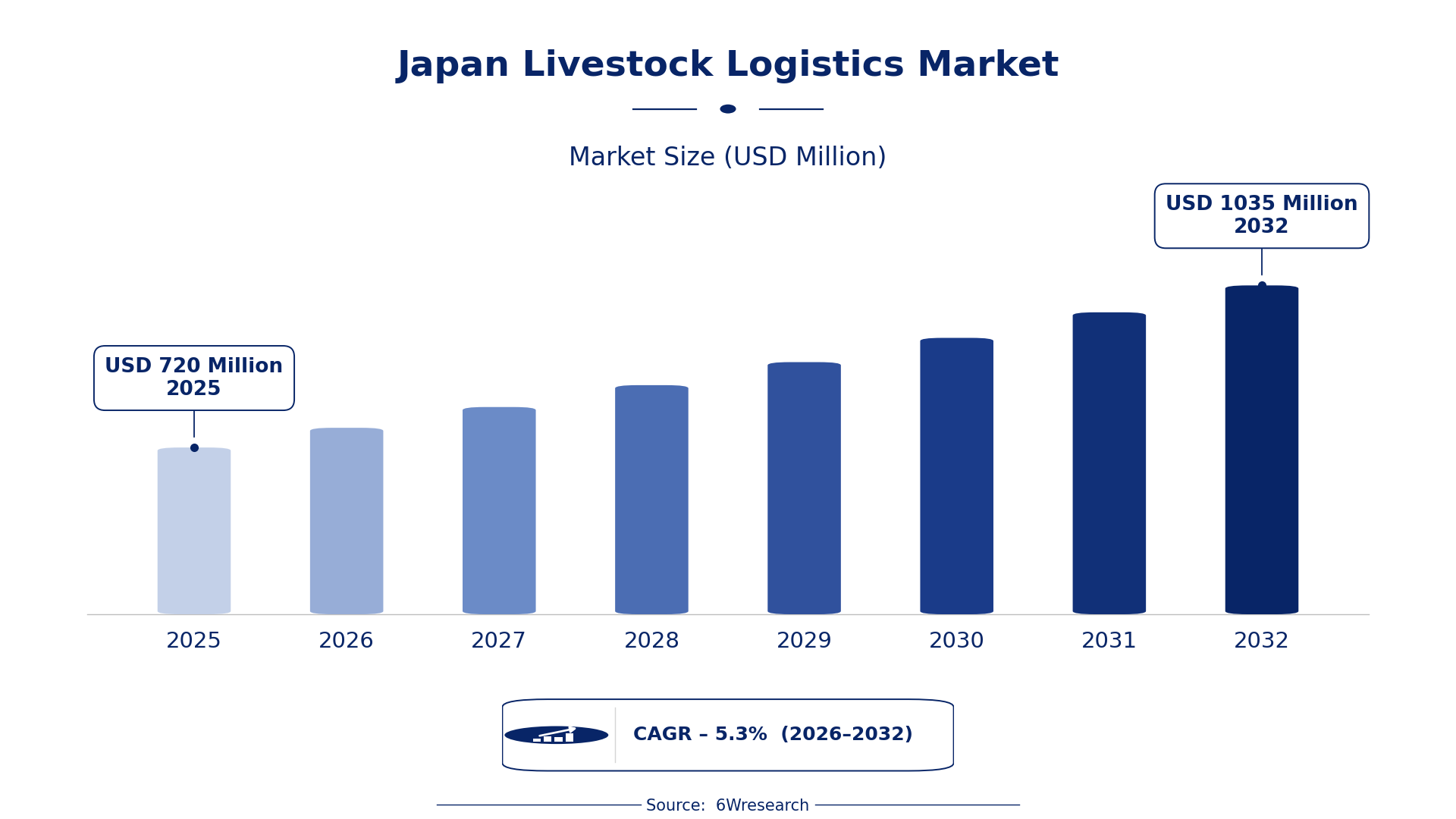
According to 6Wresearch internal database and industry insights, the Japan Livestock Logistics Market was valued at USD 720 Million in 2025 and is projected to reach USD 1,035 Million by 2032, growing at a CAGR of approximately 5.3% during 2026–2032.
Japan Livestock Logistics Market Highlights
| Report Metric | Details |
| Report Name | Japan Livestock Logistics Market (2026-2032) |
| Market Size 2025 | USD 720 Million |
| Market Size 2032 | USD 1,035 Million |
| Absolute Growth 2025–2032 | USD 315 Million |
| CAGR 2026–2032 | 5.3% |
| Peak Annual Growth | 6.6% in 2030 |
| Forecast Period | 2026–2032 |
| Historical Data | 2022–2025 |
| Base Year | 2025 |
| Leading Logistics Type, 2025 | Live Animal Hauling (39% share) |
| Leading Transport Mode, 2025 | Truck/Trailer (39% share) |
| Leading Distribution Channel, 2025 | Direct Sales (39% share) |
| Leading End User, 2025 | Vet Clinics & Farms (44% share) |
| Fastest-Growing Logistics Type | Vaccine Cold Chain (7.8% CAGR) |
| Fastest-Growing Transport Mode | Refrigerated Trucks (7.0% CAGR) |
| Fastest-Growing End User | Feed Mills & Co-ops (7.1% CAGR) |
| Growing Sector | livestock health and care |
| Key End Users | veterinary clinics, livestock farms, feed suppliers |
Japan Livestock Logistics Market Year-wise Growth Rate and Key Drivers (2022–2032)
This graph illustrates the annual growth rates of the market from 2022 to 2032, highlighting a steady upward trajectory and projected market expansion over the forecast period.
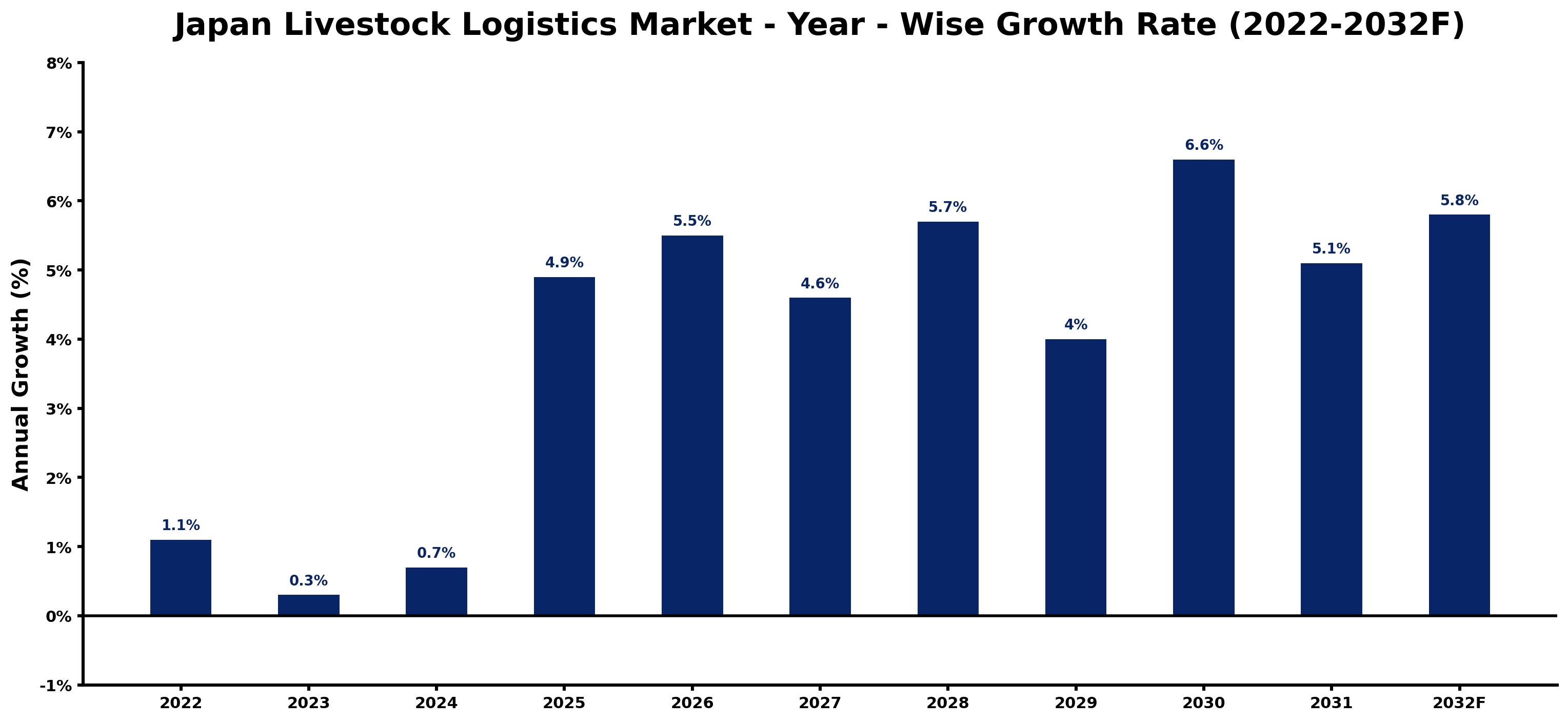
Year by year, the estimates below pair each growth rate with the development that shaped it.
| Year | Estimated Annual Growth (%) | Market Rationale |
| 2022 | 1.1 | Demand remained stable with a focus on biosecurity measures in livestock transport. |
| 2023 | 0.3 | Growth slowed as logistical challenges affected transport efficiency across regions. |
| 2024 | 0.7 | Increased attention to animal welfare boosted demand for improved logistics. |
| 2025 | 4.9 | A surge in livestock sales led to increased logistics operations nationwide. |
| 2026 | 5.5 | Rising investments in cold chain facilities will support better vaccine transport. |
| 2027 | 4.6 | Demand growth will slow as market adjustments take place following previous expansions. |
| 2028 | 5.7 | Technological advancements in logistics will improve operational efficiency, driving growth. |
| 2029 | 4.0 | Growth will slow as market saturation begins to affect new investments. |
| 2030 | 6.6 | Peak growth will be driven by the implementation of new biosecure pathways. |
| 2031 | 5.1 | Market growth will slow as regulatory changes begin to impact logistics operations. |
| 2032 | 5.8 | Demand for logistics services is expected to rise due to increased livestock production. |
Note: Market size estimations and growth projections presented in this report are based on 6Wresearch's proprietary forecasting methodology, utilizing the latest available industry data, government publications, and primary research inputs.
Japan Livestock Logistics Market Synopsis
Livestock logistics involves the transportation and management of live animals, including their movement to markets and farms, as well as the supply of feed and bedding. The Japan Livestock Logistics Market is expanding due to increasing domestic demand and a focus on biosecure transport pathways. With a livestock population of approximately 4 million cattle, the government has launched initiatives to improve transport safety, contributing to the market's growth. Investment in logistics technology and infrastructure is further supporting this expansion, as stakeholders seek to improve operational efficiency and animal welfare standards.
Market Dynamics Impact Analysis (2026–2032)
| Factor | Type | Impact | Primary Segment Affected |
| Increasing focus on biosecurity measures for livestock transport | Driver | High | Biosecure Pathways |
| Rising demand for cold chain logistics for vaccines | Driver | High | Vaccine Cold Chain |
| Growth in the livestock population driving logistics needs | Opportunity | High | Live Animal Hauling |
| Expansion of veterinary clinics requiring logistics support | Opportunity | Medium | Vet Clinics & Farms |
| Logistical inefficiencies affecting transport times | Restraint | High | Feed & Bedding Supply |
| High operational costs impacting logistics profitability | Restraint | Medium | Live Animal Hauling |
| Limited infrastructure for cold chain logistics | Challenge | High | Vaccine Cold Chain |
| Regulatory compliance costs affecting logistics operations | Challenge | Medium | Biosecure Pathways |
Evaluation of Drivers in Japan Livestock Logistics Market (2026–2032)
The table below links each growth driver to the segment it affects and the evidence for it.
| Drivers | Primary Segment Affected | Why It Matters (Evidence) |
| Increased livestock population | Live Animal Hauling | The livestock population in Japan is approximately 4 million cattle, leading to higher transport needs. |
| Government regulations for vaccine transport | Vaccine Cold Chain | The cold chain for vaccines is regulated by the Ministry of Health, Labour and Welfare, ensuring efficacy during transport. |
| Rising demand for animal welfare standards | Biosecure Pathways | Biosecurity measures mandated by national regulations drive demand for secure transport methods. |
| Growing number of veterinary clinics | Vet Clinics & Farms | Japan has approximately 3,500 veterinary clinics, increasing the need for logistics in animal care. |
| Investment in logistics technology | Refrigerated Trucks | Technological advancements in refrigerated transport improve the quality of livestock products. |
Most of the extra volume comes from the increasing livestock population, which stands at approximately 4 million cattle, driving demand for transport services. The implementation of biosecurity measures compels logistics providers to adopt secure transport methods. The growing number of veterinary clinics, which totals around 3,500, raises the demand for logistics services to support animal care. Investments in refrigerated trucks enhance product quality, further boosting demand for efficient logistics solutions.
Evaluation of Restraints in Japan Livestock Logistics Market
Below are the constraints most often cited by buyers and suppliers, with the segment each affects.
| Market Restraint | Primary Segment Affected | Why It Matters (Evidence) |
| Inefficient infrastructure for livestock transport | Live Animal Hauling | Logistical inefficiencies can lead to delays, affecting timely delivery to markets. |
| High operational costs for logistics providers | Feed & Bedding Supply | Rising costs impact profitability, limiting service expansion for logistics firms. |
| Compliance with biosecurity regulations | Biosecure Pathways | Adhering to biosecurity regulations increases operational costs for logistics providers. |
| Limited availability of cold chain facilities | Vaccine Cold Chain | Insufficient infrastructure can hinder effective vaccine transport, affecting livestock health. |
| Market saturation in logistics services | Vet Clinics & Farms | Increased competition can lead to reduced margins for logistics providers. |
Japan Livestock Logistics Market Challenges
Strict regulations governing livestock transport in Japan result in delays for producers, as compliance with JIS Z 2111 standards necessitates extensive documentation and training. Competition from alternative logistics providers pressures suppliers to lower costs, potentially compromising service quality and animal welfare. Rising operational costs, including Japan's minimum wage of JPY 1,055 per hour, strain margins for transporters, leading to higher prices for buyers. Limited availability of cattle, with around 4 million in the country, restricts sourcing options for buyers, causing increased prices and reduced supply.
Trends in the Japan Livestock Logistics Market
Buyers and suppliers in the Japan Livestock Logistics Market are adjusting to the following trends.
- Launch of Livestock Transport Safety Programme: In 2023, the Ministry of Agriculture, Forestry and Fisheries launched a programme aimed at improving livestock transport safety, with the goal of raising welfare standards. This initiative is anticipated to boost demand for compliant logistics services.
- Shift towards Biosecure Transport Pathways: Tokyo and Hokkaido are at the forefront of the shift towards biosecure transport pathways, with new regulations encouraging secure logistics. This trend is crucial for maintaining animal health and preventing disease transmission.
- Increased Adoption of Refrigerated Trucks: The demand for high-quality livestock products is propelling the adoption of refrigerated trucks, which are essential for preserving product integrity. The average age of transport vehicles currently stands at 10 years.
- Growth in Direct Sales Channels: Direct sales are gaining popularity among livestock producers, with 39% of sales occurring through this channel. This trend indicates a shift towards more efficient sales processes.
Investment Opportunities in the Japan Livestock Logistics Market
Investors looking at the Japan Livestock Logistics Market should consider the following areas.
- Expansion of Cold Chain Facilities: Tokyo is experiencing a need for more cold chain facilities to support vaccine transport, with the livestock feed market valued at approximately 1 trillion yen annually. Investing in these facilities can improve logistics efficiency.
- Investment in Biosecurity Measures: With the government allocating 500 million yen for livestock health initiatives, there is a clear opportunity to invest in biosecurity logistics solutions. Collaborating with local veterinary clinics can facilitate market entry.
- Development of Online Sales Platforms: The emergence of online platforms for livestock sales presents a unique opportunity, particularly as digital sales increase. Engaging with auction markets can help logistics providers tap into this growing segment.
- Improvement of Livestock Transport Standards: The Japanese government has set standards for livestock transport under JIS Z 2111, creating a need for logistics providers to meet these regulations. Investing in compliance technologies can open new market avenues.
Government Initiatives in the Japan Livestock Logistics Market
The Economic Security Promotion Act (2022) impacts livestock logistics by supporting supply-chain resilience for critical products. This law mandates adherence to biosecurity measures, ensuring that logistics providers maintain high standards during transport, which is vital for animal welfare and disease prevention.
In 2023, the government allocated 500 million yen for livestock health initiatives, overseen by the Ministry of Agriculture, Forestry and Fisheries. This funding aims to improve transport safety and biosecurity measures, benefiting logistics providers and ensuring compliance with national standards.
Future Insight of the Japan Livestock Logistics Market
Veterinary clinics are set to improve animal welfare standards by 2032, as new guidelines from the Japanese Veterinary Medical Association will ensure better care during transport. The government's investment of 500 million yen in livestock health initiatives will result in improved biosecurity measures, benefiting both suppliers and buyers. Advances in refrigerated transport technology will enhance product quality, ensuring that livestock products meet health standards. The average capacity of livestock trucks is expected to increase to 15 animals, allowing for more efficient logistics and reducing transportation costs for buyers.
Market Segmentation Analysis
Japan Livestock Logistics Market report covers a detailed analysis of the following market segments:
By Logistics Type – Live Animal Hauling Leads, Vaccine Cold Chain Expected to Grow Fastest
According to Saurav Kr Singh, Senior Research Analyst at 6Wresearch, Live Animal Hauling took 39% of logistics type revenue in 2025, more than any other category. Live Animal Hauling commands the largest share because it is essential for transporting livestock to markets and farms, with over 1,000 livestock farms across Japan relying on this service. The established logistics framework and compliance with standards like JIS Z 2111 further solidify its dominant position. Vaccine Cold Chain is set to record the highest CAGR in this split, 7.8% over 2026–2032. The Vaccine Cold Chain is experiencing rapid growth as the government emphasises biosecurity measures, exemplified by a 500 million yen allocation for livestock health initiatives in 2023. This focus on ensuring vaccine efficacy during transport is crucial for maintaining animal welfare and health standards. Suppliers need to enhance cold chain logistics capabilities to meet the increasing demand for vaccine transport.
By Transport Mode – Truck/Trailer Leads, Refrigerated Trucks Expected to Grow Fastest
With 39% of transport mode revenue in 2025, Truck/Trailer was the largest category. Truck/Trailer is the leading transport mode as it serves as the primary method for overland livestock transportation, accommodating the average hauling distance of around 200 km. Its widespread use aligns with the operational needs of livestock farms and markets across various prefectures. Over 2026–2032, Refrigerated Trucks are expected to post the fastest growth, at a CAGR of 7.0%. Refrigerated Trucks are growing rapidly due to the increasing need for maintaining the quality of perishable goods, which is vital for livestock products. The regulatory focus on biosecurity and quality assurance is likely to drive further adoption of this transport mode. Investing in refrigerated transport solutions will be essential for suppliers to meet regulatory standards and consumer expectations.
By Distribution Channel – Direct Sales Leads and Records the Fastest Growth
The largest distribution channel category in 2025 was Direct Sales, at 39% of revenue. Direct Sales is the leading distribution channel as it is commonly used for selling livestock directly to buyers, facilitating an efficient transaction process. This method is favoured by farmers and buyers for its simplicity and direct interaction. Direct Sales is also forecast to expand faster than any other category, at a CAGR of 6.9% over 2026–2032. Direct Sales is also the fastest-growing channel, benefiting from the rising trend towards direct farmer-to-consumer sales. This shift indicates changing consumer preferences towards sourcing livestock directly from producers, a trend likely to continue. Suppliers should optimise their direct sales approaches to capitalise on this growing consumer inclination.
By End User – Vet Clinics & Farms Lead, Feed Mills & Co-ops Expected to Grow Fastest
Vet Clinics & Farms accounted for 44% of the market by end user in 2025. Vet Clinics & Farms represent the largest end user group, as they require logistics for animal health and care, supported by approximately 3,500 veterinary clinics across Japan. Their reliance on efficient logistics is critical for maintaining animal welfare standards. Feed Mills & Co-ops are projected to grow fastest, at a CAGR of 7.1% during 2026–2032. Feed Mills & Co-ops are the fastest-growing end user segment, driven by their major role in logistics for feed supply, which is valued at around 1 trillion yen annually. This growth is indicative of the increasing demand for efficient feed distribution in the livestock sector. Suppliers should focus on strengthening partnerships with feed mills and co-ops to tap into this expanding market.
Key Attractiveness of the Report
- 10 Years of Market Numbers
- Historical Data Starting from 2022 to 2025
- Base Year 2025
- Forecast Data until 2032
- Key Performance Indicators Impacting the Market
- Major Upcoming Developments and Projects
Key Highlights of the Report:
- Japan Livestock Logistics Market Outlook
- Market Size of Japan Livestock Logistics Market, 2025
- Forecast of Japan Livestock Logistics Market, 2032
- Historical Data and Forecast of Japan Livestock Logistics Revenues & Volume for the Period 2022-2032F
- Japan Livestock Logistics Market Trend Evolution
- Japan Livestock Logistics Market Drivers and Challenges
- Japan Livestock Logistics Price Trends
- Japan Livestock Logistics Porter's Five Forces
- Japan Livestock Logistics Industry Life Cycle
- Historical Data and Forecast of Japan Livestock Logistics Market Revenues & Volume By Logistics Type for the Period 2022-2032F
- Historical Data and Forecast of Japan Livestock Logistics Market Revenues & Volume By Live Animal Hauling for the Period 2022-2032F
- Historical Data and Forecast of Japan Livestock Logistics Market Revenues & Volume By Feed & Bedding Supply for the Period 2022-2032F
- Historical Data and Forecast of Japan Livestock Logistics Market Revenues & Volume By Vaccine Cold Chain for the Period 2022-2032F
- Historical Data and Forecast of Japan Livestock Logistics Market Revenues & Volume By Biosecure Pathways for the Period 2022-2032F
- Historical Data and Forecast of Japan Livestock Logistics Market Revenues & Volume By Transport Mode for the Period 2022-2032F
- Historical Data and Forecast of Japan Livestock Logistics Market Revenues & Volume By Truck/Trailer for the Period 2022-2032F
- Historical Data and Forecast of Japan Livestock Logistics Market Revenues & Volume By Bulk/Si
- Historical Data and Forecast of Japan Livestock Logistics Market Revenues & Volume By Refrigerated Trucks for the Period 2022-2032F
- Historical Data and Forecast of Japan Livestock Logistics Market Revenues & Volume By Disinfection Routes for the Period 2022-2032F
- Historical Data and Forecast of Japan Livestock Logistics Market Revenues & Volume By Distribution Channel for the Period 2022-2032F
- Historical Data and Forecast of Japan Livestock Logistics Market Revenues & Volume By Direct Sales for the Period 2022-2032F
- Historical Data and Forecast of Japan Livestock Logistics Market Revenues & Volume By Online Platforms for the Period 2022-2032F
- Historical Data and Forecast of Japan Livestock Logistics Market Revenues & Volume By Industrial Suppliers for the Period 2022-2032F
- Historical Data and Forecast of Japan Livestock Logistics Market Revenues & Volume By Specialty Stores for the Period 2022-2032F
- Historical Data and Forecast of Japan Livestock Logistics Market Revenues & Volume By End User for the Period 2022-2032F
- Historical Data and Forecast of Japan Livestock Logistics Market Revenues & Volume By Auction Markets for the Period 2022-2032F
- Historical Data and Forecast of Japan Livestock Logistics Market Revenues & Volume By Feed Mills & Co-ops for the Period 2022-2032F
- Historical Data and Forecast of Japan Livestock Logistics Market Revenues & Volume By Vet Clinics & Farms for the Period 2022-2032F
- Historical Data and Forecast of Japan Livestock Logistics Market Revenues & Volume By Facility Managers for the Period 2022-2032F
- Japan Livestock Logistics Import Export Trade Statistics
- Market Opportunity Assessment By Logistics Type
- Market Opportunity Assessment By Transport Mode
- Market Opportunity Assessment By Distribution Channel
- Market Opportunity Assessment By End User
- Japan Livestock Logistics Top Companies Market Share
- Japan Livestock Logistics Competitive Benchmarking By Technical and Operational Parameters
- Japan Livestock Logistics Company Profiles
- Japan Livestock Logistics Key Strategic Recommendations
Market Covered
The report covers the following segments.
By Logistics Type
- Live Animal Hauling
- Feed & Bedding Supply
- Vaccine Cold Chain
- Biosecure Pathways
By Transport Mode
- Truck/Trailer
- Bulk/Si
- Refrigerated Trucks
- Disinfection Routes
By Distribution Channel
- Direct Sales
- Online Platforms
- Industrial Suppliers
- Specialty Stores
By End User
- Auction Markets
- Feed Mills & Co-ops
- Vet Clinics & Farms
- Facility Managers






































