Japan Livestock Reproduction Technologies Market Size & Growth Rate
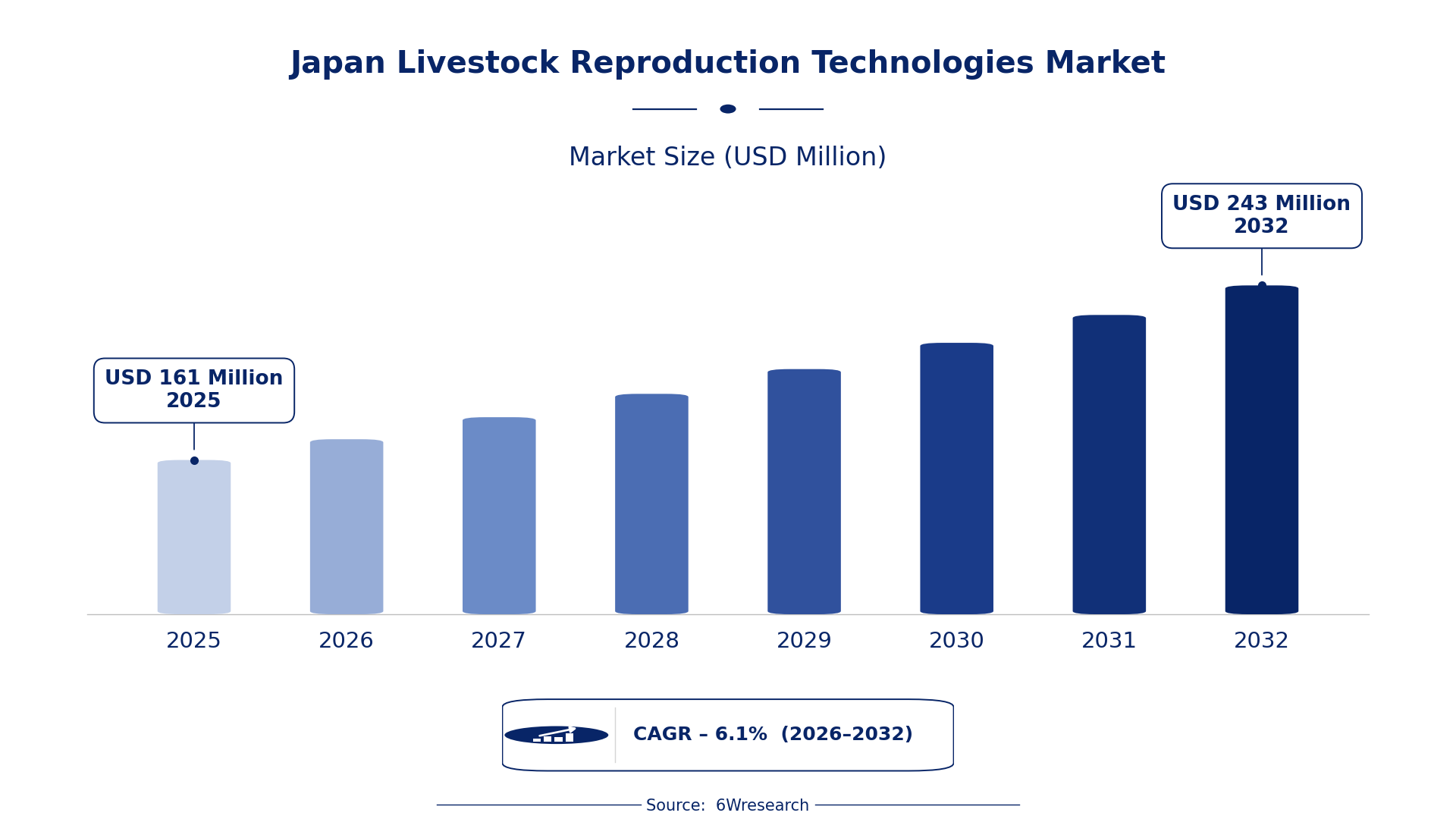
According to 6Wresearch internal database and industry insights, the Japan Livestock Reproduction Technologies Market was valued at USD 161 Million in 2025 and is projected to reach USD 243 Million by 2032, growing at a CAGR of approximately 6.1% during 2026–2032.
Japan Livestock Reproduction Technologies Market Highlights
| Report Metric | Details |
| Report Name | Japan Livestock Reproduction Technologies Market (2026-2032) |
| Market Size 2025 | USD 161 Million |
| Market Size 2032 | USD 243 Million |
| Absolute Growth 2025–2032 | USD 82 Million |
| CAGR 2026–2032 | 6.1% |
| Peak Annual Growth | 6.9% in 2026 |
| Forecast Period | 2026–2032 |
| Historical Data | 2022–2025 |
| Base Year | 2025 |
| Leading Technology Type, 2025 | Artificial Insemination (38% share) |
| Leading Target Use, 2025 | Genetic Improvement (52% share) |
| Leading Distribution Channel, 2025 | Direct Sales (35% share) |
| Leading End User, 2025 | Dairy & Beef Operations (44% share) |
| Fastest-Growing Technology Type | Embryo Transfer (8.8% CAGR) |
| Fastest-Growing Target Use | Elite Herd Generation (8.7% CAGR) |
| Fastest-Growing Distribution Channel | Online Platforms (8.0% CAGR) |
| Fastest-Growing End User | Breeder Organizations (7.9% CAGR) |
| Growing Sector | Dairy and Beef Production |
| Key End Users | Farmers, Breeders, Veterinary Clinics, Agricultural Organizations |
Japan Livestock Reproduction Technologies Market Year-wise Growth Rate and Key Drivers (2022–2032)
This graph illustrates the annual growth rates of the market from 2022 to 2032, highlighting a steady upward trajectory and projected market expansion over the forecast period.
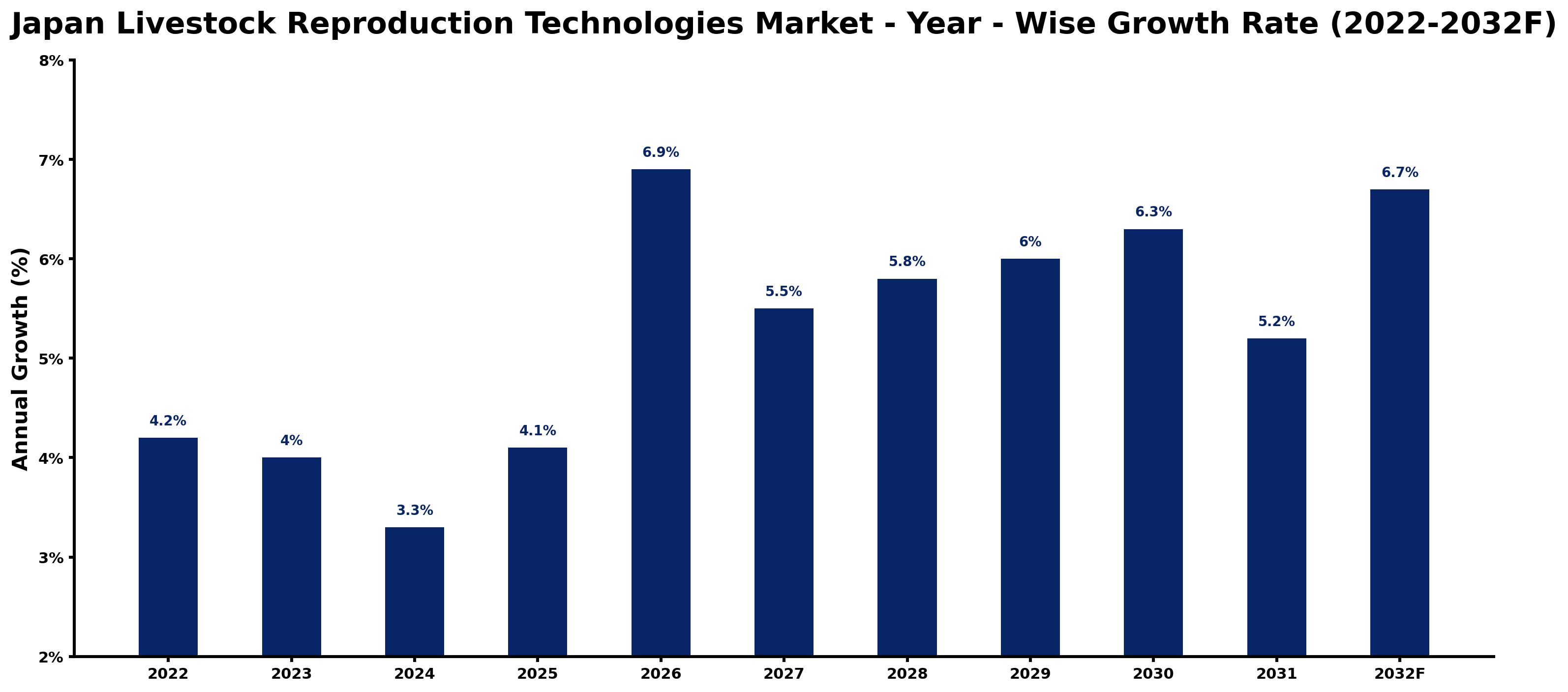
The table below sets out the estimated growth rate for each year and the main factor behind it.
| Year | Estimated Annual Growth (%) | Market Rationale |
| 2022 | 4.2 | The market experienced stable growth due to consistent demand from dairy operations. |
| 2023 | 4.0 | Growth slowed as some farmers delayed technology upgrades amid rising costs. |
| 2024 | 3.3 | The market continued to slow as producers adjusted to changing economic conditions. |
| 2025 | 4.1 | Demand increased as farmers adopted more efficient breeding practices. |
| 2026 | 6.9 | Growth accelerated due to rising investments in advanced reproductive technologies. |
| 2027 | 5.5 | The market slowed as competition intensified among technology providers. |
| 2028 | 5.8 | Demand rose as more operations sought to improve genetic diversity. |
| 2029 | 6.0 | Growth continued as breeders increasingly relied on advanced techniques. |
| 2030 | 6.3 | The market expanded due to heightened focus on genetic improvement programs. |
| 2031 | 5.2 | Growth slowed as market maturity began to set in for certain technologies. |
| 2032 | 6.7 | Demand increased as new technologies emerged to improve breeding efficiency. |
Note: Market size estimations and growth projections presented in this report are based on 6Wresearch's proprietary forecasting methodology, utilizing the latest available industry data, government publications, and primary research inputs.
Japan Livestock Reproduction Technologies Market Synopsis
Livestock Reproduction Technologies include methods such as artificial insemination and embryo transfer, which improve breeding efficiency in livestock. The Japan Livestock Reproduction Technologies Market is expanding due to strong demand from dairy and beef operations, with 75% of dairy farms using artificial insemination in 2022. The adoption of advanced reproductive methods is increasing, driven by government initiatives and a focus on improving genetic traits, particularly in the Tokyo region, where investment in genetic diversity is rising.
Market Dynamics Impact Analysis (2026–2032)
| Factor | Type | Impact | Primary Segment Affected |
| Increasing adoption of artificial insemination techniques | Driver | High | Artificial Insemination |
| Rising demand for genetic improvement in livestock | Driver | High | Genetic Improvement |
| Growth in elite herd generation programs | Opportunity | High | Elite Herd Generation |
| Expansion of online platforms for technology distribution | Opportunity | Medium | Online Platforms |
| High costs associated with advanced reproductive technologies | Restraint | High | In Vitro Technologies |
| Limited awareness of new technologies among farmers | Restraint | Medium | Embryo Transfer |
| Competition from alternative breeding methods | Challenge | High | Ultrasonography |
| Technological integration challenges in rural areas | Challenge | Medium | Veterinary Reproductive Clinics |
Evaluation of Drivers in Japan Livestock Reproduction Technologies Market (2026–2032)
Below are the drivers that matter most for revenue growth, with supporting evidence.
| Drivers | Primary Segment Affected | Why It Matters (Evidence) |
| High milk yield per cow | Dairy & Beef Operations | The average milk yield of around 8,000 liters annually encourages farmers to adopt reproductive technologies for better productivity. |
| Government support for genetic improvement | Genetic Improvement | The amendment to the Food Sanitation Act promotes better practices, leading to increased adoption of advanced reproductive technologies. |
| Utilization of embryo transfer in elite breeding programs | Embryo Transfer | Over 30% of elite breeding programs use embryo transfer, driving demand for these technologies among breeders. |
| Standard use of ultrasonography in clinics | Ultrasonography | With 90% of veterinary reproductive clinics employing ultrasonography, demand for related services and technologies is rising. |
| Focus on improving genetic diversity | Advanced Genetic Programs | The government's target to enhance genetic diversity by 2025 spurs investment in advanced reproductive technologies. |
Spending rises because the average milk yield per cow in Japan is substantial, prompting farmers to adopt reproductive technologies for improved productivity. Recent legislation encourages the use of advanced reproductive methods, increasing adoption rates. The standard use of ultrasonography in veterinary reproductive clinics increases the need for related technologies.
Evaluation of Restraints in Japan Livestock Reproduction Technologies Market
The main factors holding the market back are set out below.
| Market Restraint | Primary Segment Affected | Why It Matters (Evidence) |
| High costs associated with advanced reproductive technologies | In Vitro Technologies | The substantial investment required for in vitro technologies limits their adoption among smaller farms. |
| Limited awareness of new technologies among farmers | Embryo Transfer | Many farmers remain unaware of the benefits of embryo transfer, hindering its widespread adoption. |
| Competition from alternative breeding methods | Ultrasonography | The availability of traditional breeding methods poses a challenge to the adoption of ultrasonography. |
| Technological integration challenges in rural areas | Veterinary Reproductive Clinics | Rural clinics face difficulties in integrating advanced technologies, affecting service delivery. |
| Regulatory hurdles for new technology approvals | Advanced Genetic Programs | Stringent regulations delay the introduction of new reproductive technologies, impacting market growth. |
Japan Livestock Reproduction Technologies Market Challenges
In veterinary reproductive clinics, a shortage of trained professionals limits the effective use of advanced reproductive technologies, delaying breeding programs for farmers. Supply chain disruptions for essential equipment, such as ultrasound machines, can extend delivery times by up to three months, hindering the operations of clinics and breeders. Regulatory hurdles, including compliance with specifications outlined by the Japanese Industrial Standards, can slow down the adoption of new techniques, resulting in missed opportunities for livestock producers. Rapid technological advancements mean that many breeders struggle to keep up, risking inefficiencies in their breeding strategies and potentially lowering herd quality.
Trends in the Japan Livestock Reproduction Technologies Market
Four trends stand out in the Japan Livestock Reproduction Technologies Market.
- Shift towards Advanced Genetic Programs: Investment in advanced genetic programs is rising, particularly in the Tokyo region, where a government target aims to improve genetic diversity by 2025.
- Transition from Traditional to Artificial Insemination: The adoption of artificial insemination has surged, with 75% of dairy farms employing this method, reflecting a shift in breeding practices across the country.
- Emerging Online Platforms for Distribution: Online platforms are gaining traction in the livestock reproduction technology market, with an annual growth rate of 8.0%, facilitating easier access to advanced reproductive technologies for farmers.
- Growing Demand for Embryo Transfer: Embryo transfer technology is increasingly employed in elite breeding programs, with over 30% adoption, indicating a shift towards more efficient breeding methods.
Investment Opportunities in the Japan Livestock Reproduction Technologies Market
Below are the investment opportunities with the strongest case in the Japan Livestock Reproduction Technologies Market.
- Timing for Investment in Genetic Improvement: With the government targeting genetic diversity by 2025, there is an opportunity for investment in genetic improvement technologies, particularly among breeder organizations.
- Gap in Adoption of In Vitro Technologies: The adoption rate of advanced reproductive technologies is growing by 5% annually, indicating a gap for suppliers to meet rising demand in high-value breeding centres.
- Expansion of Services in Veterinary Reproductive Clinics: With over 1,000 veterinary reproductive clinics in Japan, there is a growing opportunity to provide advanced reproductive services and technologies to enhance livestock productivity.
- Entry into Online Technology Distribution: The rise of online platforms for technology distribution presents an opportunity for partnerships with local suppliers to strengthen market presence and reach.
Government Initiatives in the Japan Livestock Reproduction Technologies Market
The Food Sanitation Act amendment of 2018 mandates HACCP-based hygiene management for food businesses, impacting livestock producers by ensuring higher standards in animal health and safety. This law promotes better practices in livestock reproduction technologies, improving overall herd quality. The amendment also includes funding initiatives aimed at improving livestock breeding practices, ensuring that producers can access the latest technologies and methods.
The Digital Agency oversees funding for livestock reproduction technologies, supporting advancements in breeding practices. This agency funds initiatives aimed at improving genetic traits, ensuring that producers can access the latest technologies and methods. In 2023, a government initiative allocated funds for improving livestock genetics, benefiting over 500 breeder organizations across the country.
Future Insight of the Japan Livestock Reproduction Technologies Market
The adoption of in vitro fertilization will transform breeding practices by 2032, enabling farmers to improve livestock traits more efficiently. Government initiatives will drive funding for advanced genetic programs, boosting overall herd quality. By 2025, targets for genetic diversity will compel breeders to implement new standards set by the Japanese Society of Animal Reproduction. With the average milk yield per cow projected to reach 8,500 litres annually, suppliers will need to adapt their technologies to support increased productivity.
Market Segmentation Analysis
Japan Livestock Reproduction Technologies Market report covers a detailed analysis of the following market segments:
By Technology Type – Artificial Insemination Leads, Embryo Transfer Expected to Grow Fastest
According to Saurav Kr Singh, Senior Research Analyst at 6Wresearch, Artificial Insemination held 38% of the Japan Livestock Reproduction Technologies Market by technology type in 2025. Artificial insemination holds the largest share due to its widespread use among dairy farms, with 75% employing this method for breeding. This technology is essential for improving genetic traits and increasing productivity within Japan's dairy sector. The quickest growth will come from Embryo Transfer, forecast to expand at a CAGR of 8.8% between 2026 and 2032. Embryo transfer is experiencing rapid growth, utilised in over 30% of elite breeding programs, which significantly enhances genetic improvement. As breeders focus on optimising livestock quality, this method's adoption will continue to expand. Suppliers should focus on promoting embryo transfer technologies to meet the rising demand for genetic advancements.
By Target Use – Genetic Improvement Leads, Elite Herd Generation Expected to Grow Fastest
In 2025, Genetic Improvement led the target use split with a 52% share. Genetic improvement dominates the market as it is the primary goal for farmers and breeders using reproduction technologies to enhance livestock quality. This objective aligns with government initiatives aimed at improving genetic diversity in Japan's livestock sector. Elite Herd Generation is set to record the highest CAGR in this split, 8.7% over 2026–2032. Elite herd generation is growing quickly as breeders increasingly aim to produce superior livestock, reflecting the rising adoption of advanced reproductive technologies. This trend indicates a shift towards prioritising high-quality breeding outcomes in the industry. Buyers will increasingly seek technologies that support elite herd generation to maintain competitiveness in the livestock market.
By Distribution Channel – Direct Sales Leads, Online Platforms Expected to Grow Fastest
Direct Sales took 35% of distribution channel revenue in 2025, more than any other category. Direct sales dominate the distribution channel, allowing for personal engagement and tailored solutions for farmers and breeders. This method is preferred for its effectiveness in delivering livestock reproduction technologies directly to end users. Online Platforms are projected to grow fastest, at a CAGR of 8.0% during 2026–2032. Online platforms are experiencing rapid growth, providing convenient access to information and products that appeal to a tech-savvy generation of farmers. This shift suggests a potential change in purchasing behaviour among livestock producers. Suppliers should strengthen their online presence to capture the growing segment of buyers who prefer digital purchasing options.
By End User – Dairy & Beef Operations Lead, Breeder Organizations Expected to Grow Fastest
With 44% of end user revenue in 2025, Dairy & Beef Operations was the largest category. Dairy and beef operations represent the largest end user group, accounting for 80% of the market as they heavily rely on reproduction technologies for productivity. This substantial sector ensures a consistent demand for effective breeding solutions. Over 2026–2032, Breeder Organizations are expected to post the fastest growth, at a CAGR of 7.9%. Breeder organizations are rapidly expanding as they play a crucial role in implementing advanced breeding techniques, reflecting the industry's focus on quality improvement. Their involvement is vital for the adoption of new technologies in livestock reproduction. Suppliers must engage with breeder organizations to facilitate the adoption of advanced reproductive technologies in the livestock sector.
Key Attractiveness of the Report
- 10 Years of Market Numbers
- Historical Data Starting from 2022 to 2025
- Base Year 2025
- Forecast Data until 2032
- Key Performance Indicators Impacting the Market
- Major Upcoming Developments and Projects
Key Highlights of the Report:
- Japan Livestock Reproduction Technologies Market Outlook
- Market Size of Japan Livestock Reproduction Technologies Market, 2025
- Forecast of Japan Livestock Reproduction Technologies Market, 2032
- Historical Data and Forecast of Japan Livestock Reproduction Technologies Revenues & Volume for the Period 2022-2032F
- Japan Livestock Reproduction Technologies Market Trend Evolution
- Japan Livestock Reproduction Technologies Market Drivers and Challenges
- Japan Livestock Reproduction Technologies Price Trends
- Japan Livestock Reproduction Technologies Porter's Five Forces
- Japan Livestock Reproduction Technologies Industry Life Cycle
- Historical Data and Forecast of Japan Livestock Reproduction Technologies Market Revenues & Volume By Technology Type for the Period 2022-2032F
- Historical Data and Forecast of Japan Livestock Reproduction Technologies Market Revenues & Volume By Artificial Insemination for the Period 2022-2032F
- Historical Data and Forecast of Japan Livestock Reproduction Technologies Market Revenues & Volume By Embryo Transfer for the Period 2022-2032F
- Historical Data and Forecast of Japan Livestock Reproduction Technologies Market Revenues & Volume By Ultrasonography for the Period 2022-2032F
- Historical Data and Forecast of Japan Livestock Reproduction Technologies Market Revenues & Volume By In Vitro Technologies for the Period 2022-2032F
- Historical Data and Forecast of Japan Livestock Reproduction Technologies Market Revenues & Volume By Target Use for the Period 2022-2032F
- Historical Data and Forecast of Japan Livestock Reproduction Technologies Market Revenues & Volume By Genetic Improvement for the Period 2022-2032F
- Historical Data and Forecast of Japan Livestock Reproduction Technologies Market Revenues & Volume By Elite Herd Generation for the Period 2022-2032F
- Historical Data and Forecast of Japan Livestock Reproduction Technologies Market Revenues & Volume By Pregnancy Scanning for the Period 2022-2032F
- Historical Data and Forecast of Japan Livestock Reproduction Technologies Market Revenues & Volume By Advanced Genetic Programs for the Period 2022-2032F
- Historical Data and Forecast of Japan Livestock Reproduction Technologies Market Revenues & Volume By Distribution Channel for the Period 2022-2032F
- Historical Data and Forecast of Japan Livestock Reproduction Technologies Market Revenues & Volume By Direct Sales for the Period 2022-2032F
- Historical Data and Forecast of Japan Livestock Reproduction Technologies Market Revenues & Volume By Online Platforms for the Period 2022-2032F
- Historical Data and Forecast of Japan Livestock Reproduction Technologies Market Revenues & Volume By Industrial Suppliers for the Period 2022-2032F
- Historical Data and Forecast of Japan Livestock Reproduction Technologies Market Revenues & Volume By Specialty Stores for the Period 2022-2032F
- Historical Data and Forecast of Japan Livestock Reproduction Technologies Market Revenues & Volume By End User for the Period 2022-2032F
- Historical Data and Forecast of Japan Livestock Reproduction Technologies Market Revenues & Volume By Dairy & Beef Operations for the Period 2022-2032F
- Historical Data and Forecast of Japan Livestock Reproduction Technologies Market Revenues & Volume By Breeder Organizations for the Period 2022-2032F
- Historical Data and Forecast of Japan Livestock Reproduction Technologies Market Revenues & Volume By Veterinary Reproductive Clinics for the Period 2022-2032F
- Historical Data and Forecast of Japan Livestock Reproduction Technologies Market Revenues & Volume By High-Value Breeding Centers for the Period 2022-2032F
- Japan Livestock Reproduction Technologies Import Export Trade Statistics
- Market Opportunity Assessment By Technology Type
- Market Opportunity Assessment By Target Use
- Market Opportunity Assessment By Distribution Channel
- Market Opportunity Assessment By End User
- Japan Livestock Reproduction Technologies Top Companies Market Share
- Japan Livestock Reproduction Technologies Competitive Benchmarking By Technical and Operational Parameters
- Japan Livestock Reproduction Technologies Company Profiles
- Japan Livestock Reproduction Technologies Key Strategic Recommendations
Market Covered
Coverage by segment is as follows.
By Technology Type
- Artificial Insemination
- Embryo Transfer
- Ultrasonography
- In Vitro Technologies
By Target Use
- Genetic Improvement
- Elite Herd Generation
- Pregnancy Scanning
- Advanced Genetic Programs
By Distribution Channel
- Direct Sales
- Online Platforms
- Industrial Suppliers
- Specialty Stores
By End User
- Dairy & Beef Operations
- Breeder Organizations
- Veterinary Reproductive Clinics
- High-Value Breeding Centers






































