Japan Livestock Tracking Market Size & Growth Rate
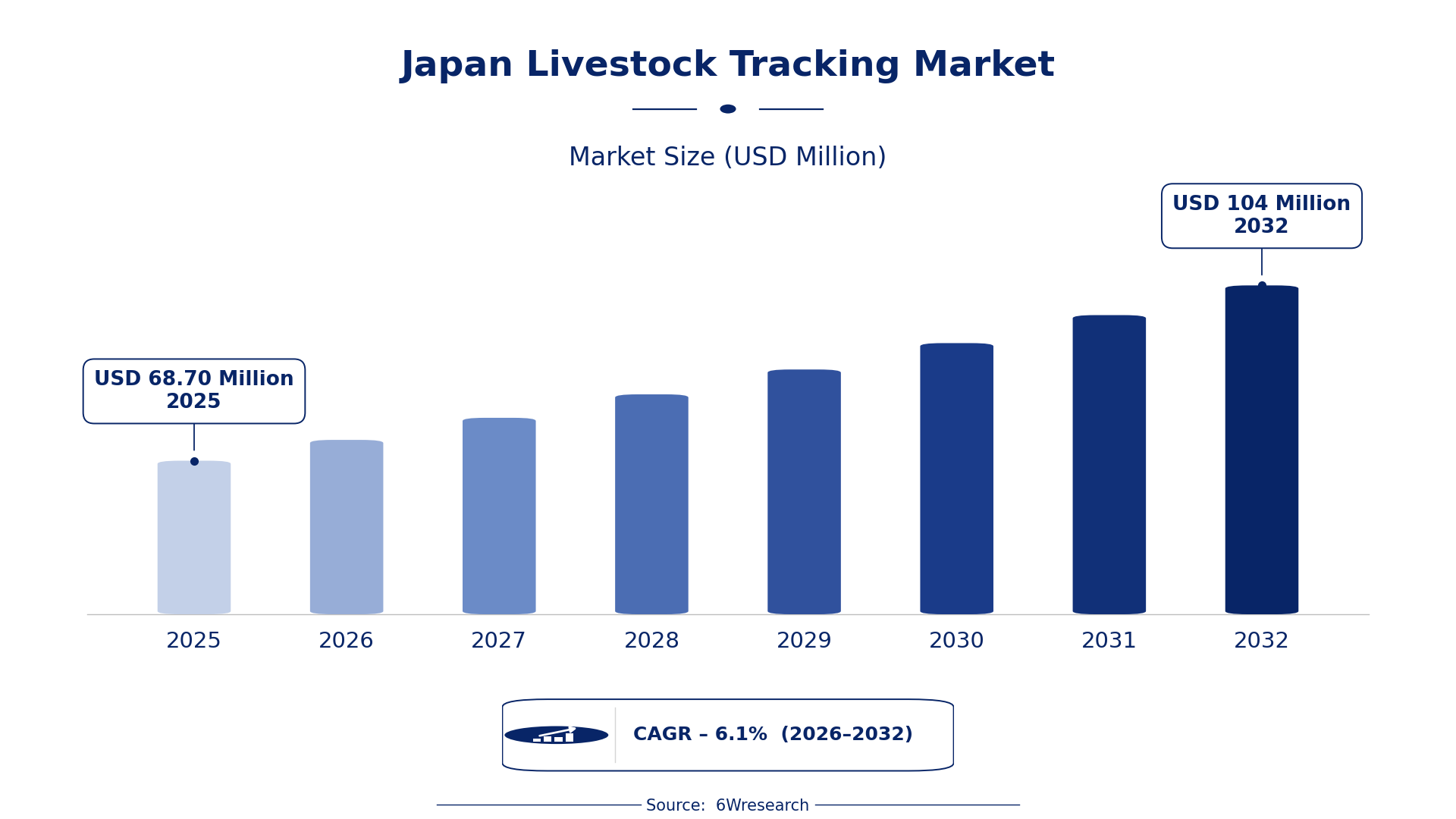
According to 6Wresearch internal database and industry insights, the Japan Livestock Tracking Market was valued at USD 68.70 Million in 2025 and is projected to reach USD 104 Million by 2032, growing at a CAGR of approximately 6.1% during 2026–2032.
Japan Livestock Tracking Market Highlights
| Report Metric | Details |
| Report Name | Japan Livestock Tracking Market (2026-2032) |
| Market Size 2025 | USD 68.70 Million |
| Market Size 2032 | USD 104 Million |
| Absolute Growth 2025–2032 | USD 35.30 Million |
| CAGR 2026–2032 | 6.1% |
| Peak Annual Growth | 6.8% in 2026 |
| Forecast Period | 2026–2032 |
| Historical Data | 2022–2025 |
| Base Year | 2025 |
| Leading Tracking Type, 2025 | GPS Ear Tags (42% share) |
| Leading Monitoring Parameter, 2025 | Activity/Vitals (39% share) |
| Leading Distribution Channel, 2025 | Direct Sales (50% share) |
| Leading End User, 2025 | Extensive Farms (44% share) |
| Fastest-Growing Tracking Type | Sensor Collars (8.9% CAGR) |
| Fastest-Growing Monitoring Parameter | Herd Management (8.4% CAGR) |
| Fastest-Growing Distribution Channel | Online Platforms (8.0% CAGR) |
| Fastest-Growing End User | Research & Production Use (8.1% CAGR) |
| Growing Sector | Livestock management |
| Key End Users | Cattle farmers, research institutions, agricultural cooperatives, feedlot operators |
Japan Livestock Tracking Market Year-wise Growth Rate and Key Drivers (2022–2032)
This graph illustrates the annual growth rates of the market from 2022 to 2032, highlighting a steady upward trajectory and projected market expansion over the forecast period.
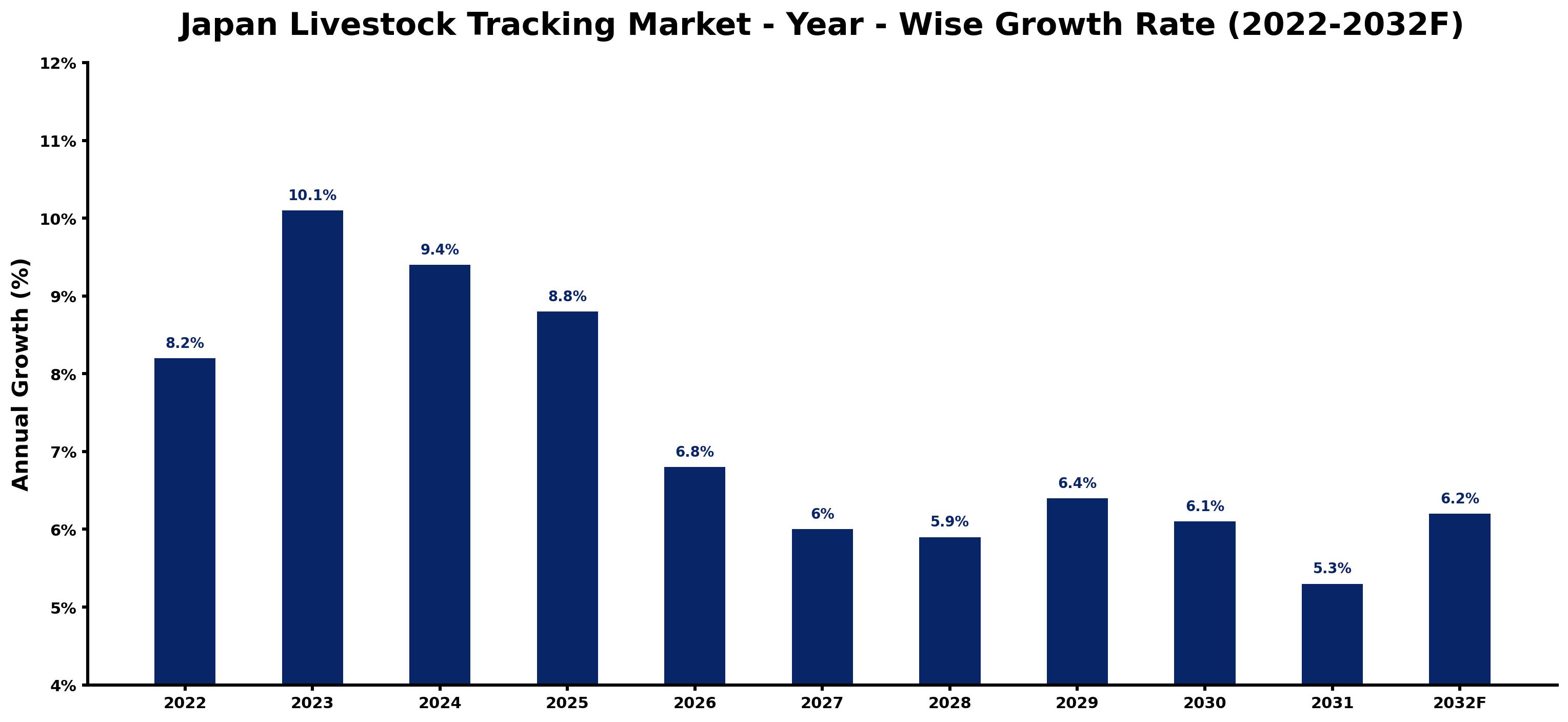
Year by year, the estimates below pair each growth rate with the development that shaped it.
| Year | Estimated Annual Growth (%) | Market Rationale |
| 2022 | 8.2 | The market showed steady growth, reflecting ongoing investments in livestock management technologies. |
| 2023 | 10.1 | Growth accelerated due to increased adoption of tracking technologies among farmers and research institutions. |
| 2024 | 9.4 | A slowdown occurred as the market adjusted to previous high growth rates while remaining positive. |
| 2025 | 8.8 | The market continued to grow, driven by sustained demand for improved herd management solutions. |
| 2026 | 6.8 | Growth is expected to slow as the market stabilises, influenced by increased competition and technology maturity. |
| 2027 | 6.0 | A further slowdown is projected, with buyers focusing on cost-effective tracking solutions. |
| 2028 | 5.9 | The market growth rate is expected to slow slightly, reflecting saturation in some segments and cautious investment. |
| 2029 | 6.4 | Growth is projected to pick up again as new technologies are introduced, improving tracking capabilities. |
| 2030 | 6.1 | The market is expected to see a slowdown as buyers become more selective in technology adoption. |
| 2031 | 5.3 | Another slowdown is anticipated, as the market adjusts to evolving buyer preferences and economic conditions. |
| 2032 | 6.2 | Growth is expected to rise again as demand for traceability and animal welfare increases. |
Note: Market size estimations and growth projections presented in this report are based on 6Wresearch's proprietary forecasting methodology, utilizing the latest available industry data, government publications, and primary research inputs.
Japan Livestock Tracking Market Synopsis
Livestock tracking utilises GPS and sensor technologies to monitor animal health and location, improving herd management and food safety. The Japan Livestock Tracking Market is expanding due to rising demand from over 1.5 million cattle farms and research institutions. The government aims to increase livestock traceability by 40% by 2025, while the adoption of GPS tracking is around 30%. This growth drives investments in advanced tracking technologies, leading to a more efficient livestock sector.
Market Dynamics Impact Analysis (2026–2032)
| Factor | Type | Impact | Primary Segment Affected |
| Rising adoption of GPS and sensor technologies | Driver | High | GPS Ear Tags |
| Increased focus on animal welfare and traceability | Driver | High | Sensor Collars |
| Growing demand for compliance with export regulations | Opportunity | High | Export/Traceability Systems |
| Expansion of online platforms for livestock tracking solutions | Opportunity | Medium | Online Platforms |
| High initial investment costs for tracking technologies | Restraint | High | Combined Smart Tags |
| Limited awareness among smaller farms about tracking benefits | Restraint | Medium | Extensive Farms |
| Challenges in integrating new technologies with existing systems | Challenge | High | Herd Management |
| Regulatory compliance costs impacting smaller producers | Challenge | Medium | Research & Production Use |
Evaluation of Drivers in Japan Livestock Tracking Market (2026–2032)
These are the developments adding the most demand over the forecast period.
| Drivers | Primary Segment Affected | Why It Matters (Evidence) |
| Increased investment in livestock tracking technologies | GPS Ear Tags | The adoption rate of GPS tracking is around 30%, prompting farmers to invest more in these solutions. |
| Focus on improving herd management efficiency | Sensor Collars | Research institutions are increasingly using sensor collars, with a 25% rise in demand for health monitoring technologies. |
| Government initiatives promoting traceability | Export/Traceability Systems | The government aims to increase livestock traceability by 40% by 2025, encouraging producers to adopt tracking systems. |
| Rising consumer demand for food safety | Combined Smart Tags | As consumers become more health-conscious, producers are investing in technologies that ensure traceability and safety, with a 20% increase in related purchases. |
| Technological advancements in tracking devices | Activity/Vitals | ISO 9001 standards are commonly adopted, ensuring quality and reliability in livestock tracking technologies. |
The strongest pull on demand comes from increased investment in livestock tracking technologies, with the adoption rate of GPS tracking around 30%. Research institutions are increasingly using sensor collars for health monitoring, driving demand for these devices. Rising consumer demand for food safety leads producers to adopt technologies that ensure traceability. Technological advancements, supported by ISO 9001 standards, guarantee quality and reliability in livestock tracking devices, further boosting market growth.
Evaluation of Restraints in Japan Livestock Tracking Market
These are the pressures that could keep growth below its potential.
| Market Restraint | Primary Segment Affected | Why It Matters (Evidence) |
| High initial investment costs for tracking technologies | Combined Smart Tags | Producers face upfront costs of approximately 1 million JPY, limiting adoption among smaller farms with tighter budgets. |
| Limited awareness among smaller farms about tracking benefits | Extensive Farms | Many smaller farms lack knowledge of the advantages of tracking technologies, hindering market penetration. |
| Challenges in integrating new technologies with existing systems | Herd Management | Producers often struggle to incorporate new tracking solutions into established herd management practices, affecting efficiency. |
| Regulatory compliance costs impacting smaller producers | Research & Production Use | Smaller producers may find it difficult to meet compliance requirements due to associated costs, which can reach 200,000 JPY. |
| Concerns over data privacy and security | GPS Ear Tags | Producers worry about the potential misuse of data collected from tracking devices, affecting adoption. |
Japan Livestock Tracking Market Challenges
Producers in Japan struggle with outdated livestock monitoring technology, which hampers operational efficiency and data accuracy. Many farms resist upgrading to GPS and sensor devices due to high costs, delaying herd management improvements for over 200,000 registered livestock producers. Supply chain disruptions occur as advanced monitoring devices are often imported, resulting in lead times that can extend by three months and raise costs for producers. A shortage of skilled workers in technology implementation limits the effective use of monitoring systems, negatively impacting productivity in a livestock sector valued at approximately 2 trillion JPY.
Trends in the Japan Livestock Tracking Market
The trends below show where the Japan Livestock Tracking Market is heading.
- Launch of Traceability Improvement Programme: In 2023, Japan initiated a programme to increase livestock traceability by 40% by 2025. This initiative encourages producers to adopt tracking technologies, ensuring compliance and boosting market growth.
- Shift towards Integrated Tracking Solutions: There is a growing trend towards integrated tracking solutions, such as combined smart tags that monitor health and location. This change reflects the need for effective data management in livestock farming, with an expected increase in adoption rates of 15%.
- Increased Adoption of Sensor Technologies: Research institutions are increasingly adopting sensor collars for animal health studies, with a notable rise in usage by 30%. This trend supports the development of more sophisticated tracking solutions, improving overall livestock management.
- Growing Online Sales Channels for Tracking Devices: The online platforms segment is experiencing rapid growth, with an expected CAGR of 8.0% by 2032. This shift allows producers to access a wider range of tracking solutions, improving market accessibility.
Investment Opportunities in the Japan Livestock Tracking Market
The openings below show where demand in the Japan Livestock Tracking Market is visible and how suppliers can enter.
- Growing Demand for Traceability Solutions: With the government's goal to increase livestock traceability by 40% by 2025, there is an opportunity for investment in tracking technologies. Producers in Hokkaido can benefit from adopting these solutions to meet compliance.
- Expansion of Online Platforms for Livestock Tracking: The online platforms segment is projected to grow, driven by increased consumer access to tracking solutions. Collaborating with local distributors can facilitate entry into this expanding market, with a potential growth of 15%.
- Investment in Smart Tracking Technologies: The adoption of smart tags is expected to rise significantly by 2026, presenting an opportunity for suppliers to provide advanced tracking solutions. Extensive farms in Kumamoto are ideal buyers for these technologies.
- Focus on Animal Welfare Standards: The Japanese government's emphasis on improving animal welfare through tracking creates a timely opportunity for investment in related technologies. Producers can partner with local agricultural cooperatives to enhance their offerings.
Government Initiatives in the Japan Livestock Tracking Market
The Ministry of Agriculture, Forestry and Fisheries (MAFF) supports livestock tracking initiatives, promoting compliance with ISO 9001 standards and improving traceability. The Economic Security Promotion Act, enacted in 2022, aims to secure supply-chain resilience for critical products, including livestock tracking technologies.
In 2023, MAFF allocated 500 million JPY for livestock tracking initiatives, focusing on improving traceability and animal welfare. The Japan Livestock Technology Association promotes innovation and ensures that producers meet the required standards.
Future Insight of the Japan Livestock Tracking Market
By 2032, suppliers will see a notable increase in the adoption of smart tags, enhancing herd management and traceability. The government's programme to boost livestock traceability will stimulate advancements in monitoring technologies. Integration of these systems with management software will become standard, streamlining operations for over 1.5 million cattle farms. Research institutions will increasingly utilise advanced monitoring devices, which will improve animal health studies and welfare standards across the sector.
Market Segmentation Analysis
Japan Livestock Tracking Market report covers a detailed analysis of the following market segments:
By Tracking Type – GPS Ear Tags Lead, Sensor Collars Expected to Grow Fastest
According to Saurav Kr Singh, Senior Research Analyst at 6Wresearch, GPS Ear Tags took 42% of tracking type revenue in 2025, more than any other category. GPS ear tags hold the largest market share due to their widespread adoption among farmers for precise location tracking, particularly in Hokkaido, where cattle farming is prevalent. Their integration with herd management software further solidifies their dominance in the livestock tracking sector. Over 2026–2032, Sensor Collars are expected to post the fastest growth, at a CAGR of 8.9%. Sensor collars are experiencing rapid growth as they provide vital health and activity monitoring, increasingly sought after by research institutions. The government's focus on enhancing animal welfare standards is likely to accelerate the adoption of these advanced technologies. Suppliers should prioritise the development of sensor collar technologies to meet the increasing demands of the livestock sector.
By Monitoring Parameter – Activity/Vitals Lead, Herd Management Expected to Grow Fastest
Activity/Vitals held 39% of the Japan Livestock Tracking Market by monitoring parameter in 2025. Activity/vitals monitoring is the leading segment as it effectively tracks essential health indicators for livestock, which is crucial for extensive farms. This focus aligns with government initiatives aimed at improving animal welfare standards across the industry. Herd Management is projected to grow fastest, at a CAGR of 8.4% during 2026–2032. Herd management is the fastest-growing segment, vital for efficiently managing large herds, especially given the average size of extensive farms is around 100 cattle. The integration of tracking technologies with herd management software significantly boosts this segment's growth potential. Suppliers should enhance their herd management solutions to cater to the increasing demand from extensive farms.
By Distribution Channel – Direct Sales Leads, Online Platforms Expected to Grow Fastest
The largest distribution channel category in 2025 was Direct Sales, at 50% of revenue. Direct sales dominate the distribution channel for livestock tracking devices, as they provide farmers with immediate access to the latest technologies. This method allows for direct interaction between suppliers and extensive farms, ensuring tailored solutions for their needs. Online Platforms are set to record the highest CAGR in this split, 8.0% over 2026–2032. Online platforms are growing rapidly as a distribution channel, making it easier for consumers to access livestock tracking technologies. The increasing digitalisation of the agricultural sector is encouraging farmers to explore online purchasing options. Vendors should invest in online sales strategies to reach a broader audience and capitalise on the shift towards digital purchasing.
By End User – Extensive Farms Lead, Research & Production Use Expected to Grow Fastest
With 44% of end user revenue in 2025, Extensive Farms was the largest category. Extensive farms represent the largest user group of livestock tracking technologies, requiring efficient solutions to manage their substantial livestock populations. With over 200,000 registered livestock producers, extensive farms are integral to the livestock tracking market in Japan. The quickest growth will come from Research & Production Use, forecast to expand at a CAGR of 8.1% between 2026 and 2032. Research and production use is the fastest-growing end user segment, propelled by the rising reliance on tracking technologies for agricultural research and health studies. Collaboration between research institutions and extensive farms is expected to further drive this growth. This suggests that suppliers should focus on targeting research institutions to expand their market reach and address emerging needs.
Key Attractiveness of the Report
- 10 Years of Market Numbers
- Historical Data Starting from 2022 to 2025
- Base Year 2025
- Forecast Data until 2032
- Key Performance Indicators Impacting the Market
- Major Upcoming Developments and Projects
Key Highlights of the Report:
- Japan Livestock Tracking Market Outlook
- Market Size of Japan Livestock Tracking Market, 2025
- Forecast of Japan Livestock Tracking Market, 2032
- Historical Data and Forecast of Japan Livestock Tracking Revenues & Volume for the Period 2022-2032F
- Japan Livestock Tracking Market Trend Evolution
- Japan Livestock Tracking Market Drivers and Challenges
- Japan Livestock Tracking Price Trends
- Japan Livestock Tracking Porter's Five Forces
- Japan Livestock Tracking Industry Life Cycle
- Historical Data and Forecast of Japan Livestock Tracking Market Revenues & Volume By Tracking Type for the Period 2022-2032F
- Historical Data and Forecast of Japan Livestock Tracking Market Revenues & Volume By GPS Ear Tags for the Period 2022-2032F
- Historical Data and Forecast of Japan Livestock Tracking Market Revenues & Volume By Sensor Collars for the Period 2022-2032F
- Historical Data and Forecast of Japan Livestock Tracking Market Revenues & Volume By UHF Ear Tags for the Period 2022-2032F
- Historical Data and Forecast of Japan Livestock Tracking Market Revenues & Volume By Combined Smart Tags for the Period 2022-2032F
- Historical Data and Forecast of Japan Livestock Tracking Market Revenues & Volume By Monitoring Parameter for the Period 2022-2032F
- Historical Data and Forecast of Japan Livestock Tracking Market Revenues & Volume By Geo-fencing for the Period 2022-2032F
- Historical Data and Forecast of Japan Livestock Tracking Market Revenues & Volume By Activity/Vitals for the Period 2022-2032F
- Historical Data and Forecast of Japan Livestock Tracking Market Revenues & Volume By Herd Management for the Period 2022-2032F
- Historical Data and Forecast of Japan Livestock Tracking Market Revenues & Volume By Location + Health Data for the Period 2022-2032F
- Historical Data and Forecast of Japan Livestock Tracking Market Revenues & Volume By Distribution Channel for the Period 2022-2032F
- Historical Data and Forecast of Japan Livestock Tracking Market Revenues & Volume By Direct Sales for the Period 2022-2032F
- Historical Data and Forecast of Japan Livestock Tracking Market Revenues & Volume By Online Platforms for the Period 2022-2032F
- Historical Data and Forecast of Japan Livestock Tracking Market Revenues & Volume By Industrial Suppliers for the Period 2022-2032F
- Historical Data and Forecast of Japan Livestock Tracking Market Revenues & Volume By Specialty Stores for the Period 2022-2032F
- Historical Data and Forecast of Japan Livestock Tracking Market Revenues & Volume By End User for the Period 2022-2032F
- Historical Data and Forecast of Japan Livestock Tracking Market Revenues & Volume By Extensive Farms for the Period 2022-2032F
- Historical Data and Forecast of Japan Livestock Tracking Market Revenues & Volume By Research & Production Use for the Period 2022-2032F
- Historical Data and Forecast of Japan Livestock Tracking Market Revenues & Volume By Feedlot Operators for the Period 2022-2032F
- Historical Data and Forecast of Japan Livestock Tracking Market Revenues & Volume By Export/Traceability Systems for the Period 2022-2032F
- Japan Livestock Tracking Import Export Trade Statistics
- Market Opportunity Assessment By Tracking Type
- Market Opportunity Assessment By Monitoring Parameter
- Market Opportunity Assessment By Distribution Channel
- Market Opportunity Assessment By End User
- Japan Livestock Tracking Top Companies Market Share
- Japan Livestock Tracking Competitive Benchmarking By Technical and Operational Parameters
- Japan Livestock Tracking Company Profiles
- Japan Livestock Tracking Key Strategic Recommendations
Market Covered
The study includes the following segmentation.
By Tracking Type
- GPS Ear Tags
- Sensor Collars
- UHF Ear Tags
- Combined Smart Tags
By Monitoring Parameter
- Geo-fencing
- Activity/Vitals
- Herd Management
- Location + Health Data
By Distribution Channel
- Direct Sales
- Online Platforms
- Industrial Suppliers
- Specialty Stores
By End User
- Extensive Farms
- Research & Production Use
- Feedlot Operators
- Export/Traceability Systems






































