Japan Livestock Transportation Market Size & Growth Rate
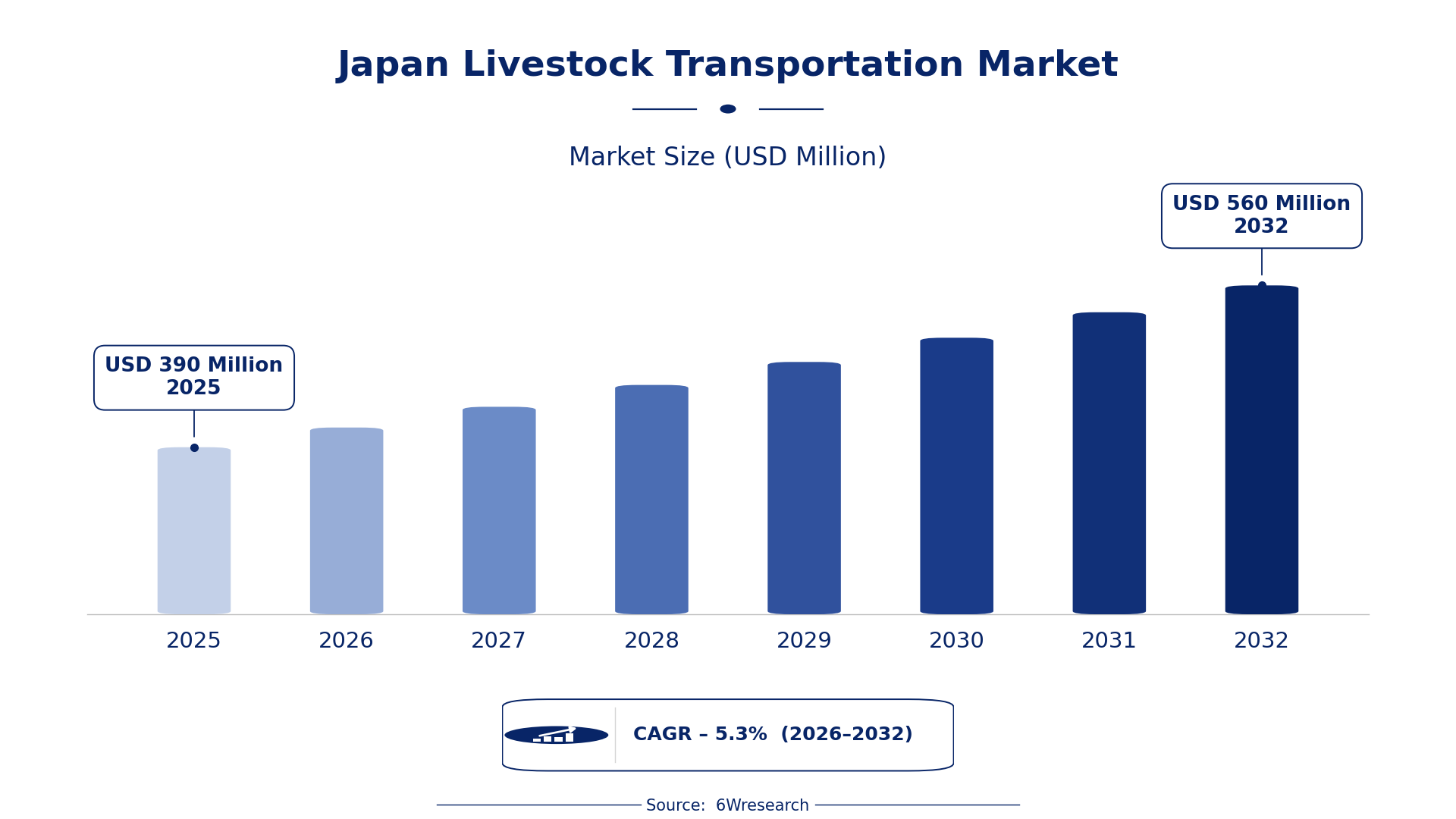
According to 6Wresearch internal database and industry insights, the Japan Livestock Transportation Market was valued at USD 390 Million in 2025 and is projected to reach USD 560 Million by 2032, growing at a CAGR of approximately 5.3% during 2026–2032.
Japan Livestock Transportation Market Highlights
| Report Metric | Details |
| Report Name | Japan Livestock Transportation Market (2026-2032) |
| Market Size 2025 | USD 390 Million |
| Market Size 2032 | USD 560 Million |
| Absolute Growth 2025–2032 | USD 170 Million |
| CAGR 2026–2032 | 5.3% |
| Peak Annual Growth | 6.2% in 2031 |
| Forecast Period | 2026–2032 |
| Historical Data | 2022–2025 |
| Base Year | 2025 |
| Leading Transport Mode, 2025 | Over-the-road Trucks (48% share) |
| Leading Regulation Compliance, 2025 | Animal Welfare (EU/NA) (36% share) |
| Leading Distribution Channel, 2025 | Logistics Providers (43% share) |
| Leading End User, 2025 | Auction Houses & Feedlots (46% share) |
| Fastest-Growing Transport Mode | Rail Transport (6.9% CAGR) |
| Fastest-Growing Regulation Compliance | Bulk Zoning (7.4% CAGR) |
| Fastest-Growing Distribution Channel | Industrial Suppliers (7.0% CAGR) |
| Fastest-Growing End User | Multinational Farms (7.1% CAGR) |
| Growing Sector | Multinational Farms |
| Key End Users | Auction Houses & Feedlots, Multinational Farms, International Breeders, Processing Centers |
Japan Livestock Transportation Market Year-wise Growth Rate and Key Drivers (2022–2032)
This graph illustrates the annual growth rates of the market from 2022 to 2032, highlighting a steady upward trajectory and projected market expansion over the forecast period.
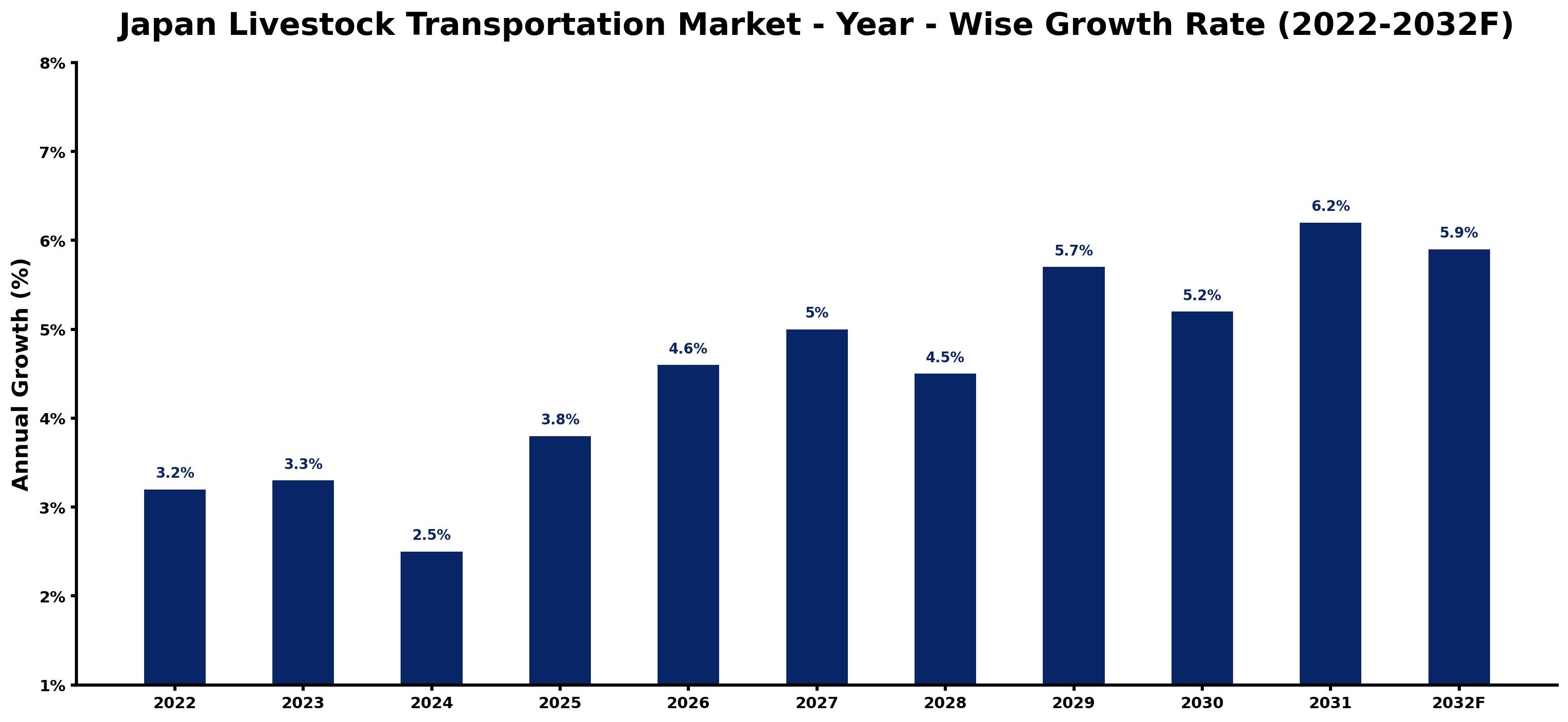
The yearly estimates that follow link every growth rate to its principal driver, so readers can see why the pace changed in each period.
| Year | Estimated Annual Growth (%) | Market Rationale |
| 2022 | 3.2 | The market experienced steady growth due to consistent demand from domestic users. |
| 2023 | 3.3 | Growth was faster than the previous year, driven by increased livestock exports. |
| 2024 | 2.5 | Growth slowed as logistical challenges began to impact transport efficiency. |
| 2025 | 3.8 | Demand surged with more livestock being transported to processing facilities. |
| 2026 | 4.6 | Growth is expected to accelerate as investments in transport infrastructure increase. |
| 2027 | 5.0 | The market will continue to expand due to rising domestic consumption of livestock. |
| 2028 | 4.5 | Growth is projected to slow as regulatory compliance becomes more stringent for transport. |
| 2029 | 5.7 | Demand is expected to increase as international trade opportunities expand for livestock. |
| 2030 | 5.2 | Growth will slow due to rising operational costs affecting transport providers. |
| 2031 | 6.2 | The market will peak as demand for livestock transportation reaches new heights. |
| 2032 | 5.9 | Growth is projected to slow as the market stabilises after reaching its peak. |
Note: Market size estimations and growth projections presented in this report are based on 6Wresearch's proprietary forecasting methodology, utilizing the latest available industry data, government publications, and primary research inputs.
Japan Livestock Transportation Market Synopsis
Livestock transportation in Japan involves the movement of animals via trucks, rail, and air, ensuring their safety and welfare. The Japan Livestock Transportation Market is growing, driven by increased domestic consumption, international trade opportunities, and investments in transport infrastructure. In 2023, Japan exported approximately 10,000 head of cattle, highlighting the demand for efficient transport solutions, particularly in regions like Tokyo, a major hub for livestock auctions and transport.
Market Dynamics Impact Analysis (2026–2032)
| Factor | Type | Impact | Primary Segment Affected |
| Increasing demand for livestock exports fuels transport needs. | Driver | High | Live Export |
| Investment in transport infrastructure enhances logistics efficiency. | Driver | High | Over-the-road Trucks |
| Growing international trade opens new markets for livestock transport. | Opportunity | High | Live Export |
| The need for compliance with animal welfare standards creates demand for certified transport. | Opportunity | Medium | Animal Welfare (EU/NA) |
| Rising operational costs challenge transport providers' profitability. | Restraint | High | Over-the-road Trucks |
| Strict regulatory compliance requirements can delay transport operations. | Restraint | Medium | Animal Welfare (EU/NA) |
| Limited capacity in transport vehicles can restrict service availability. | Challenge | High | Over-the-road Trucks |
| The need for skilled drivers limits operational capacity in the market. | Challenge | Medium | Over-the-road Trucks |
Evaluation of Drivers in Japan Livestock Transportation Market (2026–2032)
Demand rests on the following drivers, each shown with the segment it touches most.
| Drivers | Primary Segment Affected | Why It Matters (Evidence) |
| Growing domestic consumption of livestock products increases transport demand. | Over-the-road Trucks | In 2023, Japan's livestock population was approximately 4 million cattle, leading to higher transport needs. |
| Increased investment in logistics infrastructure improves transport capabilities. | Logistics Providers | The Tokyo region has seen substantial investment in transport facilities, enhancing logistics efficiency. |
| Rising international trade opportunities boost demand for livestock exports. | Live Export | Japan exported around 10,000 head of cattle in 2023, necessitating efficient transport solutions. |
| Compliance with animal welfare standards drives demand for certified transport solutions. | Animal Welfare (EU/NA) | The enforcement of animal welfare regulations mandates specific transport conditions, influencing practices. |
| Technological advancements in transport vehicles improve efficiency and capacity. | Over-the-road Trucks | ISO 9001 standards are commonly adopted, ensuring quality in transport operations. |
Volumes grow on the back of rising domestic consumption of livestock products, which reached approximately 4 million cattle in 2023. Increased investment in logistics infrastructure, particularly in the Tokyo region, improves transport capabilities. The demand for livestock exports has surged, with Japan exporting around 10,000 head of cattle in 2023. Technological advancements in transport vehicles, supported by ISO 9001 standards, improve efficiency and capacity in the sector.
Evaluation of Restraints in Japan Livestock Transportation Market
The key brakes on demand, and where they bite hardest, are shown below.
| Market Restraint | Primary Segment Affected | Why It Matters (Evidence) |
| Rising operational costs challenge transport providers' profitability. | Over-the-road Trucks | Increased fuel prices have raised operational costs, affecting transport margins. |
| Strict regulatory compliance requirements can delay transport operations. | Animal Welfare (EU/NA) | Compliance with regulations necessitates additional checks, slowing transport times. |
| Limited capacity in transport vehicles can restrict service availability. | Over-the-road Trucks | The average weight limit for livestock transport trucks is 10 tons, limiting load sizes. |
| Inadequate training for drivers affects transport efficiency. | Over-the-road Trucks | A shortage of skilled drivers can lead to delays and increased operational challenges. |
| Zoning laws can complicate transport routes and logistics planning. | Bulk Zoning | Specific zoning laws affect the routes available for livestock transport, impacting efficiency. |
Japan Livestock Transportation Market Challenges
In Japan, delays arise from a shortage of skilled livestock transport personnel, resulting in average holding times of 15 hours, which adversely affects animal welfare during peak seasons. Price competition among transport companies leads to reduced service quality, causing buyers to question reliability and potentially resulting in lost sales. Limited technology adoption hinders efficiency; without modern tracking systems, suppliers cannot ensure optimal conditions for livestock, risking losses. Compliance with stringent local zoning laws incurs additional costs, forcing companies to allocate up to 5% of their revenue to meet these requirements, ultimately raising transport prices for buyers.
Trends in the Japan Livestock Transportation Market
Buyers and suppliers in the Japan Livestock Transportation Market are adjusting to the following trends.
- Shift from Rail to Road Transport: Japan is increasingly relying on over-the-road trucks for livestock transport, with over 70% of livestock moved this way. This shift is driven by the need for flexibility and speed, particularly in urban areas.
- Improvement of Animal Welfare Standards: The enforcement of the Animal Welfare Act has led to improved transport practices, ensuring livestock safety. In 2023, compliance with these standards became a priority for transport providers.
- Growth in Live Export Opportunities: The demand for live exports is increasing, with Japan exporting approximately 10,000 head of cattle in 2023. This trend is expected to continue as international markets expand.
- Technological Advancements in Transport Solutions: Innovations in transport vehicles, particularly those adhering to ISO 9001 standards, are improving efficiency. This trend is notable as the market seeks to improve operational capabilities.
Investment Opportunities in the Japan Livestock Transportation Market
Investors looking at the Japan Livestock Transportation Market should consider the following areas.
- Gap in Efficient Transport Solutions: With Japan exporting approximately 10,000 head of cattle in 2023, there's a clear need for improved transport solutions. Logistics Providers can invest in advanced transport vehicles to meet this demand.
- Growing Demand from Multinational Farms: Multinational Farms require efficient livestock transport solutions, particularly as their operations expand. Investing in logistics partnerships can help meet their needs effectively.
- Investment in Short-Term Holding Units: The average holding time for livestock in transport is around 12 hours, indicating a need for better temporary storage solutions. Facilities can be developed to support this demand.
- Timing for Compliance Solutions: With stricter animal welfare regulations, the demand for compliant transport solutions is increasing. Transport providers should invest in training and certification to meet these requirements.
Government Initiatives in the Japan Livestock Transportation Market
The Industrial Safety and Health Act mandates safety measures that livestock transport providers must follow, ensuring the welfare of animals during transport. Compliance requires companies to implement training and safety protocols, which have been in effect since 1972, establishing standards that protect both workers and livestock. This law significantly impacts how transport operations are conducted, ensuring a focus on animal welfare and safety.
The Ministry of Agriculture, Forestry and Fisheries oversees livestock transport regulations, approving necessary permits and funding for compliance initiatives. This agency plays an important role in ensuring that transport practices align with established animal welfare standards, improving the overall safety and efficiency of livestock transportation.
Future Insight of the Japan Livestock Transportation Market
By 2032, suppliers will adopt advanced tracking technology to monitor livestock conditions in real-time, improving welfare outcomes significantly. New government subsidies will facilitate upgrades to logistics infrastructure, enhancing overall transport efficiency. The implementation of updated standards will drive service quality improvements, boosting buyer confidence. As new routes are developed, the average distance for livestock transport is projected to decrease from 150 km, optimising logistics and reducing costs for buyers.
Market Segmentation Analysis
Japan Livestock Transportation Market report covers a detailed analysis of the following market segments:
By Transport Mode – Over-the-road Trucks Lead, Rail Transport Expected to Grow Fastest
According to Saurav Kr Singh, Senior Research Analyst at 6Wresearch, in 2025, Over-the-road Trucks led the transport mode split with a 48% share. Over-the-road trucks are essential for transporting livestock to various locations, including markets and processing facilities. This mode's dominance is supported by the presence of over 1,000 registered vehicles, ensuring compliance with animal welfare regulations. The quickest growth will come from Rail Transport, forecast to expand at a CAGR of 6.9% between 2026 and 2032. Rail transport is becoming increasingly popular for bulk transport over long distances, meeting the needs of larger shipments. The government's subsidy program initiated in 2022 is expected to improve rail transport efficiency significantly. Suppliers must adapt their strategies to optimise logistics for both trucks and rail to meet market demands.
By Regulation Compliance – Animal Welfare (EU/NA) Leads, Bulk Zoning Expected to Grow Fastest
The largest regulation compliance category in 2025 was Animal Welfare (EU/NA), at 36% of revenue. The Animal Welfare (EU/NA) regulations lead the market by guiding transport practices to ensure the safety and welfare of livestock during transit. This compliance is critical for maintaining high standards, particularly in regions with strict animal welfare laws. Bulk Zoning is projected to grow fastest, at a CAGR of 7.4% during 2026–2032. Bulk zoning is gaining traction as it influences transport routes and logistics planning, allowing for more efficient movement of livestock. The increasing focus on optimising transport logistics is driving this segment's growth. Adhering to regulatory standards will be essential for suppliers to operate effectively and maintain market access.
By Distribution Channel – Logistics Providers Lead, Industrial Suppliers Expected to Grow Fastest
Logistics Providers accounted for 43% of the market by distribution channel in 2025. Logistics providers are key players in managing livestock transport logistics, ensuring compliance with regulations and smooth operations. Their expertise and established networks solidify their leading position in the distribution channel. Over 2026–2032, Industrial Suppliers are expected to post the fastest growth, at a CAGR of 7.0%. Industrial suppliers are experiencing rapid growth as they provide essential equipment and materials for transport, responding to the increasing demand for improved transport solutions. Their role is becoming more critical as the market expands. Suppliers should consider partnerships with logistics providers to enhance their distribution capabilities.
By End User – Auction Houses & Feedlots Lead, Multinational Farms Expected to Grow Fastest
With 46% of end user revenue in 2025, Auction Houses & Feedlots was the largest category. Auction houses and feedlots are the primary end-users for livestock transport, relying on reliable services to facilitate the movement of livestock to markets. Their established networks and consistent demand for efficient transport solutions reinforce their leading market position. Multinational Farms are set to record the highest CAGR in this split, 7.1% over 2026–2032. Multinational farms are rapidly expanding as they require regular transport of livestock for large-scale operations. Their growth reflects the increasing global demand for livestock products, indicating a shift in market dynamics. Suppliers must understand the specific needs of multinational farms to capture this expanding segment.
Key Attractiveness of the Report
- 10 Years of Market Numbers
- Historical Data Starting from 2022 to 2025
- Base Year 2025
- Forecast Data until 2032
- Key Performance Indicators Impacting the Market
- Major Upcoming Developments and Projects
Key Highlights of the Report:
- Japan Livestock Transportation Market Outlook
- Market Size of Japan Livestock Transportation Market, 2025
- Forecast of Japan Livestock Transportation Market, 2032
- Historical Data and Forecast of Japan Livestock Transportation Revenues & Volume for the Period 2022-2032F
- Japan Livestock Transportation Market Trend Evolution
- Japan Livestock Transportation Market Drivers and Challenges
- Japan Livestock Transportation Price Trends
- Japan Livestock Transportation Porter's Five Forces
- Japan Livestock Transportation Industry Life Cycle
- Historical Data and Forecast of Japan Livestock Transportation Market Revenues & Volume By Transport Mode for the Period 2022-2032F
- Historical Data and Forecast of Japan Livestock Transportation Market Revenues & Volume By Over-the-road Trucks for the Period 2022-2032F
- Historical Data and Forecast of Japan Livestock Transportation Market Revenues & Volume By Rail Transport for the Period 2022-2032F
- Historical Data and Forecast of Japan Livestock Transportation Market Revenues & Volume By Air Cargo for the Period 2022-2032F
- Historical Data and Forecast of Japan Livestock Transportation Market Revenues & Volume By Short-Term Holding Units for the Period 2022-2032F
- Historical Data and Forecast of Japan Livestock Transportation Market Revenues & Volume By Regulation Compliance for the Period 2022-2032F
- Historical Data and Forecast of Japan Livestock Transportation Market Revenues & Volume By Animal Welfare (EU/NA) for the Period 2022-2032F
- Historical Data and Forecast of Japan Livestock Transportation Market Revenues & Volume By Bulk Zoning for the Period 2022-2032F
- Historical Data and Forecast of Japan Livestock Transportation Market Revenues & Volume By Live Export for the Period 2022-2032F
- Historical Data and Forecast of Japan Livestock Transportation Market Revenues & Volume By Portable Tubs for the Period 2022-2032F
- Historical Data and Forecast of Japan Livestock Transportation Market Revenues & Volume By Distribution Channel for the Period 2022-2032F
- Historical Data and Forecast of Japan Livestock Transportation Market Revenues & Volume By Logistics Providers for the Period 2022-2032F
- Historical Data and Forecast of Japan Livestock Transportation Market Revenues & Volume By Industrial Suppliers for the Period 2022-2032F
- Historical Data and Forecast of Japan Livestock Transportation Market Revenues & Volume By Specialty Stores for the Period 2022-2032F
- Historical Data and Forecast of Japan Livestock Transportation Market Revenues & Volume By Direct Sales for the Period 2022-2032F
- Historical Data and Forecast of Japan Livestock Transportation Market Revenues & Volume By End User for the Period 2022-2032F
- Historical Data and Forecast of Japan Livestock Transportation Market Revenues & Volume By Auction Houses & Feedlots for the Period 2022-2032F
- Historical Data and Forecast of Japan Livestock Transportation Market Revenues & Volume By Multinational Farms for the Period 2022-2032F
- Historical Data and Forecast of Japan Livestock Transportation Market Revenues & Volume By International Breeders for the Period 2022-2032F
- Historical Data and Forecast of Japan Livestock Transportation Market Revenues & Volume By Processing Centers for the Period 2022-2032F
- Japan Livestock Transportation Import Export Trade Statistics
- Market Opportunity Assessment By Transport Mode
- Market Opportunity Assessment By Regulation Compliance
- Market Opportunity Assessment By Distribution Channel
- Market Opportunity Assessment By End User
- Japan Livestock Transportation Top Companies Market Share
- Japan Livestock Transportation Competitive Benchmarking By Technical and Operational Parameters
- Japan Livestock Transportation Company Profiles
- Japan Livestock Transportation Key Strategic Recommendations
Market Covered
The following segment groups are covered in the report.
By Transport Mode
- Over-the-road Trucks
- Rail Transport
- Air Cargo
- Short-Term Holding Units
By Regulation Compliance
- Animal Welfare (EU/NA)
- Bulk Zoning
- Live Export
- Portable Tubs
By Distribution Channel
- Logistics Providers
- Industrial Suppliers
- Specialty Stores
- Direct Sales
By End User
- Auction Houses & Feedlots
- Multinational Farms
- International Breeders
- Processing Centers






































