Japan Logistics Facility Automation Market Size & Growth Rate
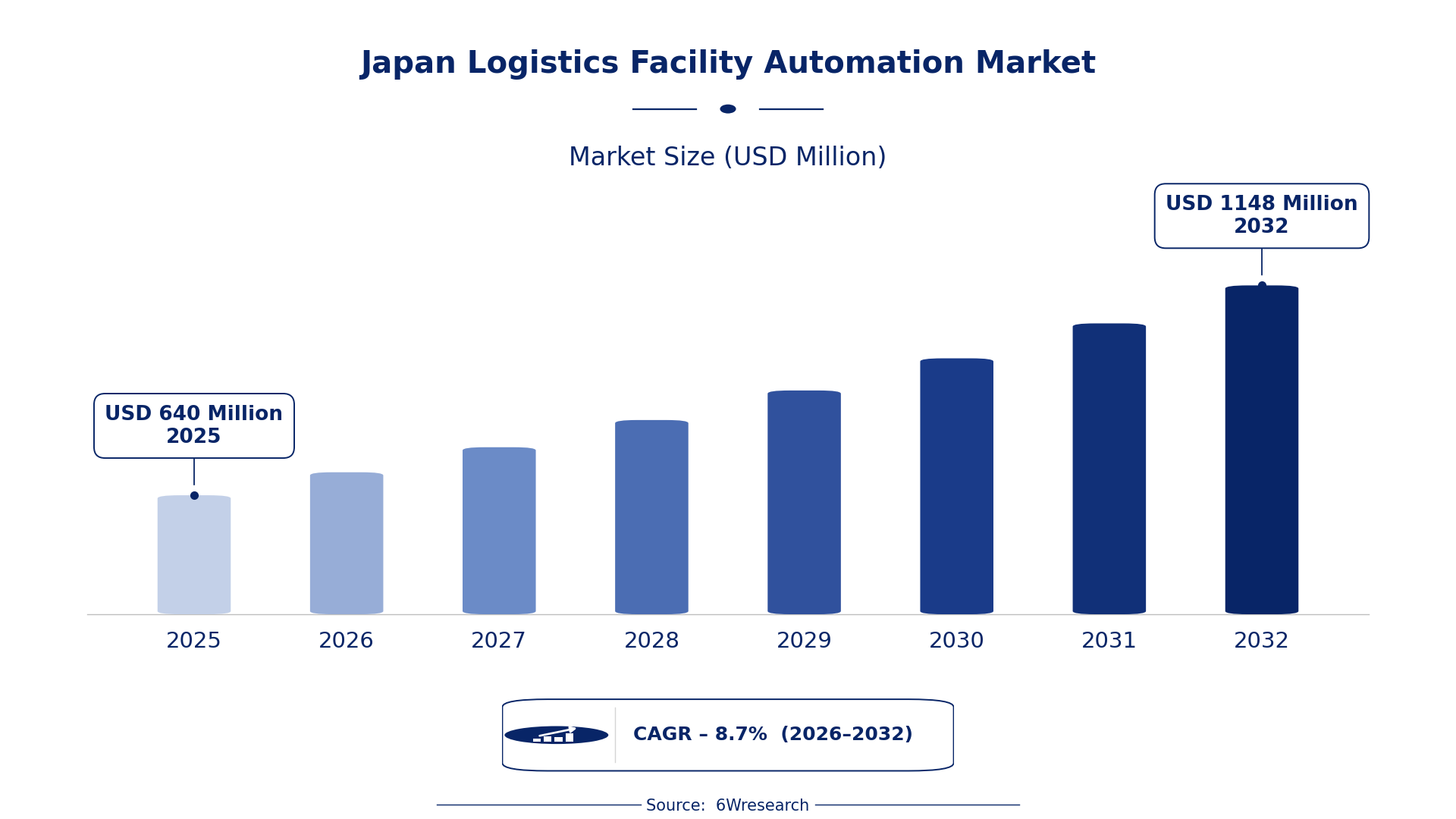
According to 6Wresearch internal database and industry insights, the Japan Logistics Facility Automation Market was valued at USD 640 Million in 2025 and is projected to reach USD 1,148 Million by 2032, growing at a CAGR of approximately 8.7% during 2026–2032.
Japan Logistics Facility Automation Market Highlights
| Report Metric | Details |
| Report Name | Japan Logistics Facility Automation Market (2026-2032) |
| Market Size 2025 | USD 640 Million |
| Market Size 2032 | USD 1,148 Million |
| Absolute Growth 2025–2032 | USD 508 Million |
| CAGR 2026–2032 | 8.7% |
| Peak Annual Growth | 10.6% in 2032 |
| Forecast Period | 2026–2032 |
| Historical Data | 2022–2025 |
| Base Year | 2025 |
| Leading Automation Type, 2025 | Conveyor & Sortation (33% share) |
| Leading Technology Used, 2025 | Belt + Roller Systems (44% share) |
| Leading Distribution Channel, 2025 | Direct Sales (36% share) |
| Leading End User, 2025 | E-Commerce Warehouses (50% share) |
| Fastest-Growing Automation Type | AMRs & AGVs (13.3% CAGR) |
| Fastest-Growing Technology Used | Robotic Handling (13.0% CAGR) |
| Fastest-Growing Distribution Channel | Online Platforms (11.7% CAGR) |
| Fastest-Growing End User | Large Distribution Centers (11.8% CAGR) |
| Growing Sector | E-Commerce |
| Key End Users | E-Commerce Warehouses, Large Distribution Centers, 3PL Providers, Pharmaceutical Firms |
Japan Logistics Facility Automation Market Year-wise Growth Rate and Key Drivers (2022–2032)
This graph illustrates the annual growth rates of the market from 2022 to 2032, highlighting a steady upward trajectory and projected market expansion over the forecast period.
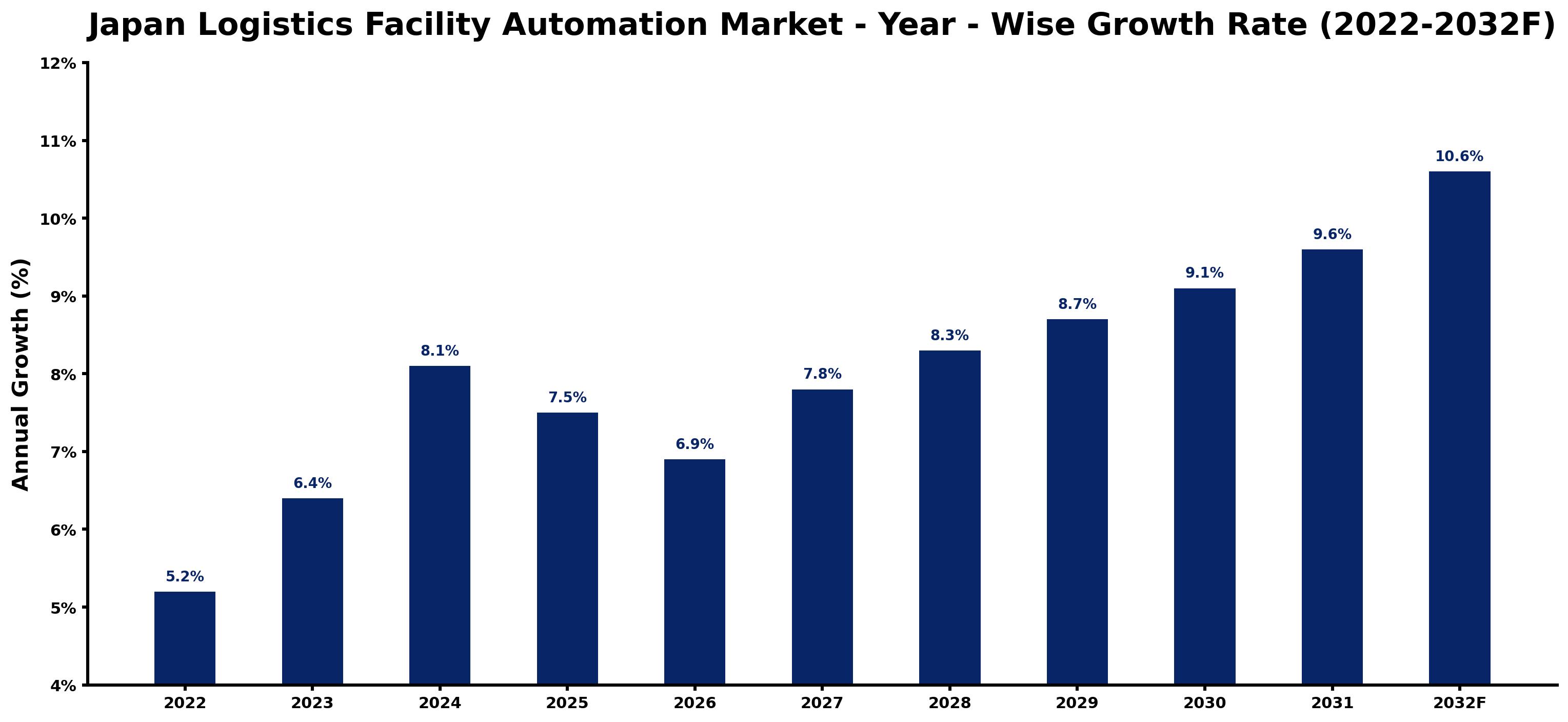
Each row of the following table gives one year's estimated growth and the event or demand shift that explains it.
| Year | Estimated Annual Growth (%) | Market Rationale |
| 2022 | 5.2 | The market exhibited stable growth, driven by rising e-commerce activities. |
| 2023 | 6.4 | Growth accelerated as businesses invested more in logistics automation solutions. |
| 2024 | 8.1 | Increased adoption of automated systems led to faster growth rates. |
| 2025 | 7.5 | Growth slowed slightly due to market saturation in some areas. |
| 2026 | 6.9 | Investment in automation technologies is expected to continue but at a slower pace. |
| 2027 | 7.8 | Demand surged as companies sought efficiency in logistics operations. |
| 2028 | 8.3 | Technological advancements will contribute to a notable increase in growth. |
| 2029 | 8.7 | The market is projected to experience strong growth as automation becomes essential. |
| 2030 | 9.1 | Rising demand for efficiency in logistics will drive further growth. |
| 2031 | 9.6 | Continued investments in automation technologies will sustain high growth rates. |
| 2032 | 10.6 | The market is expected to peak as demand for logistics automation reaches new heights. |
Note: Market size estimations and growth projections presented in this report are based on 6Wresearch's proprietary forecasting methodology, utilizing the latest available industry data, government publications, and primary research inputs.
Japan Logistics Facility Automation Market Synopsis
Logistics Facility Automation utilises advanced technologies to optimise operations in warehouses and distribution centres, including conveyor belts and automated guided vehicles. The Japan Logistics Facility Automation Market is experiencing rapid growth, driven by the booming e-commerce sector and the need for efficient inventory management. With over 1,000 e-commerce warehouses in Japan, the logistics sector is projected to see investments exceeding ¥1 trillion by 2025, underscoring the increasing demand for automation solutions to improve operational efficiency.
Market Dynamics Impact Analysis (2026–2032)
| Factor | Type | Impact | Primary Segment Affected |
| Growing e-commerce activities drive demand for automation solutions. | Driver | High | E-Commerce Warehouses |
| Technological advancements in automation systems create new opportunities. | Driver | High | Robotic Handling |
| Increasing investments in logistics automation present significant opportunities. | Opportunity | High | Large Distribution Centers |
| The need for efficient inventory management systems is rising. | Opportunity | Medium | WMS + Robotics |
| High initial investment costs can deter smaller firms from adopting automation. | Restraint | High | AMRs & AGVs |
| Limited awareness of automation benefits restricts market growth. | Restraint | Medium | Integrated Software/Hardware |
| Shortage of skilled workforce affects implementation timelines. | Challenge | High | Conveyor & Sortation |
| Rapid technological changes can outpace current systems. | Challenge | Medium | Vertical Storage |
Evaluation of Drivers in Japan Logistics Facility Automation Market (2026–2032)
Demand rests on the following drivers, each shown with the segment it touches most.
| Drivers | Primary Segment Affected | Why It Matters (Evidence) |
| Rising e-commerce demand increases the need for efficient logistics solutions. | E-Commerce Warehouses | As of 2023, Japan has over 1,000 e-commerce warehouses, driving automation adoption. |
| Technological advancements in robotic systems enhance operational efficiency. | Robotic Handling | The average order fulfillment time in e-commerce warehouses improved to under 24 hours due to automation. |
| Government support for automation initiatives encourages investment. | Large Distribution Centers | The Automated Warehouse System Promotion Program by METI aims to enhance automation adoption by 2025. |
| Growing population drives demand for logistics efficiency. | AMRs & AGVs | Japan's population is approximately 125 million, necessitating improved logistics operations. |
| Investment in decarbonisation promotes automation in logistics. | WMS + Robotics | Japan targets about JPY 150 trillion of decarbonisation investment over 10 years. |
Spending rises due to the heightened demand for efficient logistics solutions stemming from the booming e-commerce sector. The average order fulfillment time in large distribution centres has improved dramatically, illustrating the impact of automation. Japan's population of approximately 125 million necessitates enhancements in logistics efficiency, leading to greater demand for automated systems. Technological advancements in robotic systems are also boosting operational efficiency across various sectors, encouraging further investment.
Evaluation of Restraints in Japan Logistics Facility Automation Market
The following restraints limit how fast demand can grow.
| Market Restraint | Primary Segment Affected | Why It Matters (Evidence) |
| High initial investment costs deter smaller firms from automation adoption. | AMRs & AGVs | Many smaller firms find it challenging to allocate the necessary funds for automation projects, limiting their ability to compete. |
| Limited awareness of automation benefits restricts market growth. | Integrated Software/Hardware | Some logistics firms lack knowledge about how automation can improve operational efficiency, leading to missed opportunities. |
| Shortage of skilled workforce affects implementation timelines. | Conveyor & Sortation | The lack of trained professionals delays the deployment of automation technologies, hindering growth for logistics providers. |
| Technological complexity can hinder user adoption. | Robotic Handling | The intricate nature of robotic systems may discourage some firms from investing, slowing market expansion. |
| Regulatory compliance can slow down automation implementation. | Vertical Storage | Firms must navigate complex regulations, which can delay automation projects and increase costs. |
Japan Logistics Facility Automation Market Challenges
Robotic handling systems in pharmaceutical firms face integration issues due to outdated technology, which delays inventory management processes and increases operational costs for these buyers. Regulatory hurdles from the JIS Z 8801 standard can impede automation adoption, resulting in inefficiencies for logistics providers. E-commerce warehouses encounter challenges from rising minimum wage rates, which reached JPY 1,055 per hour in October 2024, raising overall labour costs and squeezing profit margins. The need for substantial investments in decarbonisation, targeting JPY 150 trillion over ten years, diverts funds from automation projects, limiting growth for suppliers.
Trends in the Japan Logistics Facility Automation Market
Several trends are reshaping the Japan Logistics Facility Automation Market; the most important are set out below.
- Automated Warehouse System Promotion Program: The Automated Warehouse System Promotion Program by METI is driving automation adoption in Japan, targeting a 20% increase in efficiency across various sectors by 2025.
- Shift towards Robotic Handling Systems: There is a notable shift towards robotic handling systems in logistics, particularly in pharmaceutical firms. As of 2023, these systems are increasingly adopted for inventory management, improving accuracy and efficiency.
- Growing Demand for Vertical Storage Solutions: The demand for vertical storage solutions is rising as firms seek to optimise space in large distribution centres. In 2023, the average size of these centres is approximately 30,000 square meters, necessitating efficient storage solutions.
- Increased Investment in Automation Technologies: Investment in logistics automation technologies is projected to exceed ¥1 trillion by 2025. This trend reflects the growing recognition of automation's importance in improving operational efficiency.
Investment Opportunities in the Japan Logistics Facility Automation Market
The following opportunities in the Japan Logistics Facility Automation Market pair current demand with a clear way in.
- Timing for Automation Investment: With logistics sector investments expected to exceed ¥1 trillion by 2025, now is the ideal time to invest in automation technologies. Large distribution centres are seeking efficient solutions to improve operations.
- Supply of Advanced Robotics: The demand for advanced robotics is increasing as firms aim to improve efficiency. E-commerce warehouses are major buyers, looking for effective solutions to streamline operations.
- E-Commerce Warehouses Seeking Automation: E-commerce warehouses are actively seeking automation solutions to improve efficiency. Investing in conveyor systems and robotic handling can effectively meet this growing need.
- Entry through Local Partnerships: Entering the Japanese market through local partnerships can facilitate access to logistics firms. Collaborating with industrial integrators can help implement automation solutions effectively.
Government Initiatives in the Japan Logistics Facility Automation Market
The New Robot Strategy (2015) impacts logistics facility automation by promoting the use of robots across various sectors, including logistics. This strategy encourages producers to invest in robotic technologies, improving operational efficiency and productivity in facilities. The strategy aims to increase the adoption of robotics, with targets set for various sectors, including logistics, to enhance competitiveness. Japan's GX Basic Policy (2023) targets about JPY 150 trillion of public and private decarbonisation investment over 10 years, which supports automation initiatives.
The Ministry of Economy, Trade and Industry (METI) oversees the Automated Warehouse System Promotion Program, which funds initiatives to support automation adoption. This program aims to improve logistics efficiency and assists firms in implementing advanced technologies. By 2025, METI's initiatives are expected to facilitate the integration of automation solutions in logistics, enhancing operational capabilities for various firms.
Future Insight of the Japan Logistics Facility Automation Market
E-commerce warehouses will adopt more automation by 2032, influenced by government initiatives to boost efficiency. Buyers will experience improved order fulfillment times, potentially decreasing to under 12 hours as technology evolves. Suppliers are expected to invest over ¥1 trillion in logistics automation by 2025, resulting in better systems and reduced operational costs. The use of automated guided vehicles will increase, supported by the Japan Automated Guided Vehicle Association, improving productivity across the logistics sector.
Market Segmentation Analysis
Japan Logistics Facility Automation Market report covers a detailed analysis of the following market segments:
By Automation Type – Conveyor & Sortation Leads, AMRs & AGVs Expected to Grow Fastest
According to Saurav Kr Singh, Senior Research Analyst at 6Wresearch, with 33% of automation type revenue in 2025, Conveyor & Sortation was the largest category. Conveyor and sortation systems are essential for the efficient movement of goods within logistics facilities, making them a staple in operations. Their widespread implementation in over 1,000 e-commerce warehouses highlights their leading role in the market. Over 2026–2032, AMRs & AGVs are expected to post the fastest growth, at a CAGR of 13.3%. The rapid uptake of AMRs and AGVs is driven by their ability to streamline the transport of goods, significantly enhancing operational efficiency. With the average order fulfillment time in e-commerce warehouses now under 24 hours, this growth trend is expected to continue. Suppliers should prioritise the development of AMRs and AGVs to meet the surging demand in logistics.
By Technology Used – Belt + Roller Systems Lead, Robotic Handling Expected to Grow Fastest
Belt + Roller Systems held 44% of the Japan Logistics Facility Automation Market by technology used in 2025. Belt and roller systems are fundamental for product movement in logistics facilities, providing reliable and efficient transport solutions. Their established presence in various distribution centres underscores their dominance in the market. Robotic Handling is projected to grow fastest, at a CAGR of 13.0% during 2026–2032. Robotic handling technology is gaining traction as it automates critical picking and packing tasks, streamlining operations. This is particularly relevant as investments in logistics automation are projected to exceed ¥1 trillion by 2025. Buyers may benefit from investing in robotic handling solutions to improve operational efficiency.
By Distribution Channel – Direct Sales Leads, Online Platforms Expected to Grow Fastest
Direct Sales accounted for 36% of the market by distribution channel in 2025. Direct sales remain the primary method for selling automation solutions, allowing suppliers to establish strong relationships with clients. This approach is particularly effective in logistics, where tailored solutions are often necessary for success. The quickest growth will come from Online Platforms, forecast to expand at a CAGR of 11.7% between 2026 and 2032. Online platforms are becoming increasingly popular for accessing information and making purchases of automation solutions. The surge in e-commerce activities has accelerated this trend, highlighting the importance of online channels in the market. Suppliers must enhance their online strategies to capitalise on the growing demand for automation solutions.
By End User – E-Commerce Warehouses Lead, Large Distribution Centers Expected to Grow Fastest
E-Commerce Warehouses took 50% of end user revenue in 2025, more than any other category. E-commerce warehouses are the leading end-users driving the demand for logistics automation, reflecting the sector's rapid growth in Japan. Their focus on improving operational efficiency and accuracy has led to increased investments in automation technologies. Large Distribution Centers are set to record the highest CAGR in this split, 11.8% over 2026–2032. Large distribution centers are rapidly embracing automation technologies to enhance efficiency and meet rising consumer demands. This shift is further bolstered by substantial investments in logistics infrastructure across Japan, indicating a strong future for this segment. Suppliers should target large distribution centers to align with their increasing automation needs.
Key Attractiveness of the Report
- 10 Years of Market Numbers
- Historical Data Starting from 2022 to 2025
- Base Year 2025
- Forecast Data until 2032
- Key Performance Indicators Impacting the Market
- Major Upcoming Developments and Projects
Key Highlights of the Report:
- Japan Logistics Facility Automation Market Outlook
- Market Size of Japan Logistics Facility Automation Market, 2025
- Forecast of Japan Logistics Facility Automation Market, 2032
- Historical Data and Forecast of Japan Logistics Facility Automation Revenues & Volume for the Period 2022-2032F
- Japan Logistics Facility Automation Market Trend Evolution
- Japan Logistics Facility Automation Market Drivers and Challenges
- Japan Logistics Facility Automation Price Trends
- Japan Logistics Facility Automation Porter's Five Forces
- Japan Logistics Facility Automation Industry Life Cycle
- Historical Data and Forecast of Japan Logistics Facility Automation Market Revenues & Volume By Automation Type for the Period 2022-2032F
- Historical Data and Forecast of Japan Logistics Facility Automation Market Revenues & Volume By Conveyor & Sortation for the Period 2022-2032F
- Historical Data and Forecast of Japan Logistics Facility Automation Market Revenues & Volume By AMRs & AGVs for the Period 2022-2032F
- Historical Data and Forecast of Japan Logistics Facility Automation Market Revenues & Volume By Automated VLMs for the Period 2022-2032F
- Historical Data and Forecast of Japan Logistics Facility Automation Market Revenues & Volume By WMS + Robotics for the Period 2022-2032F
- Historical Data and Forecast of Japan Logistics Facility Automation Market Revenues & Volume By Technology Used for the Period 2022-2032F
- Historical Data and Forecast of Japan Logistics Facility Automation Market Revenues & Volume By Belt + Roller Systems for the Period 2022-2032F
- Historical Data and Forecast of Japan Logistics Facility Automation Market Revenues & Volume By Robotic Handling for the Period 2022-2032F
- Historical Data and Forecast of Japan Logistics Facility Automation Market Revenues & Volume By Vertical Storage for the Period 2022-2032F
- Historical Data and Forecast of Japan Logistics Facility Automation Market Revenues & Volume By Integrated Software/Hardware for the Period 2022-2032F
- Historical Data and Forecast of Japan Logistics Facility Automation Market Revenues & Volume By Distribution Channel for the Period 2022-2032F
- Historical Data and Forecast of Japan Logistics Facility Automation Market Revenues & Volume By Direct Sales for the Period 2022-2032F
- Historical Data and Forecast of Japan Logistics Facility Automation Market Revenues & Volume By Online Platforms for the Period 2022-2032F
- Historical Data and Forecast of Japan Logistics Facility Automation Market Revenues & Volume By Industrial Integrators for the Period 2022-2032F
- Historical Data and Forecast of Japan Logistics Facility Automation Market Revenues & Volume By Specialty Suppliers for the Period 2022-2032F
- Historical Data and Forecast of Japan Logistics Facility Automation Market Revenues & Volume By End User for the Period 2022-2032F
- Historical Data and Forecast of Japan Logistics Facility Automation Market Revenues & Volume By E-Commerce Warehouses for the Period 2022-2032F
- Historical Data and Forecast of Japan Logistics Facility Automation Market Revenues & Volume By Large Distribution Centers for the Period 2022-2032F
- Historical Data and Forecast of Japan Logistics Facility Automation Market Revenues & Volume By MRO & Pharmaceutical Firms for the Period 2022-2032F
- Historical Data and Forecast of Japan Logistics Facility Automation Market Revenues & Volume By 3PL & Retail Packers for the Period 2022-2032F
- Japan Logistics Facility Automation Import Export Trade Statistics
- Market Opportunity Assessment By Automation Type
- Market Opportunity Assessment By Technology Used
- Market Opportunity Assessment By Distribution Channel
- Market Opportunity Assessment By End User
- Japan Logistics Facility Automation Top Companies Market Share
- Japan Logistics Facility Automation Competitive Benchmarking By Technical and Operational Parameters
- Japan Logistics Facility Automation Company Profiles
- Japan Logistics Facility Automation Key Strategic Recommendations
Market Covered
The report covers the following segments.
By Automation Type
- Conveyor & Sortation
- AMRs & AGVs
- Automated VLMs
- WMS + Robotics
By Technology Used
- Belt + Roller Systems
- Robotic Handling
- Vertical Storage
- Integrated Software/Hardware
By Distribution Channel
- Direct Sales
- Online Platforms
- Industrial Integrators
- Specialty Suppliers
By End User
- E-Commerce Warehouses
- Large Distribution Centers
- MRO & Pharmaceutical Firms
- 3PL & Retail Packers































