Japan Low-Emission Agricultural Machinery Market Size & Growth Rate
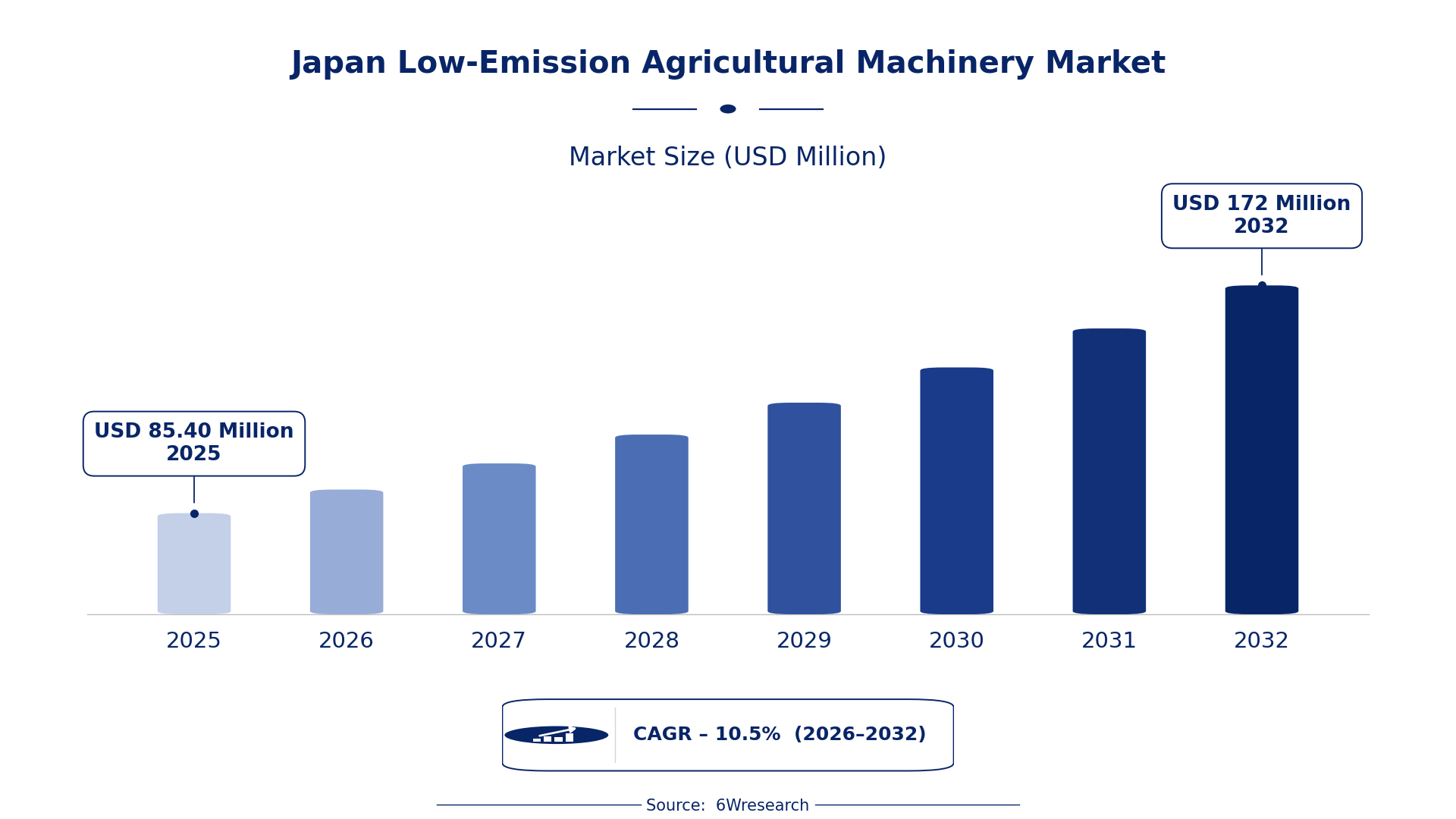
According to 6Wresearch internal database and industry insights, the Japan Low-Emission Agricultural Machinery Market was valued at USD 85.40 Million in 2025 and is projected to reach USD 172 Million by 2032, growing at a CAGR of approximately 10.5% during 2026–2032.
Japan Low-Emission Agricultural Machinery Market Highlights
| Report Metric | Details |
| Report Name | Japan Low-Emission Agricultural Machinery Market (2026-2032) |
| Market Size 2025 | USD 85.40 Million |
| Market Size 2032 | USD 172 Million |
| Absolute Growth 2025–2032 | USD 86.60 Million |
| CAGR 2026–2032 | 10.5% |
| Peak Annual Growth | 12.1% in 2026 |
| Forecast Period | 2026–2032 |
| Historical Data | 2022–2025 |
| Base Year | 2025 |
| Leading Machinery Type, 2025 | Electric Tractors (52% share) |
| Leading Propulsion System, 2025 | Battery-Electric (36% share) |
| Leading Distribution Channel, 2025 | Direct Sales (46% share) |
| Leading End User, 2025 | Sustainable Farms (37% share) |
| Fastest-Growing Machinery Type | Hybrid Combine Harvesters (14.8% CAGR) |
| Fastest-Growing Propulsion System | Hybrid Diesel- Electric (15.3% CAGR) |
| Fastest-Growing Distribution Channel | Online Equipment Dealers (13.3% CAGR) |
| Fastest-Growing End User | Large Agricultural Operators (13.5% CAGR) |
| Growing Sector | Sustainable Agriculture |
| Key End Users | Sustainable Farms, Large Agricultural Operators, Organic Farms |
Japan Low-Emission Agricultural Machinery Market Year-wise Growth Rate and Key Drivers (2022–2032)
This graph illustrates the annual growth rates of the market from 2022 to 2032, highlighting a steady upward trajectory and projected market expansion over the forecast period.
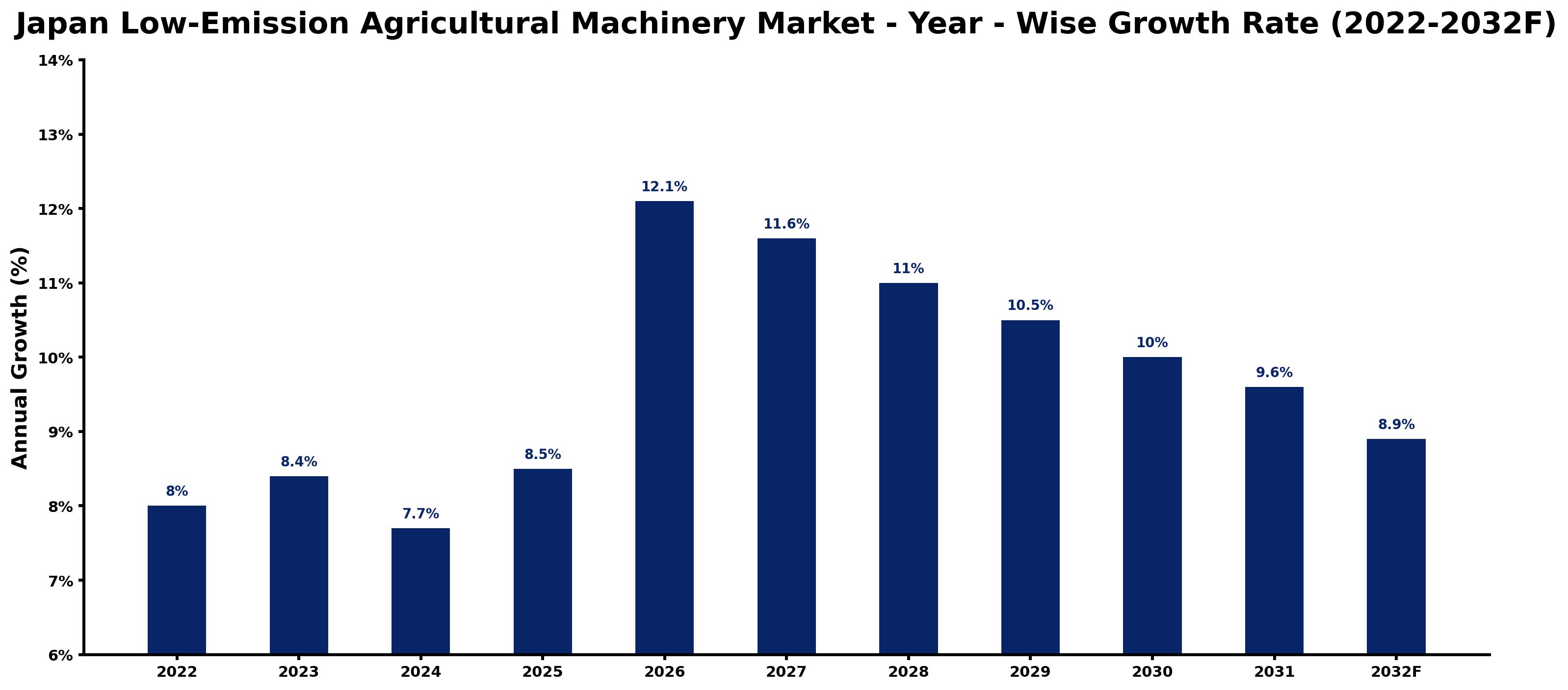
For each year, the table pairs the estimated growth rate with the leading influence on demand, showing how the drivers changed across the period.
| Year | Estimated Annual Growth (%) | Market Rationale |
| 2022 | 8.0 | The market showed steady growth, reflecting ongoing investments in low-emission technologies. |
| 2023 | 8.4 | Growth accelerated as the agricultural sector increased its focus on sustainability initiatives. |
| 2024 | 7.7 | Growth slowed slightly due to market adjustments and the maturation of early adopters. |
| 2025 | 8.5 | The market rebounded with renewed interest in modernizing outdated machinery. |
| 2026 | 12.1 | A surge in demand is expected as electric tractors gain popularity among farmers. |
| 2027 | 11.6 | Growth is projected to slow as the market begins to stabilise following rapid expansion. |
| 2028 | 11.0 | The market is expected to continue growing, driven by sustained interest in hybrid machinery. |
| 2029 | 10.5 | Growth will decelerate as the market approaches maturation and competition intensifies. |
| 2030 | 10.0 | A slight slowdown is projected as buyers become more selective in their investments. |
| 2031 | 9.6 | The market is expected to maintain growth, supported by ongoing sustainability trends in agriculture. |
| 2032 | 8.9 | Growth will continue at a slower pace, reflecting a shift towards established technologies. |
Note: Market size estimations and growth projections presented in this report are based on 6Wresearch's proprietary forecasting methodology, utilizing the latest available industry data, government publications, and primary research inputs.
Japan Low-Emission Agricultural Machinery Market Synopsis
Low-Emission Agricultural Machinery includes equipment designed to minimise emissions in farming operations, such as electric tractors and biogas-powered machinery. The Japan Low-Emission Agricultural Machinery Market is growing as the agricultural sector targets a 25% reduction in greenhouse gas emissions by 2030. The rise in electric tractor adoption, supported by subsidies from the Ministry of Agriculture, is boosting demand, especially among over 1,000 sustainable farms nationwide.
Market Dynamics Impact Analysis (2026–2032)
| Factor | Type | Impact | Primary Segment Affected |
| Growing investment in electric tractors | Driver | High | Electric Tractors |
| Increasing adoption of biogas-powered machinery | Driver | High | Biogas-Powered Machinery |
| Rising demand for sustainable farming practices | Opportunity | High | Sustainable Farms |
| Expansion of online equipment sales channels | Opportunity | Medium | Online Equipment Dealers |
| High average age of existing tractors | Restraint | High | Hybrid Combine Harvesters |
| Limited consumer awareness of low-emission options | Restraint | Medium | Solar-Powered Irrigation Pumps |
| High initial investment costs for low-emission machinery | Challenge | High | Battery-Electric |
| Slow adaptation of new technologies by traditional farmers | Challenge | Medium | Hybrid Diesel- Electric |
Evaluation of Drivers in Japan Low-Emission Agricultural Machinery Market (2026–2032)
Below are the drivers that matter most for revenue growth, with supporting evidence.
| Drivers | Primary Segment Affected | Why It Matters (Evidence) |
| Government subsidies for electric tractors | Electric Tractors | The Ministry of Agriculture, Forestry and Fisheries promotes electric tractors through financial incentives, increasing purchases by farmers by 20%. |
| Growing organic farming sector | Biogas-Powered Machinery | Organic farms, which have grown by 15% annually, are increasingly adopting biogas-powered machinery to meet sustainability goals. |
| Technological advancements in hybrid machinery | Hybrid Combine Harvesters | Innovations in hybrid technology improve efficiency, prompting larger agricultural operators to invest in new models, increasing sales by 25%. |
| Rising consumer demand for eco-friendly products | Solar-Powered Irrigation Pumps | As consumers prefer sustainable food sources, farmers invest in solar-powered irrigation systems to align with market trends, boosting sales by 30%. |
| Increased focus on reducing greenhouse gas emissions | Battery-Electric | Japan's goal of a 25% reduction in emissions by 2030 drives farmers to modernise their equipment, increasing demand by 15%. |
What keeps demand rising is the financial support for electric tractors, leading to increased purchases among farmers. In 2023, over 1,000 sustainable farms adopted low-emission technologies, reflecting a growing commitment to eco-friendly practices. The organic farming sector has expanded by 15% annually, prompting farmers to seek biogas-powered machinery to meet sustainability goals. Technological advancements in hybrid combine harvesters improve efficiency, encouraging larger agricultural operators to invest in new models. Rising consumer preference for eco-friendly products drives farmers to adopt solar-powered irrigation systems, aligning with market trends and increasing their operational efficiency.
Evaluation of Restraints in Japan Low-Emission Agricultural Machinery Market
Below are the constraints most often cited by buyers and suppliers, with the segment each affects.
| Market Restraint | Primary Segment Affected | Why It Matters (Evidence) |
| High average age of tractors in the market | Hybrid Combine Harvesters | The average age of tractors exceeds 20 years, limiting the adoption of modern low-emission machinery. |
| Limited awareness of low-emission technologies among farmers | Solar-Powered Irrigation Pumps | Approximately 40% of farmers remain unaware of the benefits and availability of solar-powered irrigation systems. |
| High initial investment costs for low-emission machinery | Battery-Electric | The upfront costs deter many farmers from investing in low-emission options despite long-term savings. |
| Slow adaptation to new technologies by traditional farmers | Hybrid Diesel- Electric | Traditional farming practices hinder the rapid adoption of hybrid machinery among older generations. |
| Inconsistent supply of components for low-emission machinery | Biogas-Powered Machinery | Supply chain issues affect the availability of parts needed for biogas-powered equipment. |
Japan Low-Emission Agricultural Machinery Market Challenges
A shortage of skilled workers in Japan's agricultural sector hampers the adoption of low-emission technologies, as training programs have not kept pace with advancements. This skills gap delays farmers' modernization efforts, costing them potential productivity gains. Rising costs of low-emission machinery, driven by material price increases and limited local production, strain budgets for small operators, resulting in a 15% increase in operational expenses. Stringent environmental regulations complicate investments, causing some farmers to face a 10% delay in upgrading their equipment. Competition from cheaper imported machinery pressures local producers, squeezing their profit margins and diminishing market share.
Trends in the Japan Low-Emission Agricultural Machinery Market
The shifts below are changing how Japan Low-Emission Agricultural Machinery Market products are bought and supplied.
- Shift towards Electric Tractors: The Ministry of Agriculture, Forestry and Fisheries has increased subsidies for electric tractors, resulting in a 20% rise in adoption among sustainable farms in 2023.
- Growth in Online Equipment Sales: The Tokyo region has seen a 30% increase in online equipment sales, particularly for low-emission machinery, reflecting changing purchasing behaviours among farmers.
- Expansion of Biogas-Powered Machinery: In 2023, the Hyogo Prefecture reported a 25% increase in biogas-powered machinery usage, driven by local sustainability initiatives.
- Rising Popularity of Solar-Powered Irrigation: The Tokyo Agricultural Fair in 2023 showcased a 30% increase in solar-powered irrigation systems, highlighting the trend towards sustainable farming practices.
Investment Opportunities in the Japan Low-Emission Agricultural Machinery Market
Below are the investment opportunities with the strongest case in the Japan Low-Emission Agricultural Machinery Market.
- Sustainable Farms seeking low-emission solutions: With over 1,000 sustainable farms in Japan, there is a growing need for low-emission machinery, particularly electric tractors, backed by government initiatives that provide financial support.
- Investment in Hybrid Combine Harvesters: As the fastest-growing segment, hybrid combine harvesters present a strong opportunity for suppliers, particularly given their projected growth rate of 14.8% through 2032.
- Large Agricultural Operators adopting new technologies: Large agricultural operators are increasingly investing in low-emission machinery, creating opportunities for manufacturers to meet their evolving needs, with a projected growth in demand of 13.5%.
- Online Equipment Dealers expanding market reach: The rise of online equipment dealers, with a projected growth rate of 13.3%, offers a timely opportunity for suppliers to tap into a growing sales channel.
Government Initiatives in the Japan Low-Emission Agricultural Machinery Market
The New Robot Strategy (2015) aims to expand automation in agriculture, complementing existing laws by promoting low-emission technologies. This strategy encourages producers to invest in advanced machinery, aligning with national sustainability goals, with a budget allocation of ¥10 billion for renewable energy in agriculture.
The Japan Agricultural Cooperatives (JA) actively promotes low-emission technologies among its members, facilitating access to subsidies and training programs. This support assists farmers in adopting advanced machinery, ensuring compliance with environmental standards and benefitting over 1,000 sustainable farms across the country.
Future Insight of the Japan Low-Emission Agricultural Machinery Market
Government incentives and subsidies will drive a substantial shift towards low-emission agricultural practices by 2032. By 2025, electric tractors are expected to represent 20% of the market, prompting suppliers to innovate in response. Research on biogas applications will improve operational efficiency, particularly in regions like Hyogo Prefecture. The agricultural sector is set to achieve a 25% reduction in greenhouse gas emissions by 2030, aligning with national sustainability goals and creating new opportunities for eco-friendly technologies.
Market Segmentation Analysis
Japan Low-Emission Agricultural Machinery Market report covers a detailed analysis of the following market segments:
By Machinery Type – Electric Tractors Lead, Hybrid Combine Harvesters Expected to Grow Fastest
According to Saurav Kr Singh, Senior Research Analyst at 6Wresearch, Electric Tractors accounted for 52% of the market by machinery type in 2025. Electric tractors dominate the market due to their role in reducing emissions, with over 1,000 sustainable farms in Japan implementing this technology. The backing of government subsidies further solidifies their status as the preferred choice for environmentally conscious farming operations. Hybrid Combine Harvesters are projected to grow fastest, at a CAGR of 14.8% during 2026–2032. Hybrid combine harvesters are experiencing rapid growth as they provide efficient harvesting capabilities while ensuring lower emissions. The fact that 40% of large agricultural operators are using these machines indicates a significant shift towards sustainable agricultural practices. Suppliers should prioritise the development and marketing of hybrid combine harvesters to align with the increasing demand for sustainable farming solutions.
By Propulsion System – Battery-Electric Leads, Hybrid Diesel- Electric Expected to Grow Fastest
Battery-Electric took 36% of propulsion system revenue in 2025, more than any other category. Battery-electric systems are at the forefront of the propulsion segment, essential for the operation of low-emission agricultural machinery. This technology is pivotal as Japan aims to increase the share of electric tractors to 20% by 2025, fostering widespread adoption. Over 2026–2032, Hybrid Diesel- Electric is expected to post the fastest growth, at a CAGR of 15.3%. Hybrid diesel-electric systems are rapidly gaining popularity due to their integration of traditional and renewable energy sources, addressing contemporary agricultural requirements. Government initiatives promoting renewable energy in agriculture further enhance their attractiveness in the market. Manufacturers should focus on advancing hybrid diesel-electric systems to leverage the rising interest in adaptable energy solutions.
By Distribution Channel – Direct Sales Leads, Online Equipment Dealers Expected to Grow Fastest
With 46% of distribution channel revenue in 2025, Direct Sales was the largest category. Direct sales serve as the main channel for acquiring low-emission agricultural machinery, facilitating direct interaction between buyers and manufacturers. This approach ensures that customers receive customised solutions and support, which is vital in a specialised market. Online Equipment Dealers are set to record the highest CAGR in this split, 13.3% over 2026–2032. Online equipment dealers are swiftly emerging as the fastest-growing distribution channel, propelled by the increasing digitalisation of purchasing methods. As farmers seek more convenient buying options, this channel's expansion reflects a shift in consumer behaviour within the agricultural sector. Suppliers must strengthen their online strategies to effectively capture the expanding market share through digital sales avenues.
By End User – Sustainable Farms Lead, Large Agricultural Operators Expected to Grow Fastest
Sustainable Farms held 37% of the Japan Low-Emission Agricultural Machinery Market by end user in 2025. Sustainable farms represent the largest user group for low-emission machinery, as they are committed to eco-friendly practices and reducing their environmental impact. The alignment of their goals with the capabilities of low-emission technologies solidifies their position as the leading end user. The quickest growth will come from Large Agricultural Operators, forecast to expand at a CAGR of 13.5% between 2026 and 2032. Large agricultural operators are emerging as the fastest-growing user segment, driven by their need for efficient machinery that meets sustainability targets. The reported use of hybrid machinery by 40% of these operators highlights their shift towards adopting low-emission solutions. Suppliers should tailor their offerings to meet the specific needs of large agricultural operators to tap into this expanding market.
Key Attractiveness of the Report
- 10 Years of Market Numbers
- Historical Data Starting from 2022 to 2025
- Base Year 2025
- Forecast Data until 2032
- Key Performance Indicators Impacting the Market
- Major Upcoming Developments and Projects
Key Highlights of the Report:
- Japan Low-Emission Agricultural Machinery Market Outlook
- Market Size of Japan Low-Emission Agricultural Machinery Market, 2025
- Forecast of Japan Low-Emission Agricultural Machinery Market, 2032
- Historical Data and Forecast of Japan Low-Emission Agricultural Machinery Revenues & Volume for the Period 2022-2032F
- Japan Low-Emission Agricultural Machinery Market Trend Evolution
- Japan Low-Emission Agricultural Machinery Market Drivers and Challenges
- Japan Low-Emission Agricultural Machinery Price Trends
- Japan Low-Emission Agricultural Machinery Porter's Five Forces
- Japan Low-Emission Agricultural Machinery Industry Life Cycle
- Historical Data and Forecast of Japan Low-Emission Agricultural Machinery Market Revenues & Volume By Machinery Type for the Period 2022-2032F
- Historical Data and Forecast of Japan Low-Emission Agricultural Machinery Market Revenues & Volume By Electric Tractors for the Period 2022-2032F
- Historical Data and Forecast of Japan Low-Emission Agricultural Machinery Market Revenues & Volume By Hybrid Combine Harvesters for the Period 2022-2032F
- Historical Data and Forecast of Japan Low-Emission Agricultural Machinery Market Revenues & Volume By Biogas-Powered Machinery for the Period 2022-2032F
- Historical Data and Forecast of Japan Low-Emission Agricultural Machinery Market Revenues & Volume By Solar-Powered Irrigation Pumps for the Period 2022-2032F
- Historical Data and Forecast of Japan Low-Emission Agricultural Machinery Market Revenues & Volume By Propulsion System for the Period 2022-2032F
- Historical Data and Forecast of Japan Low-Emission Agricultural Machinery Market Revenues & Volume By Battery-Electric for the Period 2022-2032F
- Historical Data and Forecast of Japan Low-Emission Agricultural Machinery Market Revenues & Volume By Hybrid Diesel- Electric for the Period 2022-2032F
- Historical Data and Forecast of Japan Low-Emission Agricultural Machinery Market Revenues & Volume By RNG Fueled for the Period 2022-2032F
- Historical Data and Forecast of Japan Low-Emission Agricultural Machinery Market Revenues & Volume By Photovoltaic for the Period 2022-2032F
- Historical Data and Forecast of Japan Low-Emission Agricultural Machinery Market Revenues & Volume By Distribution Channel for the Period 2022-2032F
- Historical Data and Forecast of Japan Low-Emission Agricultural Machinery Market Revenues & Volume By Direct Sales for the Period 2022-2032F
- Historical Data and Forecast of Japan Low-Emission Agricultural Machinery Market Revenues & Volume By Online Equipment Dealers for the Period 2022-2032F
- Historical Data and Forecast of Japan Low-Emission Agricultural Machinery Market Revenues & Volume By Industrial Suppliers for the Period 2022-2032F
- Historical Data and Forecast of Japan Low-Emission Agricultural Machinery Market Revenues & Volume By Specialty Equipment Stores for the Period 2022-2032F
- Historical Data and Forecast of Japan Low-Emission Agricultural Machinery Market Revenues & Volume By End User for the Period 2022-2032F
- Historical Data and Forecast of Japan Low-Emission Agricultural Machinery Market Revenues & Volume By Sustainable Farms for the Period 2022-2032F
- Historical Data and Forecast of Japan Low-Emission Agricultural Machinery Market Revenues & Volume By Large Agricultural Operators for the Period 2022-2032F
- Historical Data and Forecast of Japan Low-Emission Agricultural Machinery Market Revenues & Volume By Organic Farms for the Period 2022-2032F
- Historical Data and Forecast of Japan Low-Emission Agricultural Machinery Market Revenues & Volume By Rural Agricultural Collectives for the Period 2022-2032F
- Japan Low-Emission Agricultural Machinery Import Export Trade Statistics
- Market Opportunity Assessment By Machinery Type
- Market Opportunity Assessment By Propulsion System
- Market Opportunity Assessment By Distribution Channel
- Market Opportunity Assessment By End User
- Japan Low-Emission Agricultural Machinery Top Companies Market Share
- Japan Low-Emission Agricultural Machinery Competitive Benchmarking By Technical and Operational Parameters
- Japan Low-Emission Agricultural Machinery Company Profiles
- Japan Low-Emission Agricultural Machinery Key Strategic Recommendations
Market Covered
The following segment groups are covered in the report.
By Machinery Type
- Electric Tractors
- Hybrid Combine Harvesters
- Biogas-Powered Machinery
- Solar-Powered Irrigation Pumps
By Propulsion System
- Battery-Electric
- Hybrid Diesel- Electric
- RNG Fueled
- Photovoltaic
By Distribution Channel
- Direct Sales
- Online Equipment Dealers
- Industrial Suppliers
- Specialty Equipment Stores
By End User
- Sustainable Farms
- Large Agricultural Operators
- Organic Farms
- Rural Agricultural Collectives






































