Japan Luggage Cart Market Size & Growth Rate
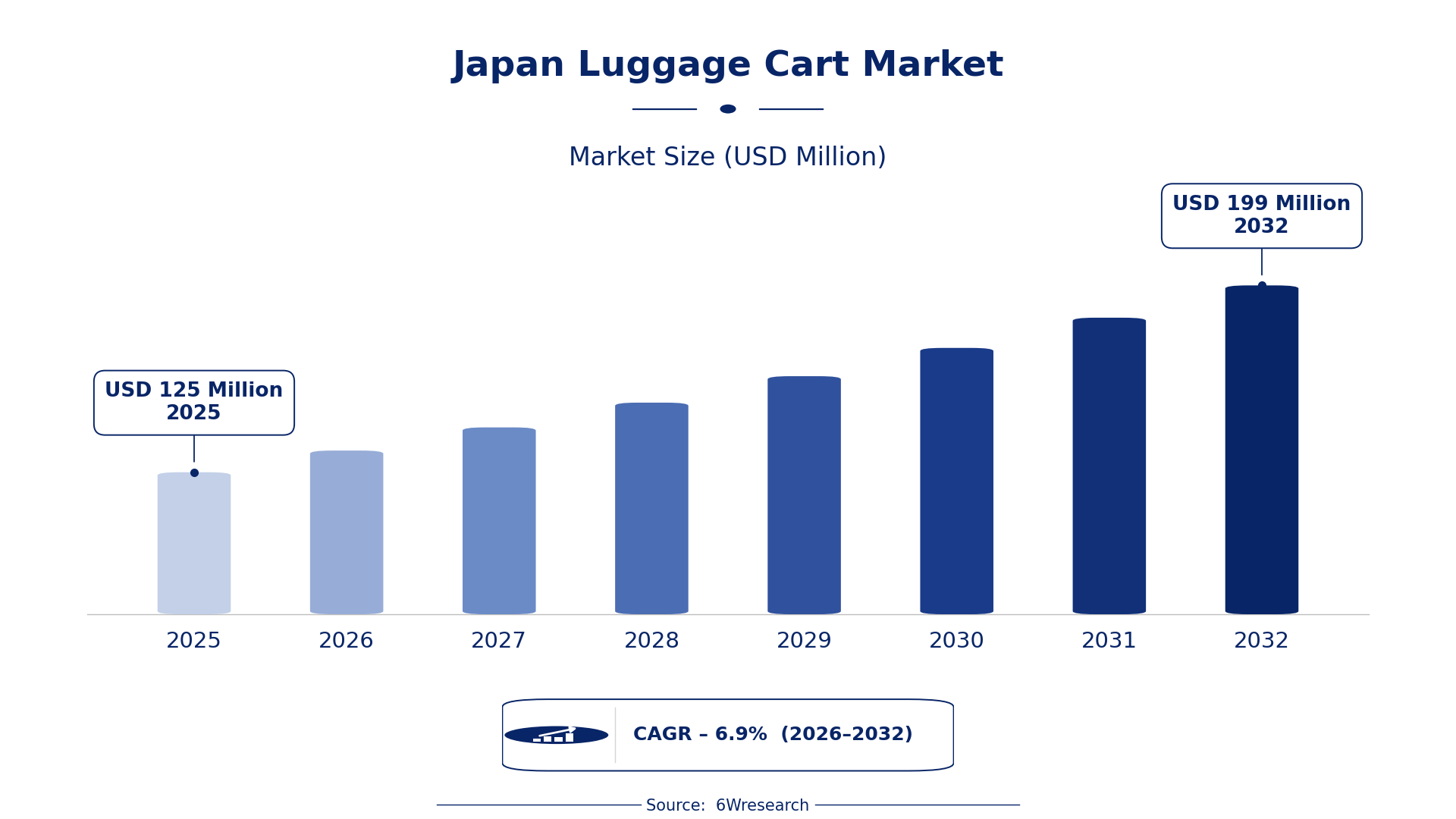
According to 6Wresearch internal database and industry insights, the Japan Luggage Cart Market was valued at USD 125 Million in 2025 and is projected to reach USD 199 Million by 2032, growing at a CAGR of approximately 6.9% during 2026–2032.
Japan Luggage Cart Market Highlights
| Report Metric | Details |
| Report Name | Japan Luggage Cart Market (2026-2032) |
| Market Size 2025 | USD 125 Million |
| Market Size 2032 | USD 199 Million |
| Absolute Growth 2025–2032 | USD 74 Million |
| CAGR 2026–2032 | 6.9% |
| Peak Annual Growth | 7.5% in 2027 |
| Forecast Period | 2026–2032 |
| Historical Data | 2022–2025 |
| Base Year | 2025 |
| Leading Product Type, 2025 | Metal Luggage Carts (56% share) |
| Leading Applications, 2025 | Airport (45% share) |
| Fastest-Growing Product Type | Plastic Luggage Carts (9.2% CAGR) |
| Fastest-Growing Applications | Train Station (9.0% CAGR) |
| Growing Sector | Travel and Hospitality |
| Key End Users | Airports, Hotels, Train Stations |
Japan Luggage Cart Market Year-wise Growth Rate and Key Drivers (2022–2032)
This graph illustrates the annual growth rates of the market from 2022 to 2032, highlighting a steady upward trajectory and projected market expansion over the forecast period.
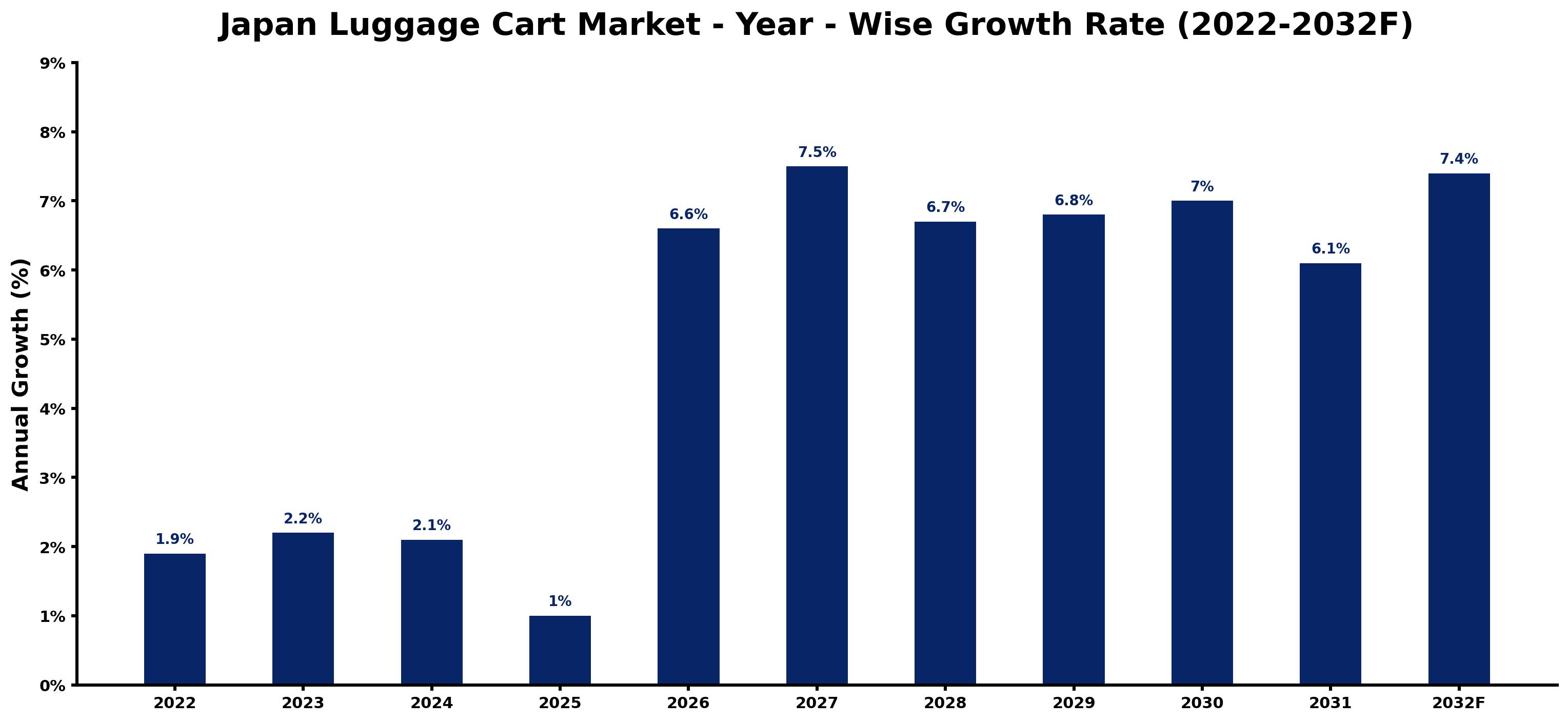
Each row of the following table gives one year's estimated growth and the event or demand shift that explains it.
| Year | Estimated Annual Growth (%) | Market Rationale |
| 2022 | 1.9 | The market maintained steady growth due to consistent travel patterns and demand. |
| 2023 | 2.2 | The increase in passenger traffic at major airports boosted luggage cart usage. |
| 2024 | 2.1 | Demand growth slowed as travel patterns stabilised following the previous year's surge. |
| 2025 | 1.0 | A further slowdown occurred as the market adjusted to post-travel levels. |
| 2026 | 6.6 | Growth accelerated as infrastructure investments began to improve luggage handling capabilities. |
| 2027 | 7.5 | The market peaked with heightened travel demand driven by tourism and business travel. |
| 2028 | 6.7 | Growth moderated slightly as the market stabilised after the peak demand year. |
| 2029 | 6.8 | Demand rose again as travel continued to rebound, particularly in urban areas. |
| 2030 | 7.0 | A steady growth rate was maintained as infrastructure improvements continued. |
| 2031 | 6.1 | The market experienced a slowdown as growth rates normalised after rapid increases. |
| 2032 | 7.4 | Demand surged again as international travel restrictions eased further. |
Note: Market size estimations and growth projections presented in this report are based on 6Wresearch's proprietary forecasting methodology, utilizing the latest available industry data, government publications, and primary research inputs.
Japan Luggage Cart Market Synopsis
Luggage carts are tools designed for transporting belongings, primarily constructed from metal or plastic. They find extensive use in airports, train stations, and hotels, facilitating efficient movement for travellers. The Japan Luggage Cart Market is expanding due to a high volume of domestic and international travel, with Tokyo International Airport accommodating over 75 million passengers each year. Infrastructure investments, particularly those initiated by the Tokyo Metropolitan Government, are driving demand for luggage carts across various environments.
Market Dynamics Impact Analysis (2026–2032)
| Factor | Type | Impact | Primary Segment Affected |
| High passenger traffic at airports drives demand for luggage carts. | Driver | High | Airport |
| Increasing domestic travel leads to higher luggage cart usage in hotels. | Driver | High | Hotels |
| Growing travel industry creates opportunities for luggage cart suppliers. | Opportunity | High | Airport |
| Investment in infrastructure upgrades presents a chance for innovation in luggage carts. | Opportunity | High | Train Station |
| High maintenance costs for luggage carts can limit profitability for hotels. | Restraint | Medium | Hotels |
| Durability issues with plastic carts may deter some buyers. | Restraint | Medium | Plastic Luggage Carts |
| Competition from alternative luggage transport solutions can impact market share. | Challenge | High | Airport |
| Supply chain disruptions may delay the availability of luggage carts. | Challenge | Medium | Train Station |
Evaluation of Drivers in Japan Luggage Cart Market (2026–2032)
These are the developments adding the most demand over the forecast period.
| Drivers | Primary Segment Affected | Why It Matters (Evidence) |
| High passenger volumes at airports increase luggage cart demand. | Airport | Tokyo International Airport sees over 75 million passengers annually, boosting usage. |
| Rising domestic travel increases luggage cart needs in hotels. | Hotels | Japan's population of approximately 125 million contributes to high demand. |
| Investments in infrastructure improvements support luggage cart demand. | Train Station | Increased investments in transport facilities improve luggage handling capabilities. |
| Growing awareness of convenience drives luggage cart adoption. | Airport | Airports are improving passenger experiences, leading to more cart usage. |
| Increased hotel occupancy rates lead to higher luggage cart usage. | Hotels | Rising occupancy rates promote best practices for luggage handling. |
Purchasing is picking up as airports and hotels respond to rising travel demands. The continuous increase in domestic travel supports the need for efficient luggage transport solutions, prompting suppliers to innovate and expand their offerings. Infrastructure investments, particularly after major events, have improved facilities, including luggage handling. The growing population of approximately 125 million in Japan is driving demand for efficient luggage transport solutions, leading to more purchases from hotels and transport hubs.
Evaluation of Restraints in Japan Luggage Cart Market
These are the pressures that could keep growth below its potential.
| Market Restraint | Primary Segment Affected | Why It Matters (Evidence) |
| High maintenance costs for luggage carts limit profitability for hotels. | Hotels | The average lifespan of a luggage cart in high-traffic areas is about 5 years. |
| Durability issues with plastic carts may deter some buyers. | Plastic Luggage Carts | Plastic carts are often found in smaller hotels, limiting their market appeal. |
| Competition from alternative luggage transport solutions can impact market share. | Airport | Alternative transport solutions may attract customers away from traditional carts. |
| Supply chain disruptions may delay the availability of luggage carts. | Train Station | Global supply chain issues have affected many industries, including luggage carts. |
| Regulatory compliance costs can burden manufacturers of luggage carts. | Metal Luggage Carts | Compliance with JIS standards requires investments in testing and certification. |
Japan Luggage Cart Market Challenges
Manufacturers encounter challenges from JIS standards, as extensive testing can delay new product launches by up to six months. Supply chain issues arise from reliance on imported components, extending lead times for producers by 15%, which disrupts delivery schedules for hotels and transport hubs. Rising raw material costs, particularly for metal, have inflated production expenses by around 20%, compelling suppliers to increase prices that burden budget-conscious buyers. Many facilities still utilise outdated carts, raising operational costs for users by as much as 10% due to inefficiencies in luggage handling.
Trends in the Japan Luggage Cart Market
The trends below show where the Japan Luggage Cart Market is heading.
- Shift from Metal to Plastic Carts: The luggage cart market is experiencing a shift towards plastic carts, particularly in smaller hotels. This trend began in 2022 as hotels aimed to reduce costs, with plastic carts now constituting a growing share of new purchases.
- Emergence of Smart Luggage Carts: The introduction of smart luggage carts commenced in 2023, integrating technology to enhance user experience. Airports are increasingly adopting these carts, with a projected growth of 10% in smart cart usage by 2025.
- Increased Focus on Sustainability: Sustainability has become a priority in luggage cart production since 2021, with manufacturers investigating eco-friendly materials. This trend is evident in the adoption of recycled plastics, with a 15% increase in sustainable cart production.
- Expansion of Luggage Cart Rental Services: The trend towards luggage cart rental services began in 2022, particularly in busy urban areas. This service has expanded by 20% annually, catering to travellers seeking convenience without the need for ownership.
Investment Opportunities in the Japan Luggage Cart Market
The following opportunities in the Japan Luggage Cart Market pair current demand with a clear way in.
- Hotels seeking efficient luggage solutions: Hotels are increasingly searching for durable luggage carts to enhance guest convenience. With a projected growth of 10% in hotel occupancy rates, suppliers can tap into this market through partnerships with hotel chains.
- Airports upgrading their equipment: Airports are investing in modern luggage handling solutions, creating opportunities for suppliers. With over 75 million passengers annually, entering this market necessitates compliance with JIS standards.
- Growing demand for eco-friendly products: The rising emphasis on sustainability presents an opportunity for suppliers of eco-friendly luggage carts. With a 15% increase in sustainable production, manufacturers can collaborate with environmental agencies for certifications.
- Train stations enhancing passenger services: Train stations are upgrading facilities to enhance passenger experiences, leading to increased luggage cart demand. Suppliers can penetrate this market by forming joint ventures with local transport authorities.
Government Initiatives in the Japan Luggage Cart Market
The Economic Security Promotion Act of 2022 supports supply-chain resilience for critical products, including luggage carts. This measure encourages manufacturers to invest in durable materials and comply with safety standards, ensuring a reliable supply for buyers. The act also aims to strengthen local production capabilities, which is vital for meeting demand.
The Japan Transport Safety Board oversees compliance with safety standards for luggage handling equipment. This agency approves designs and materials used in luggage carts, ensuring they meet JIS standards for durability and safety. Their oversight guarantees that products in the market are reliable and safe for consumers.
Future Insight of the Japan Luggage Cart Market
Hotels will improve luggage handling systems by 2032, as automated solutions streamline operations. The Tokyo Metropolitan Government's facility upgrades will modernise luggage carts across major transport hubs, catering to higher passenger volumes. Annual luggage cart usage in train stations is projected to rise by 10%, reflecting increased travel demand. Stricter safety standards from the Japan Transport Safety Board will ensure durability, equipping buyers with reliable equipment that meets high safety expectations.
Market Segmentation Analysis
Japan Luggage Cart Market report covers a detailed analysis of the following market segments:
By Product Type – Metal Luggage Carts Lead, Plastic Luggage Carts Expected to Grow Fastest
According to Ravi Bhandari, Research Head at 6Wresearch, Metal Luggage Carts accounted for 56% of the market by product type in 2025. Metal luggage carts hold the largest share due to their durability and strength, making them ideal for high-traffic areas like major airports. For example, facilities such as Narita and Haneda depend on these carts to manage the luggage transport for millions of passengers each year. The quickest growth will come from Plastic Luggage Carts, forecast to expand at a CAGR of 9.2% between 2026 and 2032. The rapid growth of plastic luggage carts is attributed to their rising popularity in smaller hotels and guesthouses, where the need for lightweight and cost-effective solutions is increasing. This trend is visible as these establishments aim to improve guest experiences without incurring substantial costs. Suppliers should consider expanding their product lines to include both metal and plastic luggage carts to meet diverse customer requirements.
By Applications – Airport Leads, Train Station Expected to Grow Fastest
Airport held 45% of the Japan Luggage Cart Market by applications in 2025. Airports hold the largest share due to their essential role in ensuring passenger convenience and operational efficiency, exemplified by Tokyo International Airport's annual traffic of over 75 million passengers. This significant volume of travellers drives the need for a robust supply of luggage carts to manage luggage effectively. Train Station is set to record the highest CAGR in this split, 9.0% over 2026–2032. Train stations are experiencing rapid growth in luggage cart usage, with a reported annual increase of 10%, as they are increasingly recognised for enhancing the travel experience. This growth trend is likely to continue as more individuals choose train travel for its convenience. Suppliers should prepare for rising demand in the train station segment, necessitating adjustments in inventory and service offerings.
Key Attractiveness of the Report
- 10 Years of Market Numbers
- Historical Data Starting from 2022 to 2025
- Base Year 2025
- Forecast Data until 2032
- Key Performance Indicators Impacting the Market
- Major Upcoming Developments and Projects
Key Highlights of the Report:
- Japan Luggage Cart Market Outlook
- Market Size of Japan Luggage Cart Market, 2025
- Forecast of Japan Luggage Cart Market, 2032
- Historical Data and Forecast of Japan Luggage Cart Revenues & Volume for the Period 2022-2032
- Japan Luggage Cart Market Trend Evolution
- Japan Luggage Cart Market Drivers and Challenges
- Japan Luggage Cart Price Trends
- Japan Luggage Cart Porter's Five Forces
- Japan Luggage Cart Industry Life Cycle
- Historical Data and Forecast of Japan Luggage Cart Market Revenues & Volume By Product Type for the Period 2022-2032
- Historical Data and Forecast of Japan Luggage Cart Market Revenues & Volume By Metal Luggage Carts for the Period 2022-2032
- Historical Data and Forecast of Japan Luggage Cart Market Revenues & Volume By Plastic Luggage Carts for the Period 2022-2032
- Historical Data and Forecast of Japan Luggage Cart Market Revenues & Volume By Applications for the Period 2022-2032
- Historical Data and Forecast of Japan Luggage Cart Market Revenues & Volume By Airport for the Period 2022-2032
- Historical Data and Forecast of Japan Luggage Cart Market Revenues & Volume By Train Station for the Period 2022-2032
- Historical Data and Forecast of Japan Luggage Cart Market Revenues & Volume By Hotels for the Period 2022-2032
- Japan Luggage Cart Import Export Trade Statistics
- Market Opportunity Assessment By Product Type
- Market Opportunity Assessment By Applications
- Japan Luggage Cart Top Companies Market Share
- Japan Luggage Cart Competitive Benchmarking By Technical and Operational Parameters
- Japan Luggage Cart Company Profiles
- Japan Luggage Cart Key Strategic Recommendations
Market Covered
The report covers the following segments.
By Product Type
- Metal Luggage Carts
- Plastic Luggage Carts
By Applications
- Airport
- Train Station
- Hotels































