Japan Machine Vision Logistics Market Size & Growth Rate
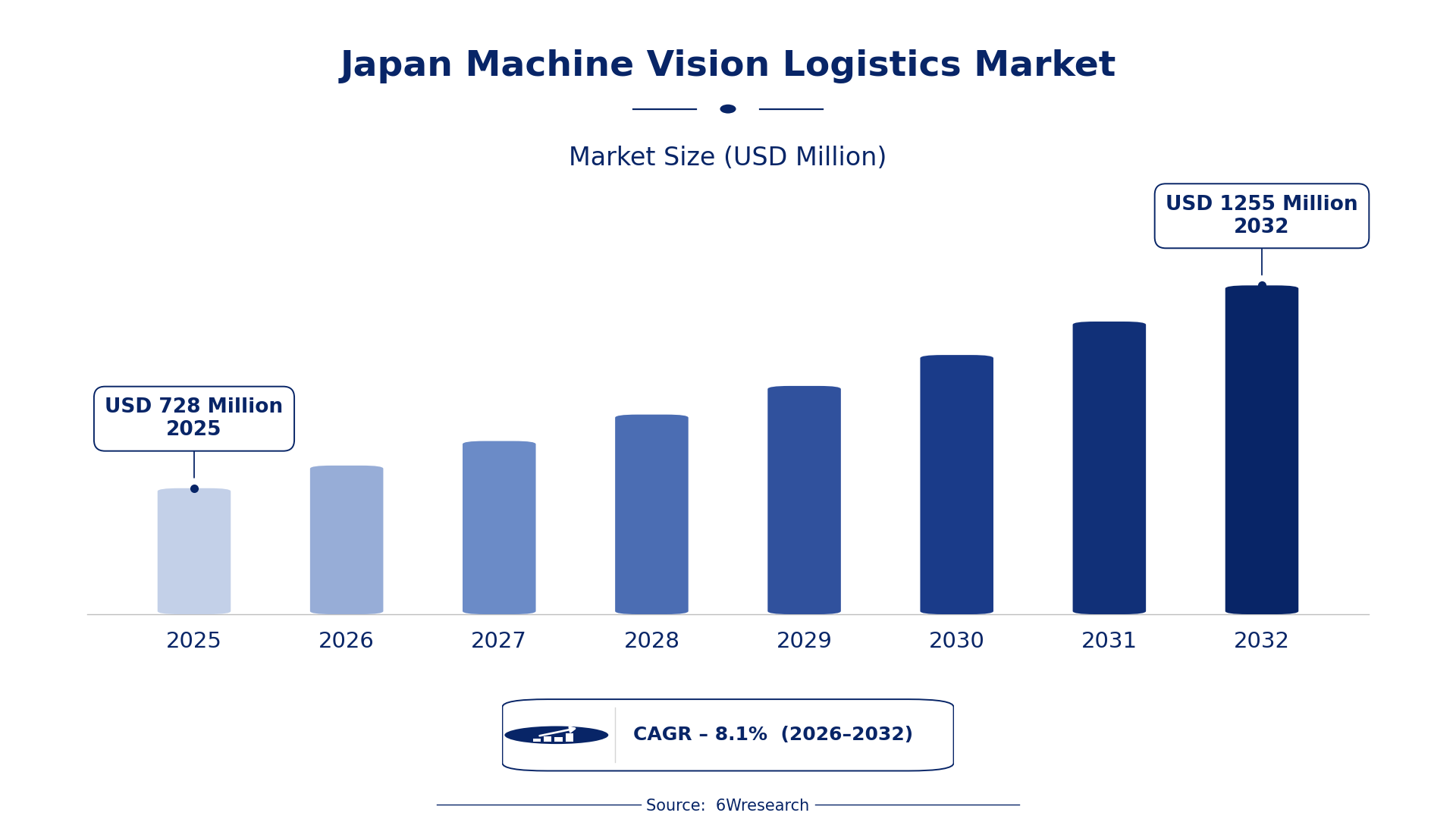
According to 6Wresearch internal database and industry insights, the Japan Machine Vision Logistics Market was valued at USD 728 Million in 2025 and is projected to reach USD 1,255 Million by 2032, growing at a CAGR of approximately 8.1% during 2026–2032.
Japan Machine Vision Logistics Market Highlights
| Report Metric | Details |
| Report Name | Japan Machine Vision Logistics Market (2026-2032) |
| Market Size 2025 | USD 728 Million |
| Market Size 2032 | USD 1,255 Million |
| Absolute Growth 2025–2032 | USD 527 Million |
| CAGR 2026–2032 | 8.1% |
| Peak Annual Growth | 9.4% in 2026 |
| Forecast Period | 2026–2032 |
| Historical Data | 2022–2025 |
| Base Year | 2025 |
| Leading PRODUCT TYPE, 2025 | Smart Camera Based Machine Vision System (60% share) |
| Leading COMPONENT, 2025 | Hardware (57% share) |
| Leading TYPE, 2025 | 2D (54% share) |
| Leading APPLICATION, 2025 | Quality and Assurance (28% share) |
| Leading DEPLOYMENT, 2025 | General Machine Vision System (56% share) |
| Fastest-Growing COMPONENT | Software (11.3% CAGR) |
| Fastest-Growing TYPE | 3D (11.4% CAGR) |
| Fastest-Growing APPLICATION | Predictive Maintenance (11.7% CAGR) |
| Fastest-Growing DEPLOYMENT | Robotic Cell (11.6% CAGR) |
| Growing Sector | Predictive Maintenance |
| Key End Users | Quality and Assurance, Identification, Positioning and Guidance, Pick and Place |
Japan Machine Vision Logistics Market Year-wise Growth Rate and Key Drivers (2022–2032)
This graph illustrates the annual growth rates of the market from 2022 to 2032, highlighting a steady upward trajectory and projected market expansion over the forecast period.
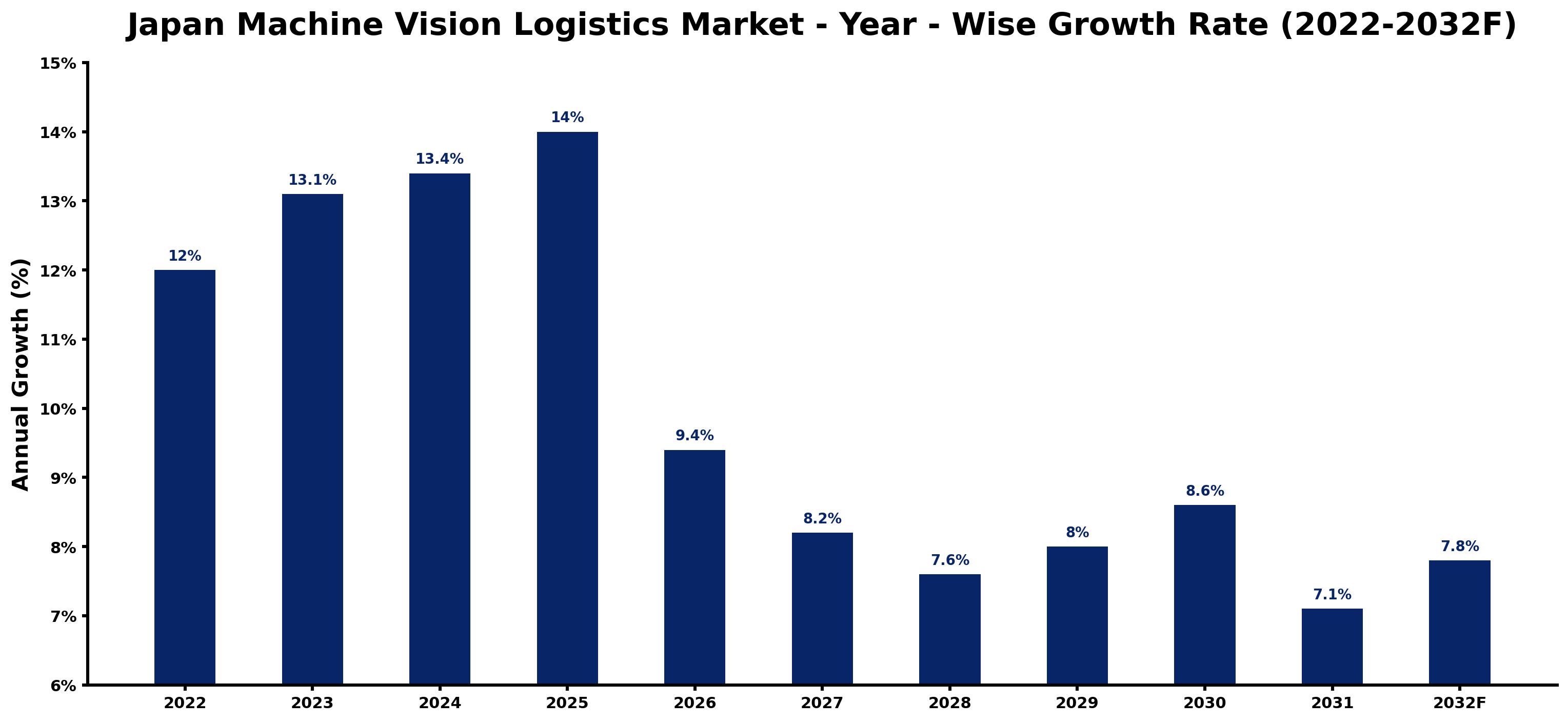
Annual growth estimates for each year appear below with the principal reason behind them, explaining the shifts that set the pace of the market.
| Year | Estimated Annual Growth (%) | Market Rationale |
| 2022 | 12.0 | The market experienced solid growth due to increasing investments in automation technologies. |
| 2023 | 13.1 | Demand rose as logistics companies adopted advanced imaging technologies for efficiency. |
| 2024 | 13.4 | Growth continued with heightened focus on quality control in logistics operations. |
| 2025 | 14.0 | The market peaked as automation became essential for competitive logistics practices. |
| 2026 | 9.4 | Growth slowed as the market is expected to stabilise after rapid expansion. |
| 2027 | 8.2 | Demand will continue to rise, albeit at a slower pace, reflecting market maturity. |
| 2028 | 7.6 | The market is projected to maintain growth as adoption of machine vision technology persists. |
| 2029 | 8.0 | Growth is expected to pick up again as new applications emerge in logistics automation. |
| 2030 | 8.6 | Demand will increase with further advancements in machine vision capabilities. |
| 2031 | 7.1 | Growth is projected to slow as the market reaches a more stable phase of development. |
| 2032 | 7.8 | Demand is expected to rise as automation technologies evolve further. |
Note: Market size estimations and growth projections presented in this report are based on 6Wresearch's proprietary forecasting methodology, utilizing the latest available industry data, government publications, and primary research inputs.
Japan Machine Vision Logistics Market Synopsis
Machine Vision Logistics utilises advanced imaging technologies to automate logistics operations, integrating cameras, sensors, and software algorithms for quality control, sorting, and tracking. The market is expanding due to ongoing investments in automation technologies and a logistics sector valued at approximately 20 trillion yen. The adoption rate of machine vision technology in manufacturing is around 30%, indicating strong demand from domestic users and continuous innovations in operations.
Market Dynamics Impact Analysis (2026–2032)
| Factor | Type | Impact | Primary Segment Affected |
| Increasing investments in automation technologies | Driver | High | General Machine Vision System |
| Rising demand for quality control solutions | Driver | High | Quality and Assurance |
| Growing need for efficient logistics operations | Opportunity | High | Robotic Cell |
| Expanding applications of machine vision in logistics | Opportunity | High | Predictive Maintenance |
| High initial investment costs for machine vision systems | Restraint | Medium | PC Based Machine Vision System |
| Limited skilled workforce for advanced technologies | Restraint | Medium | Smart Camera Based Machine Vision System |
| Competition from alternative automation solutions | Challenge | Medium | Hardware |
| Rapid technological changes requiring constant updates | Challenge | Medium | Software |
Evaluation of Drivers in Japan Machine Vision Logistics Market (2026–2032)
Demand rests on the following drivers, each shown with the segment it touches most.
| Drivers | Primary Segment Affected | Why It Matters (Evidence) |
| Increased automation in logistics operations | General Machine Vision System | Logistics companies seek to improve efficiency and reduce operational costs, with the Tokyo metropolitan area as a key hub. |
| Growing focus on quality assurance | Quality and Assurance | With logistics costs averaging about 10% of GDP, companies invest in quality control to minimise losses and improve service. |
| Rising adoption of machine vision technology in manufacturing | Smart Camera Based Machine Vision System | The adoption rate of around 30% reflects strong demand for efficient sorting and tracking solutions in warehouses. |
| Technological advancements in imaging systems | 3D | Advancements enable complex object recognition, leading to increased demand from logistics providers for enhanced capabilities. |
| Expansion of logistics facilities | Robotic Cell | The average age of logistics facilities is around 10 years, prompting upgrades to incorporate advanced automation technologies. |
Orders keep climbing as the adoption rate of machine vision technology in manufacturing is around 30%, prompting logistics companies to invest in advanced imaging systems for efficiency. The average logistics cost in Japan is about 10% of GDP, driving demand for quality assurance solutions. Advancements in 3D imaging systems enable complex object recognition, essential for modern operations. As the average age of logistics facilities is around 10 years, there is a clear need for upgrades to incorporate automation technologies. This trend pushes providers to improve capabilities and service quality.
Evaluation of Restraints in Japan Machine Vision Logistics Market
The key brakes on demand, and where they bite hardest, are shown below.
| Market Restraint | Primary Segment Affected | Why It Matters (Evidence) |
| High initial investment costs for machine vision systems | PC Based Machine Vision System | High upfront costs deter some logistics companies from adopting advanced systems, limiting market growth. |
| Limited skilled workforce for advanced technologies | Smart Camera Based Machine Vision System | A shortage of trained personnel affects the implementation and maintenance of sophisticated machine vision solutions. |
| Competition from alternative automation solutions | Hardware | Emerging technologies provide similar benefits at lower costs, impacting demand for traditional machine vision hardware. |
| Rapid technological changes requiring constant updates | Software | The fast pace of innovation necessitates ongoing investment in software updates, straining budgets for logistics companies. |
| Regulatory compliance costs associated with automation | General Machine Vision System | Compliance with standards like JIS Z 8721 imposes additional costs on logistics providers. |
Japan Machine Vision Logistics Market Challenges
Buyers face increased costs due to compliance with JIS Z 8721, which raises operational expenses by 15%. Producers encounter inefficiencies since only 30% of manufacturing facilities utilise machine vision technology, leading to slower sorting and tracking processes. Supply chain delays arise from the average age of logistics facilities being around 10 years, extending lead times by 20%. Logistics costs, averaging about 10% of GDP, further strain budgets for buyers and producers, impacting their overall profitability.
Trends in the Japan Machine Vision Logistics Market
Below are the shifts with the largest effect on the Japan Machine Vision Logistics Market.
- Shift towards Advanced 3D Imaging Solutions: A noticeable shift towards 3D imaging solutions is occurring in logistics, particularly in the Kansai region, where demand for complex object recognition is growing. The CAGR for 3D systems is projected at 11.4%, indicating a strong trend towards improved capabilities.
- Transition from Manual to Automated Sorting: The Tokyo metropolitan area is experiencing a transition from manual sorting processes to automated systems, driven by the need for efficiency. The adoption of machine vision technology is expected to rise significantly, reflecting a growing trend in logistics operations.
- Quality Control Prioritised over Cost-cutting: Logistics companies are increasingly prioritising quality control measures, particularly in the Kansai region. The focus on maintaining product standards is clear, with 28% of the market share held by quality assurance applications.
- Emergence of Predictive Maintenance Solutions: Predictive maintenance solutions are emerging as a key trend in logistics, with a CAGR of 11.7%. This growth is driven by the need for reducing downtime and increasing operational efficiency across logistics facilities.
Investment Opportunities in the Japan Machine Vision Logistics Market
Where to invest in the Japan Machine Vision Logistics Market: the main openings are set out below.
- Investment in Automation Technologies: With the logistics sector valued at approximately 20 trillion yen, there is a pressing need for automation solutions. Companies in the Kansai region are seeking advanced machine vision systems to improve efficiency, presenting a strong opportunity for suppliers.
- Growing Demand for Quality Assurance: As logistics costs average about 10% of GDP, companies are prioritising quality control investments. Suppliers can tap into this demand by providing advanced quality assurance solutions to logistics firms in the Tokyo metropolitan area.
- Expansion of 3D Imaging Solutions: The projected CAGR of 11.4% for 3D imaging systems indicates a growing market. Suppliers can enter by partnering with local logistics firms in the Kansai region to offer tailored solutions.
- Robotic Cell Automation: The average age of logistics facilities is around 10 years, creating a need for upgrades. Suppliers can collaborate with logistics companies in the Tokyo area to implement robotic cell automation solutions.
Government Initiatives in the Japan Machine Vision Logistics Market
The New Robot Strategy, launched in 2015, promotes the adoption of robots across various sectors, including logistics. This initiative encourages companies to integrate advanced technologies, benefiting producers and buyers of machine vision systems by improving operational efficiency and productivity.
In 2023, a government programme was launched with a budget of 5 billion yen to support automation in logistics. The Ministry of Land, Infrastructure, Transport and Tourism oversees this initiative, aiding companies in their automation efforts and improving overall logistics operations.
Future Insight of the Japan Machine Vision Logistics Market
A programme aimed at enhancing automation in logistics will launch new advanced imaging technologies by 2032. Facilities will increasingly modernise to meet evolving standards, improving efficiency and accuracy in operations. The installed base of machine vision systems is expected to grow significantly, enhancing capabilities across the sector. As the adoption rate of machine vision technology in manufacturing rises, buyers will benefit from streamlined processes and reduced operational costs.
Market Segmentation Analysis
Japan Machine Vision Logistics Market report covers a detailed analysis of the following market segments:
By PRODUCT TYPE – Smart Camera Based Machine Vision System Leads and Records the Fastest Growth
According to Dhaval Chaurasia, Assistant Manager at 6Wresearch, Smart Camera Based Machine Vision System accounted for 60% of the market by product type in 2025. The Smart Camera Based Machine Vision System commands the largest share due to its widespread adoption for straightforward imaging tasks in logistics operations. Its effectiveness in enhancing efficiency makes it a preferred choice for many facilities, particularly in the Tokyo metropolitan area. The same category is also set to grow fastest, at a CAGR of 9.8% during 2026–2032. The Smart Camera Based Machine Vision System is set for rapid growth as it caters to the rising demand for automation in logistics. Its established presence in various applications ensures that its lead will continue to expand as more facilities adopt this technology. Suppliers should focus on developing advanced features for smart camera systems to align with the increasing demand in the logistics sector.
By COMPONENT – Hardware Leads, Software Expected to Grow Fastest
The largest component category in 2025 was Hardware, at 57% of revenue. Hardware leads the component segment as it is essential for the operation of machine vision systems, providing the necessary infrastructure for effective logistics automation. With over 100,000 units installed, hardware plays a critical role in supporting the logistics industry's needs. The quickest growth will come from Software, forecast to expand at a CAGR of 11.3% between 2026 and 2032. Software is witnessing the fastest growth as it becomes crucial for processing and analysing visual data in logistics applications. The increasing emphasis on advanced analytics capabilities is propelling the adoption of software solutions in this market. Buyers will benefit from investing in software solutions that improve data processing and analysis capabilities.
By TYPE – 2D Leads, 3D Expected to Grow Fastest
2D held 54% of the Japan Machine Vision Logistics Market by type in 2025. The 2D segment is dominant as it is commonly employed for standard imaging tasks, making it a reliable choice for various logistics operations. Its established market presence ensures that it effectively meets the basic imaging requirements of many users. 3D is projected to grow fastest, at a CAGR of 11.4% during 2026–2032. The 3D segment is rapidly gaining traction as it addresses complex object recognition tasks, which are becoming increasingly important in logistics. As facilities seek to improve their operational capabilities, the demand for 3D solutions is expected to grow significantly. Suppliers should consider expanding their 3D product offerings to capture the rising interest in advanced imaging solutions.
By APPLICATION – Quality and Assurance Leads, Predictive Maintenance Expected to Grow Fastest
Quality and Assurance took 28% of application revenue in 2025, more than any other category. Quality and Assurance is the leading application as it is vital for maintaining product standards within logistics operations. This focus on quality control is essential for companies striving to meet both regulatory standards and customer expectations. Predictive Maintenance is set to record the highest CAGR in this split, 11.7% over 2026–2032. Predictive Maintenance is the fastest-growing application as it effectively reduces downtime, a critical issue in logistics. The heightened focus on operational efficiency is driving the adoption of predictive maintenance solutions across the industry. Buyers should prioritise predictive maintenance technologies to optimise their logistics operations and improve overall efficiency.
By DEPLOYMENT – General Machine Vision System Leads, Robotic Cell Expected to Grow Fastest
In 2025, General Machine Vision System led the deployment split with a 56% share. The General Machine Vision System is the leader in deployment due to its wide implementation across various sectors, making it a versatile choice for logistics operations. Its established use in numerous facilities underscores its importance in the market. Over 2026–2032, Robotic Cell is expected to post the fastest growth, at a CAGR of 11.6%. The Robotic Cell is experiencing the fastest growth as it is essential for automating logistics tasks, reflecting the industry's shift towards more automated solutions. The increasing integration of robotics in logistics is driving this rapid adoption. Suppliers need to focus on developing robotic cell solutions to meet the demand for automation in logistics.
Key Attractiveness of the Report
- 10 Years of Market Numbers
- Historical Data Starting from 2022 to 2025
- Base Year 2025
- Forecast Data until 2032
- Key Performance Indicators Impacting the Market
- Major Upcoming Developments and Projects
Key Highlights of the Report:
- Japan Machine Vision Logistics Market Outlook
- Market Size of Japan Machine Vision Logistics Market, 2025
- Forecast of Japan Machine Vision Logistics Market, 2032
- Historical Data and Forecast of Japan Machine Vision Logistics Revenues & Volume for the Period 2022-2032
- Japan Machine Vision Logistics Market Trend Evolution
- Japan Machine Vision Logistics Market Drivers and Challenges
- Japan Machine Vision Logistics Price Trends
- Japan Machine Vision Logistics Porter's Five Forces
- Japan Machine Vision Logistics Industry Life Cycle
- Historical Data and Forecast of Japan Machine Vision Logistics Market Revenues & Volume By PRODUCT TYPE for the Period 2022-2032
- Historical Data and Forecast of Japan Machine Vision Logistics Market Revenues & Volume By PC Based Machine Vision System for the Period 2022-2032
- Historical Data and Forecast of Japan Machine Vision Logistics Market Revenues & Volume By Smart Camera Based Machine Vision System for the Period 2022-2032
- Historical Data and Forecast of Japan Machine Vision Logistics Market Revenues & Volume By COMPONENT for the Period 2022-2032
- Historical Data and Forecast of Japan Machine Vision Logistics Market Revenues & Volume By Hardware for the Period 2022-2032
- Historical Data and Forecast of Japan Machine Vision Logistics Market Revenues & Volume By Software for the Period 2022-2032
- Historical Data and Forecast of Japan Machine Vision Logistics Market Revenues & Volume By TYPE for the Period 2022-2032
- Historical Data and Forecast of Japan Machine Vision Logistics Market Revenues & Volume By 2D for the Period 2022-2032
- Historical Data and Forecast of Japan Machine Vision Logistics Market Revenues & Volume By 3D for the Period 2022-2032
- Historical Data and Forecast of Japan Machine Vision Logistics Market Revenues & Volume By 1D for the Period 2022-2032
- Historical Data and Forecast of Japan Machine Vision Logistics Market Revenues & Volume By APPLICATION for the Period 2022-2032
- Historical Data and Forecast of Japan Machine Vision Logistics Market Revenues & Volume By Quality and Assurance for the Period 2022-2032
- Historical Data and Forecast of Japan Machine Vision Logistics Market Revenues & Volume By Identification for the Period 2022-2032
- Historical Data and Forecast of Japan Machine Vision Logistics Market Revenues & Volume By Positioning and Guidance for the Period 2022-2032
- Historical Data and Forecast of Japan Machine Vision Logistics Market Revenues & Volume By Measurement for the Period 2022-2032
- Historical Data and Forecast of Japan Machine Vision Logistics Market Revenues & Volume By Pick and Place for the Period 2022-2032
- Historical Data and Forecast of Japan Machine Vision Logistics Market Revenues & Volume By Predictive Maintenance for the Period 2022-2032
- Historical Data and Forecast of Japan Machine Vision Logistics Market Revenues & Volume By Palletizing for the Period 2022-2032
- Historical Data and Forecast of Japan Machine Vision Logistics Market Revenues & Volume By Back Office for the Period 2022-2032
- Historical Data and Forecast of Japan Machine Vision Logistics Market Revenues & Volume By DEPLOYMENT for the Period 2022-2032
- Historical Data and Forecast of Japan Machine Vision Logistics Market Revenues & Volume By General Machine Vision System for the Period 2022-2032
- Historical Data and Forecast of Japan Machine Vision Logistics Market Revenues & Volume By Robotic Cell for the Period 2022-2032
- Historical Data and Forecast of Japan Machine Vision Logistics Market Revenues & Volume By END USER for the Period 2022-2032
- Historical Data and Forecast of Japan Machine Vision Logistics Market Revenues & Volume By E-Commerce for the Period 2022-2032
- Historical Data and Forecast of Japan Machine Vision Logistics Market Revenues & Volume By Retail for the Period 2022-2032
- Historical Data and Forecast of Japan Machine Vision Logistics Market Revenues & Volume By Manufacturing for the Period 2022-2032
- Historical Data and Forecast of Japan Machine Vision Logistics Market Revenues & Volume By Consumer Electronics for the Period 2022-2032
- Historical Data and Forecast of Japan Machine Vision Logistics Market Revenues & Volume By Healthcare for the Period 2022-2032
- Historical Data and Forecast of Japan Machine Vision Logistics Market Revenues & Volume By Automotive for the Period 2022-2032
- Historical Data and Forecast of Japan Machine Vision Logistics Market Revenues & Volume By Food and Beverages for the Period 2022-2032
- Historical Data and Forecast of Japan Machine Vision Logistics Market Revenues & Volume By Aerospace and Defense for the Period 2022-2032
- Historical Data and Forecast of Japan Machine Vision Logistics Market Revenues & Volume By BUSINESS TYPE for the Period 2022-2032
- Historical Data and Forecast of Japan Machine Vision Logistics Market Revenues & Volume By B2B for the Period 2022-2032
- Historical Data and Forecast of Japan Machine Vision Logistics Market Revenues & Volume By B2C for the Period 2022-2032
- Japan Machine Vision Logistics Import Export Trade Statistics
- Market Opportunity Assessment By PRODUCT TYPE
- Market Opportunity Assessment By COMPONENT
- Market Opportunity Assessment By TYPE
- Market Opportunity Assessment By APPLICATION
- Market Opportunity Assessment By DEPLOYMENT
- Market Opportunity Assessment By END USER
- Market Opportunity Assessment By BUSINESS TYPE
- Japan Machine Vision Logistics Top Companies Market Share
- Japan Machine Vision Logistics Competitive Benchmarking By Technical and Operational Parameters
- Japan Machine Vision Logistics Company Profiles
- Japan Machine Vision Logistics Key Strategic Recommendations
Market Covered
Segments analysed in this report are listed below.
By PRODUCT TYPE
- PC Based Machine Vision System
- Smart Camera Based Machine Vision System
By COMPONENT
- Hardware
- Software
By TYPE
- 2D
- 3D
- 1D
By APPLICATION
- Quality and Assurance
- Identification
- Positioning and Guidance
- Measurement
- Pick and Place
- Predictive Maintenance
- Palletizing
- Back Office
By DEPLOYMENT
- General Machine Vision System
- Robotic Cell






































