Japan Malting Barley Market Size & Growth Rate
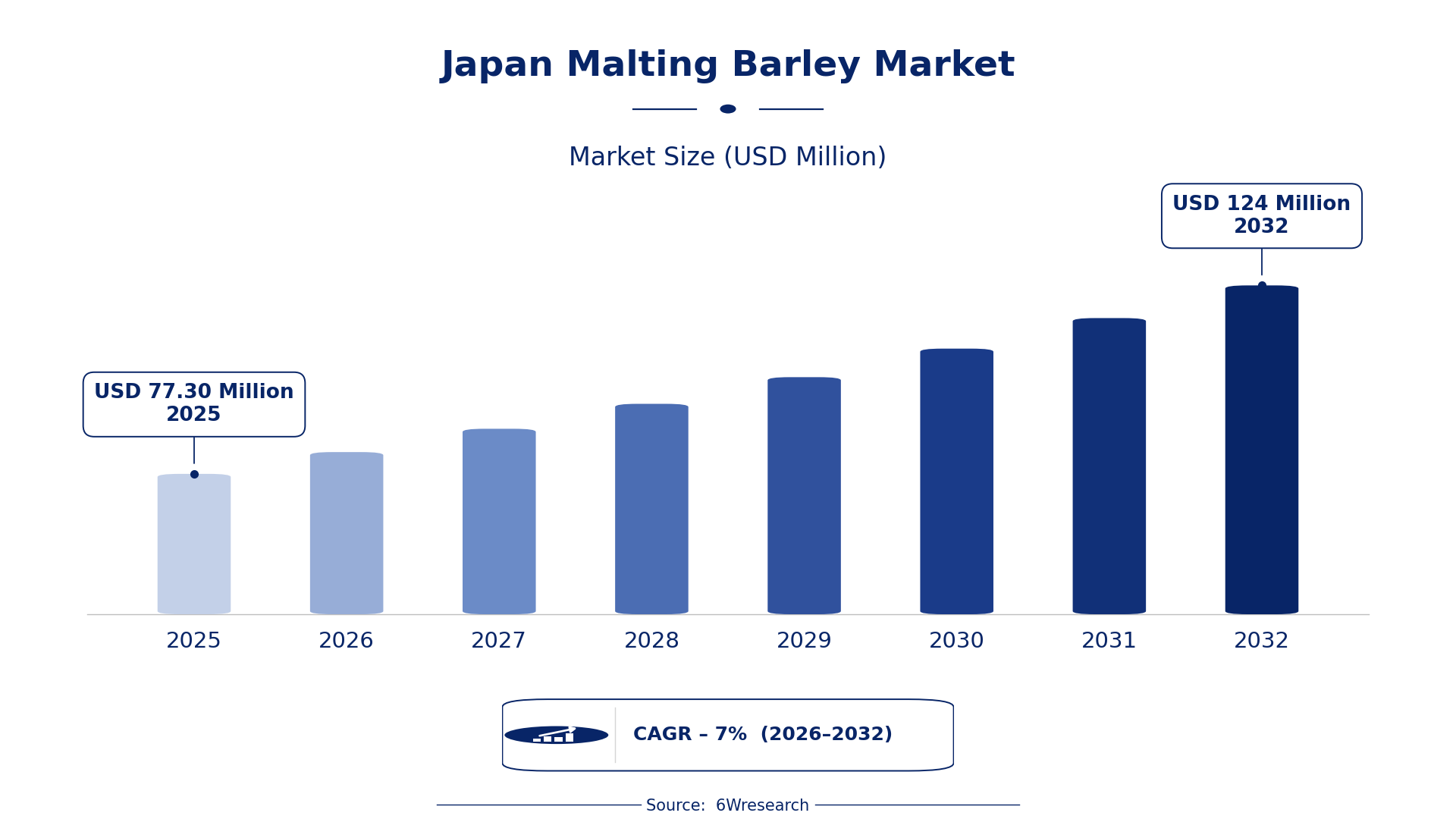
According to 6Wresearch internal database and industry insights, the Japan Malting Barley Market was valued at USD 77.30 Million in 2025 and is projected to reach USD 124 Million by 2032, growing at a CAGR of approximately 7% during 2026–2032.
Japan Malting Barley Market Highlights
| Report Metric | Details |
| Report Name | Japan Malting Barley Market (2026-2032) |
| Market Size 2025 | USD 77.30 Million |
| Market Size 2032 | USD 124 Million |
| Absolute Growth 2025–2032 | USD 46.70 Million |
| CAGR 2026–2032 | 7% |
| Peak Annual Growth | 8.3% in 2032 |
| Forecast Period | 2026–2032 |
| Historical Data | 2022–2025 |
| Base Year | 2025 |
| Leading Product Type, 2025 | 2-Row Malting Barley (51% share) |
| Leading Grade Type, 2025 | Premium (48% share) |
| Leading Distribution Channel, 2025 | Grain Cooperatives (50% share) |
| Leading End User, 2025 | Breweries (45% share) |
| Fastest-Growing Product Type | Spring Malting Barley (9.9% CAGR) |
| Fastest-Growing Grade Type | Malt Grade (10.0% CAGR) |
| Fastest-Growing Distribution Channel | Agricultural Distributors (9.3% CAGR) |
| Fastest-Growing End User | Malt Manufacturers (9.1% CAGR) |
| Growing Sector | Malt Manufacturers |
| Key End Users | Breweries, Malt Manufacturers, Distilleries, Animal Feed Producers |
Japan Malting Barley Market Year-wise Growth Rate and Key Drivers (2022–2032)
This graph illustrates the annual growth rates of the market from 2022 to 2032, highlighting a steady upward trajectory and projected market expansion over the forecast period.
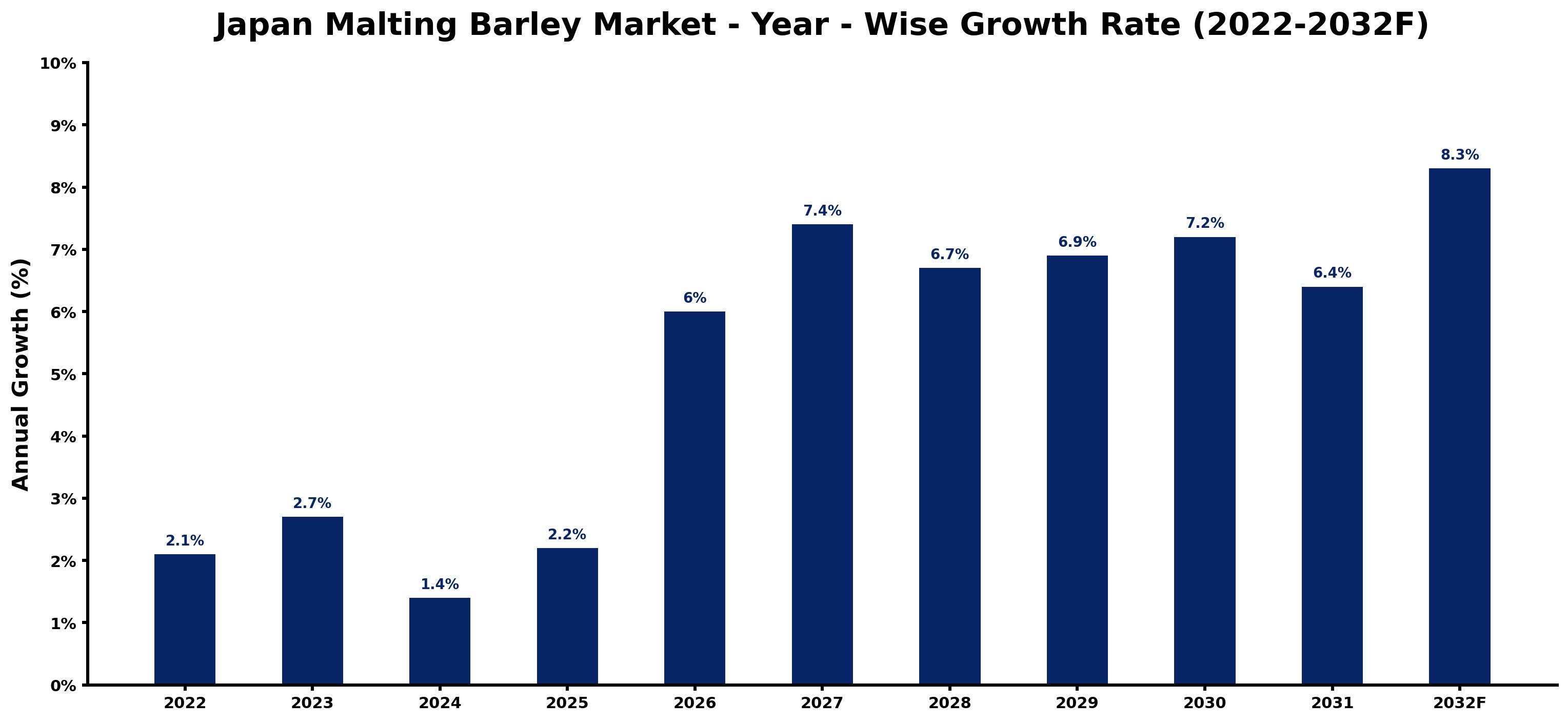
For each year, the table pairs the estimated growth rate with the leading influence on demand, showing how the drivers changed across the period.
| Year | Estimated Annual Growth (%) | Market Rationale |
| 2022 | 2.1 | The market showed steady growth due to stable demand from breweries. |
| 2023 | 2.7 | Growth accelerated as domestic production increased to meet rising brewery needs. |
| 2024 | 1.4 | Growth slowed as market adjustments occurred following the previous year's surge. |
| 2025 | 2.2 | Demand rose again as breweries expanded their production capabilities. |
| 2026 | 6.0 | Growth surged as investments in malting barley production are expected to materialise. |
| 2027 | 7.4 | Demand will continue to rise, driven by increased brewery output and capacity. |
| 2028 | 6.7 | Growth is projected to slow slightly as the market stabilises after rapid expansion. |
| 2029 | 6.9 | Demand is expected to pick up again as breweries seek to improve product quality. |
| 2030 | 7.2 | Growth will maintain momentum due to ongoing investments in local production. |
| 2031 | 6.4 | The market will experience a slight slowdown as production reaches maturity. |
| 2032 | 8.3 | Growth is projected to peak as the industry adapts to new quality standards and demand. |
Note: Market size estimations and growth projections presented in this report are based on 6Wresearch's proprietary forecasting methodology, utilizing the latest available industry data, government publications, and primary research inputs.
Japan Malting Barley Market Synopsis
Malting barley is a cereal grain cultivated specifically for malt production, primarily used in brewing and distilling. The malting process involves soaking, germinating, and drying barley grains to create malt. The Japan Malting Barley Market is growing due to increased domestic demand from over 1,500 breweries and a supportive government initiative aimed at boosting local production by 15% by 2025. With an installed capacity of around 1 million tons per year, the malt industry is attracting further investments in quality malting barley.
Market Dynamics Impact Analysis (2026–2032)
| Factor | Type | Impact | Primary Segment Affected |
| Increased domestic production capacity | Driver | High | Spring Malting Barley |
| Growing number of breweries | Driver | High | Malt Manufacturers |
| Rising interest in premium beers | Opportunity | High | Premium |
| Expansion of distribution channels | Opportunity | Medium | Agricultural Distributors |
| Climate challenges affecting yields | Restraint | High | 2-Row Malting Barley |
| Competition from imported malts | Restraint | Medium | Standard |
| High production costs for farmers | Challenge | High | Spring Malting Barley |
| Dependence on traditional brewing methods | Challenge | Medium | Breweries |
Evaluation of Drivers in Japan Malting Barley Market (2026–2032)
Below are the drivers that matter most for revenue growth, with supporting evidence.
| Drivers | Primary Segment Affected | Why It Matters (Evidence) |
| Increased investment in local malting facilities | Spring Malting Barley | This investment supports higher production levels, encouraging breweries to source locally. |
| Rising consumer preference for craft beers | Malt Manufacturers | Craft breweries are increasing their demand for high-quality malts to differentiate their products. |
| Government subsidies for barley farmers | Premium | Subsidies improve profitability for farmers, encouraging them to grow more malting barley. |
| Expansion of the brewing industry | Breweries | With over 1,500 breweries in Japan, the demand for malting barley is consistently high. |
| Technological advancements in malting processes | Malt Grade | New technologies improve efficiency and quality, leading to increased purchases from breweries. |
Buyers are adding capacity as the Japanese brewing industry expands, employing over 20,000 people directly. The average consumption of malt per brewery is approximately 200 tons annually, driving demand for malting barley. The malt industry has an installed capacity of around 1 million tons per year, encouraging breweries to source locally. Increased consumer interest in craft beers prompts malt manufacturers to seek high-quality malting barley to meet evolving preferences.
Evaluation of Restraints in Japan Malting Barley Market
The key brakes on demand, and where they bite hardest, are shown below.
| Market Restraint | Primary Segment Affected | Why It Matters (Evidence) |
| Climate variability affecting barley yields | 2-Row Malting Barley | Unpredictable weather patterns can lead to lower yields, affecting supply for breweries. |
| High costs of production for malting barley | Standard | Increased costs can limit profitability for farmers, impacting overall supply. |
| Limited awareness of malting barley quality standards | Premium | Breweries may struggle to source high-quality malting barley without clear guidelines. |
| Dependence on traditional brewing methods | Malt Manufacturers | Breweries sticking to traditional methods may not invest in new malting technologies. |
| Competition from imported malts | Spring Malting Barley | Imported malts may be cheaper, affecting local barley sales. |
Japan Malting Barley Market Challenges
Breweries face supply shortages due to inconsistent domestic production, primarily from weather variability affecting Hokkaido's barley yield. This inconsistency delays brewing schedules, costing breweries approximately 10% of annual sales. Farmers encounter slow technology adoption, limiting their ability to improve yield and quality, which results in stagnant production efficiency. Consequently, malt manufacturers struggle to meet demand, impacting their operational capacity and leading to a potential shortfall of around 100,000 tons annually. Rising input costs, driven by inflation, force buyers to pay up to 15% more for malting barley, squeezing their profit margins.
Trends in the Japan Malting Barley Market
Below are the shifts with the largest effect on the Japan Malting Barley Market.
- Shift from Traditional to Craft Brewing: Hokkaido is experiencing a shift towards craft brewing, with local breweries increasing production. In 2023, over 300 craft breweries emerged, reflecting a growing consumer preference for unique beers.
- Transition from Standard to Premium Malts: Since 2022, breweries have been prioritising premium malts to improve beer quality. The Japan Malt Association reports a 15% increase in premium malt usage among breweries.
- Emerging Focus on Sustainable Practices: Breweries are increasingly adopting sustainable practices, with many aiming for eco-friendly sourcing. In 2023, 40% of breweries began using locally sourced malting barley to reduce their carbon footprint.
- Growth of Online Sales Channels: Online grain markets are gaining traction, with a 25% increase in transactions since 2022. This trend is helping smaller breweries access malting barley more easily.
Investment Opportunities in the Japan Malting Barley Market
Below are the investment opportunities with the strongest case in the Japan Malting Barley Market.
- Hokkaido's Malting Facilities: With the government aiming for a 15% increase in barley production by 2025, investing in malting facilities in Hokkaido presents an opportunity for suppliers.
- Timing for Local Sourcing: Now is an ideal time to supply high-quality malting barley, as breweries are increasingly looking for local sources to meet rising demand.
- Entry through Partnerships: Forming partnerships with local grain cooperatives can facilitate entry into the malting barley market, ensuring a steady supply to breweries.
- Expansion of Distribution Networks: Investing in agricultural distributors can improve market reach, as they play an important role in connecting suppliers with breweries.
Government Initiatives in the Japan Malting Barley Market
The GX Basic Policy, adopted in 2023, aims for JPY 150 trillion in public-private investment over ten years, supporting malting barley producers. This policy increases funding for sustainable practices and technological advancements in barley production, building on the Industrial Standardization Act of 1949, which governs quality standards.
The Japan Malt Association utilises government subsidies to support local barley farmers. In 2023, the association initiated a programme to promote the use of locally sourced malting barley, benefiting over 1,500 breweries by ensuring consistent quality and supply.
Future Insight of the Japan Malting Barley Market
Government initiatives will drive a policy shift towards increased domestic barley production, aiming for a 15% rise by 2025. Advancements in farming technology will enable farmers to raise average production to 3 tons per hectare, improving overall supply. A new research and development initiative will focus on enhancing malting barley quality, ensuring higher standards for the industry. Buyers will benefit from more consistent pricing and availability, allowing for better planning and reduced operational disruptions.
Market Segmentation Analysis
Japan Malting Barley Market report covers a detailed analysis of the following market segments:
By Product Type – 2-Row Malting Barley Leads, Spring Malting Barley Expected to Grow Fastest
According to Saurav Kr Singh, Senior Research Analyst at 6Wresearch, 2-Row Malting Barley accounted for 51% of the market by product type in 2025. 2-Row Malting Barley holds the largest share due to its extensive use in brewing, particularly because of its high enzyme content which is essential for malt production. Many of the over 1,500 breweries in Japan rely heavily on this type for their beer production. Spring Malting Barley is projected to grow fastest, at a CAGR of 9.9% during 2026–2032. Spring Malting Barley is experiencing rapid growth as it thrives in Japan's climate, making it a preferred choice among local farmers. The recent government initiatives to boost domestic barley production further support this trend. Suppliers should focus on enhancing the availability of Spring Malting Barley to meet increasing demand.
By Grade Type – Premium Leads, Malt Grade Expected to Grow Fastest
Premium took 48% of grade type revenue in 2025, more than any other category. Premium malting barley commands the largest share as it is crucial for producing high-quality beers, which are in demand among consumers. The focus on quality in the brewing industry drives breweries to prefer premium grades for their products. Malt Grade is set to record the highest CAGR in this split, 10.0% over 2026–2032. Malt Grade is growing quickly due to its specific applications in brewing and distilling, which are essential processes for the beverage industry. The ongoing emphasis on quality standards in the Japanese market accelerates this growth. Buyers may benefit from sourcing higher-grade malting barley to ensure superior product quality.
By Distribution Channel – Grain Cooperatives Lead, Agricultural Distributors Expected to Grow Fastest
The largest distribution channel category in 2025 was Grain Cooperatives, at 50% of revenue. Grain Cooperatives dominate the distribution of malting barley as they effectively connect local farmers with the brewing industry, ensuring a steady supply. Their established networks play a vital role in maintaining the flow of barley to over 1,500 breweries. Over 2026–2032, Agricultural Distributors are expected to post the fastest growth, at a CAGR of 9.3%. Agricultural Distributors are rapidly expanding their role as they provide essential links between producers and malt manufacturers, facilitating efficient distribution. The increasing demand for malting barley from breweries drives this growth. Suppliers should consider partnerships with Agricultural Distributors to enhance market reach and improve supply chain efficiency.
By End User – Breweries Lead, Malt Manufacturers Expected to Grow Fastest
With 45% of end user revenue in 2025, Breweries was the largest category. Breweries are the largest consumers of malting barley in Japan, utilising it extensively for beer production, which remains a staple in Japanese culture. The significant employment in the brewing industry underscores its reliance on malting barley. The quickest growth will come from Malt Manufacturers, forecast to expand at a CAGR of 9.1% between 2026 and 2032. Malt Manufacturers are experiencing the fastest growth as they play a crucial role in processing malting barley into malt, which is essential for breweries. The rising number of breweries increases demand for malt production. Suppliers may find opportunities in collaborating with Malt Manufacturers to streamline production processes and meet growing needs.
Key Attractiveness of the Report
- 10 Years of Market Numbers
- Historical Data Starting from 2022 to 2025
- Base Year 2025
- Forecast Data until 2032
- Key Performance Indicators Impacting the Market
- Major Upcoming Developments and Projects
Key Highlights of the Report:
- Japan Malting Barley Market Outlook
- Market Size of Japan Malting Barley Market, 2025
- Forecast of Japan Malting Barley Market, 2032
- Historical Data and Forecast of Japan Malting Barley Revenues & Volume for the Period 2022-2032F
- Japan Malting Barley Market Trend Evolution
- Japan Malting Barley Market Drivers and Challenges
- Japan Malting Barley Price Trends
- Japan Malting Barley Porter's Five Forces
- Japan Malting Barley Industry Life Cycle
- Historical Data and Forecast of Japan Malting Barley Market Revenues & Volume By Product Type for the Period 2022-2032F
- Historical Data and Forecast of Japan Malting Barley Market Revenues & Volume By 2-Row Malting Barley for the Period 2022-2032F
- Historical Data and Forecast of Japan Malting Barley Market Revenues & Volume By 6-Row Malting Barley for the Period 2022-2032F
- Historical Data and Forecast of Japan Malting Barley Market Revenues & Volume By Winter Malting Barley for the Period 2022-2032F
- Historical Data and Forecast of Japan Malting Barley Market Revenues & Volume By Spring Malting Barley for the Period 2022-2032F
- Historical Data and Forecast of Japan Malting Barley Market Revenues & Volume By Grade Type for the Period 2022-2032F
- Historical Data and Forecast of Japan Malting Barley Market Revenues & Volume By Premium for the Period 2022-2032F
- Historical Data and Forecast of Japan Malting Barley Market Revenues & Volume By Standard for the Period 2022-2032F
- Historical Data and Forecast of Japan Malting Barley Market Revenues & Volume By Feed Grade for the Period 2022-2032F
- Historical Data and Forecast of Japan Malting Barley Market Revenues & Volume By Malt Grade for the Period 2022-2032F
- Historical Data and Forecast of Japan Malting Barley Market Revenues & Volume By Distribution Channel for the Period 2022-2032F
- Historical Data and Forecast of Japan Malting Barley Market Revenues & Volume By Grain Cooperatives for the Period 2022-2032F
- Historical Data and Forecast of Japan Malting Barley Market Revenues & Volume By Agricultural Distributors for the Period 2022-2032F
- Historical Data and Forecast of Japan Malting Barley Market Revenues & Volume By Online Grain Markets for the Period 2022-2032F
- Historical Data and Forecast of Japan Malting Barley Market Revenues & Volume By Direct Farm Sales for the Period 2022-2032F
- Historical Data and Forecast of Japan Malting Barley Market Revenues & Volume By End User for the Period 2022-2032F
- Historical Data and Forecast of Japan Malting Barley Market Revenues & Volume By Breweries for the Period 2022-2032F
- Historical Data and Forecast of Japan Malting Barley Market Revenues & Volume By Distilleries for the Period 2022-2032F
- Historical Data and Forecast of Japan Malting Barley Market Revenues & Volume By Animal Feed Producers for the Period 2022-2032F
- Historical Data and Forecast of Japan Malting Barley Market Revenues & Volume By Malt Manufacturers for the Period 2022-2032F
- Japan Malting Barley Import Export Trade Statistics
- Market Opportunity Assessment By Product Type
- Market Opportunity Assessment By Grade Type
- Market Opportunity Assessment By Distribution Channel
- Market Opportunity Assessment By End User
- Japan Malting Barley Top Companies Market Share
- Japan Malting Barley Competitive Benchmarking By Technical and Operational Parameters
- Japan Malting Barley Company Profiles
- Japan Malting Barley Key Strategic Recommendations
Market Covered
Coverage by segment is as follows.
By Product Type
- 2-Row Malting Barley
- 6-Row Malting Barley
- Winter Malting Barley
- Spring Malting Barley
By Grade Type
- Premium
- Standard
- Feed Grade
- Malt Grade
By Distribution Channel
- Grain Cooperatives
- Agricultural Distributors
- Online Grain Markets
- Direct Farm Sales
By End User
- Breweries
- Distilleries
- Animal Feed Producers
- Malt Manufacturers






































