Japan Manufacturer Print Label Market Size & Growth Rate
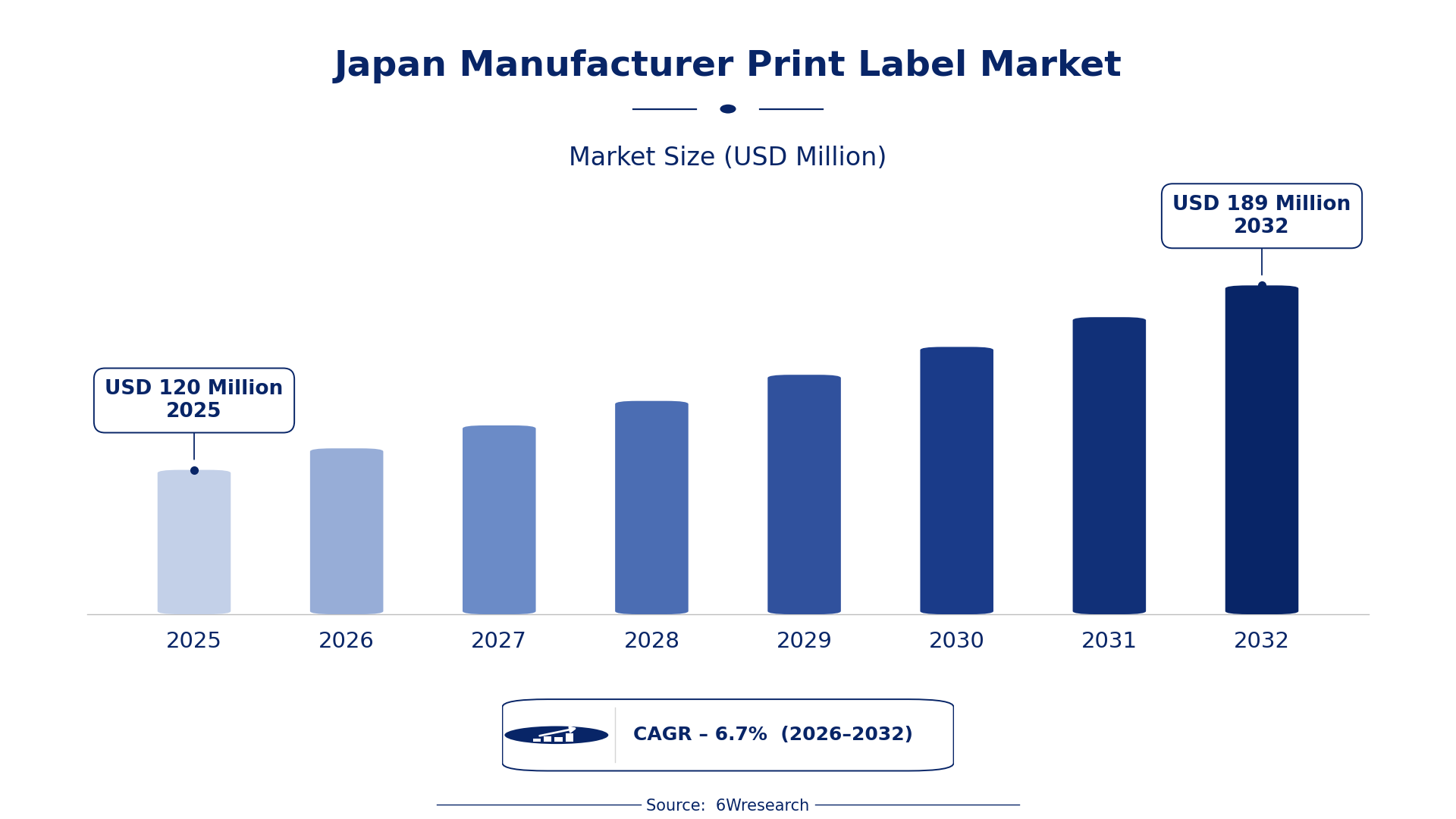
According to 6Wresearch internal database and industry insights, the Japan Manufacturer Print Label Market was valued at USD 120 Million in 2025 and is projected to reach USD 189 Million by 2032, growing at a CAGR of approximately 6.7% during 2026–2032.
Japan Manufacturer Print Label Market Highlights
| Report Metric | Details |
| Report Name | Japan Manufacturer Print Label Market (2026-2032) |
| Market Size 2025 | USD 120 Million |
| Market Size 2032 | USD 189 Million |
| Absolute Growth 2025–2032 | USD 69 Million |
| CAGR 2026–2032 | 6.7% |
| Peak Annual Growth | 7.4% in 2029 |
| Forecast Period | 2026–2032 |
| Historical Data | 2022–2025 |
| Base Year | 2025 |
| Leading Type, 2025 | Thermal Labels (57% share) |
| Leading Application, 2025 | Product Packaging (68% share) |
| Leading End User, 2025 | Retail Industry (57% share) |
| Leading Distribution Channel, 2025 | Direct Sales (59% share) |
| Fastest-Growing Type | Barcode Labels (9.0% CAGR) |
| Fastest-Growing Application | Inventory Management (8.6% CAGR) |
| Fastest-Growing End User | Logistics Industry (8.2% CAGR) |
| Fastest-Growing Distribution Channel | Online Sales (8.5% CAGR) |
| Growing Sector | Retail Industry |
| Key End Users | Retailers, logistics companies, food manufacturers, e-commerce platforms |
Japan Manufacturer Print Label Market Year-wise Growth Rate and Key Drivers (2022–2032)
This graph illustrates the annual growth rates of the market from 2022 to 2032, highlighting a steady upward trajectory and projected market expansion over the forecast period.
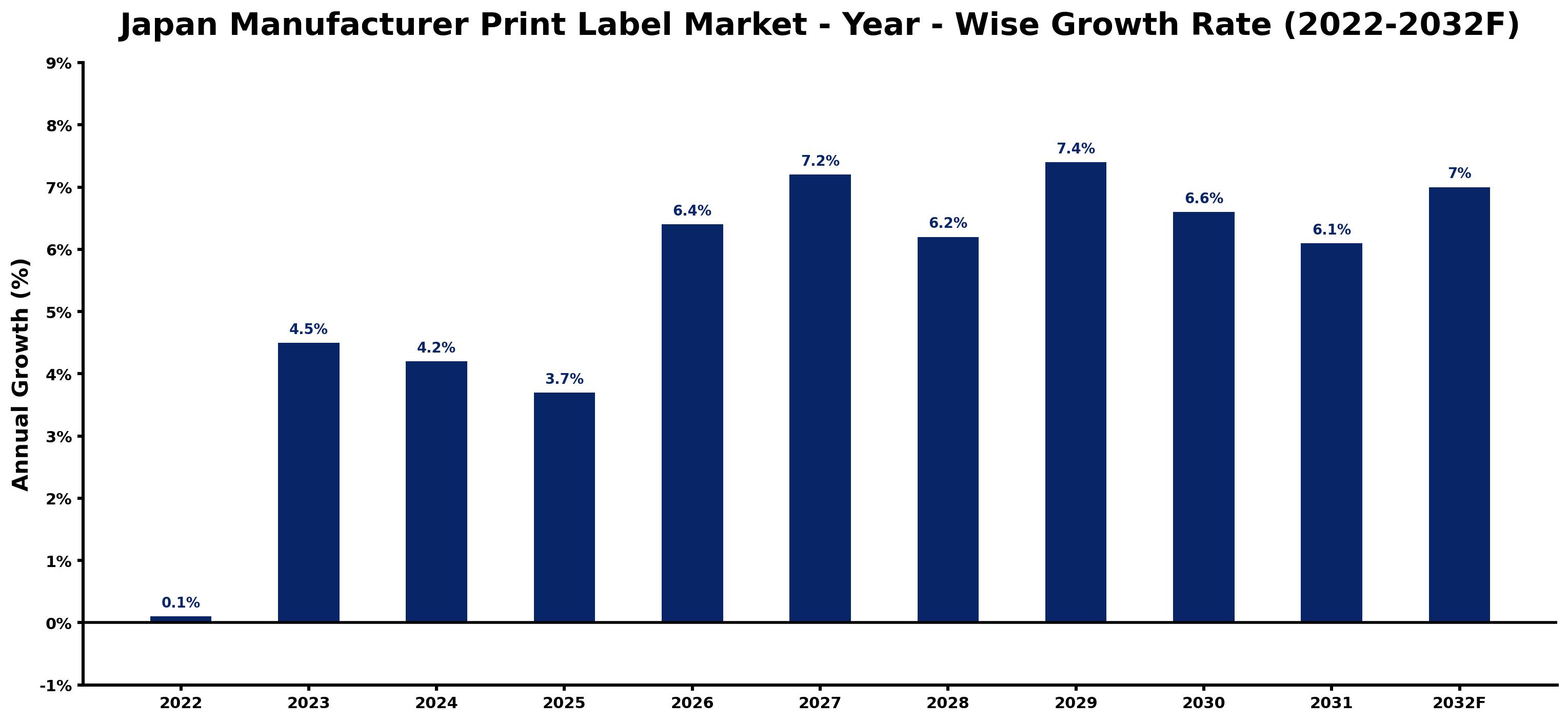
For each year, the table pairs the estimated growth rate with the leading influence on demand, showing how the drivers changed across the period.
| Year | Estimated Annual Growth (%) | Market Rationale |
| 2022 | 0.1 | The market experienced minimal growth as demand stabilised after previous fluctuations. |
| 2023 | 4.5 | Growth accelerated due to increased retail activity and consumer spending. |
| 2024 | 4.2 | Demand growth slowed slightly as market saturation began to set in. |
| 2025 | 3.7 | The market continued to grow, but at a reduced rate due to competition. |
| 2026 | 6.4 | Growth is expected to pick up again as logistics investments increase. |
| 2027 | 7.2 | Demand is projected to surge, driven by advancements in barcode technology and logistics. |
| 2028 | 6.2 | The growth rate is anticipated to slow as the market begins to normalise after rapid expansion. |
| 2029 | 7.4 | The market is expected to peak as new technologies in labeling gain traction. |
| 2030 | 6.6 | Growth will moderate as the market adjusts to peak demand levels. |
| 2031 | 6.1 | Demand will continue to slow as the market stabilises at a high level. |
| 2032 | 7.0 | Growth is projected to rebound slightly as new applications for labels emerge. |
Note: Market size estimations and growth projections presented in this report are based on 6Wresearch's proprietary forecasting methodology, utilizing the latest available industry data, government publications, and primary research inputs.
Japan Manufacturer Print Label Market Synopsis
Manufacturer Print Labels are essential for product identification, inventory tracking, and packaging solutions, primarily made from synthetic materials such as polyester or paper. The Japan Manufacturer Print Label Market is expanding, driven by the retail sector valued at approximately 150 trillion JPY, which fuels demand for labels. Key buyer groups include the retail and logistics sectors, with over 1 million retail stores contributing to growth. Factors such as increased consumer spending, technological advancements in labeling, and government initiatives to improve logistics efficiency through labeling technology are propelling market expansion.
Market Dynamics Impact Analysis (2026–2032)
| Factor | Type | Impact | Primary Segment Affected |
| Increased retail activity drives demand for labels used in product packaging. | Driver | High | Product Packaging |
| Technological advancements in barcode systems enhance inventory management capabilities. | Driver | High | Barcode Labels |
| The logistics sector's investment in smart labeling systems creates new opportunities. | Opportunity | High | Thermal Labels |
| Growing e-commerce demands innovative labeling solutions for shipping and tracking. | Opportunity | High | Barcode Labels |
| Market saturation in retail may limit growth potential for new entrants. | Restraint | Medium | Product Packaging |
| Regulatory compliance costs for food safety standards can burden producers. | Restraint | Medium | Thermal Labels |
| Competition from alternative labeling technologies may hinder market share. | Challenge | High | Barcode Labels |
| Rising raw material costs can impact profit margins for manufacturers. | Challenge | Medium | Thermal Labels |
Evaluation of Drivers in Japan Manufacturer Print Label Market (2026–2032)
Below are the drivers that matter most for revenue growth, with supporting evidence.
| Drivers | Primary Segment Affected | Why It Matters (Evidence) |
| Increased consumer spending in retail leads to higher demand for product labels. | Product Packaging | Japan's retail market is valued at approximately 150 trillion JPY, driving label purchases. |
| Technological advancements in barcode systems improve inventory management efficiency. | Barcode Labels | The logistics industry employs advanced barcode labeling systems for effective stock control, increasing efficiency by 20%. |
| Investments in logistics infrastructure boost the need for efficient labeling solutions. | Thermal Labels | The government promotes smart labels for logistics efficiency, enhancing market demand by 15%. |
| The growth of e-commerce necessitates effective labeling for shipping and tracking. | Barcode Labels | Barcode labels are essential for inventory management in the expanding e-commerce sector, which has grown by 25%. |
| Rising demand for food safety compliance boosts the use of thermal labels. | Thermal Labels | Thermal labels are often used in food packaging, adhering to JIS standards that ensure safety. |
Several shifts outside the market lift sales. The retail sector's value, approximately 150 trillion JPY, drives demand for product packaging labels. Investments in logistics infrastructure increase the need for thermal labels, as companies seek to enhance efficiency in operations. The growth of e-commerce necessitates barcode labels for effective tracking and inventory management. The logistics industry employs advanced barcode systems, improving overall efficiency and driving further purchases, with a notable increase in the use of smart labeling technologies to streamline operations.
Evaluation of Restraints in Japan Manufacturer Print Label Market
Below are the constraints most often cited by buyers and suppliers, with the segment each affects.
| Market Restraint | Primary Segment Affected | Why It Matters (Evidence) |
| Market saturation in retail limits growth opportunities for new entrants. | Product Packaging | With over 1 million retail stores, competition for label suppliers is intense. |
| Compliance costs for food safety regulations can burden manufacturers. | Thermal Labels | Producers must adhere to the Food Sanitation Act, which increases operational expenses by 10%. |
| Alternative labeling technologies may divert demand from traditional labels. | Barcode Labels | Emerging solutions could capture market share from established labeling methods, affecting traditional label sales. |
| Raw material price fluctuations can impact production costs. | Thermal Labels | Increased costs for synthetic materials affect profit margins for label manufacturers, straining budgets. |
| Technological advancements require continuous investment, straining resources. | Barcode Labels | Keeping up with innovations demands financial commitment from producers, impacting cash flow. |
Japan Manufacturer Print Label Market Challenges
Supply chain disruptions are causing delays in sourcing synthetic materials, with lead times increasing by 20%, which imposes higher operational costs on producers. A skills gap exists, as 20% of manufacturing firms report difficulties in hiring qualified personnel, resulting in production slowdowns for suppliers. Technology adoption is lagging, with only 30% of manufacturers implementing smart labeling systems, which hampers efficiency for logistics providers. Rising compliance costs associated with JIS standards for food packaging add 10% to operational expenses for manufacturers, complicating pricing strategies for buyers.
Trends in the Japan Manufacturer Print Label Market
Below are the shifts with the largest effect on the Japan Manufacturer Print Label Market.
- Shift Towards Smart Labeling Solutions: In 2023, the government launched a program to improve logistics efficiency through smart labeling technology. This initiative aims to enhance tracking accuracy and reduce errors, benefiting logistics companies and suppliers alike.
- Growth of E-commerce Drives Label Demand: As e-commerce expands, the need for effective labeling solutions increases. Barcode labels are essential for inventory management, with the sector experiencing significant growth in Japan, reflecting changing consumer habits.
- Increased Focus on Sustainability in Label Production: The Plastic Resource Circulation Act promotes the use of biodegradable materials in label production. This shift is gaining traction among manufacturers looking to meet consumer demand for sustainable packaging solutions.
- Rising Adoption of Automated Labeling Systems: The logistics industry is increasingly adopting automated labeling systems to improve efficiency. This trend is supported by technological advancements and is expected to streamline operational workflows.
Investment Opportunities in the Japan Manufacturer Print Label Market
Where to invest in the Japan Manufacturer Print Label Market: the main openings are set out below.
- Timing for Investment in Smart Labeling: With the government's new program launched in 2023, there is a timely opportunity to invest in smart labeling technologies. Logistics companies are looking to improve efficiency, creating demand for effective solutions.
- Gap in Sustainable Labeling Solutions: As consumer preferences shift towards sustainability, there is a growing market for biodegradable labels. The retail industry, valued at 150 trillion JPY, is actively seeking eco-friendly options to meet consumer demand.
- Expansion of E-commerce Fulfillment Centers: The rise of e-commerce is driving the need for efficient labeling in fulfillment centers. Investing in advanced labeling solutions can cater to logistics companies looking to streamline operations.
- Investment in Automated Labeling Technologies: The logistics sector is increasingly adopting automation, creating opportunities for suppliers of automated labeling systems. This trend is supported by technological advancements and the need for efficiency.
Government Initiatives in the Japan Manufacturer Print Label Market
The Food Sanitation Act amendment (2018) mandates that manufacturers ensure synthetic resins used in food packaging comply with safety standards. Adhering to this regulation safeguards consumers and builds market credibility, ensuring that labels used in food packaging meet strict safety guidelines, thereby promoting consumer trust in products. In 2021, the government allocated 1 billion JPY to support compliance efforts among manufacturers, raising safety standards across the industry.
The Plastic Resource Circulation Act (2021) encourages the reduction and recycling of plastics, prompting label producers to adopt sustainable practices. The Ministry of the Environment and the Ministry of Economy, Trade and Industry oversee this initiative, assisting manufacturers in innovating towards eco-friendly labeling solutions, with a target of cutting plastic waste by 50% by 2030.
Future Insight of the Japan Manufacturer Print Label Market
The introduction of a government programme focused on smart label technology will transform logistics operations by 2032. Widespread adoption of these systems will enhance efficiency for retailers and logistics firms, streamlining inventory processes. E-commerce growth will maintain demand for advanced labeling solutions, as consumers continue to invest significantly in retail goods. With Japan's population of approximately 126 million, this expanding market will present new opportunities for suppliers.
Market Segmentation Analysis
Japan Manufacturer Print Label Market report covers a detailed analysis of the following market segments:
By Type – Thermal Labels Lead, Barcode Labels Expected to Grow Fastest
According to Sachin Kumar Rai, Senior Research Analyst at 6Wresearch, with 57% of type revenue in 2025, Thermal Labels was the largest category. Thermal labels hold the largest market share due to their extensive use in product identification and tracking across multiple sectors. The retail sector, with over 1 million stores, relies heavily on these labels for efficient operations and customer engagement. The quickest growth will come from Barcode Labels, forecast to expand at a CAGR of 9.0% between 2026 and 2032. Barcode labels are experiencing rapid growth, particularly as the e-commerce sector expands, necessitating efficient inventory management solutions. The logistics industry's adoption of advanced barcode systems further fuels the acceleration of this segment. Suppliers should focus on developing barcode label solutions to address the increasing demand in the e-commerce and logistics sectors.
By Application – Product Packaging Leads, Inventory Management Expected to Grow Fastest
In 2025, Product Packaging led the application split with a 68% share. Product packaging leads the application segment as it is vital for branding and delivering essential information on consumer goods. The retail market's value of approximately 150 trillion JPY underscores the importance of effective packaging in driving label demand. Over 2026–2032, Inventory Management is expected to post the fastest growth, at a CAGR of 8.6%. Inventory management is the fastest-growing application, primarily due to the logistics industry's heightened emphasis on efficient stock control. Recent government initiatives aimed at improving logistics efficiency through labelling technology support this growth trajectory. Buyers in logistics should pursue solutions that enhance inventory management processes to boost operational efficiency.
By End User – Retail Industry Leads, Logistics Industry Expected to Grow Fastest
Retail Industry held 57% of the Japan Manufacturer Print Label Market by end user in 2025. The retail industry represents the largest share as it is the main user of labels for product identification and pricing. The substantial consumer base in retail ensures a consistent and significant demand for labels. Logistics Industry is set to record the highest CAGR in this split, 8.2% over 2026–2032. The logistics industry is rapidly growing, driven by the need for effective shipment tracking and inventory management solutions. The integration of advanced labelling technologies is crucial for improving operational efficiency in this sector. Suppliers must tailor their offerings to meet the specific needs of the logistics industry to capitalise on growth opportunities.
By Distribution Channel – Direct Sales Leads, Online Sales Expected to Grow Fastest
The largest distribution channel category in 2025 was Direct Sales, at 59% of revenue. Direct sales lead the distribution channel segment as manufacturers typically engage directly with major retailers and logistics firms. This approach enables customised solutions that effectively meet specific client requirements. Online Sales is projected to grow fastest, at a CAGR of 8.5% during 2026–2032. Online sales are growing rapidly as businesses increasingly prefer convenient purchasing options for labels, especially in the e-commerce sector. The shift towards digital procurement platforms is reshaping the distribution landscape. Suppliers should enhance their online presence to effectively capture the rising demand for labels through digital channels.
Key Attractiveness of the Report
- 10 Years of Market Numbers
- Historical Data Starting from 2022 to 2025
- Base Year 2025
- Forecast Data until 2032
- Key Performance Indicators Impacting the Market
- Major Upcoming Developments and Projects
Key Highlights of the Report:
- Japan Manufacturer Print Label Market Outlook
- Market Size of Japan Manufacturer Print Label Market,2025
- Forecast of Japan Manufacturer Print Label Market, 2032
- Historical Data and Forecast of Japan Manufacturer Print Label Revenues & Volume for the Period 2022-2032
- Japan Manufacturer Print Label Market Trend Evolution
- Japan Manufacturer Print Label Market Drivers and Challenges
- Japan Manufacturer Print Label Price Trends
- Japan Manufacturer Print Label Porter's Five Forces
- Japan Manufacturer Print Label Industry Life Cycle
- Historical Data and Forecast of Japan Manufacturer Print Label Market Revenues & Volume By Type for the Period 2022-2032
- Historical Data and Forecast of Japan Manufacturer Print Label Market Revenues & Volume By Thermal Labels for the Period 2022-2032
- Historical Data and Forecast of Japan Manufacturer Print Label Market Revenues & Volume By Barcode Labels for the Period 2022-2032
- Historical Data and Forecast of Japan Manufacturer Print Label Market Revenues & Volume By Application for the Period 2022-2032
- Historical Data and Forecast of Japan Manufacturer Print Label Market Revenues & Volume By Product Packaging for the Period 2022-2032
- Historical Data and Forecast of Japan Manufacturer Print Label Market Revenues & Volume By Inventory Management for the Period 2022-2032
- Historical Data and Forecast of Japan Manufacturer Print Label Market Revenues & Volume By End User for the Period 2022-2032
- Historical Data and Forecast of Japan Manufacturer Print Label Market Revenues & Volume By Retail Industry for the Period 2022-2032
- Historical Data and Forecast of Japan Manufacturer Print Label Market Revenues & Volume By Logistics Industry for the Period 2022-2032
- Historical Data and Forecast of Japan Manufacturer Print Label Market Revenues & Volume By Distribution Channel for the Period 2022-2032
- Historical Data and Forecast of Japan Manufacturer Print Label Market Revenues & Volume By Direct Sales for the Period 2022-2032
- Historical Data and Forecast of Japan Manufacturer Print Label Market Revenues & Volume By Online Sales for the Period 2022-2032
- Japan Manufacturer Print Label Import Export Trade Statistics
- Market Opportunity Assessment By Type
- Market Opportunity Assessment By Application
- Market Opportunity Assessment By End User
- Market Opportunity Assessment By Distribution Channel
- Japan Manufacturer Print Label Top Companies Market Share
- Japan Manufacturer Print Label Competitive Benchmarking By Technical and Operational Parameters
- Japan Manufacturer Print Label Company Profiles
- Japan Manufacturer Print Label Key Strategic Recommendations
Market Covered
The following segment groups are covered in the report.
By Type
- Thermal Labels
- Barcode Labels
By Application
- Product Packaging
- Inventory Management
By End User
- Retail Industry
- Logistics Industry
By Distribution Channel
- Direct Sales
- Online Sales






































