Japan Marine Farming Market Size & Growth Rate
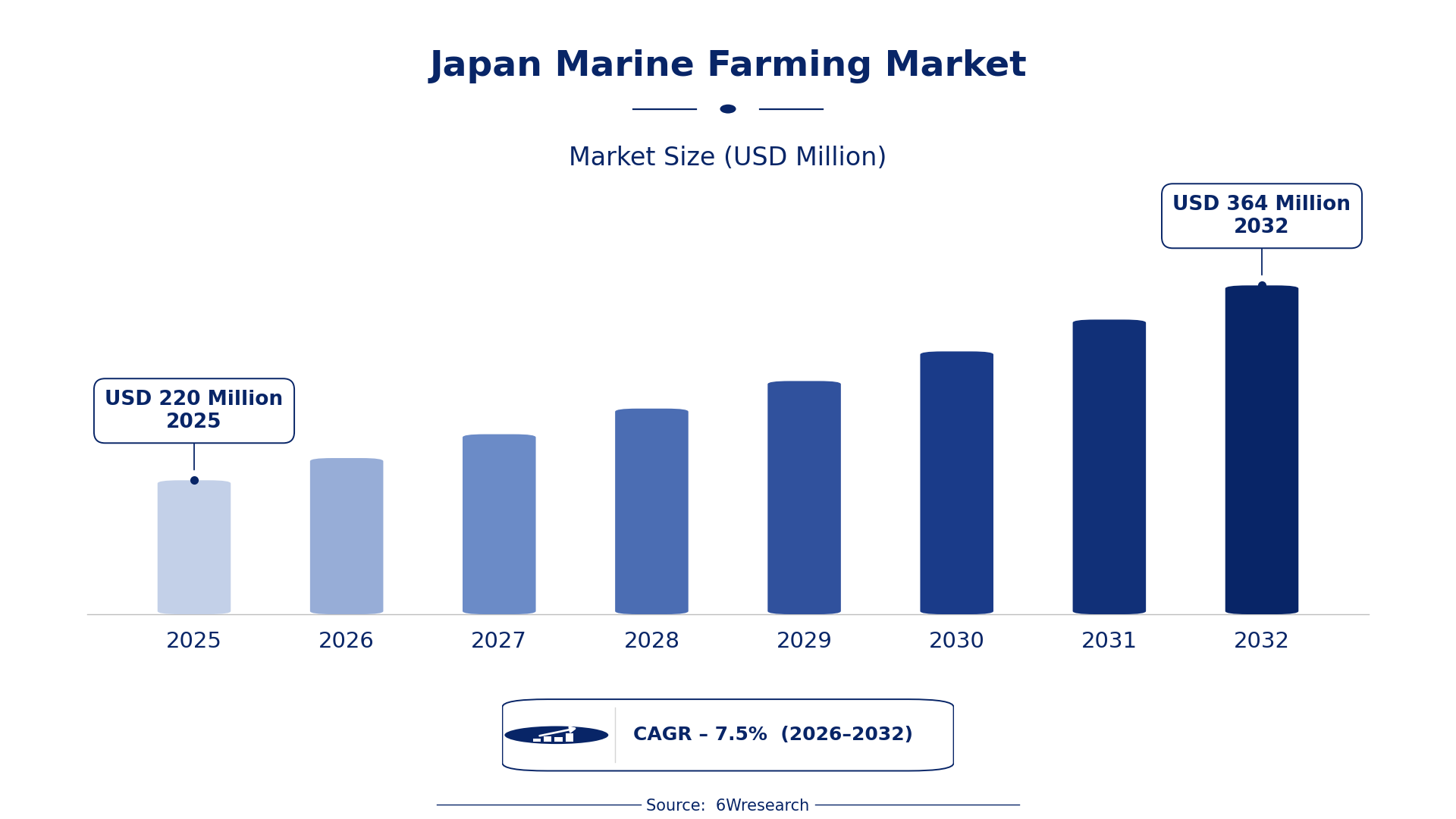
According to 6Wresearch internal database and industry insights, the Japan Marine Farming Market was valued at USD 220 Million in 2025 and is projected to reach USD 364 Million by 2032, growing at a CAGR of approximately 7.5% during 2026–2032.
Japan Marine Farming Market Highlights
| Report Metric | Details |
| Report Name | Japan Marine Farming Market (2026-2032) |
| Market Size 2025 | USD 220 Million |
| Market Size 2032 | USD 364 Million |
| Absolute Growth 2025–2032 | USD 144 Million |
| CAGR 2026–2032 | 7.5% |
| Peak Annual Growth | 8.4% in 2032 |
| Forecast Period | 2026–2032 |
| Historical Data | 2022–2025 |
| Base Year | 2025 |
| Leading Farming Type, 2025 | Coastal Farming (41% share) |
| Leading Species Farmed, 2025 | Salmon (43% share) |
| Leading Distribution Channel, 2025 | Direct Sales (41% share) |
| Leading End User, 2025 | Restaurants (43% share) |
| Fastest-Growing Farming Type | Offshore Aquaculture (10.5% CAGR) |
| Fastest-Growing Species Farmed | Tuna (10.4% CAGR) |
| Fastest-Growing Distribution Channel | Online Seafood Platforms (9.9% CAGR) |
| Fastest-Growing End User | Foodservice Industry (9.6% CAGR) |
| Growing Sector | Seafood consumption |
| Key End Users | Restaurants, Grocery Chains, Foodservice Industry |
Japan Marine Farming Market Year-wise Growth Rate and Key Drivers (2022–2032)
This graph illustrates the annual growth rates of the market from 2022 to 2032, highlighting a steady upward trajectory and projected market expansion over the forecast period.
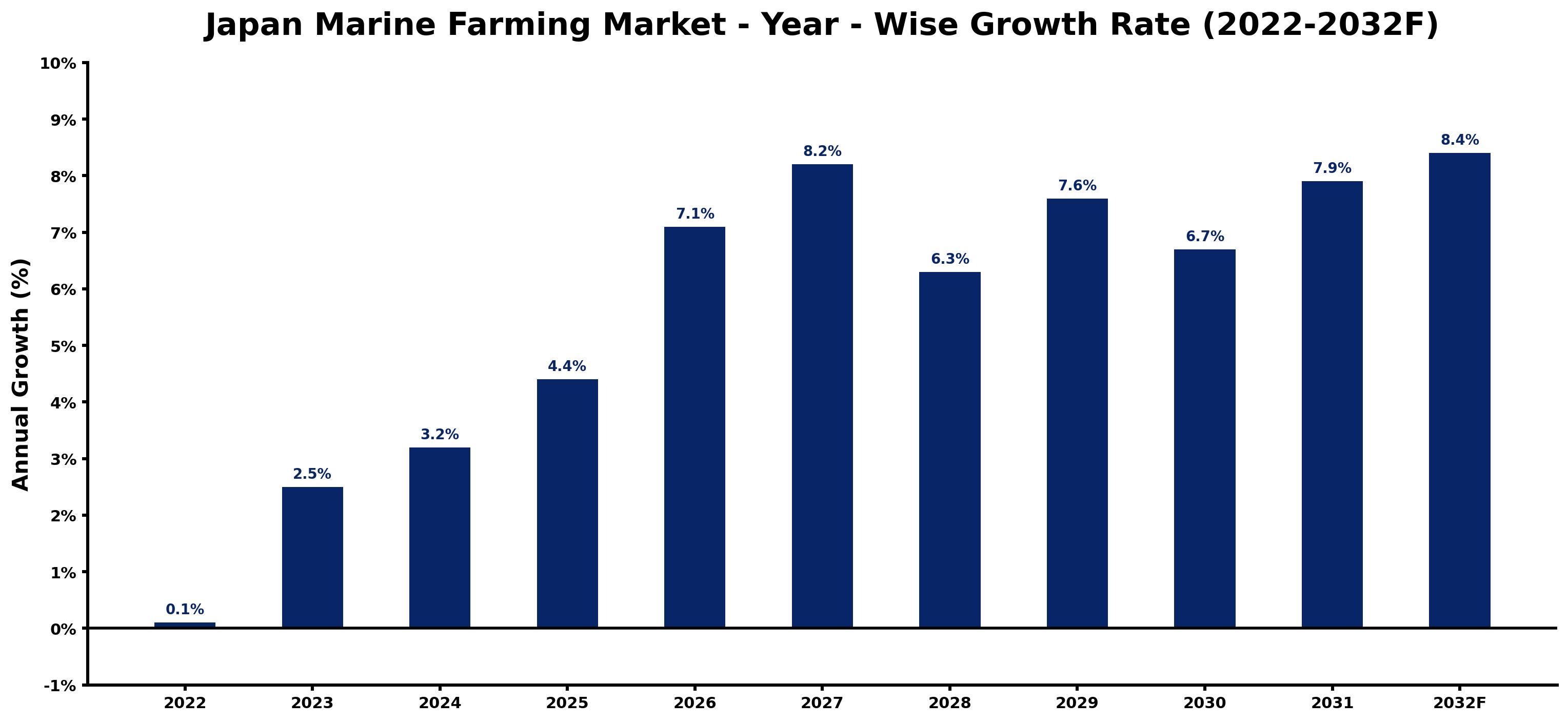
The following figures match every annual growth estimate with the main market development of that year, giving the reasoning behind each rise or slowdown.
| Year | Estimated Annual Growth (%) | Market Rationale |
| 2022 | 0.1 | The market showed minimal growth as demand stabilised post-2021. |
| 2023 | 2.5 | Growth accelerated due to increasing seafood consumption among domestic consumers. |
| 2024 | 3.2 | Rising interest in sustainable seafood practices boosted growth further. |
| 2025 | 4.4 | Market expansion continued as investments in aquaculture technology increased. |
| 2026 | 7.1 | Demand rose sharply as offshore aquaculture gained popularity among producers. |
| 2027 | 8.2 | Growth occurred due to heightened interest in tuna farming. |
| 2028 | 6.3 | Growth slowed slightly as market adjustments took place after rapid expansion. |
| 2029 | 7.6 | Demand increased again as online seafood platforms attracted more consumers. |
| 2030 | 6.7 | Market growth decelerated as competition intensified among suppliers. |
| 2031 | 7.9 | Growth picked up as restaurants sought more sustainable seafood options. |
| 2032 | 8.4 | The market peaked as technological advancements in farming techniques emerged. |
Note: Market size estimations and growth projections presented in this report are based on 6Wresearch's proprietary forecasting methodology, utilizing the latest available industry data, government publications, and primary research inputs.
Japan Marine Farming Market Synopsis
Marine farming in Japan involves cultivating marine organisms in controlled environments, primarily for food production. For instance, salmon farming in Hokkaido accounts for 30% of the country's total supply. The Japan Marine Farming Market is expanding due to rising domestic seafood consumption, with annual per capita consumption at about 25 kg, alongside investments in sustainable aquaculture practices, supported by initiatives from the Fisheries Agency of Japan.
Market Dynamics Impact Analysis (2026–2032)
| Factor | Type | Impact | Primary Segment Affected |
| Increasing domestic seafood consumption drives demand for marine farming products. | Driver | High | Coastal Farming |
| Growing interest in sustainable aquaculture practices presents opportunities for innovation. | Opportunity | High | Seaweed Farming |
| Regulatory compliance costs can burden small-scale marine farmers. | Restraint | Medium | Cage Culture |
| Limited access to advanced farming technology restricts growth potential. | Restraint | High | Offshore Aquaculture |
| Rising consumer preference for online seafood platforms enhances market access. | Driver | Medium | Online Seafood Platforms |
| The demand for organic seafood products is increasing among health-conscious consumers. | Opportunity | Medium | Organic Product Retailers |
| High operational costs challenge profitability for marine farmers. | Challenge | High | Tuna |
| Regulatory compliance with food safety standards can delay market entry. | Challenge | Medium | Oysters |
Evaluation of Drivers in Japan Marine Farming Market (2026–2032)
The table below links each growth driver to the segment it affects and the evidence for it.
| Drivers | Primary Segment Affected | Why It Matters (Evidence) |
| Rising domestic seafood consumption increases demand for farmed products. | Coastal Farming | Annual per capita seafood consumption in Japan is about 25 kg, prompting higher purchases. |
| Investments in sustainable aquaculture practices are boosting production capabilities. | Seaweed Farming | The sector is valued at approximately 200 billion yen, encouraging new projects. |
| Technological advancements in farming methods improve yield and efficiency. | Offshore Aquaculture | New techniques are being adopted, leading to larger-scale operations. |
| Growing popularity of online seafood platforms expands market reach. | Online Seafood Platforms | Usage among consumers increased by 15% in 2023, driving sales. |
| Consumer demand for fresh seafood drives direct sales channels. | Direct Sales | Restaurants and grocery chains are key buyers, accounting for significant sales. |
Buyers are adding capacity as domestic seafood consumption rises, with annual per capita consumption at about 25 kg. The seaweed farming sector is valued at approximately 200 billion yen, prompting new projects that improve production capabilities. Technological advancements in farming methods are improving yield and efficiency, prompting larger-scale operations. The growing popularity of online seafood platforms, which saw a 15% increase in usage in 2023, expands market reach. Direct sales channels thrive as restaurants remain key buyers, driving substantial sales across the sector.
Evaluation of Restraints in Japan Marine Farming Market
The main factors holding the market back are set out below.
| Market Restraint | Primary Segment Affected | Why It Matters (Evidence) |
| High operational costs challenge profitability for marine farmers. | Tuna | Operational costs have risen by 20%, affecting small-scale farmers' margins. |
| Regulatory compliance with food safety standards can delay market entry. | Oysters | Compliance with HACCP-based hygiene management is mandatory, increasing time to market. |
| Limited access to advanced farming technology restricts growth potential. | Offshore Aquaculture | Many farmers lack the capital to invest in new technologies, hindering expansion. |
| Market saturation in certain species leads to price competition. | Salmon | With salmon accounting for 43% of farmed species, competition drives prices down. |
| Environmental regulations can limit farming practices in certain regions. | Seaweed Farming | Strict environmental assessments slow down new farming project approvals. |
Japan Marine Farming Market Challenges
Rising production costs challenge buyers in Japan, as limited feed supply increases retail seafood prices by around 10% annually. Stringent regulations on sustainable practices impose compliance costs on producers, delaying new farm setups by an average of six months. Intense competition from neighbouring countries forces local suppliers to lower prices, reducing profit margins by approximately 15%. Rapid technological advancements create pressure on traditional farming methods, leaving producers struggling to adapt, which can lead to a 20% decline in output efficiency over the next few years.
Trends in the Japan Marine Farming Market
The following changes are redrawing the Japan Marine Farming Market.
- Restaurants Prioritising Sustainable Seafood: Restaurants are increasingly prioritising sustainable seafood options to meet consumer demand. The Marine Products Association of Japan supports local aquaculture initiatives, reflecting this trend.
- Online Seafood Platforms Gaining Traction: Online seafood platforms are gaining traction, particularly among younger consumers. In 2023, usage increased by 15%, indicating a shift in purchasing behaviour.
- Growth in Tuna Farming Facilities: The Kinki region is experiencing growth in tuna farming, with substantial production facilities being developed. This shift is driven by rising demand for sushi and sashimi.
- Adoption of ISO 14001 Standards: The adoption of ISO 14001 standards for environmental management is becoming more common in marine farming. This trend supports sustainable practices and is important for market competitiveness.
Investment Opportunities in the Japan Marine Farming Market
The opportunities below stand out in the Japan Marine Farming Market for new entrants and existing suppliers.
- Kinki Region as a Tuna Farming Hub: The Kinki region is emerging as a key area for tuna farming, with substantial production facilities. This growth is supported by rising demand for sushi, creating investment opportunities.
- Organic Seafood Products in Demand: There is a growing market for organic seafood products, driven by health-conscious consumers. Suppliers can target organic product retailers to meet this demand effectively.
- Investment in Aquaculture Technology: Investment in advanced aquaculture technology is essential for improving efficiency. Collaborating with local partners can facilitate entry into the market and improve production capabilities.
- Expansion of Online Sales Channels: The rise of online seafood platforms presents an opportunity for suppliers to reach new customers. Establishing partnerships with these platforms can improve market access.
Government Initiatives in the Japan Marine Farming Market
The Food Recycling Law, enacted in 2000, mandates food businesses to reduce waste and recycle it into feed, fertiliser, and energy. This law encourages marine farming producers to adopt sustainable practices and improve resource efficiency. Additionally, the Food Sanitation Act amendment introduced in 2018 requires compliance with hygiene management standards, impacting seafood safety measures.
The Fisheries Agency of Japan oversees the implementation of sustainable aquaculture practices and has allocated 5 billion yen for marine farming research and development in 2023. This funding supports innovation and strengthens the industry's capacity to meet growing demand.
Future Insight of the Japan Marine Farming Market
By 2032, improved farming techniques will emerge, driven by the 5 billion yen allocated for marine farming research and development. Enhanced environmental management will result from the Fisheries Agency's 2023 strategy promoting sustainable practices. Increased connectivity between buyers and suppliers will arise through advanced digital platforms, improving market access. The ongoing adoption of ISO 14001 standards will further elevate operational efficiency across the sector.
Market Segmentation Analysis
Japan Marine Farming Market report covers a detailed analysis of the following market segments:
By Farming Type – Coastal Farming Leads, Offshore Aquaculture Expected to Grow Fastest
According to Saurav Kr Singh, Senior Research Analyst at 6Wresearch, Coastal Farming took 41% of farming type revenue in 2025, more than any other category. Coastal farming holds the largest share due to its prevalence along Japan's extensive coastlines, catering to various marine species. The successful oyster production in the Kumamoto region highlights the method's effectiveness in meeting local seafood demand. The quickest growth will come from Offshore Aquaculture, forecast to expand at a CAGR of 10.5% between 2026 and 2032. Offshore aquaculture is experiencing rapid growth as it allows for large-scale fish farming in deeper waters, which is essential to meet the increasing seafood consumption. The government's 2023 strategy promoting sustainable practices is expected to further boost this segment's expansion. This indicates that suppliers should focus on developing offshore aquaculture solutions to capitalise on the growing market opportunities.
By Species Farmed – Salmon Leads, Tuna Expected to Grow Fastest
In 2025, Salmon led the species farmed split with a 43% share. Salmon leads the species farmed in Japan, primarily due to its strong presence in local cuisine and high consumer demand. Concentrated farming in Hokkaido, which accounts for 30% of the total salmon supply, solidifies its market dominance. Over 2026–2032, Tuna is expected to post the fastest growth, at a CAGR of 10.4%. Tuna farming is experiencing the fastest growth, fuelled by the increasing demand for sushi and sashimi in domestic and export markets. This trend is likely to persist as consumers favour premium seafood options. Buyers should expand their seafood selections to include more tuna products to align with evolving consumer preferences.
By Distribution Channel – Direct Sales Leads, Online Seafood Platforms Expected to Grow Fastest
Direct Sales held 41% of the Japan Marine Farming Market by distribution channel in 2025. Direct sales dominate the distribution channel for marine farmed products, as it is the common method for fresh seafood distribution to consumers. This approach ensures quality and freshness, which are critical for seafood buyers. Online Seafood Platforms are set to record the highest CAGR in this split, 9.9% over 2026–2032. Online seafood platforms are rapidly gaining traction, with a 15% increase in usage among consumers in 2023. This shift indicates a growing trend towards digital purchasing, making it essential for suppliers to adapt. Suppliers need to invest in online sales strategies to reach a broader consumer base effectively.
By End User – Restaurants Lead, Foodservice Industry Expected to Grow Fastest
Restaurants accounted for 43% of the market by end user in 2025. Restaurants are the primary end-users of marine farmed products, particularly seafood, as they rely on high-quality ingredients for their menus. This sector's consistent demand for fresh seafood solidifies its leading position in the market. Foodservice Industry is projected to grow fastest, at a CAGR of 9.6% during 2026–2032. The foodservice industry is growing rapidly, encompassing various establishments that serve marine products, reflecting changing dining trends. This growth is driven by an increasing number of dining options and a rise in seafood consumption. Suppliers should strengthen their relationships with foodservice operators to capitalise on this expanding market.
Key Attractiveness of the Report
- 10 Years of Market Numbers
- Historical Data Starting from 2022 to 2025
- Base Year 2025
- Forecast Data until 2032
- Key Performance Indicators Impacting the Market
- Major Upcoming Developments and Projects
Key Highlights of the Report:
- Japan Marine Farming Market Outlook
- Market Size of Japan Marine Farming Market, 2025
- Forecast of Japan Marine Farming Market, 2032
- Historical Data and Forecast of Japan Marine Farming Revenues & Volume for the Period 2022-2032F
- Japan Marine Farming Market Trend Evolution
- Japan Marine Farming Market Drivers and Challenges
- Japan Marine Farming Price Trends
- Japan Marine Farming Porter's Five Forces
- Japan Marine Farming Industry Life Cycle
- Historical Data and Forecast of Japan Marine Farming Market Revenues & Volume By Farming Type for the Period 2022-2032F
- Historical Data and Forecast of Japan Marine Farming Market Revenues & Volume By Offshore Aquaculture for the Period 2022-2032F
- Historical Data and Forecast of Japan Marine Farming Market Revenues & Volume By Coastal Farming for the Period 2022-2032F
- Historical Data and Forecast of Japan Marine Farming Market Revenues & Volume By Cage Culture for the Period 2022-2032F
- Historical Data and Forecast of Japan Marine Farming Market Revenues & Volume By Seaweed Farming for the Period 2022-2032F
- Historical Data and Forecast of Japan Marine Farming Market Revenues & Volume By Species Farmed for the Period 2022-2032F
- Historical Data and Forecast of Japan Marine Farming Market Revenues & Volume By Salmon, Tuna for the Period 2022-2032F
- Historical Data and Forecast of Japan Marine Farming Market Revenues & Volume By Mussels, Oysters for the Period 2022-2032F
- Historical Data and Forecast of Japan Marine Farming Market Revenues & Volume By Sea Bass, Sea Bream for the Period 2022-2032F
- Historical Data and Forecast of Japan Marine Farming Market Revenues & Volume By Algae, Kelp for the Period 2022-2032F
- Historical Data and Forecast of Japan Marine Farming Market Revenues & Volume By Distribution Channel for the Period 2022-2032F
- Historical Data and Forecast of Japan Marine Farming Market Revenues & Volume By Direct Sales for the Period 2022-2032F
- Historical Data and Forecast of Japan Marine Farming Market Revenues & Volume By Marine Suppliers for the Period 2022-2032F
- Historical Data and Forecast of Japan Marine Farming Market Revenues & Volume By Online Seafood Platforms for the Period 2022-2032F
- Historical Data and Forecast of Japan Marine Farming Market Revenues & Volume By Organic Product Retailers for the Period 2022-2032F
- Historical Data and Forecast of Japan Marine Farming Market Revenues & Volume By End User for the Period 2022-2032F
- Historical Data and Forecast of Japan Marine Farming Market Revenues & Volume By Grocery Chains for the Period 2022-2032F
- Historical Data and Forecast of Japan Marine Farming Market Revenues & Volume By Restaurants for the Period 2022-2032F
- Historical Data and Forecast of Japan Marine Farming Market Revenues & Volume By Foodservice Industry for the Period 2022-2032F
- Historical Data and Forecast of Japan Marine Farming Market Revenues & Volume By Health Food Manufacturers for the Period 2022-2032F
- Japan Marine Farming Import Export Trade Statistics
- Market Opportunity Assessment By Farming Type
- Market Opportunity Assessment By Species Farmed
- Market Opportunity Assessment By Distribution Channel
- Market Opportunity Assessment By End User
- Japan Marine Farming Top Companies Market Share
- Japan Marine Farming Competitive Benchmarking By Technical and Operational Parameters
- Japan Marine Farming Company Profiles
- Japan Marine Farming Key Strategic Recommendations
Market Covered
Segments analysed in this report are listed below.
By Farming Type
- Offshore Aquaculture
- Coastal Farming
- Cage Culture
- Seaweed Farming
By Species Farmed
- Salmon
- Tuna
- Mussels
- Oysters
- Sea Bass
- Sea Bream
- Algae
- Kelp
By Distribution Channel
- Direct Sales
- Marine Suppliers
- Online Seafood Platforms
- Organic Product Retailers
By End User
- Grocery Chains
- Restaurants
- Foodservice Industry
- Health Food Manufacturers






































