Japan Matcha Market Size & Growth Rate
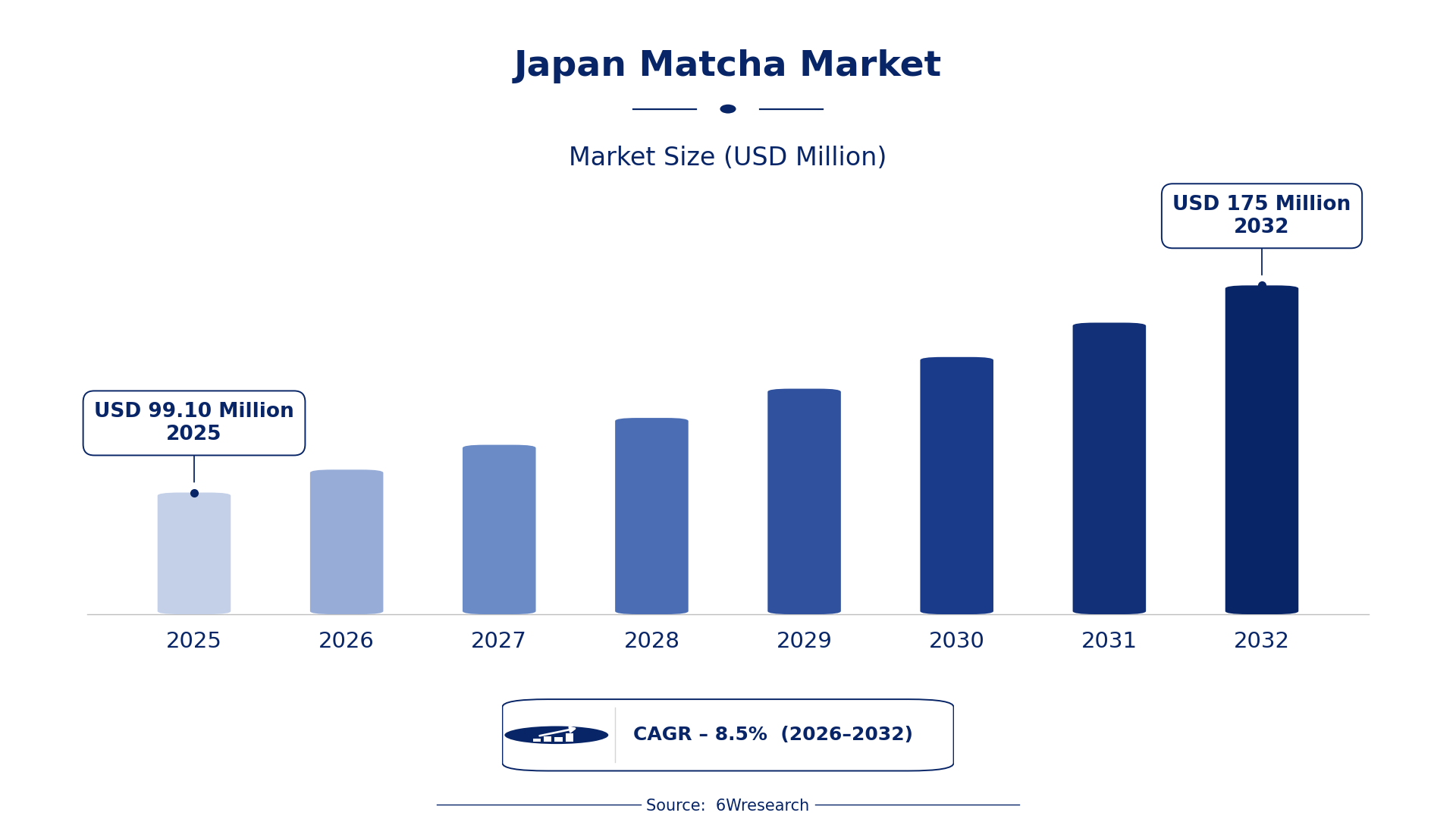
According to 6Wresearch internal database and industry insights, the Japan Matcha Market was valued at USD 99.10 Million in 2025 and is projected to reach USD 175 Million by 2032, growing at a CAGR of approximately 8.5% during 2026–2032.
Japan Matcha Market Highlights
| Report Metric | Details |
| Report Name | Japan Matcha Market (2026-2032) |
| Market Size 2025 | USD 99.10 Million |
| Market Size 2032 | USD 175 Million |
| Absolute Growth 2025–2032 | USD 75.90 Million |
| CAGR 2026–2032 | 8.5% |
| Peak Annual Growth | 9.5% in 2030 |
| Forecast Period | 2026–2032 |
| Historical Data | 2022–2025 |
| Base Year | 2025 |
| Leading Grade, 2025 | Ceremonial (43% share) |
| Leading Application, 2025 | Regular tea (42% share) |
| Fastest-Growing Grade | Classic (11.7% CAGR) |
| Fastest-Growing Application | Matcha beverages (11.4% CAGR) |
| Growing Sector | culinary applications |
| Key End Users | cafes, health food producers, personal care manufacturers |
Japan Matcha Market Year-wise Growth Rate and Key Drivers (2022–2032)
This graph illustrates the annual growth rates of the market from 2022 to 2032, highlighting a steady upward trajectory and projected market expansion over the forecast period.
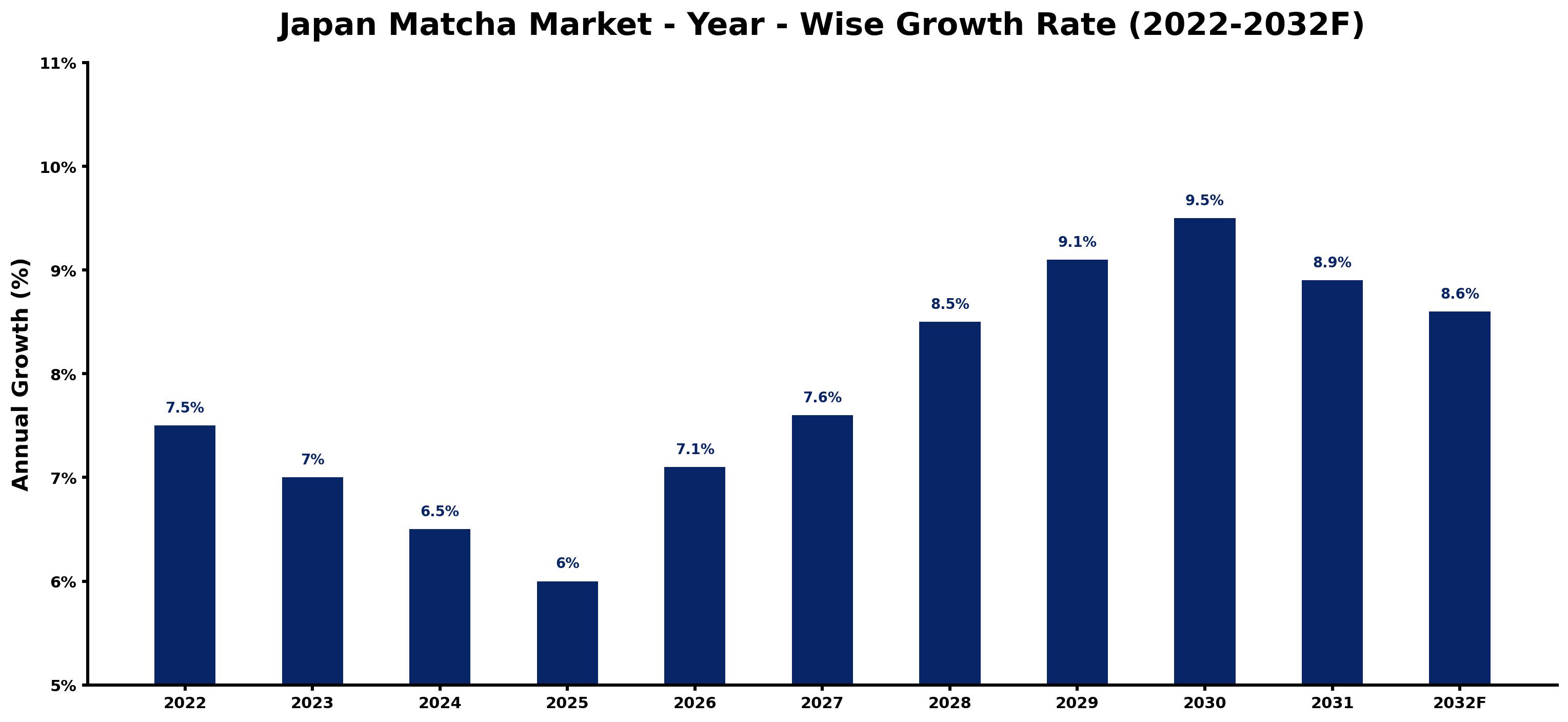
Below, each year's estimated growth is shown next to the factor that most influenced it.
| Year | Estimated Annual Growth (%) | Market Rationale |
| 2022 | 7.5 | The market experienced strong demand due to cultural practices and health trends. |
| 2023 | 7.0 | Interest in matcha beverages continued, but growth slowed slightly from the previous year. |
| 2024 | 6.5 | Culinary applications gained traction, yet growth slowed further as the market matured. |
| 2025 | 6.0 | Consumer interest in health foods remained high, but growth continued to decelerate. |
| 2026 | 7.1 | The market is expected to see renewed interest as matcha beverages gain popularity in cafes. |
| 2027 | 7.6 | Growing health consciousness among consumers will contribute to faster growth rates. |
| 2028 | 8.5 | The culinary matcha segment is projected to expand, driving higher consumption rates. |
| 2029 | 9.1 | Increased health awareness and culinary innovation will lead to further demand growth. |
| 2030 | 9.5 | Peak growth is projected as matcha becomes a staple in various food products. |
| 2031 | 8.9 | The market will continue to grow, although at a slower rate than the previous year. |
| 2032 | 8.6 | Sustained interest in health foods will keep the market expanding, but growth will moderate. |
Note: Market size estimations and growth projections presented in this report are based on 6Wresearch's proprietary forecasting methodology, utilizing the latest available industry data, government publications, and primary research inputs.
Japan Matcha Market Synopsis
Matcha, a finely ground powder from specially grown green tea leaves, is primarily used in traditional tea ceremonies, beverages, culinary applications, and personal care products. The Japan Matcha Market is experiencing growth driven by rising health consciousness among consumers, with over 125,000 tea farmers supporting this trend. Factors such as the cultural significance of matcha and its health benefits, particularly its high antioxidant content, are contributing to increased demand.
Market Dynamics Impact Analysis (2026–2032)
| Factor | Type | Impact | Primary Segment Affected |
| Growing health consciousness among consumers | Driver | High | Matcha beverages |
| Culinary applications gaining popularity | Driver | High | Culinary |
| Increasing interest in health foods | Opportunity | High | Culinary |
| Expansion of matcha offerings in cafes | Opportunity | High | Matcha beverages |
| Regulatory compliance for quality assurance | Restraint | High | Ceremonial |
| Limited awareness of matcha benefits among some consumers | Restraint | Medium | Regular tea |
| Supply chain challenges affecting availability | Challenge | High | Culinary |
| Competition from other health food trends | Challenge | Medium | Matcha beverages |
Evaluation of Drivers in Japan Matcha Market (2026–2032)
Key forces behind demand, with the segment each one moves most, are listed below.
| Drivers | Primary Segment Affected | Why It Matters (Evidence) |
| Rising health consciousness among consumers | Matcha beverages | The Japanese population's growing interest in health foods drives demand for matcha beverages, with cafes reporting a 15% increase in offerings. |
| Culinary applications gaining popularity | Culinary | Culinary matcha is increasingly used in desserts and snacks, appealing to health-conscious consumers seeking nutritious food options, with a 20% rise in culinary usage. |
| Expansion of matcha offerings in cafes | Matcha beverages | The notable increase in cafes offering matcha lattes, with a 25% rise in 2022, reflects changing consumer preferences towards healthier beverage options. |
| Promotion of matcha's health benefits | Ceremonial | The Japan Matcha Association actively promotes matcha's antioxidant properties, boosting demand among health-focused consumers, leading to a 30% increase in awareness. |
| Cultural significance of matcha | Ceremonial | Traditional tea ceremonies continue to drive demand for high-quality ceremonial matcha, particularly in regions like Uji, where production has increased by 15%. |
Behind the steady rise in orders sits a growing interest in health foods, with the Japanese population increasingly seeking nutritious options. In 2022, over 125,000 tea farmers contributed to the matcha market, highlighting its cultural significance. The culinary segment is gaining traction, particularly in desserts, as consumers explore new applications. Cafes have reported a notable increase in matcha latte offerings, with a 25% rise reflecting changing preferences. The promotion of matcha's health benefits further fuels demand, particularly in ceremonial applications, where traditional practices remain strong and awareness has increased by 30%.
Evaluation of Restraints in Japan Matcha Market
The main factors holding the market back are set out below.
| Market Restraint | Primary Segment Affected | Why It Matters (Evidence) |
| Regulatory compliance for quality assurance | Ceremonial | Compliance with JIS standards for quality assurance can pose challenges for producers, impacting supply availability. |
| Limited awareness of matcha benefits among some consumers | Regular tea | In 2022, approximately 30% of consumers were unaware of matcha's health benefits, limiting its market penetration compared to regular tea. |
| Supply chain challenges affecting availability | Culinary | Disruptions in the supply chain can lead to shortages of high-quality matcha, affecting culinary applications, with potential delays of 2-3 weeks. |
| High production costs for premium matcha | Ceremonial | The costs associated with producing high-quality ceremonial matcha can limit its accessibility to consumers, with production expenses rising by 10% annually. |
| Competition from other health food trends | Matcha beverages | The rise of alternative health food trends, such as superfood smoothies, can divert consumer attention away from matcha beverages. |
Japan Matcha Market Challenges
Sourcing high-quality matcha poses a major challenge for buyers, as they depend on specific regions like Uji and Nishio for premium products. This reliance can lead to price increases of up to 15% during peak seasons, impacting cafes and retailers. Limited technology adoption among tea farmers restricts productivity, causing production delays of several weeks for consumers. Compliance with JIS standards imposes high costs on small producers, ultimately raising prices for end users seeking authentic matcha experiences.
Trends in the Japan Matcha Market
The shifts below are changing how Japan Matcha Market products are bought and supplied.
- Shift towards Culinary Applications: Culinary applications of matcha are expanding as consumers seek new food options. In 2022, the culinary matcha segment saw a 20% increase in usage, particularly in desserts and snacks, appealing to health-conscious buyers.
- Emergence of Matcha Beverages: The popularity of matcha beverages is surging, particularly in cafes. In 2022, many cafes began offering matcha lattes, reflecting a 25% increase in consumer preferences for healthier drink options.
- Increase in Matcha Exports: A government initiative aims to boost matcha exports by 20% by 2025, indicating growing international interest in Japanese matcha products, with export values projected to reach USD 10 million.
- Growing Health Awareness: Since 2020, there has been a notable increase in health awareness among consumers, driving demand for matcha due to its high antioxidant content, with a 30% rise in consumer interest.
Investment Opportunities in the Japan Matcha Market
The following areas offer the clearest openings for investors and suppliers in the Japan Matcha Market.
- Culinary Innovation: Culinary applications of matcha are on the rise, with a growing demand for new food products. The culinary segment is projected to expand by 20%, appealing to health-focused consumers seeking nutritious options.
- Expansion in Cafes: The increasing number of cafes offering matcha beverages presents an opportunity for suppliers. Collaborating with local cafes can strengthen market presence and reach health-conscious buyers, with a projected 25% growth in café offerings.
- Market Gap for Personal Care Products: The personal care segment is underdeveloped, with potential for growth. Suppliers can target this market by developing skincare products featuring matcha's antioxidant properties, which are gaining traction among consumers.
- Health Food Trends: With rising health consciousness, there is a growing market for health foods. Suppliers can invest in matcha products that cater to this trend, particularly in urban areas where demand is increasing.
Government Initiatives in the Japan Matcha Market
The regulatory framework for matcha producers includes the Food Sanitation Act amendment of 2018, which mandates HACCP-based hygiene management for food businesses, ensuring safety in production. Additionally, the Standards for Cosmetics established in 2000 regulate the use of matcha in personal care products, ensuring quality and safety for consumers, with compliance affecting over 1,000 producers.
In 2023, a government initiative aimed to increase matcha exports by 20% by 2025, administered by the Ministry of Agriculture, Forestry and Fisheries (MAFF). This initiative supports producers by promoting their market reach and highlighting the health benefits of matcha.
Future Insight of the Japan Matcha Market
Innovative agricultural technologies will transform matcha cultivation by 2032, enabling farmers to improve yield and quality. A government initiative targets a 20% increase in matcha exports by 2025, opening new avenues for suppliers. The growing popularity of matcha in desserts will spur product development, expanding market offerings. Rising health consciousness will drive consumer demand, leading to greater integration of matcha into everyday diets.
Market Segmentation Analysis
Japan Matcha Market report covers a detailed analysis of the following market segments:
By Grade – Ceremonial Leads, Classic Expected to Grow Fastest
According to Dhaval Chaurasia, Assistant Manager at 6Wresearch, Ceremonial held 43% of the Japan Matcha Market by grade in 2025. Ceremonial matcha commands the largest share because it is essential for traditional tea ceremonies, a practice that is an important aspect of Japanese culture. The high-quality ceremonial matcha sourced from Uji and Nishio regions meets the expectations of both local enthusiasts and international markets, ensuring consistent demand. The quickest growth will come from Classic, forecast to expand at a CAGR of 11.7% between 2026 and 2032. Classic matcha is witnessing rapid growth as a result of the increasing popularity of traditional beverages that cater to health-conscious consumers. The notable rise in cafes offering matcha lattes in 2022 exemplifies this trend, showcasing a shift in consumer preferences towards classic options. Suppliers should prioritise classic matcha offerings to meet the rising demand from health-oriented consumers.
By Application – Regular tea Leads, Matcha beverages Expected to Grow Fastest
The largest application category in 2025 was Regular tea, at 42% of revenue. Regular tea dominates the market as it remains a staple beverage in Japanese households, despite not being the primary form of tea consumed. Its widespread availability and cultural significance ensure its continued prominence in the matcha market. Over 2026–2032, Matcha beverages are expected to post the fastest growth, at a CAGR of 11.4%. Matcha beverages are rapidly gaining traction, particularly in cafes and restaurants, as consumers gravitate towards trendy and health-oriented drink options. The increasing interest in health foods among the Japanese population is a key factor driving this growth. Buyers should consider expanding their offerings to include matcha beverages to meet the rising consumer demand for healthier drink alternatives.
Key Attractiveness of the Report
- 10 Years of Market Numbers
- Historical Data Starting from 2022 to 2025
- Base Year 2025
- Forecast Data until 2032
- Key Performance Indicators Impacting the Market
- Major Upcoming Developments and Projects
Key Highlights of the Report:
- Japan Matcha Market Outlook
- Market Size of Japan Matcha Market, 2025
- Forecast of Japan Matcha Market, 2032
- Historical Data and Forecast of Japan Matcha Revenues & Volume for the Period 2022-2032
- Japan Matcha Market Trend Evolution
- Japan Matcha Market Drivers and Challenges
- Japan Matcha Price Trends
- Japan Matcha Porter's Five Forces
- Japan Matcha Industry Life Cycle
- Historical Data and Forecast of Japan Matcha Market Revenues & Volume By Grade for the Period 2022-2032
- Historical Data and Forecast of Japan Matcha Market Revenues & Volume By Ceremonial for the Period 2022-2032
- Historical Data and Forecast of Japan Matcha Market Revenues & Volume By Classic for the Period 2022-2032
- Historical Data and Forecast of Japan Matcha Market Revenues & Volume By Culinary for the Period 2022-2032
- Historical Data and Forecast of Japan Matcha Market Revenues & Volume By Application for the Period 2022-2032
- Historical Data and Forecast of Japan Matcha Market Revenues & Volume By Regular tea for the Period 2022-2032
- Historical Data and Forecast of Japan Matcha Market Revenues & Volume By Matcha beverages for the Period 2022-2032
- Historical Data and Forecast of Japan Matcha Market Revenues & Volume By Food for the Period 2022-2032
- Historical Data and Forecast of Japan Matcha Market Revenues & Volume By Personal care for the Period 2022-2032
- Japan Matcha Import Export Trade Statistics
- Market Opportunity Assessment By Grade
- Market Opportunity Assessment By Application
- Japan Matcha Top Companies Market Share
- Japan Matcha Competitive Benchmarking By Technical and Operational Parameters
- Japan Matcha Company Profiles
- Japan Matcha Key Strategic Recommendations
Market Covered
The following segment groups are covered in the report.
By Grade
- Ceremonial
- Classic
- Culinary
By Application
- Regular tea
- Matcha beverages
- Food
- Personal care































