Japan Mating Disruption Products Market Size & Growth Rate
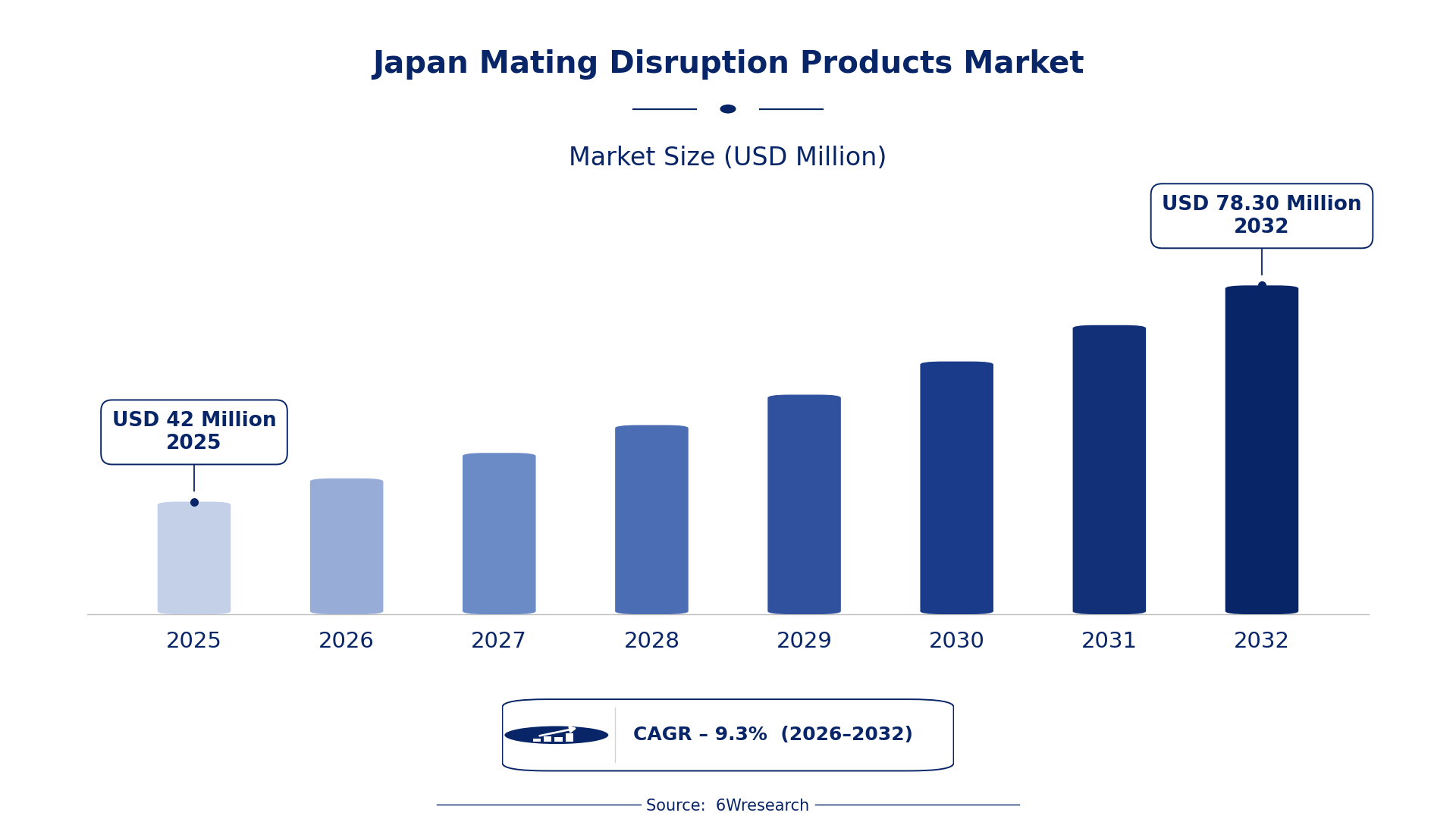
According to 6Wresearch internal database and industry insights, the Japan Mating Disruption Products Market was valued at USD 42 Million in 2025 and is projected to reach USD 78.30 Million by 2032, growing at a CAGR of approximately 9.3% during 2026–2032.
Japan Mating Disruption Products Market Highlights
| Report Metric | Details |
| Report Name | Japan Mating Disruption Products Market (2026-2032) |
| Market Size 2025 | USD 42 Million |
| Market Size 2032 | USD 78.30 Million |
| Absolute Growth 2025–2032 | USD 36.30 Million |
| CAGR 2026–2032 | 9.3% |
| Peak Annual Growth | 11.5% in 2026 |
| Forecast Period | 2026–2032 |
| Historical Data | 2022–2025 |
| Base Year | 2025 |
| Leading Product Type, 2025 | Pheromone Dispensers (47% share) |
| Leading Active Compound, 2025 | Synthetic Pheromones (50% share) |
| Leading Distribution Channel, 2025 | Agricultural Suppliers (46% share) |
| Leading End User, 2025 | Fruit/Vegetable Growers (46% share) |
| Fastest-Growing Product Type | Twist-Tie Dispensers (12.4% CAGR) |
| Fastest-Growing Active Compound | Encapsulated Pheromone (11.7% CAGR) |
| Fastest-Growing Distribution Channel | Online Platforms (11.8% CAGR) |
| Fastest-Growing End User | Vineyard Owners (12.3% CAGR) |
| Growing Sector | Vineyard Owners |
| Key End Users | Fruit/Vegetable Growers, Orchard Managers, Vineyard Owners, Greenhouse Growers |
Japan Mating Disruption Products Market Year-wise Growth Rate and Key Drivers (2022–2032)
This graph illustrates the annual growth rates of the market from 2022 to 2032, highlighting a steady upward trajectory and projected market expansion over the forecast period.
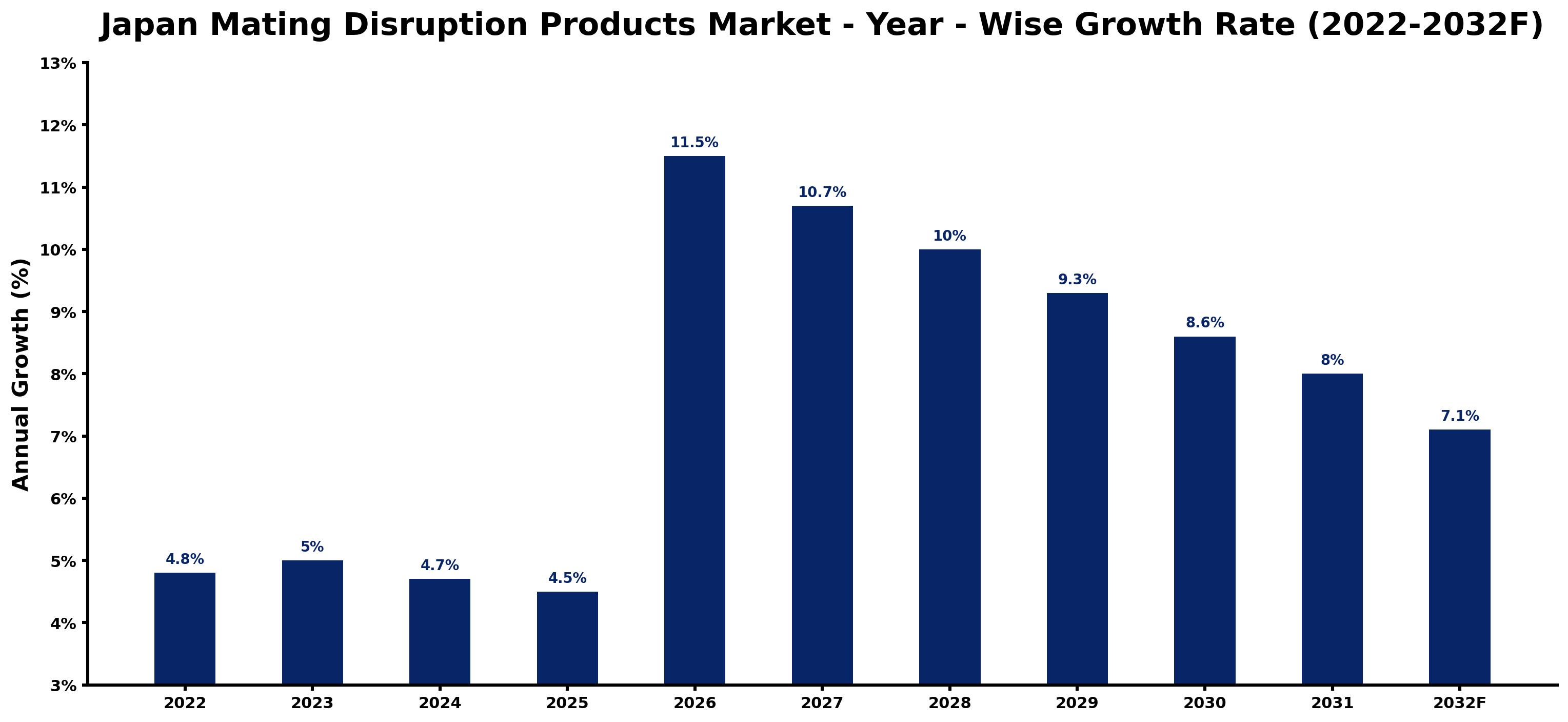
Below, each year's estimated growth is shown next to the factor that most influenced it.
| Year | Estimated Annual Growth (%) | Market Rationale |
| 2022 | 4.8 | The market experienced steady growth due to increasing awareness among growers. |
| 2023 | 5.0 | Demand rose as more farmers adopted pest management techniques. |
| 2024 | 4.7 | Growth slowed as market saturation began in some regions. |
| 2025 | 4.5 | The market continued to grow, albeit at a reduced rate due to competitive pressures. |
| 2026 | 11.5 | Growth peaked as effective pest control methods gained traction. |
| 2027 | 10.7 | The market continued to expand, but at a slower rate as competition intensified. |
| 2028 | 10.0 | Growth moderated as established practices became more common among users. |
| 2029 | 9.3 | The market saw a further slowdown as innovation cycles lengthened. |
| 2030 | 8.6 | Demand remained stable as growers focused on cost-effective solutions. |
| 2031 | 8.0 | Growth continued to slow as market maturity set in. |
| 2032 | 7.1 | The market is projected to grow steadily as new technologies emerge. |
Note: Market size estimations and growth projections presented in this report are based on 6Wresearch's proprietary forecasting methodology, utilizing the latest available industry data, government publications, and primary research inputs.
Japan Mating Disruption Products Market Synopsis
In Japan, the agricultural sector, particularly fruit and vegetable growers, actively employs these products to manage pest populations. The Ministry of Agriculture, Forestry and Fisheries supports this trend, allocating funding for research on sustainable agricultural practices.
Market Dynamics Impact Analysis (2026–2032)
| Factor | Type | Impact | Primary Segment Affected |
| Increasing adoption of integrated pest management strategies | Driver | High | Pheromone Dispensers |
| Growing awareness of environmentally friendly pest control methods | Driver | High | Synthetic Pheromones |
| Rising demand for organic produce | Opportunity | High | Fruit/Vegetable Growers |
| Expansion of online sales channels | Opportunity | Medium | Online Platforms |
| High initial investment costs for new technologies | Restraint | High | Twist-Tie Dispensers |
| Limited awareness among smaller growers | Restraint | Medium | Aerosol Disruption Units |
| Aging workforce in agriculture | Challenge | High | Orchard Managers |
| Competition from traditional pest control methods | Challenge | Medium | Vineyard Owners |
Evaluation of Drivers in Japan Mating Disruption Products Market (2026–2032)
Key forces behind demand, with the segment each one moves most, are listed below.
| Drivers | Primary Segment Affected | Why It Matters (Evidence) |
| Increased funding for sustainable agricultural practices | Pheromone Dispensers | In 2022, the government allocated ¥2 billion for research, encouraging growers to adopt these solutions. |
| Higher yield expectations from organic farming | Synthetic Pheromones | The average yield for organic grape production is 5 tons per hectare, prompting growers to seek effective pest management. |
| Growing consumer demand for chemical-free produce | Fruit/Vegetable Growers | More than 70% of greenhouse growers reported using pest management products, reflecting a shift towards organic practices. |
| Rising number of specialty agro stores | Agricultural Suppliers | The Tokyo Metropolitan area has a high concentration of these stores, facilitating access for farmers. |
| Increased awareness of pest management techniques | Twist-Tie Dispensers | The use of pheromone dispensers has increased by 30% in the last five years, indicating growing acceptance. |
Spending rises because over 50% of apple orchards in Japan now use mating disruption techniques, leading to increased purchases of pheromone dispensers. The average yield for organic grape production is 5 tons per hectare, prompting growers to seek effective pest management solutions. As awareness of pest management techniques increases, the use of pheromone dispensers has surged by 30% in the last five years, driving demand further. The Kanto region is a major area for fruit and vegetable production, boosting the market for these products.
Evaluation of Restraints in Japan Mating Disruption Products Market
Several factors work against faster growth; the main ones are summarised below.
| Market Restraint | Primary Segment Affected | Why It Matters (Evidence) |
| High initial investment costs for adopting new technologies | Twist-Tie Dispensers | Many growers find the upfront costs prohibitive, limiting their ability to invest in effective pest control. |
| Limited awareness among smaller growers about pest management benefits | Aerosol Disruption Units | This lack of knowledge restricts the adoption of advanced pest control methods in smaller operations. |
| Regulatory compliance costs for new products | Synthetic Pheromones | Producers face expenses to meet the regulations, which can deter innovation. |
| Challenges in sourcing high-quality pheromones | Pheromone Dispensers | The number of registered pheromone products in Japan exceeds 100, but quality varies, complicating choices for growers. |
| Market saturation in certain regions | Fruit/Vegetable Growers | As more growers adopt these products, competition increases, potentially leading to price pressures. |
Japan Mating Disruption Products Market Challenges
High costs impact producers, as pheromone dispensers average ¥3,000 per hectare per season, straining budgets for fruit and vegetable growers. Suppliers face fierce competition, with over 100 registered pheromone products leading to price wars that diminish profit margins. A technology gap exists, evidenced by the average age of orchard managers at 55 years, which restricts the adoption of modern pest control methods. Regulatory hurdles arise, as adherence to JIS standards can delay product approvals, affecting timely access to solutions for growers.
Trends in the Japan Mating Disruption Products Market
Below are the shifts with the largest effect on the Japan Mating Disruption Products Market.
- Expansion of Pheromone Dispensers: The use of pheromone dispensers has surged, with over 50% of apple orchards in Japan employing these techniques. This trend reflects a growing preference for environmentally friendly pest control solutions, resulting in increased sales.
- Shift Towards Organic Pest Management: Fruit and vegetable growers are increasingly adopting organic pest management practices, with 70% of greenhouse growers using pest management products. This shift is driven by consumer demand for chemical-free produce, creating market opportunities.
- Growth of Online Sales Channels: Online platforms are becoming a significant distribution channel for mating disruption products, with an expected increase in usage. This shift allows growers to access products conveniently, expanding the market reach.
- Increased Government Support for Sustainable Practices: The Japanese government allocated ¥2 billion in 2022 for research on sustainable agricultural practices. This funding encourages the adoption of effective pest control methods among growers.
Investment Opportunities in the Japan Mating Disruption Products Market
The following areas offer the clearest openings for investors and suppliers in the Japan Mating Disruption Products Market.
- Fruit/Vegetable Growers Seeking Sustainable Solutions: Fruit and vegetable growers in Japan are increasingly looking for sustainable pest control solutions, with over 50% of apple orchards using these methods. Investing in pheromone dispensers can meet this demand.
- Kanto Region's Growing Demand for Pest Control: The Kanto region, a major area for fruit and vegetable production, presents opportunities for suppliers of mating disruption products. Establishing partnerships with local agricultural suppliers can facilitate market entry.
- Supply of Twist-Tie Dispensers: Twist-Tie Dispensers are gaining popularity among growers. Suppliers can focus on this product type to cater to the rising demand in orchards.
- Entry through Joint Ventures with Local Distributors: Collaborating with local distributors can facilitate market entry for new entrants in the mating disruption products market. This strategy can help navigate regulatory requirements and build customer trust.
Government Initiatives in the Japan Mating Disruption Products Market
The Electrical Appliance and Material Safety Act regulates the safety of pest control products, ensuring they meet safety standards. This law complements the Industrial Standardization Act, which governs product and test standards, providing a framework for quality assurance in the mating disruption products market.
In 2022, the government allocated ¥2 billion for research on sustainable agricultural practices, administered by the Ministry of Agriculture, Forestry and Fisheries. This funding supports the development and adoption of effective pest management solutions, benefiting growers across Japan.
Future Insight of the Japan Mating Disruption Products Market
The upcoming agricultural research projects will focus on sustainable practices, with government funding of ¥2 billion allocated to enhance pest management techniques. Improved pest control methods will likely lead to a reduction in pesticide use, benefiting both buyers and suppliers. The integration of ISO 9001 standards will improve production quality, ensuring reliability in pest control solutions. As the annual agricultural trade fair in Tokyo showcases new technologies, suppliers must embrace these advancements to maintain competitiveness.
Market Segmentation Analysis
Japan Mating Disruption Products Market report covers a detailed analysis of the following market segments:
By Product Type – Pheromone Dispensers Lead, Twist-Tie Dispensers Expected to Grow Fastest
According to Saurav Kr Singh, Senior Research Analyst at 6Wresearch, Pheromone Dispensers accounted for 47% of the market by product type in 2025. Pheromone dispensers are extensively used in Japan's orchards and vineyards, where effective pest control is essential for maintaining crop quality. Their prevalence is underscored by the fact that over 50% of apple orchards have adopted these products for pest management. Twist-Tie Dispensers are projected to grow fastest, at a CAGR of 12.4% during 2026–2032. Twist-Tie Dispensers are gaining traction due to their user-friendly application, making them appealing for various crops. This ease of use has contributed to a notable rise in their adoption among growers recently. Suppliers should focus on increasing the availability of Twist-Tie Dispensers to meet the growing demand from farmers.
By Active Compound – Synthetic Pheromones Lead, Encapsulated Pheromone Expected to Grow Fastest
Synthetic Pheromones took 50% of active compound revenue in 2025, more than any other category. Synthetic pheromones serve as the key active ingredient in many mating disruption products, making them indispensable for effective pest control in agriculture. Their established role in pest management strategies solidifies their leading position in the market. The quickest growth will come from Encapsulated Pheromone, forecast to expand at a CAGR of 11.7% between 2026 and 2032. Encapsulated pheromones are rapidly growing in popularity as they offer sustained release, which is crucial for effective long-term pest management. This feature is particularly attractive to growers seeking efficient pest control solutions. Buyers should explore products that incorporate encapsulated pheromones to improve their pest management effectiveness.
By Distribution Channel – Agricultural Suppliers Lead, Online Platforms Expected to Grow Fastest
The largest distribution channel category in 2025 was Agricultural Suppliers, at 46% of revenue. Agricultural suppliers are the primary distribution channel for pest control products, directly addressing the needs of farmers and growers. Their established networks ensure consistent availability of mating disruption products throughout the agricultural sector. Over 2026–2032, Online Platforms are expected to post the fastest growth, at a CAGR of 11.8%. Online platforms are becoming increasingly popular as a distribution channel, providing convenience and accessibility for purchasing pest control solutions, especially among tech-savvy growers. This trend reflects a shift in purchasing preferences within the agricultural market. Suppliers should strengthen their online presence to attract the growing number of buyers who prefer digital purchasing options.
By End User – Fruit/Vegetable Growers Lead, Vineyard Owners Expected to Grow Fastest
With 46% of end user revenue in 2025, Fruit/Vegetable Growers was the largest category. Fruit and vegetable growers represent the largest user group for mating disruption products, driven by the necessity to effectively manage pest populations across extensive cultivation areas. Their significant involvement in agriculture underscores their dominant market position. Vineyard Owners are set to record the highest CAGR in this split, 12.3% over 2026–2032. Vineyard owners are experiencing the fastest growth in the use of mating disruption products, particularly for pest management in grape production. Their specific pest control needs are propelling this segment's rapid expansion. Suppliers should tailor their product offerings to address the unique requirements of vineyard owners for effective pest control.
Key Attractiveness of the Report
- 10 Years of Market Numbers
- Historical Data Starting from 2022 to 2025
- Base Year 2025
- Forecast Data until 2032
- Key Performance Indicators Impacting the Market
- Major Upcoming Developments and Projects
Key Highlights of the Report:
- Japan Mating Disruption Products Market Outlook
- Market Size of Japan Mating Disruption Products Market, 2025
- Forecast of Japan Mating Disruption Products Market, 2032
- Historical Data and Forecast of Japan Mating Disruption Products Revenues & Volume for the Period 2022-2032F
- Japan Mating Disruption Products Market Trend Evolution
- Japan Mating Disruption Products Market Drivers and Challenges
- Japan Mating Disruption Products Price Trends
- Japan Mating Disruption Products Porter's Five Forces
- Japan Mating Disruption Products Industry Life Cycle
- Historical Data and Forecast of Japan Mating Disruption Products Market Revenues & Volume By Product Type for the Period 2022-2032F
- Historical Data and Forecast of Japan Mating Disruption Products Market Revenues & Volume By Pheromone Dispensers for the Period 2022-2032F
- Historical Data and Forecast of Japan Mating Disruption Products Market Revenues & Volume By Aerosol Disruption Units for the Period 2022-2032F
- Historical Data and Forecast of Japan Mating Disruption Products Market Revenues & Volume By Twist-Tie Dispensers for the Period 2022-2032F
- Historical Data and Forecast of Japan Mating Disruption Products Market Revenues & Volume By Microencapsulated Granules for the Period 2022-2032F
- Historical Data and Forecast of Japan Mating Disruption Products Market Revenues & Volume By Active Compound for the Period 2022-2032F
- Historical Data and Forecast of Japan Mating Disruption Products Market Revenues & Volume By Synthetic Pheromones for the Period 2022-2032F
- Historical Data and Forecast of Japan Mating Disruption Products Market Revenues & Volume By Volatile Pheromones for the Period 2022-2032F
- Historical Data and Forecast of Japan Mating Disruption Products Market Revenues & Volume By Encapsulated Pheromone for the Period 2022-2032F
- Historical Data and Forecast of Japan Mating Disruption Products Market Revenues & Volume By Controlled Release for the Period 2022-2032F
- Historical Data and Forecast of Japan Mating Disruption Products Market Revenues & Volume By Distribution Channel for the Period 2022-2032F
- Historical Data and Forecast of Japan Mating Disruption Products Market Revenues & Volume By Agricultural Suppliers for the Period 2022-2032F
- Historical Data and Forecast of Japan Mating Disruption Products Market Revenues & Volume By Online Platforms for the Period 2022-2032F
- Historical Data and Forecast of Japan Mating Disruption Products Market Revenues & Volume By Nursery Distributors for the Period 2022-2032F
- Historical Data and Forecast of Japan Mating Disruption Products Market Revenues & Volume By Specialty Agro Stores for the Period 2022-2032F
- Historical Data and Forecast of Japan Mating Disruption Products Market Revenues & Volume By End User for the Period 2022-2032F
- Historical Data and Forecast of Japan Mating Disruption Products Market Revenues & Volume By Fruit/Vegetable Growers for the Period 2022-2032F
- Historical Data and Forecast of Japan Mating Disruption Products Market Revenues & Volume By Orchard Managers for the Period 2022-2032F
- Historical Data and Forecast of Japan Mating Disruption Products Market Revenues & Volume By Vineyard Owners for the Period 2022-2032F
- Historical Data and Forecast of Japan Mating Disruption Products Market Revenues & Volume By Greenhouse Growers for the Period 2022-2032F
- Japan Mating Disruption Products Import Export Trade Statistics
- Market Opportunity Assessment By Product Type
- Market Opportunity Assessment By Active Compound
- Market Opportunity Assessment By Distribution Channel
- Market Opportunity Assessment By End User
- Japan Mating Disruption Products Top Companies Market Share
- Japan Mating Disruption Products Competitive Benchmarking By Technical and Operational Parameters
- Japan Mating Disruption Products Company Profiles
- Japan Mating Disruption Products Key Strategic Recommendations
Market Covered
The report covers the following segments.
By Product Type
- Pheromone Dispensers
- Aerosol Disruption Units
- Twist-Tie Dispensers
- Microencapsulated Granules
By Active Compound
- Synthetic Pheromones
- Volatile Pheromones
- Encapsulated Pheromone
- Controlled Release
By Distribution Channel
- Agricultural Suppliers
- Online Platforms
- Nursery Distributors
- Specialty Agro Stores
By End User
- Fruit/Vegetable Growers
- Orchard Managers
- Vineyard Owners
- Greenhouse Growers






































