Japan Mechanized Farming Tools Market Size & Growth Rate
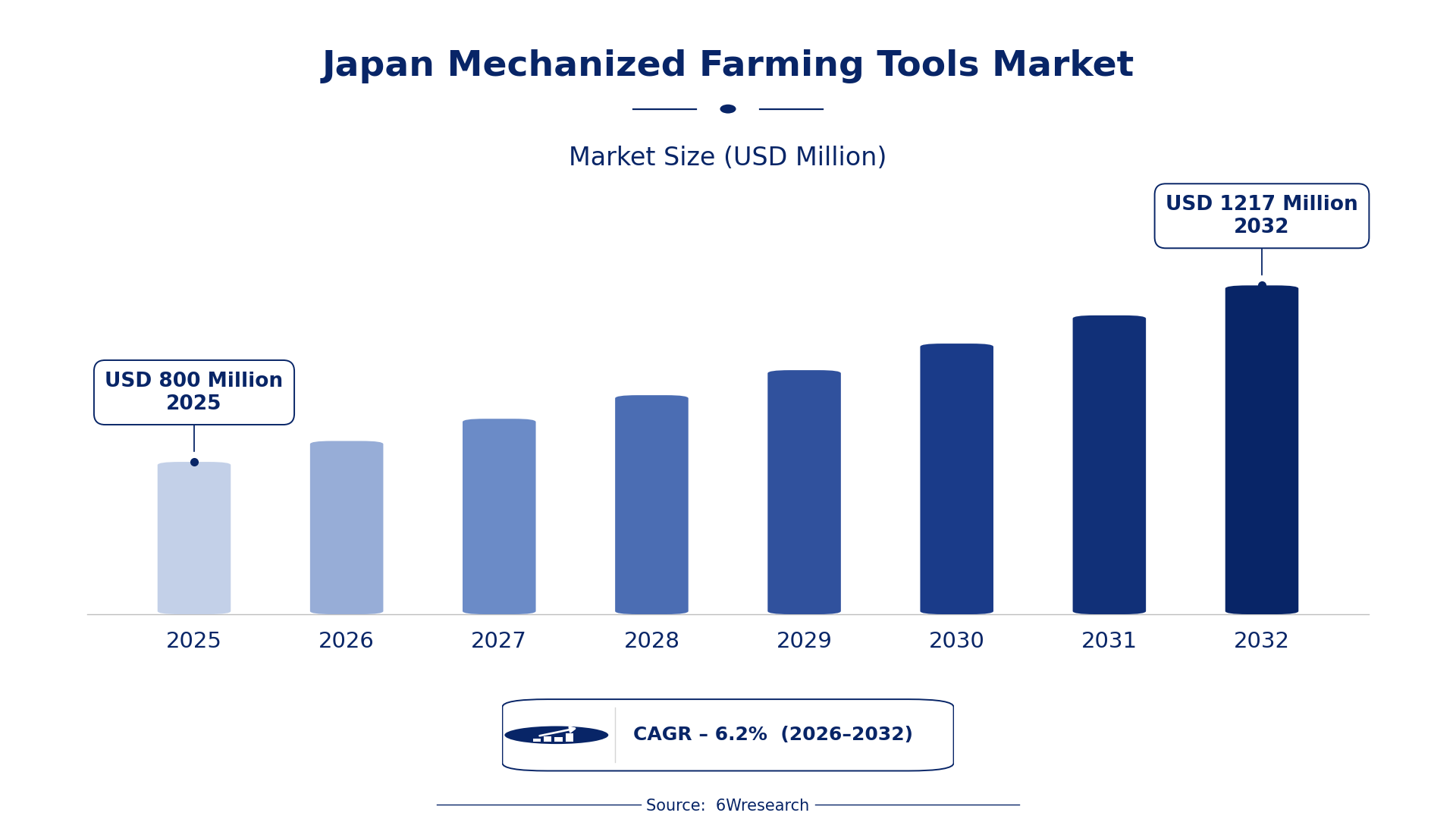
According to 6Wresearch internal database and industry insights, the Japan Mechanized Farming Tools Market was valued at USD 800 Million in 2025 and is projected to reach USD 1,217 Million by 2032, growing at a CAGR of approximately 6.2% during 2026–2032.
Japan Mechanized Farming Tools Market Highlights
| Report Metric | Details |
| Report Name | Japan Mechanized Farming Tools Market (2026-2032) |
| Market Size 2025 | USD 800 Million |
| Market Size 2032 | USD 1,217 Million |
| Absolute Growth 2025–2032 | USD 417 Million |
| CAGR 2026–2032 | 6.2% |
| Peak Annual Growth | 7.0% in 2026 |
| Forecast Period | 2026–2032 |
| Historical Data | 2022–2025 |
| Base Year | 2025 |
| Leading Tool Type, 2025 | Seed Planters (39% share) |
| Leading Power Source, 2025 | Diesel Engine (40% share) |
| Leading Distribution Channel, 2025 | Agricultural Equipment Dealers (38% share) |
| Leading End User, 2025 | Mechanized Farms (46% share) |
| Fastest-Growing Tool Type | Power Weeders (8.6% CAGR) |
| Fastest-Growing Power Source | Electric Motor (8.9% CAGR) |
| Fastest-Growing Distribution Channel | Online Platforms (8.1% CAGR) |
| Fastest-Growing End User | Horticulture Farms (7.9% CAGR) |
| Growing Sector | Mechanized Farms |
| Key End Users | Small Farms, Mechanized Farms, Crop Producers, Horticulture Farms |
Japan Mechanized Farming Tools Market Year-wise Growth Rate and Key Drivers (2022–2032)
This graph illustrates the annual growth rates of the market from 2022 to 2032, highlighting a steady upward trajectory and projected market expansion over the forecast period.
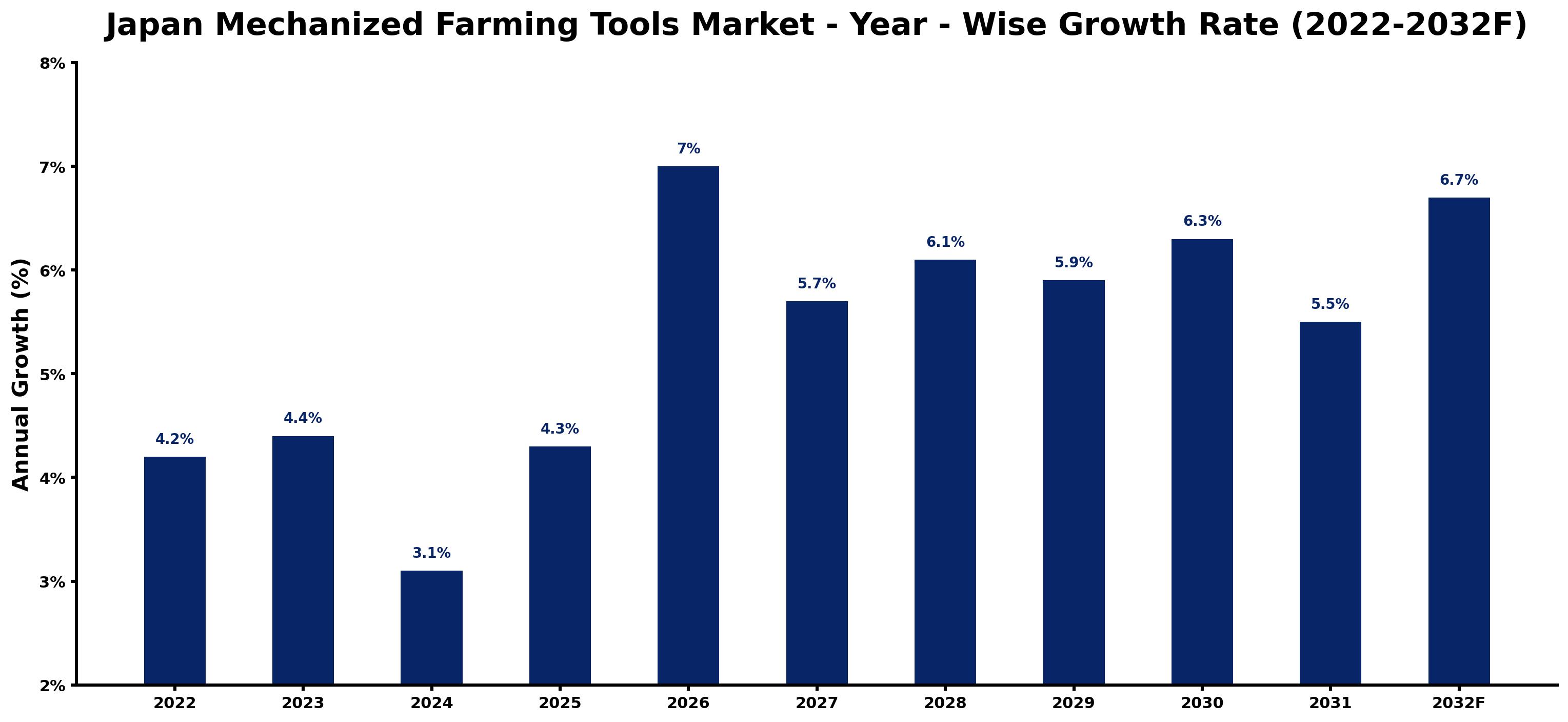
For each year, the table pairs the estimated growth rate with the leading influence on demand, showing how the drivers changed across the period.
| Year | Estimated Annual Growth (%) | Market Rationale |
| 2022 | 4.2 | The market experienced steady growth, reflecting ongoing demand for mechanized tools among farmers. |
| 2023 | 4.4 | Growth accelerated due to increased adoption of mechanization in various regions, particularly in Tohoku. |
| 2024 | 3.1 | A slowdown occurred as market conditions adjusted to previous growth rates and changing buyer preferences. |
| 2025 | 4.3 | Demand surged again as farmers sought efficiency through advanced mechanization tools amid rising costs. |
| 2026 | 7.0 | The market is expected to peak with investments in mechanization, driven by government support and innovation. |
| 2027 | 5.7 | Growth is projected to slow as market saturation begins to affect new tool purchases among existing users. |
| 2028 | 6.1 | Demand is expected to rebound slightly as new technologies emerge, attracting interest from mechanized farms. |
| 2029 | 5.9 | A slight slowdown is anticipated as buyers become more selective in their tool investments. |
| 2030 | 6.3 | Growth is projected to pick up again due to rising interest in sustainable farming practices and electric tools. |
| 2031 | 5.5 | The market is expected to experience a slowdown as competition increases and buyers become more cost-conscious. |
| 2032 | 6.7 | Growth is projected to accelerate again as the government pushes for increased automation in agriculture. |
Note: Market size estimations and growth projections presented in this report are based on 6Wresearch's proprietary forecasting methodology, utilizing the latest available industry data, government publications, and primary research inputs.
Japan Mechanized Farming Tools Market Synopsis
Mechanized farming tools are agricultural implements powered by various engines, designed for efficiency in farming operations. They are essential for soil preparation, planting, and crop maintenance. The Japan Mechanized Farming Tools Market is expanding due to rising demand from mechanized and small farms, driven by government subsidies and initiatives aimed at increasing mechanization adoption. In 2023, the Ministry of Agriculture reported a 10% increase in mechanization adoption, reflecting a strong push towards modern agricultural practices.
Market Dynamics Impact Analysis (2026–2032)
| Factor | Type | Impact | Primary Segment Affected |
| Increased mechanization adoption driven by government subsidies | Driver | High | Mechanized Farms |
| Growing interest in electric-powered tools for sustainability | Driver | Medium | Electric Motor |
| Expansion of online sales channels for agricultural tools | Opportunity | High | Online Platforms |
| Investment in training programs for farmers on mechanization | Opportunity | Medium | Small Farms |
| High average age of farmers affecting adoption rates | Restraint | High | Small Farms |
| Limited access to financing for small farm mechanization | Restraint | Medium | Mechanized Farms |
| Rising costs of advanced machinery impacting purchases | Challenge | High | Power Weeders |
| Compliance with safety standards increasing operational costs | Challenge | Medium | Trench Diggers |
Evaluation of Drivers in Japan Mechanized Farming Tools Market (2026–2032)
Demand rests on the following drivers, each shown with the segment it touches most.
| Drivers | Primary Segment Affected | Why It Matters (Evidence) |
| Government subsidies for small farm mechanization | Small Farms | In 2023, the government launched a subsidy program, encouraging small farms to adopt mechanized tools. |
| Growing interest in efficient farming practices | Mechanized Farms | With over 4.5 million hectares of arable land, farmers are investing in mechanization to boost productivity. |
| Technological advancements in electric-powered tools | Electric Motor | Electric tools are gaining traction due to sustainability initiatives, appealing to environmentally conscious farmers. |
| Increased agricultural production in the Kanto region | Crop Producers | The Kanto region accounts for 30% of agricultural production, driving demand for efficient farming tools. |
| Growing collective purchasing through farming cooperatives | Farming Co-ops | Farming cooperatives facilitate tool acquisition, improving access for small farmers. |
Orders keep climbing as demand for mechanized tools rises among farmers across Japan. The average farm size in Japan is approximately 1.5 hectares, prompting investments in efficient farming practices. The shift towards electric-powered tools aligns with sustainability trends, with increased interest in eco-friendly solutions. These factors contribute to a vibrant market for mechanized farming tools, enabling farmers to improve their operational efficiency.
Evaluation of Restraints in Japan Mechanized Farming Tools Market
These restraints slow adoption and weigh on supplier margins.
| Market Restraint | Primary Segment Affected | Why It Matters (Evidence) |
| High average age of farmers affecting adoption rates | Small Farms | With an average farmer age over 67 years, many are reluctant to invest in new technologies. |
| Limited access to financing for small farm mechanization | Mechanized Farms | Many small farms struggle to secure funding for new equipment, limiting their mechanization efforts. |
| Compliance with safety standards increasing operational costs | Trench Diggers | The JIS B 9960 standard requires rigorous safety testing, raising costs for producers and buyers. |
| Rising costs of advanced machinery impacting purchases | Power Weeders | As machinery prices rise, farmers are cautious about investing in new equipment. |
| Market saturation affecting new tool purchases | Rotary Tillers | As mechanization penetration reaches 60%, existing users may delay new purchases. |
Japan Mechanized Farming Tools Market Challenges
Delays in acquiring mechanized farming tools plague buyers in Japan, as supply chain disruptions can extend lead times by up to three months. Local suppliers face intense competition from imported tools, forcing them to cut profit margins by 15%. A shortage of skilled workers arises due to the average age of farmers exceeding 67 years, resulting in inadequate training for advanced machinery, which hampers productivity for 1.2 million small farms. Many producers grapple with outdated technology, causing inefficiencies that can reduce crop yields by 20%.
Trends in the Japan Mechanized Farming Tools Market
These developments are changing demand patterns in the Japan Mechanized Farming Tools Market.
- Shift towards Electric-Powered Tools: In 2023, electric-powered tools gained popularity among farmers, reflecting a shift towards sustainability. The government’s push for eco-friendly practices has led to a 10% increase in adoption rates.
- Transition from Traditional to Mechanized Farming: The number of mechanized farms in Japan is estimated at 200,000, showing a clear transition from traditional practices. This shift is driven by the need for increased efficiency in crop production.
- Emergence of Online Sales Channels: Online platforms for agricultural tools are becoming increasingly popular, with growth rates of 8.1% projected. This trend allows farmers greater access to equipment, particularly in remote areas.
- Increased Training for Farmers on Mechanization: The Ministry of Agriculture introduced a new training program in 2023, focusing on mechanization techniques. This initiative aims to improve farmers' skills, promoting better adoption of advanced tools.
Investment Opportunities in the Japan Mechanized Farming Tools Market
Investors looking at the Japan Mechanized Farming Tools Market should consider the following areas.
- Investment in Mechanization Training Programs: With the government allocating 5 billion JPY for agricultural innovation, there is a strong opportunity to invest in training programs for farmers. This will improve mechanization adoption, particularly in small farms.
- Expansion of Online Platforms for Tool Sales: Online platforms are rapidly growing, with an expected growth rate of 8.1%. Investing in e-commerce solutions for agricultural tools can tap into the increasing demand from tech-savvy farmers.
- Development of Electric-Powered Tools: The rising interest in sustainability creates an opportunity for electric-powered tools. Investing in this segment can cater to environmentally conscious farmers looking for efficient solutions.
- Support for Farming Cooperatives: Farming cooperatives facilitate collective purchasing, presenting an opportunity for suppliers to partner with these groups. This approach can improve access to mechanized tools for small farmers.
Government Initiatives in the Japan Mechanized Farming Tools Market
The Electrical Appliance and Material Safety Act (1961) regulates the safety of electrical appliances, ensuring that mechanized farming tools meet safety standards. The Act mandates rigorous testing and certification processes for producers, impacting their operational costs and compliance efforts. The Industrial Safety and Health Act (1972) further sets employer duties regarding hazardous substances and machinery, influencing the safety protocols in agricultural operations.
The Japan Agricultural Cooperatives (JA) utilize government funding to support local farmers in acquiring mechanized tools. In 2023, the Ministry of Agriculture introduced a training program aimed at improving mechanization skills among farmers. This initiative is important for increasing the adoption of advanced farming equipment, ultimately boosting productivity in the sector.
Future Insight of the Japan Mechanized Farming Tools Market
Farmers will increasingly embrace electric-powered tools, driven by sustainability initiatives and government subsidies that support operational improvements. By 2032, mechanization adoption is expected to rise by 20%, providing buyers with enhanced productivity. New training programs will equip farmers with vital skills for advanced machinery usage. With 5 billion JPY designated for agricultural innovation, suppliers will discover opportunities to create technologies that cater specifically to the needs of the Japanese agricultural sector.
Market Segmentation Analysis
Japan Mechanized Farming Tools Market report covers a detailed analysis of the following market segments:
By Tool Type – Seed Planters Lead, Power Weeders Expected to Grow Fastest
According to Saurav Kr Singh, Senior Research Analyst at 6Wresearch, the largest tool type category in 2025 was Seed Planters, at 39% of revenue. Seed planters dominate the market due to their essential role in efficient planting practices across Japan's extensive arable land. Their importance is particularly evident in regions like Tohoku, where high mechanization adoption supports enhanced agricultural productivity. Over 2026–2032, Power Weeders are expected to post the fastest growth, at a CAGR of 8.6%. Power weeders are experiencing rapid growth as farmers seek effective solutions for weed management in diverse crops. The recent government subsidy programme aimed at small farm mechanization has significantly accelerated their uptake among farmers. Suppliers should focus on developing power weeders to meet the rising demand in the market.
By Power Source – Diesel Engine Leads, Electric Motor Expected to Grow Fastest
Diesel Engine accounted for 40% of the market by power source in 2025. The diesel engine maintains its leading position as it powers larger machinery, making it ideal for heavy-duty agricultural operations. Its effectiveness in regions like Kanto, known for high agricultural output, reinforces its market dominance. Electric Motor is projected to grow fastest, at a CAGR of 8.9% during 2026–2032. Electric motors are witnessing swift growth, largely due to sustainability initiatives that encourage greener farming methods. The increasing farmer interest in electric-powered tools aligns with the government's push for environmentally friendly practices. Buyers may increasingly opt for electric-powered tools, prompting suppliers to invest in this technology.
By Distribution Channel – Agricultural Equipment Dealers Lead, Online Platforms Expected to Grow Fastest
In 2025, Agricultural Equipment Dealers led the distribution channel split with a 38% share. Agricultural equipment dealers serve as the primary sales channel, offering farmers essential access to a variety of mechanized tools. Their established networks and expertise provide reliable support for farmers across Japan. The quickest growth will come from Online Platforms, forecast to expand at a CAGR of 8.1% between 2026 and 2032. Online platforms are rapidly gaining traction as a distribution channel, driven by the convenience they offer to farmers. The ongoing digital transformation in agriculture makes online purchasing particularly appealing to a younger demographic of farmers. Suppliers should strengthen their online strategies to effectively engage with the growing number of buyers who prefer digital purchasing options.
By End User – Mechanized Farms Lead, Horticulture Farms Expected to Grow Fastest
With 46% of end user revenue in 2025, Mechanized Farms was the largest category. Mechanized farms represent the largest user group, relying heavily on advanced equipment to maximise productivity across their operations. The concentration of mechanized farms in regions with high agricultural output, such as Kanto, solidifies their leading role in the market. Horticulture Farms are set to record the highest CAGR in this split, 7.9% over 2026–2032. Horticulture farms are the fastest-growing segment, driven by the need for specialised tools to optimise production of high-value crops. The increasing focus on horticultural productivity aligns with government initiatives to boost agricultural innovation. Suppliers should tailor their offerings to meet the specific needs of horticulture farms, which are expanding rapidly.
Key Attractiveness of the Report
- 10 Years of Market Numbers
- Historical Data Starting from 2022 to 2025
- Base Year 2025
- Forecast Data until 2032
- Key Performance Indicators Impacting the Market
- Major Upcoming Developments and Projects
Key Highlights of the Report:
- Japan Mechanized Farming Tools Market Outlook
- Market Size of Japan Mechanized Farming Tools Market, 2025
- Forecast of Japan Mechanized Farming Tools Market, 2032
- Historical Data and Forecast of Japan Mechanized Farming Tools Revenues & Volume for the Period 2022-2032F
- Japan Mechanized Farming Tools Market Trend Evolution
- Japan Mechanized Farming Tools Market Drivers and Challenges
- Japan Mechanized Farming Tools Price Trends
- Japan Mechanized Farming Tools Porter's Five Forces
- Japan Mechanized Farming Tools Industry Life Cycle
- Historical Data and Forecast of Japan Mechanized Farming Tools Market Revenues & Volume By Tool Type for the Period 2022-2032F
- Historical Data and Forecast of Japan Mechanized Farming Tools Market Revenues & Volume By Trench Diggers for the Period 2022-2032F
- Historical Data and Forecast of Japan Mechanized Farming Tools Market Revenues & Volume By Rotary Tillers for the Period 2022-2032F
- Historical Data and Forecast of Japan Mechanized Farming Tools Market Revenues & Volume By Power Weeders for the Period 2022-2032F
- Historical Data and Forecast of Japan Mechanized Farming Tools Market Revenues & Volume By Seed Planters for the Period 2022-2032F
- Historical Data and Forecast of Japan Mechanized Farming Tools Market Revenues & Volume By Power Source for the Period 2022-2032F
- Historical Data and Forecast of Japan Mechanized Farming Tools Market Revenues & Volume By Petrol Engine for the Period 2022-2032F
- Historical Data and Forecast of Japan Mechanized Farming Tools Market Revenues & Volume By Diesel Engine for the Period 2022-2032F
- Historical Data and Forecast of Japan Mechanized Farming Tools Market Revenues & Volume By Electric Motor for the Period 2022-2032F
- Historical Data and Forecast of Japan Mechanized Farming Tools Market Revenues & Volume By PTO-Driven for the Period 2022-2032F
- Historical Data and Forecast of Japan Mechanized Farming Tools Market Revenues & Volume By Distribution Channel for the Period 2022-2032F
- Historical Data and Forecast of Japan Mechanized Farming Tools Market Revenues & Volume By Agricultural Equipment Dealers for the Period 2022-2032F
- Historical Data and Forecast of Japan Mechanized Farming Tools Market Revenues & Volume By Direct Manufacturer Sales for the Period 2022-2032F
- Historical Data and Forecast of Japan Mechanized Farming Tools Market Revenues & Volume By Online Platforms for the Period 2022-2032F
- Historical Data and Forecast of Japan Mechanized Farming Tools Market Revenues & Volume By Farming Co-ops for the Period 2022-2032F
- Historical Data and Forecast of Japan Mechanized Farming Tools Market Revenues & Volume By End User for the Period 2022-2032F
- Historical Data and Forecast of Japan Mechanized Farming Tools Market Revenues & Volume By Small Farms for the Period 2022-2032F
- Historical Data and Forecast of Japan Mechanized Farming Tools Market Revenues & Volume By Mechanized Farms for the Period 2022-2032F
- Historical Data and Forecast of Japan Mechanized Farming Tools Market Revenues & Volume By Horticulture Farms for the Period 2022-2032F
- Historical Data and Forecast of Japan Mechanized Farming Tools Market Revenues & Volume By Crop Producers for the Period 2022-2032F
- Japan Mechanized Farming Tools Import Export Trade Statistics
- Market Opportunity Assessment By Tool Type
- Market Opportunity Assessment By Power Source
- Market Opportunity Assessment By Distribution Channel
- Market Opportunity Assessment By End User
- Japan Mechanized Farming Tools Top Companies Market Share
- Japan Mechanized Farming Tools Competitive Benchmarking By Technical and Operational Parameters
- Japan Mechanized Farming Tools Company Profiles
- Japan Mechanized Farming Tools Key Strategic Recommendations
Market Covered
This report examines the market across the segments below.
By Tool Type
- Trench Diggers
- Rotary Tillers
- Power Weeders
- Seed Planters
By Power Source
- Petrol Engine
- Diesel Engine
- Electric Motor
- PTO-Driven
By Distribution Channel
- Agricultural Equipment Dealers
- Direct Manufacturer Sales
- Online Platforms
- Farming Co-ops
By End User
- Small Farms
- Mechanized Farms
- Horticulture Farms
- Crop Producers






































