Japan Metal Processing Market Size & Growth Rate
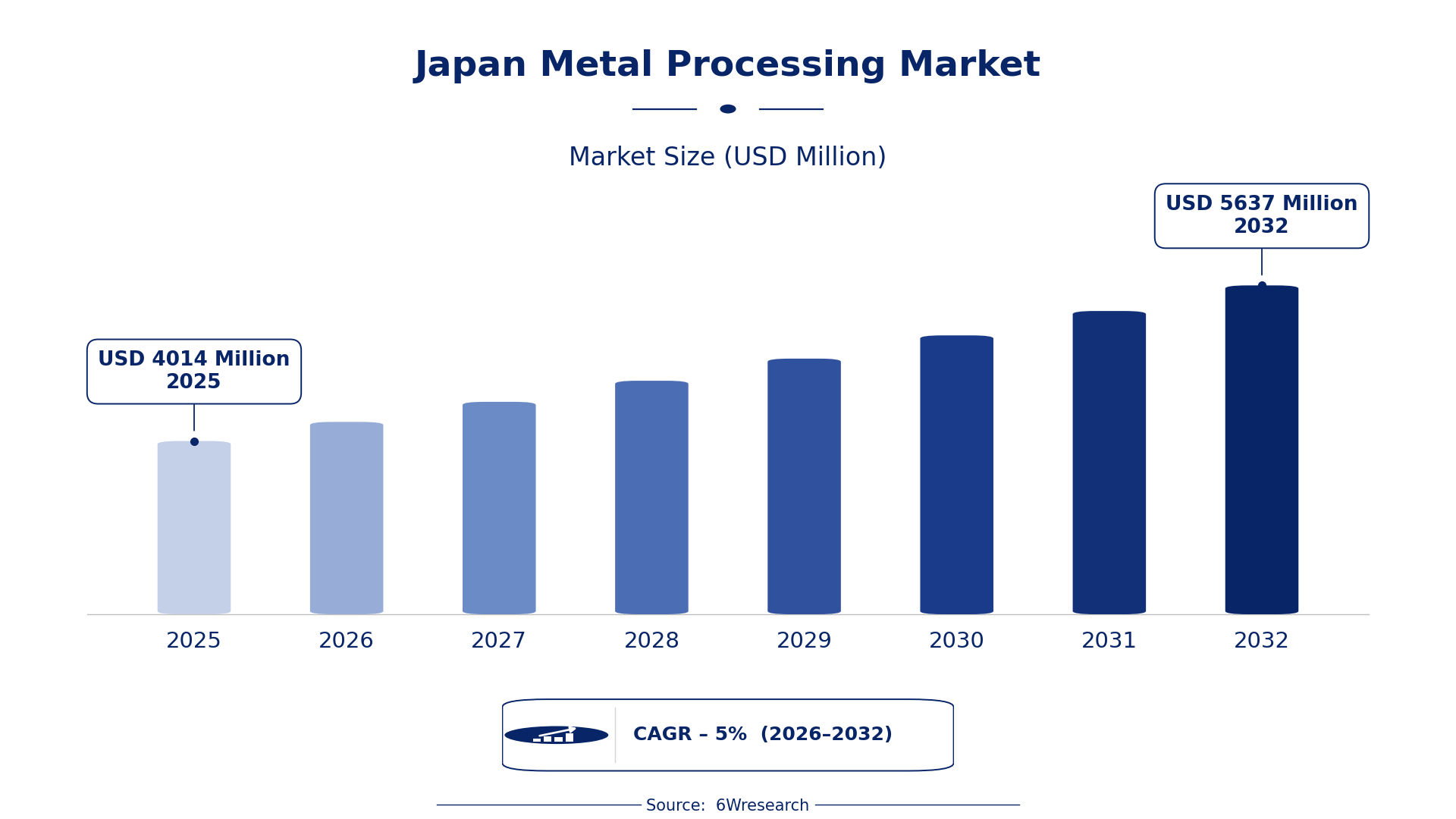
According to 6Wresearch internal database and industry insights, the Japan Metal Processing Market was valued at USD 4,014 Million in 2025 and is projected to reach USD 5,637 Million by 2032, growing at a CAGR of approximately 5% during 2026–2032.
Japan Metal Processing Market Highlights
| Report Metric | Details |
| Report Name | Japan Metal Processing Market (2026-2032) |
| Market Size 2025 | USD 4,014 Million |
| Market Size 2032 | USD 5,637 Million |
| Absolute Growth 2025–2032 | USD 1,623 Million |
| CAGR 2026–2032 | 5% |
| Peak Annual Growth | 5.7% in 2029 |
| Forecast Period | 2026–2032 |
| Historical Data | 2022–2025 |
| Base Year | 2025 |
| Leading Process Type, 2025 | Machining (54% share) |
| Leading Material Input, 2025 | Steel/Alloy (43% share) |
| Leading Application Area, 2025 | Precision Parts (42% share) |
| Leading Distribution Channel, 2025 | Direct Sales (47% share) |
| Leading End User, 2025 | Automotive & Marine Firms (37% share) |
| Fastest-Growing Process Type | Heat Treatment (6.9% CAGR) |
| Fastest-Growing Material Input | Metal Blanks (7.1% CAGR) |
| Fastest-Growing Application Area | Performance Enhancement (6.1% CAGR) |
| Fastest-Growing Distribution Channel | Specialty Distributors (6.5% CAGR) |
| Fastest-Growing End User | Construction & Infrastructure (6.6% CAGR) |
| Growing Sector | Automotive and Marine |
| Key End Users | Automotive Firms, Aerospace Component Makers, Construction Firms, Tool Manufacturers |
Japan Metal Processing Market Year-wise Growth Rate and Key Drivers (2022–2032)
This graph illustrates the annual growth rates of the market from 2022 to 2032, highlighting a steady upward trajectory and projected market expansion over the forecast period.
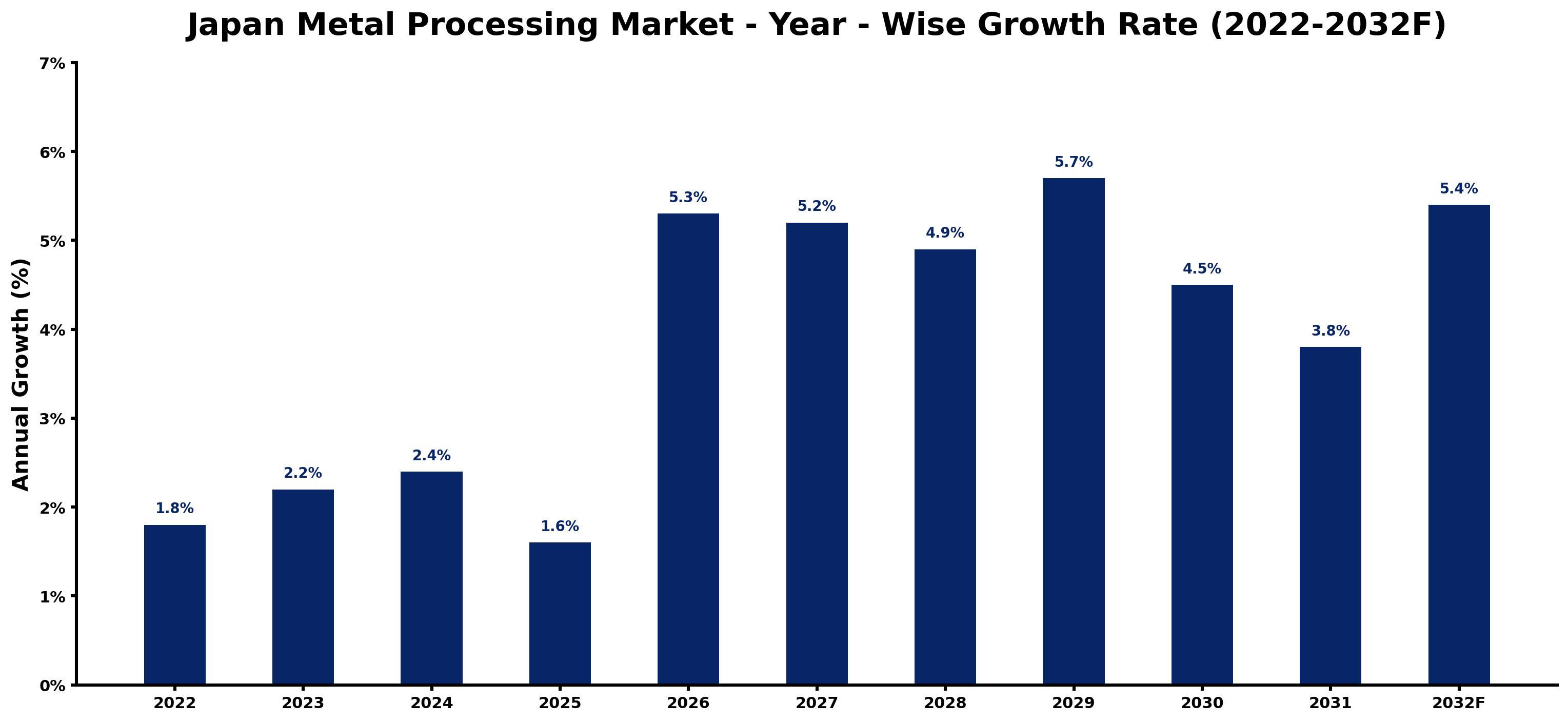
The following figures match every annual growth estimate with the main market development of that year, giving the reasoning behind each rise or slowdown.
| Year | Estimated Annual Growth (%) | Market Rationale |
| 2022 | 1.8 | The market maintained steady growth, driven by strong demand from the automotive sector. |
| 2023 | 2.2 | Growth accelerated as manufacturers increased production to meet rising consumer needs. |
| 2024 | 2.4 | Demand continued to rise, supported by advancements in metal processing technologies. |
| 2025 | 1.6 | Growth slowed slightly due to market saturation in certain segments, yet demand remained strong. |
| 2026 | 5.3 | A surge in demand is expected as investment in advanced manufacturing techniques increases. |
| 2027 | 5.2 | Growth is projected to decelerate marginally as the market adjusts to new production capacities. |
| 2028 | 4.9 | Demand is anticipated to soften further, reflecting a normalisation after the previous year's surge. |
| 2029 | 5.7 | A peak in growth is expected as the aerospace sector ramps up production. |
| 2030 | 4.5 | Growth is projected to slow as the market stabilises after reaching a peak in the previous year. |
| 2031 | 3.8 | A further slowdown is expected as the market matures and competition intensifies. |
| 2032 | 5.4 | Growth is anticipated to rebound as new investments in construction projects revitalise demand. |
Note: Market size estimations and growth projections presented in this report are based on 6Wresearch's proprietary forecasting methodology, utilizing the latest available industry data, government publications, and primary research inputs.
Japan Metal Processing Market Synopsis
Metal processing involves various techniques to shape and treat metals, enhancing their properties for applications in sectors such as automotive, aerospace, and construction. The Japan Metal Processing Market is growing, driven by the automotive industry's production of 9.7 million vehicles in 2022 and the aerospace sector's rising demand for precision components.
Market Dynamics Impact Analysis (2026–2032)
| Factor | Type | Impact | Primary Segment Affected |
| Increased automotive production | Driver | High | Machining |
| Growing demand for precision components | Driver | High | Precision Parts |
| Rising investments in advanced manufacturing | Opportunity | High | Heat Treatment |
| Expansion of aerospace manufacturing | Opportunity | High | Precision Parts |
| Fluctuating raw material prices | Restraint | High | Steel/Alloy |
| Regulatory compliance costs | Restraint | Medium | Surface Coating |
| Supply chain disruptions | Challenge | High | Metal Forming |
| Technological adaptation costs | Challenge | Medium | Machining |
Evaluation of Drivers in Japan Metal Processing Market (2026–2032)
Key forces behind demand, with the segment each one moves most, are listed below.
| Drivers | Primary Segment Affected | Why It Matters (Evidence) |
| Increased vehicle production | Machining | The automotive sector produced 9.7 million vehicles in 2022, driving demand for precision components. |
| Demand for high-quality parts | Precision Parts | The aerospace industry is projected to grow, increasing the need for high-precision metal parts by 20% by 2025. |
| Investment in advanced manufacturing techniques | Heat Treatment | In 2023, a programme was launched to promote advanced manufacturing, with an investment target of JPY 150 trillion. |
| Infrastructure development projects | Metal Forming | The Tokyo Metropolitan Government has invested in infrastructure projects requiring high-quality metal fabrication. |
| Adoption of ISO 9001 certification | Surface Coating | ISO 9001 certification is widely adopted, ensuring quality in metal processing operations. |
Several shifts outside the market lift sales. The automotive sector's production of 9.7 million vehicles in 2022 created strong demand for machining services, prompting manufacturers to enhance their production capabilities. The aerospace industry is set to grow, increasing the need for precision parts by 20% by 2025.
Evaluation of Restraints in Japan Metal Processing Market
These are the pressures that could keep growth below its potential.
| Market Restraint | Primary Segment Affected | Why It Matters (Evidence) |
| Fluctuating prices of raw materials | Steel/Alloy | Steel and alloy materials account for 60% of usage, making price volatility a concern. |
| Compliance with environmental regulations | Surface Coating | The PRTR Law requires businesses to report chemical releases, increasing operational costs for manufacturers. |
| Supply chain vulnerabilities | Metal Forming | Disruptions in supply chains can delay production schedules and increase costs for manufacturers. |
| Technological adaptation costs | Machining | Investing in new technologies can strain budgets, particularly for smaller manufacturers. |
| Market saturation in certain segments | Precision Parts | As competition increases, price pressures may limit profitability for producers. |
Japan Metal Processing Market Challenges
In the automotive sector, a skills shortage in advanced metal processing techniques limits production efficiency, as educational institutions have not aligned with industry needs. Suppliers face challenges with outdated machinery, causing production delays of up to 20%, which affects their ability to meet delivery schedules for manufacturers. Construction buyers encounter inflated project costs due to the scarcity of high-quality processed metals, potentially increasing budgets by 15%. Rising input costs for steel and alloy materials, which account for 60% of usage, further tighten supplier profit margins, resulting in less competitive pricing for manufacturers.
Trends in the Japan Metal Processing Market
Below are the shifts with the largest effect on the Japan Metal Processing Market.
- Launch of Advanced Manufacturing Programme: In 2023, a programme was initiated to promote advanced manufacturing techniques, aiming to improve productivity across sectors. This initiative is expected to increase investment in technology by JPY 150 trillion over ten years.
- Shift towards Sustainable Practices: The industry is increasingly adopting sustainable practices, guided by Japan's Green Growth Strategy. This strategy aims for a 46% reduction in greenhouse gas emissions by 2030, prompting investments in eco-friendly processing technologies.
- Increase in Aerospace Component Production: The Tokyo region is becoming a hub for aerospace component manufacturing, with demand for precision parts expected to rise significantly. This growth is projected to boost the sector's output by 20% by 2025.
- Expansion of Online Sourcing Channels: There is a growing trend towards online platforms for sourcing metal processing services, reflecting a shift in buyer behaviour. This channel is expected to account for 15% of total sales by 2025.
Investment Opportunities in the Japan Metal Processing Market
Investors looking at the Japan Metal Processing Market should consider the following areas.
- Automotive & Marine Firms Seeking Precision Parts: Automotive and marine firms require high-quality precision parts, creating an opportunity for suppliers. With the automotive sector producing 9.7 million vehicles in 2022, investment in precision machining is essential.
- Construction Sector's Demand for Metal Fabrication: The construction sector is experiencing a surge in projects, necessitating high-quality metal fabrication. The Tokyo Metropolitan Government's investment in infrastructure projects is driving this demand, offering opportunities for local suppliers.
- Investment in Heat Treatment Technologies: Heat treatment processes are gaining traction, especially with a projected growth rate of 6.9%. Suppliers can capitalise on this trend by partnering with manufacturers to improve their capabilities.
- Specialty Distributors for Niche Markets: Specialty distributors are emerging to cater to niche markets within metal processing. With a projected growth rate of 6.5%, entering this segment through local partnerships can yield returns.
Government Initiatives in the Japan Metal Processing Market
The Economic Security Promotion Act, enacted in 2022, bolsters supply-chain resilience for critical products, enhancing the stability of the metal processing sector. This act complements existing regulations, ensuring that producers can maintain consistent quality and supply, while also supporting investments in advanced manufacturing techniques.
The Ministry of Economy, Trade and Industry oversees the approval of projects under the Economic Security Promotion Act, funding initiatives that strengthen supply chains. This agency's backing is vital for manufacturers seeking to enhance their operational capabilities and improve production efficiency.
Future Insight of the Japan Metal Processing Market
A pipeline of JPY 150 trillion in decarbonisation investments will create substantial demand for advanced metal processing techniques across various sectors. By 2032, the adoption of new manufacturing programmes will streamline production processes, benefiting both suppliers and manufacturers. The aerospace industry's projected growth will necessitate an increase in precision metal components, opening avenues for suppliers to innovate. Infrastructure projects initiated by the Tokyo Metropolitan Government will heighten the demand for high-quality metal fabrication, reshaping the market.
Market Segmentation Analysis
Japan Metal Processing Market report covers a detailed analysis of the following market segments:
By Process Type – Machining Leads, Heat Treatment Expected to Grow Fastest
According to Saurav Kr Singh, Senior Research Analyst at 6Wresearch, with 54% of process type revenue in 2025, Machining was the largest category. Machining holds the largest share in Japan's metal processing market because it is critical for producing precision components required in automotive and aerospace sectors. The automotive sector's production of 9.7 million vehicles in 2022 underscores the reliance on machining for high-quality parts. Over 2026–2032, Heat Treatment is expected to post the fastest growth, at a CAGR of 6.9%. Heat Treatment is rapidly expanding as it significantly enhances the mechanical properties and durability of metals, essential for high-performance applications. The government's initiative to promote advanced manufacturing techniques is expected to further boost this segment's growth. Suppliers should focus on refining their machining capabilities while also investing in heat treatment technologies to meet rising market demands.
By Material Input – Steel/Alloy Leads, Metal Blanks Expected to Grow Fastest
Steel/Alloy accounted for 43% of the market by material input in 2025. Steel and alloy materials dominate the market as they are essential inputs for a broad array of metal processing applications across various sectors. Their substantial usage, accounting for 60% of the sector, highlights their critical role in industries such as automotive and construction. Metal Blanks are set to record the highest CAGR in this split, 7.1% over 2026–2032. Metal Blanks are witnessing the fastest growth as they serve as vital starting materials for manufacturing processes, particularly in sectors that require high volumes of precision parts. The increasing production rates in automotive and construction industries are driving this segment's rapid advancement. Buyers should prioritise securing a steady supply of metal blanks to support their manufacturing operations.
By Application Area – Precision Parts Lead, Performance Enhancement Expected to Grow Fastest
Precision Parts held 42% of the Japan Metal Processing Market by application area in 2025. Precision Parts represent the largest application area due to their necessity in high-accuracy applications across sectors like automotive and aerospace. The automotive industry's robust vehicle production and the aerospace sector's growth amplify the demand for precision components. Performance Enhancement is projected to grow fastest, at a CAGR of 6.1% during 2026–2032. Performance Enhancement is the fastest-growing application area as it directly improves the functionality and efficiency of metal components, crucial for competitive industries. The rising demand for enhanced performance in automotive and aerospace applications is propelling this segment's expansion. Suppliers must invest in technologies that enhance performance to capitalise on emerging market opportunities.
By Distribution Channel – Direct Sales Leads, Specialty Distributors Expected to Grow Fastest
In 2025, Direct Sales led the distribution channel split with a 47% share. Direct Sales is the leading distribution channel as it serves as the primary means for selling metal processing services directly to manufacturers. This channel is particularly effective in catering to the specific needs of industries such as automotive and construction. The quickest growth will come from Specialty Distributors, forecast to expand at a CAGR of 6.5% between 2026 and 2032. Specialty Distributors are growing rapidly as they cater to niche markets with specific metal processing needs, allowing for tailored solutions. The increasing complexity of metal processing requirements in various sectors is boosting the demand for these distributors. Suppliers should consider partnerships with specialty distributors to reach targeted customer segments effectively.
By End User – Automotive & Marine Firms Lead, Construction & Infrastructure Expected to Grow Fastest
The largest end user category in 2025 was Automotive & Marine Firms, at 37% of revenue. Automotive and Marine Firms are the largest end users of processed metals, driven by their substantial demand for vehicle manufacturing components. The automotive sector's production figures highlight the critical role these firms play in the metal processing market. Over 2026–2032, Construction & Infrastructure is expected to post the fastest growth, at a CAGR of 6.6%. Construction and Infrastructure are the fastest-growing end-user segments as they increasingly utilise processed metals for building and infrastructure projects. The ongoing investment in infrastructure development in Japan is a key factor in this segment's rapid growth. Suppliers should align their offerings to meet the specific needs of the construction and infrastructure sectors to capitalise on growth opportunities.
Key Attractiveness of the Report
- 10 Years of Market Numbers
- Historical Data Starting from 2022 to 2025
- Base Year 2025
- Forecast Data until 2032
- Key Performance Indicators Impacting the Market
- Major Upcoming Developments and Projects
Key Highlights of the Report:
- Japan Metal Processing Market Outlook
- Market Size of Japan Metal Processing Market, 2025
- Forecast of Japan Metal Processing Market, 2032
- Historical Data and Forecast of Japan Metal Processing Revenues & Volume for the Period 2022-2032F
- Japan Metal Processing Market Trend Evolution
- Japan Metal Processing Market Drivers and Challenges
- Japan Metal Processing Price Trends
- Japan Metal Processing Porter's Five Forces
- Japan Metal Processing Industry Life Cycle
- Historical Data and Forecast of Japan Metal Processing Market Revenues & Volume By Process Type for the Period 2022-2032F
- Historical Data and Forecast of Japan Metal Processing Market Revenues & Volume By Surface Coating for the Period 2022-2032F
- Historical Data and Forecast of Japan Metal Processing Market Revenues & Volume By Heat Treatment for the Period 2022-2032F
- Historical Data and Forecast of Japan Metal Processing Market Revenues & Volume By Machining for the Period 2022-2032F
- Historical Data and Forecast of Japan Metal Processing Market Revenues & Volume By Metal Forming for the Period 2022-2032F
- Historical Data and Forecast of Japan Metal Processing Market Revenues & Volume By Material Input for the Period 2022-2032F
- Historical Data and Forecast of Japan Metal Processing Market Revenues & Volume By Electroplating for the Period 2022-2032F
- Historical Data and Forecast of Japan Metal Processing Market Revenues & Volume By Steel/Alloy for the Period 2022-2032F
- Historical Data and Forecast of Japan Metal Processing Market Revenues & Volume By Metal Blanks for the Period 2022-2032F
- Historical Data and Forecast of Japan Metal Processing Market Revenues & Volume By Sheet/Plate for the Period 2022-2032F
- Historical Data and Forecast of Japan Metal Processing Market Revenues & Volume By Application Area for the Period 2022-2032F
- Historical Data and Forecast of Japan Metal Processing Market Revenues & Volume By Corrosion Resistance for the Period 2022-2032F
- Historical Data and Forecast of Japan Metal Processing Market Revenues & Volume By Performance Enhancement for the Period 2022-2032F
- Historical Data and Forecast of Japan Metal Processing Market Revenues & Volume By Precision Parts for the Period 2022-2032F
- Historical Data and Forecast of Japan Metal Processing Market Revenues & Volume By Shape Fabrication for the Period 2022-2032F
- Historical Data and Forecast of Japan Metal Processing Market Revenues & Volume By Distribution Channel for the Period 2022-2032F
- Historical Data and Forecast of Japan Metal Processing Market Revenues & Volume By Direct Sales for the Period 2022-2032F
- Historical Data and Forecast of Japan Metal Processing Market Revenues & Volume By Industrial Suppliers for the Period 2022-2032F
- Historical Data and Forecast of Japan Metal Processing Market Revenues & Volume By Online Platforms for the Period 2022-2032F
- Historical Data and Forecast of Japan Metal Processing Market Revenues & Volume By Specialty Distributors for the Period 2022-2032F
- Historical Data and Forecast of Japan Metal Processing Market Revenues & Volume By End User for the Period 2022-2032F
- Historical Data and Forecast of Japan Metal Processing Market Revenues & Volume By Automotive & Marine Firms for the Period 2022-2032F
- Historical Data and Forecast of Japan Metal Processing Market Revenues & Volume By Tool & Die Manufacturers for the Period 2022-2032F
- Historical Data and Forecast of Japan Metal Processing Market Revenues & Volume By Aerospace Component Makers for the Period 2022-2032F
- Historical Data and Forecast of Japan Metal Processing Market Revenues & Volume By Construction & Infrastructure for the Period 2022-2032F
- Japan Metal Processing Import Export Trade Statistics
- Market Opportunity Assessment By Process Type
- Market Opportunity Assessment By Material Input
- Market Opportunity Assessment By Application Area
- Market Opportunity Assessment By Distribution Channel
- Market Opportunity Assessment By End User
- Japan Metal Processing Top Companies Market Share
- Japan Metal Processing Competitive Benchmarking By Technical and Operational Parameters
- Japan Metal Processing Company Profiles
- Japan Metal Processing Key Strategic Recommendations
Market Covered
The study includes the following segmentation.
By Process Type
- Surface Coating
- Heat Treatment
- Machining
- Metal Forming
By Material Input
- Electroplating
- Steel/Alloy
- Metal Blanks
- Sheet/Plate
By Application Area
- Corrosion Resistance
- Performance Enhancement
- Precision Parts
- Shape Fabrication
By Distribution Channel
- Direct Sales
- Industrial Suppliers
- Online Platforms
- Specialty Distributors
By End User
- Automotive & Marine Firms
- Tool & Die Manufacturers
- Aerospace Component Makers
- Construction & Infrastructure































