Japan Metal Working Machinery Market Size & Growth Rate
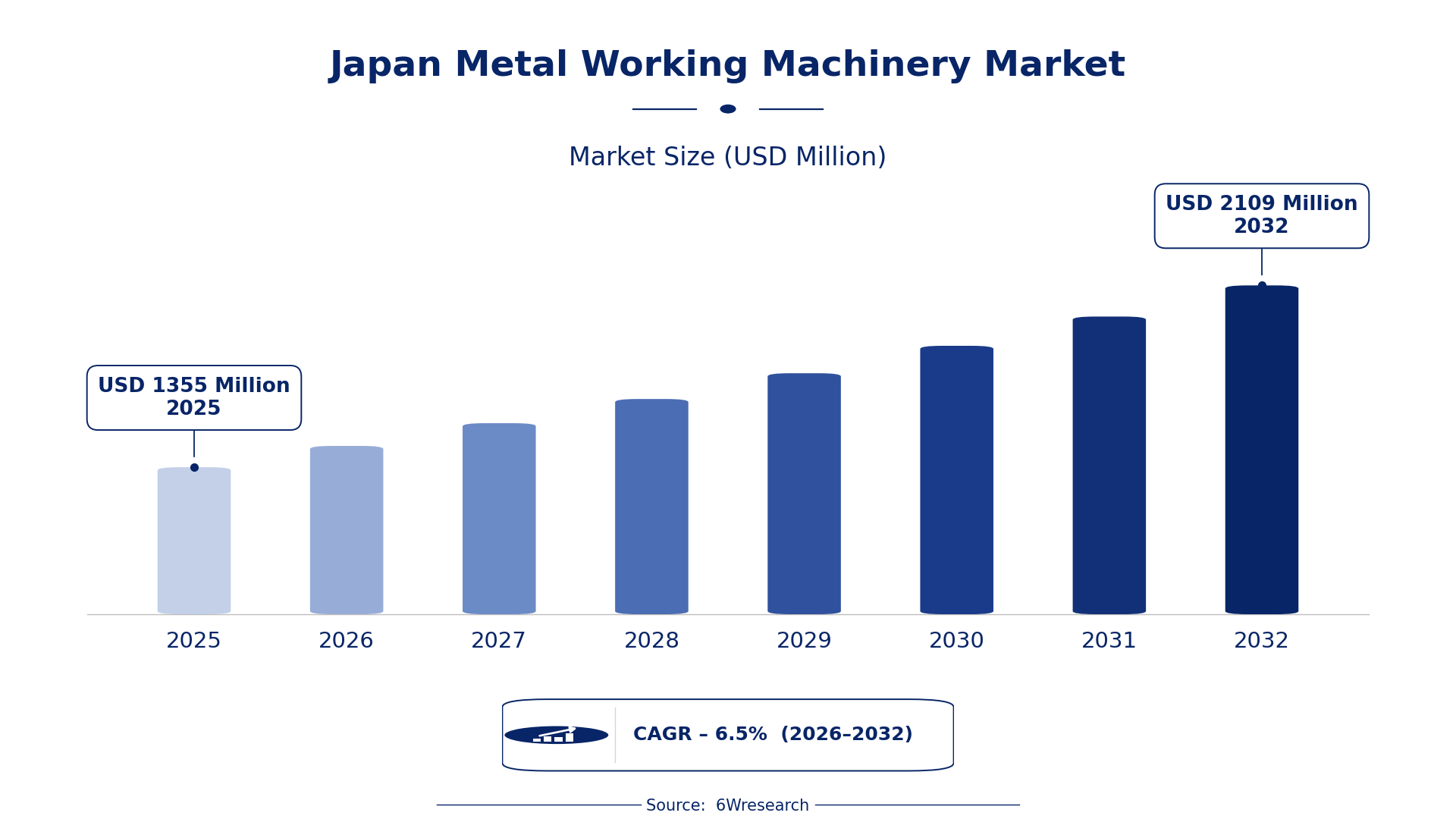
According to 6Wresearch internal database and industry insights, the Japan Metal Working Machinery Market was valued at USD 1,355 Million in 2025 and is projected to reach USD 2,109 Million by 2032, growing at a CAGR of approximately 6.5% during 2026–2032.
Japan Metal Working Machinery Market Highlights
| Report Metric | Details |
| Report Name | Japan Metal Working Machinery Market (2026-2032) |
| Market Size 2025 | USD 1,355 Million |
| Market Size 2032 | USD 2,109 Million |
| Absolute Growth 2025–2032 | USD 754 Million |
| CAGR 2026–2032 | 6.5% |
| Peak Annual Growth | 7.6% in 2029 |
| Forecast Period | 2026–2032 |
| Historical Data | 2022–2025 |
| Base Year | 2025 |
| Leading Type, 2025 | Machine Tool (35% share) |
| Leading Capacity, 2025 | Medium (51% share) |
| Leading Application, 2025 | Automotive (42% share) |
| Fastest-Growing Type | Industrial Mold (9.6% CAGR) |
| Fastest-Growing Application | Manufacturing (8.4% CAGR) |
| Growing Sector | Automotive |
| Key End Users | Manufacturers, automotive sector, consumer electronics producers |
Japan Metal Working Machinery Market Year-wise Growth Rate and Key Drivers (2022–2032)
This graph illustrates the annual growth rates of the market from 2022 to 2032, highlighting a steady upward trajectory and projected market expansion over the forecast period.
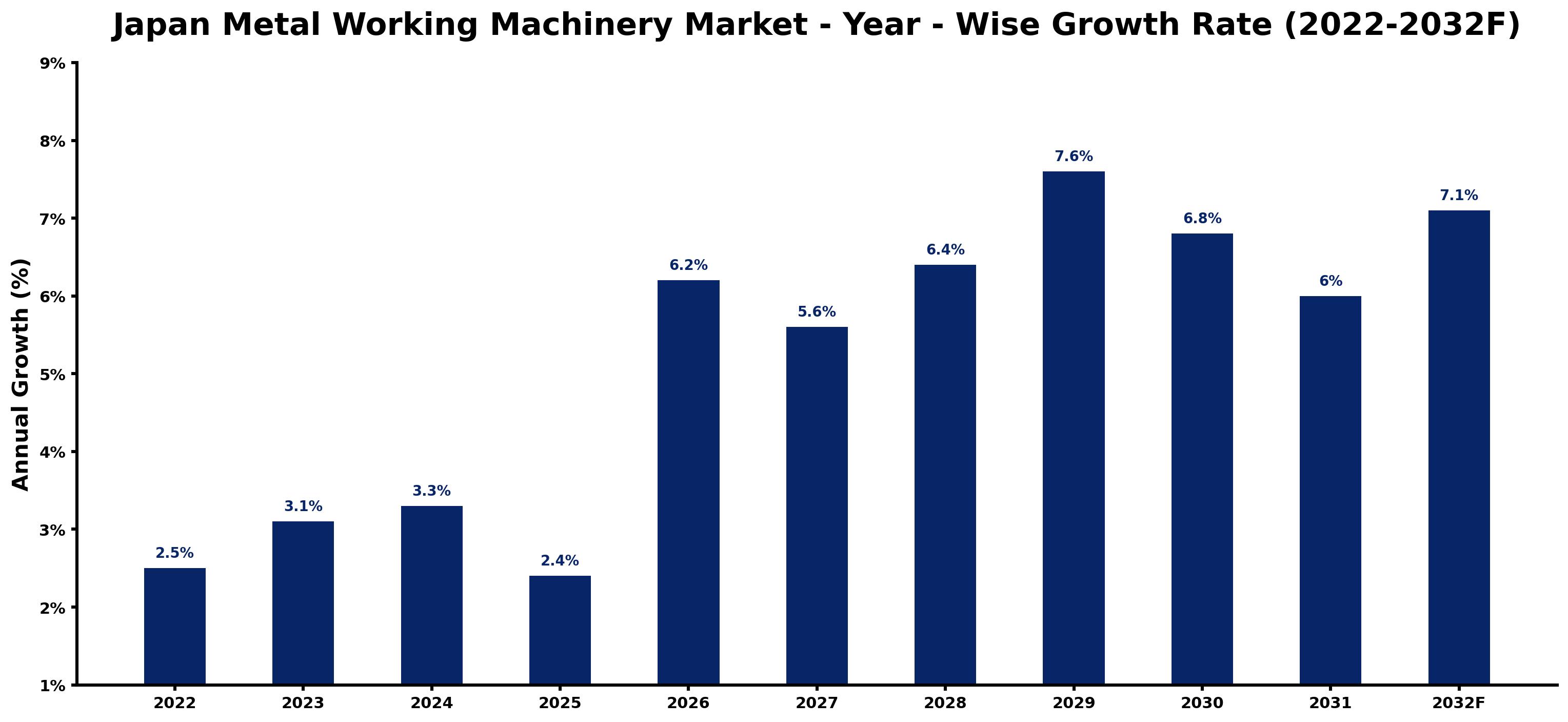
Annual growth estimates for each year appear below with the principal reason behind them, explaining the shifts that set the pace of the market.
| Year | Estimated Annual Growth (%) | Market Rationale |
| 2022 | 2.5 | The market showed steady growth due to strong domestic manufacturing activity. |
| 2023 | 3.1 | Demand increased as manufacturers ramped up production to meet export needs. |
| 2024 | 3.3 | Growth continued, supported by rising automotive production levels in the country. |
| 2025 | 2.4 | Growth slowed as manufacturers faced challenges in sourcing materials efficiently. |
| 2026 | 6.2 | The market is expected to rebound with increased investments in advanced manufacturing technologies. |
| 2027 | 5.6 | Growth is projected to slow slightly as companies adjust to changing market conditions. |
| 2028 | 6.4 | Demand is expected to surge as manufacturers adopt more efficient production processes. |
| 2029 | 7.6 | The market is projected to peak with high demand driven by automotive sector expansion. |
| 2030 | 6.8 | Growth is expected to slow as the market stabilises following peak production levels. |
| 2031 | 6.0 | Demand will continue to slow as manufacturers focus on operational efficiency. |
| 2032 | 7.1 | Growth is projected to pick up again as new technologies improve production capabilities. |
Note: Market size estimations and growth projections presented in this report are based on 6Wresearch's proprietary forecasting methodology, utilizing the latest available industry data, government publications, and primary research inputs.
Japan Metal Working Machinery Market Synopsis
Metal working machinery encompasses equipment designed for shaping and machining metal parts, produced through precision engineering processes. The Japan Metal Working Machinery Market is growing, driven by robust demand from the automotive sector, which makes up around 30% of total demand. Investments in advanced manufacturing technologies and efforts towards decarbonisation are pivotal, as Japan targets a 46% reduction in greenhouse gas emissions by 2030. The Kanto region remains a central hub for manufacturing, boosting production capabilities and facilitating increased output.
Market Dynamics Impact Analysis (2026–2032)
| Factor | Type | Impact | Primary Segment Affected |
| Rising automotive production | Driver | High | Automotive |
| Investment in advanced manufacturing technologies | Driver | High | Machine Tool |
| Growing demand for precision parts | Opportunity | High | Special Die and Tool |
| Increased adoption of industrial molds | Opportunity | High | Industrial Mold |
| Supply chain disruptions | Restraint | High | Manufacturing |
| High production costs | Restraint | Medium | Medium |
| Technological integration challenges | Challenge | High | Small |
| Skilled labour shortages | Challenge | Medium | Large |
Evaluation of Drivers in Japan Metal Working Machinery Market (2026–2032)
Below are the drivers that matter most for revenue growth, with supporting evidence.
| Drivers | Primary Segment Affected | Why It Matters (Evidence) |
| Strong automotive sector growth | Automotive | The automotive sector's demand for metal working machinery increased, accounting for about 30% of total demand. |
| Investment in advanced manufacturing technologies | Machine Tool | Investment in technologies improves production efficiency, prompting manufacturers to purchase more machinery. |
| Rising exports of manufactured goods | Manufacturing | Increased exports lead to higher production needs, driving demand for metal working machinery. |
| Focus on precision engineering | Special Die and Tool | The need for precision parts in various applications drives demand for specialized machinery. |
| Growth in consumer electronics production | Industrial Mold | The rising production of consumer electronics boosts the demand for industrial molds. |
Purchasing is picking up as Japan's automotive sector accounts for approximately 30% of total metal working machinery demand, leading to increased orders for machine tools. In 2022, Japan produced around 1.2 million units of machine tools, reflecting strong manufacturing activity. The growing consumer electronics market is driving demand for industrial molds, essential for producing components. The Kanto region remains a significant manufacturing hub, contributing to the overall growth of the sector.
Evaluation of Restraints in Japan Metal Working Machinery Market
The key brakes on demand, and where they bite hardest, are shown below.
| Market Restraint | Primary Segment Affected | Why It Matters (Evidence) |
| Supply chain disruptions | Manufacturing | Supply chain issues have caused delays in machinery production, impacting delivery times for manufacturers. |
| High production costs | Medium | Rising costs for materials and labour have pressured manufacturers, limiting their ability to invest in new machinery. |
| Technological integration challenges | Small | Integration of advanced technologies often proves difficult for smaller manufacturers, affecting their competitiveness. |
| Skilled labour shortages | Large | A shortage of skilled workers affects large manufacturers' ability to operate efficiently and meet demand. |
| Regulatory compliance costs | Industrial Mold | Compliance with environmental regulations increases operational costs for manufacturers of industrial molds. |
Japan Metal Working Machinery Market Challenges
A significant challenge for buyers in the metal working machinery market is the shortage of skilled workers, as Japan's ageing population limits the available talent pool. This skills gap leads to delays in production schedules for manufacturers, hindering their ability to meet demand. Regulatory requirements impose high operational costs on suppliers, with ISO 9001 certification costing smaller manufacturers approximately JPY 5 million annually. Rapid technological changes require ongoing innovation, which can lengthen development timelines and raise costs for producers. Intense competition from international firms pressures local suppliers to lower prices, squeezing profit margins and restricting investment in research and development.
Trends in the Japan Metal Working Machinery Market
The following changes are redrawing the Japan Metal Working Machinery Market.
- Shift towards Automation in Manufacturing: In 2023, around 30% of manufacturers adopted automated systems, improving production efficiency. This trend is visible in the Kanto region, where many facilities are upgrading their machinery.
- Transition from Traditional to Smart Manufacturing: Since 2022, manufacturers have increasingly adopted smart technologies, improving operational efficiency. The Tokyo Metropolitan Government supports this transition through funding for advanced technologies.
- Emergence of Eco-Friendly Manufacturing Practices: The push for sustainability has led to a rise in eco-friendly practices among manufacturers, with Japan targeting a 46% cut in greenhouse gas emissions by 2030.
- Growing Demand for Customised Machinery Solutions: Manufacturers are increasingly seeking customised machinery solutions to meet specific production needs, reflecting a shift in buyer preferences towards tailored equipment.
Investment Opportunities in the Japan Metal Working Machinery Market
Below are the investment opportunities with the strongest case in the Japan Metal Working Machinery Market.
- Investment Gap in Advanced Machinery: With Japan's GX Basic Policy targeting JPY 150 trillion in decarbonisation investment, there is an opportunity for suppliers of advanced machinery solutions to fulfil this demand.
- Supply of Precision Engineering Equipment: The growth of the automotive sector presents an opportunity to provide precision engineering equipment, particularly in the Kanto region, where demand is strong.
- Expansion in Consumer Electronics Production: As the production of consumer electronics increases, there is a growing need for innovative industrial molds, creating opportunities for manufacturers in this segment.
- Support for Advanced Manufacturing Technologies: The Japanese government's allocation of ¥10 billion for manufacturing innovation in 2023 presents a chance for suppliers to collaborate with local manufacturers.
Government Initiatives in the Japan Metal Working Machinery Market
The Economic Security Promotion Act (2022) affects buyers by bolstering supply-chain resilience for critical products. This measure ensures that manufacturers can secure necessary materials and components, promoting production stability. Additionally, the PRTR Law requires businesses to report chemical substance releases, ensuring compliance and encouraging environmental responsibility in manufacturing processes.
The Ministry of Economy, Trade and Industry (METI) plays a crucial role in approving funding for innovation programmes. In 2023, METI allocated ¥10 billion to support advanced manufacturing technologies, assisting manufacturers in modernising their operations and enhancing competitiveness in the global market.
Future Insight of the Japan Metal Working Machinery Market
Japan's commitment to a 46% reduction in greenhouse-gas emissions by 2030 will drive advancements in energy-efficient machinery, prompting suppliers to innovate. By 2032, the anticipated JPY 150 trillion investment in decarbonisation will transform manufacturing processes. Support from the Tokyo Metropolitan Government for advanced manufacturing technologies will further strengthen industry capabilities. Rising wages, with the minimum wage reaching JPY 1,055 per hour, will compel buyers to pursue automation, fundamentally altering demand for metal working machinery.
Market Segmentation Analysis
Japan Metal Working Machinery Market report covers a detailed analysis of the following market segments:
By Type – Machine Tool Leads, Industrial Mold Expected to Grow Fastest
According to Ravi Bhandari, Research Head at 6Wresearch, in 2025, Machine Tool led the type split with a 35% share. Machine tools dominate the market as they are essential for shaping and cutting metal materials, particularly in the automotive sector, which constitutes about 30% of total demand. The extensive use of machine tools across various manufacturing facilities in Japan solidifies their leading position. Industrial Mold is projected to grow fastest, at a CAGR of 9.6% during 2026–2032. Industrial molds are rapidly gaining traction as they are increasingly utilised in the production of consumer electronics, reflecting a shift towards precision manufacturing. This growth is fuelled by the rising need for intricate components in a technology-driven environment. Suppliers must focus on developing industrial molds to capitalise on this emerging growth trend.
By Capacity – Medium Leads and Records the Fastest Growth
The largest capacity category in 2025 was Medium, at 51% of revenue. Medium capacity machinery holds the largest share as it is widely used across various manufacturing sectors, catering to diverse production needs. This versatility allows medium capacity machines to serve a broad range of applications, reinforcing their market leadership. The same category is also set to grow fastest, at a CAGR of 7.6% during 2026–2032. The medium capacity segment is also the fastest growing due to its adaptability in meeting the demands of both traditional and emerging industries. As manufacturers seek to optimise production efficiency, the appeal of medium capacity machinery continues to rise. Buyers may benefit from investing in medium capacity machinery to ensure flexibility in their production processes.
By Application – Automotive Leads, Manufacturing Expected to Grow Fastest
With 42% of application revenue in 2025, Automotive was the largest category. The automotive sector leads in application as it heavily relies on metal working machinery for its production processes, representing a substantial share of market demand. This reliance is bolstered by Japan's strong automotive manufacturing base, which consistently drives machinery requirements. Over 2026–2032, Manufacturing is expected to post the fastest growth, at a CAGR of 8.4%. Manufacturing is witnessing swift growth, covering a wide range of industries that employ metal working machinery for diverse applications. This broad applicability ensures that manufacturing remains a key growth contributor in the market. Suppliers should expand their product offerings to align with the diverse needs of the manufacturing sector.
Key Attractiveness of the Report
- 10 Years of Market Numbers
- Historical Data Starting from 2022 to 2025
- Base Year 2025
- Forecast Data until 2032
- Key Performance Indicators Impacting the Market
- Major Upcoming Developments and Projects
Key Highlights of the Report:
- Japan Metal Working Machinery Market Outlook
- Market Size of Japan Metal Working Machinery Market, 2025
- Forecast of Japan Metal Working Machinery Market, 2032
- Historical Data and Forecast of Japan Metal Working Machinery Revenues & Volume for the Period 2022-2032
- Japan Metal Working Machinery Market Trend Evolution
- Japan Metal Working Machinery Market Drivers and Challenges
- Japan Metal Working Machinery Price Trends
- Japan Metal Working Machinery Porter's Five Forces
- Japan Metal Working Machinery Industry Life Cycle
- Historical Data and Forecast of Japan Metal Working Machinery Market Revenues & Volume By Type for the Period 2022-2032
- Historical Data and Forecast of Japan Metal Working Machinery Market Revenues & Volume By Special Die and Tool for the Period 2022-2032
- Historical Data and Forecast of Japan Metal Working Machinery Market Revenues & Volume By Die Set for the Period 2022-2032
- Historical Data and Forecast of Japan Metal Working Machinery Market Revenues & Volume By Jig and Fixture for the Period 2022-2032
- Historical Data and Forecast of Japan Metal Working Machinery Market Revenues & Volume By Machine Tool for the Period 2022-2032
- Historical Data and Forecast of Japan Metal Working Machinery Market Revenues & Volume By Industrial Mold for the Period 2022-2032
- Historical Data and Forecast of Japan Metal Working Machinery Market Revenues & Volume By Rolling Mill for the Period 2022-2032
- Historical Data and Forecast of Japan Metal Working Machinery Market Revenues & Volume By Capacity for the Period 2022-2032
- Historical Data and Forecast of Japan Metal Working Machinery Market Revenues & Volume By Small for the Period 2022-2032
- Historical Data and Forecast of Japan Metal Working Machinery Market Revenues & Volume By Medium for the Period 2022-2032
- Historical Data and Forecast of Japan Metal Working Machinery Market Revenues & Volume By Large for the Period 2022-2032
- Historical Data and Forecast of Japan Metal Working Machinery Market Revenues & Volume By Application for the Period 2022-2032
- Historical Data and Forecast of Japan Metal Working Machinery Market Revenues & Volume By Automotive for the Period 2022-2032
- Historical Data and Forecast of Japan Metal Working Machinery Market Revenues & Volume By Manufacturing for the Period 2022-2032
- Historical Data and Forecast of Japan Metal Working Machinery Market Revenues & Volume By Others for the Period 2022-2032
- Japan Metal Working Machinery Import Export Trade Statistics
- Market Opportunity Assessment By Type
- Market Opportunity Assessment By Capacity
- Market Opportunity Assessment By Application
- Japan Metal Working Machinery Top Companies Market Share
- Japan Metal Working Machinery Competitive Benchmarking By Technical and Operational Parameters
- Japan Metal Working Machinery Company Profiles
- Japan Metal Working Machinery Key Strategic Recommendations
Market Covered
This report examines the market across the segments below.
By Type
- Special Die and Tool
- Die Set
- Jig and Fixture
- Machine Tool
- Industrial Mold
- Rolling Mill
By Capacity
- Small
- Medium
- Large
By Application
- Automotive
- Manufacturing
- Others































