Japan Metaverse In Healthcare Market Size & Growth Rate
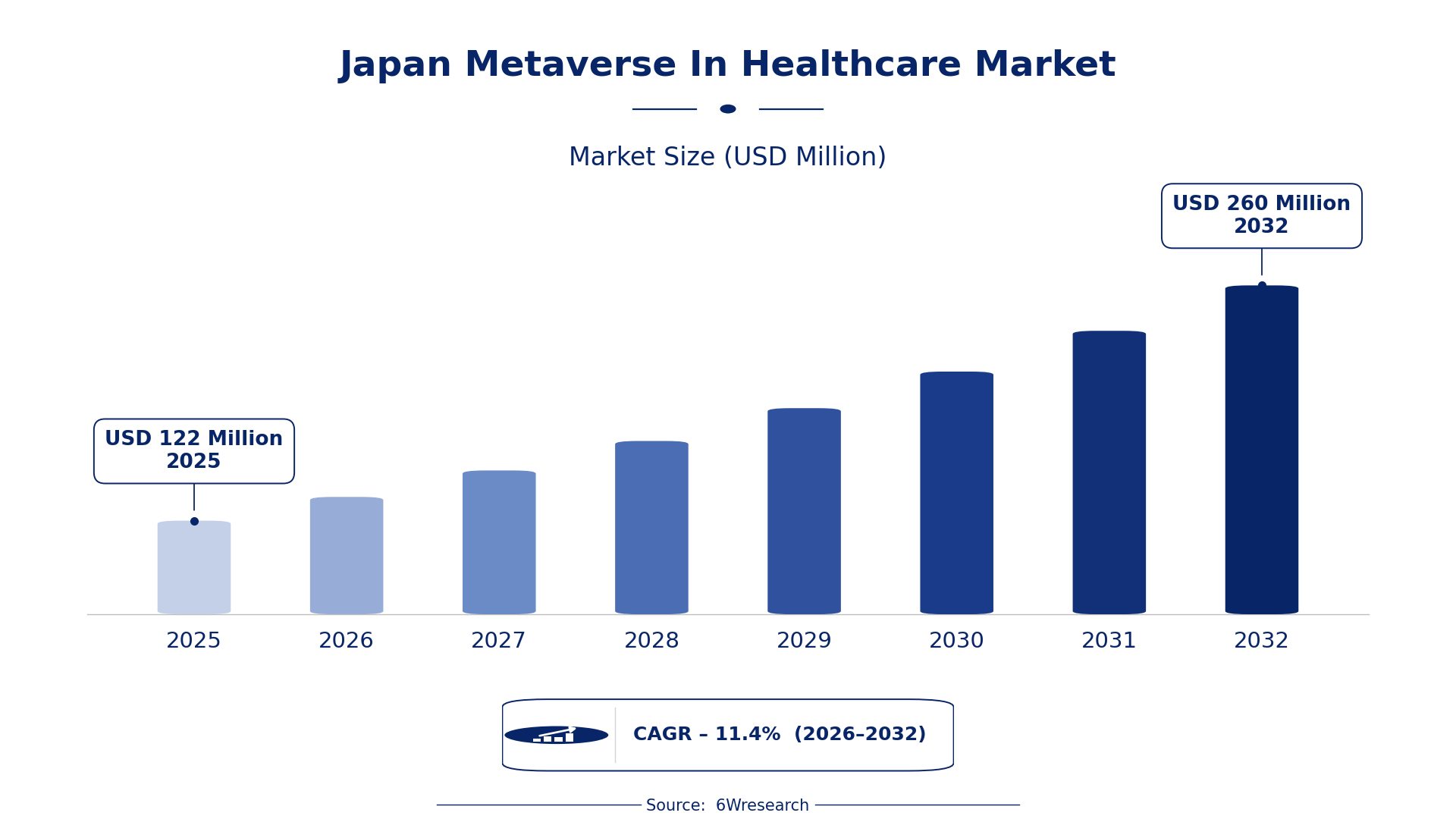
According to 6Wresearch internal database and industry insights, the Japan Metaverse In Healthcare Market was valued at USD 122 Million in 2025 and is projected to reach USD 260 Million by 2032, growing at a CAGR of approximately 11.4% during 2026–2032.
Japan Metaverse In Healthcare Market Highlights
| Report Metric | Details |
| Report Name | Japan Metaverse In Healthcare Market (2026-2032) |
| Market Size 2025 | USD 122 Million |
| Market Size 2032 | USD 260 Million |
| Absolute Growth 2025–2032 | USD 138 Million |
| CAGR 2026–2032 | 11.4% |
| Peak Annual Growth | 16.2% in 2032 |
| Forecast Period | 2026–2032 |
| Historical Data | 2022–2025 |
| Base Year | 2025 |
| Leading Component, 2025 | Software (42% share) |
| Leading Technology, 2025 | AR and VR (51% share) |
| Leading Application, 2025 | Telemedicine (37% share) |
| Leading End-use, 2025 | Medical Centers (36% share) |
| Fastest-Growing Technology | Artificial Intelligence (17.2% CAGR) |
| Fastest-Growing Application | Medical Training and Simulation (16.6% CAGR) |
| Fastest-Growing End-use | Clinical Research (16.1% CAGR) |
| Growing Sector | Remote Monitoring |
| Key End Users | Healthcare providers, medical centers, telemedicine practitioners, training institutions |
Japan Metaverse In Healthcare Market Year-wise Growth Rate and Key Drivers (2022–2032)
This graph illustrates the annual growth rates of the market from 2022 to 2032, highlighting a steady upward trajectory and projected market expansion over the forecast period.
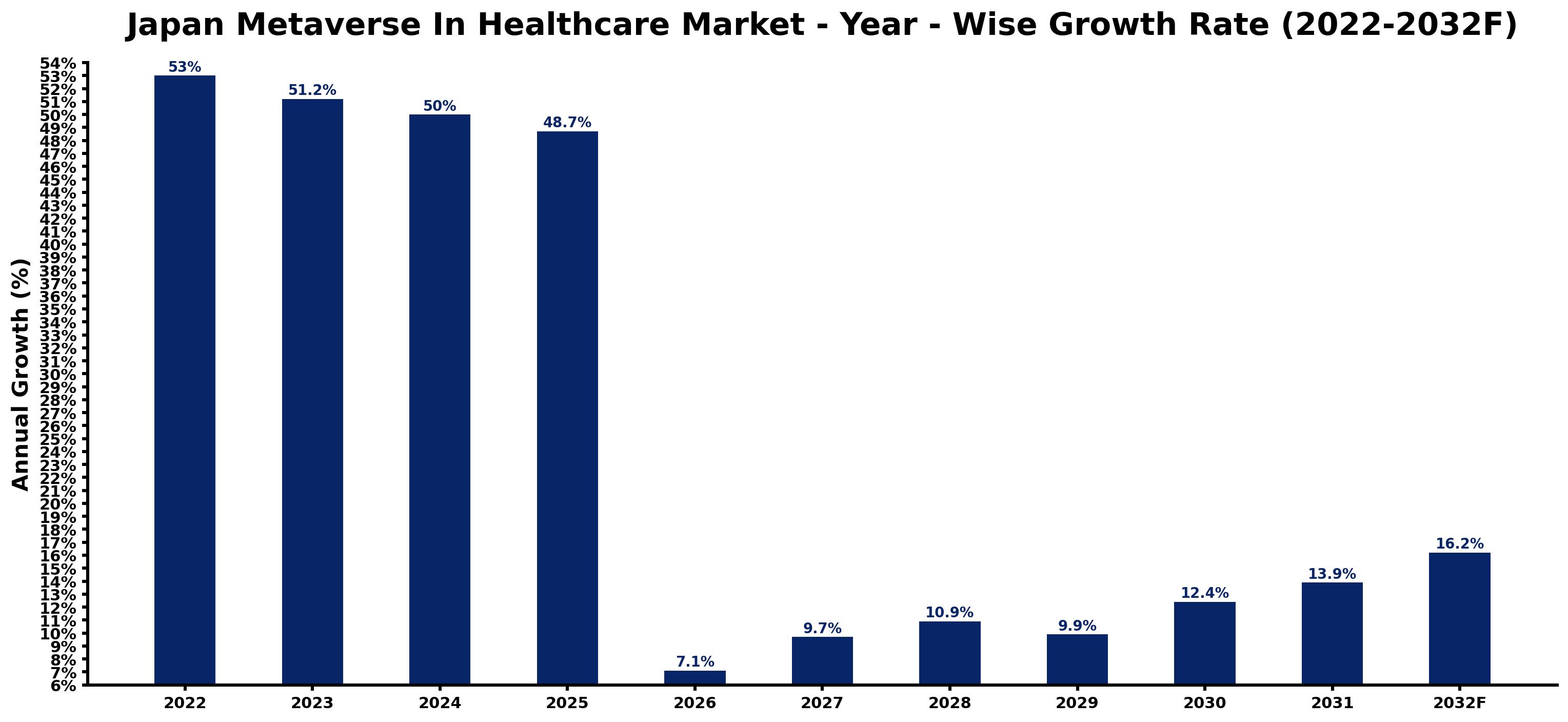
The yearly estimates that follow link every growth rate to its principal driver, so readers can see why the pace changed in each period.
| Year | Estimated Annual Growth (%) | Market Rationale |
| 2022 | 53.0 | Demand surged due to increased telemedicine adoption and healthcare technology investments. |
| 2023 | 51.2 | Growth slowed as telemedicine consultations reached 5 million, indicating market maturity. |
| 2024 | 50.0 | Market expansion continued, driven by the integration of AR and VR in medical training. |
| 2025 | 48.7 | The slowdown persisted as healthcare providers focused on implementing existing technologies. |
| 2026 | 7.1 | Growth is projected to decelerate as the market stabilises after rapid early adoption. |
| 2027 | 9.7 | Demand is expected to rise as hospitals enhance telemedicine services and remote monitoring capabilities. |
| 2028 | 10.9 | The market will grow as healthcare facilities adopt more advanced metaverse applications. |
| 2029 | 9.9 | Growth is anticipated to decelerate slightly as the focus shifts to optimising current technologies. |
| 2030 | 12.4 | Demand will increase with the introduction of new AI-driven healthcare solutions. |
| 2031 | 13.9 | The market is set to continue expanding as healthcare providers embrace innovative training methods. |
| 2032 | 16.2 | Growth is projected to peak as the integration of metaverse technologies transforms patient care. |
Note: Market size estimations and growth projections presented in this report are based on 6Wresearch's proprietary forecasting methodology, utilizing the latest available industry data, government publications, and primary research inputs.
Japan Metaverse In Healthcare Market Synopsis
Metaverse in Healthcare integrates virtual environments and augmented reality technologies to improve medical practices. Its applications include telemedicine, medical training, and remote patient monitoring. The Japan Metaverse in Healthcare Market is expanding due to rising healthcare expenditure, with approximately JPY 46.7 trillion spent in fiscal 2022, alongside an aging population, with 29.3% aged 65 or older. The adoption of telemedicine surged by 30% in 2023, driving demand for advanced healthcare solutions.
Market Dynamics Impact Analysis (2026–2032)
| Factor | Type | Impact | Primary Segment Affected |
| Increased telemedicine adoption | Driver | High | Telemedicine |
| Growing healthcare expenditure | Driver | High | Medical Centers |
| Rising demand for remote monitoring | Opportunity | High | Remote Monitoring |
| Technological advancements in AR and VR | Opportunity | High | AR and VR |
| Limited infrastructure for digital health | Restraint | Medium | Medical Centers |
| High initial investment costs for technology | Restraint | Medium | Software |
| Shortage of trained professionals in AR and VR | Challenge | High | Medical Training and Simulation |
| Regulatory hurdles for telemedicine practices | Challenge | High | Telemedicine |
Evaluation of Drivers in Japan Metaverse In Healthcare Market (2026–2032)
The factors lifting demand, and the evidence behind each, are summarised below.
| Drivers | Primary Segment Affected | Why It Matters (Evidence) |
| Increased telemedicine consultations | Telemedicine | Telemedicine consultations reached 5 million in 2023, prompting healthcare providers to invest more in metaverse technologies. |
| Healthcare expenditure growth | Medical Centers | Japan's healthcare expenditure was approximately ¥42 trillion in 2022, leading to increased investment in advanced medical technologies. |
| Rising aging population | Remote Monitoring | With 29.3% of Japan's population aged 65 or older, demand for remote patient monitoring solutions is expanding. |
| Technological advancements in AR and VR | AR and VR | The integration of AR and VR in medical training is driving healthcare facilities to adopt these technologies. |
| Support from healthcare associations | Medical Training and Simulation | The Japan Medical Association promotes telemedicine initiatives, encouraging healthcare providers to adopt metaverse solutions. |
Behind the steady rise in orders sits the increasing adoption of telemedicine, with consultations reaching 5 million in 2023. The growing healthcare expenditure, approximately ¥42 trillion in 2022, has prompted medical centres to invest in advanced technologies. The aging population, with 29.3% aged 65 or older, drives demand for remote monitoring solutions. Technological advancements in AR and VR are improving medical training, encouraging healthcare facilities to integrate these technologies. Support from healthcare associations further promotes the adoption of metaverse applications in medical training and patient care.
Evaluation of Restraints in Japan Metaverse In Healthcare Market
These restraints slow adoption and weigh on supplier margins.
| Market Restraint | Primary Segment Affected | Why It Matters (Evidence) |
| Limited infrastructure for digital health | Medical Centers | Many medical centers lack the necessary infrastructure to implement metaverse technologies effectively, hindering adoption. |
| High initial investment costs for technology | Software | The high costs associated with developing and implementing metaverse software deter smaller healthcare providers from investing. |
| Shortage of trained professionals in AR and VR | Medical Training and Simulation | The limited number of trained professionals in AR and VR technologies restricts the effective use of these tools in medical education. |
| Regulatory hurdles for telemedicine practices | Telemedicine | Strict regulations surrounding telemedicine practices create barriers for healthcare providers looking to adopt metaverse solutions. |
| Concerns over data privacy and security | Remote Monitoring | Concerns regarding patient information privacy in virtual environments may slow the adoption of remote monitoring technologies. |
Japan Metaverse In Healthcare Market Challenges
Japan's healthcare sector faces escalating costs, with national medical care expenditure at about JPY 46.7 trillion in fiscal 2022, burdening buyers with higher service fees. Workforce limitations emerge as the healthcare workforce is projected to grow by only 10% by 2025, constraining hospitals' capacity to adopt new technologies and delaying essential upgrades. Rising operational costs, driven by an aging population where 29.3% are 65 or older, compel clinics to seek cost-effective solutions. Intensified competition arises from the rapid increase in telemedicine consultations, which reached 5 million in 2023, pushing providers to innovate swiftly or risk obsolescence.
Trends in the Japan Metaverse In Healthcare Market
Below are the shifts with the largest effect on the Japan Metaverse In Healthcare Market.
- Shift from Traditional to Virtual Training: Tokyo is experiencing a shift towards virtual training environments in medical education, with 51% of training now using AR and VR technologies, improving learning outcomes.
- Emergence of AI in Patient Care: The integration of AI technologies in healthcare began in 2023, with a target of full implementation by 2025, enhancing patient interaction and data analysis.
- Increased Focus on Remote Monitoring Solutions: In 2023, over 2,000 clinics adopted remote monitoring technologies, reflecting a growing trend towards continuous patient observation through virtual platforms.
- Expansion of Telemedicine Services: Telemedicine services have expanded significantly, with a 30% increase in adoption in 2023, indicating a shift towards more accessible healthcare solutions.
Investment Opportunities in the Japan Metaverse In Healthcare Market
Investors looking at the Japan Metaverse In Healthcare Market should consider the following areas.
- Healthcare Providers Seeking Advanced Solutions: Medical centres are increasingly looking for advanced metaverse solutions, with a projected growth in telemedicine consultations to 10 million by 2025, presenting an opportunity for technology providers.
- Collaborations with Technology Firms: Healthcare providers can establish collaborations with technology firms to improve their metaverse capabilities, responding to the growing demand for remote monitoring solutions.
- Investment in Training Programs: With the healthcare workforce projected to grow by 10% by 2025, there is an opportunity to invest in training programs focused on AR and VR technologies for medical professionals.
- Expansion of Digital Health Projects: The government allocated ¥1 billion for digital health projects in 2023, creating opportunities for companies to develop and implement advanced healthcare technologies.
Government Initiatives in the Japan Metaverse In Healthcare Market
The Next-Generation Medical Infrastructure Act (2017) allows certified bodies to anonymise medical data for research, improving how healthcare providers utilise data effectively. This builds on earlier laws by providing clearer guidelines for data usage in developing metaverse applications, which are important for improving patient care and operational efficiency. The act enhances the capacity for data-driven innovations in healthcare.
Funding from the Pharmaceuticals and Medical Devices Agency (PMDA) supports research and development initiatives, enabling healthcare providers to integrate new technologies in their practices. This funding facilitates the adoption of metaverse solutions, allowing for improved patient interactions and enhanced healthcare delivery. The PMDA's support is crucial for advancing metaverse applications in healthcare.
Future Insight of the Japan Metaverse In Healthcare Market
The establishment of integrated digital health facilities will transform healthcare delivery by 2032, driven by the government's commitment to AI integration in healthcare by 2025. Enhanced remote monitoring capabilities will expand, with over 2,000 clinics already adopting such technologies, leading to better patient outcomes. The Digital Agency of Japan will lead significant digital health initiatives, supported by ¥1 billion allocated for 2023. As telemedicine adoption continues to rise, suppliers will need to adapt their solutions to meet the specific demands of healthcare providers and patients.
Market Segmentation Analysis
Japan Metaverse In Healthcare Market report covers a detailed analysis of the following market segments:
By Component – Software Leads and Records the Fastest Growth
According to Dhaval Chaurasia, Assistant Manager at 6Wresearch, Software took 42% of component revenue in 2025, more than any other category. Software holds the largest share due to its essential role in developing and managing metaverse platforms in healthcare. Its extensive application across over 8,000 hospitals in Japan underscores its importance in improving healthcare delivery. The same category is also set to grow fastest, at a CAGR of 13.0% during 2026–2032. Software is also the fastest-growing segment, driven by a notable 30% increase in telemedicine adoption in 2023. This trend suggests that as healthcare providers further integrate software solutions, growth will likely accelerate even more. Suppliers should focus on enhancing software capabilities to meet the rising demand within the healthcare sector.
By Technology – AR and VR Leads, Artificial Intelligence Expected to Grow Fastest
AR and VR held 51% of the Japan Metaverse In Healthcare Market by technology in 2025. AR and VR technologies lead the market because they are crucial for training and simulation in medical education. Their implementation in numerous medical training programmes across various institutions solidifies their dominant position. Over 2026–2032, Artificial Intelligence is expected to post the fastest growth, at a CAGR of 17.2%. Artificial Intelligence is the fastest-growing technology segment, fuelled by its ability to enhance data analysis and patient interactions in virtual environments. The government's push to incorporate AI into healthcare by 2025 will likely further stimulate this growth. Buyers should invest in AR and VR technologies to improve training and simulation capabilities in healthcare settings.
By Application – Telemedicine Leads, Medical Training and Simulation Expected to Grow Fastest
With 37% of application revenue in 2025, Telemedicine was the largest category. Telemedicine is the leading application, serving as a primary platform for remote consultations. The substantial increase in telemedicine consultations, reaching 5 million in 2023, underscores its critical role in modern healthcare delivery. The quickest growth will come from Medical Training and Simulation, forecast to expand at a CAGR of 16.6% between 2026 and 2032. Medical Training and Simulation is the fastest-growing application, extensively utilised for training healthcare professionals. The ongoing demand for skilled medical personnel ensures that this segment will continue to experience rapid expansion. Healthcare providers should focus on investing in medical training solutions to develop a more capable workforce.
By End-use – Medical Centers Lead, Clinical Research Expected to Grow Fastest
The largest end-use category in 2025 was Medical Centers, at 36% of revenue. Medical Centers dominate the end-use segment as they increasingly adopt metaverse technologies for diverse healthcare applications. The existence of over 8,100 hospitals utilising these technologies highlights their widespread acceptance and integration into healthcare practices. Clinical Research is projected to grow fastest, at a CAGR of 16.1% during 2026–2032. Clinical Research is the fastest-growing end-use area, reflecting a shift towards virtual trials and patient data collection. This trend indicates the healthcare industry's movement towards more efficient research methodologies. Suppliers should strategically engage with clinical research institutions to capitalise on the increasing demand for virtual trial technologies.
Key Attractiveness of the Report
- 10 Years of Market Numbers
- Historical Data Starting from 2022 to 2025
- Base Year 2025
- Forecast Data until 2032
- Key Performance Indicators Impacting the Market
- Major Upcoming Developments and Projects
Key Highlights of the Report:
- Japan Metaverse In Healthcare Market Outlook
- Market Size of Japan Metaverse In Healthcare Market, 2025
- Forecast of Japan Metaverse In Healthcare Market, 2032
- Historical Data and Forecast of Japan Metaverse In Healthcare Revenues & Volume for the Period 2022-2032
- Japan Metaverse In Healthcare Market Trend Evolution
- Japan Metaverse In Healthcare Market Drivers and Challenges
- Japan Metaverse In Healthcare Price Trends
- Japan Metaverse In Healthcare Porter's Five Forces
- Japan Metaverse In Healthcare Industry Life Cycle
- Historical Data and Forecast of Japan Metaverse In Healthcare Market Revenues & Volume By Component for the Period 2022-2032
- Historical Data and Forecast of Japan Metaverse In Healthcare Market Revenues & Volume By Hardware for the Period 2022-2032
- Historical Data and Forecast of Japan Metaverse In Healthcare Market Revenues & Volume By Software for the Period 2022-2032
- Historical Data and Forecast of Japan Metaverse In Healthcare Market Revenues & Volume By Services for the Period 2022-2032
- Historical Data and Forecast of Japan Metaverse In Healthcare Market Revenues & Volume By Technology for the Period 2022-2032
- Historical Data and Forecast of Japan Metaverse In Healthcare Market Revenues & Volume By AR and VR for the Period 2022-2032
- Historical Data and Forecast of Japan Metaverse In Healthcare Market Revenues & Volume By IoT and Wearable Health Devices for the Period 2022-2032
- Historical Data and Forecast of Japan Metaverse In Healthcare Market Revenues & Volume By Artificial Intelligence for the Period 2022-2032
- Historical Data and Forecast of Japan Metaverse In Healthcare Market Revenues & Volume By Others for the Period 2022-2032
- Historical Data and Forecast of Japan Metaverse In Healthcare Market Revenues & Volume By Application for the Period 2022-2032
- Historical Data and Forecast of Japan Metaverse In Healthcare Market Revenues & Volume By Telemedicine for the Period 2022-2032
- Historical Data and Forecast of Japan Metaverse In Healthcare Market Revenues & Volume By Medical Training and Simulation for the Period 2022-2032
- Historical Data and Forecast of Japan Metaverse In Healthcare Market Revenues & Volume By Remote Monitoring for the Period 2022-2032
- Historical Data and Forecast of Japan Metaverse In Healthcare Market Revenues & Volume By Robot Assisted Surgery for the Period 2022-2032
- Historical Data and Forecast of Japan Metaverse In Healthcare Market Revenues & Volume By Others for the Period 2022-2032
- Historical Data and Forecast of Japan Metaverse In Healthcare Market Revenues & Volume By End-use for the Period 2022-2032
- Historical Data and Forecast of Japan Metaverse In Healthcare Market Revenues & Volume By Clinical Research for the Period 2022-2032
- Historical Data and Forecast of Japan Metaverse In Healthcare Market Revenues & Volume By Medical Centers for the Period 2022-2032
- Historical Data and Forecast of Japan Metaverse In Healthcare Market Revenues & Volume By Diagnostic Centers for the Period 2022-2032
- Historical Data and Forecast of Japan Metaverse In Healthcare Market Revenues & Volume By Medical Device Manufacturers for the Period 2022-2032
- Historical Data and Forecast of Japan Metaverse In Healthcare Market Revenues & Volume By Biotech and Pharmaceutical Companies for the Period 2022-2032
- Historical Data and Forecast of Japan Metaverse In Healthcare Market Revenues & Volume By Others for the Period 2022-2032
- Japan Metaverse In Healthcare Import Export Trade Statistics
- Market Opportunity Assessment By Component
- Market Opportunity Assessment By Technology
- Market Opportunity Assessment By Application
- Market Opportunity Assessment By End-use
- Japan Metaverse In Healthcare Top Companies Market Share
- Japan Metaverse In Healthcare Competitive Benchmarking By Technical and Operational Parameters
- Japan Metaverse In Healthcare Company Profiles
- Japan Metaverse In Healthcare Key Strategic Recommendations
Market Covered
The report covers the following segments.
By Component
- Hardware
- Software
- Services
By Technology
- AR and VR
- IoT and Wearable Health Devices
- Artificial Intelligence
- Others
By Application
- Telemedicine
- Medical Training and Simulation
- Remote Monitoring
- Robot Assisted Surgery
- Others
By End-use
- Clinical Research
- Medical Centers
- Diagnostic Centers
- Medical Device Manufacturers
- Biotech and Pharmaceutical Companies
- Others































