Japan Methanol Market Size & Growth Rate
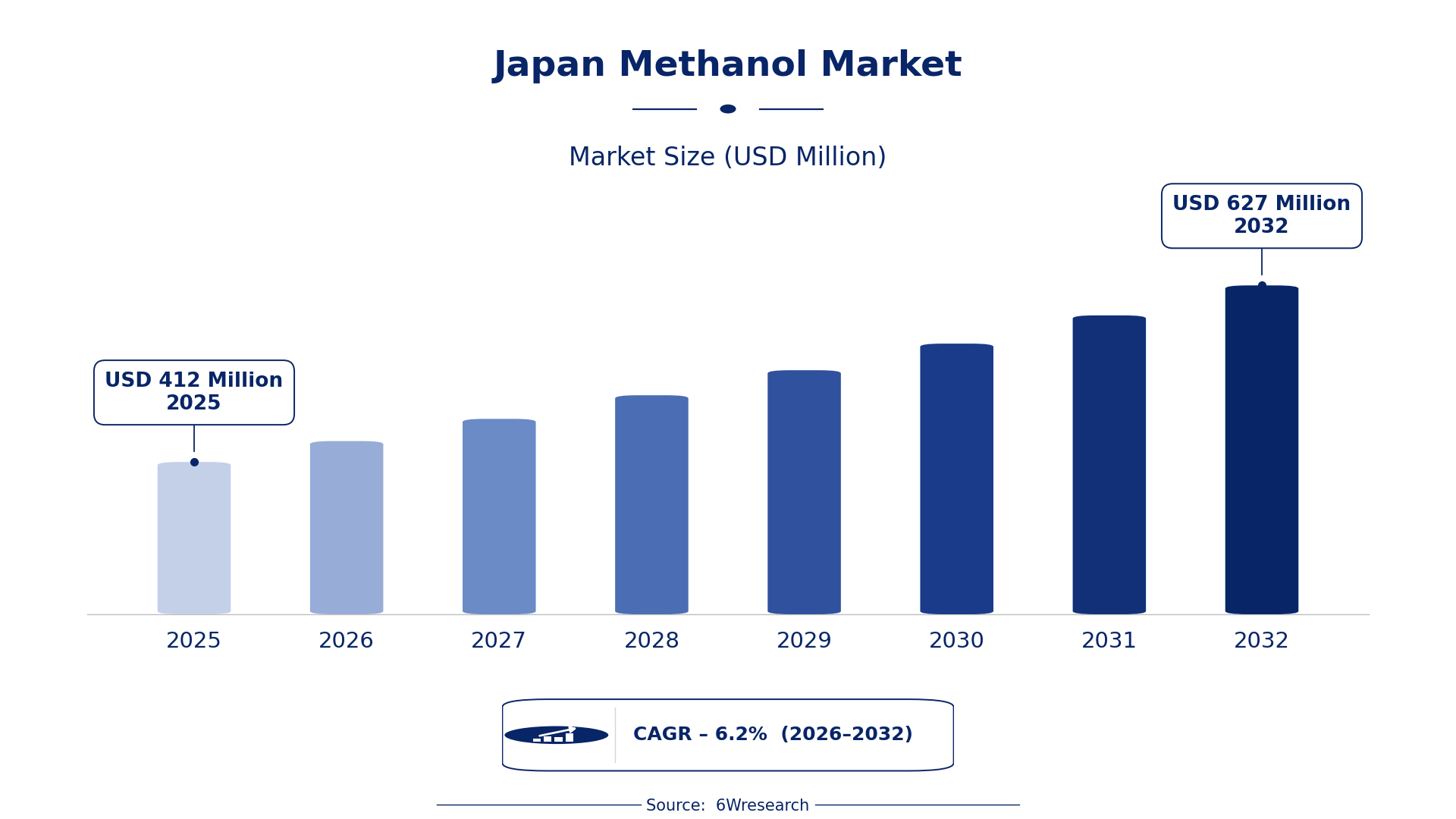
According to 6Wresearch internal database and industry insights, the Japan Methanol Market was valued at USD 412 Million in 2025 and is projected to reach USD 627 Million by 2032, growing at a CAGR of approximately 6.2% during 2026–2032.
Japan Methanol Market Highlights
| Report Metric | Details |
| Report Name | Japan Methanol Market (2026-2032) |
| Market Size 2025 | USD 412 Million |
| Market Size 2032 | USD 627 Million |
| Absolute Growth 2025–2032 | USD 215 Million |
| CAGR 2026–2032 | 6.2% |
| Peak Annual Growth | 7.0% in 2032 |
| Forecast Period | 2026–2032 |
| Historical Data | 2022–2025 |
| Base Year | 2025 |
| Leading Feedstock, 2025 | Natural Gas (58% share) |
| Leading Derivatives, 2025 | Formaldehyde (30% share) |
| Leading Sub-Derivatives, 2025 | Gasoline additives (41% share) |
| Leading End-Use Industry, 2025 | Automotive (31% share) |
| Fastest-Growing Feedstock | Coal (8.4% CAGR) |
| Fastest-Growing Derivatives | Dimethyl Ether (DME) (8.6% CAGR) |
| Fastest-Growing End-Use Industry | Pharmaceuticals (8.5% CAGR) |
| Growing Sector | Pharmaceuticals |
| Key End Users | Automotive, Pharmaceuticals, Construction, Chemical manufacturers |
Japan Methanol Market Year-wise Growth Rate and Key Drivers (2022–2032)
This graph illustrates the annual growth rates of the market from 2022 to 2032, highlighting a steady upward trajectory and projected market expansion over the forecast period.
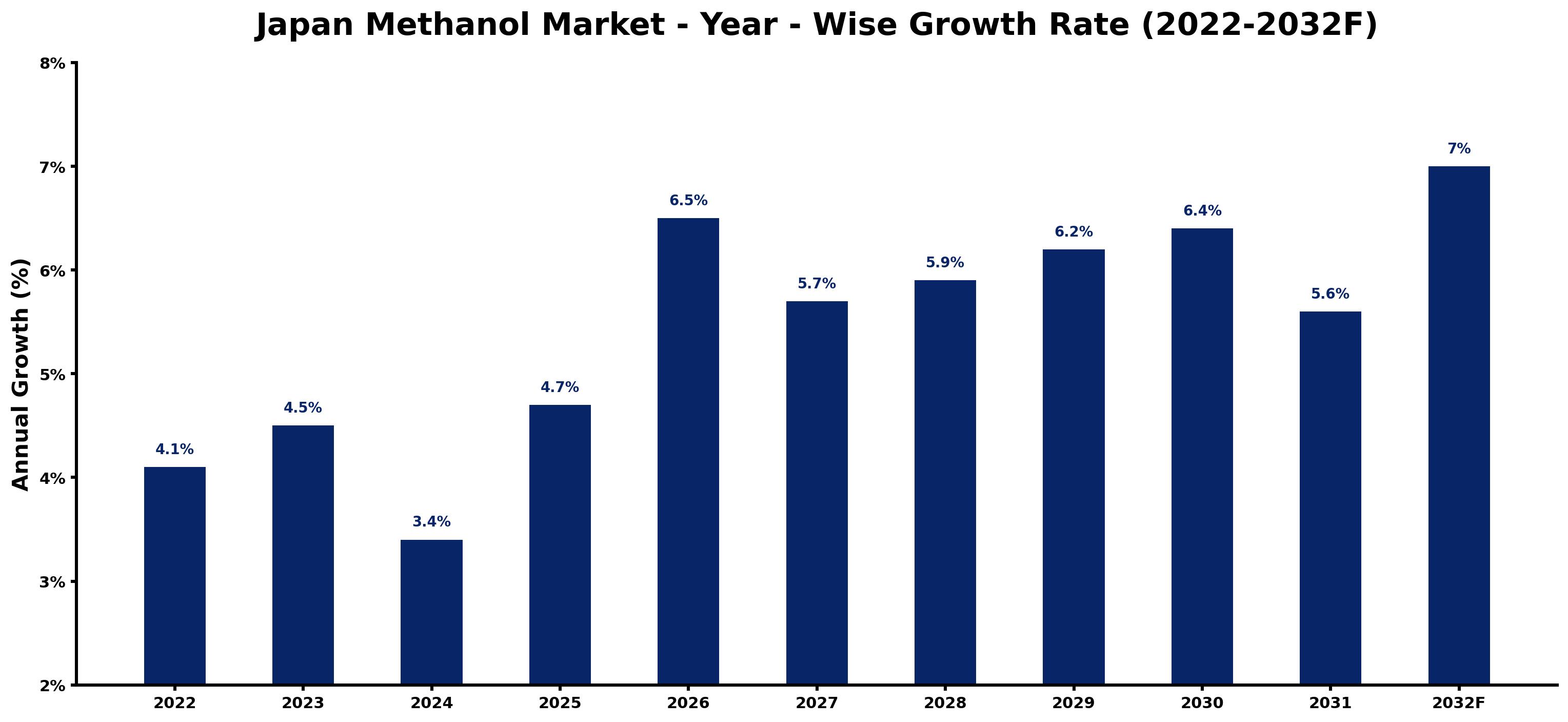
Year by year, the estimates below pair each growth rate with the development that shaped it.
| Year | Estimated Annual Growth (%) | Market Rationale |
| 2022 | 4.1 | The methanol market experienced steady demand from various sectors, particularly automotive fuel applications. |
| 2023 | 4.5 | Growth accelerated as automotive fuel additives gained popularity amidst rising energy needs. |
| 2024 | 3.4 | Demand growth slowed slightly due to market saturation in certain derivative applications. |
| 2025 | 4.7 | Increased production of formaldehyde contributed to a resurgence in methanol demand. |
| 2026 | 6.5 | The automotive sector's shift towards methanol-based fuel additives is expected to spur growth. |
| 2027 | 5.7 | Demand growth is projected to decelerate as the market adjusts to previous rapid expansions. |
| 2028 | 5.9 | Rising interest in methanol as a clean energy source will revitalise market activity. |
| 2029 | 6.2 | The pharmaceutical sector's increasing use of methanol will drive further demand. |
| 2030 | 6.4 | Sustained investments in methanol fuel cell technology will support market growth. |
| 2031 | 5.6 | Growth is anticipated to moderate as the market stabilises following several years of expansion. |
| 2032 | 7.0 | The introduction of new methanol applications is expected to boost demand. |
Note: Market size estimations and growth projections presented in this report are based on 6Wresearch's proprietary forecasting methodology, utilizing the latest available industry data, government publications, and primary research inputs.
Japan Methanol Market Synopsis
Methanol is a colourless, flammable liquid primarily produced from natural gas and coal, serving as a key chemical feedstock and fuel. Its main applications include the production of formaldehyde, acetic acid, and as a fuel additive. The Japan Methanol Market is expanding due to rising demand from the automotive sector, which utilises methanol-based fuel additives, and ongoing initiatives promoting methanol as a clean energy source. With production reaching approximately 1.5 million tons in 2022, the market is set for growth driven by both domestic consumption and imports of around 1.2 million tons in 2023.
Market Dynamics Impact Analysis (2026–2032)
| Factor | Type | Impact | Primary Segment Affected |
| Rising automotive sector demand for methanol-based fuel additives | Driver | High | Gasoline additives |
| Increasing applications of methanol in pharmaceuticals | Driver | High | Pharmaceuticals |
| Growing interest in methanol as a clean energy source | Opportunity | High | Natural Gas |
| Expansion of methanol fuel cell technology installations | Opportunity | High | Natural Gas |
| Regulatory compliance costs impacting production | Restraint | High | Natural Gas |
| Market volatility due to fluctuating feedstock prices | Restraint | Medium | Coal |
| High investment requirements for new production facilities | Challenge | High | Natural Gas |
| Technological challenges in methanol synthesis processes | Challenge | Medium | Natural Gas |
Evaluation of Drivers in Japan Methanol Market (2026–2032)
The factors lifting demand, and the evidence behind each, are summarised below.
| Drivers | Primary Segment Affected | Why It Matters (Evidence) |
| Increased production of formaldehyde from methanol | Formaldehyde | Formaldehyde production accounts for about 40% of methanol demand, leading to higher purchases from chemical manufacturers. |
| Rising use of methanol in pharmaceuticals | Pharmaceuticals | The pharmaceutical industry is increasingly sourcing methanol for drug synthesis, driving higher demand for methanol in this sector. |
| Investment in methanol fuel cell technology | Natural Gas | The installed base of methanol fuel cells, around 10,000 units, encourages further investments and purchases, increasing market penetration. |
| Expansion of methanol applications in construction materials | Construction | Methanol's role in producing insulation materials leads to increased demand from construction firms, supporting growth in this sector. |
| Growing demand for methanol-based fuel additives | Gasoline additives | The automotive sector's shift towards cleaner fuel options boosts the demand for methanol-based additives, increasing overall consumption. |
Much of the new demand traces back to the automotive sector's increasing use of methanol-based fuel additives, which accounted for 41% of gasoline additives in 2025. The pharmaceutical industry is also driving demand, with methanol used in drug synthesis, contributing to a rising need for approximately 1.5 million tons produced in 2022. Methanol's growing applications in construction materials, particularly insulation, are expanding its market presence. The installed base of methanol fuel cells supports further investments in this technology, increasing overall market demand. Japan's strategic plan for promoting methanol as a hydrogen carrier by 2025 is anticipated to further stimulate market growth.
Evaluation of Restraints in Japan Methanol Market
The main factors holding the market back are set out below.
| Market Restraint | Primary Segment Affected | Why It Matters (Evidence) |
| High compliance costs due to regulatory requirements | Natural Gas | Producers must adhere to the Chemical Substances Control Law, increasing operational costs and impacting profitability. |
| Fluctuating prices of natural gas and coal feedstocks | Coal | Price volatility impacts production costs, affecting profitability for methanol manufacturers and limiting competitive pricing. |
| Limited domestic production capacity for methanol | Gasoline additives | Dependence on imports for certain derivatives constrains local supply capabilities, resulting in potential shortages. |
| Environmental regulations impacting production methods | Natural Gas | Stricter regulations necessitate investment in cleaner technologies, raising costs for producers and affecting their competitiveness. |
| Market saturation in certain derivative applications | Formaldehyde | Overproduction in formaldehyde leads to reduced demand for methanol in this segment, impacting overall market health. |
Japan Methanol Market Challenges
Japan's methanol producers struggle with a skills shortage, which hampers production efficiency and increases operational costs for manufacturers. Intense competition from international suppliers pressures local producers to reduce prices, eroding profit margins. Importers face unpredictable import prices, which can fluctuate by as much as 15% quarterly, complicating budgeting for domestic users, particularly in the automotive sector. Adhering to the Chemical Substances Control Law requires substantial investment, diverting resources from innovation and limiting the competitiveness of local producers.
Trends in the Japan Methanol Market
The following changes are redrawing the Japan Methanol Market.
- Shift towards Methanol Fuel Cells: In 2023, Japan's installed base of methanol fuel cells reached approximately 10,000 units, reflecting a growing interest in clean energy solutions. This trend encourages manufacturers to invest in fuel cell technologies, reinforcing methanol's role in the energy transition.
- Growing Use of Methanol in Pharmaceuticals: The pharmaceutical sector is increasingly utilising methanol for drug synthesis, with demand rising as new applications are explored. This trend is projected to expand, driven by the need for efficient production processes.
- Expansion of Methanol Applications in Construction: Methanol is gaining traction in the construction sector, particularly for insulation materials. The demand for these materials is expected to increase as the construction industry focuses on energy-efficient solutions.
- Increased Focus on Clean Energy Initiatives: Japan's strategic plan for promoting methanol as a hydrogen carrier by 2025 highlights the country's commitment to clean energy. This initiative is set to drive further investments in methanol production and applications.
Investment Opportunities in the Japan Methanol Market
Several openings in the Japan Methanol Market merit attention from investors.
- Supply of Methanol for Fuel Additives: The automotive sector is seeking methanol for fuel additives, with demand projected to rise. Investment in production facilities in the Kanto region can meet this growing need, particularly as the market expands.
- Investment in Methanol Fuel Cell Technology: With around 1.2 million tons of methanol imported in 2023, there is a notable gap in production capacity. Investing in new production facilities can help meet the increasing demand from energy providers and automotive manufacturers.
- Expansion of Methanol in Pharmaceuticals: Pharmaceutical companies are increasingly sourcing methanol for drug synthesis, with demand on the rise. Establishing partnerships with local producers can facilitate access to this growing market.
- Growth in Construction Material Applications: There is a rising demand for methanol in insulation materials within the construction sector. Suppliers can enter this market by collaborating with construction firms focused on energy-efficient solutions.
Government Initiatives in the Japan Methanol Market
The Chemical Substances Control Law, established in 1973, mandates the evaluation and control of chemical substances in production and import. This law ensures that methanol producers adhere to safety and environmental standards, impacting their operational practices. Additionally, the Semiconductor and Digital Industry Strategy, introduced in June 2021, aims to secure domestic semiconductor manufacturing, indirectly influencing methanol demand for various applications.
In 2023, the Ministry of Economy, Trade and Industry (METI) launched initiatives supporting methanol fuel cell development. These initiatives are designed to promote clean energy solutions, with funding allocated to research and development projects. METI oversees these programmes, ensuring that methanol's potential as a clean energy source is fully realised.
Future Insight of the Japan Methanol Market
Investment in methanol fuel cell technology will drive demand for cleaner energy solutions, particularly in transportation. The government's strategic plan to promote methanol as a hydrogen carrier will unlock new markets and applications. Research initiatives by the National Institute of Advanced Industrial Science and Technology will strengthen methanol's role in various sectors. With Japan importing approximately 1.2 million tons of methanol in 2023, the emphasis on sustainable energy will likely increase import volumes and diversify supply sources.
Market Segmentation Analysis
Japan Methanol Market report covers a detailed analysis of the following market segments:
By Feedstock – Natural Gas Lead, Coal Expected to Grow Fastest
According to Ravi Bhandari, Research Head at 6Wresearch, Natural Gas held 58% of the Japan Methanol Market by feedstock in 2025. Natural gas serves as the primary feedstock for methanol production in Japan, predominantly sourced from the Kanto region where extraction and processing are concentrated. The production of approximately 1.5 million tons of methanol in 2022 underscores the critical role of natural gas in this industry. Coal is projected to grow fastest, at a CAGR of 8.4% during 2026–2032. Coal is gaining traction as a viable alternative feedstock for methanol synthesis, driven by Japan's initiatives to diversify its energy sources. The government's support for coal-based methanol production is expected to significantly enhance its market share in the coming years. Suppliers should secure natural gas supplies while exploring coal options to adapt to the changing energy landscape.
By Derivatives – Formaldehyde Leads, Dimethyl Ether (DME) Expected to Grow Fastest
The largest derivatives category in 2025 was Formaldehyde, at 30% of revenue. Formaldehyde, accounting for about 40% of methanol demand in Japan, is extensively used in various industrial applications, including the production of synthetic resins. The strong established market for formaldehyde ensures its dominance in the derivatives segment. The quickest growth will come from Dimethyl Ether (DME), forecast to expand at a CAGR of 8.6% between 2026 and 2032. Dimethyl Ether (DME) is experiencing rapid growth as a cleaner fuel alternative, supported by government initiatives promoting methanol as a clean energy source. This trend is expected to accelerate DME's adoption in fuel applications, further driving its market share. Buyers may benefit from exploring formaldehyde and DME options for their production needs, given their growing significance.
By Sub-Derivatives – Gasoline additives Lead and Record the Fastest Growth
With 41% of sub-derivatives revenue in 2025, Gasoline additives was the largest category. Gasoline additives represent a substantial share of methanol's sub-derivative applications, extensively used in various fuel formulations within Japan's automotive sector. The automotive industry's considerable consumption of these additives solidifies this sub-segment's dominant position in the market. Gasoline additives are also forecast to expand faster than any other category, at a CAGR of 8.7% over 2026–2032. Gasoline additives are also witnessing the fastest growth, as the automotive sector increasingly incorporates methanol for cleaner fuel solutions. This simultaneous leadership and rapid growth indicate a sustained demand for methanol in fuel formulations, reinforcing its market presence. Suppliers should prioritise the development of gasoline additives to capitalise on the expanding automotive market and meet rising demand.
By End-Use Industry – Automotive Leads, Pharmaceuticals Expected to Grow Fastest
Automotive took 31% of end-use industry revenue in 2025, more than any other category. The automotive sector stands as the largest end-use industry for methanol, with significant applications in fuel additives driving high demand. This reliance on methanol for cleaner fuel options highlights the automotive industry's vital role in the overall market. Pharmaceuticals are set to record the highest CAGR in this split, 8.5% over 2026–2032. Pharmaceuticals are emerging as the fastest-growing end-use industry, with increasing demand for methanol in drug synthesis and intermediates. This trend reflects a shift towards utilising methanol in high-value applications, further broadening its market usage. Buyers in the pharmaceutical sector should acknowledge the growing importance of methanol in drug production to ensure a reliable supply.
Key Attractiveness of the Report
- 10 Years of Market Numbers
- Historical Data Starting from 2022 to 2025
- Base Year 2025
- Forecast Data until 2032
- Key Performance Indicators Impacting the Market
- Major Upcoming Developments and Projects
Key Highlights of the Report:
- Japan Methanol Market Outlook
- Market Size of Japan Methanol Market, 2025
- Forecast of Japan Methanol Market, 2032
- Historical Data and Forecast of Japan Methanol Revenues & Volume for the Period 2022-2032
- Japan Methanol Market Trend Evolution
- Japan Methanol Market Drivers and Challenges
- Japan Methanol Price Trends
- Japan Methanol Porter's Five Forces
- Japan Methanol Industry Life Cycle
- Historical Data and Forecast of Japan Methanol Market Revenues & Volume By Feedstock for the Period 2022-2032
- Historical Data and Forecast of Japan Methanol Market Revenues & Volume By Natural Gas for the Period 2022-2032
- Historical Data and Forecast of Japan Methanol Market Revenues & Volume By Coal for the Period 2022-2032
- Historical Data and Forecast of Japan Methanol Market Revenues & Volume By Others for the Period 2022-2032
- Historical Data and Forecast of Japan Methanol Market Revenues & Volume By Derivatives for the Period 2022-2032
- Historical Data and Forecast of Japan Methanol Market Revenues & Volume By Gasoline for the Period 2022-2032
- Historical Data and Forecast of Japan Methanol Market Revenues & Volume By MTO/MTP for the Period 2022-2032
- Historical Data and Forecast of Japan Methanol Market Revenues & Volume By Formaldehyde for the Period 2022-2032
- Historical Data and Forecast of Japan Methanol Market Revenues & Volume By Methyl Tertiary Butyl Ether (MTBE) for the Period 2022-2032
- Historical Data and Forecast of Japan Methanol Market Revenues & Volume By Acetic Acid for the Period 2022-2032
- Historical Data and Forecast of Japan Methanol Market Revenues & Volume By Dimethyl Ether (DME) for the Period 2022-2032
- Historical Data and Forecast of Japan Methanol Market Revenues & Volume By Methyl Methacrylate (MMA) for the Period 2022-2032
- Historical Data and Forecast of Japan Methanol Market Revenues & Volume By Others for the Period 2022-2032
- Historical Data and Forecast of Japan Methanol Market Revenues & Volume By Sub-Derivatives for the Period 2022-2032
- Historical Data and Forecast of Japan Methanol Market Revenues & Volume By Gasoline additives for the Period 2022-2032
- Historical Data and Forecast of Japan Methanol Market Revenues & Volume By Olefins for the Period 2022-2032
- Historical Data and Forecast of Japan Methanol Market Revenues & Volume By UF/PF resins for the Period 2022-2032
- Historical Data and Forecast of Japan Methanol Market Revenues & Volume By VAM for the Period 2022-2032
- Historical Data and Forecast of Japan Methanol Market Revenues & Volume By Polyacetals for the Period 2022-2032
- Historical Data and Forecast of Japan Methanol Market Revenues & Volume By MDI for the Period 2022-2032
- Historical Data and Forecast of Japan Methanol Market Revenues & Volume By PTA for the Period 2022-2032
- Historical Data and Forecast of Japan Methanol Market Revenues & Volume By Others for the Period 2022-2032
- Historical Data and Forecast of Japan Methanol Market Revenues & Volume By End-Use Industry for the Period 2022-2032
- Historical Data and Forecast of Japan Methanol Market Revenues & Volume By Construction for the Period 2022-2032
- Historical Data and Forecast of Japan Methanol Market Revenues & Volume By Automotive for the Period 2022-2032
- Historical Data and Forecast of Japan Methanol Market Revenues & Volume By Electronics for the Period 2022-2032
- Historical Data and Forecast of Japan Methanol Market Revenues & Volume By Appliances for the Period 2022-2032
- Historical Data and Forecast of Japan Methanol Market Revenues & Volume By Paints & Coatings for the Period 2022-2032
- Historical Data and Forecast of Japan Methanol Market Revenues & Volume By Insulation for the Period 2022-2032
- Historical Data and Forecast of Japan Methanol Market Revenues & Volume By Pharmaceuticals for the Period 2022-2032
- Historical Data and Forecast of Japan Methanol Market Revenues & Volume By Others for the Period 2022-2032
- Japan Methanol Import Export Trade Statistics
- Market Opportunity Assessment By Feedstock
- Market Opportunity Assessment By Derivatives
- Market Opportunity Assessment By Sub-Derivatives
- Market Opportunity Assessment By End-Use Industry
- Japan Methanol Top Companies Market Share
- Japan Methanol Competitive Benchmarking By Technical and Operational Parameters
- Japan Methanol Company Profiles
- Japan Methanol Key Strategic Recommendations
Market Covered
The following segment groups are covered in the report.
By Feedstock
- Natural Gas
- Coal
- Others
By Derivatives
- Gasoline
- MTO/MTP
- Formaldehyde
- Methyl Tertiary Butyl Ether (MTBE)
- Acetic Acid
- Dimethyl Ether (DME)
- Methyl Methacrylate (MMA)
- Others
By Sub-Derivatives
- Gasoline additives
- Olefins
- UF/PF resins
- VAM
- Polyacetals
- MDI
- PTA
- Others
By End-Use Industry
- Construction
- Automotive
- Electronics
- Appliances
- Paints & Coatings
- Insulation
- Pharmaceuticals
- Others































