Japan Micro Finance Market Size & Growth Rate
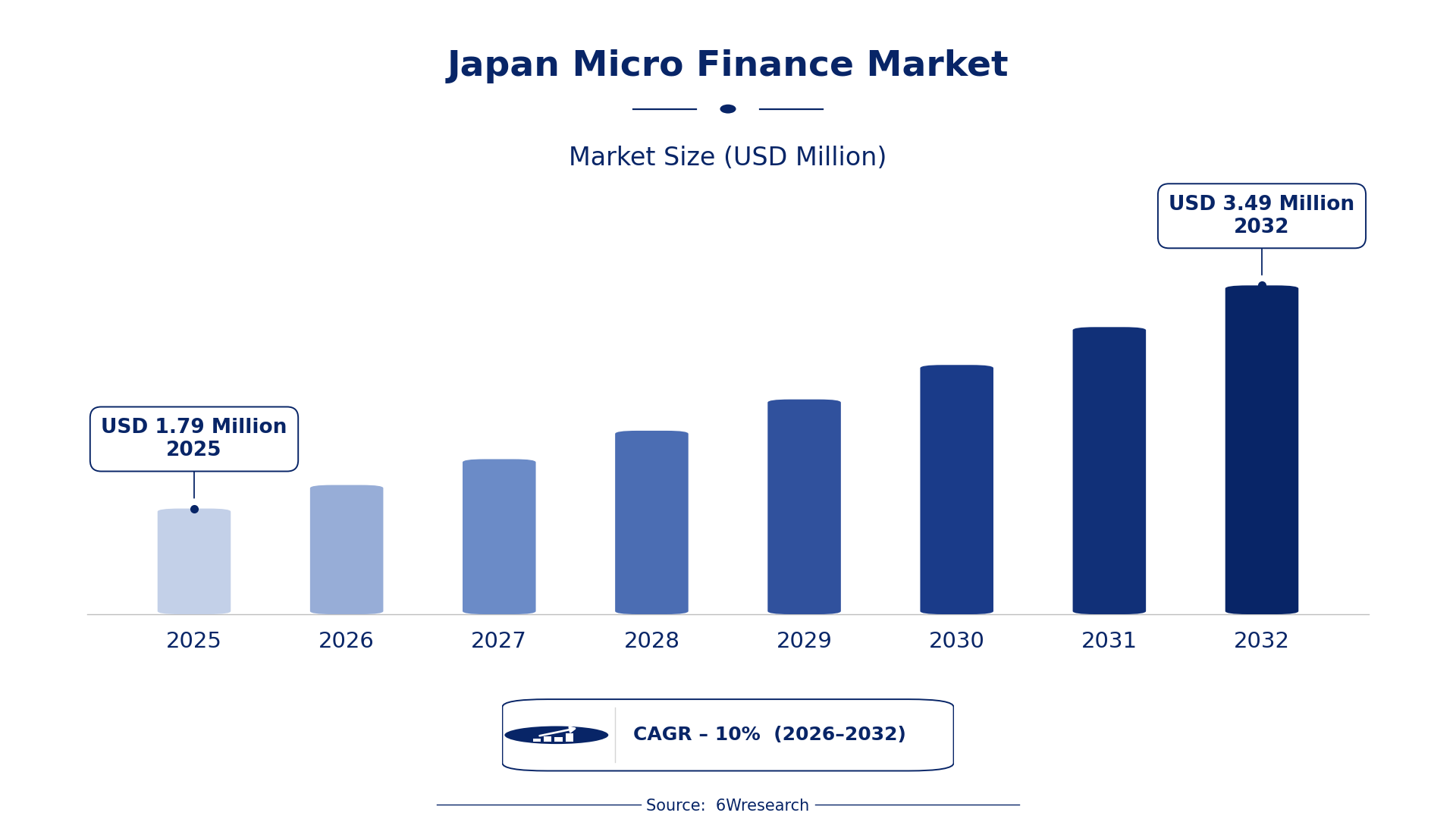
According to 6Wresearch internal database and industry insights, the Japan Micro Finance Market was valued at USD 1.79 Million in 2025 and is projected to reach USD 3.49 Million by 2032, growing at a CAGR of approximately 10% during 2026–2032.
Japan Micro Finance Market Highlights
| Report Metric | Details |
| Report Name | Japan Micro Finance Market (2026-2032) |
| Market Size 2025 | USD 1.79 Million |
| Market Size 2032 | USD 3.49 Million |
| Absolute Growth 2025–2032 | USD 1.70 Million |
| CAGR 2026–2032 | 10% |
| Peak Annual Growth | 14.4% in 2029 |
| Forecast Period | 2026–2032 |
| Historical Data | 2022–2025 |
| Base Year | 2025 |
| Leading Type, 2025 | Banks (48% share) |
| Leading End-User, 2025 | Small Enterprises (52% share) |
| Fastest-Growing Type | Micro Finance Institute (13.5% CAGR) |
| Fastest-Growing End-User | Solo Entrepreneurs (12.4% CAGR) |
| Growing Sector | micro finance |
| Key End Users | small enterprises, solo entrepreneurs, micro entrepreneurs |
Japan Micro Finance Market Year-wise Growth Rate and Key Drivers (2022–2032)
This graph illustrates the annual growth rates of the market from 2022 to 2032, highlighting a steady upward trajectory and projected market expansion over the forecast period.
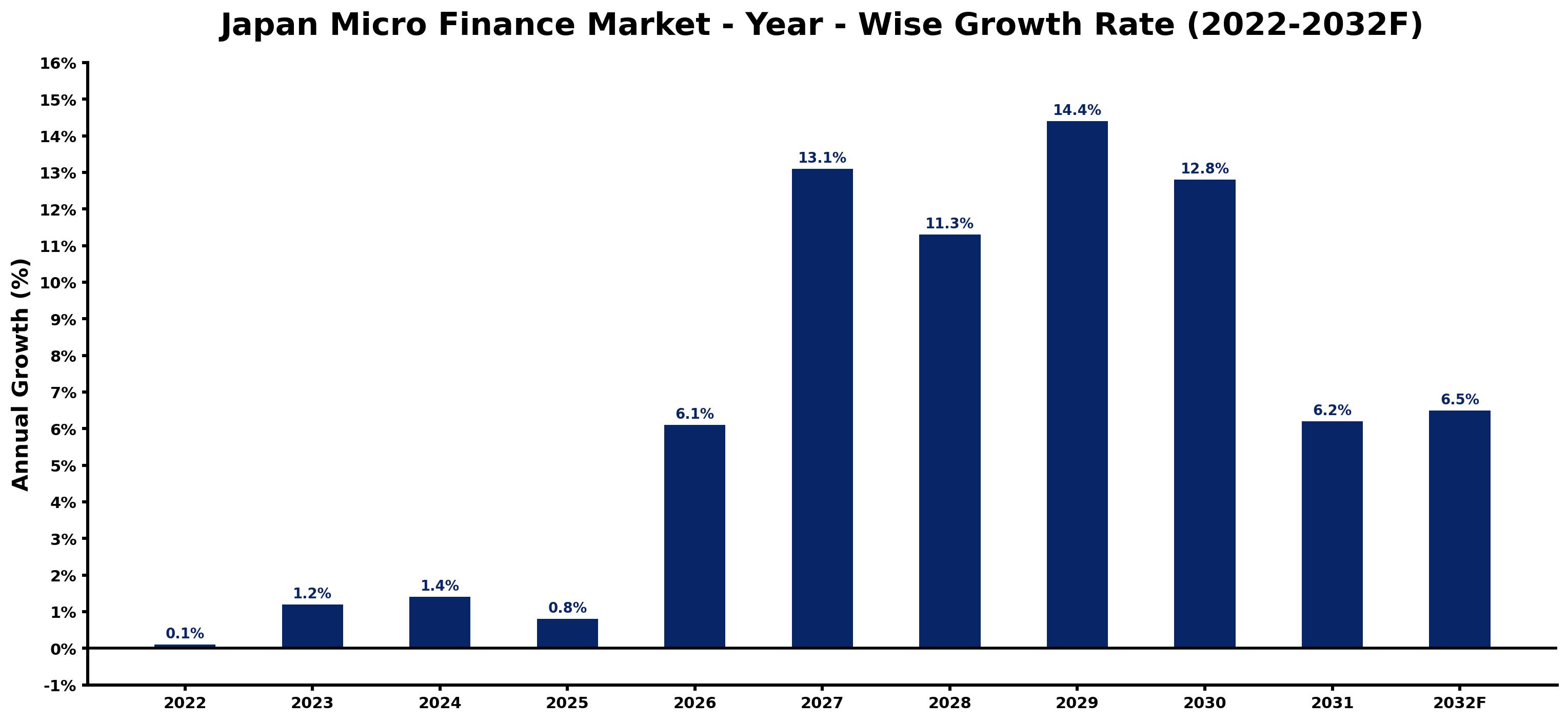
Each row of the following table gives one year's estimated growth and the event or demand shift that explains it.
| Year | Estimated Annual Growth (%) | Market Rationale |
| 2022 | 0.1 | The market experienced minimal growth as micro finance awareness was still developing. |
| 2023 | 1.2 | Outreach efforts targeting underserved communities accelerated growth this year. |
| 2024 | 1.4 | Demand for small loans among entrepreneurs continued to rise, driving expansion. |
| 2025 | 0.8 | Market saturation began to impact new client acquisition, slowing growth. |
| 2026 | 6.1 | Investment in micro finance institutions is expected to increase, boosting service availability. |
| 2027 | 13.1 | More entrepreneurs will seek funding for business expansion, driving demand. |
| 2028 | 11.3 | Growth will slow slightly due to market adjustments and competition among MFIs. |
| 2029 | 14.4 | New financing solutions will attract more clients, leading to peak growth. |
| 2030 | 12.8 | The market will stabilise after rapid expansion, resulting in slower growth. |
| 2031 | 6.2 | Financial literacy improvements will support continued demand growth, albeit at a slower pace. |
| 2032 | 6.5 | More micro entrepreneurs entering the market will drive growth. |
Note: Market size estimations and growth projections presented in this report are based on 6Wresearch's proprietary forecasting methodology, utilizing the latest available industry data, government publications, and primary research inputs.
Japan Micro Finance Market Synopsis
Micro finance encompasses financial services aimed at low-income individuals and small enterprises that lack access to traditional banking. This sector supports around 500,000 micro entrepreneurs each year, with loans typically ranging from ¥100,000 to ¥3,000,000. The Japan Micro Finance Market is growing due to increased investment in micro finance institutions, government initiatives such as the 2023 funding programme, and heightened financial literacy efforts. The Tokyo region, which accounts for 40% of market activity, shows strong demand for these services.
Market Dynamics Impact Analysis (2026–2032)
| Factor | Type | Impact | Primary Segment Affected |
| Increased investment in micro finance institutions | Driver | High | Micro Finance Institute |
| Growing demand for small loans among entrepreneurs | Driver | High | Small Enterprises |
| Expansion of micro finance programs | Opportunity | High | Micro Finance Institute |
| Government funding initiatives for micro enterprises | Opportunity | High | Small Enterprises |
| Regulatory compliance costs for micro finance institutions | Restraint | Medium | Micro Finance Institute |
| Limited access to traditional banking services | Restraint | High | Small Enterprises |
| High operational costs for micro finance institutions | Challenge | Medium | Micro Finance Institute |
| Competition among micro finance providers | Challenge | Medium | Small Enterprises |
Evaluation of Drivers in Japan Micro Finance Market (2026–2032)
The factors lifting demand, and the evidence behind each, are summarised below.
| Drivers | Primary Segment Affected | Why It Matters (Evidence) |
| Increased funding for micro finance institutions | Micro Finance Institute | In 2023, the government allocated ¥5 billion to support micro enterprises, improving service delivery. |
| Rising demand for small loans | Small Enterprises | Around 500,000 micro entrepreneurs seek loans annually, driving demand for financial services. |
| Government initiatives to support financial literacy | Micro Finance Institute | The 2023 initiative aims to educate 100,000 individuals, increasing client engagement. |
| Growth of urban micro finance activity | Small Enterprises | The Tokyo region accounts for 40% of micro finance activity, highlighting urban demand. |
| Compliance with JIS standards | Micro Finance Institute | Micro finance institutions must adhere to JIS standards, ensuring service quality and trust. |
Demand for small loans continues to rise as more entrepreneurs seek funding for their ventures. Enhanced service quality through compliance with JIS standards is fostering trust among borrowers and encouraging more applications for loans. The Tokyo region's significant micro finance activity illustrates the growing urban demand for these services.
Evaluation of Restraints in Japan Micro Finance Market
The key brakes on demand, and where they bite hardest, are shown below.
| Market Restraint | Primary Segment Affected | Why It Matters (Evidence) |
| High operational costs for micro finance institutions | Micro Finance Institute | Operational costs are increasing, limiting profitability for institutions, which affects loan availability. |
| Limited access to traditional banking services | Small Enterprises | Many small enterprises still struggle to access traditional banking, hindering their growth potential. |
| Regulatory compliance costs | Micro Finance Institute | Institutions face costs to comply with regulations, impacting their ability to lend. |
| Market saturation in urban areas | Small Enterprises | In urban areas, competition among providers limits new client acquisition opportunities. |
| Economic fluctuations affecting borrower repayment | Micro Finance Institute | Economic instability can lead to higher default rates among borrowers, impacting institutions. |
Japan Micro Finance Market Challenges
Micro finance institutions face a skills shortage that limits their ability to assist clients effectively. This issue arises from inadequate training, leading to delays in loan approvals for many borrowers. Outdated technology restricts operational efficiency, resulting in longer processing times for loans, which affects small businesses that require quick access to funds. Increased competition from alternative lenders compels institutions to reduce interest rates, impacting profitability and sustainability. Additionally, disruptions in the supply chain can impede capital availability, delaying loan disbursement for clients who depend on timely financial support.
Trends in the Japan Micro Finance Market
These developments are changing demand patterns in the Japan Micro Finance Market.
- Shift towards Digital Micro Finance Solutions: Micro finance institutions are increasingly embracing digital platforms to enhance service delivery. In 2023, about 30% of loans were processed online, improving access for borrowers.
- Increased Focus on Financial Literacy: A government initiative launched in 2023 aims to educate 100,000 individuals on financial management. This effort is expected to empower more micro entrepreneurs to effectively utilise financial services.
- Growth of Micro Finance in Urban Areas: The Tokyo region has emerged as a centre for micro finance activity, accounting for 40% of the market. This concentration reflects the high demand for financial services among urban entrepreneurs.
- Expansion of Government Funding Initiatives: In 2023, the government allocated ¥5 billion to support micro enterprises. This funding seeks to enhance access to financial services for underserved populations.
Investment Opportunities in the Japan Micro Finance Market
Several openings in the Japan Micro Finance Market merit attention from investors.
- Gap in Financial Services for Low-Income Individuals: With many micro entrepreneurs annually, there is a gap in financial services. Investing in micro finance institutions can meet this demand effectively.
- Growing Demand for Small Business Loans: The increasing number of small enterprises in urban areas presents an opportunity for micro finance providers. Collaborating with local governments can improve outreach efforts.
- Potential for Digital Transformation: The shift towards digital platforms offers a chance for micro finance institutions to streamline operations. Partnering with tech firms can facilitate this transformation.
- Government Support for Financial Literacy Initiatives: The 2023 initiative to educate individuals on financial management opens avenues for investment in educational programs. Collaborating with local educational institutions can improve effectiveness.
Government Initiatives in the Japan Micro Finance Market
The micro finance sector in Japan is governed by laws such as the Industrial Standardization Act of 1949, which sets standards for financial services. Additionally, the Act against Unjustifiable Premiums and Misleading Representations from 1962 prohibits misleading advertising, ensuring transparency in micro finance operations.
The Financial Services Agency oversees micro finance regulations and requires institutions to report their activities. The Small and Medium Enterprise Agency provides resources and funding for micro finance development, supporting initiatives that improve access to financial services.
Future Insight of the Japan Micro Finance Market
Emerging technologies will reshape micro finance services by 2032, allowing institutions to engage with a broader customer base. Enhanced funding initiatives will inject ¥5 billion into the sector, driving growth for small businesses. New financial literacy initiatives will target 150,000 individuals, equipping them with essential skills to manage their finances. Compliance with evolving JIS standards will elevate service quality, benefiting both borrowers and lenders in the micro finance ecosystem.
Market Segmentation Analysis
Japan Micro Finance Market report covers a detailed analysis of the following market segments:
By Type – Banks Lead, Micro Finance Institute Expected to Grow Fastest
According to Dhaval Chaurasia, Assistant Manager at 6Wresearch, the largest type category in 2025 was Banks, at 48% of revenue. Banks hold the largest share in Japan's micro finance market due to their established infrastructure and customer base. They provide traditional financial services, which indirectly support micro finance initiatives, particularly in urban areas with higher demand for such services. Micro Finance Institute is projected to grow fastest, at a CAGR of 13.5% during 2026–2032. Micro Finance Institutes are experiencing rapid growth as they directly cater to underserved populations, filling the gap left by traditional banks. With over 1,200 registered MFIs in Japan, their focus on micro finance services is increasingly appealing to borrowers. Suppliers should consider aligning their offerings with the growing demand for micro finance services provided by MFIs.
By End-User – Small Enterprises Lead, Solo Entrepreneurs Expected to Grow Fastest
In 2025, Small Enterprises led the end-user split with a 52% share. Small Enterprises dominate Japan's micro finance market as they are the primary recipients of loans aimed at enhancing their operations. In urban areas like Tokyo, where 40% of micro finance activity occurs, these enterprises actively seek financial assistance to grow their businesses. Over 2026–2032, Solo Entrepreneurs are expected to post the fastest growth, at a CAGR of 12.4%. Solo Entrepreneurs are witnessing the fastest growth in this sector as they increasingly rely on micro finance for vital startup and operational funds. The government's initiative, which allocates ¥5 billion to support micro enterprises, is a key factor driving this rapid expansion. This indicates that suppliers should tailor their financial offerings to meet the specific requirements of solo entrepreneurs.
Key Attractiveness of the Report
- 10 Years of Market Numbers
- Historical Data Starting from 2022 to 2025
- Base Year 2025
- Forecast Data until 2032
- Key Performance Indicators Impacting the Market
- Major Upcoming Developments and Projects
Key Highlights of the Report:
- Japan Micro Finance Market Outlook
- Market Size of Japan Micro Finance Market, 2025
- Forecast of Japan Micro Finance Market, 2032
- Historical Data and Forecast of Japan Micro Finance Revenues & Volume for the Period 2022-2032
- Japan Micro Finance Market Trend Evolution
- Japan Micro Finance Market Drivers and Challenges
- Japan Micro Finance Price Trends
- Japan Micro Finance Porter's Five Forces
- Japan Micro Finance Industry Life Cycle
- Historical Data and Forecast of Japan Micro Finance Market Revenues & Volume By Type for the Period 2022-2032
- Historical Data and Forecast of Japan Micro Finance Market Revenues & Volume By Banks for the Period 2022-2032
- Historical Data and Forecast of Japan Micro Finance Market Revenues & Volume By Micro Finance Institute for the Period 2022-2032
- Historical Data and Forecast of Japan Micro Finance Market Revenues & Volume By Non-Banking Financial Institutions for the Period 2022-2032
- Historical Data and Forecast of Japan Micro Finance Market Revenues & Volume By End-User for the Period 2022-2032
- Historical Data and Forecast of Japan Micro Finance Market Revenues & Volume By Small Enterprises for the Period 2022-2032
- Historical Data and Forecast of Japan Micro Finance Market Revenues & Volume By Solo Entrepreneurs for the Period 2022-2032
- Historical Data and Forecast of Japan Micro Finance Market Revenues & Volume By Micro Entrepreneurs for the Period 2022-2032
- Japan Micro Finance Import Export Trade Statistics
- Market Opportunity Assessment By Type
- Market Opportunity Assessment By End-User
- Japan Micro Finance Top Companies Market Share
- Japan Micro Finance Competitive Benchmarking By Technical and Operational Parameters
- Japan Micro Finance Company Profiles
- Japan Micro Finance Key Strategic Recommendations
Market Covered
Coverage by segment is as follows.
By Type
- Banks
- Micro Finance Institute
- Non-Banking Financial Institutions
By End-User
- Small Enterprises
- Solo Entrepreneurs
- Micro Entrepreneurs































