Japan microalgae fertilizers Market Size & Growth Rate
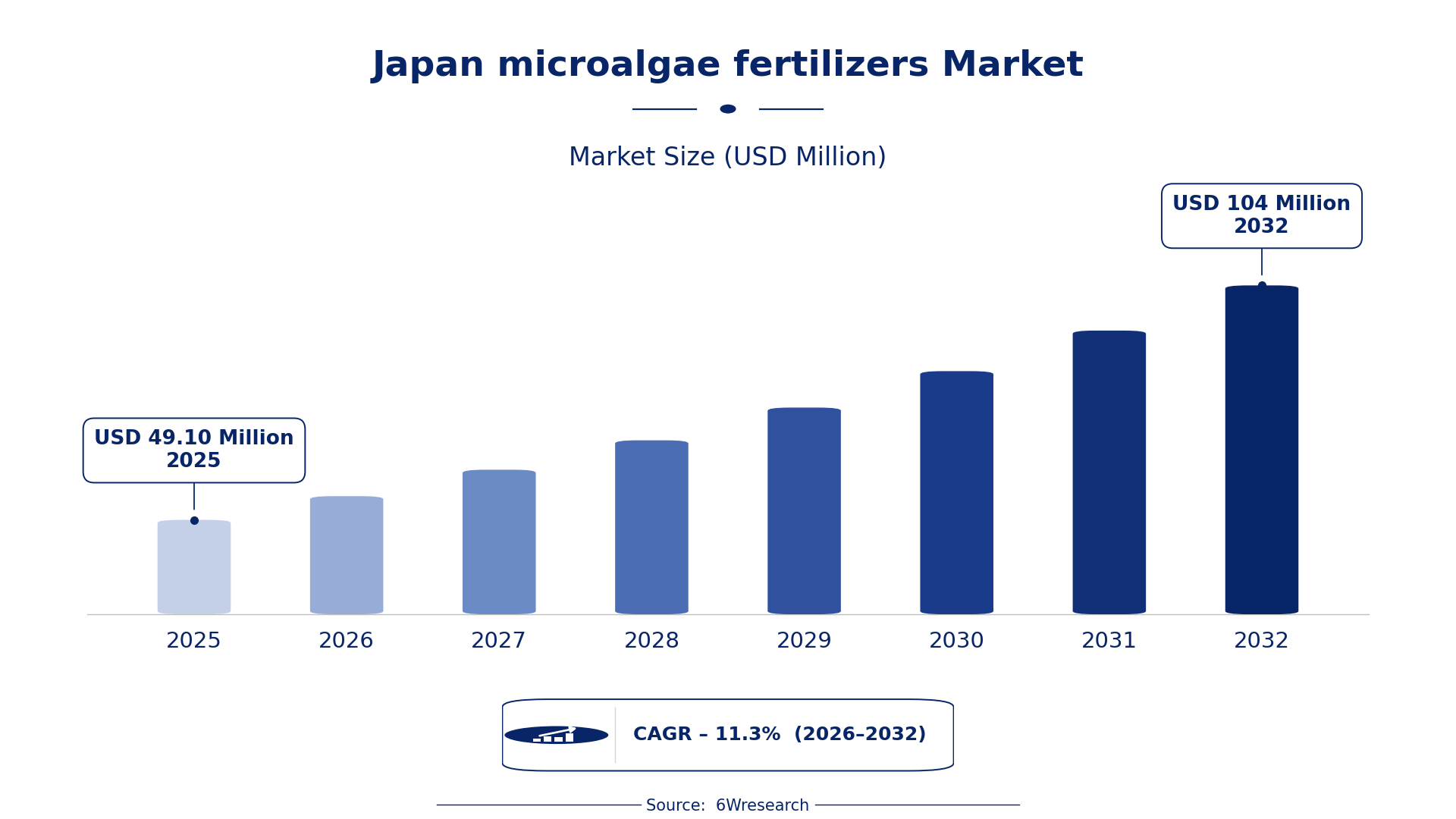
According to 6Wresearch internal database and industry insights, the Japan microalgae fertilizers Market was valued at USD 49.10 Million in 2025 and is projected to reach USD 104 Million by 2032, growing at a CAGR of approximately 11.3% during 2026–2032.
Japan microalgae fertilizers Market Highlights
| Report Metric | Details |
| Report Name | Japan microalgae fertilizers Market (2026-2032) |
| Market Size 2025 | USD 49.10 Million |
| Market Size 2032 | USD 104 Million |
| Absolute Growth 2025–2032 | USD 54.90 Million |
| CAGR 2026–2032 | 11.3% |
| Peak Annual Growth | 15.8% in 2026 |
| Forecast Period | 2026–2032 |
| Historical Data | 2022–2025 |
| Base Year | 2025 |
| Leading Product Type, 2025 | Liquid Fertilizers (44% share) |
| Leading Algae Type, 2025 | Spirulina (49% share) |
| Leading Application Area, 2025 | Foliar Application (43% share) |
| Leading Distribution Channel, 2025 | Agro Distributors (40% share) |
| Leading End User, 2025 | Farmers (46% share) |
| Fastest-Growing Product Type | Bio-stimulants (15.7% CAGR) |
| Fastest-Growing Algae Type | Mixed Algae (15.1% CAGR) |
| Fastest-Growing Application Area | Horticulture (12.9% CAGR) |
| Fastest-Growing Distribution Channel | Online Platforms (14.3% CAGR) |
| Fastest-Growing End User | Organic Farms (14.7% CAGR) |
| Growing Sector | Organic Farming |
| Key End Users | Farmers, Agricultural Cooperatives, Organic Farms, Greenhouses |
Japan microalgae fertilizers Market Year-wise Growth Rate and Key Drivers (2022–2032)
This graph illustrates the annual growth rates of the market from 2022 to 2032, highlighting a steady upward trajectory and projected market expansion over the forecast period.
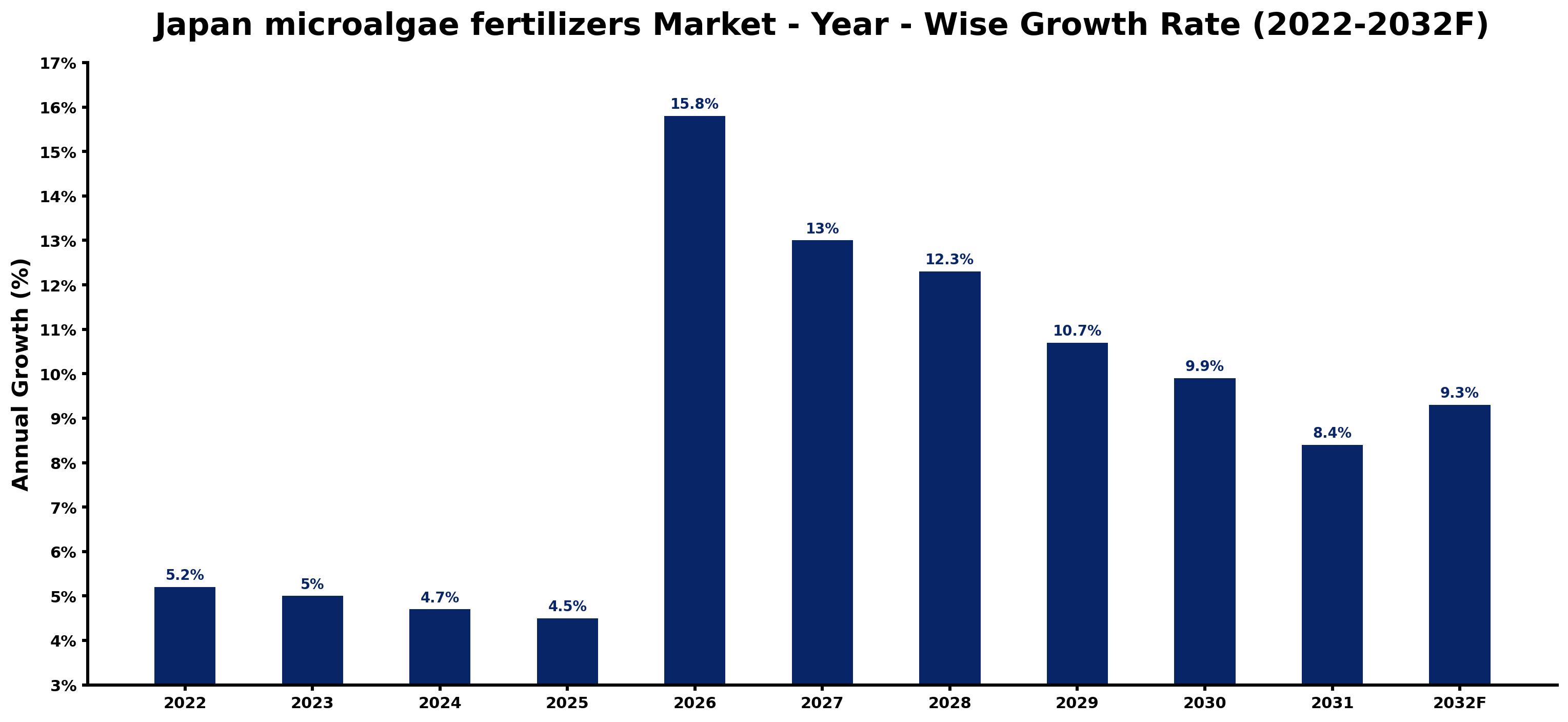
Annual growth estimates for each year appear below with the principal reason behind them, explaining the shifts that set the pace of the market.
| Year | Estimated Annual Growth (%) | Market Rationale |
| 2022 | 5.2 | The market showed steady growth due to increased awareness of organic farming practices. |
| 2023 | 5.0 | Growth slowed slightly as the total population of farmers continued to decline. |
| 2024 | 4.7 | The market experienced a further slowdown as farmers adjusted to changing agricultural practices. |
| 2025 | 4.5 | Growth remained slow as organic farmland expansion faced challenges in adoption rates. |
| 2026 | 15.8 | Demand surged as the government launched a program to support organic farming initiatives. |
| 2027 | 13.0 | Growth slowed after the peak, as the market stabilised following rapid expansion. |
| 2028 | 12.3 | The market continued to grow, driven by increasing interest in sustainable agriculture. |
| 2029 | 10.7 | Demand growth slowed as the average age of farmers influenced adoption rates. |
| 2030 | 9.9 | The market experienced a slight slowdown, yet interest in organic practices remained strong. |
| 2031 | 8.4 | Growth continued to slow as the market adjusted to new agricultural trends. |
| 2032 | 9.3 | Demand is expected to rise again as organic farming targets are pursued. |
Note: Market size estimations and growth projections presented in this report are based on 6Wresearch's proprietary forecasting methodology, utilizing the latest available industry data, government publications, and primary research inputs.
Japan microalgae fertilizers Market Synopsis
Microalgae fertilizers are organic fertilizers derived from microalgae, used to improve soil fertility and crop yield. In Japan, the microalgae fertilizers Market is expanding, driven by over 1,000 organic farms and a total organic farmland area of approximately 75,000 hectares. Growth stems from increasing demand among farmers and agricultural cooperatives, along with government initiatives that include a ¥5 billion budget for 2023 to support organic farming.
Market Dynamics Impact Analysis (2026–2032)
| Factor | Type | Impact | Primary Segment Affected |
| Increasing adoption of organic farming practices | Driver | High | Liquid Fertilizers |
| Government initiatives promoting sustainable agriculture | Driver | High | Bio-stimulants |
| Growing consumer preference for organic produce | Opportunity | High | Granular Fertilizers |
| Expansion of agricultural cooperatives supporting local farmers | Opportunity | Medium | Agro Distributors |
| Declining number of farmers impacting overall demand | Restraint | High | Farmers |
| Limited awareness of microalgae benefits among traditional farmers | Restraint | Medium | Agricultural Cooperatives |
| Aging farmer population leading to slower adoption rates | Challenge | High | Organic Farms |
| Competition from synthetic fertilizers affecting market share | Challenge | Medium | Greenhouses |
Evaluation of Drivers in Japan microalgae fertilizers Market (2026–2032)
Demand rests on the following drivers, each shown with the segment it touches most.
| Drivers | Primary Segment Affected | Why It Matters (Evidence) |
| Rising interest in organic farming | Liquid Fertilizers | The agricultural sector employs approximately 2 million farmers, increasing demand for organic solutions. |
| Government support for organic initiatives | Bio-stimulants | The Ministry of Agriculture promotes sustainable practices, leading to higher fertilizer usage. |
| Increased yield from microalgae fertilizers | Granular Fertilizers | Average yield increases of up to 20% encourage farmers to adopt these products. |
| Growth in organic farmland area | Nutrient Blends | The total area of organic farmland in Japan reached about 75,000 hectares, boosting demand. |
| Popularity of foliar application methods | Microalgae Extracts | Foliar application is gaining traction among greenhouse operators, improving nutrient absorption. |
Buyers are adding capacity as the average yield increase from using microalgae fertilizers can reach up to 20%. The agricultural sector employs around 2 million farmers, creating demand for organic solutions. The total area of organic farmland has reached about 75,000 hectares, further boosting interest in these products. Support for sustainable practices, including a ¥5 billion budget for organic farming in 2023, encourages adoption among agricultural cooperatives. The popularity of foliar application methods is rising, particularly among greenhouse operators, improving nutrient absorption and crop productivity.
Evaluation of Restraints in Japan microalgae fertilizers Market
These are the pressures that could keep growth below its potential.
| Market Restraint | Primary Segment Affected | Why It Matters (Evidence) |
| Declining number of farmers | Farmers | The total population of farmers in Japan is declining, impacting fertilizer demand. |
| Limited awareness of microalgae benefits | Agricultural Cooperatives | Many traditional farmers remain unaware of the advantages of microalgae fertilizers, hindering adoption. |
| Aging population of farmers | Organic Farms | The average age of farmers in Japan is around 66 years, affecting adoption rates of new practices. |
| Competition from synthetic fertilizers | Greenhouses | Synthetic fertilizers often offer lower costs, making it challenging for microalgae fertilizers to compete. |
| Regulatory hurdles for organic certification | Bio-stimulants | Microalgae fertilizers must meet strict JAS standards, complicating market entry for some producers. |
Japan microalgae fertilizers Market Challenges
Farmers face rising costs as local microalgae fertilizer production cannot meet demand, pushing input prices up by 15%. Supply chain disruptions occur when agricultural cooperatives cannot secure adequate fertilizers, impacting over 30% of organic crop production. Buyers experience fluctuating prices due to this imbalance, forcing them to adjust budgets and potentially reduce planting areas. A skills gap is evident as the average age of farmers is around 66 years, limiting the adoption of modern practices and hindering the overall growth of the market.
Trends in the Japan microalgae fertilizers Market
These developments are changing demand patterns in the Japan microalgae fertilizers Market.
- Shift towards Sustainable Agriculture: Farmers are increasingly adopting sustainable practices, with over 1,000 organic farms now utilising microalgae fertilizers. This shift is supported by initiatives aiming to increase organic farmland to 3% by 2030.
- Rise of Foliar Application Techniques: Foliar application of microalgae fertilizers is gaining popularity among greenhouse operators, improving nutrient absorption directly through plant leaves. This method is becoming a preferred choice for many, especially in regions with controlled environments.
- Growth of Agricultural Cooperatives: Agricultural cooperatives are expanding their role in distributing microalgae fertilizers, supporting local farmers in procurement. With approximately 2 million farmers in Japan, these cooperatives are important for increasing fertilizer accessibility.
- Emergence of Online Platforms: The rise of online platforms for purchasing fertilizers is changing the distribution model. This trend is evident as more farmers turn to digital channels for convenience and accessibility.
Investment Opportunities in the Japan microalgae fertilizers Market
The opportunities below stand out in the Japan microalgae fertilizers Market for new entrants and existing suppliers.
- Increasing Organic Farmland Area: With the target to increase organic farmland to 3% by 2030, there is a gap in supply. Producers can invest in microalgae fertilizers to meet this growing demand from farmers across Japan.
- Expansion of Agro Distributor Networks: Agro distributors play a key role in reaching farmers. Collaborating with local distributors can enhance market penetration and increase sales of microalgae fertilizers.
- Development of Bio-stimulant Products: The growing interest in bio-stimulants presents an opportunity for suppliers to develop microalgae-based products. The Japan Bio-Stimulant Association supports this trend, driving demand from organic farms.
- Investment in Greenhouse Cultivation: The total area under greenhouse cultivation in Japan is approximately 20,000 hectares. Suppliers can target this sector by providing tailored microalgae fertilizers for controlled environments.
Government Initiatives in the Japan microalgae fertilizers Market
The Waste Management and Public Cleansing Act (1970) regulates the treatment of waste, impacting producers of microalgae fertilizers by enforcing strict disposal standards. This law ensures that fertilizers are produced sustainably, aligning with environmental goals. Additionally, the Building Energy Efficiency Act (2015, amended 2022) sets energy standards for new buildings, indirectly supporting sustainable practices in agriculture.
The Ministry of Agriculture, Forestry and Fisheries oversees programs supporting organic farming initiatives. In 2023, a budget of ¥5 billion was allocated to promote sustainable practices, benefiting farmers and agricultural cooperatives by improving access to microalgae fertilizers.
Future Insight of the Japan microalgae fertilizers Market
By 2032, policy-driven initiatives will significantly influence the market, with the government aiming to increase organic farmland to 3% by 2030. Suppliers will adapt by developing advanced microalgae fertilizer products tailored to evolving agricultural standards. A programme with a budget of ¥5 billion will facilitate better access to these fertilizers, particularly for smaller farms. Technological advancements in cultivation methods will enhance production efficiency, ensuring a reliable supply for farmers.
Market Segmentation Analysis
Japan microalgae fertilizers Market report covers a detailed analysis of the following market segments:
By Product Type – Liquid Fertilizers Lead, Bio-stimulants Expected to Grow Fastest
According to Ayushi Shukla, Senior Research Analyst at 6Wresearch, with 44% of product type revenue in 2025, Liquid Fertilizers was the largest category. Liquid fertilizers dominate the market as they provide efficient nutrient delivery, which is crucial for enhancing crop yields. Their popularity among agricultural cooperatives stems from their ease of application in various farming practices, particularly in organic farming. The quickest growth will come from Bio-stimulants, forecast to expand at a CAGR of 15.7% between 2026 and 2032. Bio-stimulants are experiencing rapid growth due to their ability to enhance plant growth and improve stress resistance, which is essential for sustainable farming. The government's support for bio-stimulant adoption is significantly increasing their usage among farmers. Suppliers should prioritise the development and marketing of bio-stimulants to meet the rising demand in the agricultural sector.
By Algae Type – Spirulina Leads, Mixed Algae Expected to Grow Fastest
Spirulina took 49% of algae type revenue in 2025, more than any other category. Spirulina holds the largest market share primarily due to its extensive use in health supplements, creating a strong supply chain. This popularity indirectly supports its limited agricultural applications, particularly in niche markets. Mixed Algae is set to record the highest CAGR in this split, 15.1% over 2026–2032. Mixed algae are expanding quickly as they offer diverse nutrient profiles suitable for various fertilisation needs. The growing emphasis on customised fertilisation strategies in agriculture is propelling this segment's growth. Buyers should explore mixed algae options for improved nutrient management tailored to their specific agricultural requirements.
By Application Area – Foliar Application Leads, Horticulture Expected to Grow Fastest
Foliar Application held 43% of the Japan microalgae fertilizers Market by application area in 2025. Foliar application leads the market as it allows for direct nutrient absorption, maximising the effectiveness of microalgae fertilizers. This method is particularly favoured in regions with high-value crops, such as the Tokyo area, where growers seek optimal yield. Horticulture is projected to grow fastest, at a CAGR of 12.9% during 2026–2032. Horticulture is the fastest-growing application area, primarily due to its extensive use in the cultivation of ornamental plants. The rising interest in gardening and landscaping activities among consumers is significantly driving this growth. Suppliers should focus on creating horticulture-specific formulations to effectively capture this expanding market.
By Distribution Channel – Agro Distributors Lead, Online Platforms Expected to Grow Fastest
In 2025, Agro Distributors led the distribution channel split with a 40% share. Agro distributors are the primary channel for reaching farmers and agricultural cooperatives, ensuring that microalgae fertilizers are accessible where they are most needed. Their established networks facilitate efficient distribution across various agricultural regions, enhancing product availability. Over 2026–2032, Online Platforms are expected to post the fastest growth, at a CAGR of 14.3%. Online platforms are rapidly becoming a preferred distribution channel, driven by the increasing digitalisation of purchasing processes among farmers. Younger farmers are particularly inclined to utilise e-commerce solutions for their fertilizer needs, contributing to this trend. Suppliers must enhance their online presence to effectively engage a broader customer base.
By End User – Farmers Lead, Organic Farms Expected to Grow Fastest
Farmers accounted for 46% of the market by end user in 2025. Farmers represent the largest user group of microalgae fertilizers, directly applying these products to improve crop productivity. The considerable number of farmers in Japan ensures a steady demand for these fertilizers, particularly in organic farming. The quickest growth will come from Organic Farms, forecast to expand at a CAGR of 14.7% between 2026 and 2032. Organic farms are witnessing the fastest growth as they increasingly adopt microalgae fertilizers to comply with organic farming standards. The government's initiative to expand organic farmland is further accelerating this trend and encouraging adoption. Suppliers should tailor their marketing strategies to specifically target organic farms and capitalise on this growing segment.
Key Attractiveness of the Report
- 10 Years of Market Numbers
- Historical Data Starting from 2022 to 2025
- Base Year 2025
- Forecast Data until 2032
- Key Performance Indicators Impacting the Market
- Major Upcoming Developments and Projects
Key Highlights of the Report:
- Japan microalgae fertilizers Market Outlook
- Market Size of Japan microalgae fertilizers Market, 2025
- Forecast of Japan microalgae fertilizers Market, 2032
- Historical Data and Forecast of Japan microalgae fertilizers Market Revenues & Volume for the Period 2022-2032F
- Japan microalgae fertilizers Market Trend Evolution
- Japan microalgae fertilizers Market Drivers and Challenges
- Japan microalgae fertilizers Market Price Trends
- Japan microalgae fertilizers Market Porter's Five Forces
- Japan microalgae fertilizers Market Industry Life Cycle
- Historical Data and Forecast of Japan microalgae fertilizers Market Revenues & Volume By Product Type for the Period 2022-2032F
- Historical Data and Forecast of Japan microalgae fertilizers Market Revenues & Volume By Liquid Fertilizers for the Period 2022-2032F
- Historical Data and Forecast of Japan microalgae fertilizers Market Revenues & Volume By Granular Fertilizers for the Period 2022-2032F
- Historical Data and Forecast of Japan microalgae fertilizers Market Revenues & Volume By Bio-stimulants for the Period 2022-2032F
- Historical Data and Forecast of Japan microalgae fertilizers Market Revenues & Volume By Nutrient Blends for the Period 2022-2032F
- Historical Data and Forecast of Japan microalgae fertilizers Market Revenues & Volume By Algae Type for the Period 2022-2032F
- Historical Data and Forecast of Japan microalgae fertilizers Market Revenues & Volume By Spirulina for the Period 2022-2032F
- Historical Data and Forecast of Japan microalgae fertilizers Market Revenues & Volume By Chlorella for the Period 2022-2032F
- Historical Data and Forecast of Japan microalgae fertilizers Market Revenues & Volume By Mixed Algae for the Period 2022-2032F
- Historical Data and Forecast of Japan microalgae fertilizers Market Revenues & Volume By Microalgae Extracts for the Period 2022-2032F
- Historical Data and Forecast of Japan microalgae fertilizers Market Revenues & Volume By Application Area for the Period 2022-2032F
- Historical Data and Forecast of Japan microalgae fertilizers Market Revenues & Volume By Foliar Application for the Period 2022-2032F
- Historical Data and Forecast of Japan microalgae fertilizers Market Revenues & Volume By Soil Enrichment for the Period 2022-2032F
- Historical Data and Forecast of Japan microalgae fertilizers Market Revenues & Volume By Crop Yield Enhancement for the Period 2022-2032F
- Historical Data and Forecast of Japan microalgae fertilizers Market Revenues & Volume By Horticulture for the Period 2022-2032F
- Historical Data and Forecast of Japan microalgae fertilizers Market Revenues & Volume By Distribution Channel for the Period 2022-2032F
- Historical Data and Forecast of Japan microalgae fertilizers Market Revenues & Volume By Agro Distributors for the Period 2022-2032F
- Historical Data and Forecast of Japan microalgae fertilizers Market Revenues & Volume By Direct Sales for the Period 2022-2032F
- Historical Data and Forecast of Japan microalgae fertilizers Market Revenues & Volume By Online Platforms for the Period 2022-2032F
- Historical Data and Forecast of Japan microalgae fertilizers Market Revenues & Volume By Specialty Stores for the Period 2022-2032F
- Historical Data and Forecast of Japan microalgae fertilizers Market Revenues & Volume By End User for the Period 2022-2032F
- Historical Data and Forecast of Japan microalgae fertilizers Market Revenues & Volume By Farmers for the Period 2022-2032F
- Historical Data and Forecast of Japan microalgae fertilizers Market Revenues & Volume By Agricultural Cooperatives for the Period 2022-2032F
- Historical Data and Forecast of Japan microalgae fertilizers Market Revenues & Volume By Organic Farms for the Period 2022-2032F
- Historical Data and Forecast of Japan microalgae fertilizers Market Revenues & Volume By Greenhouses for the Period 2022-2032F
- Japan microalgae fertilizers Market Import Export Trade Statistics
- Market Opportunity Assessment By Product Type
- Market Opportunity Assessment By Algae Type
- Market Opportunity Assessment By Application Area
- Market Opportunity Assessment By Distribution Channel
- Market Opportunity Assessment By End User
- Japan microalgae fertilizers Market Top Companies Market Share
- Japan microalgae fertilizers Market Competitive Benchmarking By Technical and Operational Parameters
- Japan microalgae fertilizers Market Company Profiles
- Japan microalgae fertilizers Market Key Strategic Recommendations
Market Covered
The following segment groups are covered in the report.
By Product Type
- Liquid Fertilizers
- Granular Fertilizers
- Bio-stimulants
- Nutrient Blends
By Algae Type
- Spirulina
- Chlorella
- Mixed Algae
- Microalgae Extracts
By Application Area
- Foliar Application
- Soil Enrichment
- Crop Yield Enhancement
- Horticulture
By Distribution Channel
- Agro Distributors
- Direct Sales
- Online Platforms
- Specialty Stores
By End User
- Farmers
- Agricultural Cooperatives
- Organic Farms
- Greenhouses






































