Japan Microbial-Based Agricultural Products Market Size & Growth Rate
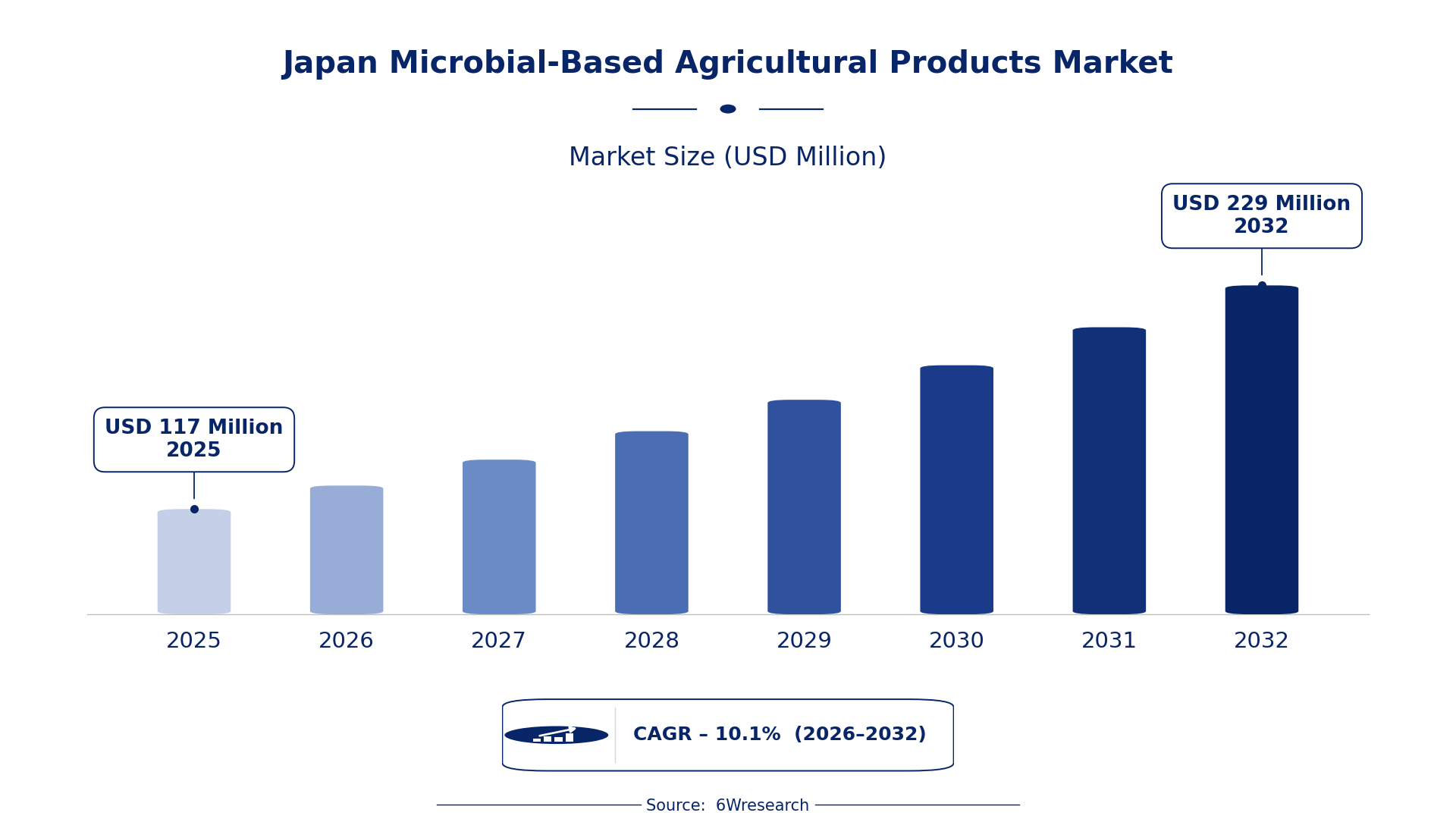
According to 6Wresearch internal database and industry insights, the Japan Microbial-Based Agricultural Products Market was valued at USD 117 Million in 2025 and is projected to reach USD 229 Million by 2032, growing at a CAGR of approximately 10.1% during 2026–2032.
Japan Microbial-Based Agricultural Products Market Highlights
| Report Metric | Details |
| Report Name | Japan Microbial-Based Agricultural Products Market (2026-2032) |
| Market Size 2025 | USD 117 Million |
| Market Size 2032 | USD 229 Million |
| Absolute Growth 2025–2032 | USD 112 Million |
| CAGR 2026–2032 | 10.1% |
| Peak Annual Growth | 11.5% in 2031 |
| Forecast Period | 2026–2032 |
| Historical Data | 2022–2025 |
| Base Year | 2025 |
| Leading Product Category, 2025 | Biofertilizers (42% share) |
| Leading Microbial Type, 2025 | Bacillus thuringiensis (45% share) |
| Leading Crop Application, 2025 | Vegetable Crops (34% share) |
| Leading Delivery Mode, 2025 | Spray/Foliar Application (52% share) |
| Leading End User, 2025 | Organic Farmers (40% share) |
| Fastest-Growing Product Category | Plant Growth Promoters (14.7% CAGR) |
| Fastest-Growing Microbial Type | Mycorrhizae (14.3% CAGR) |
| Fastest-Growing Crop Application | Fruits (14.4% CAGR) |
| Fastest-Growing Delivery Mode | Soil Drenching (13.5% CAGR) |
| Fastest-Growing End User | Nurseries (13.9% CAGR) |
| Growing Sector | Organic Farming |
| Key End Users | Organic Farmers, Vegetable Growers, Field Crop Producers, Nurseries |
Japan Microbial-Based Agricultural Products Market Year-wise Growth Rate and Key Drivers (2022–2032)
This graph illustrates the annual growth rates of the market from 2022 to 2032, highlighting a steady upward trajectory and projected market expansion over the forecast period.
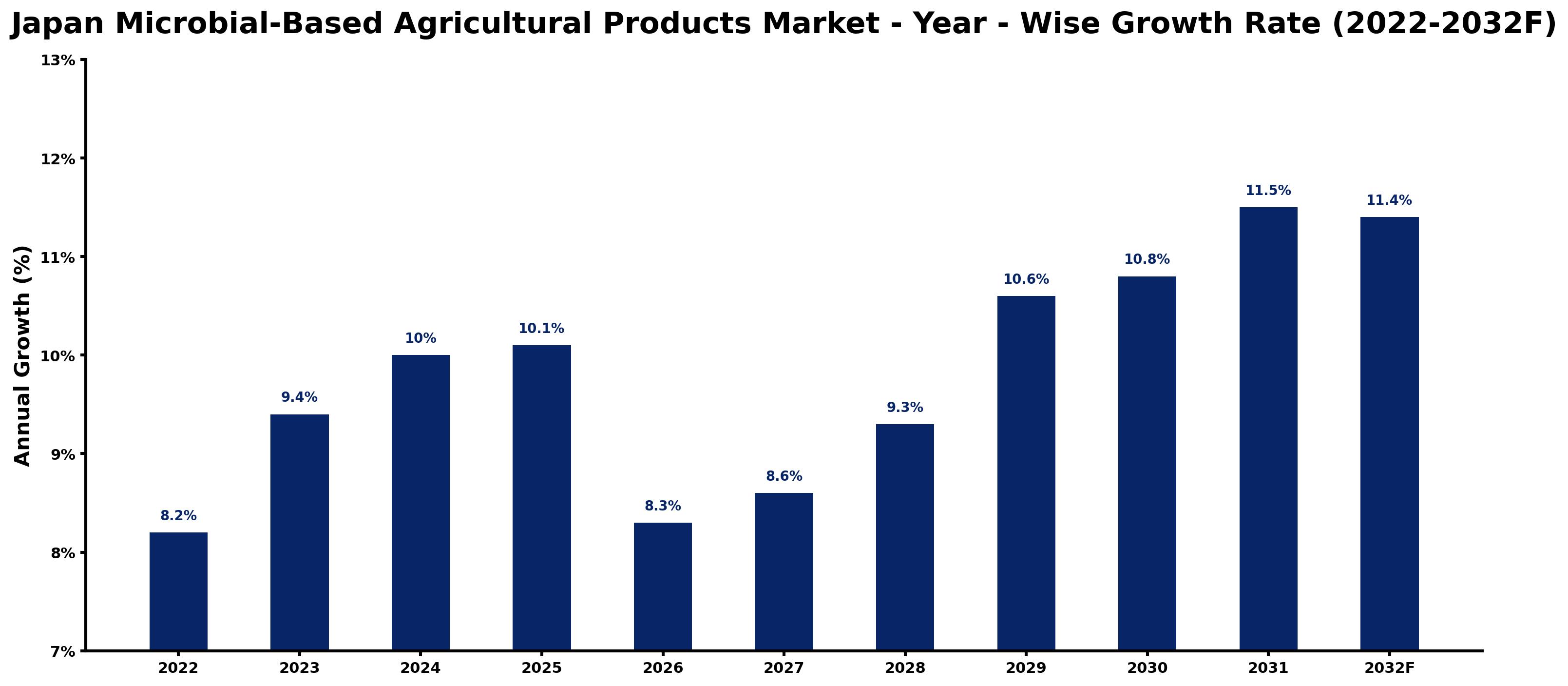
Annual growth estimates for each year appear below with the principal reason behind them, explaining the shifts that set the pace of the market.
| Year | Estimated Annual Growth (%) | Market Rationale |
| 2022 | 8.2 | The agricultural sector showed a steady demand for microbial products, reflecting established practices. |
| 2023 | 9.4 | Increased awareness of sustainable farming practices drove faster adoption of microbial solutions. |
| 2024 | 10.0 | Growing interest in organic farming led to more investments in microbial-based products. |
| 2025 | 10.1 | The market reached a peak due to heightened demand from organic farmers and sustainable agriculture. |
| 2026 | 8.3 | A slowdown in growth is expected as market expansion begins to stabilise after rapid increases. |
| 2027 | 8.6 | Demand is projected to rise as more farmers adopt microbial solutions for crop management. |
| 2028 | 9.3 | Sustained interest in organic practices is expected to continue supporting growth in microbial products. |
| 2029 | 10.6 | The market is anticipated to surge as new technologies improve product effectiveness. |
| 2030 | 10.8 | Increased awareness of environmental impacts will drive demand for microbial solutions. |
| 2031 | 11.5 | The market is projected to peak as adoption rates among organic farmers reach new heights. |
| 2032 | 11.4 | A slight slowdown in growth is expected as the market matures and stabilises. |
Note: Market size estimations and growth projections presented in this report are based on 6Wresearch's proprietary forecasting methodology, utilizing the latest available industry data, government publications, and primary research inputs.
Japan Microbial-Based Agricultural Products Market Synopsis
Microbial-based agricultural products derive from natural microorganisms and are used to improve crop growth and protect plants from pests. In Japan, the organic farming area reached 400,000 hectares in 2022, driving demand for these solutions. The market is expanding due to increased adoption of sustainable practices, with biopesticides accounting for 25% of the total pesticide market. The Ministry of Agriculture, Forestry and Fisheries promotes biofertilizers, further supporting this growth through its initiatives.
Market Dynamics Impact Analysis (2026–2032)
| Factor | Type | Impact | Primary Segment Affected |
| Increased adoption of biopesticides among vegetable growers | Driver | High | Biopesticides |
| Rising organic farming area leading to higher demand for biofertilizers | Driver | High | Biofertilizers |
| Growing interest in sustainable agriculture practices | Opportunity | High | Plant Growth Promoters |
| Expansion of organic farming initiatives in urban areas | Opportunity | Medium | Soil Conditioners |
| Limited awareness of microbial product benefits among traditional farmers | Restraint | Medium | Biopesticides |
| Higher initial investment costs for microbial solutions compared to chemical alternatives | Restraint | High | Biofertilizers |
| Competition from synthetic fertilizers and pesticides | Challenge | High | Plant Growth Promoters |
| Regulatory hurdles in product approval and certification | Challenge | Medium | Soil Conditioners |
Evaluation of Drivers in Japan Microbial-Based Agricultural Products Market (2026–2032)
Demand rests on the following drivers, each shown with the segment it touches most.
| Drivers | Primary Segment Affected | Why It Matters (Evidence) |
| Increased organic farming practices | Biofertilizers | Japan's organic farming area reached 400,000 hectares in 2022, boosting demand for biofertilizers. |
| Rising adoption of biopesticides | Biopesticides | The adoption rate of biopesticides among vegetable growers is estimated at 30% as of 2023. |
| Growing government support for sustainable agriculture | Plant Growth Promoters | The Ministry of Agriculture, Forestry and Fisheries promotes biofertilizers through its 2023 Sustainable Agriculture Program. |
| Enhanced crop yields through microbial applications | Soil Conditioners | Biofertilizers are projected to enhance crop yields by 10-20% in various regions of Japan. |
| Increased awareness of soil health benefits | Soil Conditioners | The Soil Association of Japan advocates for soil conditioners in sustainable farming since 2021. |
Much of the new demand traces back to the growing organic farming area, which reached 400,000 hectares in 2022, prompting more farmers to adopt microbial solutions. The adoption rate of biopesticides among vegetable growers is estimated at 30% as of 2023, reflecting a shift towards sustainable pest management.
Evaluation of Restraints in Japan Microbial-Based Agricultural Products Market
The key brakes on demand, and where they bite hardest, are shown below.
| Market Restraint | Primary Segment Affected | Why It Matters (Evidence) |
| Limited awareness of microbial product benefits among traditional farmers | Biopesticides | Many traditional farmers remain unaware of the advantages of biopesticides, limiting their adoption. |
| Higher initial investment costs for microbial solutions compared to chemical alternatives | Biofertilizers | The higher costs associated with microbial products deter some farmers from switching from chemical fertilizers. |
| Regulatory hurdles in product approval and certification | Plant Growth Promoters | Strict regulations can delay the introduction of new microbial products to the market. |
| Competition from synthetic fertilizers and pesticides | Soil Conditioners | Synthetic alternatives often offer lower upfront costs, making them more attractive to some farmers. |
| Limited distribution networks for microbial products | Soil Conditioners | The lack of established distribution channels can hinder access to microbial solutions for farmers. |
Japan Microbial-Based Agricultural Products Market Challenges
Regulatory hurdles challenge buyers, as compliance with JIS standards from 2021 requires extensive testing, causing delays in product availability for farmers. Technology limitations affect suppliers, particularly in fermentation processes, resulting in inconsistent product quality that frustrates farmers seeking reliable solutions. A shortage of skilled agricultural workers limits effective product application, costing farmers potential yield increases of 10-20%. High costs arise for buyers due to the limited availability of microbial solutions, with only 25% of the total pesticide market consisting of biopesticides, restricting their pest management options.
Trends in the Japan Microbial-Based Agricultural Products Market
The following changes are redrawing the Japan Microbial-Based Agricultural Products Market.
- Shift from Chemical to Microbial Solutions: Since 2022, there has been a notable shift towards microbial solutions in agriculture, particularly in the Tokyo region, where organic vegetable production is rising. The adoption of microbial-based products is increasing as farmers seek sustainable alternatives.
- Emergence of Soil Conditioners in Sustainable Farming: The Soil Association of Japan has been advocating for soil conditioners since 2021, leading to a growing interest among organic farmers. This trend is supported by increased awareness of soil health, with usage rising significantly in recent years.
- Growing Use of Mycorrhizae in Crop Production: The use of mycorrhizae has been supported by local government initiatives since 2022, enhancing nutrient uptake in crops. This trend reflects a broader movement towards sustainable agricultural practices across Japan.
- Expansion of Biofertilizer Adoption Among Farmers: The PRTR Law has driven biofertilizer adoption, with projections indicating a 10-20% yield increase. This initiative highlights the growing recognition of microbial solutions in enhancing agricultural productivity.
Investment Opportunities in the Japan Microbial-Based Agricultural Products Market
Where to invest in the Japan Microbial-Based Agricultural Products Market: the main openings are set out below.
- Kanto Region's Demand for Soil Conditioners: The Kanto region is experiencing increased demand for soil conditioners, focusing on improving soil health. This presents an opportunity for suppliers to engage with local nurseries and organic farmers.
- Organic Farmers Seeking Sustainable Solutions: With 90,000 organic farmers in Japan as of 2023, there is strong demand for microbial products. Suppliers can enter this market through partnerships with local agricultural cooperatives.
- Partnerships for Microbial Product Distribution: Establishing joint ventures with local distributors can facilitate access to the growing market for microbial solutions. This approach is particularly relevant for biofertilizers and biopesticides.
- Investment in Research for New Microbial Applications: Investing in research to develop new microbial applications can meet the evolving needs of farmers. The increasing focus on sustainable practices creates a ripe environment for innovation.
Government Initiatives in the Japan Microbial-Based Agricultural Products Market
The GX Promotion Act, introduced in 2023, strengthens the legal framework for promoting sustainable agricultural practices, building on earlier laws like the PRTR Law and the Chemical Substances Control Law. This act encourages the adoption of microbial-based products by providing clearer guidelines for their use in agriculture.
In 2023, the government allocated ¥1 billion to promote sustainable agricultural practices, with the Ministry of Agriculture, Forestry and Fisheries overseeing the initiative. This funding supports the development and adoption of microbial-based agricultural products, ensuring that farmers have access to effective solutions.
Future Insight of the Japan Microbial-Based Agricultural Products Market
Organic farmers will increasingly embrace microbial-based products by 2032, driven by government initiatives that promote sustainable agriculture. Advances in fermentation technology will improve product consistency, encouraging broader adoption among agricultural producers. New training programs will equip farmers with essential skills to effectively use microbial applications. Growing awareness of soil health will motivate farmers to integrate microbial solutions into their practices, leading to better crop yields and supporting sustainable farming efforts.
Market Segmentation Analysis
Japan Microbial-Based Agricultural Products Market report covers a detailed analysis of the following market segments:
By Product Category – Biofertilizers Lead, Plant Growth Promoters Expected to Grow Fastest
According to Saurav Kr Singh, Senior Research Analyst at 6Wresearch, Biofertilizers accounted for 42% of the market by product category in 2025. Biofertilizers hold the largest share because they play a crucial role in enhancing soil fertility, particularly within Japan's organic farming sector. The 2023 Sustainable Agriculture Program by the Ministry of Agriculture, Forestry and Fisheries actively promotes their use, reinforcing their importance in agricultural practices. Plant Growth Promoters are set to record the highest CAGR in this split, 14.7% over 2026–2032. The rapid growth of Plant Growth Promoters is driven by their effectiveness in stimulating plant development, which is essential for optimising yields amid climate challenges. Government initiatives aimed at reducing chemical fertiliser use further fuel interest in these products among farmers. Suppliers should focus on developing Plant Growth Promoters to meet the increasing demand from farmers seeking sustainable agricultural solutions.
By Microbial Type – Bacillus thuringiensis Leads, Mycorrhizae Expected to Grow Fastest
The largest microbial type category in 2025 was Bacillus thuringiensis, at 45% of revenue. Bacillus thuringiensis leads the microbial type segment due to its effectiveness against specific insect pests, making it a preferred choice among farmers for pest management. Its widespread use in various agricultural regions highlights its critical role in enhancing crop protection strategies. Mycorrhizae is projected to grow fastest, at a CAGR of 14.3% during 2026–2032. Mycorrhizae are experiencing rapid growth as they significantly enhance nutrient uptake in plants, which is vital for improving crop yields. The increasing adoption of sustainable practices among farmers is expected to drive demand for mycorrhizal products further. This trend indicates that suppliers should invest in the development and promotion of mycorrhizal products to capture the growing market interest.
By Crop Application – Vegetable Crops Lead, Fruits Expected to Grow Fastest
In 2025, Vegetable Crops led the crop application split with a 34% share. Vegetable Crops are the leading application area for microbial products, largely due to their significant role in Japan's agricultural sector and the high demand for organic produce. The focus on organic vegetable production in the Tokyo region underscores the importance of microbial solutions in this segment. Over 2026–2032, Fruits are expected to post the fastest growth, at a CAGR of 14.4%. Fruits are projected to grow rapidly as farmers seek to enhance both growth and quality, driven by consumer demand for high-quality produce. This reflects a shift towards more sustainable agricultural practices and the increasing adoption of microbial products in fruit cultivation. Suppliers should tailor their offerings to meet the specific needs of fruit growers as they increasingly adopt microbial solutions.
By Delivery Mode – Spray/Foliar Application Leads, Soil Drenching Expected to Grow Fastest
With 52% of delivery mode revenue in 2025, Spray/Foliar Application was the largest category. Spray/Foliar Application is the predominant delivery mode, as it is a common method for applying microbial products effectively to crops. This method allows for targeted application, ensuring that the products reach the plant where they are needed most, thus supporting optimal growth. The quickest growth will come from Soil Drenching, forecast to expand at a CAGR of 13.5% between 2026 and 2032. Soil Drenching is gaining traction due to its effectiveness in treating the root zone, which is critical for plant health and productivity. As farmers recognise the benefits of direct application to the soil, this method is expected to see increased adoption. Suppliers should consider expanding their product lines to include soil drenching options to cater to this growing preference among farmers.
By End User – Organic Farmers Lead, Nurseries Expected to Grow Fastest
Organic Farmers took 40% of end user revenue in 2025, more than any other category. Organic Farmers represent the largest user group for microbial products, as they are key advocates of sustainable agricultural practices in Japan. With around 90,000 organic farmers in the country, their demand for microbial solutions significantly influences market dynamics. Nurseries are set to record the highest CAGR in this split, 13.9% over 2026–2032. Nurseries are experiencing rapid growth as they increasingly adopt microbial products for plant propagation and care, reflecting a broader trend towards sustainability in plant production. This shift highlights the growing recognition of the benefits of microbial solutions in early plant development. Suppliers should develop targeted marketing strategies to effectively reach nursery operators and meet their specific needs.
Key Attractiveness of the Report
- 10 Years of Market Numbers
- Historical Data Starting from 2022 to 2025
- Base Year 2025
- Forecast Data until 2032
- Key Performance Indicators Impacting the Market
- Major Upcoming Developments and Projects
Key Highlights of the Report:
- Japan Microbial-Based Agricultural Products Market Outlook
- Market Size of Japan Microbial-Based Agricultural Products Market, 2025
- Forecast of Japan Microbial-Based Agricultural Products Market, 2032
- Historical Data and Forecast of Japan Microbial-Based Agricultural Products Revenues & Volume for the Period 2022-2032F
- Japan Microbial-Based Agricultural Products Market Trend Evolution
- Japan Microbial-Based Agricultural Products Market Drivers and Challenges
- Japan Microbial-Based Agricultural Products Price Trends
- Japan Microbial-Based Agricultural Products Porter's Five Forces
- Japan Microbial-Based Agricultural Products Industry Life Cycle
- Historical Data and Forecast of Japan Microbial-Based Agricultural Products Market Revenues & Volume By Product Category for the Period 2022-2032F
- Historical Data and Forecast of Japan Microbial-Based Agricultural Products Market Revenues & Volume By Biopesticides for the Period 2022-2032F
- Historical Data and Forecast of Japan Microbial-Based Agricultural Products Market Revenues & Volume By Biofertilizers for the Period 2022-2032F
- Historical Data and Forecast of Japan Microbial-Based Agricultural Products Market Revenues & Volume By Plant Growth Promoters for the Period 2022-2032F
- Historical Data and Forecast of Japan Microbial-Based Agricultural Products Market Revenues & Volume By Soil Conditioners for the Period 2022-2032F
- Historical Data and Forecast of Japan Microbial-Based Agricultural Products Market Revenues & Volume By Microbial Type for the Period 2022-2032F
- Historical Data and Forecast of Japan Microbial-Based Agricultural Products Market Revenues & Volume By Bacillus thuringiensis for the Period 2022-2032F
- Historical Data and Forecast of Japan Microbial-Based Agricultural Products Market Revenues & Volume By Azotobacter spp. for the Period 2022-2032F
- Historical Data and Forecast of Japan Microbial-Based Agricultural Products Market Revenues & Volume By Pseudomonas fluorescens for the Period 2022-2032F
- Historical Data and Forecast of Japan Microbial-Based Agricultural Products Market Revenues & Volume By Mycorrhizae for the Period 2022-2032F
- Historical Data and Forecast of Japan Microbial-Based Agricultural Products Market Revenues & Volume By Crop Application for the Period 2022-2032F
- Historical Data and Forecast of Japan Microbial-Based Agricultural Products Market Revenues & Volume By Vegetable Crops for the Period 2022-2032F
- Historical Data and Forecast of Japan Microbial-Based Agricultural Products Market Revenues & Volume By Cereals, Grains for the Period 2022-2032F
- Historical Data and Forecast of Japan Microbial-Based Agricultural Products Market Revenues & Volume By Fruits, Flowers for the Period 2022-2032F
- Historical Data and Forecast of Japan Microbial-Based Agricultural Products Market Revenues & Volume By Legumes, Vegetables for the Period 2022-2032F
- Historical Data and Forecast of Japan Microbial-Based Agricultural Products Market Revenues & Volume By Delivery Mode for the Period 2022-2032F
- Historical Data and Forecast of Japan Microbial-Based Agricultural Products Market Revenues & Volume By Spray/Foliar Application for the Period 2022-2032F
- Historical Data and Forecast of Japan Microbial-Based Agricultural Products Market Revenues & Volume By Soil Drenching for the Period 2022-2032F
- Historical Data and Forecast of Japan Microbial-Based Agricultural Products Market Revenues & Volume By Root Dip for the Period 2022-2032F
- Historical Data and Forecast of Japan Microbial-Based Agricultural Products Market Revenues & Volume By Granular Soil Amendment for the Period 2022-2032F
- Historical Data and Forecast of Japan Microbial-Based Agricultural Products Market Revenues & Volume By End User for the Period 2022-2032F
- Historical Data and Forecast of Japan Microbial-Based Agricultural Products Market Revenues & Volume By Vegetable Growers for the Period 2022-2032F
- Historical Data and Forecast of Japan Microbial-Based Agricultural Products Market Revenues & Volume By Field Crop Producers for the Period 2022-2032F
- Historical Data and Forecast of Japan Microbial-Based Agricultural Products Market Revenues & Volume By Nurseries for the Period 2022-2032F
- Historical Data and Forecast of Japan Microbial-Based Agricultural Products Market Revenues & Volume By Organic Farmers for the Period 2022-2032F
- Japan Microbial-Based Agricultural Products Import Export Trade Statistics
- Market Opportunity Assessment By Product Category
- Market Opportunity Assessment By Microbial Type
- Market Opportunity Assessment By Crop Application
- Market Opportunity Assessment By Delivery Mode
- Market Opportunity Assessment By End User
- Japan Microbial-Based Agricultural Products Top Companies Market Share
- Japan Microbial-Based Agricultural Products Competitive Benchmarking By Technical and Operational Parameters
- Japan Microbial-Based Agricultural Products Company Profiles
- Japan Microbial-Based Agricultural Products Key Strategic Recommendations
Market Covered
Segments analysed in this report are listed below.
By Product Category
- Biopesticides
- Biofertilizers
- Plant Growth Promoters
- Soil Conditioners
By Microbial Type
- Bacillus thuringiensis
- Azotobacter spp.
- Pseudomonas fluorescens
- Mycorrhizae
By Crop Application
- Vegetable Crops
- Cereals
- Grains
- Fruits
- Flowers
- Legumes
- Vegetables
By Delivery Mode
- Spray/Foliar Application
- Soil Drenching
- Root Dip
- Granular Soil Amendment
By End User
- Vegetable Growers
- Field Crop Producers
- Nurseries
- Organic Farmers






































