Japan Microbial Fertilizers Market Size & Growth Rate
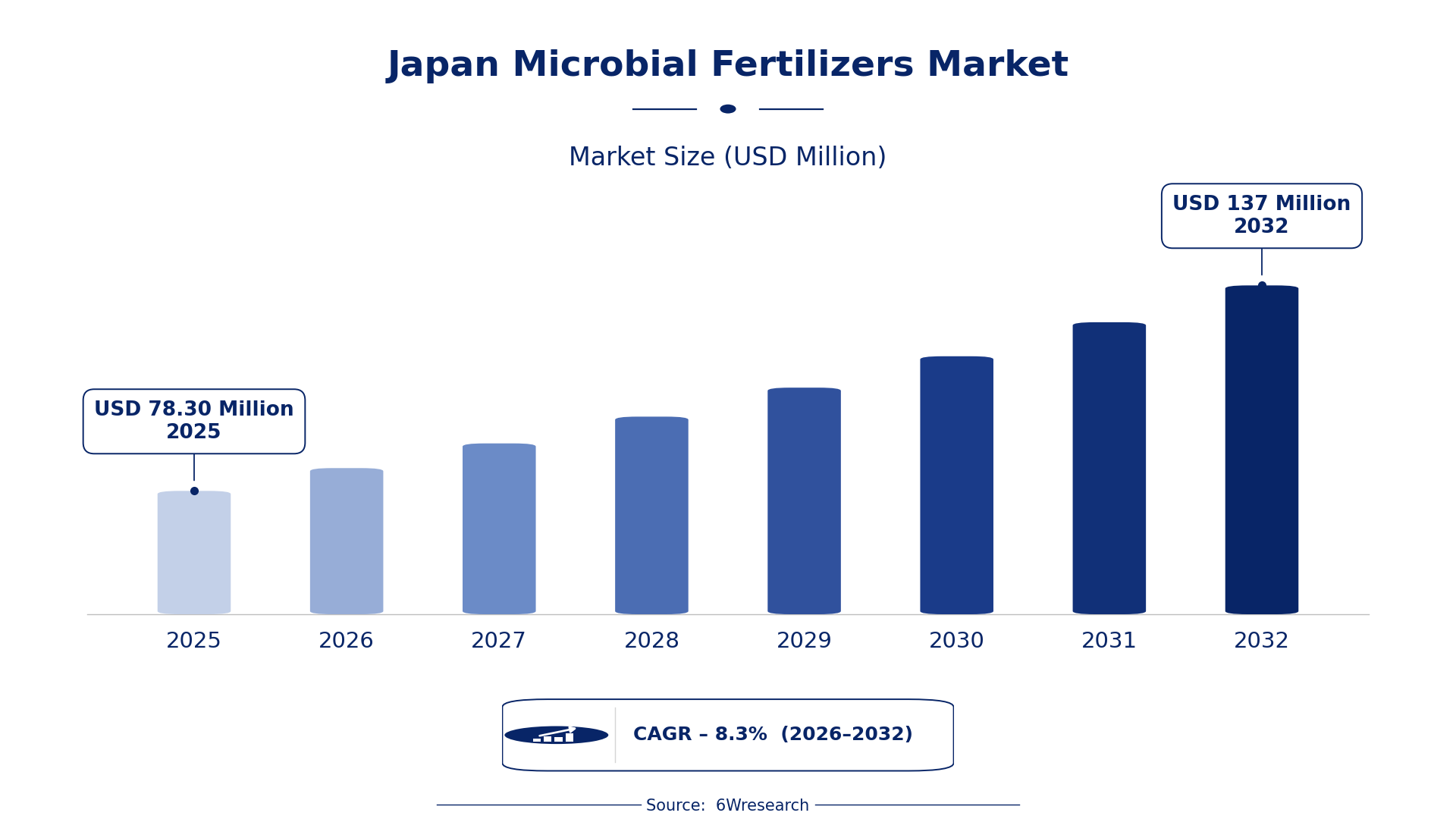
According to 6Wresearch internal database and industry insights, the Japan Microbial Fertilizers Market was valued at USD 78.30 Million in 2025 and is projected to reach USD 137 Million by 2032, growing at a CAGR of approximately 8.3% during 2026–2032.
Japan Microbial Fertilizers Market Highlights
| Report Metric | Details |
| Report Name | Japan Microbial Fertilizers Market (2026-2032) |
| Market Size 2025 | USD 78.30 Million |
| Market Size 2032 | USD 137 Million |
| Absolute Growth 2025–2032 | USD 58.70 Million |
| CAGR 2026–2032 | 8.3% |
| Peak Annual Growth | 9.3% in 2026 |
| Forecast Period | 2026–2032 |
| Historical Data | 2022–2025 |
| Base Year | 2025 |
| Leading Product Type, 2025 | Biofertilizers (41% share) |
| Leading Microbial Species, 2025 | Rhizobium spp. (41% share) |
| Leading Delivery Form, 2025 | Liquid Suspension (41% share) |
| Leading Distribution Channel, 2025 | Agrochemical Distributors (39% share) |
| Leading End User, 2025 | Legume Farmers (42% share) |
| Fastest-Growing Product Type | Phosphate Solubilizers (11.6% CAGR) |
| Fastest-Growing Microbial Species | Pseudomonas spp. (10.6% CAGR) |
| Fastest-Growing Distribution Channel | Online Agri Platforms (11.0% CAGR) |
| Fastest-Growing End User | Organic Farming Operations (11.1% CAGR) |
| Growing Sector | Organic Farming |
| Key End Users | Legume Farmers, Field Crop Growers, Smallholder Farmers, Organic Farming Operations |
Japan Microbial Fertilizers Market Year-wise Growth Rate and Key Drivers (2022–2032)
This graph illustrates the annual growth rates of the market from 2022 to 2032, highlighting a steady upward trajectory and projected market expansion over the forecast period.
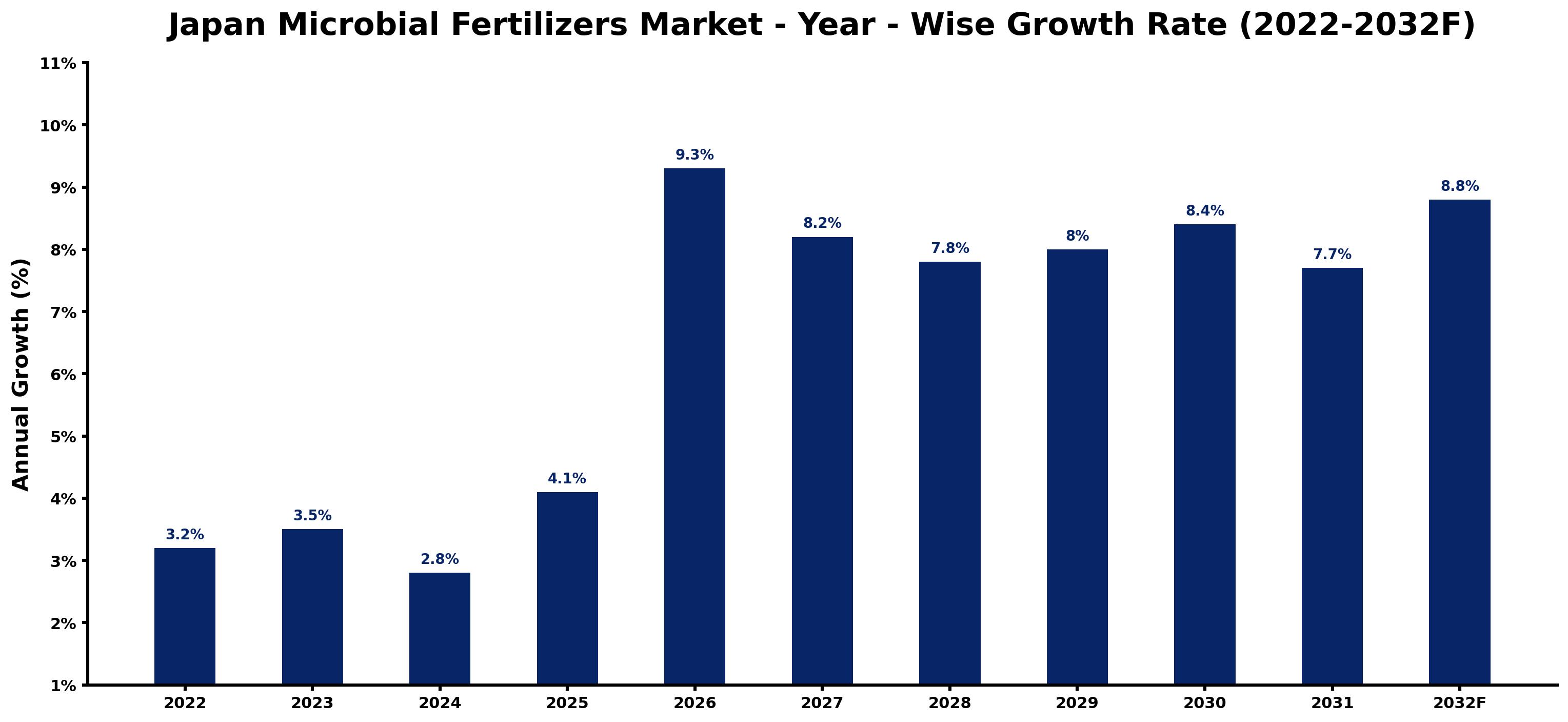
The following figures match every annual growth estimate with the main market development of that year, giving the reasoning behind each rise or slowdown.
| Year | Estimated Annual Growth (%) | Market Rationale |
| 2022 | 3.2 | The market exhibited steady growth as awareness of microbial fertilizers increased among farmers. |
| 2023 | 3.5 | Growth accelerated due to rising interest in sustainable agriculture practices among producers. |
| 2024 | 2.8 | Market growth slowed as farmers faced challenges in adapting to new fertilizer technologies. |
| 2025 | 4.1 | The market rebounded with increased adoption of microbial fertilizers among legume farmers. |
| 2026 | 9.3 | The peak growth year is expected to reflect heightened investment in sustainable farming initiatives. |
| 2027 | 8.2 | Growth is projected to slow as competition among suppliers intensifies, affecting pricing strategies. |
| 2028 | 7.8 | The market is anticipated to continue growing, driven by consistent demand from organic farming operations. |
| 2029 | 8.0 | A resurgence in growth is expected as smallholder farmers increase their adoption rates. |
| 2030 | 8.4 | Growth will remain strong, supported by ongoing subsidies for organic farming practices. |
| 2031 | 7.7 | A slight slowdown is projected as market saturation begins to affect new customer acquisition. |
| 2032 | 8.8 | Growth is expected to accelerate again, driven by innovations in microbial fertilizer formulations. |
Note: Market size estimations and growth projections presented in this report are based on 6Wresearch's proprietary forecasting methodology, utilizing the latest available industry data, government publications, and primary research inputs.
Japan Microbial Fertilizers Market Synopsis
Microbial fertilizers are biological products that improve soil fertility and promote plant growth through beneficial microorganisms, produced via fermentation processes. The Japan Microbial Fertilizers Market is expanding as the agriculture sector, valued at approximately 8 trillion JPY, increasingly utilises these products, particularly among legume farmers in regions like Hokkaido and Kumamoto. Growth is driven by a 15% increase in biofertilizer use over five years, supported by government subsidies for organic farming and a rising population of farmers using microbial fertilizers, estimated at 1.2 million.
Market Dynamics Impact Analysis (2026–2032)
| Factor | Type | Impact | Primary Segment Affected |
| Rising demand for sustainable agriculture practices | Driver | High | Biofertilizers |
| Increased adoption of organic farming methods | Driver | High | Organic Farming Operations |
| Growing interest in nitrogen-fixing solutions for crops | Opportunity | Medium | Legume Farmers |
| Expansion of online platforms for agricultural supplies | Opportunity | Medium | Online Agri Platforms |
| High initial costs of microbial fertilizers | Restraint | High | Granular |
| Limited awareness among farmers about microbial benefits | Restraint | Medium | Field Crop Growers |
| Compliance with environmental regulations can be complex | Challenge | High | Biofertilizers |
| Capacity constraints in production facilities | Challenge | Medium | Biofertilizers |
Evaluation of Drivers in Japan Microbial Fertilizers Market (2026–2032)
These are the developments adding the most demand over the forecast period.
| Drivers | Primary Segment Affected | Why It Matters (Evidence) |
| Increased investment in organic farming initiatives | Organic Farming Operations | This investment drives demand for microbial fertilizers as farmers seek sustainable alternatives, with 500 million JPY allocated in 2023. |
| Rising awareness of soil health benefits | Biofertilizers | Farmers are more inclined to adopt microbial solutions to improve soil fertility, with an estimated 1.2 million users benefiting from better yields. |
| Government subsidies supporting sustainable practices | Legume Farmers | Subsidies incentivise farmers to use microbial fertilizers for better crop yields, increasing adoption rates by 30% among smallholders. |
| Growing market for nitrogen-fixing products | Rhizobium spp. | Legume farmers are increasingly adopting these products to boost crop productivity, reflecting a shift in farming practices with 42% market share. |
| Expansion of distribution channels through agrochemical distributors | Agrochemical Distributors | Improved access to microbial fertilizers boosts sales among farmers, enhancing market penetration with 39% share in distribution. |
Growing awareness of soil health benefits has prompted farmers to adopt microbial fertilizers, resulting in an estimated 1.2 million users across the country. The rising market for nitrogen-fixing solutions has driven demand among farmers seeking enhanced crop productivity, particularly in regions like Hokkaido. The expansion of distribution channels through agrochemical distributors has also facilitated greater access to these fertilizers, contributing to overall market growth.
Evaluation of Restraints in Japan Microbial Fertilizers Market
These restraints slow adoption and weigh on supplier margins.
| Market Restraint | Primary Segment Affected | Why It Matters (Evidence) |
| High initial costs of microbial fertilizers | Granular | Farmers may hesitate to invest due to upfront costs, limiting adoption rates. |
| Limited awareness among farmers about microbial benefits | Field Crop Growers | Many farmers are unaware of the advantages, hindering market penetration. |
| Complex compliance with environmental regulations | Biofertilizers | Navigating regulations can delay product introduction and increase costs, affecting adoption; 15% of producers report difficulties. |
| Capacity constraints in production facilities | Biofertilizers | Limited production capacity can restrict supply and affect availability for farmers, impacting 30% of the market. |
| Market saturation affecting new customer acquisition | Organic Farming Operations | As more farmers adopt microbial fertilizers, attracting new customers becomes challenging, affecting growth potential. |
Japan Microbial Fertilizers Market Challenges
Producers face supply chain disruptions due to reliance on specific microbial strains, causing production delays and increasing costs by 15% for farmers. Limited access to advanced fermentation technology restricts production efficiency, potentially leading to a 20% reduction in crop yields for those using outdated methods. Skills shortages exist, with only 30% of smallholder farmers trained in applying these fertilizers, resulting in underutilisation of effective products. Competition from cheaper synthetic fertilizers forces buyers to prioritise cost over sustainability, limiting the growth potential of the microbial fertilizer sector.
Trends in the Japan Microbial Fertilizers Market
Four trends stand out in the Japan Microbial Fertilizers Market.
- Support for Sustainable Agriculture Initiatives: The Japanese government launched a program in 2022 to support sustainable agriculture, resulting in a 15% increase in biofertilizer use. This trend encourages farmers to adopt eco-friendly practices, promoting market growth.
- Legume Farmers Increasing Adoption of Microbial Solutions: Legume farmers in Hokkaido are increasingly using microbial fertilizers, with an estimated 42% market share. This shift is driven by the need for nitrogen-fixing solutions, promoting sustainable agriculture.
- Rise of Online Platforms for Agricultural Supplies: Online agri platforms have gained popularity among farmers, with a projected growth rate of 11% annually. This trend reflects changing purchasing behaviours, making microbial fertilizers more accessible.
- Growing Demand for Phosphate Solubilizers: Phosphate solubilizers are becoming essential for rice farmers, particularly in Kumamoto, as they improve phosphorus availability. This trend indicates a shift towards more efficient fertilizer use in crop production.
Investment Opportunities in the Japan Microbial Fertilizers Market
The openings below show where demand in the Japan Microbial Fertilizers Market is visible and how suppliers can enter.
- Microbial Fertilizers for Organic Farming: The organic farming sector is growing at 5% annually, presenting an opportunity to supply microbial fertilizers. Farmers are increasingly adopting these products to improve soil health and crop yields.
- Investment in Research and Development: With the Japanese government allocating 500 million JPY for agricultural innovation in 2023, there is an opportunity for suppliers to invest in R&D for microbial fertilizers, enhancing product offerings.
- Expansion of Distribution Channels: The market gap for online agri platforms is evident, with a growth rate of 11%. Suppliers can partner with these platforms to reach a broader audience of farmers, increasing sales.
- Targeting Smallholder Farmers: The adoption rate of microbial fertilizers among smallholder farmers has reached 30%. Suppliers can focus on this segment to promote sustainable practices and increase market penetration.
Government Initiatives in the Japan Microbial Fertilizers Market
The PRTR Law, enacted in 1999, mandates businesses to report chemical releases, ensuring environmental safety. This law complements the Chemical Substances Control Law, which requires rigorous evaluation of chemicals, ensuring that microbial fertilizers meet safety standards. The combination of these regulations promotes responsible practices in the production and use of microbial fertilizers, benefiting both producers and consumers.
In 2023, the Japanese government allocated 500 million JPY to support agricultural innovation, overseen by the Ministry of Agriculture, Forestry and Fisheries. This funding aims to promote sustainable practices, benefiting producers and buyers of microbial fertilizers.
Future Insight of the Japan Microbial Fertilizers Market
By 2032, government policies will shift focus towards sustainable agriculture, prompting a response from suppliers to innovate. The Japanese government has allocated 500 million JPY for agricultural innovation, which will boost research into new microbial formulations. Organic farming, growing at 5% annually, will expand the market for these fertilizers. Enhanced distribution networks through agricultural cooperatives will improve accessibility for farmers, leading to better soil health and increased crop yields.
Market Segmentation Analysis
Japan Microbial Fertilizers Market report covers a detailed analysis of the following market segments:
By Product Type – Biofertilizers Lead, Phosphate Solubilizers Expected to Grow Fastest
According to Saurav Kr Singh, Senior Research Analyst at 6Wresearch, with 41% of product type revenue in 2025, Biofertilizers was the largest category. Biofertilizers dominate the market due to their widespread application in enhancing soil nutrients, especially among rice farmers who rely on these products for improved yields. The emphasis on organic farming practices further solidifies their status as the preferred option in Japan. Phosphate Solubilizers are projected to grow fastest, at a CAGR of 11.6% during 2026–2032. Phosphate solubilizers are experiencing rapid growth owing to their essential role in making phosphorus available to plants, which is crucial for crop productivity. The increasing adoption of these products among farmers highlights their importance in advancing sustainable agriculture. Suppliers should focus on phosphate solubilizers to take advantage of this growth trend.
By Microbial Species – Rhizobium spp. Leads, Pseudomonas spp. Expected to Grow Fastest
Rhizobium spp. accounted for 41% of the market by microbial species in 2025. Rhizobium spp. lead the segment as they are critical for legume crop growth and nitrogen fixation, making them indispensable for farmers in regions like Hokkaido. Their established usage ensures a strong market presence and loyalty among agricultural producers. The quickest growth will come from Pseudomonas spp., forecast to expand at a CAGR of 10.6% between 2026 and 2032. Pseudomonas spp. are rapidly gaining traction for their capacity to enhance disease resistance and nutrient uptake, which is becoming increasingly valued by farmers. Their effectiveness in improving crop resilience is driving their swift adoption across various agricultural practices. Buyers should consider integrating Pseudomonas spp. into their farming practices to improve crop health.
By Delivery Form – Liquid Suspension Leads and Records the Fastest Growth
Liquid Suspension held 41% of the Japan Microbial Fertilizers Market by delivery form in 2025. Liquid suspension forms dominate the market due to their ease of application in fields, making them highly preferred among farmers for efficient use. This convenience aligns with the needs of the average farm size in Japan, which is about 1.5 hectares. Its lead should widen, with a projected CAGR of 11.4% during 2026–2032, the highest in this split. Liquid suspension is also the fastest-growing delivery form, as its ease of use continues to attract more farmers seeking efficient solutions. The consistency in performance and application method ensures ongoing demand. Suppliers should maintain a focus on liquid suspension products to meet growing farmer preferences.
By Distribution Channel – Agrochemical Distributors Lead, Online Agri Platforms Expected to Grow Fastest
Agrochemical Distributors took 39% of distribution channel revenue in 2025, more than any other category. Agrochemical distributors are the primary channel as they effectively connect with farmers, ensuring that products are easily accessible where needed. Their established networks facilitate the distribution of microbial fertilizers across diverse agricultural areas. Online Agri Platforms are set to record the highest CAGR in this split, 11.0% over 2026–2032. Online agri platforms are the fastest-growing distribution channel, propelled by the rising demand for convenience among farmers. The shift towards digital platforms for purchasing agricultural inputs is reshaping market dynamics. Suppliers need to enhance their online presence to capture the growing segment of farmers using digital channels.
By End User – Legume Farmers Lead, Organic Farming Operations Expected to Grow Fastest
The largest end user category in 2025 was Legume Farmers, at 42% of revenue. Legume farmers represent the largest user group due to their reliance on nitrogen-fixing benefits provided by microbial fertilizers, particularly in legume-dominant regions. Their established practices ensure a consistent demand for these products. Organic Farming Operations are projected to grow fastest, at a CAGR of 11.1% during 2026–2032. Organic farming operations are the fastest-growing user segment, as they increasingly prioritise natural inputs for sustainable agriculture. The annual growth rate of 5% in organic farming operations reflects a shift towards environmentally friendly practices. Suppliers should tailor their offerings to meet the specific needs of organic farming operations.
Key Attractiveness of the Report
- 10 Years of Market Numbers
- Historical Data Starting from 2022 to 2025
- Base Year 2025
- Forecast Data until 2032
- Key Performance Indicators Impacting the Market
- Major Upcoming Developments and Projects
Key Highlights of the Report:
- Japan Microbial Fertilizers Market Outlook
- Market Size of Japan Microbial Fertilizers Market, 2025
- Forecast of Japan Microbial Fertilizers Market, 2032
- Historical Data and Forecast of Japan Microbial Fertilizers Revenues & Volume for the Period 2022-2032F
- Japan Microbial Fertilizers Market Trend Evolution
- Japan Microbial Fertilizers Market Drivers and Challenges
- Japan Microbial Fertilizers Price Trends
- Japan Microbial Fertilizers Porter's Five Forces
- Japan Microbial Fertilizers Industry Life Cycle
- Historical Data and Forecast of Japan Microbial Fertilizers Market Revenues & Volume By Product Type for the Period 2022-2032F
- Historical Data and Forecast of Japan Microbial Fertilizers Market Revenues & Volume By Biofertilizers for the Period 2022-2032F
- Historical Data and Forecast of Japan Microbial Fertilizers Market Revenues & Volume By Phosphate Solubilizers for the Period 2022-2032F
- Historical Data and Forecast of Japan Microbial Fertilizers Market Revenues & Volume By Azotobacter Products for the Period 2022-2032F
- Historical Data and Forecast of Japan Microbial Fertilizers Market Revenues & Volume By Multi-strain Mixes for the Period 2022-2032F
- Historical Data and Forecast of Japan Microbial Fertilizers Market Revenues & Volume By Microbial Species for the Period 2022-2032F
- Historical Data and Forecast of Japan Microbial Fertilizers Market Revenues & Volume By Rhizobium spp. for the Period 2022-2032F
- Historical Data and Forecast of Japan Microbial Fertilizers Market Revenues & Volume By Pseudomonas spp. for the Period 2022-2032F
- Historical Data and Forecast of Japan Microbial Fertilizers Market Revenues & Volume By Azotobacter spp. for the Period 2022-2032F
- Historical Data and Forecast of Japan Microbial Fertilizers Market Revenues & Volume By Various PGPRs for the Period 2022-2032F
- Historical Data and Forecast of Japan Microbial Fertilizers Market Revenues & Volume By Delivery Form for the Period 2022-2032F
- Historical Data and Forecast of Japan Microbial Fertilizers Market Revenues & Volume By Liquid Suspension for the Period 2022-2032F
- Historical Data and Forecast of Japan Microbial Fertilizers Market Revenues & Volume By Granular for the Period 2022-2032F
- Historical Data and Forecast of Japan Microbial Fertilizers Market Revenues & Volume By Powder for the Period 2022-2032F
- Historical Data and Forecast of Japan Microbial Fertilizers Market Revenues & Volume By Encapsulated Pellets for the Period 2022-2032F
- Historical Data and Forecast of Japan Microbial Fertilizers Market Revenues & Volume By Distribution Channel for the Period 2022-2032F
- Historical Data and Forecast of Japan Microbial Fertilizers Market Revenues & Volume By Agrochemical Distributors for the Period 2022-2032F
- Historical Data and Forecast of Japan Microbial Fertilizers Market Revenues & Volume By Online Agri Platforms for the Period 2022-2032F
- Historical Data and Forecast of Japan Microbial Fertilizers Market Revenues & Volume By Rural Retailers for the Period 2022-2032F
- Historical Data and Forecast of Japan Microbial Fertilizers Market Revenues & Volume By B2B Agricultural Suppliers for the Period 2022-2032F
- Historical Data and Forecast of Japan Microbial Fertilizers Market Revenues & Volume By End User for the Period 2022-2032F
- Historical Data and Forecast of Japan Microbial Fertilizers Market Revenues & Volume By Legume Farmers for the Period 2022-2032F
- Historical Data and Forecast of Japan Microbial Fertilizers Market Revenues & Volume By Field Crop Growers for the Period 2022-2032F
- Historical Data and Forecast of Japan Microbial Fertilizers Market Revenues & Volume By Smallholder Farmers for the Period 2022-2032F
- Historical Data and Forecast of Japan Microbial Fertilizers Market Revenues & Volume By Organic Farming Operations for the Period 2022-2032F
- Japan Microbial Fertilizers Import Export Trade Statistics
- Market Opportunity Assessment By Product Type
- Market Opportunity Assessment By Microbial Species
- Market Opportunity Assessment By Delivery Form
- Market Opportunity Assessment By Distribution Channel
- Market Opportunity Assessment By End User
- Japan Microbial Fertilizers Top Companies Market Share
- Japan Microbial Fertilizers Competitive Benchmarking By Technical and Operational Parameters
- Japan Microbial Fertilizers Company Profiles
- Japan Microbial Fertilizers Key Strategic Recommendations
Market Covered
The report covers the following segments.
By Product Type
- Biofertilizers
- Phosphate Solubilizers
- Azotobacter Products
- Multi-strain Mixes
By Microbial Species
- Rhizobium spp.
- Pseudomonas spp.
- Azotobacter spp.
- Various PGPRs
By Delivery Form
- Liquid Suspension
- Granular
- Powder
- Encapsulated Pellets
By Distribution Channel
- Agrochemical Distributors
- Online Agri Platforms
- Rural Retailers
- B2B Agricultural Suppliers
By End User
- Legume Farmers
- Field Crop Growers
- Smallholder Farmers
- Organic Farming Operations






































