Japan Microbial Inoculants Market Size & Growth Rate
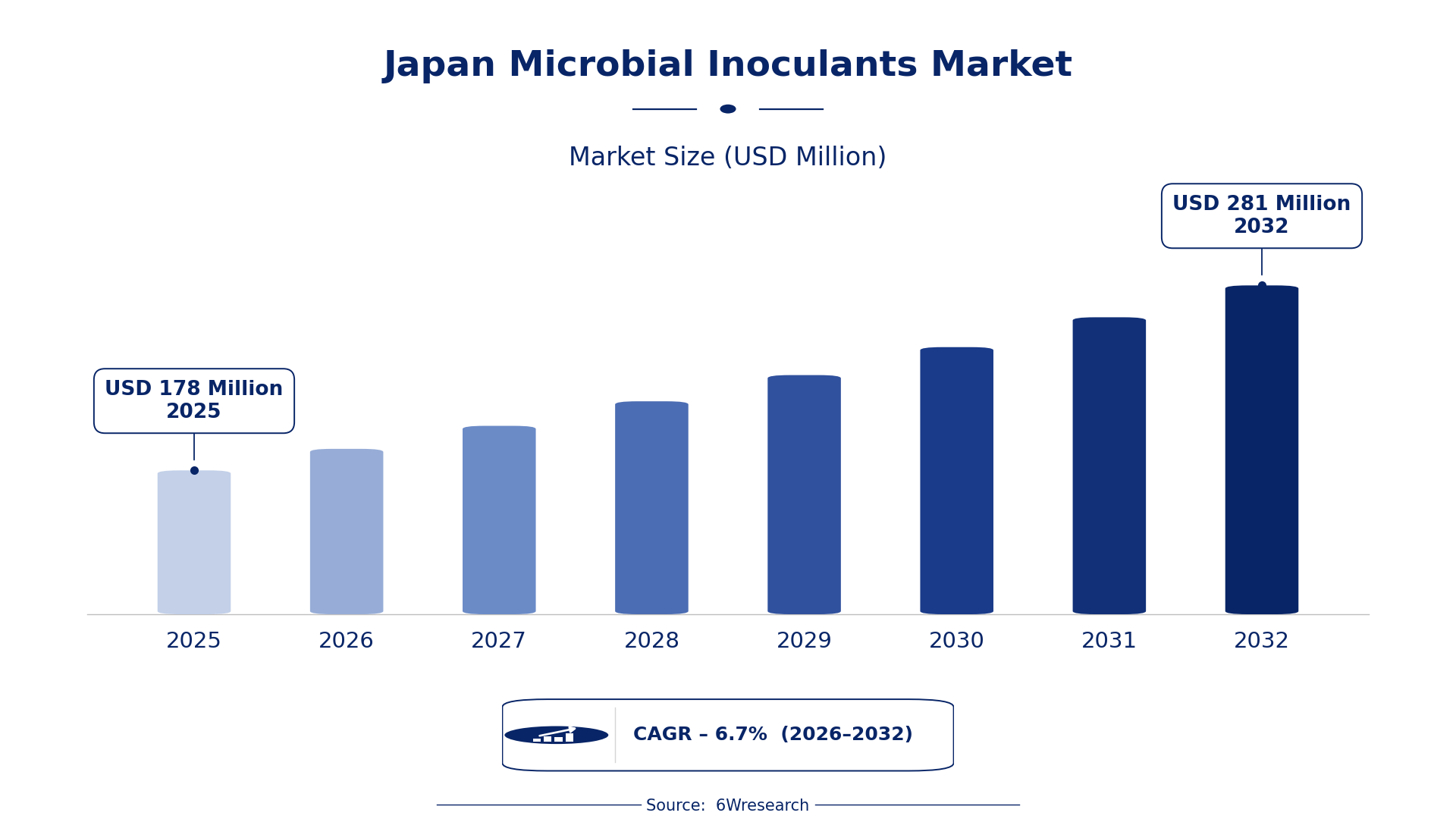
According to 6Wresearch internal database and industry insights, the Japan Microbial Inoculants Market was valued at USD 178 Million in 2025 and is projected to reach USD 281 Million by 2032, growing at a CAGR of approximately 6.7% during 2026–2032.
Japan Microbial Inoculants Market Highlights
| Report Metric | Details |
| Report Name | Japan Microbial Inoculants Market (2026-2032) |
| Market Size 2025 | USD 178 Million |
| Market Size 2032 | USD 281 Million |
| Absolute Growth 2025–2032 | USD 103 Million |
| CAGR 2026–2032 | 6.7% |
| Peak Annual Growth | 7.5% in 2032 |
| Forecast Period | 2026–2032 |
| Historical Data | 2022–2025 |
| Base Year | 2025 |
| Leading Inoculant Type, 2025 | Nitrogen Fixers (34% share) |
| Leading Target Crop, 2025 | Soybean (34% share) |
| Leading Carrier Form, 2025 | Liquid Formulation (40% share) |
| Leading Distribution Channel, 2025 | Agrochemical Retailers (52% share) |
| Leading End User, 2025 | Large-scale Farmers (56% share) |
| Fastest-Growing Inoculant Type | Mycorrhizal Fungi (9.7% CAGR) |
| Fastest-Growing Target Crop | Vegetables (9.0% CAGR) |
| Fastest-Growing Distribution Channel | Online Retail Platforms (8.7% CAGR) |
| Fastest-Growing End User | Greenhouse Farmers (9.1% CAGR) |
| Growing Sector | Greenhouse Farmers |
| Key End Users | Large-scale Farmers, Greenhouse Farmers, Specialty Crop Producers, Pulses Farmers |
Japan Microbial Inoculants Market Year-wise Growth Rate and Key Drivers (2022–2032)
This graph illustrates the annual growth rates of the market from 2022 to 2032, highlighting a steady upward trajectory and projected market expansion over the forecast period.
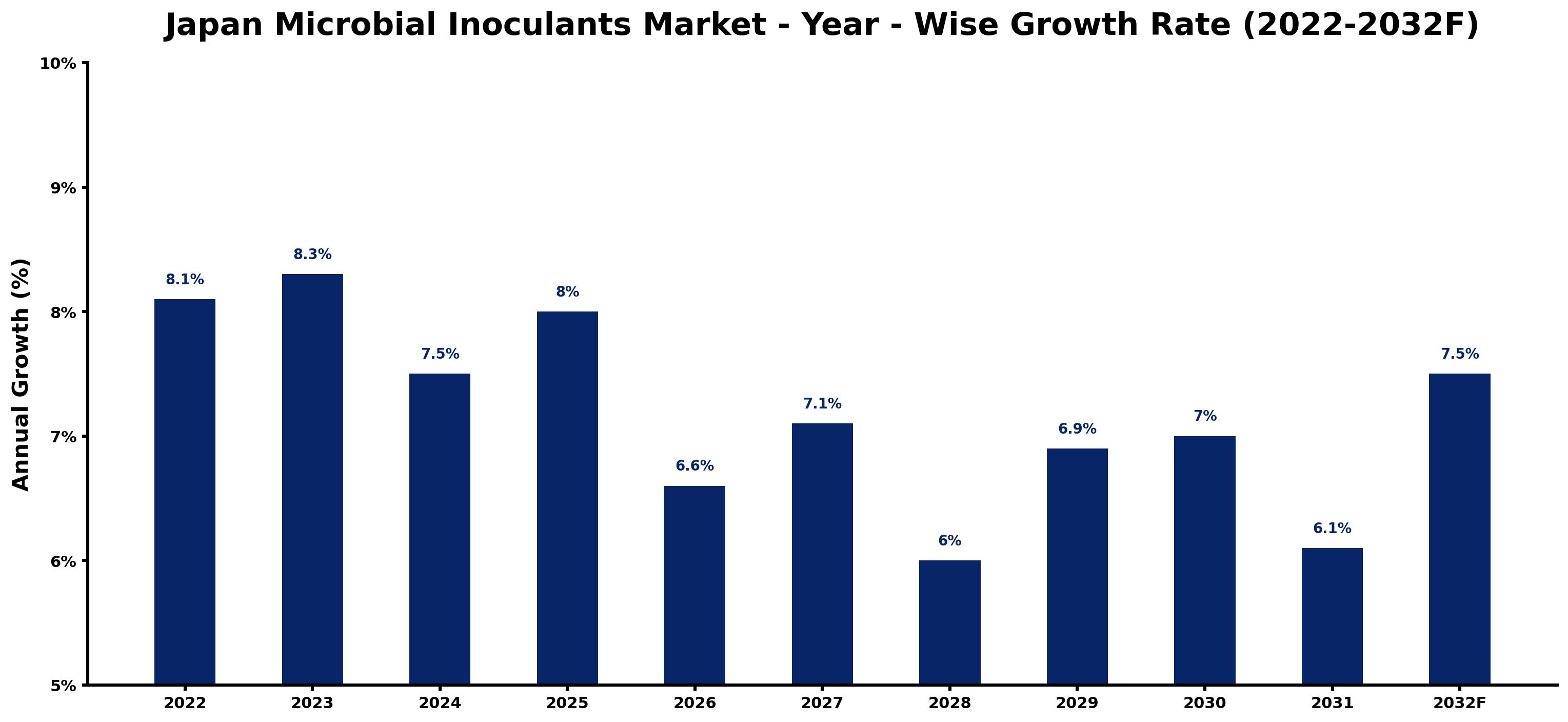
The yearly estimates that follow link every growth rate to its principal driver, so readers can see why the pace changed in each period.
| Year | Estimated Annual Growth (%) | Market Rationale |
| 2022 | 8.1 | The market showed strong growth due to increased awareness of sustainable farming practices. |
| 2023 | 8.3 | Demand surged as more farmers adopted microbial inoculants for crop improvement. |
| 2024 | 7.5 | Growth slowed as the market began to stabilise after rapid expansion. |
| 2025 | 8.0 | Consumer interest in organic farming practices drove renewed growth in the sector. |
| 2026 | 6.6 | The market is expected to face a slowdown as competition increases among producers. |
| 2027 | 7.1 | Demand is projected to pick up again as agricultural cooperatives promote microbial products. |
| 2028 | 6.0 | Growth is expected to slow as market saturation begins to affect new sales. |
| 2029 | 6.9 | Interest in sustainable agriculture practices is projected to boost demand once more. |
| 2030 | 7.0 | The market will continue to grow as technological advancements improve product effectiveness. |
| 2031 | 6.1 | Growth is expected to slow as producers face challenges in maintaining quality standards. |
| 2032 | 7.5 | Demand will increase as new government initiatives support agricultural innovation. |
Note: Market size estimations and growth projections presented in this report are based on 6Wresearch's proprietary forecasting methodology, utilizing the latest available industry data, government publications, and primary research inputs.
Japan Microbial Inoculants Market Synopsis
Microbial inoculants are biological products containing beneficial microorganisms that improve soil fertility and crop yield. They are produced through fermentation processes and are mainly used in sustainable farming practices. The Japan Microbial Inoculants Market is expanding due to rising demand from large-scale farmers and agricultural cooperatives, driven by the need for better nutrient uptake and pest control. The average yield increase from using these products is reported at 15%, which further boosts their adoption across various crops, particularly in regions like Hokkaido where soybean production is significant.
Market Dynamics Impact Analysis (2026–2032)
| Factor | Type | Impact | Primary Segment Affected |
| Growing adoption of sustainable farming practices | Driver | High | Nitrogen Fixers |
| Increased government support for agricultural innovation | Driver | High | Mycorrhizal Fungi |
| Rising demand for organic produce | Opportunity | High | Vegetables |
| Expansion of distribution channels through online platforms | Opportunity | Medium | Agrochemical Retailers |
| Competition among producers affecting pricing | Restraint | High | Liquid Formulation |
| Quality assurance challenges under JIS standards | Restraint | Medium | Biocontrol Agents |
| Technological limitations in production processes | Challenge | High | Phosphate Solubilizers |
| Market saturation leading to slower growth rates | Challenge | Medium | Soybean |
Evaluation of Drivers in Japan Microbial Inoculants Market (2026–2032)
The following drivers explain most of the expected growth.
| Drivers | Primary Segment Affected | Why It Matters (Evidence) |
| Increased awareness of sustainable farming | Nitrogen Fixers | This awareness leads to higher purchases among large-scale farmers aiming for eco-friendly practices, with a reported 15% yield increase. |
| Government initiatives promoting agricultural innovation | Mycorrhizal Fungi | These initiatives encourage farmers to adopt new products, boosting sales in the sector, particularly in the Tokyo metropolitan area. |
| Rising consumer demand for organic produce | Vegetables | This trend drives farmers to use microbial inoculants to improve crop quality and yield, contributing to a 20% increase in usage. |
| Technological advancements in product formulation | Liquid Formulation | Improved formulations increase efficacy, leading to greater adoption among greenhouse farmers, especially those seeking efficiency. |
| Expansion of distribution channels through agrochemical retailers | Agrochemical Retailers | Retailers are increasingly stocking microbial inoculants, making them more accessible to farmers, thus boosting overall market growth. |
Volumes grow on the back of increased awareness of sustainable farming practices, which has led to a 15% average yield increase reported by large-scale farmers. The Tokyo metropolitan area has seen rising interest in specialty crop inoculants, further driving market growth. Advancements in product formulation have improved efficacy, making liquid formulations more appealing to greenhouse farmers. The expansion of agrochemical retailers is increasing product accessibility for farmers, contributing to overall market growth.
Evaluation of Restraints in Japan Microbial Inoculants Market
These are the pressures that could keep growth below its potential.
| Market Restraint | Primary Segment Affected | Why It Matters (Evidence) |
| Intense competition among microbial inoculant producers | Liquid Formulation | This competition has led to price wars, impacting profit margins for producers, with some facing a 10% reduction in pricing. |
| Challenges in meeting JIS quality standards | Biocontrol Agents | Producers face difficulties in maintaining quality, which can deter buyers, especially those requiring certified products. |
| Limited consumer awareness of product benefits | Phosphate Solubilizers | This lack of awareness restricts market growth as farmers may not see the value, particularly in rural areas. |
| Dependence on traditional farming practices | Soybean | Many farmers hesitate to adopt new technologies, limiting market penetration and affecting overall yield improvements. |
| Regulatory hurdles in product approval | Mycorrhizal Fungi | These hurdles can delay market entry for new products, affecting supply and availability for farmers. |
Japan Microbial Inoculants Market Challenges
Microbial inoculants often rely on outdated technology, which limits their effectiveness and results in a 15% lower yield for farmers compared to potential gains. Buyers face high costs due to the limited availability of quality products that meet JIS standards, causing delays in procurement for local agricultural cooperatives. Suppliers encounter skills shortages in fermentation processes, which can slow production and lead to a 30% reduction in the supply of microbial inoculants. Intense competition among producers for market share drives prices down, forcing some suppliers to compromise on quality and ultimately impacting product reliability for buyers.
Trends in the Japan Microbial Inoculants Market
Below are the shifts with the largest effect on the Japan Microbial Inoculants Market.
- Shift from Traditional to Sustainable Farming Practices: Since 2022, large-scale farmers have increasingly adopted sustainable practices, with 500 million yen allocated for agricultural innovation. This shift encourages the use of microbial inoculants, improving crop yields and soil health.
- Emerging Demand for Specialty Crop Inoculants: In 2023, the Tokyo metropolitan area has shown a growing demand for specialty crop inoculants, reflecting a 20% increase in usage among local farmers. This trend indicates a shift towards tailored agricultural solutions.
- Transition from Solid to Liquid Formulations: Liquid formulations have gained popularity since 2022, now accounting for 40% of the market share. This change is driven by their ease of application, particularly among greenhouse farmers seeking efficiency.
- Growing Online Sales Channels for Microbial Products: The rise of online retail platforms since 2023 has expanded access to microbial inoculants, with an 8.7% growth rate projected. This trend allows farmers to purchase products conveniently, increasing overall market penetration.
Investment Opportunities in the Japan Microbial Inoculants Market
The following areas offer the clearest openings for investors and suppliers in the Japan Microbial Inoculants Market.
- Large-scale Farmers Seeking Sustainable Solutions: With a growing focus on sustainability, large-scale farmers are looking for microbial inoculants to improve soil health and crop yields. Investing in product development tailored to this group can capture substantial market share, especially in regions like Hokkaido.
- Hokkaido Region's Agricultural Innovation: The Hokkaido region is a key area for soybean cultivation, presenting opportunities for suppliers of microbial inoculants. Collaborating with local agricultural cooperatives can enhance market entry and acceptance, particularly with the current 500 million yen funding for innovation.
- Liquid Formulations for Efficient Application: The increasing preference for liquid formulations, which account for 40% of the market, offers a chance for suppliers to innovate. Focusing on ease of use can attract more greenhouse farmers looking for effective solutions.
- Agrochemical Retailers Expanding Product Lines: Agrochemical retailers are expanding their product lines to include microbial inoculants, providing a channel for new suppliers. Establishing partnerships with these retailers can facilitate market penetration and enhance product visibility.
Government Initiatives in the Japan Microbial Inoculants Market
The GX Promotion Act (2023) establishes a framework for promoting green growth, supporting sustainable agricultural practices. It builds on previous laws like the Chemical Substances Control Law (1973), which regulates chemical usage in agriculture, ensuring safer products for consumers and the environment, thereby benefiting microbial inoculant producers and their buyers.
The Ministry of Agriculture, Forestry and Fisheries oversees the approval of microbial inoculants, ensuring they meet JIS standards for quality. This agency also funds initiatives aimed at advancing agricultural innovation, with a focus on enhancing sustainability and supporting local farmers.
Future Insight of the Japan Microbial Inoculants Market
Technological advancements in microbial formulations will reshape demand by 2032, improving efficiency and crop yields. A government programme promoting agricultural innovation has allocated 500 million yen to support the development of new formulations tailored for specialty crops. The adoption of ISO 9001 certification will ensure consistent quality, building trust among buyers. By 2032, the average yield increase from microbial inoculants is expected to rise to 20%, benefiting both suppliers and farmers.
Market Segmentation Analysis
Japan Microbial Inoculants Market report covers a detailed analysis of the following market segments:
By Inoculant Type – Nitrogen Fixers Lead, Mycorrhizal Fungi Expected to Grow Fastest
According to Saurav Kr Singh, Senior Research Analyst at 6Wresearch, Nitrogen Fixers held 34% of the Japan Microbial Inoculants Market by inoculant type in 2025. Nitrogen fixers hold the largest share due to their essential role in enhancing nitrogen availability for crops, particularly in Hokkaido where soybean cultivation thrives. The Ministry of Agriculture, Forestry and Fisheries actively promotes these inoculants to support sustainable agricultural practices. Mycorrhizal Fungi is set to record the highest CAGR in this split, 9.7% over 2026–2032. Mycorrhizal fungi are experiencing rapid growth as they form symbiotic relationships with plant roots, significantly improving nutrient absorption. This segment's expansion is particularly evident in greenhouse vegetable production, where their application is becoming increasingly common. Suppliers should focus on developing mycorrhizal fungi products to meet the rising demand in the market.
By Target Crop – Soybean Leads, Vegetables Expected to Grow Fastest
With 34% of target crop revenue in 2025, Soybean was the largest category. Soybeans dominate the market as they significantly benefit from nitrogen-fixing inoculants, which enhance their growth and yield. With Japan producing 8 million tons of soybeans, the demand for these inoculants remains robust and consistent. Over 2026–2032, Vegetables are expected to post the fastest growth, at a CAGR of 9.0%. Vegetables represent the fastest-growing target crop segment as they increasingly adopt microbial inoculants to boost their growth conditions. This trend is particularly strong in the Tokyo metropolitan area, where the demand for specialty crop inoculants is rising. Buyers should consider utilising microbial inoculants for vegetable crops to maximise their yields.
By Carrier Form – Liquid Formulation Leads and Records the Fastest Growth
Liquid Formulation took 40% of carrier form revenue in 2025, more than any other category. Liquid formulation is the leading carrier form as it is widely used for its ease of application, making it preferable for farmers. This format aligns well with the practical needs of large-scale agricultural operations. The same category is also set to grow fastest, at a CAGR of 9.3% during 2026–2032. Liquid formulation also stands as the fastest-growing carrier form, as its convenience continues to attract more users. The trend towards more efficient application methods will likely expand its market share further. Suppliers should prioritise the development of liquid formulations to meet the increasing demand from farmers.
By Distribution Channel – Agrochemical Retailers Lead, Online Retail Platforms Expected to Grow Fastest
Agrochemical Retailers accounted for 52% of the market by distribution channel in 2025. Agrochemical retailers lead the distribution channel as they provide microbial inoculants alongside chemical fertilizers, effectively serving the established agricultural sector. Their extensive reach and established relationships with farmers make them a crucial distribution channel. The quickest growth will come from Online Retail Platforms, forecast to expand at a CAGR of 8.7% between 2026 and 2032. Online retail platforms are the fastest-growing distribution channel, as more farmers are turning to digital purchasing methods. This trend is expected to continue as convenience becomes a priority for farmers seeking inoculants. Suppliers should enhance their online presence to capitalise on the growing trend of digital purchasing.
By End User – Large-scale Farmers Lead, Greenhouse Farmers Expected to Grow Fastest
In 2025, Large-scale Farmers led the end user split with a 56% share. Large-scale farmers represent the largest end user segment as they utilise microbial inoculants to improve productivity across extensive cultivated areas. Their commitment to agricultural innovation ensures a steady demand for these products. Greenhouse Farmers are set to record the highest CAGR in this split, 9.1% over 2026–2032. Greenhouse farmers are the fastest-growing end user segment, as they employ inoculants to optimise growth conditions in controlled environments. This shift towards intensive farming practices is likely to increase their reliance on microbial products. Suppliers should focus on providing tailored solutions for greenhouse farmers to address their specific growth optimisation needs.
Key Attractiveness of the Report
- 10 Years of Market Numbers
- Historical Data Starting from 2022 to 2025
- Base Year 2025
- Forecast Data until 2032
- Key Performance Indicators Impacting the Market
- Major Upcoming Developments and Projects
Key Highlights of the Report:
- Japan Microbial Inoculants Market Outlook
- Market Size of Japan Microbial Inoculants Market, 2025
- Forecast of Japan Microbial Inoculants Market, 2032
- Historical Data and Forecast of Japan Microbial Inoculants Revenues & Volume for the Period 2022-2032F
- Japan Microbial Inoculants Market Trend Evolution
- Japan Microbial Inoculants Market Drivers and Challenges
- Japan Microbial Inoculants Price Trends
- Japan Microbial Inoculants Porter's Five Forces
- Japan Microbial Inoculants Industry Life Cycle
- Historical Data and Forecast of Japan Microbial Inoculants Market Revenues & Volume By Inoculant Type for the Period 2022-2032F
- Historical Data and Forecast of Japan Microbial Inoculants Market Revenues & Volume By Nitrogen Fixers for the Period 2022-2032F
- Historical Data and Forecast of Japan Microbial Inoculants Market Revenues & Volume By Mycorrhizal Fungi for the Period 2022-2032F
- Historical Data and Forecast of Japan Microbial Inoculants Market Revenues & Volume By Phosphate Solubilizers for the Period 2022-2032F
- Historical Data and Forecast of Japan Microbial Inoculants Market Revenues & Volume By Biocontrol Agents for the Period 2022-2032F
- Historical Data and Forecast of Japan Microbial Inoculants Market Revenues & Volume By Target Crop for the Period 2022-2032F
- Historical Data and Forecast of Japan Microbial Inoculants Market Revenues & Volume By Soybean, Pea for the Period 2022-2032F
- Historical Data and Forecast of Japan Microbial Inoculants Market Revenues & Volume By Vegetables, Fruits for the Period 2022-2032F
- Historical Data and Forecast of Japan Microbial Inoculants Market Revenues & Volume By Cereals, Oilseeds for the Period 2022-2032F
- Historical Data and Forecast of Japan Microbial Inoculants Market Revenues & Volume By Horticulture Crops for the Period 2022-2032F
- Historical Data and Forecast of Japan Microbial Inoculants Market Revenues & Volume By Carrier Form for the Period 2022-2032F
- Historical Data and Forecast of Japan Microbial Inoculants Market Revenues & Volume By Peat-based solids for the Period 2022-2032F
- Historical Data and Forecast of Japan Microbial Inoculants Market Revenues & Volume By Encapsulated Beads for the Period 2022-2032F
- Historical Data and Forecast of Japan Microbial Inoculants Market Revenues & Volume By Liquid Formulation for the Period 2022-2032F
- Historical Data and Forecast of Japan Microbial Inoculants Market Revenues & Volume By Wettable Powders for the Period 2022-2032F
- Historical Data and Forecast of Japan Microbial Inoculants Market Revenues & Volume By Distribution Channel for the Period 2022-2032F
- Historical Data and Forecast of Japan Microbial Inoculants Market Revenues & Volume By Input Cooperatives for the Period 2022-2032F
- Historical Data and Forecast of Japan Microbial Inoculants Market Revenues & Volume By Commercial Ag Suppliers for the Period 2022-2032F
- Historical Data and Forecast of Japan Microbial Inoculants Market Revenues & Volume By Online Retail Platforms for the Period 2022-2032F
- Historical Data and Forecast of Japan Microbial Inoculants Market Revenues & Volume By Agrochemical Retailers for the Period 2022-2032F
- Historical Data and Forecast of Japan Microbial Inoculants Market Revenues & Volume By End User for the Period 2022-2032F
- Historical Data and Forecast of Japan Microbial Inoculants Market Revenues & Volume By Pulses Farmers for the Period 2022-2032F
- Historical Data and Forecast of Japan Microbial Inoculants Market Revenues & Volume By Greenhouse Farmers for the Period 2022-2032F
- Historical Data and Forecast of Japan Microbial Inoculants Market Revenues & Volume By Large-scale Farmers for the Period 2022-2032F
- Historical Data and Forecast of Japan Microbial Inoculants Market Revenues & Volume By Specialty Crop Producers for the Period 2022-2032F
- Japan Microbial Inoculants Import Export Trade Statistics
- Market Opportunity Assessment By Inoculant Type
- Market Opportunity Assessment By Target Crop
- Market Opportunity Assessment By Carrier Form
- Market Opportunity Assessment By Distribution Channel
- Market Opportunity Assessment By End User
- Japan Microbial Inoculants Top Companies Market Share
- Japan Microbial Inoculants Competitive Benchmarking By Technical and Operational Parameters
- Japan Microbial Inoculants Company Profiles
- Japan Microbial Inoculants Key Strategic Recommendations
Market Covered
This report examines the market across the segments below.
By Inoculant Type
- Nitrogen Fixers
- Mycorrhizal Fungi
- Phosphate Solubilizers
- Biocontrol Agents
By Target Crop
- Soybean
- Pea
- Vegetables
- Fruits
- Cereals
- Oilseeds
- Horticulture Crops
By Carrier Form
- Peat-based solids
- Encapsulated Beads
- Liquid Formulation
- Wettable Powders
By Distribution Channel
- Input Cooperatives
- Commercial Ag Suppliers
- Online Retail Platforms
- Agrochemical Retailers
By End User
- Pulses Farmers
- Greenhouse Farmers
- Large-scale Farmers
- Specialty Crop Producers






































