Japan Microbial Seed Treatments Market Size & Growth Rate
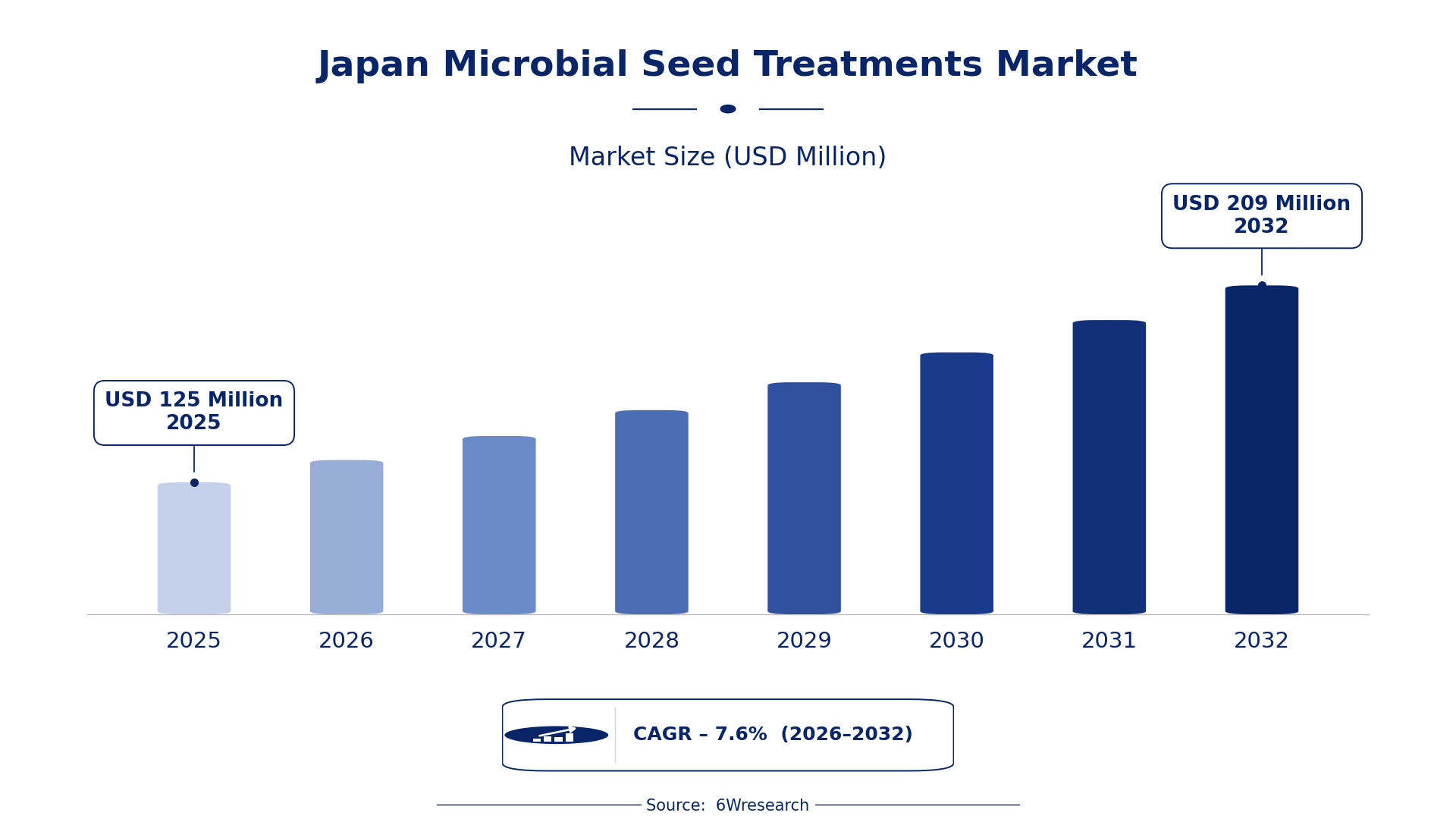
According to 6Wresearch internal database and industry insights, the Japan Microbial Seed Treatments Market was valued at USD 125 Million in 2025 and is projected to reach USD 209 Million by 2032, growing at a CAGR of approximately 7.6% during 2026–2032.
Japan Microbial Seed Treatments Market Highlights
| Report Metric | Details |
| Report Name | Japan Microbial Seed Treatments Market (2026-2032) |
| Market Size 2025 | USD 125 Million |
| Market Size 2032 | USD 209 Million |
| Absolute Growth 2025–2032 | USD 84 Million |
| CAGR 2026–2032 | 7.6% |
| Peak Annual Growth | 8.2% in 2030 |
| Forecast Period | 2026–2032 |
| Historical Data | 2022–2025 |
| Base Year | 2025 |
| Leading Treatment Type, 2025 | Rhizobia Coating (54% share) |
| Leading Microbial Strain, 2025 | Rhizobium spp. (37% share) |
| Leading Seed Type, 2025 | Legumes (39% share) |
| Leading Distribution Channel, 2025 | Seed Companies (45% share) |
| Leading End User, 2025 | Soy (42% share) |
| Fastest-Growing Treatment Type | Biocontrol Coating (11.0% CAGR) |
| Fastest-Growing Microbial Strain | Bacillus subtilis (9.7% CAGR) |
| Fastest-Growing Seed Type | Vegetable Seeds (10.7% CAGR) |
| Fastest-Growing Distribution Channel | Seed Distributors (9.4% CAGR) |
| Fastest-Growing End User | Pulses Seed Producers (9.8% CAGR) |
| Growing Sector | Agriculture |
| Key End Users | Seed Companies, Farmers, Agricultural Cooperatives, Pulses Seed Producers |
Japan Microbial Seed Treatments Market Year-wise Growth Rate and Key Drivers (2022–2032)
This graph illustrates the annual growth rates of the market from 2022 to 2032, highlighting a steady upward trajectory and projected market expansion over the forecast period.
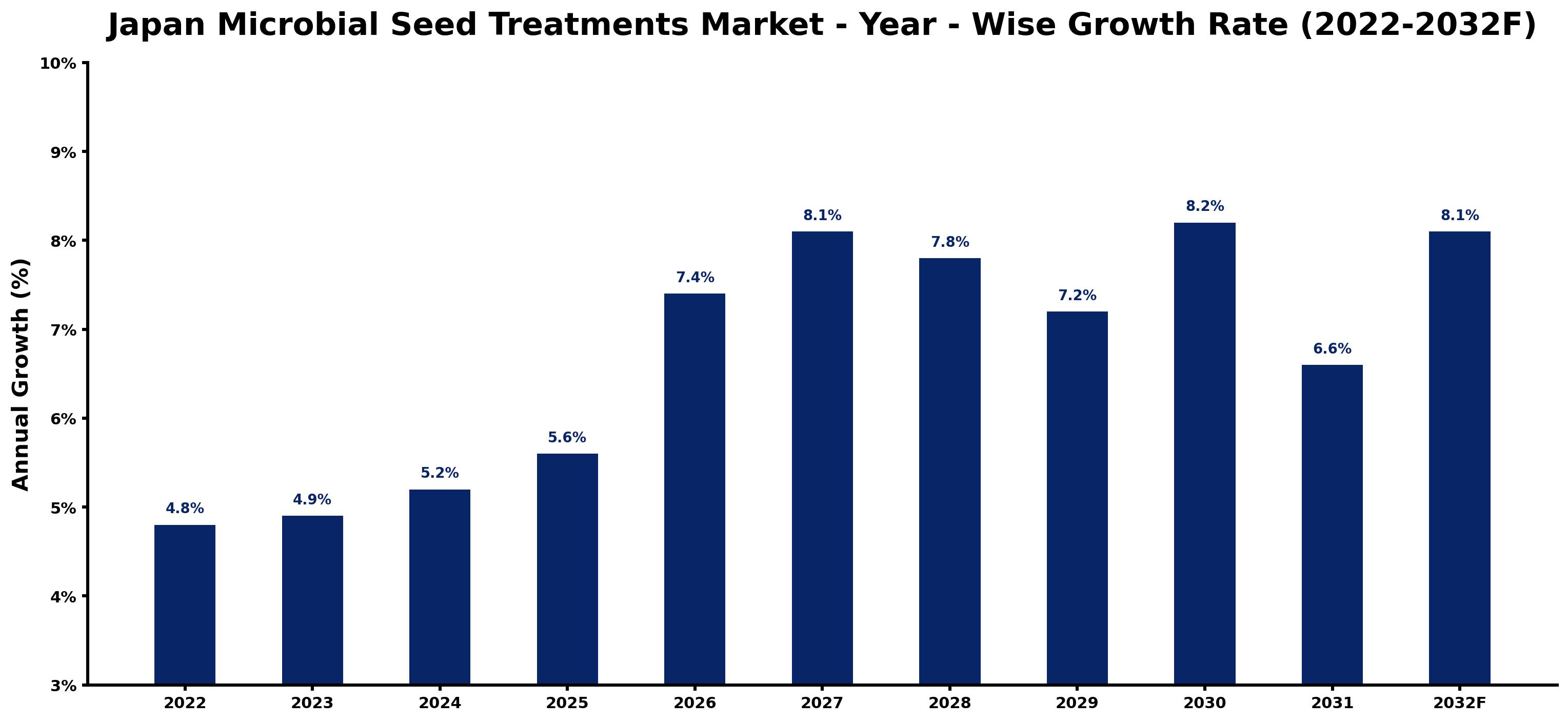
The table below sets out the estimated growth rate for each year and the main factor behind it.
| Year | Estimated Annual Growth (%) | Market Rationale |
| 2022 | 4.8 | The market experienced steady growth, supported by increasing awareness of sustainable practices. |
| 2023 | 4.9 | Demand for microbial treatments grew faster due to rising interest in organic farming methods. |
| 2024 | 5.2 | The expansion of the agricultural sector contributed to higher adoption rates of seed treatments. |
| 2025 | 5.6 | The introduction of new biocontrol products drove growth, improving crop protection strategies. |
| 2026 | 7.4 | Investment in agricultural innovation is expected to spur demand for advanced microbial treatments. |
| 2027 | 8.1 | The market will continue to grow as farmers seek effective solutions for crop resilience. |
| 2028 | 7.8 | Growth is projected to slow slightly as market saturation begins to influence purchasing decisions. |
| 2029 | 7.2 | Demand is expected to remain strong, though growth rates will moderate as competition increases. |
| 2030 | 8.2 | A surge in interest for biostimulants will lead to the highest growth rate in the forecast period. |
| 2031 | 6.6 | The market is projected to experience a slowdown as buyers adjust to new product offerings. |
| 2032 | 8.1 | Continued investment in sustainable agriculture practices will drive demand for microbial treatments. |
Note: Market size estimations and growth projections presented in this report are based on 6Wresearch's proprietary forecasting methodology, utilizing the latest available industry data, government publications, and primary research inputs.
Japan Microbial Seed Treatments Market Synopsis
Microbial seed treatments involve applying beneficial microorganisms to seeds to improve growth and protect against diseases. In 2022, 30% of soybean seeds were treated with these products, reflecting a shift towards sustainable agricultural practices. Key growth drivers include the rising adoption of organic farming methods and government support for biopesticides, which encourage farmers to invest in microbial solutions for improved crop yields.
Market Dynamics Impact Analysis (2026–2032)
| Factor | Type | Impact | Primary Segment Affected |
| Increasing adoption of sustainable farming practices | Driver | High | Rhizobia Coating |
| Rising crop yield demands from domestic users | Driver | High | Legumes |
| Growing interest in organic farming | Opportunity | High | Biocontrol Coating |
| Emerging technologies in seed treatment | Opportunity | Medium | Biostimulant Coating |
| Limited awareness among farmers about microbial benefits | Restraint | High | Bradyrhizobia Coating |
| High initial costs of microbial treatments | Restraint | Medium | Bacillus subtilis |
| Regulatory compliance challenges for new products | Challenge | High | Trichoderma harzianum |
| Capacity constraints in production facilities | Challenge | Medium | Seed Companies |
Evaluation of Drivers in Japan Microbial Seed Treatments Market (2026–2032)
Key forces behind demand, with the segment each one moves most, are listed below.
| Drivers | Primary Segment Affected | Why It Matters (Evidence) |
| Increased investment in agricultural innovation | Rhizobia Coating | Japan's agricultural sector, valued at approximately ¥9 trillion, drives demand for effective treatments. |
| Higher crop yield expectations | Legumes | Research indicates that treated seeds can increase crop yields by up to 20%, prompting purchases. |
| Government support for biopesticides | Biocontrol Coating | The Ministry of Agriculture, Forestry and Fisheries promotes sustainable agriculture practices, boosting demand. |
| Rising consumer preference for organic products | Biostimulant Coating | In 2023, the government allocated ¥5 billion for agricultural innovation projects, encouraging organic farming. |
| Growing agricultural workforce | Bradyrhizobia Coating | With approximately 1.5 million agricultural workers, demand for efficient farming solutions is increasing. |
Most of the extra volume comes from increased investment in agricultural innovation, with the sector valued at approximately ¥9 trillion. The introduction of new biocontrol products is expected to drive demand, as farmers seek effective solutions. The agricultural workforce, comprising around 1.5 million people, is increasingly pursuing sustainable practices. Consumer preference for organic products continues to rise, compelling farmers to align with market trends.
Evaluation of Restraints in Japan Microbial Seed Treatments Market
These restraints slow adoption and weigh on supplier margins.
| Market Restraint | Primary Segment Affected | Why It Matters (Evidence) |
| Limited awareness among farmers about microbial benefits | Bradyrhizobia Coating | Many farmers lack knowledge about the advantages of microbial treatments, limiting market growth. |
| High initial costs of microbial treatments | Bacillus subtilis | The upfront investment for microbial seed treatments can deter potential buyers. |
| Regulatory compliance challenges for new products | Trichoderma harzianum | Complex regulations can delay product launches, affecting market availability. |
| Capacity constraints in production facilities | Seed Companies | Limited production capacity restricts the supply of microbial treatments to meet demand. |
| Competition from traditional seed treatments | Biocontrol Coating | Established chemical treatments challenge the adoption of microbial alternatives. |
Japan Microbial Seed Treatments Market Challenges
Buyers struggle with limited access to microbial seed treatments due to the average farm size of 1.5 hectares, which restricts purchasing power and delays crop yield improvements. Skills shortages within the agricultural workforce of approximately 1.5 million people hinder effective application of these treatments, resulting in lower productivity. Supply chain disruptions arise as the Ministry of Agriculture, Forestry and Fisheries promotes sustainable practices, complicating the timely delivery of essential products to farmers. Technology adoption lags, with only 30% of soybean seeds treated with microbial products in 2022, limiting competitiveness for local producers reliant on innovation.
Trends in the Japan Microbial Seed Treatments Market
Four trends stand out in the Japan Microbial Seed Treatments Market.
- Tokyo Leading in Sustainable Practices: The Tokyo region is at the forefront of agricultural innovation, focusing on sustainable practices. In 2023, the government launched a program to support organic farming, reflecting this trend.
- Growing Demand for Organic Farming: Farmers are increasingly adopting organic farming methods, driven by consumer demand. In 2022, 30% of soybean seeds were treated with microbial products, boosting market growth.
- Emergence of New Biocontrol Products: The introduction of new biocontrol products is transforming seed treatment practices. Research indicates that treated seeds can increase crop yields by up to 20%, driving adoption.
- Rising Interest in Biostimulants: The use of biostimulants is gaining traction among farmers seeking to improve crop health. The Japan Seed Trade Association supports microbial treatments, promoting this trend.
Investment Opportunities in the Japan Microbial Seed Treatments Market
The opportunities below stand out in the Japan Microbial Seed Treatments Market for new entrants and existing suppliers.
- Awareness Gap in Microbial Treatments: With 70% of farmers unaware of microbial benefits, there is an opportunity to educate and supply these products. Seed companies can promote their offerings to fill this gap.
- Demand for Organic Seed Treatments: The organic farming sector is expanding, creating a need for effective seed treatments. Pulses seed producers are particularly interested in sustainable solutions to meet consumer demand.
- Investment in Biopesticide Development: The government allocated ¥5 billion for agricultural innovation projects, highlighting the opportunity for investment in biopesticides. Collaborating with research institutions can enhance product development.
- Expansion of Biostimulant Market: The biostimulant market is projected to grow, driven by increasing consumer demand for organic products. Entering this market through partnerships with local distributors can facilitate access.
Government Initiatives in the Japan Microbial Seed Treatments Market
The Food Sanitation Act amendment of 2018 introduced a positive list system for synthetic resins, which improves food safety standards. This complements existing regulations, ensuring that microbial seed treatments meet stringent safety requirements for agricultural products.
The Japan Agricultural Cooperatives (JA) actively promotes microbial seed treatments among farmers, facilitating access to these products. In 2023, the government allocated ¥5 billion for agricultural innovation projects, supporting initiatives that encourage the use of biopesticides and biostimulants.
Future Insight of the Japan Microbial Seed Treatments Market
By 2032, a policy-driven shift towards sustainable agriculture will reshape the market, enhancing the role of microbial seed treatments. Increased government support for organic farming will expand the availability of biopesticides and biostimulants, benefiting both buyers and suppliers. The Tokyo region is set to emerge as a hub for agricultural innovation, fostering collaboration between research institutes and farmers. Research indicates that treated seeds can boost crop yields by up to 20%, encouraging wider adoption and investment in advanced seed treatment technologies.
Market Segmentation Analysis
Japan Microbial Seed Treatments Market report covers a detailed analysis of the following market segments:
By Treatment Type – Rhizobia Coating Leads, Biocontrol Coating Expected to Grow Fastest
According to Saurav Kr Singh, Senior Research Analyst at 6Wresearch, Rhizobia Coating took 54% of treatment type revenue in 2025, more than any other category. Rhizobia Coating commands the largest share due to its vital role in nitrogen fixation for legumes, a key crop type in Japan. Its application across approximately 150,000 hectares in legume cultivation reinforces its market position. Biocontrol Coating is projected to grow fastest, at a CAGR of 11.0% during 2026–2032. Biocontrol Coating is rapidly growing as it effectively shields crops from soil-borne pathogens, which is becoming increasingly essential for farmers. The government's promotion of biopesticides is further accelerating the adoption of this treatment. Suppliers should prioritise the development of biocontrol solutions to cater to the increasing demand in agriculture.
By Microbial Strain – Rhizobium spp. Leads, Bacillus subtilis Expected to Grow Fastest
In 2025, Rhizobium spp. led the microbial strain split with a 37% share. Rhizobium spp. is the leading strain owing to its crucial role in legume cultivation, a cornerstone of Japan's agricultural practices. The extensive treatment of soybean seeds with Rhizobium highlights its dominance in the market. Over 2026–2032, Bacillus subtilis is expected to post the fastest growth, at a CAGR of 9.7%. Bacillus subtilis is experiencing rapid growth as it enhances overall plant health, appealing to producers aiming to improve crop resilience. Its endorsement by agricultural research institutions is significantly driving its adoption among farmers. Buyers should diversify their use of microbial strains to enhance crop yields and health.
By Seed Type – Legumes Lead, Vegetable Seeds Expected to Grow Fastest
With 39% of seed type revenue in 2025, Legumes was the largest category. Legumes dominate the market as they represent a major crop type for microbial seed treatments, with 30% of soybean seeds treated in 2022. This extensive application underscores the significance of legumes in Japan's agricultural framework. The quickest growth will come from Vegetable Seeds, forecast to expand at a CAGR of 10.7% between 2026 and 2032. Vegetable Seeds are witnessing the fastest growth due to their increasing applications in sustainable farming practices. The rising consumer demand for fresh produce is prompting more farmers to adopt these treatments. Suppliers should consider broadening their product offerings to include treatments specifically for vegetable seeds.
By Distribution Channel – Seed Companies Lead, Seed Distributors Expected to Grow Fastest
Seed Companies accounted for 45% of the market by distribution channel in 2025. Seed Companies lead the distribution channel as they are the primary producers of treated seeds, ensuring a consistent supply to the market. Their established connections with farmers facilitate the adoption of microbial treatments. Seed Distributors are set to record the highest CAGR in this split, 9.4% over 2026–2032. Seed Distributors are growing swiftly as they serve as a crucial channel for treatments, linking producers directly with end users. Their role in the supply chain is becoming increasingly important as demand for microbial treatments escalates. Suppliers need to strengthen collaborations with seed distributors to enhance market penetration.
By End User – Soy Leads, Pulses Seed Producers Expected to Grow Fastest
The largest end user category in 2025 was Soy, at 42% of revenue. Soy is the leading end user as it is extensively cultivated with microbial seed treatments, significantly contributing to Japan's agricultural output. The prevalent use of these treatments in soybean farming underscores their importance in boosting crop yields. Pulses Seed Producers are projected to grow fastest, at a CAGR of 9.8% during 2026–2032. Pulses Seed Producers are experiencing the fastest growth as they increasingly utilise treatments to enhance yield and resilience. The emphasis on sustainable practices in pulse cultivation is driving this trend. Buyers should explore microbial treatments to maximise yield potential in pulse production.
Key Attractiveness of the Report
- 10 Years of Market Numbers
- Historical Data Starting from 2022 to 2025
- Base Year 2025
- Forecast Data until 2032
- Key Performance Indicators Impacting the Market
- Major Upcoming Developments and Projects
Key Highlights of the Report:
- Japan Microbial Seed Treatments Market Outlook
- Market Size of Japan Microbial Seed Treatments Market, 2025
- Forecast of Japan Microbial Seed Treatments Market, 2032
- Historical Data and Forecast of Japan Microbial Seed Treatments Revenues & Volume for the Period 2022-2032F
- Japan Microbial Seed Treatments Market Trend Evolution
- Japan Microbial Seed Treatments Market Drivers and Challenges
- Japan Microbial Seed Treatments Price Trends
- Japan Microbial Seed Treatments Porter's Five Forces
- Japan Microbial Seed Treatments Industry Life Cycle
- Historical Data and Forecast of Japan Microbial Seed Treatments Market Revenues & Volume By Treatment Type for the Period 2022-2032F
- Historical Data and Forecast of Japan Microbial Seed Treatments Market Revenues & Volume By Rhizobia Coating for the Period 2022-2032F
- Historical Data and Forecast of Japan Microbial Seed Treatments Market Revenues & Volume By Bradyrhizobia Coating for the Period 2022-2032F
- Historical Data and Forecast of Japan Microbial Seed Treatments Market Revenues & Volume By Biostimulant Coating for the Period 2022-2032F
- Historical Data and Forecast of Japan Microbial Seed Treatments Market Revenues & Volume By Biocontrol Coating for the Period 2022-2032F
- Historical Data and Forecast of Japan Microbial Seed Treatments Market Revenues & Volume By Microbial Strain for the Period 2022-2032F
- Historical Data and Forecast of Japan Microbial Seed Treatments Market Revenues & Volume By Rhizobium spp. for the Period 2022-2032F
- Historical Data and Forecast of Japan Microbial Seed Treatments Market Revenues & Volume By Bradyrhizobium spp. for the Period 2022-2032F
- Historical Data and Forecast of Japan Microbial Seed Treatments Market Revenues & Volume By Bacillus subtilis for the Period 2022-2032F
- Historical Data and Forecast of Japan Microbial Seed Treatments Market Revenues & Volume By Trichoderma harzianum for the Period 2022-2032F
- Historical Data and Forecast of Japan Microbial Seed Treatments Market Revenues & Volume By Seed Type for the Period 2022-2032F
- Historical Data and Forecast of Japan Microbial Seed Treatments Market Revenues & Volume By Legumes for the Period 2022-2032F
- Historical Data and Forecast of Japan Microbial Seed Treatments Market Revenues & Volume By Groundnuts, Peas for the Period 2022-2032F
- Historical Data and Forecast of Japan Microbial Seed Treatments Market Revenues & Volume By Cereals for the Period 2022-2032F
- Historical Data and Forecast of Japan Microbial Seed Treatments Market Revenues & Volume By Vegetable Seeds for the Period 2022-2032F
- Historical Data and Forecast of Japan Microbial Seed Treatments Market Revenues & Volume By Distribution Channel for the Period 2022-2032F
- Historical Data and Forecast of Japan Microbial Seed Treatments Market Revenues & Volume By Seed Distributors for the Period 2022-2032F
- Historical Data and Forecast of Japan Microbial Seed Treatments Market Revenues & Volume By Seed Companies for the Period 2022-2032F
- Historical Data and Forecast of Japan Microbial Seed Treatments Market Revenues & Volume By Input Aggregators for the Period 2022-2032F
- Historical Data and Forecast of Japan Microbial Seed Treatments Market Revenues & Volume By Nursery Suppliers for the Period 2022-2032F
- Historical Data and Forecast of Japan Microbial Seed Treatments Market Revenues & Volume By End User for the Period 2022-2032F
- Historical Data and Forecast of Japan Microbial Seed Treatments Market Revenues & Volume By Soy, Beans Seed Companies for the Period 2022-2032F
- Historical Data and Forecast of Japan Microbial Seed Treatments Market Revenues & Volume By Pulses Seed Producers for the Period 2022-2032F
- Historical Data and Forecast of Japan Microbial Seed Treatments Market Revenues & Volume By Crop Seed Breeders for the Period 2022-2032F
- Historical Data and Forecast of Japan Microbial Seed Treatments Market Revenues & Volume By Garden Seed Producers for the Period 2022-2032F
- Japan Microbial Seed Treatments Import Export Trade Statistics
- Market Opportunity Assessment By Treatment Type
- Market Opportunity Assessment By Microbial Strain
- Market Opportunity Assessment By Seed Type
- Market Opportunity Assessment By Distribution Channel
- Market Opportunity Assessment By End User
- Japan Microbial Seed Treatments Top Companies Market Share
- Japan Microbial Seed Treatments Competitive Benchmarking By Technical and Operational Parameters
- Japan Microbial Seed Treatments Company Profiles
- Japan Microbial Seed Treatments Key Strategic Recommendations
Market Covered
Coverage by segment is as follows.
By Treatment Type
- Rhizobia Coating
- Bradyrhizobia Coating
- Biostimulant Coating
- Biocontrol Coating
By Microbial Strain
- Rhizobium spp.
- Bradyrhizobium spp.
- Bacillus subtilis
- Trichoderma harzianum
By Seed Type
- Legumes
- Groundnuts
- Peas
- Cereals
- Vegetable Seeds
By Distribution Channel
- Seed Distributors
- Seed Companies
- Input Aggregators
- Nursery Suppliers
By End User
- Soy
- Beans Seed Companies
- Pulses Seed Producers
- Crop Seed Breeders
- Garden Seed Producers






































