Japan Microbiome-Driven Crop Products Market Size & Growth Rate
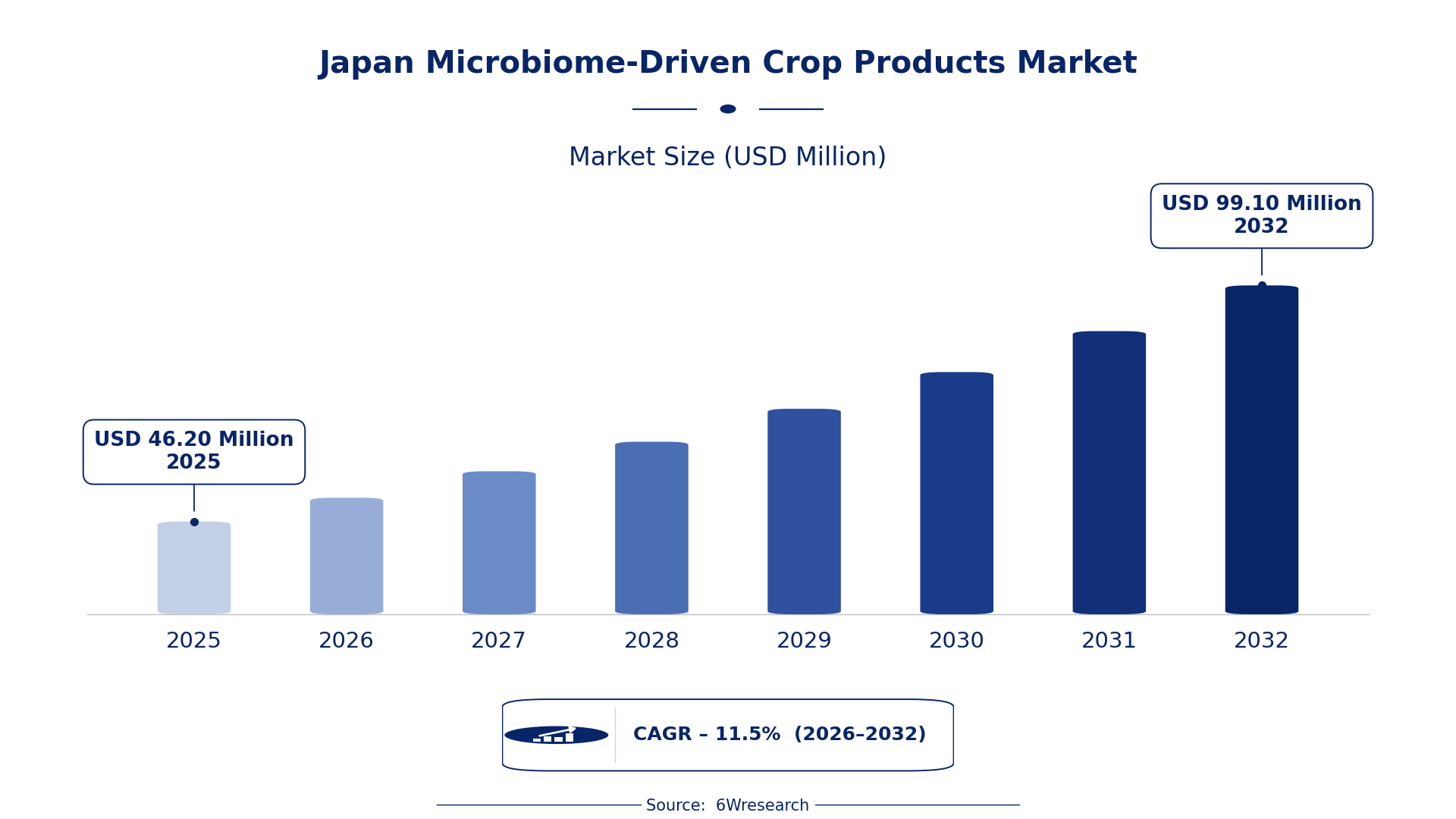
According to 6Wresearch internal database and industry insights, the Japan Microbiome-Driven Crop Products Market was valued at USD 46.20 Million in 2025 and is projected to reach USD 99.10 Million by 2032, growing at a CAGR of approximately 11.5% during 2026–2032.
Japan Microbiome-Driven Crop Products Market Highlights
| Report Metric | Details |
| Report Name | Japan Microbiome-Driven Crop Products Market (2026-2032) |
| Market Size 2025 | USD 46.20 Million |
| Market Size 2032 | USD 99.10 Million |
| Absolute Growth 2025–2032 | USD 52.90 Million |
| CAGR 2026–2032 | 11.5% |
| Peak Annual Growth | 12.6% in 2029 |
| Forecast Period | 2026–2032 |
| Historical Data | 2022–2025 |
| Base Year | 2025 |
| Leading Product Type, 2025 | Soil Microbiome Enhancers (40% share) |
| Leading Microbial Source, 2025 | Rhizobacteria (37% share) |
| Leading Application Method, 2025 | Soil Application (42% share) |
| Leading Distribution Channel, 2025 | Agri-biotech Distributors (41% share) |
| Leading End User, 2025 | Regenerative Agriculture Farms (48% share) |
| Fastest-Growing Product Type | Microbial Biostimulants (16.5% CAGR) |
| Fastest-Growing Microbial Source | Mycorrhizae & PGPR (16.4% CAGR) |
| Fastest-Growing Application Method | Seed Coating (15.4% CAGR) |
| Fastest-Growing Distribution Channel | Organic Product Suppliers (15.3% CAGR) |
| Fastest-Growing End User | Sustainable Crop Producers (16.6% CAGR) |
| Growing Sector | sustainable agriculture |
| Key End Users | regenerative agriculture farms, horticulturalists, sustainable crop producers, organic greenhouse growers |
Japan Microbiome-Driven Crop Products Market Year-wise Growth Rate and Key Drivers (2022–2032)
This graph illustrates the annual growth rates of the market from 2022 to 2032, highlighting a steady upward trajectory and projected market expansion over the forecast period.
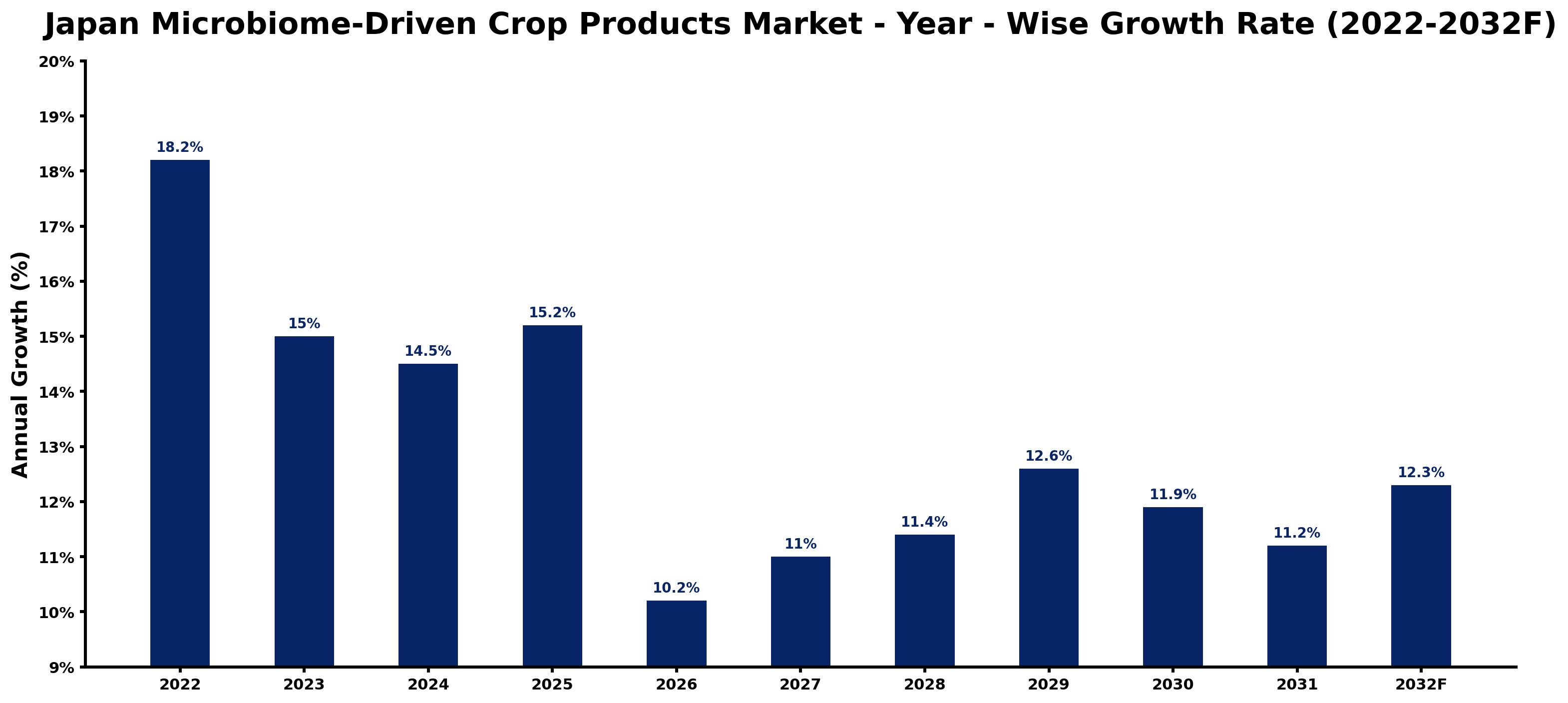
Each row of the following table gives one year's estimated growth and the event or demand shift that explains it.
| Year | Estimated Annual Growth (%) | Market Rationale |
| 2022 | 18.2 | The market experienced high demand due to increased awareness of sustainable practices. |
| 2023 | 15.0 | Demand continued to grow, but at a slower rate as market conditions stabilised. |
| 2024 | 14.5 | Growth slowed further as the market adjusted to previous peaks in demand. |
| 2025 | 15.2 | The market rebounded with renewed interest in microbiome products for agriculture. |
| 2026 | 10.2 | Growth is expected to slow again as market maturity begins to set in. |
| 2027 | 11.0 | Demand is projected to pick up as new products gain traction among farmers. |
| 2028 | 11.4 | The market is expected to continue expanding with increasing adoption of sustainable practices. |
| 2029 | 12.6 | A peak in growth is projected as investments in technology surge. |
| 2030 | 11.9 | Growth is expected to slow as the market stabilises after rapid expansion. |
| 2031 | 11.2 | The market will maintain a steady growth rate as consumer awareness increases. |
| 2032 | 12.3 | Demand is expected to rise again with new product developments emerging. |
Note: Market size estimations and growth projections presented in this report are based on 6Wresearch's proprietary forecasting methodology, utilizing the latest available industry data, government publications, and primary research inputs.
Japan Microbiome-Driven Crop Products Market Synopsis
Microbiome-driven crop products are agricultural inputs that use beneficial microorganisms to improve soil health and plant growth. Their main applications include improving nutrient uptake and suppressing diseases. The Japan Microbiome-Driven Crop Products Market is expanding due to over 1.5 million farms focusing on sustainable practices and government support for microbiome products. Organic farming adoption has increased by 20% over the last five years, further boosting demand for these agricultural solutions.
Market Dynamics Impact Analysis (2026–2032)
| Factor | Type | Impact | Primary Segment Affected |
| Growing interest in sustainable farming practices | Driver | High | Microbial Biostimulants |
| Increasing adoption of organic farming methods | Driver | High | Soil Microbiome Enhancers |
| Rising demand for eco-friendly agricultural inputs | Opportunity | High | Disease Suppressors |
| Investment in research for innovative agricultural technologies | Opportunity | Medium | Growth Boosters |
| Limited awareness among traditional farmers | Restraint | Medium | Microbial Biostimulants |
| Regulatory challenges in product approval processes | Restraint | High | Soil Microbiome Enhancers |
| High initial costs for adopting new technologies | Challenge | High | Growth Boosters |
| Capacity constraints in production facilities | Challenge | Medium | Disease Suppressors |
Evaluation of Drivers in Japan Microbiome-Driven Crop Products Market (2026–2032)
These are the developments adding the most demand over the forecast period.
| Drivers | Primary Segment Affected | Why It Matters (Evidence) |
| Increased focus on sustainable agriculture | Microbial Biostimulants | This trend leads to higher purchases from regenerative agriculture farms, which have seen a 20% increase in organic farming adoption. |
| Government support for microbiome products | Soil Microbiome Enhancers | Support from agricultural programmes encourages farmers to invest in soil health, increasing product demand. |
| Rising consumer demand for organic produce | Disease Suppressors | Horticulturalists are increasingly purchasing disease suppressors to enhance crop resilience and yield. |
| Technological advancements in microbial solutions | Growth Boosters | New developments in microbial products are gaining traction, leading to higher demand from sustainable crop producers. |
| Educational initiatives on microbiome benefits | Microbial Biostimulants | Workshops and seminars are increasing awareness among farmers, driving up sales of biostimulants. |
Purchasing is picking up as farmers increasingly focus on sustainable practices, with over 1.5 million farms in Japan adopting eco-friendly methods. Rising consumer preference for organic produce is driving horticulturalists to invest in disease suppressors. Technological advancements in microbial solutions are gaining traction, resulting in increased demand from sustainable crop producers.
Evaluation of Restraints in Japan Microbiome-Driven Crop Products Market
The table below lists the restraints and the evidence behind each.
| Market Restraint | Primary Segment Affected | Why It Matters (Evidence) |
| Limited awareness among traditional farmers | Microbial Biostimulants | Many traditional farmers lack knowledge about the benefits of microbiome products, hindering market growth. |
| Regulatory challenges in product approval processes | Soil Microbiome Enhancers | Stringent regulations can delay product launches, affecting supply to the market. |
| High initial costs for adopting new technologies | Growth Boosters | The investment required for new microbiome products can deter farmers from switching. |
| Capacity constraints in production facilities | Disease Suppressors | Limited production capacity can lead to supply shortages, impacting availability for buyers. |
| Market fragmentation among suppliers | Microbial Biostimulants | A fragmented market complicates distribution and reduces product visibility. |
Japan Microbiome-Driven Crop Products Market Challenges
Japan's agricultural sector encounters a skills gap, as an ageing population results in fewer young workers entering farming, which delays the adoption of microbiome products across over 1.5 million farms. High production costs stem from complex fermentation processes, raising input prices by 15% for producers and squeezing their profit margins. Technological limitations impede efficient distribution, causing delays in product availability that can extend lead times for buyers by three months. Domestic buyers face challenges due to limited awareness of microbiome-driven solutions, restricting their access to effective agricultural inputs and impacting crop yields.
Trends in the Japan Microbiome-Driven Crop Products Market
Below are the shifts with the largest effect on the Japan Microbiome-Driven Crop Products Market.
- Shift towards Regenerative Agriculture in Tohoku: The Tohoku region is increasingly embracing regenerative agriculture practices, with a 20% rise in organic farming over the last five years. This shift is driving demand for microbiome-driven crop products among local farmers.
- Increase in Microbial Biostimulants Usage: In 2023, the adoption of microbial biostimulants rose, with 40% of farmers in the Kanto region utilising these products. This trend reflects a growing awareness of their benefits in improving soil health.
- Focus on Soil Microbiome Enhancers: The Japanese Society of Soil Science and Plant Nutrition has endorsed soil microbiome enhancers, promoting their use among farmers. This endorsement is expected to significantly increase market penetration.
- Rising Interest in Organic Greenhouse Production: The number of organic greenhouse growers reached 10,000 in 2022, indicating a shift towards sustainable practices. This trend is anticipated to drive demand for microbiome products that support organic production.
Investment Opportunities in the Japan Microbiome-Driven Crop Products Market
The opportunities below stand out in the Japan Microbiome-Driven Crop Products Market for new entrants and existing suppliers.
- Investment in Sustainable Agriculture Technologies: With ¥5 billion allocated for research in 2023, there is an opportunity for suppliers to develop microbiome products. This funding will support local farmers in adopting advanced agricultural solutions.
- Growing Market for Organic Products: The organic farming sector is expanding rapidly, with a 20% increase in adoption over the last five years. Suppliers can target regenerative agriculture farms to meet this rising demand.
- Expansion of Agri-biotech Distribution Channels: The distribution channel for organic product suppliers is growing rapidly. Entering this channel can provide suppliers with access to a wider customer base.
- Collaboration with Research Institutions: Partnering with local agricultural research centres can improve product development. This collaboration can help suppliers align their products with the latest scientific advancements.
Government Initiatives in the Japan Microbiome-Driven Crop Products Market
The PMDA's review of microbiome products under the PMD Act ensures safety and efficacy, complementing previous regulations. This measure builds consumer confidence in these products, encouraging broader adoption among farmers.
In 2023, the government allocated ¥5 billion for sustainable agriculture research, administered by the Ministry of Agriculture, Forestry and Fisheries. This funding supports the development of microbiome solutions for local farmers.
Future Insight of the Japan Microbiome-Driven Crop Products Market
By 2032, the investment pipeline for sustainable agriculture technologies will expand, driven by government initiatives and research funding. This shift will create strong demand for microbiome products as farmers prioritise soil health and crop productivity. The establishment of JIS standards will ensure product quality, directly benefiting buyers and suppliers alike. As organic farming adoption increases by 20% over five years, suppliers will need to refine their offerings to meet the evolving needs of this growing market.
Market Segmentation Analysis
Japan Microbiome-Driven Crop Products Market report covers a detailed analysis of the following market segments:
By Product Type – Soil Microbiome Enhancers Lead, Microbial Biostimulants Expected to Grow Fastest
According to Saurav Kr Singh, Senior Research Analyst at 6Wresearch, Soil Microbiome Enhancers accounted for 40% of the market by product type in 2025. Soil microbiome enhancers command the largest share due to their essential role in improving soil health and nutrient availability, crucial for Japan's vast agricultural landscape. The Ministry of Agriculture, Forestry and Fisheries actively promotes these products through its Sustainable Agriculture Program, leading to widespread adoption among farmers. Over 2026–2032, Microbial Biostimulants are expected to post the fastest growth, at a CAGR of 16.5%. The rapid growth of microbial biostimulants stems from the increasing demand for sustainable farming practices, with organic farming in Japan witnessing a 20% rise over the last five years. This trend is reinforced by government funding for research on sustainable agriculture technologies, ensuring continued momentum in this segment. Suppliers should prioritise the development of microbiome products that align with sustainable practices to seize emerging market opportunities.
By Microbial Source – Rhizobacteria Leads, Mycorrhizae & PGPR Expected to Grow Fastest
Rhizobacteria took 37% of microbial source revenue in 2025, more than any other category. Rhizobacteria lead the market as they significantly enhance root development and nutrient uptake, which are vital for crop productivity. Their effectiveness has been acknowledged by agricultural organisations, resulting in widespread adoption among farmers across various regions. Mycorrhizae & PGPR is projected to grow fastest, at a CAGR of 16.4% during 2026–2032. Mycorrhizae and PGPR are experiencing the fastest growth due to their ability to improve soil structure and plant health, increasingly valued in sustainable farming. As regenerative agriculture practices gain traction, the adoption of these microbial sources is expected to accelerate further. Buyers should consider incorporating mycorrhizae and PGPR into their practices to enhance crop resilience and yield.
By Application Method – Soil Application Leads, Seed Coating Expected to Grow Fastest
In 2025, Soil Application led the application method split with a 42% share. Soil application remains the leading method as it allows for direct integration of microbiome products into the soil ecosystem, maximising their benefits. This method is widely embraced by farmers aiming to enhance soil health and productivity across diverse agricultural practices. The quickest growth will come from Seed Coating, forecast to expand at a CAGR of 15.4% between 2026 and 2032. Seed coating is the fastest growing application method, as it inoculates seeds with beneficial microbes, ensuring early plant development and resilience. The growing interest in precision agriculture is propelling this trend, as farmers seek to optimise their input use effectively. Suppliers should invest in seed coating technologies to meet the increasing demand for efficient application methods in crop production.
By Distribution Channel – Agri-biotech Distributors Lead, Organic Product Suppliers Expected to Grow Fastest
The largest distribution channel category in 2025 was Agri-biotech Distributors, at 41% of revenue. Agri-biotech distributors dominate the market by effectively supplying microbiome products to farmers and growers, ensuring accessibility and support for product usage. Their established networks and expertise in agricultural inputs make them crucial partners for product distribution throughout Japan. Organic Product Suppliers are set to record the highest CAGR in this split, 15.3% over 2026–2032. Organic product suppliers are witnessing the fastest growth as they specifically cater to the rising demand for organic farming inputs, driven by consumer preferences for sustainable produce. This trend is likely to persist as more farmers transition to organic practices in response to market demands. Suppliers should strengthen partnerships with organic product suppliers to enhance their market reach and align with consumer trends.
By End User – Regenerative Agriculture Farms Lead, Sustainable Crop Producers Expected to Grow Fastest
With 48% of end user revenue in 2025, Regenerative Agriculture Farms was the largest category. Regenerative agriculture farms constitute the largest segment as they prioritise sustainable farming practices that improve soil health and biodiversity, aligning with the increasing focus on eco-friendly agriculture. Their commitment to these practices drives demand for microbiome products across various farming systems. Over 2026–2032, Sustainable Crop Producers are expected to post the fastest growth, at a CAGR of 16.6%. Sustainable crop producers represent the fastest growing end user group, motivated by the need for eco-friendly crop production methods in light of environmental concerns. This shift is supported by government initiatives promoting sustainable agriculture practices, which will continue to shape the market. Suppliers should tailor their offerings to meet the specific needs of sustainable crop producers to capitalise on this expanding market segment.
Key Attractiveness of the Report
- 10 Years of Market Numbers
- Historical Data Starting from 2022 to 2025
- Base Year 2025
- Forecast Data until 2032
- Key Performance Indicators Impacting the Market
- Major Upcoming Developments and Projects
Key Highlights of the Report:
- Japan Microbiome-Driven Crop Products Market Outlook
- Market Size of Japan Microbiome-Driven Crop Products Market, 2025
- Forecast of Japan Microbiome-Driven Crop Products Market, 2032
- Historical Data and Forecast of Japan Microbiome-Driven Crop Products Revenues & Volume for the Period 2022-2032F
- Japan Microbiome-Driven Crop Products Market Trend Evolution
- Japan Microbiome-Driven Crop Products Market Drivers and Challenges
- Japan Microbiome-Driven Crop Products Price Trends
- Japan Microbiome-Driven Crop Products Porter's Five Forces
- Japan Microbiome-Driven Crop Products Industry Life Cycle
- Historical Data and Forecast of Japan Microbiome-Driven Crop Products Market Revenues & Volume By Product Type for the Period 2022-2032F
- Historical Data and Forecast of Japan Microbiome-Driven Crop Products Market Revenues & Volume By Soil Microbiome Enhancers for the Period 2022-2032F
- Historical Data and Forecast of Japan Microbiome-Driven Crop Products Market Revenues & Volume By Microbial Biostimulants for the Period 2022-2032F
- Historical Data and Forecast of Japan Microbiome-Driven Crop Products Market Revenues & Volume By Disease Suppressors for the Period 2022-2032F
- Historical Data and Forecast of Japan Microbiome-Driven Crop Products Market Revenues & Volume By Growth Boosters for the Period 2022-2032F
- Historical Data and Forecast of Japan Microbiome-Driven Crop Products Market Revenues & Volume By Microbial Source for the Period 2022-2032F
- Historical Data and Forecast of Japan Microbiome-Driven Crop Products Market Revenues & Volume By Rhizobacteria for the Period 2022-2032F
- Historical Data and Forecast of Japan Microbiome-Driven Crop Products Market Revenues & Volume By Mycorrhizae & PGPR for the Period 2022-2032F
- Historical Data and Forecast of Japan Microbiome-Driven Crop Products Market Revenues & Volume By Trichoderma spp. for the Period 2022-2032F
- Historical Data and Forecast of Japan Microbiome-Driven Crop Products Market Revenues & Volume By Engineered Consortia for the Period 2022-2032F
- Historical Data and Forecast of Japan Microbiome-Driven Crop Products Market Revenues & Volume By Application Method for the Period 2022-2032F
- Historical Data and Forecast of Japan Microbiome-Driven Crop Products Market Revenues & Volume By Soil Application for the Period 2022-2032F
- Historical Data and Forecast of Japan Microbiome-Driven Crop Products Market Revenues & Volume By Seed Coating for the Period 2022-2032F
- Historical Data and Forecast of Japan Microbiome-Driven Crop Products Market Revenues & Volume By Foliar Spray for the Period 2022-2032F
- Historical Data and Forecast of Japan Microbiome-Driven Crop Products Market Revenues & Volume By Root Drench for the Period 2022-2032F
- Historical Data and Forecast of Japan Microbiome-Driven Crop Products Market Revenues & Volume By Distribution Channel for the Period 2022-2032F
- Historical Data and Forecast of Japan Microbiome-Driven Crop Products Market Revenues & Volume By Agri-biotech Distributors for the Period 2022-2032F
- Historical Data and Forecast of Japan Microbiome-Driven Crop Products Market Revenues & Volume By Organic Product Suppliers for the Period 2022-2032F
- Historical Data and Forecast of Japan Microbiome-Driven Crop Products Market Revenues & Volume By Rural Ag Retailers for the Period 2022-2032F
- Historical Data and Forecast of Japan Microbiome-Driven Crop Products Market Revenues & Volume By Online Ag Platforms for the Period 2022-2032F
- Historical Data and Forecast of Japan Microbiome-Driven Crop Products Market Revenues & Volume By End User for the Period 2022-2032F
- Historical Data and Forecast of Japan Microbiome-Driven Crop Products Market Revenues & Volume By Regenerative Agriculture Farms for the Period 2022-2032F
- Historical Data and Forecast of Japan Microbiome-Driven Crop Products Market Revenues & Volume By Sustainable Crop Producers for the Period 2022-2032F
- Historical Data and Forecast of Japan Microbiome-Driven Crop Products Market Revenues & Volume By Horticulturalists for the Period 2022-2032F
- Historical Data and Forecast of Japan Microbiome-Driven Crop Products Market Revenues & Volume By Organic Greenhouse Growers for the Period 2022-2032F
- Japan Microbiome-Driven Crop Products Import Export Trade Statistics
- Market Opportunity Assessment By Product Type
- Market Opportunity Assessment By Microbial Source
- Market Opportunity Assessment By Application Method
- Market Opportunity Assessment By Distribution Channel
- Market Opportunity Assessment By End User
- Japan Microbiome-Driven Crop Products Top Companies Market Share
- Japan Microbiome-Driven Crop Products Competitive Benchmarking By Technical and Operational Parameters
- Japan Microbiome-Driven Crop Products Company Profiles
- Japan Microbiome-Driven Crop Products Key Strategic Recommendations
Market Covered
The report covers the following segments.
By Product Type
- Soil Microbiome Enhancers
- Microbial Biostimulants
- Disease Suppressors
- Growth Boosters
By Microbial Source
- Rhizobacteria
- Mycorrhizae & PGPR
- Trichoderma spp.
- Engineered Consortia
By Application Method
- Soil Application
- Seed Coating
- Foliar Spray
- Root Drench
By Distribution Channel
- Agri-biotech Distributors
- Organic Product Suppliers
- Rural Ag Retailers
- Online Ag Platforms
By End User
- Regenerative Agriculture Farms
- Sustainable Crop Producers
- Horticulturalists
- Organic Greenhouse Growers






































