Japan Micronutrient Fertilizer / Micronutrient Fertilizers Market Size & Growth Rate
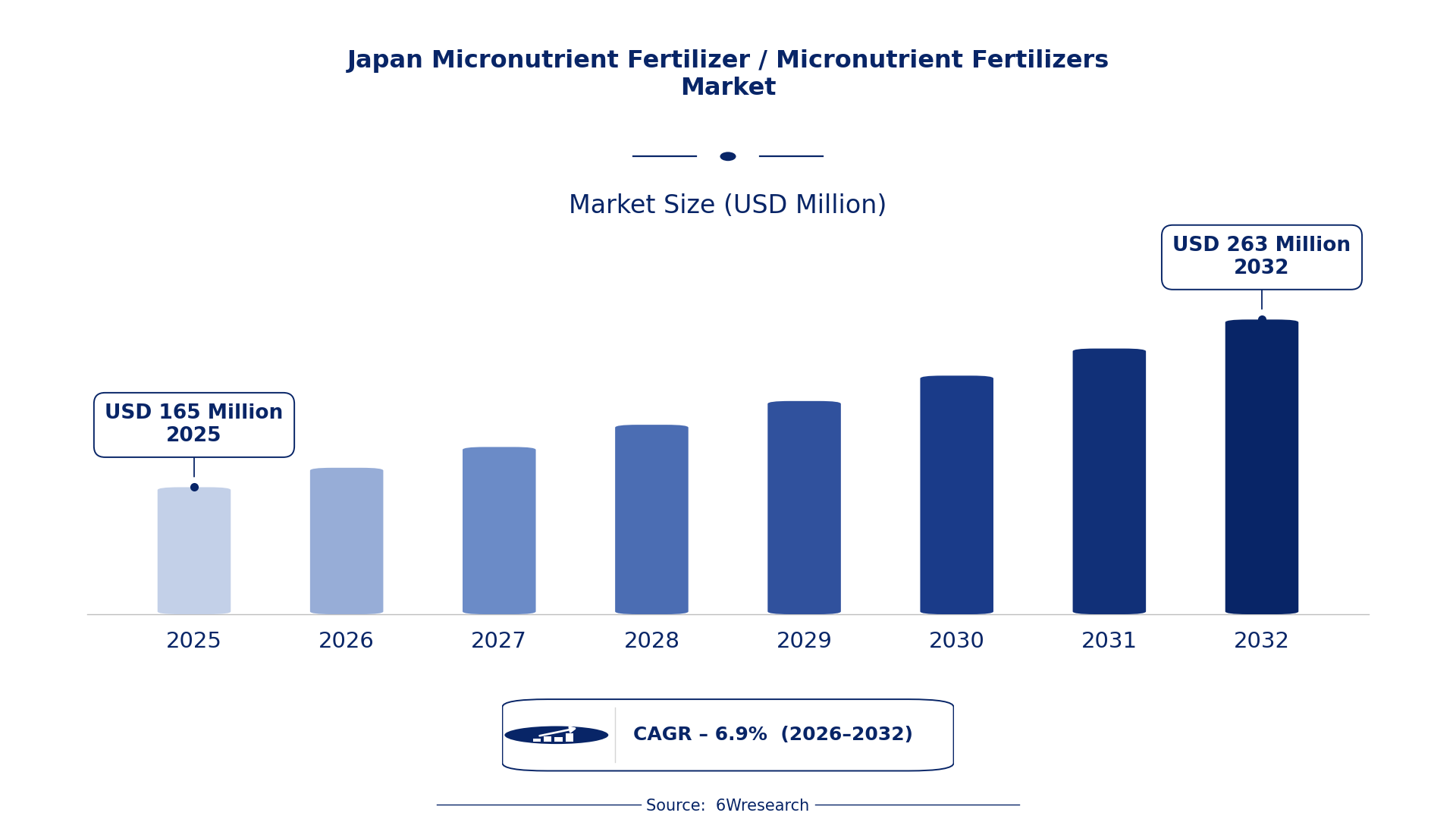
According to 6Wresearch internal database and industry insights, the Japan Micronutrient Fertilizer / Micronutrient Fertilizers Market was valued at USD 165 Million in 2025 and is projected to reach USD 263 Million by 2032, growing at a CAGR of approximately 6.9% during 2026–2032.
Japan Micronutrient Fertilizer / Micronutrient Fertilizers Market Highlights
| Report Metric | Details |
| Report Name | Japan Micronutrient Fertilizer / Micronutrient Fertilizers Market (2026-2032) |
| Market Size 2025 | USD 165 Million |
| Market Size 2032 | USD 263 Million |
| Absolute Growth 2025–2032 | USD 98 Million |
| CAGR 2026–2032 | 6.9% |
| Peak Annual Growth | 7.8% in 2032 |
| Forecast Period | 2026–2032 |
| Historical Data | 2022–2025 |
| Base Year | 2025 |
| Leading Nutrient Type, 2025 | Zinc Fertilizers (36% share) |
| Leading Formulation Type, 2025 | Chelated/EDTA (46% share) |
| Leading Crop Segment, 2025 | Rice (34% share) |
| Leading Distribution Channel, 2025 | Agrochemical Distributors (40% share) |
| Leading End User, 2025 | Cereal Crop Farmers (46% share) |
| Fastest-Growing Nutrient Type | Boron Fertilizers (9.6% CAGR) |
| Fastest-Growing Formulation Type | Soluble Granules (9.9% CAGR) |
| Fastest-Growing Crop Segment | Wheat (9.5% CAGR) |
| Fastest-Growing Distribution Channel | Rural Retail Chains (9.0% CAGR) |
| Fastest-Growing End User | Horticulturists (9.3% CAGR) |
| Growing Sector | Cereal Crop Farming |
| Key End Users | Cereal Crop Farmers, Horticulturists, Organic Farming Operators, Greenhouse Growers |
Japan Micronutrient Fertilizer / Micronutrient Fertilizers Market Year-wise Growth Rate and Key Drivers (2022–2032)
This graph illustrates the annual growth rates of the market from 2022 to 2032, highlighting a steady upward trajectory and projected market expansion over the forecast period.
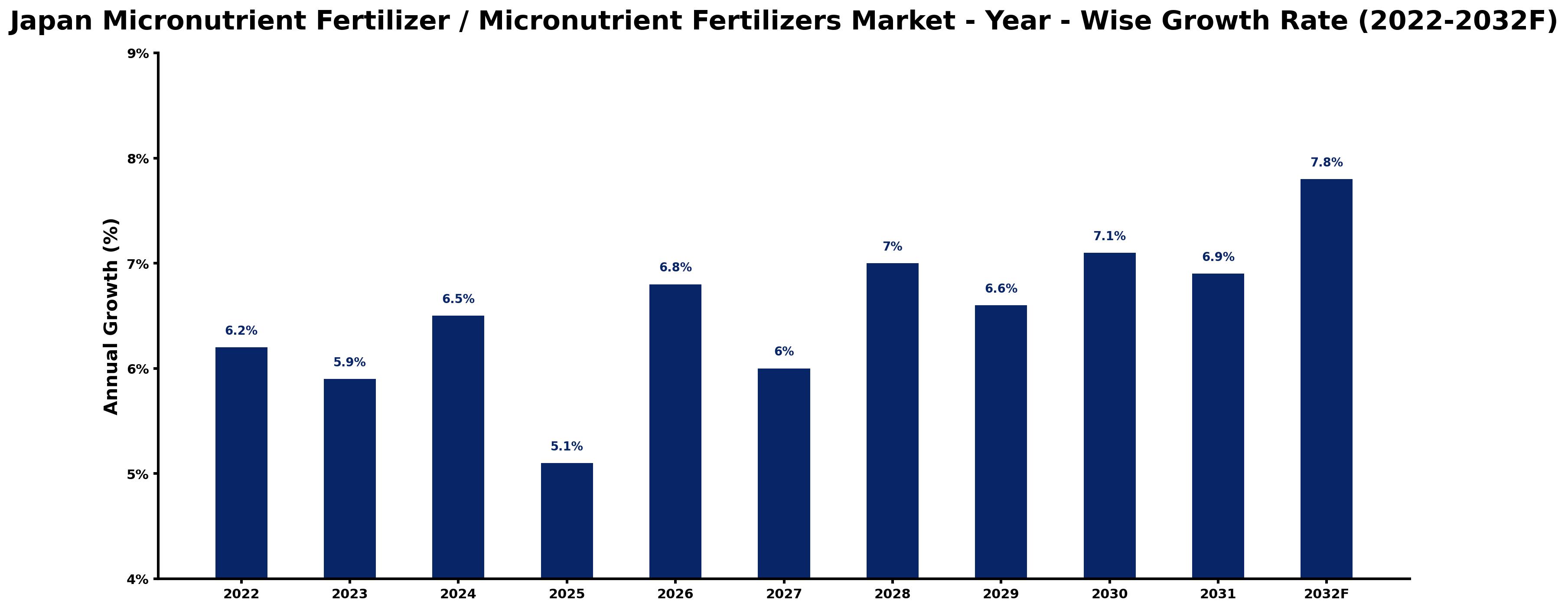
The following figures match every annual growth estimate with the main market development of that year, giving the reasoning behind each rise or slowdown.
| Year | Estimated Annual Growth (%) | Market Rationale |
| 2022 | 6.2 | The market experienced steady growth due to the rising adoption of micronutrient fertilizers among farmers. |
| 2023 | 5.9 | Demand growth slowed as farmers adjusted to evolving agricultural practices and market conditions. |
| 2024 | 6.5 | Growth accelerated with increased awareness of soil health and crop yield improvements. |
| 2025 | 5.1 | The market saw a slowdown as farmers faced challenges in accessing specific micronutrient products. |
| 2026 | 6.8 | Demand is expected to rise as farmers increasingly recognise the benefits of micronutrient application for crop health. |
| 2027 | 6.0 | Growth is projected to decelerate slightly as the market adapts to new supply chain conditions. |
| 2028 | 7.0 | A resurgence in growth is anticipated as farmers adopt new fertilisation techniques. |
| 2029 | 6.6 | Demand growth is expected to slow as market saturation begins to affect purchasing decisions. |
| 2030 | 7.1 | Growth is projected to accelerate again due to rising investments in agricultural technology and practices. |
| 2031 | 6.9 | The market is expected to experience a slowdown as farmers face economic pressures affecting purchasing. |
| 2032 | 7.8 | Demand is projected to peak as the focus on sustainable agriculture drives higher micronutrient usage. |
Note: Market size estimations and growth projections presented in this report are based on 6Wresearch's proprietary forecasting methodology, utilizing the latest available industry data, government publications, and primary research inputs.
Japan Micronutrient Fertilizer / Micronutrient Fertilizers Market Synopsis
Micronutrient fertilizers are chemical compounds that supply necessary nutrients to crops, promoting their growth and yield. In Japan, these fertilizers are produced through chemical synthesis or mineral extraction for use in domestic crop production. The Japan Micronutrient Fertilizer / Micronutrient Fertilizers Market is growing due to increasing demand from local farmers and agricultural cooperatives, driven by a commitment to sustainable practices and improved nutrient management, highlighted by a programme launched in 2023 aimed at enhancing nutrient management in agriculture, with funding of around USD 10 million.
Market Dynamics Impact Analysis (2026–2032)
| Factor | Type | Impact | Primary Segment Affected |
| Growing awareness of soil health and nutrient deficiencies among farmers | Driver | High | Zinc Fertilizers |
| Rising adoption of sustainable agricultural practices | Driver | High | Boron Fertilizers |
| Increasing demand for organic farming practices | Opportunity | Medium | Organic Farming Operators |
| Expansion of online agri portals facilitating easier access to products | Opportunity | Medium | Online Agri Portals |
| High average age of farmers impacting adoption rates | Restraint | High | Cereal Crop Farmers |
| Regulatory compliance costs associated with fertilizer production | Restraint | Medium | Agrochemical Distributors |
| Rising costs of raw materials affecting pricing | Challenge | High | Liquid/EDTA Form |
| Capacity constraints in production facilities | Challenge | Medium | Chelated/EDTA |
Evaluation of Drivers in Japan Micronutrient Fertilizer / Micronutrient Fertilizers Market (2026–2032)
The main growth drivers and the segments they affect most are set out below.
| Drivers | Primary Segment Affected | Why It Matters (Evidence) |
| Increased crop yield awareness among farmers | Zinc Fertilizers | Zinc fertilizers account for approximately 30% of the micronutrient market, prompting farmers to purchase more for better yields. |
| Focus on sustainable agriculture | Boron Fertilizers | Boron fertilizers are crucial for fruit crops, especially apples and pears, leading to higher demand from fruit growers. |
| Rising popularity of liquid fertilizers | Liquid/EDTA Form | Liquid fertilizers are gaining traction due to their ease of use, prompting farmers to buy more for efficient application. |
| Improved nutrient management practices | Chelated/EDTA | Research on micronutrient applications is increasing demand for chelated fertilizers, particularly in greenhouse operations. |
| Growth in greenhouse operations | Soluble Granules | Chelated fertilizers are preferred in greenhouse operations, driving up their market share as more growers adopt these methods. |
Most of the extra volume comes from rising crop yield awareness among farmers, particularly in the Tohoku region, where manganese fertilizers are essential for rice cultivation, prompting increased investment in these products. The growing focus on sustainable agriculture is pushing fruit growers to adopt boron fertilizers, which are vital for apple and pear production, further expanding the market. In addition, the increasing emphasis on nutrient management practices is driving demand for chelated fertilizers, particularly in greenhouse operations, as producers seek to improve crop productivity. The average yield of rice in Japan is about 5.3 tons per hectare, motivating farmers to invest in micronutrient solutions that enhance soil fertility and crop health.
Evaluation of Restraints in Japan Micronutrient Fertilizer / Micronutrient Fertilizers Market
These restraints slow adoption and weigh on supplier margins.
| Market Restraint | Primary Segment Affected | Why It Matters (Evidence) |
| High average age of farmers limiting adoption of new practices | Cereal Crop Farmers | With the average age of Japanese farmers at 67 years, younger farmers are less likely to adopt new fertilizer technologies. |
| Regulatory compliance costs impacting production | Agrochemical Distributors | Compliance with the Chemical Substances Control Law increases operational costs for distributors, affecting pricing strategies. |
| Limited access to certain micronutrient products | Liquid/EDTA Form | Supply chain disruptions have made it difficult for farmers to access necessary micronutrient fertilizers. |
| Market saturation affecting purchasing decisions | Boron Fertilizers | As the market matures, farmers are becoming more selective, impacting overall sales growth. |
| Environmental regulations increasing production costs | Chelated/EDTA | Compliance with ISO 14001 standards raises production costs, affecting pricing for chelated fertilizers. |
Japan Micronutrient Fertilizer / Micronutrient Fertilizers Market Challenges
Zinc fertilizers, which represent 30% of the micronutrient market, are facing supply challenges due to limited domestic production, resulting in increased input costs for agricultural cooperatives that depend on these nutrients. Technology adoption is hindered by the average age of farmers at 67 years, causing delays in implementing modern nutrient management practices and negatively impacting crop yields. Buyers struggle with compliance to ISO 14001 standards, which can lead to delays in product availability and higher costs for local farmers. The push for organic farming, targeting 10% by 2025, complicates fertilizer strategies, forcing producers to adapt quickly and increasing their operational expenses.
Trends in the Japan Micronutrient Fertilizer / Micronutrient Fertilizers Market
The trends below show where the Japan Micronutrient Fertilizer / Micronutrient Fertilizers Market is heading.
- Cereal Crop Farmers Shifting to Sustainable Practices: Cereal crop farmers are increasingly adopting sustainable practices, with a 25% rise in online agri portal usage in 2023. This shift indicates a growing focus on environmentally friendly farming methods.
- Transition to Liquid Fertilizers: The adoption of liquid fertilizers has gained momentum since 2022, driven by their ease of application. Farmers are increasingly opting for these products to improve nutrient delivery.
- Rise of Boron Fertilizers in Fruit Production: Since 2023, boron fertilizers have become vital for fruit crops, especially apples and pears, resulting in a notable increase in their usage among fruit growers.
- Growth in Organic Farming Practices: The Japanese agricultural sector aims to increase organic farming to 10% by 2025, prompting a surge in demand for micronutrient fertilizers among organic farming operators.
Investment Opportunities in the Japan Micronutrient Fertilizer / Micronutrient Fertilizers Market
Below are the investment opportunities with the strongest case in the Japan Micronutrient Fertilizer / Micronutrient Fertilizers Market.
- Gap in Organic Farming Micronutrient Supply: With the goal of 10% organic farming by 2025, there is a gap in micronutrient supply for organic operators, presenting an opportunity for new product development.
- Expansion of Rural Retail Chains for Better Access: Rural retail chains are expanding, providing greater access to micronutrient fertilizers for farmers, particularly in remote areas, which can be facilitated through local partnerships.
- Investment in Online Agri Portals: Online agri portals have seen a 25% increase in usage, indicating a need for investment in digital platforms to reach farmers more effectively.
- Growth in Greenhouse Operations: With the rising preference for chelated fertilizers in greenhouse operations, suppliers can focus on developing tailored products for this growing segment.
Government Initiatives in the Japan Micronutrient Fertilizer / Micronutrient Fertilizers Market
The Chemical Substances Control Law, enacted in 1973, mandates the evaluation and control of chemical substances, impacting the production and import of micronutrient fertilizers. This law ensures that producers adhere to safety and efficacy standards, requiring regular testing and reporting to maintain compliance with established guidelines. The PRTR Law, established in 1999, requires businesses to report releases and transfers of designated chemical substances, further regulating the industry and ensuring environmental protection.
In 2023, Japan initiated a programme to improve nutrient management in agriculture, with funding of approximately USD 10 million allocated for research and development. The Ministry of Agriculture, Forestry and Fisheries oversees this initiative, aiming to improve nutrient efficiency and promote sustainable practices among farmers.
Future Insight of the Japan Micronutrient Fertilizer / Micronutrient Fertilizers Market
By 2032, local farmers will increasingly utilise liquid fertilizers, which offer ease of application and effective nutrient delivery. The nutrient management program launched in 2023 will enhance crop productivity, particularly in areas where specific micronutrients are essential. Research on micronutrient efficiency will lead to improved formulations that will benefit both suppliers and buyers. Initiatives from the Tokyo Agricultural Technology Center will drive sustainable practices, prompting agricultural cooperatives to adopt solutions that comply with stricter environmental standards.
Market Segmentation Analysis
Japan Micronutrient Fertilizer / Micronutrient Fertilizers Market report covers a detailed analysis of the following market segments:
By Nutrient Type – Zinc Fertilizers Lead, Boron Fertilizers Expected to Grow Fastest
According to Saurav Kr Singh, Senior Research Analyst at 6Wresearch, the largest nutrient type category in 2025 was Zinc Fertilizers, at 36% of revenue. Zinc fertilizers hold the largest share as they are essential for crop health, particularly in the Kanto region where agricultural activities are concentrated. Their widespread application among local farmers ensures a consistent supply that meets the nutrient needs of various crops. Boron Fertilizers are projected to grow fastest, at a CAGR of 9.6% during 2026–2032. Boron fertilizers are experiencing rapid growth due to their critical role in flowering and seed development, especially for fruit crops like apples and pears. The recent launch of a programme to enhance nutrient management in agriculture is further driving their adoption among farmers. Suppliers should focus on promoting boron fertilizers to capitalise on the growing demand from agricultural producers.
By Formulation Type – Chelated/EDTA Leads, Soluble Granules Expected to Grow Fastest
Chelated/EDTA held 46% of the Japan Micronutrient Fertilizer / Micronutrient Fertilizers Market by formulation type in 2025. Chelated/EDTA fertilizers dominate the market because they significantly enhance nutrient availability, making them a preferred choice for many farmers. Their proven effectiveness in addressing nutrient deficiencies has established a strong foothold in various agricultural practices. Soluble Granules are set to record the highest CAGR in this split, 9.9% over 2026–2032. Soluble granules are witnessing notable growth, primarily due to their ease of application and effectiveness, appealing to farmers looking for efficient solutions. The trend towards simplified farming practices is likely to further boost the adoption of this formulation type. Buyers may benefit from considering soluble granules for their convenience and effectiveness in nutrient management.
By Crop Segment – Rice Leads, Wheat Expected to Grow Fastest
In 2025, Rice led the crop segment split with a 34% share. Rice is the dominant crop segment as it is a major crop that requires micronutrients for optimal yield, particularly in regions like Tohoku where specific nutrient needs are critical. The average yield of rice in Japan highlights the importance of micronutrient application in this sector. The quickest growth will come from Wheat, forecast to expand at a CAGR of 9.5% between 2026 and 2032. Wheat is experiencing the fastest growth as it is an essential staple crop that increasingly requires micronutrient support to boost productivity. The rising demand for wheat in domestic markets is likely to further accelerate its adoption. Suppliers should consider targeting wheat farmers to address the growing need for micronutrient fertilizers.
By Distribution Channel – Agrochemical Distributors Lead, Rural Retail Chains Expected to Grow Fastest
Agrochemical Distributors accounted for 40% of the market by distribution channel in 2025. Agrochemical distributors are the leading distribution channel for fertilizers, serving as a crucial link between manufacturers and farmers. Their well-established networks ensure that essential products are effectively delivered to a wide range of agricultural users. Over 2026–2032, Rural Retail Chains are expected to post the fastest growth, at a CAGR of 9.0%. Rural retail chains are rapidly growing as they provide accessible distribution points for farmers, particularly in remote regions. The increasing reliance on these chains for agricultural supplies is expected to continue as farmers seek convenience and local availability. Suppliers should enhance partnerships with rural retail chains to strengthen their market presence.
By End User – Cereal Crop Farmers Lead, Horticulturists Expected to Grow Fastest
Cereal Crop Farmers took 46% of end user revenue in 2025, more than any other category. Cereal crop farmers are the largest end user group for micronutrient fertilizers, as they are the primary consumers for staple crops. Their vital role in domestic agriculture ensures a steady demand for essential nutrients necessary for crop production. Horticulturists are projected to grow fastest, at a CAGR of 9.3% during 2026–2032. Horticulturists are the fastest-growing end user group, driven by their focus on specialty crops that require precise nutrient management. The increasing interest in high-value horticultural products is propelling this segment's rapid expansion in the market. Suppliers should tailor their offerings to meet the specific needs of horticulturists to capture this growing market.
Key Attractiveness of the Report
- 10 Years of Market Numbers
- Historical Data Starting from 2022 to 2025
- Base Year 2025
- Forecast Data until 2032
- Key Performance Indicators Impacting the Market
- Major Upcoming Developments and Projects
Key Highlights of the Report:
- Japan Micronutrient Fertilizer / Micronutrient Fertilizers Market Outlook
- Market Size of Japan Micronutrient Fertilizer / Micronutrient Fertilizers Market, 2025
- Forecast of Japan Micronutrient Fertilizer / Micronutrient Fertilizers Market, 2032
- Historical Data and Forecast of Japan Micronutrient Fertilizer / Micronutrient Fertilizers Revenues & Volume for the Period 2022-2032F
- Japan Micronutrient Fertilizer / Micronutrient Fertilizers Market Trend Evolution
- Japan Micronutrient Fertilizer / Micronutrient Fertilizers Market Drivers and Challenges
- Japan Micronutrient Fertilizer / Micronutrient Fertilizers Price Trends
- Japan Micronutrient Fertilizer / Micronutrient Fertilizers Porter's Five Forces
- Japan Micronutrient Fertilizer / Micronutrient Fertilizers Industry Life Cycle
- Historical Data and Forecast of Japan Micronutrient Fertilizer / Micronutrient Fertilizers Market Revenues & Volume By Nutrient Type for the Period 2022-2032F
- Historical Data and Forecast of Japan Micronutrient Fertilizer / Micronutrient Fertilizers Market Revenues & Volume By Zinc Fertilizers for the Period 2022-2032F
- Historical Data and Forecast of Japan Micronutrient Fertilizer / Micronutrient Fertilizers Market Revenues & Volume By Boron Fertilizers for the Period 2022-2032F
- Historical Data and Forecast of Japan Micronutrient Fertilizer / Micronutrient Fertilizers Market Revenues & Volume By Iron Fertilizers for the Period 2022-2032F
- Historical Data and Forecast of Japan Micronutrient Fertilizer / Micronutrient Fertilizers Market Revenues & Volume By Manganese Fertilizers for the Period 2022-2032F
- Historical Data and Forecast of Japan Micronutrient Fertilizer / Micronutrient Fertilizers Market Revenues & Volume By Formulation Type for the Period 2022-2032F
- Historical Data and Forecast of Japan Micronutrient Fertilizer / Micronutrient Fertilizers Market Revenues & Volume By Chelated/EDTA for the Period 2022-2032F
- Historical Data and Forecast of Japan Micronutrient Fertilizer / Micronutrient Fertilizers Market Revenues & Volume By Soluble Granules for the Period 2022-2032F
- Historical Data and Forecast of Japan Micronutrient Fertilizer / Micronutrient Fertilizers Market Revenues & Volume By Liquid/EDTA Form for the Period 2022-2032F
- Historical Data and Forecast of Japan Micronutrient Fertilizer / Micronutrient Fertilizers Market Revenues & Volume By Foliar Spray Solutions for the Period 2022-2032F
- Historical Data and Forecast of Japan Micronutrient Fertilizer / Micronutrient Fertilizers Market Revenues & Volume By Crop Segment for the Period 2022-2032F
- Historical Data and Forecast of Japan Micronutrient Fertilizer / Micronutrient Fertilizers Market Revenues & Volume By Rice, Wheat for the Period 2022-2032F
- Historical Data and Forecast of Japan Micronutrient Fertilizer / Micronutrient Fertilizers Market Revenues & Volume By Sugarcane, Fruits for the Period 2022-2032F
- Historical Data and Forecast of Japan Micronutrient Fertilizer / Micronutrient Fertilizers Market Revenues & Volume By Vegetables, Leafy Crops for the Period 2022-2032F
- Historical Data and Forecast of Japan Micronutrient Fertilizer / Micronutrient Fertilizers Market Revenues & Volume By Pulses, Oilseeds for the Period 2022-2032F
- Historical Data and Forecast of Japan Micronutrient Fertilizer / Micronutrient Fertilizers Market Revenues & Volume By Distribution Channel for the Period 2022-2032F
- Historical Data and Forecast of Japan Micronutrient Fertilizer / Micronutrient Fertilizers Market Revenues & Volume By Agrochemical Distributors for the Period 2022-2032F
- Historical Data and Forecast of Japan Micronutrient Fertilizer / Micronutrient Fertilizers Market Revenues & Volume By Rural Retail Chains for the Period 2022-2032F
- Historical Data and Forecast of Japan Micronutrient Fertilizer / Micronutrient Fertilizers Market Revenues & Volume By Online Agri Portals for the Period 2022-2032F
- Historical Data and Forecast of Japan Micronutrient Fertilizer / Micronutrient Fertilizers Market Revenues & Volume By Field Consultants for the Period 2022-2032F
- Historical Data and Forecast of Japan Micronutrient Fertilizer / Micronutrient Fertilizers Market Revenues & Volume By End User for the Period 2022-2032F
- Historical Data and Forecast of Japan Micronutrient Fertilizer / Micronutrient Fertilizers Market Revenues & Volume By Cereal Crop Farmers for the Period 2022-2032F
- Historical Data and Forecast of Japan Micronutrient Fertilizer / Micronutrient Fertilizers Market Revenues & Volume By Horticulturists for the Period 2022-2032F
- Historical Data and Forecast of Japan Micronutrient Fertilizer / Micronutrient Fertilizers Market Revenues & Volume By Greenhouse Growers for the Period 2022-2032F
- Historical Data and Forecast of Japan Micronutrient Fertilizer / Micronutrient Fertilizers Market Revenues & Volume By Organic Farming Operators for the Period 2022-2032F
- Japan Micronutrient Fertilizer / Micronutrient Fertilizers Import Export Trade Statistics
- Market Opportunity Assessment By Nutrient Type
- Market Opportunity Assessment By Formulation Type
- Market Opportunity Assessment By Crop Segment
- Market Opportunity Assessment By Distribution Channel
- Market Opportunity Assessment By End User
- Japan Micronutrient Fertilizer / Micronutrient Fertilizers Top Companies Market Share
- Japan Micronutrient Fertilizer / Micronutrient Fertilizers Competitive Benchmarking By Technical and Operational Parameters
- Japan Micronutrient Fertilizer / Micronutrient Fertilizers Company Profiles
- Japan Micronutrient Fertilizer / Micronutrient Fertilizers Key Strategic Recommendations
Market Covered
Coverage by segment is as follows.
By Nutrient Type
- Zinc Fertilizers
- Boron Fertilizers
- Iron Fertilizers
- Manganese Fertilizers
By Formulation Type
- Chelated/EDTA
- Soluble Granules
- Liquid/EDTA Form
- Foliar Spray Solutions
By Crop Segment
- Rice
- Wheat
- Sugarcane
- Fruits
- Vegetables
- Leafy Crops
- Pulses
- Oilseeds
By Distribution Channel
- Agrochemical Distributors
- Rural Retail Chains
- Online Agri Portals
- Field Consultants
By End User
- Cereal Crop Farmers
- Horticulturists
- Greenhouse Growers
- Organic Farming Operators






































