Japan Military Airborne Collision Avoidance System Market Size & Growth Rate
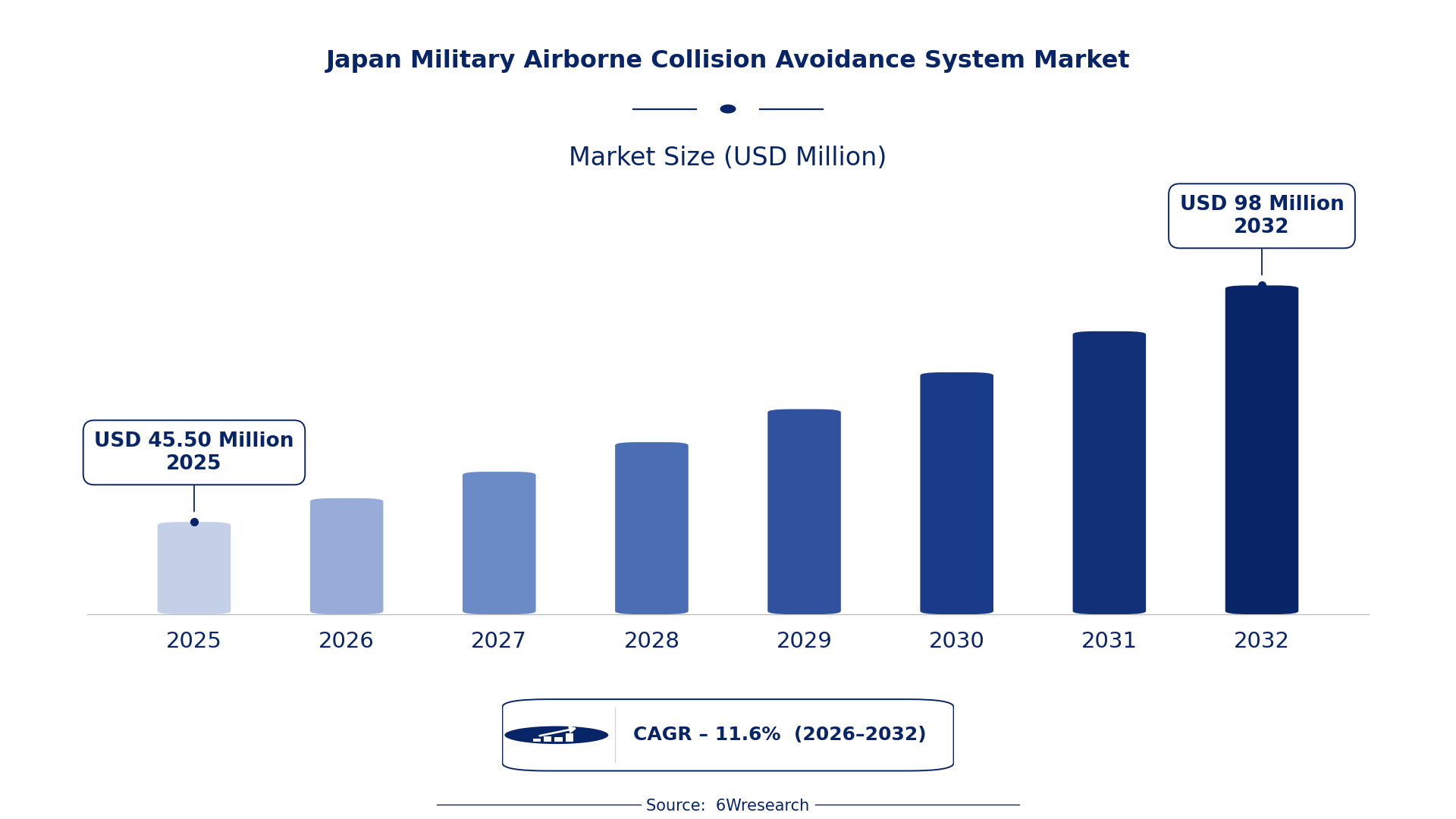
According to 6Wresearch internal database and industry insights, the Japan Military Airborne Collision Avoidance System Market was valued at USD 45.50 Million in 2025 and is projected to reach USD 98 Million by 2032, growing at a CAGR of approximately 11.6% during 2026–2032.
Japan Military Airborne Collision Avoidance System Market Highlights
| Report Metric | Details |
| Report Name | Japan Military Airborne Collision Avoidance System Market (2026-2032) |
| Market Size 2025 | USD 45.50 Million |
| Market Size 2032 | USD 98 Million |
| Absolute Growth 2025–2032 | USD 52.50 Million |
| CAGR 2026–2032 | 11.6% |
| Peak Annual Growth | 12.6% in 2029 |
| Forecast Period | 2026–2032 |
| Historical Data | 2022–2025 |
| Base Year | 2025 |
| Leading System Type, 2025 | Radars (43% share) |
| Leading Aircraft Type, 2025 | Manned Aircraft (62% share) |
| Fastest-Growing System Type | TCAS (17.5% CAGR) |
| Fastest-Growing Aircraft Type | Unmanned Aircraft (15.7% CAGR) |
| Growing Sector | Unmanned Aircraft |
| Key End Users | Manned Aircraft, Unmanned Aircraft |
Japan Military Airborne Collision Avoidance System Market Year-wise Growth Rate and Key Drivers (2022–2032)
This graph illustrates the annual growth rates of the market from 2022 to 2032, highlighting a steady upward trajectory and projected market expansion over the forecast period.
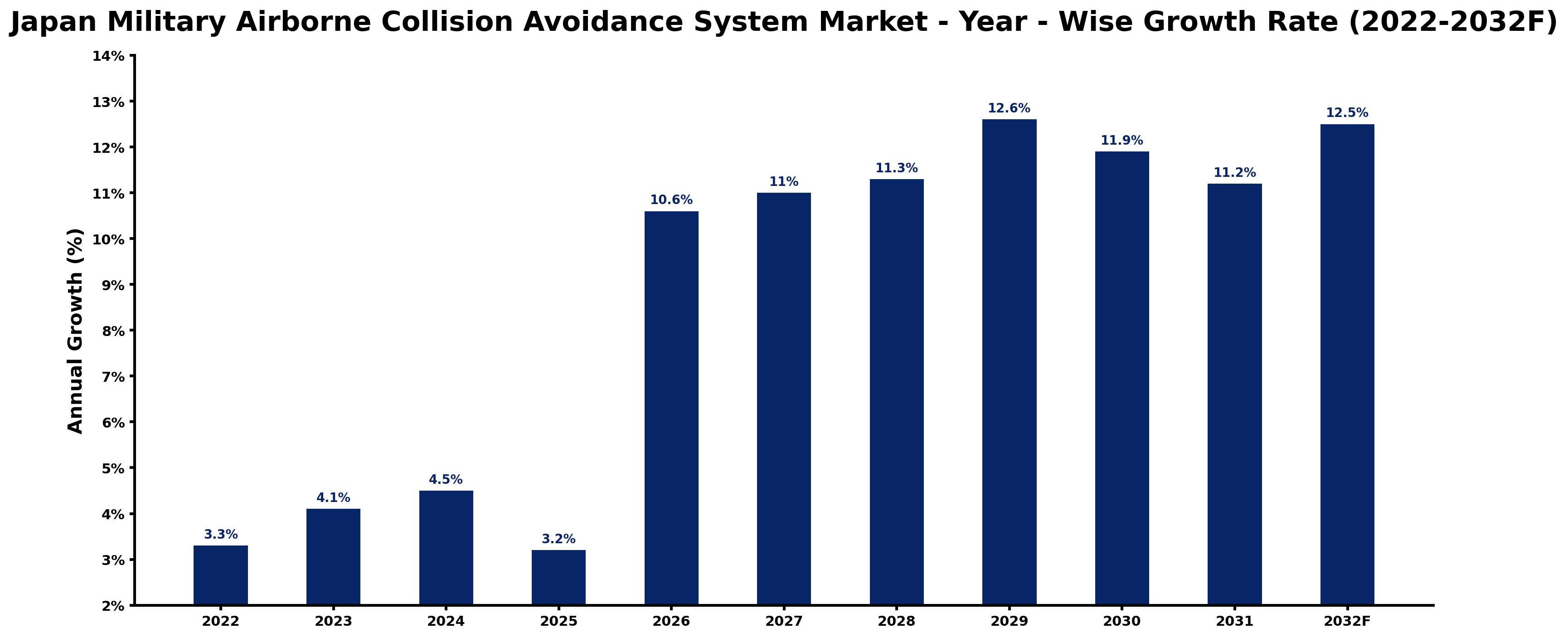
The yearly estimates that follow link every growth rate to its principal driver, so readers can see why the pace changed in each period.
| Year | Estimated Annual Growth (%) | Market Rationale |
| 2022 | 3.3 | The market exhibited stable growth, supported by existing military contracts and modernization efforts. |
| 2023 | 4.1 | Increased funding for advanced technologies boosted growth, reflecting a commitment to military aviation safety. |
| 2024 | 4.5 | Demand continued to rise as military operations expanded, leading to further investments in collision avoidance systems. |
| 2025 | 3.2 | Growth slowed slightly due to market saturation in certain segments, yet demand remained strong overall. |
| 2026 | 10.6 | A notable increase in defense spending is expected to drive demand for advanced systems. |
| 2027 | 11.0 | Continued investment in military aviation technology will support further growth in the market. |
| 2028 | 11.3 | The introduction of new aircraft models is projected to increase demand for collision avoidance systems. |
| 2029 | 12.6 | Peak growth is anticipated as military modernization efforts reach critical milestones. |
| 2030 | 11.9 | Demand remains high, although growth rates are expected to moderate slightly as the market stabilizes. |
| 2031 | 11.2 | The market will continue to grow, driven by ongoing technological advancements and military needs. |
| 2032 | 12.5 | A strong focus on safety and operational effectiveness will sustain growth in the collision avoidance sector. |
Note: Market size estimations and growth projections presented in this report are based on 6Wresearch's proprietary forecasting methodology, utilizing the latest available industry data, government publications, and primary research inputs.
Japan Military Airborne Collision Avoidance System Market Synopsis
Military Airborne Collision Avoidance Systems are essential technologies designed to prevent mid-air collisions in military aviation. The Japan Air Self-Defense Force's commitment to upgrading its aircraft fleet with these systems further fuels market growth. The growing defense budget, which focuses on advanced military technologies, drives demand for these systems. Collaboration between the Japan Aerospace Exploration Agency and defense contractors supports innovation in airborne safety systems, creating a strong investment environment. In 2023, Japan's Ministry of Defense allocated funds for upgrading military aircraft, reflecting the increasing importance of these technologies.
Market Dynamics Impact Analysis (2026–2032)
| Factor | Type | Impact | Primary Segment Affected |
| Growing defense budget focusing on advanced technologies | Driver | High | TCAS |
| Increased military aviation operations requiring enhanced safety measures | Driver | High | Radars |
| Emerging demand for unmanned aircraft safety solutions | Opportunity | Medium | Unmanned Aircraft |
| Technological advancements in collision avoidance systems | Opportunity | Medium | Synthetic Vision Systems |
| Limited integration of new technologies in older aircraft | Restraint | High | Manned Aircraft |
| Potential delays in defense procurement processes | Restraint | Medium | TCAS |
| Competition from alternative safety technologies | Challenge | High | Radars |
| Rising costs associated with advanced system development | Challenge | Medium | Synthetic Vision Systems |
Evaluation of Drivers in Japan Military Airborne Collision Avoidance System Market (2026–2032)
These are the developments adding the most demand over the forecast period.
| Drivers | Primary Segment Affected | Why It Matters (Evidence) |
| Increased defense spending | TCAS | Japan's defense budget has been growing, with allocations for advanced technologies reaching JPY 6 trillion in 2023, leading to more TCAS purchases for military aircraft. |
| Expansion of military aviation operations | Radars | The Japan Air Self-Defense Force operates over 300 aircraft, necessitating the integration of advanced radar systems for enhanced safety. |
| Growing use of unmanned aircraft | Unmanned Aircraft | As unmanned systems become more prevalent, demand for collision avoidance solutions in these aircraft is increasing, driven by safety concerns and a projected 20% growth in drone operations by 2025. |
| Technological advancements in avionics | Synthetic Vision Systems | Innovations in avionics technology are prompting military users to adopt synthetic vision systems, enhancing situational awareness in flight operations, with a projected market size of JPY 10 billion by 2025. |
| Government contracts for military upgrades | Manned Aircraft | Government contracts for upgrading military aircraft with advanced collision avoidance systems are driving demand, with an estimated JPY 15 billion allocated for these upgrades in 2023. |
What keeps demand rising is the increasing defense budget, which has reached JPY 6 trillion in 2023, supporting technologies like TCAS. The Japan Air Self-Defense Force operates a substantial fleet of aircraft, necessitating the integration of advanced radar systems for improved safety. The growing prevalence of unmanned systems is increasing the demand for collision avoidance solutions, driven by safety concerns and a projected 20% growth in drone operations by 2025. Innovations in avionics technology are prompting military users to adopt synthetic vision systems, improving situational awareness in flight operations. Contracts for upgrading military aircraft with advanced collision avoidance systems are also driving demand in the manned aircraft segment, with significant allocations for these upgrades in 2023.
Evaluation of Restraints in Japan Military Airborne Collision Avoidance System Market
These are the pressures that could keep growth below its potential.
| Market Restraint | Primary Segment Affected | Why It Matters (Evidence) |
| Integration challenges with older aircraft models | Manned Aircraft | Older aircraft models face difficulties in integrating new collision avoidance technologies, limiting their operational effectiveness. |
| Delays in defense procurement processes | TCAS | Bureaucratic delays in the procurement process can slow the adoption of TCAS, affecting military readiness. |
| High costs of advanced system development | Synthetic Vision Systems | The development of synthetic vision systems incurs high costs, which may deter some military users from upgrading. |
| Limited awareness of new technologies | Radars | Some military operators may lack awareness of the benefits of advanced radar systems, hindering their adoption. |
| Competition from alternative safety technologies | Synthetic Vision Systems | The emergence of alternative safety technologies can divert attention and funding away from traditional collision avoidance systems. |
Japan Military Airborne Collision Avoidance System Market Challenges
Japan's military airborne collision avoidance systems face intense competition from global suppliers, which pressures local producers to lower prices and diminishes their profit margins. Rapid technological advancements require ongoing research and development, delaying critical updates for military users who need state-of-the-art capabilities. Supply chain disruptions stem from reliance on specific components, resulting in postponed deliveries of upgraded systems to the armed forces. Stringent regulatory requirements for defence procurement can lengthen approval processes, causing military buyers to experience extended wait times for new technologies.
Trends in the Japan Military Airborne Collision Avoidance System Market
Buyers and suppliers in the Japan Military Airborne Collision Avoidance System Market are adjusting to the following trends.
- Shift towards Advanced Avionics: Tokyo is experiencing a shift towards advanced avionics systems in military aircraft, with the Japan Defense Agency emphasising their importance. In 2023, the agency allocated JPY 5 billion for upgrading existing aircraft, reflecting this trend.
- Transition from Manned to Unmanned Systems: The military is increasingly transitioning from manned to unmanned aircraft, which require advanced collision avoidance systems. The Japan Air Self-Defense Force is expanding its drone fleet, with plans to integrate new safety technologies by 2025.
- Emergence of Synthetic Vision Systems: The integration of synthetic vision systems is becoming more common in new manned aircraft designs. In 2023, Japan showcased innovations in airborne safety systems at a defense technology exhibition, highlighting this trend with over JPY 2 billion in investments.
- Prioritisation of Flight Safety: Military aviation operations are prioritising flight safety, leading to increased demand for collision avoidance technologies. The Japan Aerospace Exploration Agency is collaborating with defence contractors to enhance safety measures, with funding exceeding JPY 1 billion.
Investment Opportunities in the Japan Military Airborne Collision Avoidance System Market
Below are the investment opportunities with the strongest case in the Japan Military Airborne Collision Avoidance System Market.
- Current focus on military modernization: With Japan's defense budget reaching JPY 6 trillion, there is an opportunity to supply advanced collision avoidance systems, particularly in the Tokyo region, which is central to military operations.
- Investment in unmanned aircraft safety solutions: The growing use of unmanned aircraft presents an opportunity to invest in specialized collision avoidance technologies, targeting military users who are expanding their drone operations, projected to grow by 20% by 2025.
- Integration of synthetic vision systems: The emphasis on synthetic vision systems in new aircraft designs creates an opportunity for suppliers to provide these technologies, particularly to the Japan Air Self-Defense Force, with significant market potential by 2025.
- Funding for advanced avionics systems: The Japan Defense Agency's funding for advanced avionics systems, exceeding JPY 5 billion, offers a chance for suppliers to enter the market by partnering with local defense contractors.
Government Initiatives in the Japan Military Airborne Collision Avoidance System Market
The GX Basic Policy, adopted in 2023, aims for JPY 150 trillion of public-private investment in military technologies, improving the capabilities of collision avoidance systems. This policy builds on the Industrial Standardization Act, which governs product and test standards, ensuring that systems meet rigorous safety requirements and are suitable for military use.
The Consumer Affairs Agency oversees the enforcement of regulations that ensure military airborne collision avoidance systems are accurately represented in the market. The agency's regulations help maintain consumer trust and ensure that military buyers receive reliable products.
Future Insight of the Japan Military Airborne Collision Avoidance System Market
By 2032, the integration of advanced radar systems will reshape demand for military airborne collision avoidance systems, as military users seek enhanced safety features. Collaborations between the Japan Aerospace Exploration Agency and defence contractors will drive innovation in safety technologies, improving system reliability. Japan's Ministry of Defense intends to allocate additional funds for aircraft upgrades by 2025, creating more procurement opportunities for suppliers. Compliance with ISO 9001 standards will improve quality management in production, benefiting both buyers and suppliers.
Market Segmentation Analysis
Japan Military Airborne Collision Avoidance System Market report covers a detailed analysis of the following market segments:
By System Type – Radars Lead, TCAS Expected to Grow Fastest
According to Dhaval Chaurasia, Assistant Manager at 6Wresearch, with 43% of system type revenue in 2025, Radars was the largest category. Radars hold the largest share in the market as they are essential for detecting other aircraft in proximity, thereby ensuring safety during military operations. The Japan Air Self-Defense Force utilises these systems extensively to maintain operational effectiveness across its diverse fleet of aircraft. TCAS is projected to grow fastest, at a CAGR of 17.5% during 2026–2032. TCAS is experiencing rapid growth due to its capability to provide crucial alerts for collision avoidance, significantly enhancing flight safety. The Japanese Ministry of Defense's focus on upgrading military aircraft with advanced technologies is further propelling the demand for TCAS systems. This indicates that suppliers must focus on advancing TCAS technology to meet the rising safety requirements in military aviation.
By Aircraft Type – Manned Aircraft Leads, Unmanned Aircraft Expected to Grow Fastest
Manned Aircraft held 62% of the Japan Military Airborne Collision Avoidance System Market by aircraft type in 2025. Manned Aircraft dominate the market as they are the primary users of collision avoidance systems, ensuring safety during complex military operations. The Japan Defense Agency prioritises these systems for its fleet, which includes various manned aircraft. The quickest growth will come from Unmanned Aircraft, forecast to expand at a CAGR of 15.7% between 2026 and 2032. Unmanned Aircraft are growing quickly as they are increasingly used for safety in drone operations, reflecting the shift towards automation in military strategies. The integration of advanced collision avoidance solutions in these systems is becoming a necessity. Suppliers must adapt their offerings to cater to the growing demand for collision avoidance systems in unmanned aircraft to remain competitive.
Key Attractiveness of the Report
- 10 Years of Market Numbers
- Historical Data Starting from 2022 to 2025
- Base Year 2025
- Forecast Data until 2032
- Key Performance Indicators Impacting the Market
- Major Upcoming Developments and Projects
Key Highlights of the Report:
- Japan Military Airborne Collision Avoidance System Market Outlook
- Market Size of Japan Military Airborne Collision Avoidance System Market, 2025
- Forecast of Japan Military Airborne Collision Avoidance System Market, 2032
- Historical Data and Forecast of Japan Military Airborne Collision Avoidance System Revenues & Volume for the Period 2022-2032
- Japan Military Airborne Collision Avoidance System Market Trend Evolution
- Japan Military Airborne Collision Avoidance System Market Drivers and Challenges
- Japan Military Airborne Collision Avoidance System Price Trends
- Japan Military Airborne Collision Avoidance System Porter's Five Forces
- Japan Military Airborne Collision Avoidance System Industry Life Cycle
- Historical Data and Forecast of Japan Military Airborne Collision Avoidance System Market Revenues & Volume By System Type for the Period 2022-2032
- Historical Data and Forecast of Japan Military Airborne Collision Avoidance System Market Revenues & Volume By Radars for the Period 2022-2032
- Historical Data and Forecast of Japan Military Airborne Collision Avoidance System Market Revenues & Volume By TCAS for the Period 2022-2032
- Historical Data and Forecast of Japan Military Airborne Collision Avoidance System Market Revenues & Volume By TAWS for the Period 2022-2032
- Historical Data and Forecast of Japan Military Airborne Collision Avoidance System Market Revenues & Volume By CWS for the Period 2022-2032
- Historical Data and Forecast of Japan Military Airborne Collision Avoidance System Market Revenues & Volume By OCAS for the Period 2022-2032
- Historical Data and Forecast of Japan Military Airborne Collision Avoidance System Market Revenues & Volume By Synthetic Vision Systems for the Period 2022-2032
- Historical Data and Forecast of Japan Military Airborne Collision Avoidance System Market Revenues & Volume By Aircraft Type for the Period 2022-2032
- Historical Data and Forecast of Japan Military Airborne Collision Avoidance System Market Revenues & Volume By Manned Aircraft for the Period 2022-2032
- Historical Data and Forecast of Japan Military Airborne Collision Avoidance System Market Revenues & Volume By Unmanned Aircraft for the Period 2022-2032
- Japan Military Airborne Collision Avoidance System Import Export Trade Statistics
- Market Opportunity Assessment By System Type
- Market Opportunity Assessment By Aircraft Type
- Japan Military Airborne Collision Avoidance System Top Companies Market Share
- Japan Military Airborne Collision Avoidance System Competitive Benchmarking By Technical and Operational Parameters
- Japan Military Airborne Collision Avoidance System Company Profiles
- Japan Military Airborne Collision Avoidance System Key Strategic Recommendations
Market Covered
The study includes the following segmentation.
By System Type
- Radars
- TCAS
- TAWS
- CWS
- OCAS
- Synthetic Vision Systems
By Aircraft Type
- Manned Aircraft
- Unmanned Aircraft































