Japan Mineral and Vitamin Feed Additives Market Size & Growth Rate
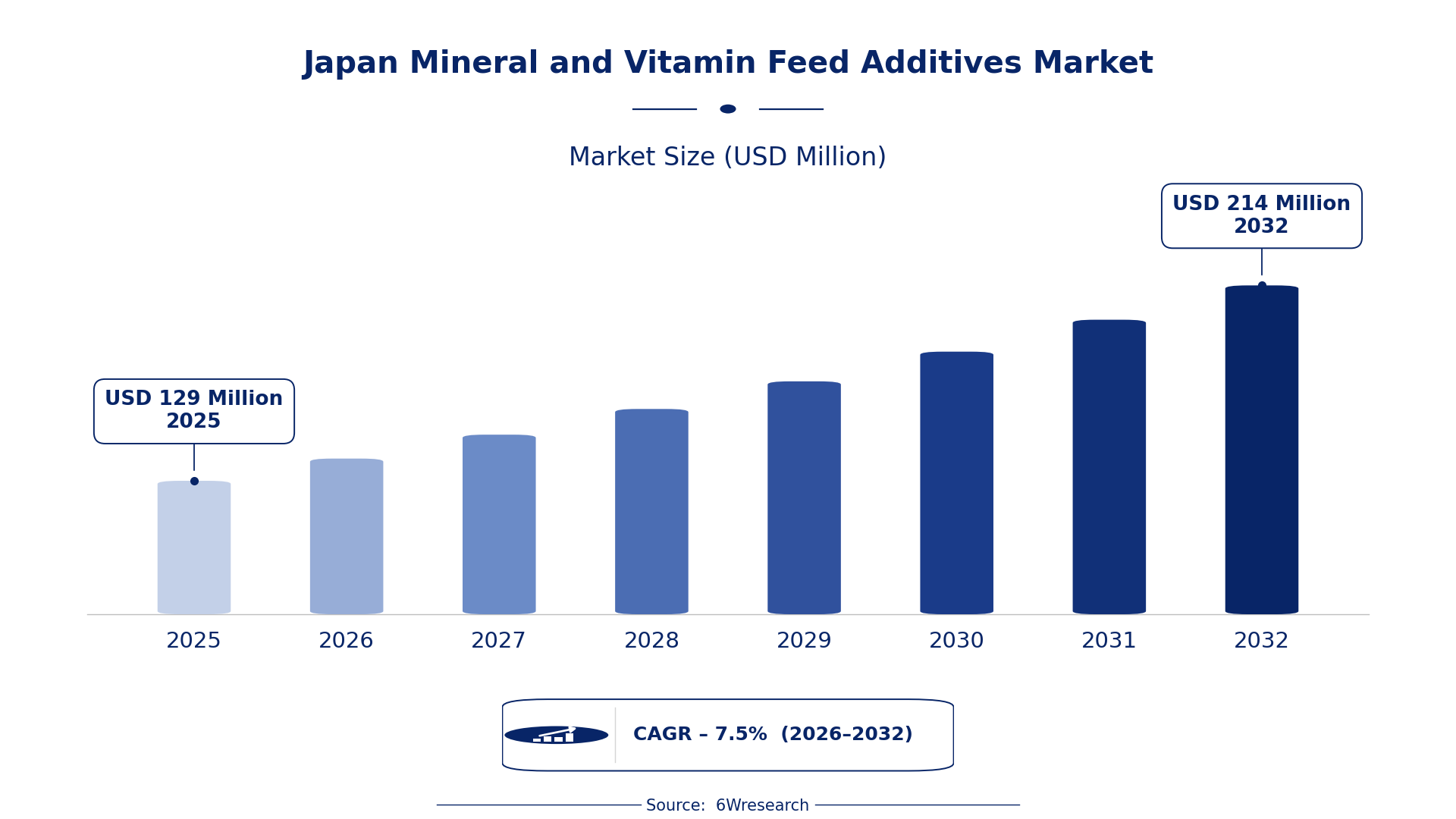
According to 6Wresearch internal database and industry insights, the Japan Mineral and Vitamin Feed Additives Market was valued at USD 129 Million in 2025 and is projected to reach USD 214 Million by 2032, growing at a CAGR of approximately 7.5% during 2026–2032.
Japan Mineral and Vitamin Feed Additives Market Highlights
| Report Metric | Details |
| Report Name | Japan Mineral and Vitamin Feed Additives Market (2026-2032) |
| Market Size 2025 | USD 129 Million |
| Market Size 2032 | USD 214 Million |
| Absolute Growth 2025–2032 | USD 85 Million |
| CAGR 2026–2032 | 7.5% |
| Peak Annual Growth | 8.6% in 2032 |
| Forecast Period | 2026–2032 |
| Historical Data | 2022–2025 |
| Base Year | 2025 |
| Leading Additive Type, 2025 | Multivitamin Premix (27% share) |
| Leading Animal Type, 2025 | Poultry (48% share) |
| Leading Form Type, 2025 | Powder (34% share) |
| Leading Distribution Channel, 2025 | Agricultural Suppliers (35% share) |
| Leading End User, 2025 | Poultry Farms (34% share) |
| Fastest-Growing Additive Type | Zinc (10.9% CAGR) |
| Fastest-Growing Animal Type | Aqua (10.4% CAGR) |
| Fastest-Growing Distribution Channel | Online Feed Retailers (9.9% CAGR) |
| Fastest-Growing End User | Aquaculture Enterprises (9.6% CAGR) |
| Growing Sector | Aquaculture Enterprises |
| Key End Users | Poultry Farms, Dairy Farms, Pig Farms, Aquaculture Enterprises |
Japan Mineral and Vitamin Feed Additives Market Year-wise Growth Rate and Key Drivers (2022–2032)
This graph illustrates the annual growth rates of the market from 2022 to 2032, highlighting a steady upward trajectory and projected market expansion over the forecast period.
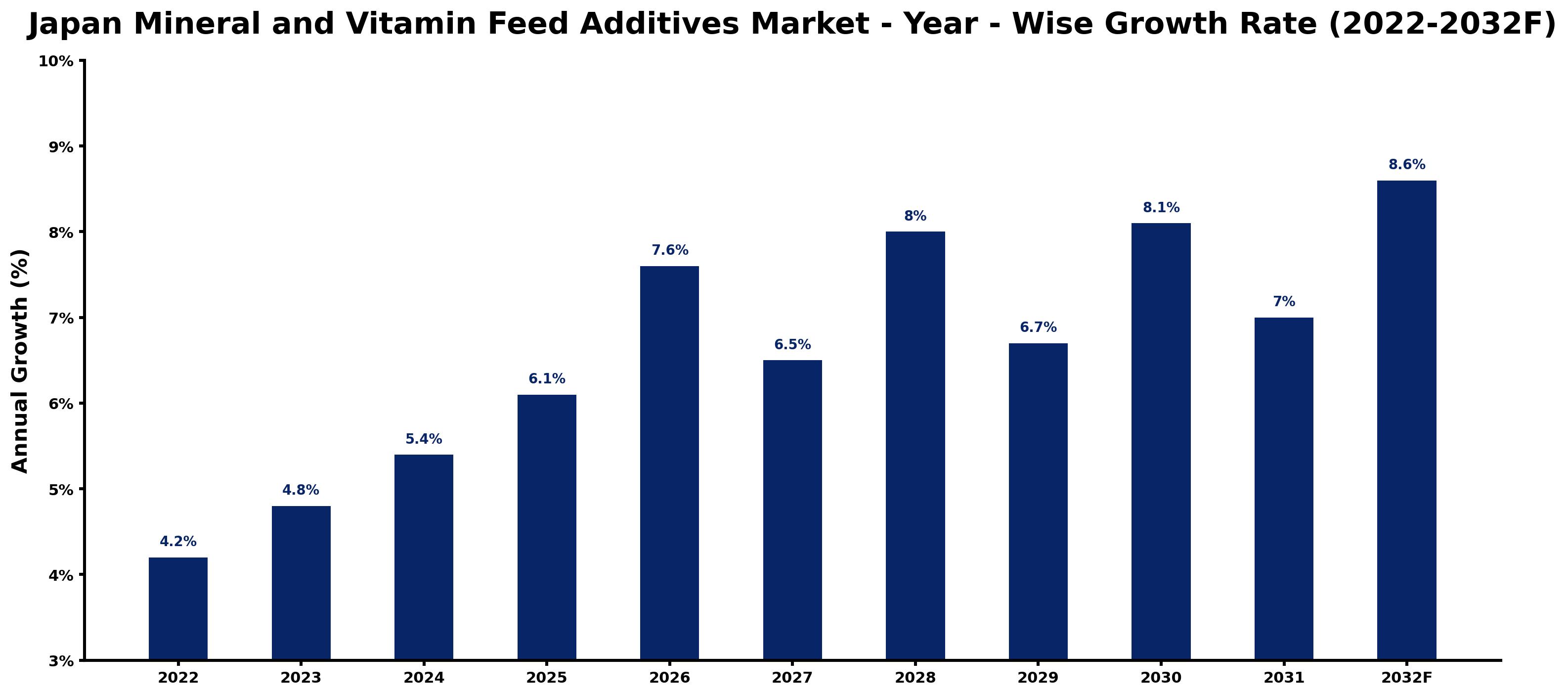
The table below sets out the estimated growth rate for each year and the main factor behind it.
| Year | Estimated Annual Growth (%) | Market Rationale |
| 2022 | 4.2 | The market maintained steady growth due to stable demand from the livestock sector. |
| 2023 | 4.8 | Demand for feed additives increased as poultry farms sought to enhance productivity. |
| 2024 | 5.4 | Growth accelerated as aquaculture enterprises expanded their operations and requirements. |
| 2025 | 6.1 | The market peaked with strong investments in feed efficiency and quality improvements. |
| 2026 | 7.6 | Demand is expected to rise sharply as producers adopt advanced nutritional solutions for livestock. |
| 2027 | 6.5 | Growth is projected to slow as market saturation begins to influence purchasing decisions. |
| 2028 | 8.0 | The market is expected to rebound with renewed interest in innovative feed formulations. |
| 2029 | 6.7 | Growth is projected to decelerate as competition intensifies among suppliers in the sector. |
| 2030 | 8.1 | Demand is expected to surge again as producers focus on enhancing livestock health and yield. |
| 2031 | 7.0 | Growth is projected to slow as market dynamics shift towards cost management strategies. |
| 2032 | 8.6 | The market is expected to peak with heightened focus on sustainable practices in feed production. |
Note: Market size estimations and growth projections presented in this report are based on 6Wresearch's proprietary forecasting methodology, utilizing the latest available industry data, government publications, and primary research inputs.
Japan Mineral and Vitamin Feed Additives Market Synopsis
Mineral and vitamin feed additives are nutritional supplements used in animal feed to improve health and productivity. The Japan Mineral and Vitamin Feed Additives Market is driven by a poultry population of approximately 150 million birds and expanding aquaculture production. Increased livestock production and a focus on improving feed efficiency propel this market forward. The Ministry of Agriculture's recent initiative to improve feed efficiency further supports this trend, encouraging more purchases across the sector.
Market Dynamics Impact Analysis (2026–2032)
| Factor | Type | Impact | Primary Segment Affected |
| Rising poultry population | Driver | High | Poultry |
| Increased aquaculture production | Driver | High | Aqua |
| Growing demand for multivitamin premixes | Opportunity | High | Multivitamin Premix |
| Expansion of online distribution channels | Opportunity | Medium | Online Feed Retailers |
| Regulatory compliance costs | Restraint | High | D |
| Market saturation in feed additives | Restraint | Medium | D |
| Supply chain disruptions affecting availability | Challenge | High | D |
| Rising competition among suppliers | Challenge | Medium | D |
Evaluation of Drivers in Japan Mineral and Vitamin Feed Additives Market (2026–2032)
The following drivers explain most of the expected growth.
| Drivers | Primary Segment Affected | Why It Matters (Evidence) |
| Increased poultry production | Poultry | Japan's poultry population of approximately 150 million birds drives demand for feed additives to support growth and health. |
| Expansion of aquaculture | Aqua | The aquaculture sector produced 600,000 tons of fish in 2022, increasing the need for specialized feed additives. |
| Focus on improving feed efficiency | D | A recent initiative promotes better feed efficiency, leading to higher purchases of additives. |
| Rising health awareness in livestock | Cattle | Cattle farms are focusing on improving milk yield through feed additives, increasing their consumption. |
| Growing adoption of multivitamin premixes | Multivitamin Premix | Aquaculture enterprises are increasingly adopting multivitamin premixes to support fish health. |
Spending rises because Japan's poultry population of approximately 150 million birds creates strong demand for mineral and vitamin feed additives that support growth and health. The aquaculture sector, producing 600,000 tons of fish in 2022, drives the need for specialised formulations. Dairy farms are focusing on milk yield improvements, which increases their consumption of these additives. Additionally, aquaculture enterprises are adopting multivitamin premixes to support livestock health, further boosting demand.
Evaluation of Restraints in Japan Mineral and Vitamin Feed Additives Market
The key brakes on demand, and where they bite hardest, are shown below.
| Market Restraint | Primary Segment Affected | Why It Matters (Evidence) |
| Regulatory compliance costs | D | Producers face high costs to meet regulations set by the Ministry of Health, impacting profitability. |
| Market saturation in feed additives | D | Increased competition among suppliers has led to market saturation, limiting growth opportunities. |
| Supply chain disruptions | D | Disruptions in supply chains have affected the availability of essential feed additives, delaying production. |
| Price volatility of raw materials | D | Fluctuating prices of raw materials used in feed additives create uncertainty for producers. |
| Limited consumer awareness | D | Low awareness among farmers about the benefits of specific additives restricts market growth. |
Japan Mineral and Vitamin Feed Additives Market Challenges
High competition among suppliers drives down prices, forcing producers to reduce their profit margins. This situation exists due to the large number of local manufacturers, complicating pricing strategies for suppliers. Rising raw material costs, especially for essential minerals, increase production expenses, resulting in tighter budgets for farms. In 2023, the average dairy farm, with about 50 cows, faces challenges in managing feed costs effectively. Rapid technological changes in feed formulation can overwhelm smaller producers, leading to inconsistent supply that restricts buyers' access to quality additives.
Trends in the Japan Mineral and Vitamin Feed Additives Market
The shifts below are changing how Japan Mineral and Vitamin Feed Additives Market products are bought and supplied.
- Shift towards Sustainable Feed Practices: Japan's livestock sector is increasingly adopting sustainable feed practices, supported by government initiatives. In 2022, a programme promoted sustainable aquaculture, resulting in a 15% increase in eco-friendly feed usage.
- Transition from Traditional to Advanced Nutritional Solutions: The feed industry is moving towards advanced nutritional solutions, with multivitamin premixes gaining popularity. In 2023, approximately 30% of aquaculture enterprises adopted these premixes to improve health outcomes.
- Emergence of Online Distribution Channels: Online feed retailers are becoming more prominent, with a 20% increase in sales through digital platforms in 2022. This shift allows easier access for farmers to purchase feed additives.
- Growing Interest in Customised Feed Solutions: There is a rising demand for customised feed solutions tailored to specific livestock needs. In 2023, 25% of dairy farms reported using tailored feed formulations to improve productivity.
Investment Opportunities in the Japan Mineral and Vitamin Feed Additives Market
The opportunities below stand out in the Japan Mineral and Vitamin Feed Additives Market for new entrants and existing suppliers.
- Rising Demand for Feed Additives: With the total livestock population around 4 million, there is a growing need for feed additives. Investing in multivitamin premixes for poultry farms can meet this demand, particularly in regions like Hokkaido.
- Expansion in Aquaculture: The aquaculture sector is expanding rapidly, producing 600,000 tons of fish in 2022. Suppliers should focus on providing specialised additives to aquaculture enterprises in coastal regions.
- Growth in Online Sales Channels: Online feed retailers are gaining traction, with a 20% increase in sales in 2022. Entering this market through partnerships with established online platforms can facilitate access to a broader customer base.
- Focus on Sustainable Practices: With increasing awareness of sustainability, there is a need for eco-friendly feed solutions. Suppliers can invest in developing sustainable feed additives to cater to environmentally conscious farms.
Government Initiatives in the Japan Mineral and Vitamin Feed Additives Market
The Economic Security Promotion Act (2022) supports supply-chain resilience for critical products, including feed additives. This measure encourages producers to invest in local sourcing and sustainable practices, improving the overall quality of feed products in the market. Additionally, the act aims to strengthen production capabilities and ensure a steady supply of essential materials.
The Japan Animal Feed Manufacturers Association plays a key role in implementing industry standards and promoting safety. This agency provides guidelines for producers to ensure compliance with regulations, benefiting both buyers and suppliers. The association's efforts include overseeing quality checks and facilitating training programmes for manufacturers to improve their operational standards.
Future Insight of the Japan Mineral and Vitamin Feed Additives Market
By 2032, buyers will see a shift towards advanced nutritional programmes that focus on improving livestock health and productivity. Digital technologies will enhance distribution efficiency, benefiting suppliers and buyers alike. As multivitamin premixes gain traction in livestock diets, nutritional standards will elevate, contributing to better animal health. Government initiatives will encourage innovation in feed formulations, ensuring adherence to safety regulations. The total livestock population, around 4 million, will drive demand for these advancements, resulting in a more robust market.
Market Segmentation Analysis
Japan Mineral and Vitamin Feed Additives Market report covers a detailed analysis of the following market segments:
By Additive Type – Multivitamin Premix Leads, Zinc Expected to Grow Fastest
According to Saurav Kr Singh, Senior Research Analyst at 6Wresearch, Multivitamin Premix accounted for 27% of the market by additive type in 2025. Multivitamin premixes lead the market as they provide a comprehensive nutrient profile essential for livestock health and productivity. Their widespread acceptance among farmers in Japan is bolstered by adherence to JIS standards, ensuring quality and effectiveness. Over 2026–2032, Zinc is expected to post the fastest growth, at a CAGR of 10.9%. Zinc is experiencing rapid growth due to its critical role in immune function and growth in livestock, especially in swine. The increasing awareness among farmers regarding its benefits is driving demand significantly. Suppliers should focus on developing zinc-based products to align with the growing needs of livestock producers.
By Animal Type – Poultry Leads, Aqua Expected to Grow Fastest
Poultry took 48% of animal type revenue in 2025, more than any other category. Poultry is the dominant segment, representing a major share of feed additive consumption, supported by a poultry population of approximately 150 million birds. This large population drives continuous demand for nutritional supplements that improve growth and overall health. Aqua is projected to grow fastest, at a CAGR of 10.4% during 2026–2032. The aquaculture sector is expanding rapidly, necessitating specialised additives to ensure the health of aquatic species, with production reaching 600,000 tons of fish in 2022. Government initiatives promoting sustainable practices are further enhancing this sector's growth. Buyers in aquaculture should seek tailored feed additives to support their operational growth and health standards.
By Form Type – Powder Leads and Records the Fastest Growth
The largest form type category in 2025 was Powder, at 34% of revenue. Powder is the leading form of feed additive, preferred for its ease of mixing in feed, which aligns with farmer preferences. This practicality ensures its widespread application across various livestock sectors, facilitating consistent use. Its lead should widen, with a projected CAGR of 10.8% during 2026–2032, the highest in this split. Powder remains the fastest-growing form due to its versatility and convenience, meeting the increasing demand for efficient feed solutions. Its consistent application across different livestock types reinforces its market position. Suppliers should enhance the quality and formulation of powder additives to cater to the growing market needs.
By Distribution Channel – Agricultural Suppliers Lead, Online Feed Retailers Expected to Grow Fastest
With 35% of distribution channel revenue in 2025, Agricultural Suppliers was the largest category. Agricultural suppliers serve as the primary channel for distributing feed additives, providing direct access to farmers and ensuring a steady supply. Their established relationships with livestock producers facilitate consistent sales and product availability. Online Feed Retailers are set to record the highest CAGR in this split, 9.9% over 2026–2032. Online feed retailers are rapidly gaining traction as a distribution channel, reflecting the shift towards digital purchasing methods among farmers. This trend is accelerated by the increasing online presence of agricultural suppliers. Suppliers must invest in online platforms to reach a broader audience and adapt to changing purchasing behaviours.
By End User – Poultry Farms Lead, Aquaculture Enterprises Expected to Grow Fastest
In 2025, Poultry Farms led the end user split with a 34% share. Poultry farms are the largest end users of feed additives, driven by the need to improve growth rates and overall health in their flocks. The substantial poultry population in Japan highlights the ongoing demand for these nutritional supplements. Over 2026–2032, Aquaculture Enterprises are expected to post the fastest growth, at a CAGR of 9.6%. Aquaculture enterprises are the fastest-growing end user, as they require specialised additives to support the health of aquatic species. The government's support for sustainable aquaculture practices is significantly contributing to this rapid growth. Suppliers should tailor their offerings to meet the specific needs of aquaculture enterprises to capitalise on this growth opportunity.
Key Attractiveness of the Report
- 10 Years of Market Numbers
- Historical Data Starting from 2022 to 2025
- Base Year 2025
- Forecast Data until 2032
- Key Performance Indicators Impacting the Market
- Major Upcoming Developments and Projects
Key Highlights of the Report:
- Japan Mineral and Vitamin Feed Additives Market Outlook
- Market Size of Japan Mineral and Vitamin Feed Additives Market, 2025
- Forecast of Japan Mineral and Vitamin Feed Additives Market, 2032
- Historical Data and Forecast of Japan Mineral and Vitamin Feed Additives Revenues & Volume for the Period 2022-2032F
- Japan Mineral and Vitamin Feed Additives Market Trend Evolution
- Japan Mineral and Vitamin Feed Additives Market Drivers and Challenges
- Japan Mineral and Vitamin Feed Additives Price Trends
- Japan Mineral and Vitamin Feed Additives Porter's Five Forces
- Japan Mineral and Vitamin Feed Additives Industry Life Cycle
- Historical Data and Forecast of Japan Mineral and Vitamin Feed Additives Market Revenues & Volume By Additive Type for the Period 2022-2032F
- Historical Data and Forecast of Japan Mineral and Vitamin Feed Additives Market Revenues & Volume By Vitamin A, D, E for the Period 2022-2032F
- Historical Data and Forecast of Japan Mineral and Vitamin Feed Additives Market Revenues & Volume By Zinc, Selenium, Copper for the Period 2022-2032F
- Historical Data and Forecast of Japan Mineral and Vitamin Feed Additives Market Revenues & Volume By Iron, Magnesium for the Period 2022-2032F
- Historical Data and Forecast of Japan Mineral and Vitamin Feed Additives Market Revenues & Volume By Multivitamin Premix for the Period 2022-2032F
- Historical Data and Forecast of Japan Mineral and Vitamin Feed Additives Market Revenues & Volume By Animal Type for the Period 2022-2032F
- Historical Data and Forecast of Japan Mineral and Vitamin Feed Additives Market Revenues & Volume By Poultry for the Period 2022-2032F
- Historical Data and Forecast of Japan Mineral and Vitamin Feed Additives Market Revenues & Volume By Cattle for the Period 2022-2032F
- Historical Data and Forecast of Japan Mineral and Vitamin Feed Additives Market Revenues & Volume By Swine for the Period 2022-2032F
- Historical Data and Forecast of Japan Mineral and Vitamin Feed Additives Market Revenues & Volume By Aqua for the Period 2022-2032F
- Historical Data and Forecast of Japan Mineral and Vitamin Feed Additives Market Revenues & Volume By Form Type for the Period 2022-2032F
- Historical Data and Forecast of Japan Mineral and Vitamin Feed Additives Market Revenues & Volume By Powder for the Period 2022-2032F
- Historical Data and Forecast of Japan Mineral and Vitamin Feed Additives Market Revenues & Volume By Pellet for the Period 2022-2032F
- Historical Data and Forecast of Japan Mineral and Vitamin Feed Additives Market Revenues & Volume By Liquid for the Period 2022-2032F
- Historical Data and Forecast of Japan Mineral and Vitamin Feed Additives Market Revenues & Volume By Granule for the Period 2022-2032F
- Historical Data and Forecast of Japan Mineral and Vitamin Feed Additives Market Revenues & Volume By Distribution Channel for the Period 2022-2032F
- Historical Data and Forecast of Japan Mineral and Vitamin Feed Additives Market Revenues & Volume By Agricultural Suppliers for the Period 2022-2032F
- Historical Data and Forecast of Japan Mineral and Vitamin Feed Additives Market Revenues & Volume By Feed Distributors for the Period 2022-2032F
- Historical Data and Forecast of Japan Mineral and Vitamin Feed Additives Market Revenues & Volume By Veterinary Pharmacies for the Period 2022-2032F
- Historical Data and Forecast of Japan Mineral and Vitamin Feed Additives Market Revenues & Volume By Online Feed Retailers for the Period 2022-2032F
- Historical Data and Forecast of Japan Mineral and Vitamin Feed Additives Market Revenues & Volume By End User for the Period 2022-2032F
- Historical Data and Forecast of Japan Mineral and Vitamin Feed Additives Market Revenues & Volume By Poultry Farms for the Period 2022-2032F
- Historical Data and Forecast of Japan Mineral and Vitamin Feed Additives Market Revenues & Volume By Dairy Farms for the Period 2022-2032F
- Historical Data and Forecast of Japan Mineral and Vitamin Feed Additives Market Revenues & Volume By Pig Farms for the Period 2022-2032F
- Historical Data and Forecast of Japan Mineral and Vitamin Feed Additives Market Revenues & Volume By Aquaculture Enterprises for the Period 2022-2032F
- Japan Mineral and Vitamin Feed Additives Import Export Trade Statistics
- Market Opportunity Assessment By Additive Type
- Market Opportunity Assessment By Animal Type
- Market Opportunity Assessment By Form Type
- Market Opportunity Assessment By Distribution Channel
- Market Opportunity Assessment By End User
- Japan Mineral and Vitamin Feed Additives Top Companies Market Share
- Japan Mineral and Vitamin Feed Additives Competitive Benchmarking By Technical and Operational Parameters
- Japan Mineral and Vitamin Feed Additives Company Profiles
- Japan Mineral and Vitamin Feed Additives Key Strategic Recommendations
Market Covered
The following segment groups are covered in the report.
By Additive Type
- Vitamin A
- D
- E
- Zinc
- Selenium
- Copper
- Iron
- Magnesium
- Multivitamin Premix
By Animal Type
- Poultry
- Cattle
- Swine
- Aqua
By Form Type
- Powder
- Pellet
- Liquid
- Granule
By Distribution Channel
- Agricultural Suppliers
- Feed Distributors
- Veterinary Pharmacies
- Online Feed Retailers
By End User
- Poultry Farms
- Dairy Farms
- Pig Farms
- Aquaculture Enterprises






































