Japan Minimalist Furniture Market Size & Growth Rate
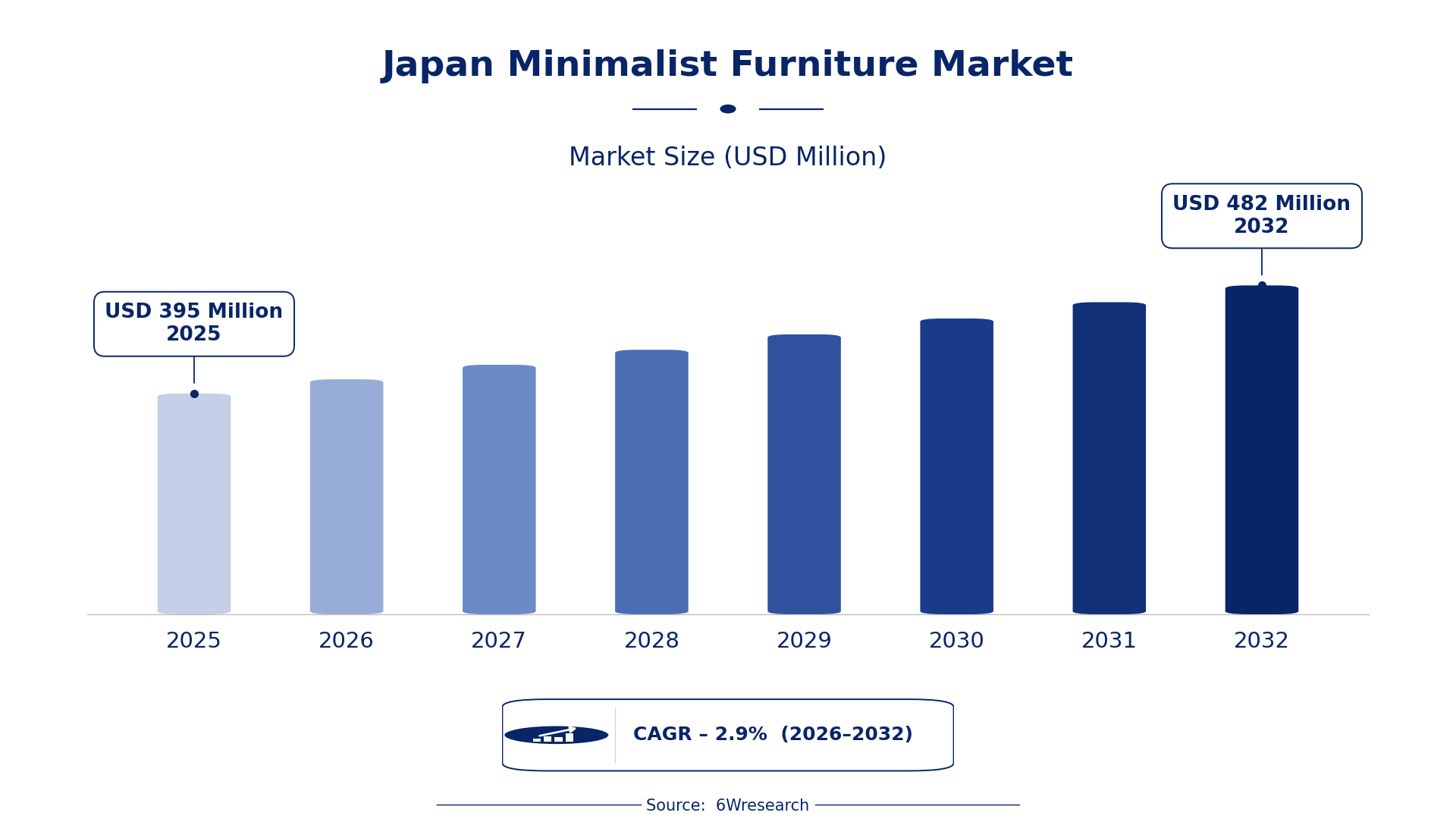
According to 6Wresearch internal database and industry insights, the Japan Minimalist Furniture Market was valued at USD 395 Million in 2025 and is projected to reach USD 482 Million by 2032, growing at a CAGR of approximately 2.9% during 2026–2032.
Japan Minimalist Furniture Market Highlights
| Report Metric | Details |
| Report Name | Japan Minimalist Furniture Market (2026-2032) |
| Market Size 2025 | USD 395 Million |
| Market Size 2032 | USD 482 Million |
| Absolute Growth 2025–2032 | USD 87 Million |
| CAGR 2026–2032 | 2.9% |
| Peak Annual Growth | 3.8% in 2032 |
| Forecast Period | 2026–2032 |
| Historical Data | 2022–2025 |
| Base Year | 2025 |
| Leading Furniture Type, 2025 | Chairs (38% share) |
| Leading Material, 2025 | Solid Wood (39% share) |
| Leading Application Area, 2025 | Residential (44% share) |
| Leading Distribution Channel, 2025 | Furniture Stores (42% share) |
| Leading End User, 2025 | Homeowners (42% share) |
| Fastest-Growing Furniture Type | Tables (4.1% CAGR) |
| Fastest-Growing Material | Metal & Glass (4.4% CAGR) |
| Fastest-Growing Application Area | Offices (3.9% CAGR) |
| Fastest-Growing Distribution Channel | Online Retail (4.3% CAGR) |
| Fastest-Growing End User | Corporates (4.0% CAGR) |
| Growing Sector | Residential |
| Key End Users | Homeowners, Urban Consumers, Corporates |
Japan Minimalist Furniture Market Year-wise Growth Rate and Key Drivers (2022–2032)
This graph illustrates the annual growth rates of the market from 2022 to 2032, highlighting a steady upward trajectory and projected market expansion over the forecast period.
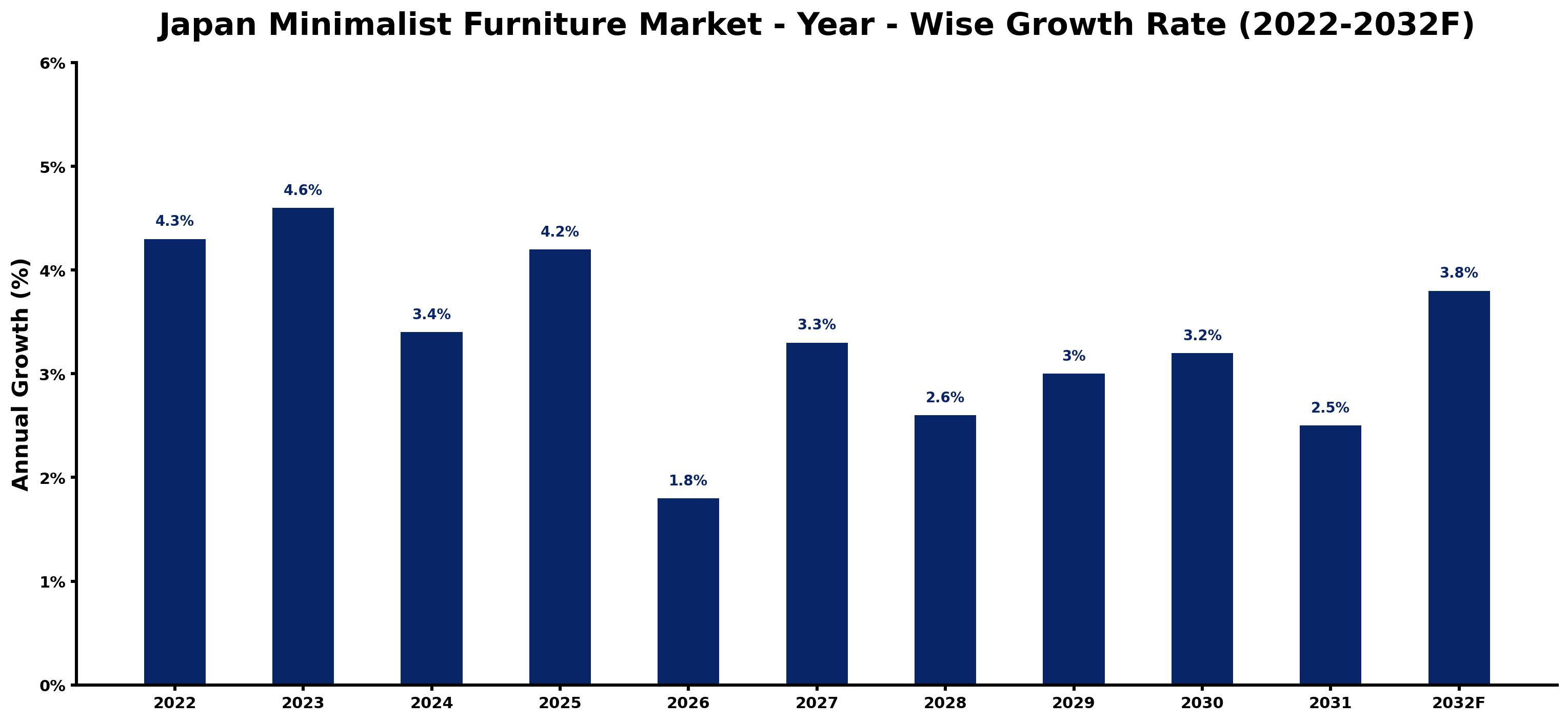
Year by year, the estimates below pair each growth rate with the development that shaped it.
| Year | Estimated Annual Growth (%) | Market Rationale |
| 2022 | 4.3 | The market experienced steady growth as urban consumers sought minimalist designs. |
| 2023 | 4.6 | Demand surged due to increased interest in sustainable living and eco-friendly materials. |
| 2024 | 3.4 | Growth slowed as consumers became more selective in their purchases. |
| 2025 | 4.2 | A resurgence in demand occurred as more homeowners embraced minimalist aesthetics. |
| 2026 | 1.8 | Growth is expected to slow again as market saturation begins to take effect. |
| 2027 | 3.3 | Demand is projected to increase as urban living trends continue to favour space-saving solutions. |
| 2028 | 2.6 | Growth is anticipated to decelerate as economic factors influence consumer spending habits. |
| 2029 | 3.0 | A rebound in demand is expected as new design trends emerge in the market. |
| 2030 | 3.2 | Growth will pick up as appealing minimalist designs attract more buyers. |
| 2031 | 2.5 | The market will see a slowdown as consumers focus on practicality over aesthetics. |
| 2032 | 3.8 | Demand is projected to accelerate again as sustainability becomes a top priority for consumers. |
Note: Market size estimations and growth projections presented in this report are based on 6Wresearch's proprietary forecasting methodology, utilizing the latest available industry data, government publications, and primary research inputs.
Japan Minimalist Furniture Market Synopsis
Minimalist furniture features simple designs, functionality, and natural materials that enhance living spaces in homes and offices. The Japan Minimalist Furniture Market is expanding as urban consumers, approximately 37 million, increasingly prefer modern aesthetics. A government sustainability initiative launched in 2023 promotes eco-friendly materials, while online retail sales accounted for 20% of total furniture sales in 2022, highlighting a shift towards digital purchasing.
Market Dynamics Impact Analysis (2026–2032)
| Factor | Type | Impact | Primary Segment Affected |
| Growing urban population | Driver | High | Residential |
| Increased interest in sustainable materials | Driver | High | Sustainable Wood |
| Rising demand for space-saving furniture | Opportunity | High | Apartments |
| Expansion of online retail channels | Opportunity | High | Online Retail |
| Market saturation in urban areas | Restraint | Medium | Residential |
| Consumer preference for established brands | Restraint | Medium | Furniture Stores |
| High production costs for sustainable materials | Challenge | High | Sustainable Wood |
| Competition from imported furniture | Challenge | Medium | Furniture Stores |
Evaluation of Drivers in Japan Minimalist Furniture Market (2026–2032)
The following drivers explain most of the expected growth.
| Drivers | Primary Segment Affected | Why It Matters (Evidence) |
| Urban population growth | Residential | With approximately 37 million urban residents, demand for minimalist furniture rises as living spaces become more compact. |
| Sustainability trends | Sustainable Wood | The government's sustainability initiative promotes eco-friendly materials, leading to a 15% increase in sustainable wood usage since 2020. |
| Preference for modern aesthetics | Apartments | As the average size of new apartments in Tokyo is around 40 square meters, minimalist designs are increasingly favoured. |
| Expansion of online retail | Online Retail | Online sales accounted for 20% of total furniture sales in 2022, reflecting changing consumer purchasing habits. |
| Increased disposable income | Homeowners | Urban consumers are spending more on home furnishings, driving demand for stylish and functional minimalist furniture. |
Most of the extra volume comes from the urban population, which is approximately 37 million in Japan, driving demand for minimalist furniture that fits compact living spaces. The average size of new apartments in Tokyo is around 40 square meters, influencing the need for space-saving designs. Sustainability trends are also notable, with sustainable wood usage increasing by 15% since 2020 due to consumer preferences for eco-friendly products. Online retail sales accounted for 20% of total furniture sales in 2022, indicating a shift towards digital purchasing. Rising disposable income among urban homeowners is increasing spending on stylish minimalist furniture.
Evaluation of Restraints in Japan Minimalist Furniture Market
Below are the constraints most often cited by buyers and suppliers, with the segment each affects.
| Market Restraint | Primary Segment Affected | Why It Matters (Evidence) |
| Market saturation in urban areas | Residential | In urban settings, competition escalates as more companies enter the market, making it challenging for new entrants to establish a foothold. |
| Consumer preference for established brands | Furniture Stores | Many consumers favour well-known brands, which restricts opportunities for emerging or lesser-known manufacturers. |
| High production costs for sustainable materials | Sustainable Wood | Producers face rising costs in sourcing sustainable materials, which can diminish profitability and pricing flexibility. |
| Limited space in urban homes | Apartments | Smaller living spaces restrict the types of furniture that can be sold, impacting overall sales volume. |
| Regulatory compliance costs | Furniture Stores | Compliance with safety and material standards can increase operational costs for retailers. |
Japan Minimalist Furniture Market Challenges
Producers face rising costs due to intense competition, which has resulted in a 15% decline in average selling prices over the past two years. This situation arises from Japan's urban population of around 37 million, creating a saturated market where producers must lower prices to attract buyers. Skills shortages in craftsmanship hinder production, causing delays of up to six months for manufacturers as fewer artisans enter the field. Regulatory changes, such as the new sustainability initiative, can increase costs for buyers by 10% as they adapt to new eco-friendly material requirements.
Trends in the Japan Minimalist Furniture Market
Below are the shifts with the largest effect on the Japan Minimalist Furniture Market.
- Shift towards Eco-Friendly Materials: Japan is prioritising eco-friendly materials in furniture design, supported by a government initiative launched in 2023 promoting sustainability. This shift has led to a 15% increase in sustainable wood usage since 2020, appealing to environmentally conscious consumers.
- Growing Online Sales Channels: The online retail segment for furniture is expanding rapidly, accounting for 20% of total sales in 2022. This trend reflects changing consumer preferences for convenience and accessibility in purchasing furniture.
- Emphasis on Space-Saving Designs: With the average size of new apartments in Tokyo around 40 square meters, there is a growing demand for space-saving minimalist furniture. This trend is reshaping product offerings to meet urban living needs.
- Rise of Design Competitions: In 2023, a new design competition was introduced to encourage fresh minimalist furniture designs. This initiative aims to stimulate creativity and attract new talent to the industry, fostering innovative ideas.
Investment Opportunities in the Japan Minimalist Furniture Market
Several openings in the Japan Minimalist Furniture Market merit attention from investors.
- Partnerships with Local Artisans: Collaborating with local artisans can improve product offerings. The Tokyo Metropolitan Government supports local craftsmen, providing grants and programs to boost their visibility and sales.
- Targeting Urban Homeowners: Urban homeowners are increasingly seeking minimalist furniture solutions. Focusing on this demographic can lead to significant sales growth, especially in metropolitan areas like Tokyo.
- Investment in Online Retail Platforms: Investing in online retail platforms can capture the growing segment of digital consumers. With online sales accounting for 20% of total furniture sales, this channel presents a lucrative opportunity.
- Development of Space-Saving Furniture: Creating innovative space-saving furniture designs can meet the needs of urban dwellers. The demand for such products is rising, particularly in cities with limited living space.
Government Initiatives in the Japan Minimalist Furniture Market
The Economic Security Promotion Act of 2022 supports supply-chain resilience for critical products, including furniture materials. This law encourages manufacturers to invest in local sourcing and production, improving the overall sustainability of the industry. Additionally, the Chemical Substances Control Law requires evaluation and control of chemical substances in furniture production, ensuring safety and compliance with environmental standards.
The Ministry of the Environment (MoE) oversees the implementation of various initiatives, including grants for local furniture artisans. These programs aim to promote craftsmanship and sustainability in furniture production, providing financial support to small manufacturers and encouraging the use of eco-friendly materials.
Future Insight of the Japan Minimalist Furniture Market
By 2032, suppliers will focus on creating multifunctional furniture that optimises space, driven by the average apartment size of 40 square meters. Design competitions will encourage unique and contemporary creations that appeal to urban consumers. Online retail sales are projected to grow, potentially reaching 30% of total furniture sales, improving convenience for buyers. The Japan Furniture Association is expected to enforce stricter standards, enhancing quality and safety in minimalist furniture, which will benefit both buyers and suppliers.
Market Segmentation Analysis
Japan Minimalist Furniture Market report covers a detailed analysis of the following market segments:
By Furniture Type – Chairs Lead, Tables Expected to Grow Fastest
According to Vasu Joshi, Associate Consultant at 6Wresearch, Chairs held 38% of the Japan Minimalist Furniture Market by furniture type in 2025. Chairs dominate the market due to their essential role in providing seating solutions for both residential and office environments. The demand is particularly strong in urban areas like Tokyo, where space optimisation is crucial for consumers. Over 2026–2032, Tables are expected to post the fastest growth, at a CAGR of 4.1%. Tables are rapidly gaining traction as they adapt to multifunctional spaces, with many urban homes requiring versatile surfaces for various activities. The average size of new apartments in Tokyo necessitates innovative table designs that maximise utility. Suppliers should prioritise the development of multifunctional table designs to meet the increasing demand from urban consumers.
By Material – Solid Wood Leads, Metal & Glass Expected to Grow Fastest
Solid Wood took 39% of material revenue in 2025, more than any other category. Solid wood is the leading material choice for minimalist furniture, valued for its durability and natural aesthetic that appeals to quality-conscious consumers. The focus on craftsmanship in Japan further enhances its desirability among buyers seeking sustainable options. The quickest growth will come from Metal & Glass, forecast to expand at a CAGR of 4.4% between 2026 and 2032. Metal and glass materials are experiencing the fastest growth, aligning well with modern design preferences among urban consumers who favour sleek aesthetics. The rise in eco-friendly initiatives encourages the integration of these materials into contemporary furniture designs. Manufacturers should consider expanding their product lines to include metal and glass options to cater to evolving consumer tastes.
By Application Area – Residential Leads, Offices Expected to Grow Fastest
Residential accounted for 44% of the market by application area in 2025. Residential areas are the primary application for minimalist furniture, driven by homeowners who desire to optimise their living spaces with functional designs. The urban population, especially in cities like Tokyo, significantly influences this demand for stylish and practical furniture. Offices are projected to grow fastest, at a CAGR of 3.9% during 2026–2032. Offices are increasingly adopting minimalist furniture to create modern work environments that enhance productivity and maintain a clutter-free atmosphere. The shift towards flexible office layouts is propelling this segment's rapid growth. Suppliers must adapt their product offerings to meet the specific requirements of office environments as demand continues to rise.
By Distribution Channel – Furniture Stores Lead, Online Retail Expected to Grow Fastest
With 42% of distribution channel revenue in 2025, Furniture Stores was the largest category. Furniture stores are the main distribution channel for minimalist furniture, providing consumers with a tactile experience that is vital for such products. The concentration of urban consumers in regions like Tokyo supports the success of these retail outlets. Online Retail is set to record the highest CAGR in this split, 4.3% over 2026–2032. Online retail is expanding swiftly, accounting for 20% of total furniture sales in 2022 as consumers increasingly favour the convenience of shopping from home. This trend is expected to persist as digital platforms improve their service offerings. Retailers should enhance their online presence to capture the growing segment of consumers who prefer digital shopping.
By End User – Homeowners Lead, Corporates Expected to Grow Fastest
The largest end user category in 2025 was Homeowners, at 42% of revenue. Homeowners constitute a major consumer group for minimalist furniture, seeking to improve their living spaces with functional and aesthetically pleasing designs. The average household size in Japan influences the demand for space-efficient solutions that cater to smaller living areas. Over 2026–2032, Corporates are expected to post the fastest growth, at a CAGR of 4.0%. Corporates are increasingly purchasing minimalist furniture for office spaces, albeit in smaller volumes, as they aim to create modern work environments. The trend towards flexible office designs is driving this growth in corporate purchases. Suppliers should develop targeted marketing strategies for corporate clients to capitalise on this emerging demand.
Key Attractiveness of the Report
- 10 Years of Market Numbers
- Historical Data Starting from 2022 to 2025
- Base Year 2025
- Forecast Data until 2032
- Key Performance Indicators Impacting the Market
- Major Upcoming Developments and Projects
Key Highlights of the Report:
- Japan Minimalist Furniture Market Outlook
- Market Size of Japan Minimalist Furniture Market, 2025
- Forecast of Japan Minimalist Furniture Market, 2032
- Historical Data and Forecast of Japan Minimalist Furniture Market Revenues & Volume for the Period 2022-2032F
- Japan Minimalist Furniture Market Trend Evolution
- Japan Minimalist Furniture Market Drivers and Challenges
- Japan Minimalist Furniture Market Price Trends
- Japan Minimalist Furniture Market Porter's Five Forces
- Japan Minimalist Furniture Market Industry Life Cycle
- Historical Data and Forecast of Japan Minimalist Furniture Market Revenues & Volume By Furniture Type for the Period 2022-2032F
- Historical Data and Forecast of Japan Minimalist Furniture Market Revenues & Volume By Chairs for the Period 2022-2032F
- Historical Data and Forecast of Japan Minimalist Furniture Market Revenues & Volume By Tables for the Period 2022-2032F
- Historical Data and Forecast of Japan Minimalist Furniture Market Revenues & Volume By Storage Units for the Period 2022-2032F
- Historical Data and Forecast of Japan Minimalist Furniture Market Revenues & Volume By Beds for the Period 2022-2032F
- Historical Data and Forecast of Japan Minimalist Furniture Market Revenues & Volume By Material for the Period 2022-2032F
- Historical Data and Forecast of Japan Minimalist Furniture Market Revenues & Volume By Solid Wood for the Period 2022-2032F
- Historical Data and Forecast of Japan Minimalist Furniture Market Revenues & Volume By Metal & Glass for the Period 2022-2032F
- Historical Data and Forecast of Japan Minimalist Furniture Market Revenues & Volume By Engineered Wood for the Period 2022-2032F
- Historical Data and Forecast of Japan Minimalist Furniture Market Revenues & Volume By Sustainable Wood for the Period 2022-2032F
- Historical Data and Forecast of Japan Minimalist Furniture Market Revenues & Volume By Application Area for the Period 2022-2032F
- Historical Data and Forecast of Japan Minimalist Furniture Market Revenues & Volume By Residential for the Period 2022-2032F
- Historical Data and Forecast of Japan Minimalist Furniture Market Revenues & Volume By Offices for the Period 2022-2032F
- Historical Data and Forecast of Japan Minimalist Furniture Market Revenues & Volume By Apartments for the Period 2022-2032F
- Historical Data and Forecast of Japan Minimalist Furniture Market Revenues & Volume By Bedrooms for the Period 2022-2032F
- Historical Data and Forecast of Japan Minimalist Furniture Market Revenues & Volume By Distribution Channel for the Period 2022-2032F
- Historical Data and Forecast of Japan Minimalist Furniture Market Revenues & Volume By Furniture Stores for the Period 2022-2032F
- Historical Data and Forecast of Japan Minimalist Furniture Market Revenues & Volume By Online Retail for the Period 2022-2032F
- Historical Data and Forecast of Japan Minimalist Furniture Market Revenues & Volume By Direct Sales for the Period 2022-2032F
- Historical Data and Forecast of Japan Minimalist Furniture Market Revenues & Volume By Specialty Stores for the Period 2022-2032F
- Historical Data and Forecast of Japan Minimalist Furniture Market Revenues & Volume By End User for the Period 2022-2032F
- Historical Data and Forecast of Japan Minimalist Furniture Market Revenues & Volume By Homeowners for the Period 2022-2032F
- Historical Data and Forecast of Japan Minimalist Furniture Market Revenues & Volume By Corporates for the Period 2022-2032F
- Historical Data and Forecast of Japan Minimalist Furniture Market Revenues & Volume By Urban Consumers for the Period 2022-2032F
- Historical Data and Forecast of Japan Minimalist Furniture Market Revenues & Volume By Families for the Period 2022-2032F
- Japan Minimalist Furniture Market Import Export Trade Statistics
- Market Opportunity Assessment By Furniture Type
- Market Opportunity Assessment By Material
- Market Opportunity Assessment By Application Area
- Market Opportunity Assessment By Distribution Channel
- Market Opportunity Assessment By End User
- Japan Minimalist Furniture Market Top Companies Market Share
- Japan Minimalist Furniture Market Competitive Benchmarking By Technical and Operational Parameters
- Japan Minimalist Furniture Market Company Profiles
- Japan Minimalist Furniture Market Key Strategic Recommendations
Market Covered
Coverage by segment is as follows.
By Furniture Type
- Chairs
- Tables
- Storage Units
- Beds
By Material
- Solid Wood
- Metal & Glass
- Engineered Wood
- Sustainable Wood
By Application Area
- Residential
- Offices
- Apartments
- Bedrooms
By Distribution Channel
- Furniture Stores
- Online Retail
- Direct Sales
- Specialty Stores
By End User
- Homeowners
- Corporates
- Urban Consumers
- Families






































