Japan Monochloroacetic Acid Market Size & Growth Rate
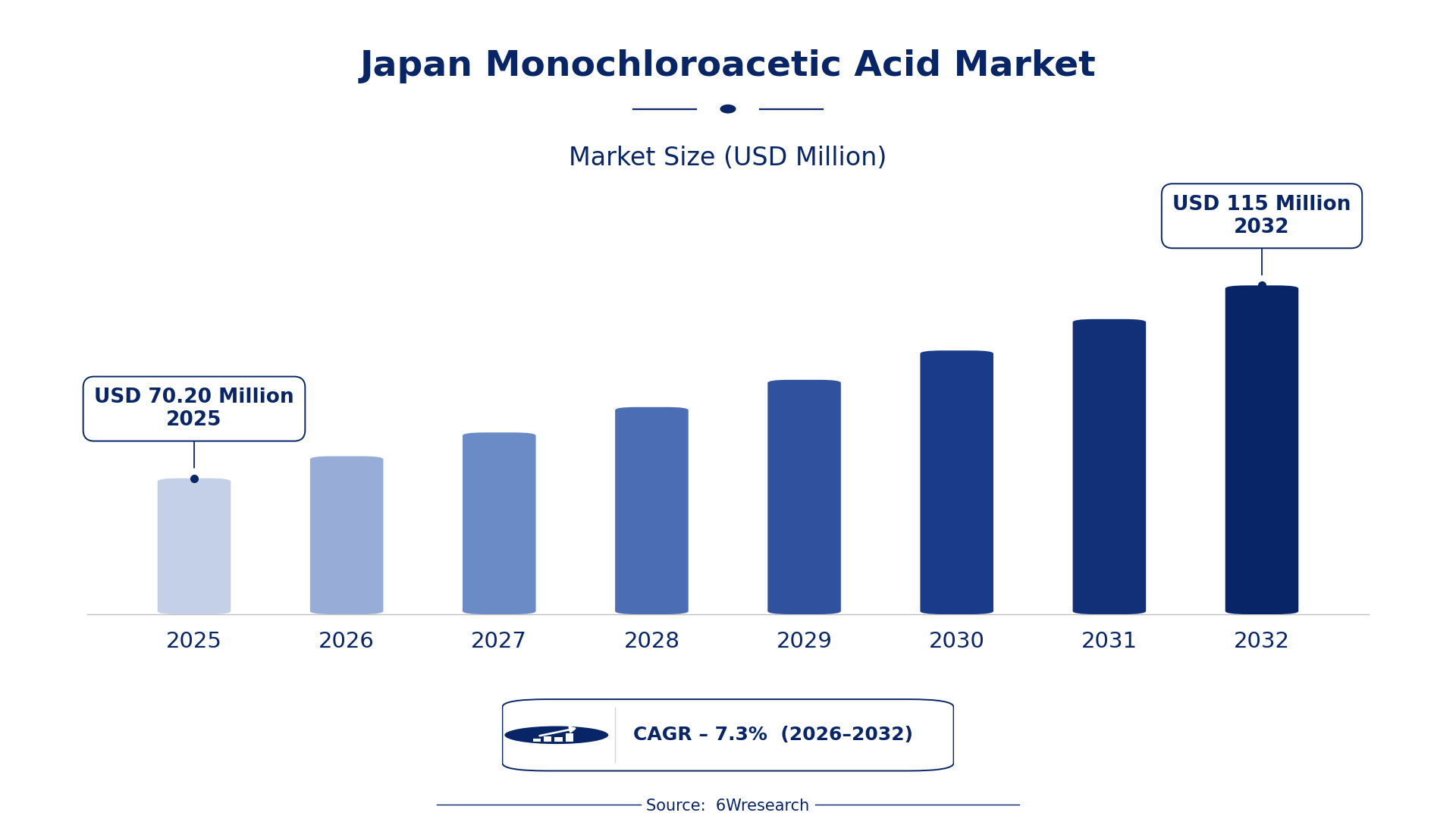
According to 6Wresearch internal database and industry insights, the Japan Monochloroacetic Acid Market was valued at USD 70.20 Million in 2025 and is projected to reach USD 115 Million by 2032, growing at a CAGR of approximately 7.3% during 2026–2032.
Japan Monochloroacetic Acid Market Highlights
| Report Metric | Details |
| Report Name | Japan Monochloroacetic Acid Market (2026-2032) |
| Market Size 2025 | USD 70.20 Million |
| Market Size 2032 | USD 115 Million |
| Absolute Growth 2025–2032 | USD 44.80 Million |
| CAGR 2026–2032 | 7.3% |
| Peak Annual Growth | 8.3% in 2026 |
| Forecast Period | 2026–2032 |
| Historical Data | 2022–2025 |
| Base Year | 2025 |
| Leading Application, 2025 | Chemical Compounds (35% share) |
| Leading End Use, 2025 | Pharmaceuticals (39% share) |
| Fastest-Growing Application | Drugs (9.6% CAGR) |
| Fastest-Growing End Use | Chemicals (9.2% CAGR) |
| Growing Sector | Pharmaceuticals |
| Key End Users | Pharmaceutical manufacturers, chemical producers, agricultural cooperatives, food safety regulators |
Japan Monochloroacetic Acid Market Year-wise Growth Rate and Key Drivers (2022–2032)
This graph illustrates the annual growth rates of the market from 2022 to 2032, highlighting a steady upward trajectory and projected market expansion over the forecast period.
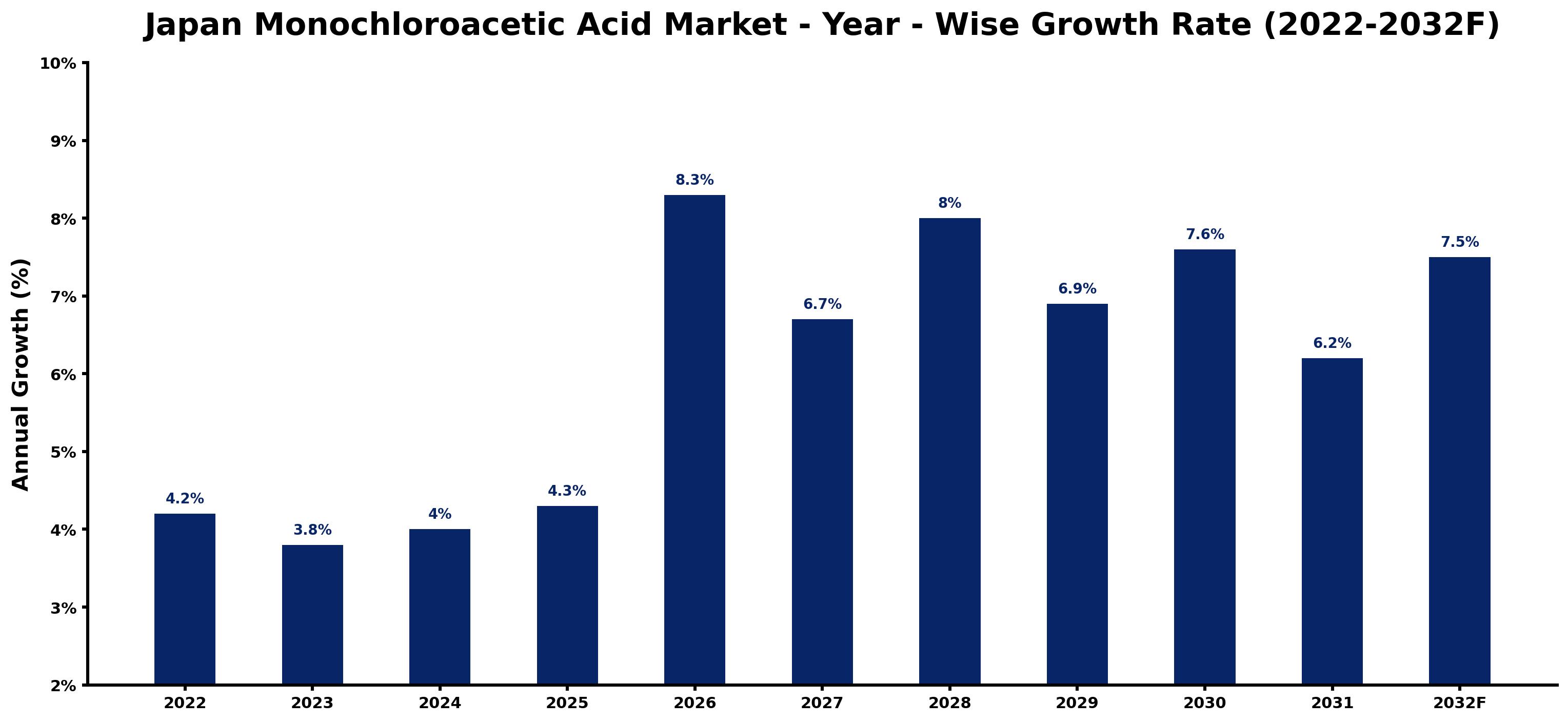
For each year, the table pairs the estimated growth rate with the leading influence on demand, showing how the drivers changed across the period.
| Year | Estimated Annual Growth (%) | Market Rationale |
| 2022 | 4.2 | The market showed steady growth, driven by stable demand from the chemical sector. |
| 2023 | 3.8 | Growth slowed due to market adjustments and a slight decrease in pharmaceutical demand. |
| 2024 | 4.0 | Demand increased as the pharmaceutical sector expanded its production capabilities. |
| 2025 | 4.3 | The market continued to grow as domestic chemical production remained strong. |
| 2026 | 8.3 | A surge in demand from the pharmaceutical sector drove growth this year. |
| 2027 | 6.7 | Growth slowed as the market began to stabilise after the previous peak. |
| 2028 | 8.0 | Demand increased again, supported by rising pharmaceutical production and exports. |
| 2029 | 6.9 | The market experienced a slowdown as growth rates normalised post-peak. |
| 2030 | 7.6 | Demand rose again, driven by investments in chemical manufacturing capabilities. |
| 2031 | 6.2 | Growth slowed as the market stabilised after a period of rapid expansion. |
| 2032 | 7.5 | Demand is expected to rise as new technologies improve production efficiency. |
Note: Market size estimations and growth projections presented in this report are based on 6Wresearch's proprietary forecasting methodology, utilizing the latest available industry data, government publications, and primary research inputs.
Japan Monochloroacetic Acid Market Synopsis
Monochloroacetic Acid is a chlorinated derivative of acetic acid, produced through the chlorination of acetic acid. The Japan Monochloroacetic Acid Market is primarily driven by strong demand from the pharmaceutical sector, valued at over 8 trillion JPY, and the chemical industry. Growth is anticipated due to increased production capabilities and a focus on improving chemical safety standards, particularly in pharmaceuticals and agricultural applications.
Market Dynamics Impact Analysis (2026–2032)
| Factor | Type | Impact | Primary Segment Affected |
| Strong demand from the pharmaceutical sector | Driver | High | Pharmaceuticals |
| Growing agricultural practices requiring herbicides | Driver | High | Herbicides and Insecticides |
| Increasing demand for chemical compounds in various industries | Opportunity | High | Chemical Compounds |
| Rising investments in pharmaceutical production capacity | Opportunity | High | Drugs |
| Regulatory compliance costs affecting production | Restraint | High | Drugs |
| Limited applications in food and beverage sectors | Restraint | Medium | Food & Beverages |
| High compliance costs with safety regulations | Challenge | High | Herbicides and Insecticides |
| Competition from alternative chemical production methods | Challenge | Medium | Chemical Compounds |
Evaluation of Drivers in Japan Monochloroacetic Acid Market (2026–2032)
Key forces behind demand, with the segment each one moves most, are listed below.
| Drivers | Primary Segment Affected | Why It Matters (Evidence) |
| Increased pharmaceutical production | Pharmaceuticals | The pharmaceutical sector's value exceeds 8 trillion JPY, driving demand for Monochloroacetic Acid in drug formulation. |
| Rising agricultural chemical usage | Herbicides and Insecticides | The agricultural sector's focus on sustainable practices boosts demand for herbicides, projected at 300,000 tons annually. |
| Expanding chemical manufacturing | Chemical Compounds | Japan's chemical industry employs approximately 1.5 million people, increasing the need for foundational chemical products. |
| Growing exports of chemical products | Chemical Compounds | In 2022, Japan exported 1.2 million tons of chemical products, enhancing domestic production capabilities. |
| Adoption of ISO 9001 standards | Drugs | Compliance with ISO 9001 in production enhances quality assurance, driving demand for Monochloroacetic Acid. |
Buyers are adding capacity as the pharmaceutical sector expands, with a value exceeding 8 trillion JPY driving interest in Monochloroacetic Acid. The agricultural sector's focus on sustainable practices supports a stable demand for herbicides, projected at around 300,000 tons annually. Japan's chemical industry, employing approximately 1.5 million people, continues to grow, increasing the need for foundational products. In 2022, Japan exported 1.2 million tons of chemical products, boosting domestic production capabilities. Compliance with ISO 9001 standards ensures quality assurance in drug formulation, driving further interest in Monochloroacetic Acid.
Evaluation of Restraints in Japan Monochloroacetic Acid Market
The main factors holding the market back are set out below.
| Market Restraint | Primary Segment Affected | Why It Matters (Evidence) |
| High compliance costs with safety regulations | Drugs | Compliance with the Chemical Substances Control Law raises production costs, impacting profitability for pharmaceutical manufacturers. |
| Limited applications in food and beverage sectors | Food & Beverages | Monochloroacetic Acid's restricted use in food additives constrains market growth in this segment. |
| Regulatory complexities in chemical production | Herbicides and Insecticides | The PRTR Law requires extensive reporting, increasing operational costs for producers. |
| Market competition from alternative chemicals | Chemical Compounds | Emerging alternatives to Monochloroacetic Acid may reduce its market share in chemical production. |
| Dependence on domestic demand fluctuations | Pharmaceuticals | Changes in domestic pharmaceutical demand can impact Monochloroacetic Acid consumption. |
Japan Monochloroacetic Acid Market Challenges
Producers in Japan's Kanagawa and Osaka regions encounter supply chain disruptions due to dependence on specific raw materials, delaying production schedules by up to three weeks. Technological limitations in production processes lead to inefficiencies, raising operational costs by 15% for suppliers. Regulatory requirements from the Food Safety Commission of Japan impose strict compliance measures, extending lead times by two months for distributors. Intense competition in the chemical sector drives down prices, compelling producers to reduce margins, which restricts investment in quality improvements for buyers.
Trends in the Japan Monochloroacetic Acid Market
Four trends stand out in the Japan Monochloroacetic Acid Market.
- Stable Demand for Herbicides: Japan's demand for herbicides is projected to remain stable at around 300,000 tons annually, supported by sustainable agricultural practices. This consistency helps suppliers maintain production levels.
- Growing Focus on Pharmaceutical Production: Pharmaceuticals are increasingly prioritised in Japan, with the sector valued at over 8 trillion JPY. This focus encourages investments in Monochloroacetic Acid for drug formulation.
- Expansion of Chemical Exports: Japan exported 1.2 million tons of chemical products in 2022, indicating a growing international market presence. This trend motivates domestic producers to enhance their manufacturing capabilities.
- Shift Towards Improved Chemical Safety Standards: The Ministry of Health, Labour and Welfare's 2023 program aims to improve chemical safety standards, impacting production practices across the industry. This shift will lead to increased compliance costs for manufacturers.
Investment Opportunities in the Japan Monochloroacetic Acid Market
Where to invest in the Japan Monochloroacetic Acid Market: the main openings are set out below.
- Rising Demand in Pharmaceuticals: With the pharmaceutical sector valued at over 8 trillion JPY, there is an opportunity to invest in Monochloroacetic Acid production. Collaborating with pharmaceutical manufacturers can facilitate market entry.
- Investment in Sustainable Agriculture: The agricultural sector's focus on sustainable practices creates a demand for herbicides, projected at 300,000 tons annually. Partnering with agricultural cooperatives can facilitate market access.
- Expansion of Chemical Manufacturing Capacity: The chemical industry employs approximately 1.5 million people, indicating a need for foundational chemical products. Investing in local production facilities can effectively meet this demand.
- Compliance with ISO Standards: Adopting ISO 9001 standards in production improves quality assurance. Suppliers can enter the market by ensuring compliance with these standards, appealing to pharmaceutical manufacturers.
Government Initiatives in the Japan Monochloroacetic Acid Market
The Ministry of Health, Labour and Welfare's 2023 program improves chemical safety standards, building on the Chemical Substances Control Law of 1973. This measure requires stricter evaluations and controls of chemical substances, ensuring safer production practices for Monochloroacetic Acid.
The PRTR Law mandates businesses to report chemical releases, helping buyers assess safety and compliance. This law, administered by the Ministry of the Environment and Ministry of Economy, Trade and Industry, ensures transparency in chemical management.
Future Insight of the Japan Monochloroacetic Acid Market
Advancements in automated production technologies will reshape demand by 2032, enhancing efficiency and reducing lead times. The Ministry of Health, Labour and Welfare's new chemical safety standards will improve product reliability for buyers. The agricultural sector's stable demand for herbicides, projected at around 300,000 tons annually, will drive innovation among suppliers. The Japan Chemical Industry Association's initiatives will promote advancements in manufacturing, enabling buyers to access superior products and services.
Market Segmentation Analysis
Japan Monochloroacetic Acid Market report covers a detailed analysis of the following market segments:
By Application – Chemical Compounds Lead, Drugs Expected to Grow Fastest
According to Shubham Deep, Research Manager at 6Wresearch, Chemical Compounds accounted for 35% of the market by application in 2025. The Chemical Compounds application holds the largest share as it is extensively used in the production of various chemicals, which are vital for numerous industries. The robust chemical sector in Japan, particularly in regions like Kanagawa and Osaka, relies on Monochloroacetic Acid for its operations. Over 2026–2032, Drugs are expected to post the fastest growth, at a CAGR of 9.6%. The Drugs application is experiencing rapid growth due to the pharmaceutical sector's expansion, which is valued at over 8 trillion JPY. This growth is propelled by increased investments in research and development for new medications and active pharmaceutical ingredients. Suppliers should focus on establishing strong relationships with pharmaceutical firms to capitalise on this growth trend.
By End Use – Pharmaceuticals Lead, Chemicals Expected to Grow Fastest
In 2025, Pharmaceuticals led the end use split with a 39% share. Pharmaceuticals leads the market as Monochloroacetic Acid is essential for drug formulation and synthesis, making it integral to the pharmaceutical industry. Continuous advancements in drug development within Japan further solidify this segment's dominant position. The quickest growth will come from Chemicals, forecast to expand at a CAGR of 9.2% between 2026 and 2032. Chemicals is the fastest-growing end-use segment, driven by the critical role of Monochloroacetic Acid in producing a wide range of chemical products. The stable demand for these products, highlighted by the export of 1.2 million tons in 2022, supports this growth trajectory. Buyers in the chemical sector should prepare for increased competition as the demand for Monochloroacetic Acid rises.
Key Attractiveness of the Report
- 10 Years of Market Numbers
- Historical Data Starting from 2022 to 2025
- Base Year 2025
- Forecast Data until 2032
- Key Performance Indicators Impacting the Market
- Major Upcoming Developments and Projects
Key Highlights of the Report:
- Japan Monochloroacetic Acid Market Outlook
- Market Size of Japan Monochloroacetic Acid Market, 2025
- Forecast of Japan Monochloroacetic Acid Market, 2032
- Historical Data and Forecast of Japan Monochloroacetic Acid Revenues & Volume for the Period 2022-2032
- Japan Monochloroacetic Acid Market Trend Evolution
- Japan Monochloroacetic Acid Market Drivers and Challenges
- Japan Monochloroacetic Acid Price Trends
- Japan Monochloroacetic Acid Porter's Five Forces
- Japan Monochloroacetic Acid Industry Life Cycle
- Historical Data and Forecast of Japan Monochloroacetic Acid Market Revenues & Volume By Application for the Period 2022-2032
- Historical Data and Forecast of Japan Monochloroacetic Acid Market Revenues & Volume By Chemical Compounds for the Period 2022-2032
- Historical Data and Forecast of Japan Monochloroacetic Acid Market Revenues & Volume By Drugs for the Period 2022-2032
- Historical Data and Forecast of Japan Monochloroacetic Acid Market Revenues & Volume By Herbicides and Insecticides for the Period 2022-2032
- Historical Data and Forecast of Japan Monochloroacetic Acid Market Revenues & Volume By Others for the Period 2022-2032
- Historical Data and Forecast of Japan Monochloroacetic Acid Market Revenues & Volume By End Use for the Period 2022-2032
- Historical Data and Forecast of Japan Monochloroacetic Acid Market Revenues & Volume By Pharmaceuticals for the Period 2022-2032
- Historical Data and Forecast of Japan Monochloroacetic Acid Market Revenues & Volume By Chemicals for the Period 2022-2032
- Historical Data and Forecast of Japan Monochloroacetic Acid Market Revenues & Volume By Food & Beverages for the Period 2022-2032
- Historical Data and Forecast of Japan Monochloroacetic Acid Market Revenues & Volume By Others for the Period 2022-2032
- Japan Monochloroacetic Acid Import Export Trade Statistics
- Market Opportunity Assessment By Application
- Market Opportunity Assessment By End Use
- Japan Monochloroacetic Acid Top Companies Market Share
- Japan Monochloroacetic Acid Competitive Benchmarking By Technical and Operational Parameters
- Japan Monochloroacetic Acid Company Profiles
- Japan Monochloroacetic Acid Key Strategic Recommendations
Market Covered
Coverage by segment is as follows.
By Application
- Chemical Compounds
- Drugs
- Herbicides and Insecticides
- Others
By End Use
- Pharmaceuticals
- Chemicals
- Food & Beverages
- Others






































