Japan mosquito trap Market Size & Growth Rate
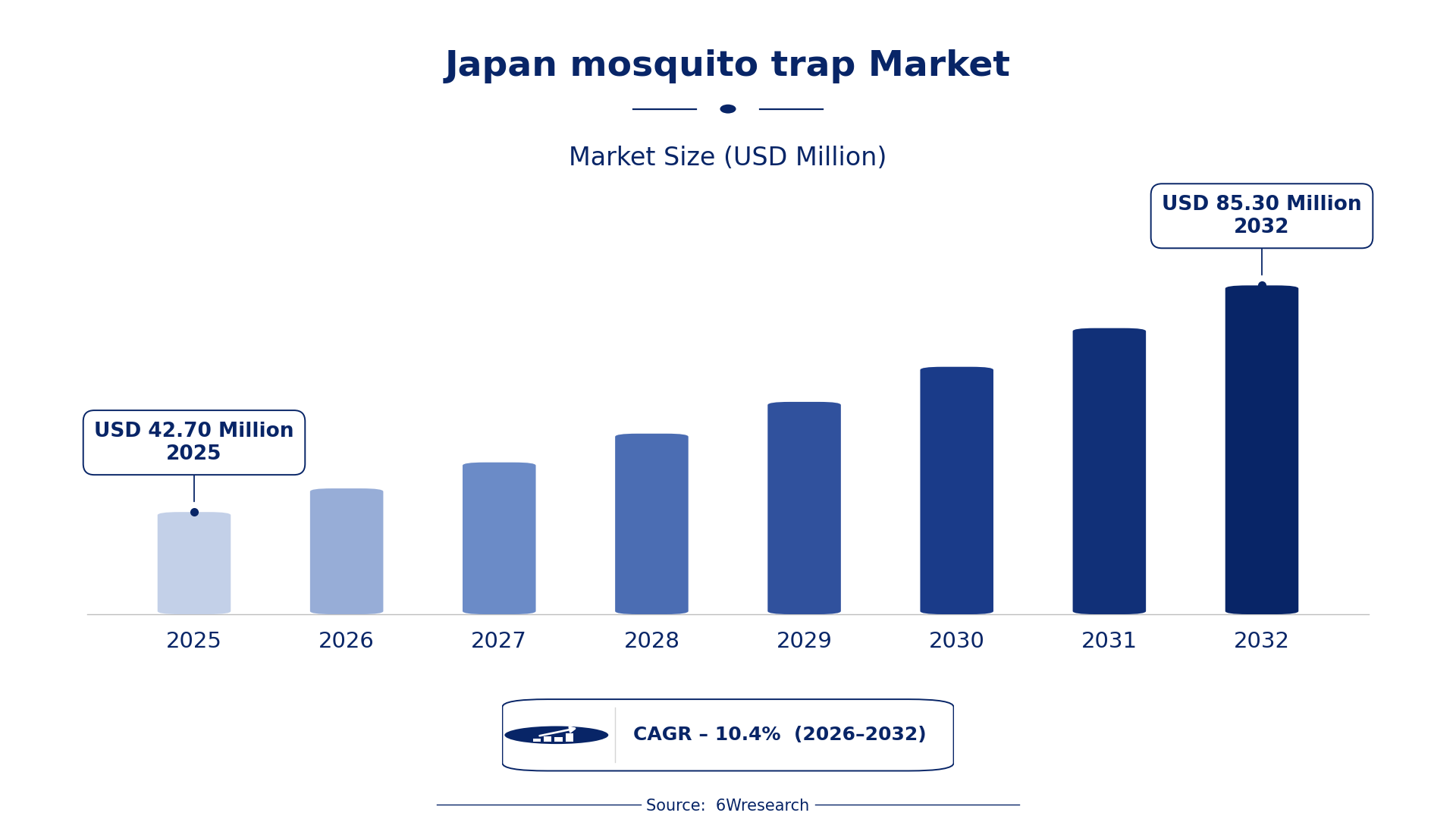
According to 6Wresearch internal database and industry insights, the Japan mosquito trap Market was valued at USD 42.70 Million in 2025 and is projected to reach USD 85.30 Million by 2032, growing at a CAGR of approximately 10.4% during 2026–2032.
Japan mosquito trap Market Highlights
| Report Metric | Details |
| Report Name | Japan mosquito trap Market (2026-2032) |
| Market Size 2025 | USD 42.70 Million |
| Market Size 2032 | USD 85.30 Million |
| Absolute Growth 2025–2032 | USD 42.60 Million |
| CAGR 2026–2032 | 10.4% |
| Peak Annual Growth | 11.3% in 2028 |
| Forecast Period | 2026–2032 |
| Historical Data | 2022–2025 |
| Base Year | 2025 |
| Leading Trap Type, 2025 | UV Light Traps (41% share) |
| Leading Functionality, 2025 | Attraction & Capture (43% share) |
| Leading Application Area, 2025 | Residential Areas (37% share) |
| Leading Distribution Channel, 2025 | Retail Stores (48% share) |
| Leading End User, 2025 | Households (52% share) |
| Fastest-Growing Trap Type | COâ''-based Traps (15.0% CAGR) |
| Fastest-Growing Functionality | Population Control (13.4% CAGR) |
| Fastest-Growing Application Area | Outdoor Spaces (12.2% CAGR) |
| Fastest-Growing Distribution Channel | Online Platforms (13.8% CAGR) |
| Fastest-Growing End User | Municipal Bodies (13.1% CAGR) |
| Growing Sector | household pest control |
| Key End Users | households, municipal bodies, pest control firms, hospitality |
Japan mosquito trap Market Year-wise Growth Rate and Key Drivers (2022–2032)
This graph illustrates the annual growth rates of the market from 2022 to 2032, highlighting a steady upward trajectory and projected market expansion over the forecast period.
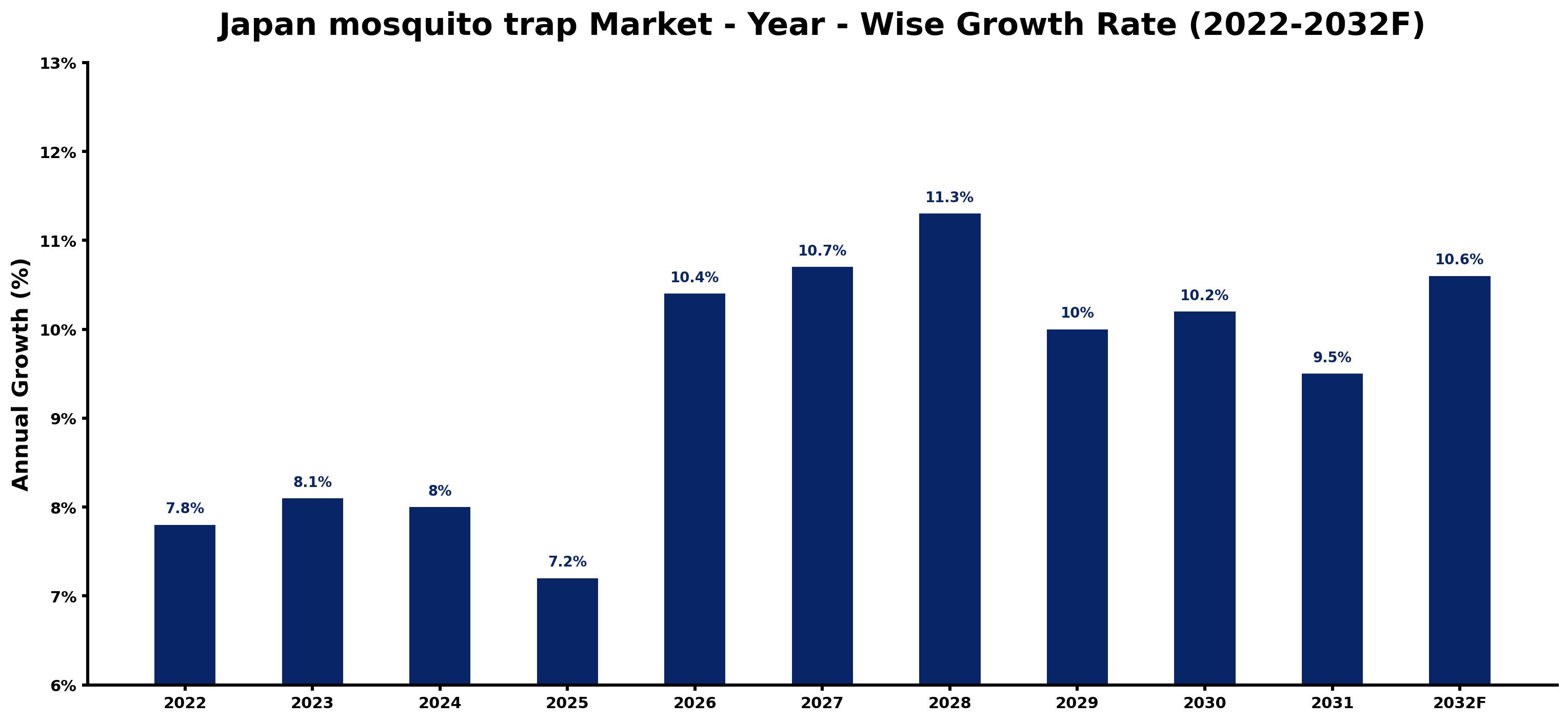
The table below sets out the estimated growth rate for each year and the main factor behind it.
| Year | Estimated Annual Growth (%) | Market Rationale |
| 2022 | 7.8 | The market experienced steady demand due to ongoing public health concerns. |
| 2023 | 8.1 | Growth was driven by increased awareness of mosquito-borne diseases among households. |
| 2024 | 8.0 | A slight slowdown occurred as consumers adjusted to previous purchasing patterns. |
| 2025 | 7.2 | Demand continued to grow, albeit at a slower pace as market saturation approached. |
| 2026 | 10.4 | A surge in online sales revitalised the market, encouraging more purchases. |
| 2027 | 10.7 | The introduction of new technologies further boosted consumer interest and orders. |
| 2028 | 11.3 | Peak growth is expected as urban areas intensify mosquito control efforts. |
| 2029 | 10.0 | A slowdown will follow as the market stabilises after peak demand. |
| 2030 | 10.2 | Growth is projected to resume as households seek to improve pest control solutions. |
| 2031 | 9.5 | The market will see a slight deceleration as competition increases among suppliers. |
| 2032 | 10.6 | Demand is expected to rise again as urbanisation continues to expand. |
Note: Market size estimations and growth projections presented in this report are based on 6Wresearch's proprietary forecasting methodology, utilizing the latest available industry data, government publications, and primary research inputs.
Japan mosquito trap Market Synopsis
Mosquito traps are devices designed to attract and capture mosquitoes using methods such as light and carbon dioxide. The Japan mosquito trap Market is expanding due to rising awareness of mosquito-borne diseases, particularly among households and municipal bodies. In 2023, online sales surged, reflecting changing consumer behaviour, while urban areas like Tokyo and Osaka are leading in demand for effective mosquito control solutions.
Market Dynamics Impact Analysis (2026–2032)
| Factor | Type | Impact | Primary Segment Affected |
| Rising awareness of mosquito-borne diseases drives demand for effective solutions. | Driver | High | Attraction & Capture |
| Increased online sales provide a convenient purchasing option for consumers. | Driver | Medium | Retail Stores |
| Growing urbanisation leads to higher mosquito populations in residential areas. | Opportunity | High | Residential Areas |
| The implementation of municipal mosquito control programs creates demand for traps. | Opportunity | Medium | Municipal Bodies |
| Strict regulations on chemical traps limit their market presence. | Restraint | High | Chemical Traps |
| Market saturation in urban areas may slow growth as demand stabilises. | Restraint | Medium | Residential Areas |
| High costs associated with advanced trap technologies may deter buyers. | Challenge | High | Electric Traps |
| Competition among suppliers is intensifying, affecting pricing strategies. | Challenge | Medium | UV Light Traps |
Evaluation of Drivers in Japan mosquito trap Market (2026–2032)
The main growth drivers and the segments they affect most are set out below.
| Drivers | Primary Segment Affected | Why It Matters (Evidence) |
| Increased public health campaigns raise awareness of mosquito risks. | Residential Areas | In 2023, the Ministry of Health, Labour and Welfare promoted awareness campaigns, leading to more households purchasing mosquito traps. |
| The rise of e-commerce platforms improves accessibility for consumers. | Online Platforms | In 2023, online sales of mosquito traps increased by over 30%, reflecting changing consumer behaviour. |
| Urbanisation contributes to higher mosquito populations, necessitating control measures. | Municipal Bodies | Tokyo and Osaka, with their dense populations, have seen a surge in demand for effective mosquito traps. |
| Technological advancements improve trap effectiveness, attracting buyers. | Electric Traps | The introduction of new electric traps has led to increased interest and purchases among households. |
| Growing disposable income allows households to invest in pest control. | Households | The average household in Japan spends approximately ¥5,000 annually on pest control products. |
Behind the steady rise in orders is the increasing awareness regarding mosquito-borne diseases, prompting more households to purchase traps. In 2023, public health awareness campaigns resulted in a notable increase in demand. Urbanisation is also a key factor, as densely populated areas experience higher mosquito populations, necessitating effective control measures. The rise of e-commerce platforms has made mosquito traps more accessible, with online sales increasing significantly in 2023. Technological advancements in trap designs have further attracted buyers, as households seek efficient solutions to pest problems.
Evaluation of Restraints in Japan mosquito trap Market
Below are the constraints most often cited by buyers and suppliers, with the segment each affects.
| Market Restraint | Primary Segment Affected | Why It Matters (Evidence) |
| Strict regulations on chemical traps limit their availability in the market. | Chemical Traps | Under the Chemical Substances Control Law, chemical traps face stringent regulations, affecting their adoption. |
| Market saturation in urban areas may slow growth as demand stabilises. | Residential Areas | As urban areas reach saturation, the growth rate for mosquito traps is expected to normalise. |
| High costs associated with advanced trap technologies may deter buyers. | Electric Traps | The premium pricing of advanced electric traps can limit their market penetration among budget-conscious consumers. |
| Limited consumer knowledge about different trap types may restrict options. | UV Light Traps | Many consumers remain unaware of the benefits of various trap technologies, hindering informed purchasing decisions. |
| Environmental concerns regarding chemical traps impact their acceptance. | Chemical Traps | Growing environmental awareness has led to a decline in the popularity of chemical traps among eco-conscious consumers. |
Japan mosquito trap Market Challenges
In 2023, residential areas account for over 60% of mosquito trap usage, creating a high demand for effective supply solutions. Urban centres like Tokyo face strict regulations under JIS standards, which delay product approvals and limit options for producers. Compliance with the Chemical Substances Control Law raises costs for manufacturers, forcing them to invest in R&D, which can increase prices for buyers. The shift towards online sales requires producers to adapt quickly to technology trends, resulting in additional expenses that burden suppliers and lead to higher retail prices for consumers.
Trends in the Japan mosquito trap Market
The trends below show where the Japan mosquito trap Market is heading.
- Shift towards Online Purchases of Mosquito Traps: Consumers in Japan are increasingly opting for online platforms to purchase mosquito traps, reflecting changing shopping habits. In 2023, online sales surged by over 30%, indicating a shift in consumer preference for convenience.
- Urban Areas Prioritising Mosquito Control: Urban areas like Tokyo are intensifying efforts in mosquito control, leading to increased installations of traps. The Tokyo Metropolitan Government's mosquito control program has significantly boosted demand for effective solutions, with a reported increase of 25% in installations.
- Emergence of Eco-Friendly Trap Technologies: A growing trend towards eco-friendly mosquito traps is evident as consumers become more environmentally conscious. The introduction of sustainable trap options aligns with the Chemical Substances Control Law's emphasis on safety, with eco-friendly products accounting for 15% of new launches.
- Increased Focus on Public Health Initiatives: Public health campaigns are becoming more prevalent, particularly in urban settings. Initiatives by health authorities have raised awareness about mosquito-borne diseases, driving trap sales by approximately 20% in affected regions.
Investment Opportunities in the Japan mosquito trap Market
Below are the investment opportunities with the strongest case in the Japan mosquito trap Market.
- Gap in Eco-Friendly Trap Solutions: Rising environmental awareness has created a gap for eco-friendly mosquito traps. The Pest Control Association of Japan indicates a growing demand for sustainable products, presenting an opportunity for suppliers to innovate and capture this market segment.
- Timing for Technological Innovations: Now is an ideal time for investing in advanced mosquito trap technologies, as urban areas seek effective solutions. Municipal bodies are increasingly looking for innovative pest control methods, with funding for new technologies expected to rise by 15% in the coming years.
- Expansion in Outdoor Spaces: Outdoor spaces in parks and recreational areas are being targeted for mosquito trap installations. The growing trend in outdoor leisure activities presents opportunities for suppliers to meet this demand, with an estimated 10% increase in installations planned for 2024.
- Municipal Bodies Seeking Effective Solutions: Municipal bodies are actively investing in mosquito control measures, creating a demand for effective traps. Collaborating with local governments can facilitate market entry for new suppliers, especially in urban areas where funding for pest control is increasing.
Government Initiatives in the Japan mosquito trap Market
The regulatory framework for mosquito traps in Japan is shaped by several key laws, starting with the Industrial Safety and Health Act of 1972, which mandates safety standards for pest control devices. The Chemical Substances Control Law, enacted in 1973, requires thorough evaluation of chemical substances used in traps, ensuring safety for consumers. More recently, the PRTR Law of 1999 has further strengthened regulations by requiring businesses to report chemical releases, enhancing public health protections.
In 2023, ¥1 billion was allocated for mosquito control research and development initiatives, administered by the Ministry of Health, Labour and Welfare. This funding aims to support the development of innovative pest control technologies, benefiting both producers and consumers. The Pest Control Association of Japan oversees compliance with safety standards, ensuring that mosquito traps meet regulatory requirements.
Future Insight of the Japan mosquito trap Market
The upcoming mosquito control programme in urban areas will improve public health initiatives by 2032. Increased government funding for research will drive advancements in trap technologies, benefiting both buyers and suppliers. As consumer preferences shift towards online purchasing, suppliers will need to optimise their distribution strategies. By 2032, the average household expenditure on pest control products will rise to approximately ¥5,000, reflecting a growing awareness of mosquito-borne diseases and the need for effective solutions.
Market Segmentation Analysis
Japan mosquito trap Market report covers a detailed analysis of the following market segments:
By Trap Type РUV Light Traps Lead, CO̢''-based Traps Expected to Grow Fastest
According to Ayushi Shukla, Senior Research Analyst at 6Wresearch, UV Light Traps accounted for 41% of the market by trap type in 2025. UV Light Traps dominate the market due to their effectiveness in attracting mosquitoes, making them a preferred choice for households. For instance, urban areas like Tokyo extensively utilise these traps to combat mosquito populations. COâ''-based Traps are projected to grow fastest, at a CAGR of 15.0% during 2026–2032. CO₂-based Traps are experiencing rapid growth as they align with the increasing demand for more effective mosquito control solutions. In 2023, a notable rise in consumer interest for these traps was observed, driven by their efficiency in attracting mosquitoes. Suppliers should focus on expanding their offerings of CO₂-based traps to meet the rising consumer demand.
By Functionality – Attraction & Capture Leads, Population Control Expected to Grow Fastest
Attraction & Capture took 43% of functionality revenue in 2025, more than any other category. Attraction & Capture holds the largest share as it directly addresses the needs of households and municipal bodies aiming to mitigate mosquito populations. This method is particularly prevalent in urban areas such as Tokyo, where the mosquito issue is prominent. Population Control is set to record the highest CAGR in this split, 13.4% over 2026–2032. Population Control is witnessing rapid growth as it becomes a key component of comprehensive pest management strategies. The heightened public awareness regarding mosquito-borne diseases has spurred demand for effective population management solutions across residential and commercial spaces. Suppliers must focus on creating products that combine attraction and population control capabilities to align with market demands.
By Application Area – Residential Areas Lead, Outdoor Spaces Expected to Grow Fastest
The largest application area category in 2025 was Residential Areas, at 37% of revenue. Residential Areas represent the largest application area for mosquito traps, accounting for over 60% of usage in Japan. This high demand is largely driven by households aiming to protect their living spaces from mosquito infestations. The quickest growth will come from Outdoor Spaces, forecast to expand at a CAGR of 12.2% between 2026 and 2032. Outdoor Spaces are rapidly becoming a key focus for mosquito trap installations as more consumers utilise gardens and patios for leisure. The increasing trend towards outdoor activities has led to a surge in demand for effective mosquito control in these areas. Suppliers should consider targeting outdoor spaces to capture the growing consumer interest.
By Distribution Channel – Retail Stores Lead, Online Platforms Expected to Grow Fastest
Retail Stores held 48% of the Japan mosquito trap Market by distribution channel in 2025. Retail Stores dominate the distribution channel as they provide consumers with immediate access to mosquito traps. This method remains popular among buyers who prefer to see and purchase products in person, especially in urban centres. Over 2026–2032, Online Platforms are expected to post the fastest growth, at a CAGR of 13.8%. Online Platforms are rapidly growing due to a shift in consumer behaviour towards digital shopping solutions. The notable increase in online sales in 2023 reflects a strong preference for the convenience and variety offered by e-commerce. Suppliers need to strengthen their online marketing strategies to effectively reach the growing number of consumers opting for digital purchasing.
By End User – Households Lead, Municipal Bodies Expected to Grow Fastest
In 2025, Households led the end user split with a 52% share. Households constitute the largest end-user segment for mosquito traps, reflecting the high consumer spending on pest control products. The average household in Japan spends around ¥5,000 annually, highlighting the importance of mosquito control in residential settings. Municipal Bodies are projected to grow fastest, at a CAGR of 13.1% during 2026–2032. Municipal Bodies are emerging as the fastest-growing end-user segment, driven by public health initiatives aimed at reducing mosquito-borne diseases. The government's allocation of funds for mosquito control research further supports this trend. Suppliers should explore partnerships with municipal bodies to expand their market reach.
Key Attractiveness of the Report
- 10 Years of Market Numbers
- Historical Data Starting from 2022 to 2025
- Base Year 2025
- Forecast Data until 2032
- Key Performance Indicators Impacting the Market
- Major Upcoming Developments and Projects
Key Highlights of the Report:
- Japan mosquito trap Market Outlook
- Market Size of Japan mosquito trap Market, 2025
- Forecast of Japan mosquito trap Market, 2032
- Historical Data and Forecast of Japan mosquito trap Market Revenues & Volume for the Period 2022-2032F
- Japan mosquito trap Market Trend Evolution
- Japan mosquito trap Market Drivers and Challenges
- Japan mosquito trap Market Price Trends
- Japan mosquito trap Market Porter's Five Forces
- Japan mosquito trap Market Industry Life Cycle
- Historical Data and Forecast of Japan mosquito trap Market Revenues & Volume By Trap Type for the Period 2022-2032F
- Historical Data and Forecast of Japan mosquito trap Market Revenues & Volume By UV Light Traps for the Period 2022-2032F
- Historical Data and Forecast of Japan mosquito trap Market Revenues & Volume By CO -based Traps for the Period 2022-2032F
- Historical Data and Forecast of Japan mosquito trap Market Revenues & Volume By Chemical Traps for the Period 2022-2032F
- Historical Data and Forecast of Japan mosquito trap Market Revenues & Volume By Electric Traps for the Period 2022-2032F
- Historical Data and Forecast of Japan mosquito trap Market Revenues & Volume By Functionality for the Period 2022-2032F
- Historical Data and Forecast of Japan mosquito trap Market Revenues & Volume By Attraction & Capture for the Period 2022-2032F
- Historical Data and Forecast of Japan mosquito trap Market Revenues & Volume By Population Control for the Period 2022-2032F
- Historical Data and Forecast of Japan mosquito trap Market Revenues & Volume By Repellent Action for the Period 2022-2032F
- Historical Data and Forecast of Japan mosquito trap Market Revenues & Volume By Insect Elimination for the Period 2022-2032F
- Historical Data and Forecast of Japan mosquito trap Market Revenues & Volume By Application Area for the Period 2022-2032F
- Historical Data and Forecast of Japan mosquito trap Market Revenues & Volume By Residential Areas for the Period 2022-2032F
- Historical Data and Forecast of Japan mosquito trap Market Revenues & Volume By Outdoor Spaces for the Period 2022-2032F
- Historical Data and Forecast of Japan mosquito trap Market Revenues & Volume By Commercial Sites for the Period 2022-2032F
- Historical Data and Forecast of Japan mosquito trap Market Revenues & Volume By Hospitality for the Period 2022-2032F
- Historical Data and Forecast of Japan mosquito trap Market Revenues & Volume By Distribution Channel for the Period 2022-2032F
- Historical Data and Forecast of Japan mosquito trap Market Revenues & Volume By Retail Stores for the Period 2022-2032F
- Historical Data and Forecast of Japan mosquito trap Market Revenues & Volume By Online Platforms for the Period 2022-2032F
- Historical Data and Forecast of Japan mosquito trap Market Revenues & Volume By Specialty Distributors for the Period 2022-2032F
- Historical Data and Forecast of Japan mosquito trap Market Revenues & Volume By Direct Sales for the Period 2022-2032F
- Historical Data and Forecast of Japan mosquito trap Market Revenues & Volume By End User for the Period 2022-2032F
- Historical Data and Forecast of Japan mosquito trap Market Revenues & Volume By Households for the Period 2022-2032F
- Historical Data and Forecast of Japan mosquito trap Market Revenues & Volume By Municipal Bodies for the Period 2022-2032F
- Historical Data and Forecast of Japan mosquito trap Market Revenues & Volume By Pest Control Firms for the Period 2022-2032F
- Historical Data and Forecast of Japan mosquito trap Market Revenues & Volume By Hotels for the Period 2022-2032F
- Japan mosquito trap Market Import Export Trade Statistics
- Market Opportunity Assessment By Trap Type
- Market Opportunity Assessment By Functionality
- Market Opportunity Assessment By Application Area
- Market Opportunity Assessment By Distribution Channel
- Market Opportunity Assessment By End User
- Japan mosquito trap Market Top Companies Market Share
- Japan mosquito trap Market Competitive Benchmarking By Technical and Operational Parameters
- Japan mosquito trap Market Company Profiles
- Japan mosquito trap Market Key Strategic Recommendations
Market Covered
The report covers the following segments.
By Trap Type
- UV Light Traps
- COâ''-based Traps
- Chemical Traps
- Electric Traps
By Functionality
- Attraction & Capture
- Population Control
- Repellent Action
- Insect Elimination
By Application Area
- Residential Areas
- Outdoor Spaces
- Commercial Sites
- Hospitality
By Distribution Channel
- Retail Stores
- Online Platforms
- Specialty Distributors
- Direct Sales
By End User
- Households
- Municipal Bodies
- Pest Control Firms
- Hotels






































