Japan Motor Vehicle Braking System Parts Market Size & Growth Rate
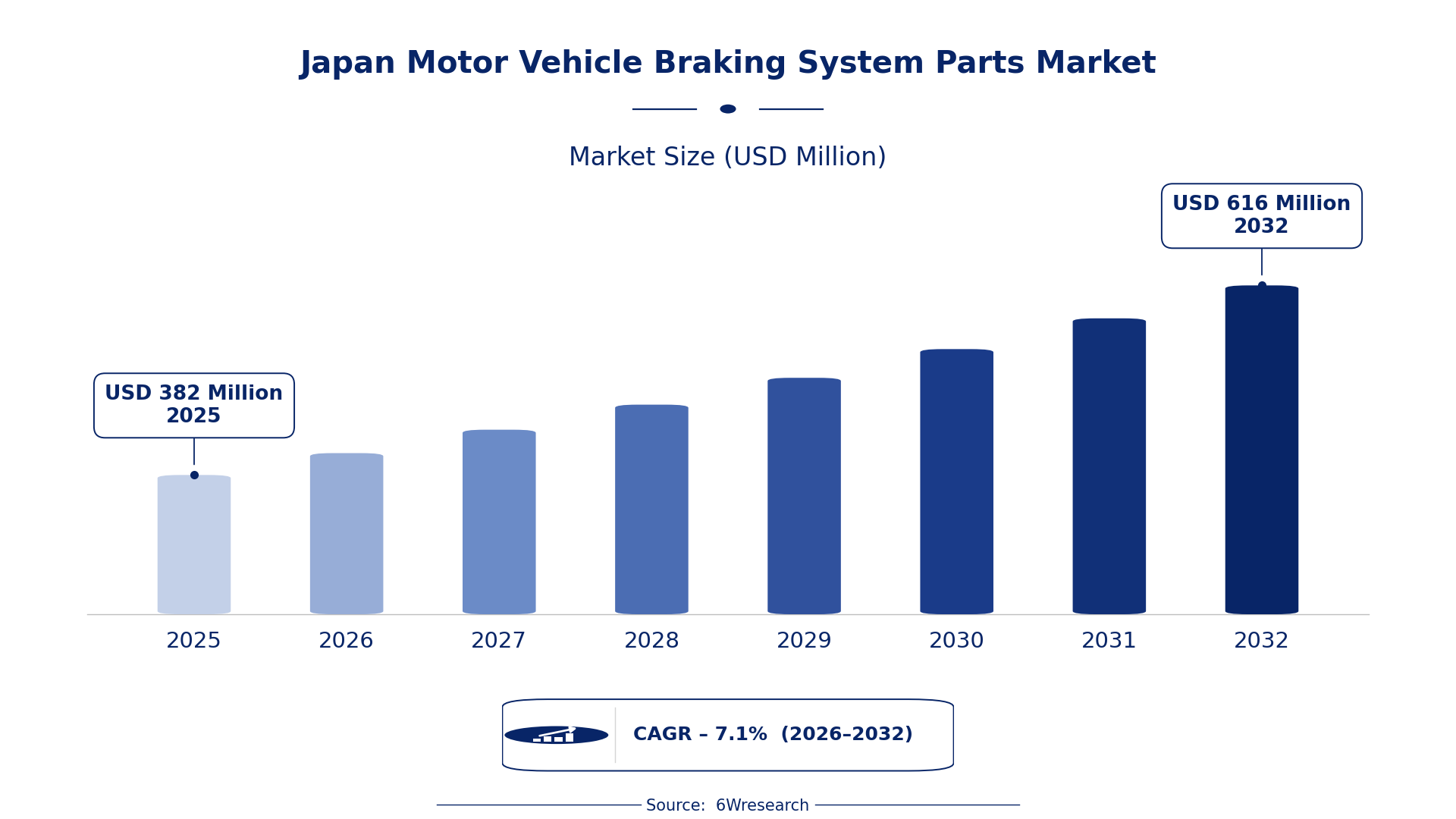
According to 6Wresearch internal database and industry insights, the Japan Motor Vehicle Braking System Parts Market was valued at USD 382 Million in 2025 and is projected to reach USD 616 Million by 2032, growing at a CAGR of approximately 7.1% during 2026–2032.
Japan Motor Vehicle Braking System Parts Market Highlights
| Report Metric | Details |
| Report Name | Japan Motor Vehicle Braking System Parts Market (2026-2032) |
| Market Size 2025 | USD 382 Million |
| Market Size 2032 | USD 616 Million |
| Absolute Growth 2025–2032 | USD 234 Million |
| CAGR 2026–2032 | 7.1% |
| Peak Annual Growth | 8.9% in 2026 |
| Forecast Period | 2026–2032 |
| Historical Data | 2022–2025 |
| Base Year | 2025 |
| Leading Product Types, 2025 | Disc Brakes (56% share) |
| Leading Brake Pad Material Type, 2025 | Organic (50% share) |
| Leading Sales Channel, 2025 | Original Equipment Manufacturers (OEM) (67% share) |
| Leading Vehicle Type, 2025 | Passenger Cars (56% share) |
| Fastest-Growing Product Types | Drum Brakes (9.2% CAGR) |
| Fastest-Growing Brake Pad Material Type | Metallic (9.6% CAGR) |
| Fastest-Growing Sales Channel | Aftermarket (8.2% CAGR) |
| Fastest-Growing Vehicle Type | Commercial Vehicles (10.0% CAGR) |
| Growing Sector | automotive |
| Key End Users | OEMs, aftermarket suppliers, commercial vehicle manufacturers, passenger car manufacturers |
Japan Motor Vehicle Braking System Parts Market Year-wise Growth Rate and Key Drivers (2022–2032)
This graph illustrates the annual growth rates of the market from 2022 to 2032, highlighting a steady upward trajectory and projected market expansion over the forecast period.
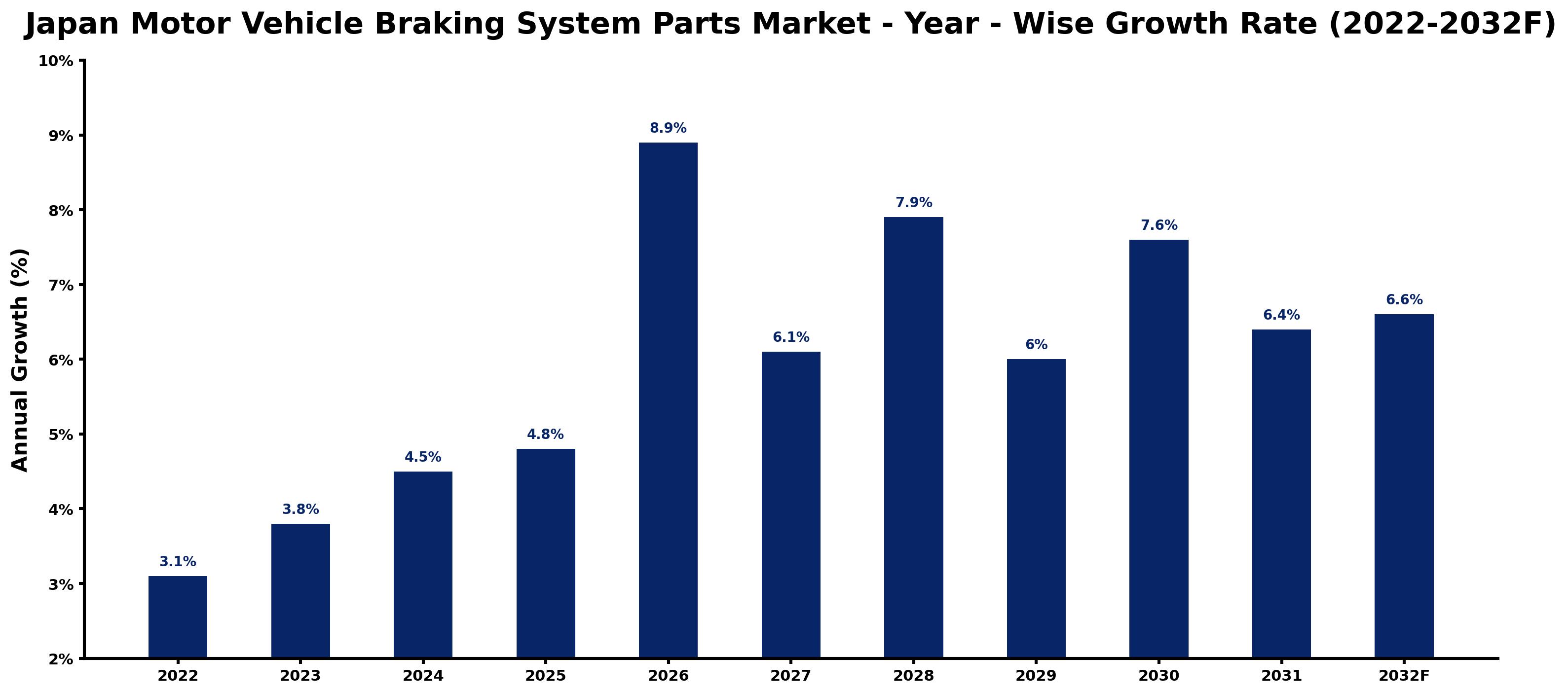
For each year, the table pairs the estimated growth rate with the leading influence on demand, showing how the drivers changed across the period.
| Year | Estimated Annual Growth (%) | Market Rationale |
| 2022 | 3.1 | The market experienced stable demand from domestic manufacturers and aftermarket services. |
| 2023 | 3.8 | Growth accelerated due to increased vehicle production and technology investments. |
| 2024 | 4.5 | Demand continued to rise as manufacturers focused on safety and performance improvements. |
| 2025 | 4.8 | The market reached a peak growth rate, driven by innovations in braking technologies. |
| 2026 | 8.9 | Growth is expected to surge as electric vehicle adoption prompts new braking system designs. |
| 2027 | 6.1 | The market is projected to experience a slowdown as growth rates normalise after the peak. |
| 2028 | 7.9 | Demand is expected to increase again, supported by ongoing investments in automotive technology. |
| 2029 | 6.0 | A slight slowdown is anticipated as the market adjusts to previous growth levels. |
| 2030 | 7.6 | Growth is expected to pick up as manufacturers align with carbon neutrality targets. |
| 2031 | 6.4 | The market will continue to grow, driven by advancements in braking technologies. |
| 2032 | 6.6 | Demand is projected to remain strong as the automotive sector embraces sustainable practices. |
Note: Market size estimations and growth projections presented in this report are based on 6Wresearch's proprietary forecasting methodology, utilizing the latest available industry data, government publications, and primary research inputs.
Japan Motor Vehicle Braking System Parts Market Synopsis
Motor Vehicle Braking System Parts are crucial for ensuring safety and performance in vehicles, made from materials like metal and composites. The Japan Motor Vehicle Braking System Parts Market is growing, driven by a strong automotive industry that produced 8.3 million vehicles in 2022. Investments in technology upgrades, including the ¥1 trillion allocated in 2023, and the transition towards electric vehicles are generating new demand, particularly in the aftermarket segment.
Market Dynamics Impact Analysis (2026–2032)
| Factor | Type | Impact | Primary Segment Affected |
| Growing vehicle production and technological advancements | Driver | High | Disc Brakes |
| Rising demand for electric vehicles requiring innovative braking solutions | Driver | High | Disc Brakes |
| Expansion of the aftermarket due to increasing vehicle age | Opportunity | High | Aftermarket |
| Technological upgrades in automotive manufacturing facilities | Opportunity | Medium | Disc Brakes |
| High costs associated with advanced braking technologies | Restraint | High | Disc Brakes |
| Regulatory compliance costs for safety standards | Restraint | Medium | Disc Brakes |
| Limited capacity for rapid scaling in production | Challenge | High | Disc Brakes |
| Challenges in meeting evolving safety regulations | Challenge | Medium | Disc Brakes |
Evaluation of Drivers in Japan Motor Vehicle Braking System Parts Market (2026–2032)
Key forces behind demand, with the segment each one moves most, are listed below.
| Drivers | Primary Segment Affected | Why It Matters (Evidence) |
| Increased vehicle production | Disc Brakes | Japan produced 8.3 million vehicles in 2022, boosting demand for braking parts. |
| Technological advancements in braking systems | Disc Brakes | Investments of ¥1 trillion in 2023 are improving braking technologies. |
| Growing aftermarket demand due to vehicle aging | Aftermarket | The average lifespan of brake pads necessitates frequent replacements, increasing demand. |
| Shift towards electric vehicles | Disc Brakes | The 2023 programme promoting electric vehicles is influencing braking system designs. |
| Focus on R&D for advanced braking technologies | Disc Brakes | Japan's automotive sector is investing heavily in regenerative braking technologies. |
Buyers are adding capacity as the automotive industry in Japan has seen notable growth, with vehicle production reaching 8.3 million units in 2022. This surge has led to increased demand for braking system parts, particularly disc brakes, which are essential for modern vehicles. In 2023, the industry invested ¥1 trillion in technology upgrades, improving braking system performance. The shift towards electric vehicles is also boosting demand for advanced braking solutions, as manufacturers adapt to new designs. The average lifespan of brake pads necessitates frequent replacements, further increasing the aftermarket segment.
Evaluation of Restraints in Japan Motor Vehicle Braking System Parts Market
The following restraints limit how fast demand can grow.
| Market Restraint | Primary Segment Affected | Why It Matters (Evidence) |
| High production costs for advanced braking technologies | Disc Brakes | The need for new materials raises manufacturing expenses, impacting pricing. |
| Compliance costs with safety regulations | Disc Brakes | Manufacturers must invest in meeting standards like JIS D 5015, increasing operational costs. |
| Dependence on domestic suppliers for raw materials | Disc Brakes | Supply chain disruptions can affect production schedules and availability. |
| Limited production capacity for rapid scaling | Disc Brakes | Manufacturers face challenges in quickly ramping up output to meet rising demand. |
| Challenges in adapting to evolving safety regulations | Disc Brakes | Compliance with new regulations can delay product development and market entry. |
Japan Motor Vehicle Braking System Parts Market Challenges
In 2023, rising raw material costs have escalated production expenses for domestic manufacturers of braking system parts. Supply chain disruptions in the Tokyo region are delaying essential component deliveries, causing production schedules to slip for local producers and risking a 15% reduction in output. A shortage of skilled workers in advanced braking technologies is hindering manufacturers' ability to innovate, resulting in slower adoption of critical safety features. The transition to electric vehicles demands substantial technology upgrades, which may delay product launches for suppliers unprepared for these changes.
Trends in the Japan Motor Vehicle Braking System Parts Market
These developments are changing demand patterns in the Japan Motor Vehicle Braking System Parts Market.
- Shift in Focus to Electric Vehicle Braking Systems: The aftermarket for braking parts is adapting to electric vehicle designs, highlighted by the 2023 Tokyo Motor Show showcasing innovations in braking systems. This shift is projected to drive growth in the sector.
- Transition to Advanced Brake Pad Materials: The popularity of metallic brake pads is rising, with a projected CAGR of 9.6% from 2026 to 2032, driven by their durability and performance in high-demand environments.
- Emergence of Regenerative Braking Technologies: Japan's automotive sector is increasingly investing in regenerative braking systems, focusing on sustainability and efficiency, aligning with the national target of net zero emissions by 2050.
- Growth of Aftermarket Services for Aging Vehicles: As vehicles age, the demand for aftermarket braking parts is increasing, with the sector expected to expand due to the average lifespan of brake pads prompting more replacements.
Investment Opportunities in the Japan Motor Vehicle Braking System Parts Market
The openings below show where demand in the Japan Motor Vehicle Braking System Parts Market is visible and how suppliers can enter.
- Tokyo as a Hub for Electric Vehicle Innovations: The Tokyo region is experiencing a surge in electric vehicle technology, with investments driving demand for advanced braking systems, projected to reach new heights in the coming years.
- Increasing Demand for Aftermarket Parts: With the automotive sector investing ¥1 trillion in technology, the aftermarket for braking parts is set to grow, providing opportunities for suppliers to meet increasing replacement needs.
- Investment in Regenerative Braking Technologies: The focus on regenerative braking systems is creating opportunities for manufacturers to innovate and supply advanced components, aligning with Japan's carbon neutrality goals.
- Expansion of Manufacturing Facilities: As the automotive industry grows, there is a need for new manufacturing facilities to meet demand, particularly in the Tokyo region, where automotive production is concentrated.
Government Initiatives in the Japan Motor Vehicle Braking System Parts Market
The Ministry of Land, Infrastructure, Transport and Tourism regulates vehicle safety, enforcing standards like JIS D 5015 for brake pads. The Green Growth Strategy, adopted in 2020 and updated in 2021, identifies growth sectors, including automotive technologies, aiming for carbon neutrality by 2050. These measures ensure that manufacturers comply with safety standards, influencing the production and quality of Motor Vehicle Braking System Parts.
The Ministry of Economy, Trade and Industry (METI) funds initiatives that support battery manufacturing and electric vehicle technologies. The Battery Industry Strategy, introduced in August 2022, targets 150 GWh of domestic battery capacity by 2030, enhancing the automotive sector's sustainability. This funding supports advancements in braking technologies, benefiting manufacturers and consumers alike.
Future Insight of the Japan Motor Vehicle Braking System Parts Market
The introduction of electric vehicle technology programmes will transform braking system designs by 2032, compelling suppliers to improve their manufacturing capabilities. Investment in R&D for regenerative braking technologies will elevate vehicle safety and performance, benefiting both manufacturers and consumers. The Tokyo Motor Show 2023 showcased innovations that indicate a shift towards more sustainable automotive solutions. Suppliers must adapt to new standards to remain competitive and meet the growing demand for efficient braking systems.
Market Segmentation Analysis
Japan Motor Vehicle Braking System Parts Market report covers a detailed analysis of the following market segments:
By Product Types – Disc Brakes Lead, Drum Brakes Expected to Grow Fastest
According to Ravi Bhandari, Research Head at 6Wresearch, Disc Brakes took 56% of product types revenue in 2025, more than any other category. Disc brakes are prevalent in modern vehicles due to their superior stopping power and performance. Their widespread adoption in the Tokyo region, a major automotive manufacturing hub, underscores their dominance in the market. Drum Brakes are set to record the highest CAGR in this split, 9.2% over 2026–2032. Drum brakes are experiencing growth as they remain common in older vehicle models, which constitute a significant portion of Japan's automotive fleet. The increasing age of vehicles in the market is driving demand for these components. Suppliers should focus on enhancing the availability of drum brakes to cater to the growing aftermarket needs.
By Brake Pad Material Type – Organic Leads, Metallic Expected to Grow Fastest
Organic accounted for 50% of the market by brake pad material type in 2025. Organic brake pads are favoured for their low noise levels and cost-effectiveness, making them a popular choice among consumers. Their widespread use in passenger vehicles contributes to their leading market share. Metallic is projected to grow fastest, at a CAGR of 9.6% during 2026–2032. Metallic brake pads are gaining traction due to their durability and performance, particularly in high-demand driving conditions. The focus on advanced braking technologies is also enhancing their appeal in the market. Buyers may benefit from considering metallic options for improved performance in demanding driving scenarios.
By Sales Channel – Original Equipment Manufacturers (OEM) Leads, Aftermarket Expected to Grow Fastest
The largest sales channel category in 2025 was Original Equipment Manufacturers (OEM), at 67% of revenue. Original Equipment Manufacturers (OEM) serve as the primary source for new vehicle parts, ensuring quality and compliance with safety standards. Their established relationships with automakers solidify their leading position in the market. The quickest growth will come from Aftermarket, forecast to expand at a CAGR of 8.2% between 2026 and 2032. The aftermarket is expanding as vehicle owners increasingly seek replacement parts for maintenance and repairs, driven by the rising average age of vehicles on the road. This trend highlights the importance of accessible aftermarket channels for suppliers. Suppliers should strengthen their aftermarket strategies to capture the growing demand for replacement parts.
By Vehicle Type – Passenger Cars Lead, Commercial Vehicles Expected to Grow Fastest
With 56% of vehicle type revenue in 2025, Passenger Cars was the largest category. Passenger cars represent the largest segment of vehicle types using braking systems, reflecting their dominance in Japan's automotive landscape. The high production volume of passenger vehicles supports the substantial demand for braking system parts. Over 2026–2032, Commercial Vehicles are expected to post the fastest growth, at a CAGR of 10.0%. Commercial vehicles are witnessing growth as they are essential for heavy-duty applications, necessitating robust braking systems. The increasing investment in logistics and transportation sectors is significantly driving this demand. Suppliers should consider expanding their offerings to meet the specific needs of commercial vehicle braking systems.
Key Attractiveness of the Report
- 10 Years of Market Numbers
- Historical Data Starting from 2022 to 2025
- Base Year 2025
- Forecast Data until 2032
- Key Performance Indicators Impacting the Market
- Major Upcoming Developments and Projects
Key Highlights of the Report:
- Japan Motor Vehicle Braking System Parts Market Outlook
- Market Size of Japan Motor Vehicle Braking System Parts Market, 2025
- Forecast of Japan Motor Vehicle Braking System Parts Market, 2032
- Historical Data and Forecast of Japan Motor Vehicle Braking System Parts Revenues & Volume for the Period 2022-2032
- Japan Motor Vehicle Braking System Parts Market Trend Evolution
- Japan Motor Vehicle Braking System Parts Market Drivers and Challenges
- Japan Motor Vehicle Braking System Parts Price Trends
- Japan Motor Vehicle Braking System Parts Porter's Five Forces
- Japan Motor Vehicle Braking System Parts Industry Life Cycle
- Historical Data and Forecast of Japan Motor Vehicle Braking System Parts Market Revenues & Volume By Product Types for the Period 2022-2032
- Historical Data and Forecast of Japan Motor Vehicle Braking System Parts Market Revenues & Volume By Disc Brakes for the Period 2022-2032
- Historical Data and Forecast of Japan Motor Vehicle Braking System Parts Market Revenues & Volume By Drum Brakes for the Period 2022-2032
- Historical Data and Forecast of Japan Motor Vehicle Braking System Parts Market Revenues & Volume By Brake Pad Material Type for the Period 2022-2032
- Historical Data and Forecast of Japan Motor Vehicle Braking System Parts Market Revenues & Volume By Organic for the Period 2022-2032
- Historical Data and Forecast of Japan Motor Vehicle Braking System Parts Market Revenues & Volume By Metallic for the Period 2022-2032
- Historical Data and Forecast of Japan Motor Vehicle Braking System Parts Market Revenues & Volume By Ceramic for the Period 2022-2032
- Historical Data and Forecast of Japan Motor Vehicle Braking System Parts Market Revenues & Volume By Sales Channel for the Period 2022-2032
- Historical Data and Forecast of Japan Motor Vehicle Braking System Parts Market Revenues & Volume By Original Equipment Manufacturers (OEM) for the Period 2022-2032
- Historical Data and Forecast of Japan Motor Vehicle Braking System Parts Market Revenues & Volume By Aftermarket for the Period 2022-2032
- Historical Data and Forecast of Japan Motor Vehicle Braking System Parts Market Revenues & Volume By Vehicle Type for the Period 2022-2032
- Historical Data and Forecast of Japan Motor Vehicle Braking System Parts Market Revenues & Volume By Passenger Cars for the Period 2022-2032
- Historical Data and Forecast of Japan Motor Vehicle Braking System Parts Market Revenues & Volume By Commercial Vehicles for the Period 2022-2032
- Japan Motor Vehicle Braking System Parts Import Export Trade Statistics
- Market Opportunity Assessment By Product Types
- Market Opportunity Assessment By Brake Pad Material Type
- Market Opportunity Assessment By Sales Channel
- Market Opportunity Assessment By Vehicle Type
- Japan Motor Vehicle Braking System Parts Top Companies Market Share
- Japan Motor Vehicle Braking System Parts Competitive Benchmarking By Technical and Operational Parameters
- Japan Motor Vehicle Braking System Parts Company Profiles
- Japan Motor Vehicle Braking System Parts Key Strategic Recommendations
Market Covered
The following segment groups are covered in the report.
By Product Types
- Disc Brakes
- Drum Brakes
By Brake Pad Material Type
- Organic
- Metallic
- Ceramic
By Sales Channel
- Original Equipment Manufacturers (OEM)
- Aftermarket
By Vehicle Type
- Passenger Cars
- Commercial Vehicles































