Japan Mycotoxin Binders Market Size & Growth Rate
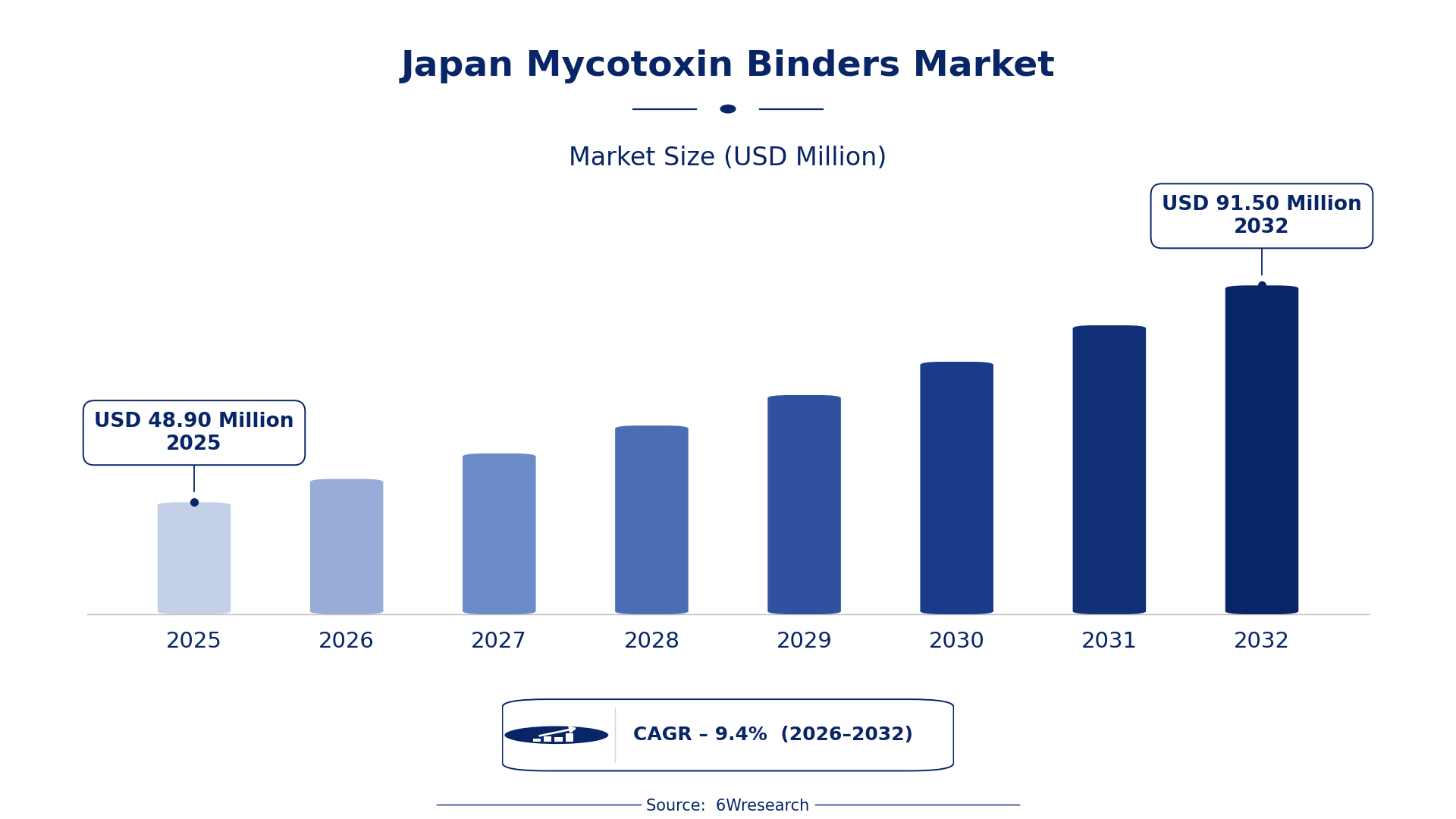
According to 6Wresearch internal database and industry insights, the Japan Mycotoxin Binders Market was valued at USD 48.90 Million in 2025 and is projected to reach USD 91.50 Million by 2032, growing at a CAGR of approximately 9.4% during 2026–2032.
Japan Mycotoxin Binders Market Highlights
| Report Metric | Details |
| Report Name | Japan Mycotoxin Binders Market (2026-2032) |
| Market Size 2025 | USD 48.90 Million |
| Market Size 2032 | USD 91.50 Million |
| Absolute Growth 2025–2032 | USD 42.60 Million |
| CAGR 2026–2032 | 9.4% |
| Peak Annual Growth | 10.0% in 2028 |
| Forecast Period | 2026–2032 |
| Historical Data | 2022–2025 |
| Base Year | 2025 |
| Leading Binder Type, 2025 | Organic Binders (46% share) |
| Leading Source Type, 2025 | Clay Minerals (39% share) |
| Leading Distribution Channel, 2025 | Livestock Suppliers (35% share) |
| Leading End User, 2025 | Poultry Farms (44% share) |
| Fastest-Growing Binder Type | Combined Binders (13.3% CAGR) |
| Fastest-Growing Source Type | Plant-Based (13.0% CAGR) |
| Fastest-Growing Distribution Channel | Direct Sales (12.1% CAGR) |
| Fastest-Growing End User | Dairy Farms (11.8% CAGR) |
| Growing Sector | livestock feed |
| Key End Users | poultry farms, cattle feed mills, swine producers, dairy farms |
Japan Mycotoxin Binders Market Year-wise Growth Rate and Key Drivers (2022–2032)
This graph illustrates the annual growth rates of the market from 2022 to 2032, highlighting a steady upward trajectory and projected market expansion over the forecast period.
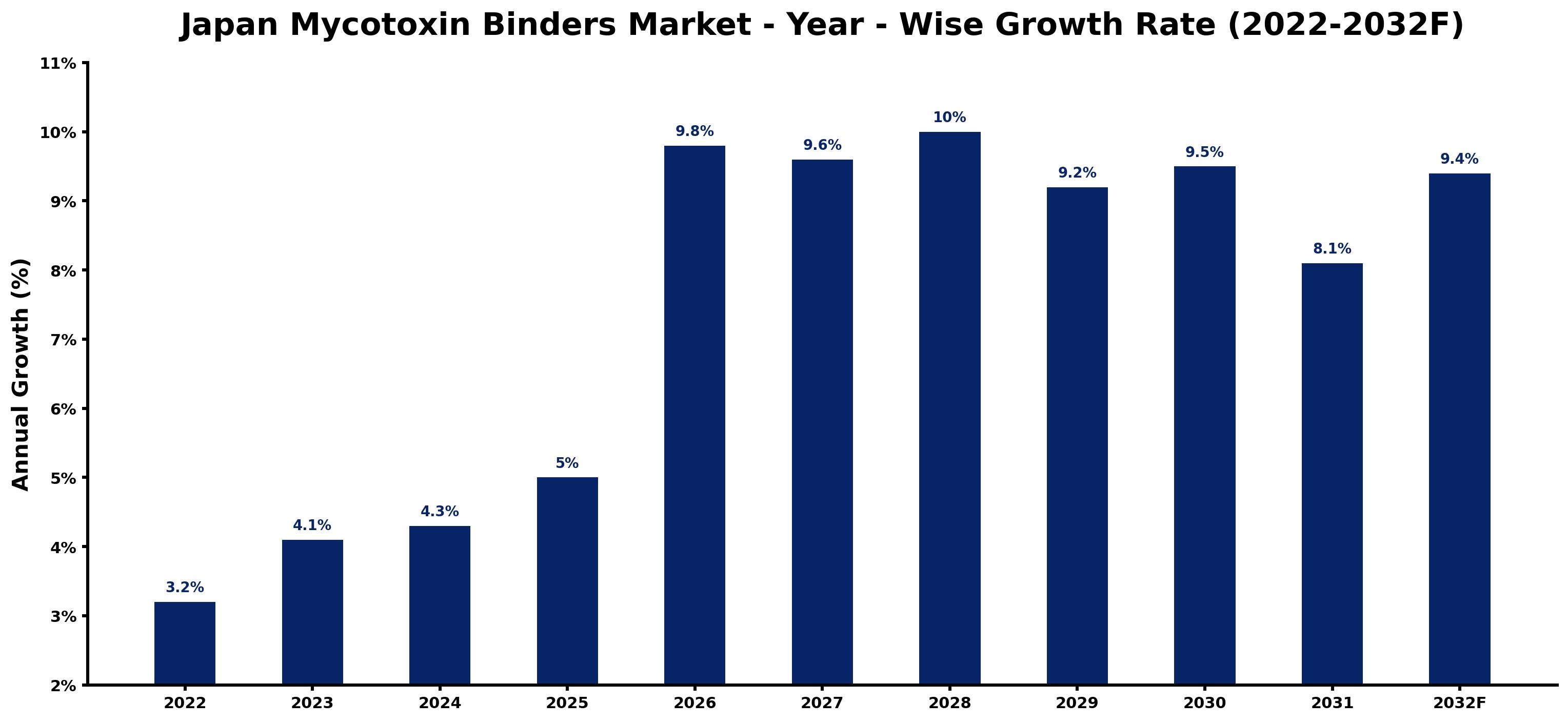
Each row of the following table gives one year's estimated growth and the event or demand shift that explains it.
| Year | Estimated Annual Growth (%) | Market Rationale |
| 2022 | 3.2 | The market experienced steady growth, driven by increasing awareness of mycotoxin risks. |
| 2023 | 4.1 | Demand rose as livestock producers sought effective solutions for feed safety and animal health. |
| 2024 | 4.3 | Growth continued with more producers adopting mycotoxin binders for improved feed efficiency. |
| 2025 | 5.0 | The livestock sector expanded, leading to higher consumption of mycotoxin binders in feed. |
| 2026 | 9.8 | A surge in demand is anticipated as feed safety standards strengthen across the industry. |
| 2027 | 9.6 | Growth is projected to slow slightly, reflecting a stabilisation in the adoption of new feed technologies. |
| 2028 | 10.0 | The market is expected to peak with heightened focus on animal health and feed quality improvements. |
| 2029 | 9.2 | Growth is projected to decelerate as the market adjusts to previous peaks in demand. |
| 2030 | 9.5 | An uptick in demand is expected as producers prepare for stricter regulations. |
| 2031 | 8.1 | Growth is projected to slow again, as market saturation begins to affect new purchases. |
| 2032 | 9.4 | Demand is expected to rise again as innovations in feed additives gain traction. |
Note: Market size estimations and growth projections presented in this report are based on 6Wresearch's proprietary forecasting methodology, utilizing the latest available industry data, government publications, and primary research inputs.
Japan Mycotoxin Binders Market Synopsis
Mycotoxin binders are substances used in animal feed to adsorb harmful mycotoxins, ensuring livestock health and food safety. In Japan, the poultry population of approximately 150 million drives demand for these binders. The Japan Mycotoxin Binders Market is growing due to rising awareness of mycotoxin contamination, the livestock sector's contribution to GDP, and improved feed safety standards, supported by initiatives from the Ministry of Agriculture, Forestry and Fisheries. This growth reflects the increasing need for effective solutions to improve animal health and feed efficiency across the industry.
Market Dynamics Impact Analysis (2026–2032)
| Factor | Type | Impact | Primary Segment Affected |
| Growing poultry population drives demand for mycotoxin binders. | Driver | High | Poultry Farms |
| Increased focus on feed safety regulations boosts binder usage. | Driver | High | Cattle Feed Mills |
| The need for improved animal health creates opportunities for binder suppliers. | Opportunity | High | Swine Producers |
| Rising concerns over mycotoxin contamination open new markets for binders. | Opportunity | High | Dairy Farms |
| Strict regulations on mycotoxin levels limit binder formulations available. | Restraint | High | Organic Binders |
| The high cost of raw materials affects binder production pricing. | Restraint | Medium | Inorganic Binders |
| Supply chain disruptions can delay binder availability to producers. | Challenge | High | Livestock Suppliers |
| Technological advancements in feed additives may outpace current binder offerings. | Challenge | Medium | Agrochemical Distributors |
Evaluation of Drivers in Japan Mycotoxin Binders Market (2026–2032)
These are the developments adding the most demand over the forecast period.
| Drivers | Primary Segment Affected | Why It Matters (Evidence) |
| The poultry population of approximately 150 million increases demand for mycotoxin binders. | Poultry Farms | This large population necessitates effective feed solutions to ensure animal health. |
| The livestock sector's contribution of 1.5% to GDP encourages investment in feed safety. | Cattle Feed Mills | Producers are motivated to improve feed quality to maintain profitability. |
| ISO 9001 standards in feed production promote the use of mycotoxin binders. | Dairy Farms | Compliance with these standards drives demand for effective feed additives. |
| The launch of a program to strengthen feed safety standards in 2023 increases binder adoption. | Swine Producers | Producers seek to comply with new regulations, boosting binder sales. |
| Mycotoxin contamination concerns prompt livestock producers to seek preventive measures. | Livestock Suppliers | Awareness of health risks leads to increased purchases of binders. |
Several shifts outside the market lift sales. The poultry population in Japan, approximately 150 million, drives the demand for mycotoxin binders, as producers seek effective solutions for animal health. The livestock sector contributes about 1.5% to GDP, prompting investments in feed safety. Concerns about mycotoxin contamination encourage livestock producers to seek preventive measures, leading to increased purchases of binders.
Evaluation of Restraints in Japan Mycotoxin Binders Market
Several factors work against faster growth; the main ones are summarised below.
| Market Restraint | Primary Segment Affected | Why It Matters (Evidence) |
| Strict regulations on mycotoxin levels limit the types of binders available. | Organic Binders | Producers must comply with these regulations, restricting formulation options. |
| High raw material costs impact the pricing of mycotoxin binders. | Inorganic Binders | Increased production costs may lead to higher prices for end-users. |
| Supply chain disruptions can delay the availability of mycotoxin binders. | Livestock Suppliers | These delays can hinder timely access to essential feed additives. |
| Technological advancements may outpace current binder formulations. | Agrochemical Distributors | This can lead to a mismatch between market needs and available products. |
| Limited awareness among smaller producers about the benefits of mycotoxin binders. | Cattle Feed Mills | This knowledge gap can restrict market growth in certain segments. |
Japan Mycotoxin Binders Market Challenges
Mycotoxin contamination affects around 30% of livestock feed in Japan, creating health risks for animals and increasing expenses for producers who must implement additional safety measures. Compliance with strict regulations on mycotoxin levels delays feed production, raising operational costs for manufacturers. Intense competition among suppliers drives prices higher, as the livestock sector contributes only 1.5% to Japan's GDP, limiting buyers' capacity to absorb these costs. Many producers rely on outdated methods, resulting in inefficiencies that can waste up to 15% of feed resources, negatively impacting overall profitability for farms.
Trends in the Japan Mycotoxin Binders Market
Several trends are reshaping the Japan Mycotoxin Binders Market; the most important are set out below.
- Shift towards Natural Binders: A growing preference for natural mycotoxin binders is apparent among livestock producers, particularly in poultry farms. In 2023, 39% of binders used were clay minerals, reflecting this trend towards organic solutions.
- Increase in Direct Sales Channels: Direct sales of mycotoxin binders are projected to grow by 12.1% from 2026 to 2032. This shift allows producers to establish closer relationships with suppliers, improving service levels.
- Focus on Feed Safety Standards: Since the launch of the feed safety enhancement programme in 2023, producers are increasingly prioritising compliance. This trend is expected to drive up the adoption of mycotoxin binders in the coming years.
- Growing Demand for Combined Binders: The market is experiencing a rise in the use of combined binders, with a CAGR of 13.3% projected from 2026 to 2032. This trend reflects the need for more effective solutions in feed safety.
Investment Opportunities in the Japan Mycotoxin Binders Market
The following areas offer the clearest openings for investors and suppliers in the Japan Mycotoxin Binders Market.
- $10 Billion Livestock Feed Market: With Japan's livestock feed market valued at approximately $10 billion, there is a strong opportunity for suppliers to expand their offerings. Poultry farms are particularly in need of effective mycotoxin binders to ensure feed safety.
- Rising Demand for Plant-Based Binders: The growing preference for plant-based binders presents an opportunity for suppliers to invest in natural formulations. This trend is particularly strong among cattle feed mills seeking sustainable solutions.
- Timing for Innovation in Binders: As the market adjusts to new regulations, there is a timely opportunity for companies to innovate. Producers are looking for advanced solutions to meet stricter feed safety standards.
- Focus on Dairy Farms: Dairy farms are increasingly adopting mycotoxin binders to ensure quality milk production. Suppliers can enter this market by partnering with local distributors to meet the rising demand.
Government Initiatives in the Japan Mycotoxin Binders Market
The Economic Security Promotion Act of 2022 supports supply-chain resilience for critical products, including mycotoxin binders. This measure encourages producers to invest in reliable sourcing and manufacturing processes, ensuring a stable supply of binders in the market. The Ministry of Agriculture, Forestry and Fisheries oversees these initiatives, aiming to improve food safety and security across the livestock sector.
The Ministry of Agriculture, Forestry and Fisheries implements feed safety regulations. It approves various safety standards and oversees compliance measures for mycotoxin binders. The agency's efforts ensure that producers adhere to strict guidelines, promoting the use of effective binders in livestock feed.
Future Insight of the Japan Mycotoxin Binders Market
Poultry producers will gain from new feed safety standards by 2032, as Japan's recent program aims to reduce mycotoxin levels. Advanced detection technologies will streamline compliance processes, enabling suppliers to respond promptly to market demands. Improved feed efficiency will become essential, driven by the need to maximise the value of the $10 billion livestock feed market. As investments in modernisation rise, the average cattle feed mill will process over 10,000 tons annually, supporting higher output and enhanced quality.
Market Segmentation Analysis
Japan Mycotoxin Binders Market report covers a detailed analysis of the following market segments:
By Binder Type – Organic Binders Lead, Combined Binders Expected to Grow Fastest
According to Saurav Kr Singh, Senior Research Analyst at 6Wresearch, Organic Binders held 46% of the Japan Mycotoxin Binders Market by binder type in 2025. Organic binders hold the largest share due to their proven ability to effectively bind mycotoxins, which is crucial for maintaining animal health. They are predominantly used in poultry farms, where mycotoxin contamination is a major concern, ensuring the safety of livestock products. Combined Binders are projected to grow fastest, at a CAGR of 13.3% during 2026–2032. Combined binders are experiencing rapid growth as they are increasingly employed in specialised applications that demand superior mycotoxin control. This growth is further propelled by Japan's recent programme aimed at enhancing feed safety standards, highlighting the importance of effective solutions. Suppliers should focus on developing organic and combined binders to cater to the increasing demand in the livestock industry.
By Source Type – Clay Minerals Lead, Plant-Based Expected to Grow Fastest
With 39% of source type revenue in 2025, Clay Minerals was the largest category. Clay minerals hold the largest market share owing to their established effectiveness in binding mycotoxins in animal feed. Their reliability has made them a preferred option among livestock suppliers throughout Japan. Over 2026–2032, Plant-Based is expected to post the fastest growth, at a CAGR of 13.0%. Plant-based binders are experiencing the fastest growth as there is a notable shift towards natural and sustainable feed additives, appealing to environmentally conscious producers. The increasing focus on feed safety and quality standards is further propelling this trend. Buyers should consider plant-based options to align with sustainability trends while ensuring feed safety.
By Distribution Channel – Livestock Suppliers Lead, Direct Sales Expected to Grow Fastest
In 2025, Livestock Suppliers led the distribution channel split with a 35% share. Livestock suppliers dominate the distribution channel, serving as the primary link between mycotoxin binders and farms that rely on these products for animal health. Their established relationships with producers facilitate a consistent supply of essential feed additives throughout the sector. Direct Sales is set to record the highest CAGR in this split, 12.1% over 2026–2032. Direct sales are witnessing significant growth as they foster closer relationships between suppliers and farmers, enabling tailored solutions and immediate assistance. This trend is vital as producers seek to improve feed safety standards directly through personal engagement. Suppliers should strengthen their direct sales strategies to effectively address the needs of livestock producers.
By End User – Poultry Farms Lead, Dairy Farms Expected to Grow Fastest
Poultry Farms accounted for 44% of the market by end user in 2025. Poultry farms are the largest user group of mycotoxin binders, driven by the necessity to ensure the health and productivity of their flocks. With Japan's poultry population around 150 million, this segment is vital to the market. The quickest growth will come from Dairy Farms, forecast to expand at a CAGR of 11.8% between 2026 and 2032. Dairy farms are the fastest-growing end user segment as they increasingly acknowledge the importance of mycotoxin binders in maintaining milk quality and safety. The focus on feed quality in average dairy farms is fuelling this growth. Suppliers should target dairy farms with tailored solutions to capitalise on this increasing demand.
Key Attractiveness of the Report
- 10 Years of Market Numbers
- Historical Data Starting from 2022 to 2025
- Base Year 2025
- Forecast Data until 2032
- Key Performance Indicators Impacting the Market
- Major Upcoming Developments and Projects
Key Highlights of the Report:
- Japan Mycotoxin Binders Market Outlook
- Market Size of Japan Mycotoxin Binders Market, 2025
- Forecast of Japan Mycotoxin Binders Market, 2032
- Historical Data and Forecast of Japan Mycotoxin Binders Revenues & Volume for the Period 2022-2032F
- Japan Mycotoxin Binders Market Trend Evolution
- Japan Mycotoxin Binders Market Drivers and Challenges
- Japan Mycotoxin Binders Price Trends
- Japan Mycotoxin Binders Porter's Five Forces
- Japan Mycotoxin Binders Industry Life Cycle
- Historical Data and Forecast of Japan Mycotoxin Binders Market Revenues & Volume By Binder Type for the Period 2022-2032F
- Historical Data and Forecast of Japan Mycotoxin Binders Market Revenues & Volume By Organic Binders for the Period 2022-2032F
- Historical Data and Forecast of Japan Mycotoxin Binders Market Revenues & Volume By Inorganic Binders for the Period 2022-2032F
- Historical Data and Forecast of Japan Mycotoxin Binders Market Revenues & Volume By Synthetic Binders for the Period 2022-2032F
- Historical Data and Forecast of Japan Mycotoxin Binders Market Revenues & Volume By Combined Binders for the Period 2022-2032F
- Historical Data and Forecast of Japan Mycotoxin Binders Market Revenues & Volume By Source Type for the Period 2022-2032F
- Historical Data and Forecast of Japan Mycotoxin Binders Market Revenues & Volume By Plant-Based for the Period 2022-2032F
- Historical Data and Forecast of Japan Mycotoxin Binders Market Revenues & Volume By Clay Minerals for the Period 2022-2032F
- Historical Data and Forecast of Japan Mycotoxin Binders Market Revenues & Volume By Polymer-Based for the Period 2022-2032F
- Historical Data and Forecast of Japan Mycotoxin Binders Market Revenues & Volume By Mixed Origin for the Period 2022-2032F
- Historical Data and Forecast of Japan Mycotoxin Binders Market Revenues & Volume By Distribution Channel for the Period 2022-2032F
- Historical Data and Forecast of Japan Mycotoxin Binders Market Revenues & Volume By Livestock Suppliers for the Period 2022-2032F
- Historical Data and Forecast of Japan Mycotoxin Binders Market Revenues & Volume By Agrochemical Distributors for the Period 2022-2032F
- Historical Data and Forecast of Japan Mycotoxin Binders Market Revenues & Volume By Direct Sales for the Period 2022-2032F
- Historical Data and Forecast of Japan Mycotoxin Binders Market Revenues & Volume By Online Retailers for the Period 2022-2032F
- Historical Data and Forecast of Japan Mycotoxin Binders Market Revenues & Volume By End User for the Period 2022-2032F
- Historical Data and Forecast of Japan Mycotoxin Binders Market Revenues & Volume By Poultry Farms for the Period 2022-2032F
- Historical Data and Forecast of Japan Mycotoxin Binders Market Revenues & Volume By Cattle Feed Mills for the Period 2022-2032F
- Historical Data and Forecast of Japan Mycotoxin Binders Market Revenues & Volume By Swine Producers for the Period 2022-2032F
- Historical Data and Forecast of Japan Mycotoxin Binders Market Revenues & Volume By Dairy Farms for the Period 2022-2032F
- Japan Mycotoxin Binders Import Export Trade Statistics
- Market Opportunity Assessment By Binder Type
- Market Opportunity Assessment By Source Type
- Market Opportunity Assessment By Distribution Channel
- Market Opportunity Assessment By End User
- Japan Mycotoxin Binders Top Companies Market Share
- Japan Mycotoxin Binders Competitive Benchmarking By Technical and Operational Parameters
- Japan Mycotoxin Binders Company Profiles
- Japan Mycotoxin Binders Key Strategic Recommendations
Market Covered
Coverage by segment is as follows.
By Binder Type
- Organic Binders
- Inorganic Binders
- Synthetic Binders
- Combined Binders
By Source Type
- Plant-Based
- Clay Minerals
- Polymer-Based
- Mixed Origin
By Distribution Channel
- Livestock Suppliers
- Agrochemical Distributors
- Direct Sales
- Online Retailers
By End User
- Poultry Farms
- Cattle Feed Mills
- Swine Producers
- Dairy Farms






































